Introduction
With the introduction of the WHO Framework Convention on Tobacco Control (WHO FCTC) guidelines in 2005, several countries have adopted measures to reduce the prevalence of cigarette smoking (WHO, 2005). While developed countries have made significant progress in their tobacco control efforts, most low and middle income countries (LMICs) are yet to achieve appreciable landmarks. The tobacco burden in LMICs continues to grow and it is estimated that more than 80% of tobacco deaths would be in these countries by 2030 (Ali, Safwat, Onyemelukwe, Otaibi, Amir, Nawas, Aouina, & Bolliger, Reference Ali, Safwat, Onyemelukwe, Otaibi, Amir, Nawas, Aouina and Bolliger2012).
In November 2010, the guidelines for the adoption of article 14 of the FCTC were adopted by the Fourth Conference of Parties. Article 14 of the FCTC highlights the importance of tobacco dependence treatment as an effective strategy for tobacco control (Pine-Abata, McNeill, Murray, Bitton, Rigotti, & Raw, Reference Pine-Abata, McNeill, Murray, Bitton, Rigotti and Raw2012). In this article, tobacco dependence treatment is referred to as smoking cessation intervention in the form of physicians’ brief advice, physicians’ intensive counselling, and prescription of pharmacotherapy. The focus on physician-provided smoking cessation modalities stems from the evidence that demonstrates the effectiveness of physician brief advice and pharmacotherapy in increasing smoking cessation rates (Ontario Medical Assessment Secretariat, 2010). However, one study in which trained counsellors delivered brief cessation counselling to smokers in a clinic setting was also included in this review.
Most studies that demonstrate the effectiveness of smoking cessation interventions have been conducted in developed countries. High-income countries with the capacity to provide and institutionalise smoking cessation interventions have experienced remarkable increase in smoking cessation rates (Nichter, Nichter, Muramoto, and Project Quit Tobacco International, Reference Nichter, Nichter and Muramoto2010). Because smoking cessation intervention is usually a component of a more comprehensive tobacco control strategy, the increase in cessation rates can be attributed to the combined effects of different tobacco control measures.
Furthermore, most tobacco control efforts in LMICs have been concentrated on the advocacy for the development of national tobacco control policies, particularly the demand-side strategies of the FCTC. These include increased tobacco taxation, ban on advertising, sponsorships and promotions, pictorial or graphical warnings on package labels, smoke-free legislation, restricted sales to minors, and ban on point of sale displays (WHO, 2005). However, for unspecified reasons, little emphasis has been placed on promoting smoking cessation interventions in low and lower-middle income countries. Recent developments and newly emerging evidence are re-defining the pivotal effects smoking cessation interventions can have on reducing adult smoking rates in these countries.
Several studies have analysed the capacity of different countries (mostly developed and some developing) to provide tobacco dependence treatment to adult smokers (Pine-Abata, et al., Reference Pine-Abata, McNeill, Murray, Bitton, Rigotti and Raw2012; Raw, McNeill, and Murray, Reference Raw, McNeill and Murray2010); however little literature is available on the impact smoking cessation interventions have had particularly in low income countries. This study aims to systematically review the available literature on the current developments and impact of smoking cessation interventions in low and middle income countries. The impact of this intervention would be assessed with the RE-AIM framework for evaluating health interventions (Glasgow, McKay, Piette, and Reynolds Reference Glasgow, McKay, Piette and Reynolds2001). The research objectives of the current study are to identify and summarise the existing literature on: (1) the reach of smoking cessation, in terms of availability, accessibility, and affordability, in LMICs; (2) the effectiveness and cost-effectiveness of the different types of smoking cessation interventions in LMICs; (3) the adoption and institutionalisation of smoking cessation services in LMICs. This study provides a concise narrative on the current state of smoking cessation interventions in LMICs based on existing literature. It also highlights research priorities and provides information and recommendations on the future direction of smoking cessation efforts in LMICs.
Methods
Inclusion and exclusion criteria
Inclusion and exclusion criteria were determined before conducting database searches. The inclusion criteria include: (1) studies based on empirical findings that demonstrate the impact of smoking cessation interventions in LMICs (reach, effectiveness, adoption, implementation and institutionalisation); (2) studies conducted in LMICs or that focused on LMICs; (3) studies targeted at the adult smoking population; (4) studies focused on the smoking cessation component of tobacco control in LMICs; (5) studies that reported on the capacity for smoking cessation intervention and current developments in LMICs; (6) published in peer review journals between 2003 and April, 2013 (period after the FCTC was adopted by the World Health Assembly); (7) written or transcribed in English. The exclusion criteria are: (1) studies conducted in high income countries with no reference to LMICs; (2) targeted at other population subgroups such as adolescents, college students, patients with co-morbidities, pregnant women, women alone, and men alone; (3) commentaries, letters or editorials based on personal opinion; (4) studies published earlier than 2003; (5) studies that focus on the pharmacological effects of cessation agents on the body. Countries are classified using World Bank's income criteria (The World Bank, 2013).
Search strategy
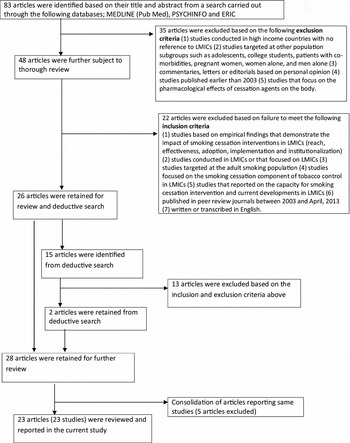
A comprehensive search was conducted in the following electronic databases; MEDLine (PubMed), PsycInfo and ERIC. The search was conducted between February and April, 2013. The following search terms were used alone or in combination: smoking cessation, tobacco dependence treatment, low income countries, middle income countries, developing countries, NRTs, bupropion, varenicline, brief advice, counselling, effectiveness, access to, cost, affordability, availability, impact, physicians, provision of, capacity to, use of, result of, implementation. A total of 83 articles were identified based on their titles. After reading through the abstracts, 35 articles were excluded based on the exclusion criteria. With comprehensive reading of the articles, another set of 22 articles were excluded because they do not meet the inclusion criteria. Twenty-six articles met the inclusion criteria. A deductive search was conducted on the reference sections of the 26 articles. Fifteen articles were identified from the deductive search, 13 were excluded based on both the exclusion and inclusion criteria and two articles met the inclusion criteria. The resulting 28 articles were further reviewed and five articles were excluded because of duplication of studies. A total of 23 studies were analysed for this current study. Figure 1, summarises search strategy with a flowchart.
Flow chart of literature search

Data extraction
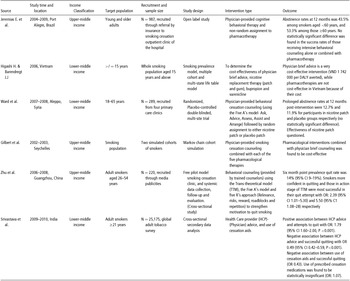
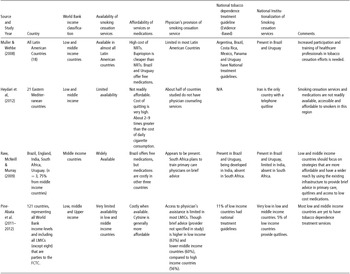
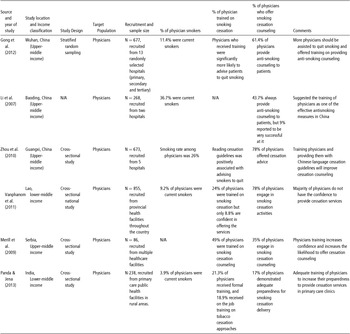
The extracted data from the articles were developed into four tables. Table 1 highlights the effectiveness and cost-effectiveness of specific smoking cessation intervention types. Table 2 demonstrates the capacity of physicians to provide smoking cessation services. Table 3 illustrates the reach, adoption, and institutionalisation of smoking cessation services. Table 4 provides information on the current trends and developments on smoking cessation interventions in LMICs.
Summary of the studies that assessed the effectiveness and cost-effectiveness of specific smoking cessation intervention types in LMICs

Summary of the studies that explored the reach, adoption, implementation and institutionalization of smoking cessation interventions in LMICs

Summary of the studies that assessed the capacity of physicians to provide smoking cessation services

Summary of studies that provided insights on current developments and best approaches

Results
Study location and time
A total of 23 studies (23 articles) were analysed for this review. Countries were classified based on the World Bank's income classification. The countries are low, lower-middle and upper-middle countries from all the WHO regions. Only studies published between 2003 and April, 2013 were included in this current review.
Target population
Six studies assessed the effectiveness and cost-effectiveness of different smoking cessation interventions on adult smoking population (Jeremias et al., Reference Jeremias, Chatkin, Chatkin, Seibert, Martins and Wagner2012; Higashi and Barendregt, Reference Higashi and Barendregt2011; Ward et al., Reference Ward, Asfar, Al Ali, Rastam, Vander Weg, Eissenberg and Maziak2012; Gilbert et al., Reference Gilbert, Pinget, Bovet, Cornuz, Shamlaye and Paccaud2004; Srivastava, Malhotra, Harries, Lal, and Arora, Reference Srivastava, Malhotra, Harries, Lal and Arora2013; and Zhu et al., Reference Zhu, Yang, Jiang, Deng, Lam, Zhang and Chan2009). Four studies explored the reach, adoption, and institutionalisation of smoking cessation interventions in LMICs (Muller and Wehbe, Reference Muller and Wehbe2008; Heydari et al., Reference Heydari, Talischi, Mojgani, Masjedi, Algouhmani, Lando and Ahmady2012; Raw, McNeill, and Murray, Reference Raw, McNeill and Murray2010; Pine-Abata et al., Reference Pine-Abata, McNeill, Murray, Bitton, Rigotti and Raw2012). Four of these studies (Muller and Wehbe, Reference Muller and Wehbe2008; Heydari et al., Reference Heydari, Talischi, Mojgani, Masjedi, Algouhmani, Lando and Ahmady2012; Raw et al., Reference Raw, McNeill and Murray2010; Pine-Abata et al., Reference Pine-Abata, McNeill, Murray, Bitton, Rigotti and Raw2012), with an additional six studies (n = 10) demonstrated physicians’ capacity to provide smoking cessation interventions to adult smokers (Li et al., Reference Li, Sun, Liu, Zhang and Cheng2007; Zhou et al., Reference Zhou, Abdullah, Pun, Huang, Lu and Luo2010; Vanphanom et al., Reference Vanphanom, Morrow, Phengsavanh, Hansana, Phommachanh and Tomson2011; Gong et al., Reference Gong, Zhang, Zhu, Wan, Yang, Li, Sun and Chen2012; Merill, Harmon, and Gagon, Reference Merill, Harmon and Gagon2009). Seven studies reported on the current developments (Ali et al., Reference Ali, Safwat, Onyemelukwe, Otaibi, Amir, Nawas, Aouina and Bolliger2012; Dozier et al., Reference Dozier, Ossip-Klein, Diaz, Chin, Sierra, Quinones and Armstrong2006; Lee et al., Reference Lee, Siddiqi, Khan, Ahmed, Shafiq-Ur-Rehman, Shams and Nazir2010; Nichter et al., Reference Nichter, Nichter and Muramoto2010; Bitton & Eyal, Reference Bitton and Eyal2011; Chapman & Mackenzie, Reference Chapman and Mackenzie2012; McRobbie et al., Reference McRobbie, Raw and Chan2013).
Recruitment and sample characteristics
Of the six studies conducted to assess the effectiveness and cost-effectiveness of cessation interventions on adult smokers, two actively recruited participants from hospitals and primary care clinics (Jeremias et al., Reference Jeremias, Chatkin, Chatkin, Seibert, Martins and Wagner2012; Ward et al., Reference Ward, Asfar, Al Ali, Rastam, Vander Weg, Eissenberg and Maziak2012). One study recruited participants through mass media publicities (Zhu et al., Reference Zhu, Yang, Jiang, Deng, Lam, Zhang and Chan2009), two were simulated cohorts of smokers (Higashi and Barendregt Reference Higashi and Barendregt2011; Gilbert et al., Reference Gilbert, Pinget, Bovet, Cornuz, Shamlaye and Paccaud2004), and one was a cross-sectional analysis of the Global Adult Tobacco Survey (GATS), India (Srivastava et al., Reference Srivastava, Malhotra, Harries, Lal and Arora2013). For the ten studies on physicians’ capacity, six studies recruited physicians from hospitals and health centres (Li et al., Reference Li, Sun, Liu, Zhang and Cheng2007; Zhou et al., Reference Zhou, Abdullah, Pun, Huang, Lu and Luo2010; Vanphanom et al., Reference Vanphanom, Morrow, Phengsavanh, Hansana, Phommachanh and Tomson2011; Gong et al., Reference Gong, Zhang, Zhu, Wan, Yang, Li, Sun and Chen2012; Merill et al., Reference Merill, Harmon and Gagon2009; and Panda et al., Reference Panda and Jena2013). The other four studies were deduced from filled questionnaires sent to the identified government officials responsible for tobacco dependence treatment in the study countries (Muller and Wehbe, Reference Muller and Wehbe2008; Heydari et al., Reference Heydari, Talischi, Mojgani, Masjedi, Algouhmani, Lando and Ahmady2012; Raw et al., Reference Raw, McNeill and Murray2010; Pine-Abata et al., Reference Pine-Abata, McNeill, Murray, Bitton, Rigotti and Raw2012). The six studies that explored the reach, adoption, and institutionalisation, were also derived from filled questionnaires from the identified government officials responsible for tobacco dependence treatment in the study countries.
Study design
Out of the six studies that assessed effectiveness and cost-effectiveness, one study applied randomised controlled trial methodology (Ward et al., Reference Ward, Asfar, Al Ali, Rastam, Vander Weg, Eissenberg and Maziak2012), one employed an open label study (Jeremias et al., Reference Jeremias, Chatkin, Chatkin, Seibert, Martins and Wagner2012), two were cohort studies (Higashi and Barendregt, Reference Higashi and Barendregt2011; Gilbert et al., Reference Gilbert, Pinget, Bovet, Cornuz, Shamlaye and Paccaud2004), one used cross-sectional data analysis (Srivastava et al., Reference Srivastava, Malhotra, Harries, Lal and Arora2013), and one used systemic data collection, follow-up and evaluation to design a free pilot model smoking cessation clinic (Zhu et al., Reference Zhu, Yang, Jiang, Deng, Lam, Zhang and Chan2009). For the ten studies that assessed physicians’ capacity, eight were cross-sectional surveys (Vanphanom et al., Reference Vanphanom, Morrow, Phengsavanh, Hansana, Phommachanh and Tomson2011; Zhou et al., Reference Zhou, Abdullah, Pun, Huang, Lu and Luo2010; Muller and Wehbe, Reference Muller and Wehbe2008; Heydari et al., Reference Heydari, Talischi, Mojgani, Masjedi, Algouhmani, Lando and Ahmady2012; Merill et al., Reference Merill, Harmon and Gagon2009; Raw et al., Reference Raw, McNeill and Murray2010; Panda et al., Reference Panda and Jena2013; and Pine-Abata et al., Reference Pine-Abata, McNeill, Murray, Bitton, Rigotti and Raw2012), one employed stratified random sampling methodology (Gong et al., Reference Gong, Zhang, Zhu, Wan, Yang, Li, Sun and Chen2012), and the last was a review (Li et al., Reference Li, Sun, Liu, Zhang and Cheng2007). Five of the articles that explored the reach, adoption and institutionalisation were cross-sectional studies (Muller and Wehbe, Reference Muller and Wehbe2008; Raw et al., Reference Raw, McNeill and Murray2010; Pine-Abata et al., Reference Pine-Abata, McNeill, Murray, Bitton, Rigotti and Raw2012) and one was a review (Heydari et al., Reference Heydari, Talischi, Mojgani, Masjedi, Algouhmani, Lando and Ahmady2012). The seven articles that provided insight on the current developments were based on empirical findings (Ali et al., Reference Ali, Safwat, Onyemelukwe, Otaibi, Amir, Nawas, Aouina and Bolliger2012; Bitton and Eyal, Reference Bitton and Eyal2011; Chapman and MacKenzie, Reference Chapman and Mackenzie2012; Dozier et al., Reference Dozier, Ossip-Klein, Diaz, Chin, Sierra, Quinones and Armstrong2006; Lee et al., Reference Lee, Siddiqi, Khan, Ahmed, Shafiq-Ur-Rehman, Shams and Nazir2010; Nichter et al., Reference Nichter, Nichter and Muramoto2010; and McRobbie, Reference McRobbie, Raw and Chan2013).
Effectiveness and cost-effectiveness of smoking cessation interventions
Of the 23 studies being analysed, six studies assessed the effectiveness and/or cost-effectiveness of smoking cessation interventions in some LMICs. One study found physician intensive behavioural counselling delivered alone or in combination with pharmacotherapy to be effective in promoting adult smoking cessation in Port Alegre, Brazil (Jeremias et al., Reference Jeremias, Chatkin, Chatkin, Seibert, Martins and Wagner2012). Similarly, a study found brief cessation advice offered by trained counsellors to be effective in promoting adult smoking cessation in Guangzhou, China (Zhu et al., Reference Zhu, Yang, Jiang, Deng, Lam, Zhang and Chan2009). Also, a study conducted in India, found a positive association between healthcare provider (physician) advice and attempts to quit, but a negative association between healthcare provider advice and successful quitting. The study also found a negative association between use of cessation aids and successful quitting. The use of prescribed cessation medications was found to be statistically insignificant in promoting smoking cessation among smokers in the study population. These negative associations were somewhat attributed to lack of knowledge among healthcare providers about delivering tobacco cessation advice, and the fact that most tobacco users in India quit without cessation aids (Srivastava et al., Reference Srivastava, Malhotra, Harries, Lal and Arora2013). Another study conducted in Seychelles, reported that the combination of both physician brief advice and pharmacotherapy is cost-effective, particularly when the cost of pharmacotherapy is subsidised (Gilbert et al., Reference Gilbert, Pinget, Bovet, Cornuz, Shamlaye and Paccaud2004). One study demonstrates the cost-effectiveness of physician brief cessation advice and found pharmacotherapy to be cost-ineffective in Vietnam based on disability-adjusted life year (DALY) averted by smoking cessation support (Higashi and Barendregt, Reference Higashi and Barendregt2011). A study conducted in Aleppo, Syria found no statistically significant difference in the effectiveness of nicotine patch and physician-provided cessation counselling in increasing smoking abstinence rates (Ward et al., Reference Ward, Asfar, Al Ali, Rastam, Vander Weg, Eissenberg and Maziak2012). Table 1 provides a summary of the findings of studies that assessed the effectiveness and cost-effectiveness of specific smoking cessation interventions in LMICS.
Reach, adoption and institutionalisation of smoking cessation intervention services
Six articles reported on the reach, adoption, and institutionalisation of smoking cessation services in LMICs. Though a study reported that physicians in LMICS provide more brief cessation advice compared to those in high-income countries (Pine-Abata et al., Reference Pine-Abata, McNeill, Murray, Bitton, Rigotti and Raw2012), all the six studies discovered that availability of pharmacotherapy is limited in LMICs, particularly in low and lower-middle income countries. Four studies also reported that in countries where services are available, access is limited because of high cost (Muller and Wehbe, Reference Muller and Wehbe2008; Raw et al., Reference Raw, McNeill and Murray2010; Pine-Abata et al., Reference Pine-Abata, McNeill, Murray, Bitton, Rigotti and Raw2012). However, one study identified cytisine to be affordable in most LMICs (Pine-Abata et al., Reference Pine-Abata, McNeill, Murray, Bitton, Rigotti and Raw2012). Similarly, the six studies reported that most LMICs lack national tobacco dependence treatment guidelines and do not have the capacity to provide smoking cessation intervention on a national scale. Table 2 provides a summary of the findings of studies that explored the reach, adoption, implementation, and institutionalisation of smoking cessation interventions in LMICs.
Physicians’ capacity to provide smoking cessation services
The ten studies identify limited capacity of physicians to provide cessation services in the LMICs studied and recommended more training of physicians to increase their confidence and ability to provide these services. Table 3 provides a summary of the findings of studies that assessed the capacity of physicians to provide smoking cessation services.
Current trends and developments
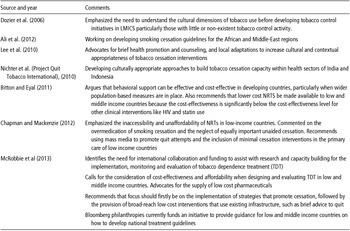
In recognition of the need to include smoking cessation interventions as an integral part of tobacco control agenda for LMICs, seven articles particularly reported on the best approaches and research priorities. Ali et al., (Reference Ali, Safwat, Onyemelukwe, Otaibi, Amir, Nawas, Aouina and Bolliger2012) are working on developing tobacco dependence treatment guidelines for the Africa and MiddleEast regions. Nichter et al., (Reference Nichter, Nichter and Muramoto2010) through the Project Quit Tobacco International are developing culturally appropriate methods to build tobacco cessation capacity in India and Indonesia. Also, Lee et al., (Reference Lee, Siddiqi, Khan, Ahmed, Shafiq-Ur-Rehman, Shams and Nazir2010) recommend brief cessation advice and counselling, and the local adaptations of cessation approaches to increase their cultural and contextual appropriateness. Dozier et al., (Reference Dozier, Ossip-Klein, Diaz, Chin, Sierra, Quinones and Armstrong2006) also emphasised the need to understand the cultural dimensions of tobacco use before developing tobacco control initiatives in LMICS particularly those with little or non-existent tobacco control activity. Bitton and Eyal (Reference Bitton and Eyal2011), opine that behavioural support can be effective and cost-effective particularly when combined with more comprehensive population-wide strategies in LMICs. They also recommend the supply of low cost Nicotine Replacement Therapy (NRTs) to low-income countries. Chapman and Mackenzie (Reference Chapman and Mackenzie2012) reiterate the inaccessibility and unaffordability of NRTs in low-income countries and the need to focus on mass media approaches to promote cessation coupled with the provision of minimal cessation services in primary care. McRobben et al., (2013), call for the consideration of cost-effectiveness and affordability when planning smoking cessation interventions for low-income countries. They strongly emphasise the need for international collaboration and funding for research and capacity building for smoking cessation interventions in LMICs. Summary of findings are presented in Table 4.
Discussion
Most studies on smoking cessation interventions for adult smokers have been concentrated on high-income countries with well-established smoking cessation services. Limited data is available from LMICs on the impact these services have had and can potentially have on increasing cessation rates among adult smokers. As the tobacco burden continues to build in LMICs, the provision of evidence-based cessation interventions is imperative. Based on the available evidence, this current review provides beneficial data on the current impact of cessation interventions in LMICs and the best approaches for future developments.
In this review, most of the studies that assessed the effectiveness and cost-effectiveness of smoking cessation interventions were conducted in upper-middle income countries, some in lower-middle income and none in low-income countries. This shows that very little evidence is available concerning effectiveness and cost-effectiveness of these services in low-income countries. It is important to have evidence from these countries because of their unique characteristics and the effect these would have on smoking cessation intervention efforts. Also, because these studies were conducted more in upper-middle income countries they are not generalisable to all LMICs. Similarly, some of the studies under review had small sample sizes that limit their validity (internal and external). Also, there were conflicting inferences from studies conducted and more research would be needed to draw substantive conclusions. However, findings from this review suggest that physicians’ brief cessation advice with or without intensive counselling are effective in promoting cessation among adult smokers in the countries studied. There were conflicting findings on the effectiveness and cost-effectiveness of pharmacotherapy for smoking cessation among adult smokers in the countries studied. Three studies provided evidence to show that pharmacotherapy does not offer superior advantage over physician advice or intensive counselling in aiding smoking cessation among adult smokers studied (Jeremias et al., Reference Jeremias, Chatkin, Chatkin, Seibert, Martins and Wagner2012; Srivastava et al., Reference Srivastava, Malhotra, Harries, Lal and Arora2013; Ward et al., Reference Ward, Asfar, Al Ali, Rastam, Vander Weg, Eissenberg and Maziak2012); one demonstrated the cost-effectiveness of pharmacotherapy combined with physician brief advice among smokers in Seychelles (Gilbert et al., Reference Gilbert, Pinget, Bovet, Cornuz, Shamlaye and Paccaud2004); another showed that pharmacotherapy is not cost-effective because of the high cost in Vietnam (Higashi and Barendregt, Reference Higashi and Barendregt2011).
Most countries in the World Bank's income classification that are parties to the FCTC were included in the reviewed studies, particularly the Pine-Abata et al., (2013) study, which was conducted in 121 countries (including all LMICs [except eight] that are parties to the FCTC). This increases confidence in the generalisation of findings from studies conducted to explore the reach, adoption, and institutionalisation of smoking cessation interventions in LMICs. Findings from these studies show that NRTs, Varenicline, and Bupropion are least available and affordable in low-income countries. National treatment guidelines and national institutionalisation of smoking cessation services including the presence of quitlines were found to be very limited in LMICs.
Studies that demonstrated physicians’ capacity to provide cessation counselling were mainly cross-sectional surveys conducted in upper-middle income countries. More research is needed in low and lower-middle income countries to determine how competent and confident physicians are in providing smoking cessation counselling. However, the reviewed studies show significantly high smoking rates among physicians. Physicians’ provision of cessation counselling was also found to be low and was mainly attributed to lack of training to provide the service. Physicians can play significant roles in promoting cessation among adult smokers. High prevalence of smoking among physicians can negatively affect tobacco cessation efforts. Conversely, physicians’ abstinence or successful quitting can increase their ability to confidently deliver smoking cessation interventions. Physicians should be provided with adequate training on the best practices with regard to the delivery of smoking cessation interventions. This is particularly important in LMICs where the level of knowledge of the health risks associated with smoking is relatively low compared to high-income countries. Adult smokers in LMICS might be more responsive to physicians’ brief advice when offered during clinical visits (Bitton and Eyal, Reference Bitton and Eyal2011).
The last set of studies reviewed provided information on the latest developments in efforts to increase access to smoking cessation interventions in LMICs. Through the Project Quit Tobacco International, culturally appropriate cessation capacity is being built in India and Indonesia (Nichter et al., Reference Nichter, Nichter and Muramoto2010). Treatment guidelines are being developed for the Africa and Middle East regions and Bloomberg philanthropies are funding initiatives to assist countries in developing their national treatment guidelines (Ali et al., Reference Ali, Safwat, Onyemelukwe, Otaibi, Amir, Nawas, Aouina and Bolliger2012; Raw et al., Reference Raw, McNeill and Murray2010). The recommended best approaches are summarily described as measures that will promote cessation through population-based strategies including mass media campaigns, and the provision of the basic infrastructure for cessation intervention (Chapman and Mackenzie, Reference Chapman and Mackenzie2012). These would include physicians’ provision of brief advice at the primary care level and possible graduation to low cost pharmacotherapy when available (Bitton and Eyal, Reference Bitton and Eyal2011). It is also stressed that each country should develop the minimal capacity to provide cessation interventions by having national treatment guidelines, training physicians to provide cessation counselling, providing cessation counselling at all healthcare facilities, creating national quitlines, and possibly providing access to low cost cessation medications (Raw et al., Reference Raw, McNeill and Murray2010). Also emphasised is the need for international collaboration on research and capacity building for implementing, monitoring, and evaluation of cessation services (McRobbie et al., Reference McRobbie, Raw and Chan2013).
Apart from income classification, LMICs particularly low and lower-middle countries have unique characteristics and challenges that distinguish them from other countries. They have the lowest levels of infrastructural development and the highest population of impoverished people. Some of these countries are currently struggling to control infectious diseases such as HIV/AIDS, tuberculosis and malaria; an additional tobacco burden and the associated economic cost of tobacco control will put them in a very difficult situation. The implementation of effective population-based tobacco control measures in these countries has been very slow paced. Also, the high prevalence of smokeless tobacco use in countries such as India further complicates smoking cessation intervention efforts (Joshi, Modi, and Yadav, Reference Joshi, Modi and Yadav2010). Extensive research should be conducted to determine the most cost-effective and culturally appropriate tobacco control measures for these countries considering their peculiarities.
In conclusion, smoking cessation interventions are not readily available, affordable and accessible to adult smokers in LMICS. More evidence is needed to demonstrate the effectiveness of physician brief advice in promoting smoking cessation in LMICs. However, physician brief advice should be encouraged based on evidence from developed countries and those provided by the reviewed studies. Access to pharmacotherapy can be possibly enhanced by significant subsidisation but this should be preceded by building national capacity for cessation interventions through physicians training, national quitlines, and institutionalisation of cessation services. The gaps in research should be filled in order to develop the most socioeconomically and culturally appropriate cessation intervention methods for adult smokers in LMICs.
Financial support
This research received no specific grant from any funding agency, commercial or not-for-profit sectors
Conflict of interest
None
Ethical standards
Not applicable