Introduction
Cognitive deficits are common in both schizophrenia and bipolar disorder (Keefe et al. Reference Keefe, Bilder, Harvey, Davis, Palmer, Gold, Meltzer, Green, Miller, Canive, Adler, Manschreck, Swartz, Rosenheck, Perkins, Walker, Stroup, McEvoy and Lieberman2006; Martinez-Aran et al. Reference Martinez-Aran, Vieta, Torrent, Sanchez-Moreno, Goikolea, Salamero, Malhi, Gonzalez-Pinto, Daban, Varez-Grandi, Fountoulakis, Kaprinis, Tabares-Seisdedos and Yuso-Mateos2007; Simonsen et al. Reference Simonsen, Sundet, Vaskinn, Birkenaes, Engh, Hansen, Jonsdottir, Ringen, Opjordsmoen, Friis and Andreassen2008). Substance use is also highly prevalent in both disorders, especially of cannabis (Kavanagh et al. Reference Kavanagh, Waghorn, Jenner, Chant, Carr, Evans, Hemnan, Jablensky and McGrath2004; Green et al. Reference Green, Young and Kavanagh2005; Murray et al. Reference Murray, Morrison, Henquet and Di Forti2007). Although cannabis is reported to affect neurocognition in healthy individuals (Ilan et al. Reference Ilan, Smith and Gevins2004; Ranganathan & D'Souza, Reference Ranganathan and D'Souza2006), there are few studies of cannabis use in relation to neuropsychological test performance in schizophrenia, and to our knowledge there are no studies investigating this association in bipolar disorder.
The only existing study of a combined sample of schizophrenia and bipolar disorder found no clear associations between cannabis use and neurocognition (Liraud & Verdoux, Reference Liraud and Verdoux2002). Carey et al. (Reference Carey, Carey and Simons2003) reported that dual-diagnosis patients with schizophrenia or bipolar disorder performed better on non-verbal neuropsychological tests than those who never abused. Studies of general substance use in schizophrenia spectrum disorder patients showed diverging results (Joyal et al. Reference Joyal, Halle, Lapierre and Hodgins2003; Herman, Reference Herman2004; Thoma et al. Reference Thoma, Wiebel and Daum2007; Wobrock et al. Reference Wobrock, Sittinger, Behrendt, D'Amelio, Falkai and Caspari2007; Potvin et al. Reference Potvin, Joyal, Pelletier and Stip2008; van Os et al. Reference van Os, Linscott, Myin-Germeys, Delespaul and Krabbendam2009). In the only intervention study, administration of Δ9-tetrahydrocannabinol (THC) to patients with schizophrenia was followed by a temporary reduction in verbal learning and memory (D'Souza et al. Reference D'Souza, Abi-Saab, Madonick, Forselius-Bielen, Doersch, Braley, Gueorguieva, Cooper and Krystal2005). The few existing clinical studies of cannabis use, however, have mainly shown equal or better cognitive functioning in cannabis users with schizophrenia compared with abstainers (Coulston et al. Reference Coulston, Perdices and Tennant2007a, Reference Coulston, Perdices and Tennantb; Potvin et al. Reference Potvin, Joyal, Pelletier and Stip2008).
A continuum of traits between the diagnostic groups of schizophrenia and bipolar disorder rather than distinct categories is proposed in the mood–psychosis spectrum continuum model (Craddock & Owen, Reference Craddock and Owen2007; van Os et al. Reference van Os, Linscott, Myin-Germeys, Delespaul and Krabbendam2009). Findings of milder neurocognitive deficits in bipolar disorder than in schizophrenia (Cahill et al. Reference Cahill, Malhi, Ivanovski, Lagopoulos and Cohen2006; Daban et al. Reference Daban, Martinez-Aran, Torrent, Tabares-Seisdedos, Balanza-Martinez, Salazar-Fraile, Selva-Vera and Vieta2006; Simonsen et al. Reference Simonsen, Sundet, Vaskinn, Birkenaes, Engh, Faerden, Jonsdottir, Ringen, Opjordsmoen, Melle, Friis and Andreassen2009) and less neurocognitive dysfunction in bipolar II than bipolar I disorder (Simonsen et al. Reference Simonsen, Sundet, Vaskinn, Birkenaes, Engh, Hansen, Jonsdottir, Ringen, Opjordsmoen, Friis and Andreassen2008) may support such a view. No study has yet investigated the association of cannabis and neurocognitive functioning across the diagnostic categories. Both neuropsychological test performance and individual effects of substance use can be regarded as endophenotypes, mediating factors between the neurobiological substrate and the expressed phenotype (Gottesman & Gould, Reference Gottesman and Gould2003). This can help in assessing whether there is a continuum of traits between the diagnostic groups rather than distinct categories as proposed in the mood–psychosis spectrum continuum model. The relationships between substance use and neurocognitive performance across both disorders can be used to inform the question of dimensions versus categories in the nosology of severe mental illness, and may thus provide new knowledge about underlying disease mechanisms.
The present study was conducted on a large, naturalistic and thoroughly described representative patient population, where a range of possible confounders was controlled for. The naturalistic design enables observation of real-life associations in an actual clinical setting. The aim was to investigate if there are differences in neurocognitive functioning between cannabis users and non-users in bipolar disorder and schizophrenia, and if these relationships are different in the two diagnostic groups.
Method
Setting
The study is part of the Thematic Organized Psychosis Research (TOP) study. Patients were recruited from the Departments of Psychiatry at Ulleval University Hospital, Aker University Hospital and Diakonhjemmet Hospital in Oslo. The three departments cover a geographical catchment area including 10 districts of Oslo and five suburbs. The catchment areas covers 485 000 inhabitants (88% of Oslo's total population), are located in different areas of the city and are representative of the city's variation in sociodemographic characteristics.
Subjects
Patients that consecutively gave consent to enter the study between May 2003 and September 2007 were included in the present part of the study. Each patient was referred to the project by their treating clinician after an evaluation of their eligibility and ability to give informed consent. Emphasis was put on recruiting all patients regardless of level of involvement in their respective treatment programmes. All patients had given written informed consent to participation, and the study was approved by the Regional Committee for Medical Research Ethics and the Norwegian Data Inspectorate. In the main TOP study the rate of non-participants was about 13%. Due to the Norwegian Data Security Act, information about non-consenting patients is inaccessible. We have previously shown that the TOP sample is representative of psychosis patients receiving treatment at Oslo University Hospital (Ringen et al. Reference Ringen, Melle, Birkenæs, Engh, Færden, Jönsdóttir, Nesvåg, Vaskinn, Friis, Larsen, Opjordsmoen, Sundet and Andreassen2007).
The assessments were conducted by trained clinicians working as research fellows (psychiatrists or psychologists) before signing the informed consent, and before the interview started. The recruitment teams were based in out-patient clinics, which patients were transferred to after acute illness phases. This procedure restricted inclusion to symptomatically stable patients.
Further inclusion criteria were: aged 18–65 years and meeting DSM-IV criteria for a diagnosis of schizophrenia, schizophreniform disorder, schizo-affective disorder, bipolar I disorder, bipolar II disorder or bipolar disorder not otherwise specified (NOS). Subjects had to be fluent in a Scandinavian language. Exclusion criteria were presence of a diagnosis of developmental disorder [intelligence quotient (IQ) <70] or acquired brain damage (head injury with hospitalization). For the present part of the study, patients had to have Norwegian as their first language or have received their compulsory schooling in Norway (to ensure valid neuropsychological test performance) and not use any other substances than cannabis during the previous 6 months. There were no exclusion criteria based on course of illness or history of treatment.
Clinical assessments
Diagnoses were established using the Structural Clinical Interview for the DSM-IV Axis I disorders (SCID-I), modules A–E (APA, 1994). All interviewers participated in regular diagnostic consensus meetings led by an experienced clinical researcher in the field of diagnostics in severe mental disorder. In addition, all raters finished a course in SCID assessment based on the training programme at the University of California, Los Angeles (UCLA; Ventura et al. Reference Ventura, Liberman, Green, Shaner and Mintz1998). Mean overall κ for SCID diagnoses assessed by the UCLA procedure was 0.77. To assess reliability for actual study interviews a stratified random sample was drawn, consisting of cases from every assessment staff member. Anonymous vignettes describing symptoms and development of the illness were then rated by two experts blind to the study ratings. For the 28 vignettes the overall agreement for the nine DSM-IV diagnostic categories was 82% and the overall κ again 0.77 (95% confidence interval 0.60–0.94).
Psychotic symptoms were assessed by the Positive and Negative Syndrome Scale (PANSS; Kay et al. Reference Kay, Fiszbein and Opler1987). Global symptoms and psychosocial functioning were measured by the Global Assessment of Functioning (GAF) scale, and the scores were split into scales of symptoms (GAF-S) and functioning (GAF-F) to improve psychometric properties (Pedersen et al. Reference Pedersen, Hagtvet and Karterud2007). Pre-morbid functioning was assessed by the Premorbid Adjustment Scale (PAS; Cannon-Spoor et al. Reference Cannon-Spoor, Potkin and Wyatt1982). PAS scores were divided into academic and social domains according to pre-morbid age intervals (Larsen et al. Reference Larsen, Friis, Haahr, Johannessen, Melle, Opjordsmoen, Rund, Simonsen, Vaglum and McGlashan2004). Increasing scores on PAS signify poorer functioning and higher GAF scores signify fewer symptoms. For the rest of the symptom scores, high scores signify more symptoms.
Data were recorded about age at first experience of psychosis, number of psychotic episodes, hospitalizations because of psychosis and current medication (type and duration).
Substance use assessments
Substance-use disorders were diagnosed through the SCID-E module. Patients were additionally interviewed about their recent use of substances, with structured questions about the specific substances they had used in the past 6 months and the amount of use of each substance. Records were also made of daily nicotine and caffeine use. Current medication, including the use of psychopharmacological substances at the day of testing, was also recorded. All participants were screened for the presence of THC or other recreational drugs in the urine 1 h prior to the neurocognitive assessment. Of the subjects, nine had THC in their urine; of these, two denied recent use, implying a high reliability of self-report. One subject had amphetamine in their urine.
Neurocognitive assessment
A comprehensive neuropsychological test battery was administered to all participants by psychologists or test technicians trained by a specialist in clinical neuropsychology.
Tests from domains previously found to be sensitive to dysfunction in groups with cannabis use, bipolar disorder and/or schizophrenia were included.
General cognitive functioning
The number of errors on the Norwegian research version of the National Adult Reading Test (NART; Vaskinn & Sundet, Reference Vaskinn and Sundet2001) was used as a measure of pre-morbid IQ. Current IQ was assessed with the Wechsler Abbreviated Scale of Intelligence (Wechsler, Reference Wechsler2007). All subjects showed adequate neuropsychological test effort as indicated by scoring less than two errors on the forced recognition trial of the California Verbal Learning Task (CVLT-II; Delis et al. Reference Delis, Kramer, Kaplan and Ober2004).
Domains
Psychomotor speed
The Digit Symbol Test from Wechsler Adult Intelligence Scale (WAIS-III; Wechsler, Reference Wechsler2003) was used as a measure of psychomotor speed.
Attention and working memory
With the digit span test (forward version), from the WAIS-III (Wechsler, Reference Wechsler2003), the maximum number of digits repeated in the same order as presented was used as a measure of focused attention and the maximum number of digits repeated in a backward order of presentation (backward version) was used as a measure of working memory. The Working Memory–Mental Arithmetic (WM–MA) test (Hugdahl et al. Reference Hugdahl, Rund, Lund, Asbjornsen, Egeland, Ersland, Landro, Roness, Stordal, Sundet and Thomsen2004) is a computer-based test requiring that a button be pressed every time the two numbers displayed on the screen are the same as the numbers displayed two screen pictures back (‘2-back’). The number of correct responses minus the number of false positives (commissions) was used as a measure of working memory.
Executive functioning
From the Verbal Fluency Test, part of the Delis–Kaplan Executive Function System (D-KEFS; Delis et al. Reference Delis, Kaplan and Kramer2005) the number of words beginning with the letters ‘F’, ‘A’ and ‘S’ generated separately within 60 s was used as a measure of phonetic fluency. The number of animals' and boys' names generated separately within 60 s was used as a measure of semantic fluency. Finally, the number of fruit and furniture generated while alternating between the two categories was used as a measure of semantic set shift. From the third trial in the Color–Word Interference Test, part of the D-KEFS (Delis et al. Reference Delis, Kaplan and Kramer2005), the time taken to name the colour of the ink on a list of written colour names incongruent with the colour of the ink was used to measure interference control. From the fourth trial, the time taken to complete the alternation between naming the colour of the ink and naming the written word was included as a measure of interference set shift.
Verbal learning and memory
From the Logical Memory Test, part of the Wechsler Memory Scale (WMS-III; Wechsler, Reference Wechsler2008), the total number of items immediately recalled from two short stories that were read once each was used as a measure of verbal learning, while the total number of items freely recalled after 30 min was used to measure delayed verbal recall. From the CVLT-II (Delis et al. Reference Delis, Kramer, Kaplan and Ober2004) the total number of words repeated immediately after five reading trials of a list of 16 words was used as an additional measure of verbal learning. The number of words freely recalled after 30 min was used to measure delayed verbal recall.
Higher scores on the neuropsychological tests signify better performance on all tests except for the NART and the D-KEFS interference tests where higher scores signify poorer performance.
Statistical procedures
SPSS version 16.0 (SPSS Inc., USA) was used. All tests were two-tailed with a predefined level of significance of 0.05. Group differences in diagnostic category and dichotomous variables (substance use/abuse, stimulant use, medication, cannabis in urine) were evaluated with χ2 tests or Fisher exact tests. For continuous data (years of education, number of episodes, symptom scores, PAS and neuropsychological test scores), group differences were evaluated with independent t tests for normally distributed data and Mann–Whitney tests for skewed data. The bivariate relationships between cannabis use, diagnosis, neuropsychological test performance and significant demographic and clinical independent variables were analysed using Spearman rank correlations. Spearman rank correlations were also used for analysing the relationships between the different neuropsychological test results. The associations between neurocognitive functioning in cannabis users and non-users and for the two diagnostic categories (including the interaction term for cannabis use and diagnosis) were analysed with multiple regression analyses. We did not correct for multiple testing, since the current neuropsychological tests can be considered to be different measures for broader domains which were selected based on specific hypotheses derived from previous findings (D'Souza et al. Reference D'Souza, Abi-Saab, Madonick, Forselius-Bielen, Doersch, Braley, Gueorguieva, Cooper and Krystal2005; Coulston et al. Reference Coulston, Perdices and Tennant2007a). Finally, the possibility of confounders of the relationship between each neuropsychological test score and cannabis-use group was explored through hierarchical multiple regression analysis. Background variables that according to the available literature could affect results, that were unequally distributed between the cannabis use groups and/or diagnostic groups, and at the same time were associated with the neuropsychological test results (that is; diagnosis, age, gender, years of education, pre-morbid academic functioning and daily tobacco use), were entered hierarchically in the analyses, with the interaction term of diagnosis×cannabis use entered last.
Results
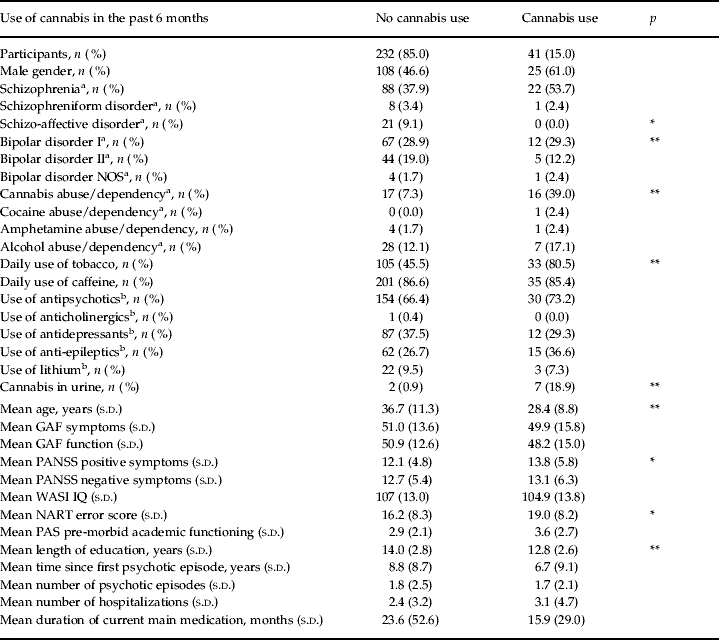
The study sample included 273 subjects, of which 48.7% (n=133) were male. Mean age was 35.4 years (s.d.=11.3). Of the subjects, 40.3% (n=110) had schizophrenia, 3.3% (n=9) schizophreniform disorder, 7.7% (n=21) schizo-affective disorder (schizophrenia group), 28.9% (n=79) bipolar I disorder, 17.9% (n=49) bipolar II disorder and 1.8% (n=5) had bipolar NOS disorder (bipolar disorder group). Schizophrenia patients were younger (mean age 33.3 years, s.d.=10.1) than bipolar patients (mean age 37.6 years, s.d.=12.1), more often male (55.0% v. 42.1%) and had a poorer pre-morbid academic functioning (PAS academic). As expected, we found poorer neurocognitive functioning in schizophrenia versus bipolar disorder patient groups (Fig. 1). These differences were highly statistically significant (p<0.001) in all areas except NART errors (p=0.01), digit span forward (p=0.11) and WM–MA (p=0.06) (Mann–Whitney U test). Among subjects reporting cannabis use in the past 6 months, the median number of incidents of cannabis use was 4.5, and the median number of daily cigarettes was 10. There were no significant differences in amount of use between the diagnostic groups. Subjects with cannabis use compared with non-users were younger [28.4 (s.d.=8.8) years v. 36.7 (s.d.=11.3) years, p<0.001], more often daily tobacco users (80.5% v. 45.5%, p<0.001), had less education [12.8 (s.d.=2.6) years v. 14.0 (s.d.=2.8) years, p=0.010] and poorer pre-morbid cognitive functioning measured by NART [19.2 (s.d.=8.2) v. 16.2 (s.d.=8.3), p=0.051]. Cannabis use was associated with more positive symptoms on the PANSS [13.8 (s.d.=5.8) v. 16.2 (s.d.=4.8), p=0.041] (Table 1). There were no associations between historical clinical variables and use group (Table 1).
Neurocognitive performance in patients with schizophrenia (◆) or bipolar disorder ( ), with and without cannabis use. (a) Digit span forwards (attention); (b) 2-back (working memory); (c) colour–word interference, set shifting (executive functioning); (d) semantic set shifting (executive functioning); (e) logical memory, learning (verbal learning); (f) California Verbal Learning Test (CVLT)-II, learning (verbal learning). A higher score on colour–word interference, set shifting signifies poorer functioning. There were significant interaction effects of diagnosis (p⩽0.05) for digit span forwards, semantic set shifting, logical memory, learning, and CVLT-II, learning.

Sample characteristics

NOS, Not otherwise specified; GAF, Global Assessment of Functioning; s.d., standard deviation; PANSS, Positive and Negative Syndrome Scale; WASI, Wechsler Abbreviated Scale of Intelligence; IQ, intelligence quotient; NART, National Adult Reading Test; PAS, Premorbid Adjustment Scale.
a Diagnostic and Statistical Manual of Mental Disorders, 4th edition (DSM-IV) diagnoses.
b Regular use by prescription.
* p⩽0.05, ** p⩽0.01 (t tests for parametric data, Mann–Whitney tests for non-parametric data, Fisher's exact tests for categorical data).
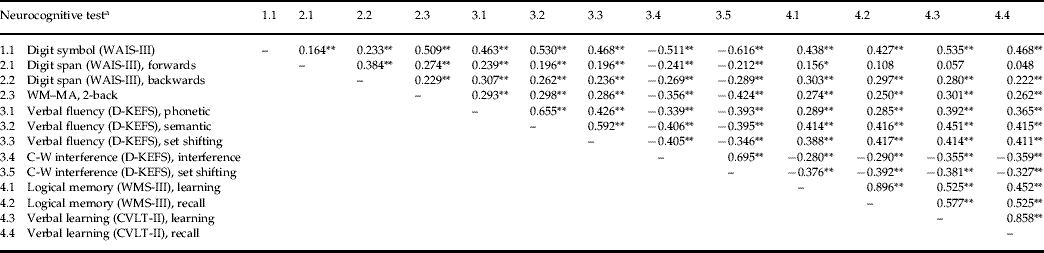
The neuropsychological test results were not correlated with length of current antipsychotic medication or with THC in urine. As shown in Table 2, there were statistically significant correlations between the neuropsychological test results within all domains. The correlations between the neuropsychological test results differed across the domains (Table 2).
Pearson correlations between neurocognitive variables

WAIS, Wechsler Adult Intelligence Scale; WM–MA, working memory–mental arithmetic test; D-KEFS, Delis–Kaplan Executive Function System; C-W interference, colour–word interference; WMS, Wechsler Memory Scale; CVLT, California Verbal Learning Test.
a The test number is according to the numbering of neurocognitive domains in the Method section and Table 3.
** Significant correlation (p⩽0.01; two-tailed).
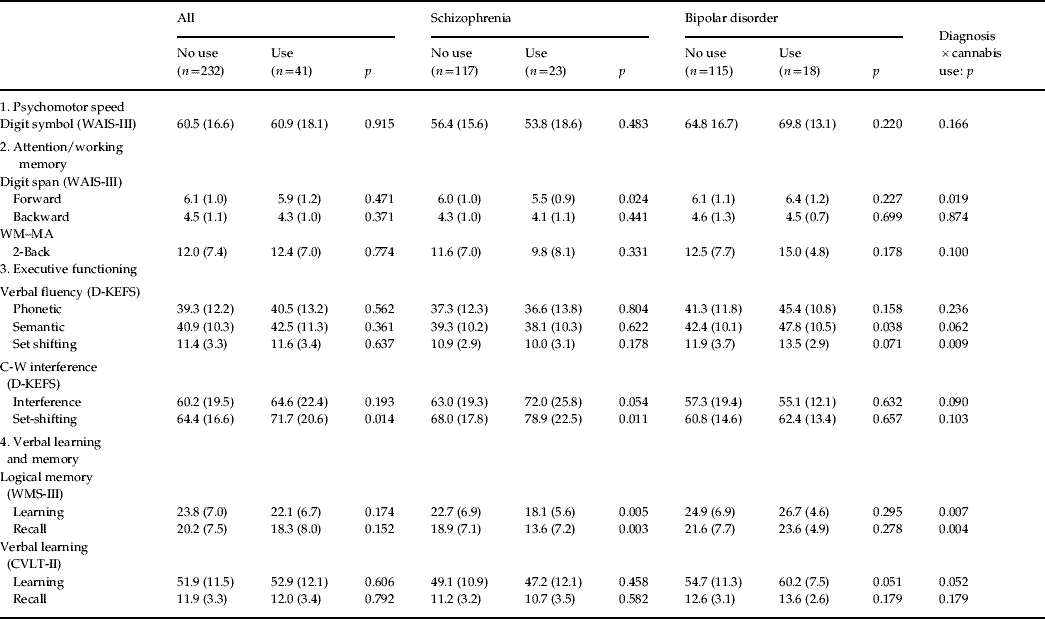
The only main effect of belonging to the cannabis-use group versus the no-use group in the analyses of the total patient group (both diagnostic groups combined) was a statistically significant poorer result for the interference-set shifting subtest of the colour–word interference test [71.7 (s.d.=20.6) v. 64.4 (s.d.=16.6), p=0.014] (Table 3). In the schizophrenia group cannabis users performed significantly poorer than the non-using group on the digit span forward test [5.5 (s.d.=0.9) v. 6.0 (s.d.=1.0), p=0.024], on the colour–word interference set-shifting subtest [78.9 (s.d.=22.5) v. 68.0 (s.d.=17.8), p=0.011] (with a trend for interference control without the set-shifting condition) and on the subtests of the logical memory test; learning [18.1 (s.d.=5.6) v. 22.7 (s.d.=6.9), p=0.005] and recall [13.6 (s.d.=7.2) v. 18.9 (s.d.=7.1), p=0.003]. In the bipolar disorder group cannabis users, however, performed significantly better on the semantic fluency subtest of the verbal fluency test [47.8 (s.d.=10.5) v. 54.7 (s.d.=11.3), p=0.038] (Table 3). In addition there was a trend for better functioning on the CVLT-II learning test (Table 3). No other significant differences were present.
Neurocognitive performance with and without cannabis useFootnote a

Values are given as mean (standard deviation).
WAIS, Wechsler Adult Intelligence Scale; WM–MA, working memory–mental arithmetic test; D-KEFS, Delis–Kaplan Executive Function System; C-W interference, colour–word interference; WMS, Wechsler Memory Scale; CVLT, California Verbal Learning Test.
a Independent t tests and linear regression analyses controlling for the interaction between diagnosis and cannabis use.
There were statistically significant interaction effects (poorer functioning in cannabis-using patients with schizophrenia compared with non-users; better functioning in cannabis-using patients with bipolar disorder compared with non-users) for digit span forward (p=0.019), semantic set shifting (p=0.009) and the learning subtest (p=0.007) and recall subtest (p=0.004) of the logical memory test, with trend levels for semantic fluency and CVLT-II learning (Table 3). There was a very high level of correlation between the two logical memory tests. These tests correlated considerably with the semantic set-shifting test, and to a modest degree with the digit span forward test (Table 2).
Hierarchical regression analyses controlling for effects of possible confounders (see Statistical procedures) did not indicate that the interaction effects were caused by the presence of confounding variables.
Discussion
Our main finding was the presence of opposite associations between cannabis use and measures of verbal memory and executive functioning in schizophrenia and bipolar disorder. The interaction effects remained significant also after controlling for potential confounders.
To the best of our knowledge this is the first study to simultaneously address the relationship between cannabis and neurocognitive function for the two diagnostic categories. In the bipolar disorder group, the neuropsychological test performance was numerically better in most of the measured areas for cannabis users, but reached statistical significance only for executive functioning. In the schizophrenia group, the neuropsychological test performance was poorer in the cannabis users compared with the abstainers on all measures, reaching statistical significance for attention, executive functioning and verbal memory. Our findings of an interaction effect may explain why the only previous study investigating a mixed diagnostic sample (Liraud & Verdoux, Reference Liraud and Verdoux2002) did not find any association between cannabis use and neurocognition, as this study did not examine the diagnostic groups separately.
As far as we are aware, the present study is also the first report of an association between cannabis use and altered neurocognitive functioning in bipolar disorder. The findings may indicate that improved cognition is related to recent cannabis use in these patients. However, the statistical association was weak, and would not remain significant after correction for multiple comparisons. Thus, the results should be replicated in independent samples. The findings in the schizophrenia subjects of an association with cannabis use and worse performance on the interference tests are in accordance with Liraud &Verdoux (Reference Liraud and Verdoux2002). The results of poorer verbal learning/memory and attention are in line with the acute cannabis effects reported by D'Souza et al. (Reference D'Souza, Abi-Saab, Madonick, Forselius-Bielen, Doersch, Braley, Gueorguieva, Cooper and Krystal2005). However, there are still unsolved questions. Improved cognition in the areas of attention and executive function has been indicated to be related to recent cannabis use in subjects with schizophrenia (Coulston et al. Reference Coulston, Perdices and Tennant2007a; Sevy et al. Reference Sevy, Burdick, Visweswaraiah, Abdelmessih, Lukin, Yechiam and Bechara2007). If cannabis use is regarded to elicit psychotic symptoms in people that otherwise would not get a psychotic disorder, this group of people could be regarded as a selection of patients with good pre-morbid function. This group would probably have a better prognosis and better cognitive functioning than the group of patients who got their symptoms due to other causes, e.g. neurodevelopmental abnormalities. This could explain why studies have reported improved cognition in substance users.
The current findings may have implications for the conceptual understanding of the disorders. The traditional Kraepelinian dichotomy between schizophrenia and bipolar disorder has been challenged over some time (Crow, Reference Crow1986), recently with more force as more biological similarities have been revealed (Snyder, Reference Snyder1973; Craddock et al. Reference Craddock, O'Donovan and Owen2006; Craddock & Owen, Reference Craddock and Owen2007; Crow, Reference Crow2008; Ivleva et al. Reference Ivleva, Thaker and Tamminga2008; O'Donovan et al. Reference O'Donovan, Craddock, Norton, Williams, Peirce, Moskvina, Nikolov, Hamshere, Carroll, Georgieva, Dwyer, Holmans, Marchini, Spencer, Howie, Leung, Hartmann, Moller, Morris, Shi, Feng, Hoffmann, Propping, Vasilescu, Maier, Rietschel, Zammit, Schumacher, Quinn, Schulze, Williams, Giegling, Iwata, Ikeda, Darvasi, Shifman, He, Duan, Sanders, Levinson, Gejman, Cichon, Nothen, Gill, Corvin, Rujescu, Kirov and Owen2008). The disorders are suggested as opposite extremes on a continuous spectrum of conditions with psychotic episodes (Craddock et al. Reference Craddock, O'Donovan and Owen2006). The present results of opposite correlations between cannabis use and neurocognition in schizophrenia and bipolar disorder suggest that different mechanisms are related to the effect of cannabis on neurocognition in the two disorders. However, some cognitive domains were not affected in different directions, and it is not known whether there is a linear relationship between the actual amount of cannabis used and the impact on neurocognitive functioning. Thus, while our overall findings do not support the continuum model, dimensional explanations cannot be ruled out.
It is of interest that cannabis use was not related to differences in general cognitive functioning, but rather associated with differences in specific domains of cognition. The finding of a negative association with verbal memory in schizophrenia patients was as expected from earlier experiments (D'Souza et al. Reference D'Souza, Abi-Saab, Madonick, Forselius-Bielen, Doersch, Braley, Gueorguieva, Cooper and Krystal2005), but the positive associations in bipolar disorder were unexpected. There are several psychoactive components of cannabis, with potentially different neurochemical effects (Morgan & Curran, Reference Morgan and Curran2008). Drugs modulating brain signalling can hamper cognition, while others may also enhance certain types of cognitive performance (Turner et al. Reference Turner, Clark, Pomarol-Clotet, McKenna, Robbins and Sahakian2004). The putative effect might, however, be indirect, and related to other factors. For instance, the anxiolytic effect of cannabis could improve cognition in patients with high levels of co-morbid anxiety (Simon et al. Reference Simon, Otto, Wisniewski, Fossey, Sagduyu, Frank, Sachs, Nierenberg, Thase and Pollack2004), as anxiety may interfere with attentional control (Eysenck et al. Reference Eysenck, Derakshan, Santos and Calvo2007). In our sample, anxiety ratings were equal between the two diagnostic categories. However, bipolar disorder patients with cannabis use had significantly lower anxiety ratings than non-users, which was not the case in the schizophrenia group. In this cross-sectional study we cannot discern whether cannabis use has different effects in the two disorders, or whether there are different subgroups of patients that are at risk for cannabis use in the two diagnostic groups. A possible preference for the best-functioning bipolar disorder patients and the poorest-functioning schizophrenia patients to use cannabis could be an alternative explanation for the results, but this seems less likely as controlling for pre-morbid functioning did not affect the interaction of diagnosis and cannabis use on neurocognitive functioning.
The high level of correlation between some neuropsychological test results indicates that some of the diagnosis×cannabis interactions across these tests arise because they measure aspects of the same cognitive phenomena. However, for some tests that showed significant interaction effects (logical memory and digit span, forward), the correlations were low, which suggests that these interactions are related to independent aspects of different cognitive domains.
The current study has some limitations. It is cross-sectional and cannot answer questions about causations. The total number of subjects using cannabis was small, restricting the statistical possibilities and the basis for strong conclusions. The criteria for substance use were wide (any use in the past 6 months), with a low median level of cannabis use. As the study also did control for THC-positive urine screening, direct pharmacological effects seem less plausible. There is no information about the amount of smoked cannabis, duration of use or on the content of THC and other active substances in the cannabis, which is of relevance when considering pharmacological factors and possible effects of long-term use. Unknown active substances could affect the results. Only duration of current medication is accounted for. Previous medication history could bias our results, as medication could influence neurocognition in clinical samples. Stable medication, especially with novel antipsychotics, is reported to be beneficial to cognition in schizophrenia (Cuesta et al. 2001; Szoke et al. 2008). Less is known about bipolar disorder, and it remains unclear if or how this could affect the associations between diagnoses. Several key measures are based on self-report and thus imply some uncertainty even if both self-reports of substance use (Weiss et al. Reference Weiss, Najavits, Greenfield, Soto, Shaw and Wyner1998) and PAS data (Brill et al. Reference Brill, Reichenberg, Rabinowitz, Harary, Lubin, Davidson and Weiser2007) previously have been shown to have a high degree of validity. Thus, clinical longitudinal studies are required for the investigation of the neuropsychopharmacological properties of cannabinoids in bipolar disorder and schizophrenia. Intervention studies should aim at discerning the role of the different cannabinoid compounds.
According to our aim of investigating cannabis use only, the study groups are not representative of the ‘dual-diagnosis’ population in general. Our findings indicate that use of cannabis should be evaluated when assessing neurocognition in both schizophrenia and bipolar disorder. Further studies should focus on clearly defined diagnostic or phenomenological categories; as different mechanisms might be at play in broad and heterogeneous diagnostic clusters. Eventual evidence of positive effects of cannabis on neurocognition in any disorder must be weighed against evidence for poor outcome in other areas of functioning. The evidence linking drug use/abuse with poor outcome in severe mental disorder (Henquet et al. Reference Henquet, Krabbendam, de Graaf, ten Have and van Os2006; Cerullo & Strakowski, Reference Cerullo and Strakowski2007; Moore et al. Reference Moore, Zammit, Lingford-Hughes, Barnes, Jones, Burke and Lewis2007) must still be decisive for clinical advice.
To conclude, the present findings of an interaction effect of cannabis use with diagnosis suggests that cannabis use is differentially related to neurocognition in bipolar disorder and schizophrenia. These findings of opposite directions of associations may indicate different underlying mechanisms, but should be replicated in independent samples.
Acknowledgements
We thank all participants of the TOP study for their contribution, and the TOP study group members for participation in data collection. The study is part of the Thematic Organized Psychosis Research (TOP) study group and has been funded by grants from the Research Council of Norway (no. 147787, 167153 and 164778/V50) and Eastern Norway Health Authority (no. 123/2004). The authors thank Kenneth Hugdahl for use of the Working Memory-Mental Arithmetic test.
Declaration of Interest
None.