





As a representation of public grief, the funeral of the British composer William Sterndale Bennett at Westminster Abbey on 6 February 1875 was striking both in its scale and the level of detail reported in the press, testifying to its cultural importance. Readers were provided with published lists of distinguished mourners (as ‘almost every professor and amateur of note was present, besides distinguished representatives of art, science, and literature’), vivid descriptions of the funeral procession, and a clear sense of the ‘vast crowd of spectators’ in attendance.Footnote 2 Others were struck by the mood of the event; for Charles Villiers Stanford, despite the suitably ‘stately and proud’ ceremony, it was ‘resolved, by the all-pervading affectionate spirit of the man it honoured, into a close, intimate and family-like gathering of sorrowing friends’.Footnote 3 Finding other ways to commemorate Bennett was a more complex issue, however. Obituary writers were somewhat divided over Bennett’s status, and there were several debates over how Bennett’s death should be suitably marked – not only in terms of his funeral, but in what forms (literary, sculptural, musical) might represent appropriate commemorative objects or events. Two contrasting musical responses to Bennett’s death, both written in 1875, are particularly fascinating: Thomas Wingham’s Elegy on the Death of Sir Sterndale Bennett and George Alexander Macfarren’s Idyll in Memory of Sterndale Bennett. In highlighting the nature and range of elements that contributed to Bennett’s memorialization, this article places them in a wider perspective. Whilst the size of Bennett’s funeral and the level of reportage associated with it can be partly explained and contextualized via cultural shifts in mourning and commemorative practices in Victorian Britain combined with the nature of Bennett’s institutional reach and international networks, the musical tributes can be reassessed as a refiguring of conventions from literary models: the poetic elegy and the obituary. This allows us to appreciate the choices made to mark Bennett’s passing in relation to ideas of public bereavement, legacy and memorial in Victorian Britain.
Bennett’s Funeral in a Victorian Context
The first issue in relation to Bennett’s funeral was the potential site of his internment. A requisition to the Dean of Westminster, Arthur Penryhn Stanley, was signed by the leading musicians of the day – composers, performers, critics and publishers that included Julius Benedict, Hans von Bülow, William Cusins, William Davison, Sir George Elvey, Manuel Garcia, Sir John Goss, Charles Hallé, John Hullah, Joseph Joachim, Jenny Lind, Stanley Lucas, George and Walter Macfarren, Sir Frederic Ouseley, Alfredo Piatti and Arthur Sullivan.Footnote 4 As John Wolffe has suggested, the criteria that Stanley used for a Westminster Abbey burial were ‘related far more to evidence of an individual’s acknowledged national standing than to the personal morality of religious views of the deceased’, with a range of writers, scientists, explorers and historians being given this honour.Footnote 5 The nine internments for which Stanley was responsible between 1864 and 1881, for example, were those of Charles Dickens (1870), Sir John Herschel and the historian George Grote (1871), Edward Bulwer-Lytton (1873), Dr David Livingston (1874), the geologist Sir Charles Lyell, Bishop Connop Thirlwall and Bennett (all 1875), and the statesman Lord Lawrence (Viceroy of India, 1864–69) in 1879.Footnote 6 Bennett was therefore in good company; George Macfarren, Bennett’s replacement as Principal of the Royal Academy of Music and Professor of Music at Cambridge from 1875, was not accorded that honour in 1887 by Stanley’s successor, Dean George Granville Bradley, despite the apparent urging ‘thereto by an extensive and influentially-signed requisition’.Footnote 7
If the wealth of detail reported in the press was particularly striking (whether the respective roles of Samuel Hatchard and Chief Inspector Eleazar Denning in overseeing funeral arrangements and supervising security, or the intricacies of the coffin’s design),Footnote 8 so was the scale of the event. The cortège that drove through the streets from Bennett’s home at 66 St John’s Wood to the Abbey was made up of four family carriages, a further 21 carriages that underlined Bennett’s institutional affiliations and musical networks (representing Cambridge University, the Royal Academy of Music, the Philharmonic Society, the Royal Society of Musicians, and the Verein für Kunst und Wissenschaft – the German Athenaeum), and additional private carriages of the royal family.Footnote 9 ‘Long before’ the start of the service ‘every unreserved nook and corner inside the Abbey were tenanted, and those who held special admission tickets had some difficulty in getting to their places’, with a ‘dense crowd’ remaining outside.Footnote 10 Bennett’s ‘fellow-students’ from the RAM (including George Macfarren) made up the 12 pall bearers,Footnote 11 the choir consisted of 28 boys and 26 men representative of Westminster Abbey, St Paul’s, the Temple, the Chapel Royal, and Lincoln’s Inn,Footnote 12 and the plethora of organists in the service included John Stainer.Footnote 13 There was traditional funeral music by Croft, Purcell and Handel (including the Dead March from Saul), but it was Bennett’s anthem ‘God is a Spirit’ from The Woman of Samaria, ‘delivered by 4 solo voices, then repeated by the entire choir’, that was particularly impactful:
The effect produced by this large body of trained voices singing sotto voce, without any kind of accompaniment, approached sublimity, and was intensified by the reflection that these touching strains of sacred melody – these masterly harmonies – had been penned by the hand that now lay cold and rigid in yonder coffin; never again to labour for the delight of mankind, never again to exchange the grasp of friendship with those who now stood weeping beside the grave of him they loved so well.Footnote 14
The relative scale of the funeral arrangements for the three British composers who preceded Bennett as RAM Principals, and the reporting of these events, was strikingly low-key in comparison. Newspapers provided the same brief account of the death of William Crotch (1775–1847), the first Principal from 1822 and Heather Professor at Oxford from 1797, with no meaningful reporting of his funeral at St Peter and St Paul’s Church in Bishop’s Hull near Taunton. Cipriani Potter (1792–1871) took over from Crotch in 1832, but his funeral, which took place only four years earlier than Bennett’s on 2 October 1871 at All Soul’s Cemetery, Kensal Green, merited merely a brief paragraph in the press. Bennett attended, along with others who were later present at his own funeral,Footnote 15 but Potter’s hearse was followed by only three mourning carriages and one private carriage.Footnote 16 Potter’s resignation as Principal in 1858 had led to the composer and conductor Charles Lucas (1808–1869) taking the post before Bennett; his funeral in Woking Cemetery (which preceded Potter’s) was attended by many of the same RAM staff, and again merited only brief reports.Footnote 17 For further context, although the commemoration service at Westminster Abbey for Bennett’s successor, George Macfarren, apparently attracted a ‘vast congregation’, no specific mourners were listed in the meagre reports,Footnote 18 and the funeral itself took place at West Hampstead Cemetery. There was an increased level of reportage for the funeral of Sir Arthur Sullivan in 1900, but even here, after the service in the Chapel Royal, St James’s, the procession that made its way to the internment at St Paul’s Cathedral consisted only of eight carriages, despite the ‘crowded streets’ providing ‘more striking evidence of his popularity than the distinguished gathering of musicians and others’.Footnote 19
The scale of Bennett’s funeral may have been partly shaped by previous public events, particularly the ‘massive proportions’ of the funeral of the Duke of Wellington at St Paul’s Cathedral on 18 November 1852 – seen by Cornelia Pearsall as ‘constitut[ing] an extension of the Great Exhibition’ of the previous year.Footnote 20 Here ‘a million and a half people beheld and participated in the ceremonial’ – a ‘mass audience … demonstrat[ing] … national solidarity and unity’,Footnote 21 and there were detailed press descriptions of the lying in state at Chelsea Hospital (which attracted an estimated 235,000 visitors), the funeral procession that ‘combined almost every symbol of military and civil greatness’ (with its battalions of infantry and cavalry, deputations from public bodies ranging from the East India Company to the University of Oxford, range of funeral batons from Spain to Hanover, and where the ornate funeral car held the four coffins of pine, lead, English oak and Spanish mahogany), and the ceremony itself, including the music (incorporating Croft, Handel, Purcell, and the chorale ‘Sleepers, wake! a voice is calling’ from Mendelssohn’s St Paul).Footnote 22 Although the funeral of Prince Albert on 23 December 1861 (with its procession of fifteen mourning coaches that covered the short distance from Windsor Castle to St George’s Chapel) was a more private affair, this was keenly felt across the country, with the ‘closure of public and private places of business’ and special church services.Footnote 23 If Queen Victoria’s consequent withdrawal from public life has been characterized by Pat Jalland as ‘chronic grief’ (and not representative of the more common two or three years of grieving endorsed by Victorian ‘rules of etiquette’),Footnote 24 Victoria’s impact upon the nature of formal mourning wear and jewellery (including the rising significance of Whitby jet) was clear, and she was also aware of how her photographic image (in one case incorporating an image of Albert set as a bracelet) offered a message of ‘the universal experience of widowhood, and the importance of protecting and promoting the legacy of the dead’.Footnote 25 Victoria therefore contributed to the already burgeoning rise in memorial objects – whether the ‘70,000 cartes de visite’ bearing Albert’s portrait ordered from Marion & Co.,Footnote 26 or the plethora of memorial busts and statuary commissioned for him, particularly those created by William Theed (1804–1891), in addition to the 1872 Albert Memorial by George Gilbert Scott (1811–1878). Some ‘found the outbreak of Albert-adulation difficult to take’, such as Charles Dickens – who wrote to his friend John Leech in September 1864 ‘If you should meet with an inaccessible cave anywhere to which a hermit could retire from the memory of Prince Albert and testimonials to the same, pray let me know of it’.Footnote 27 However, this broad growth of memorialization underpinned some of the commemorative events and objects that marked Bennett’s death, detailed below.
Obituaries and Memorial Concerts
Inevitably, Bennett’s death offered the press an opportunity to comment on his status as a composer and his role in musical life, and a number of tropes can be identified. Transcending mere national significance as ‘the greatest composer England has ever produced’ (with only Purcell, and ‘possibly’ Arne as suitable comparators),Footnote 28 it was Bennett’s international standing (particularly his Germanic connections) that was consistently highlighted.Footnote 29 He shared the ‘highest honours with the recognised leaders of contemporary art’ (Mendelssohn, Schumann, Hiller), and ‘after Mendelssohn’s demise’, there was none ‘fitter to support the prestige of modern music’.Footnote 30 Writers were particularly keen to recount Mendelssohn’s awareness of Bennett’s talents after the latter’s visit to Düsseldorf in May 1836, Bennett’s successful performance (aged only 18) of his Third Piano Concerto in the Leipzig Gewandhaus on 9 January 1837, Robert Schumann’s enthusiastic championing of Bennett in the Neue Zeitschrift für Musik, and Bennett’s successful return to the Gewandhaus to perform his Fourth Piano Concerto on 17 January 1839.Footnote 31 In addition to listing his various honours and achievements (including his 1871 knighthood), his important role in promoting the music of J.S. Bach in Britain was noted; writers also highlighted his early ‘precocity’,Footnote 32 his musical memory (knowing ‘by heart all Handel and the whole of the operas of Mozart’),Footnote 33 and his ‘genial nature’, expanded upon by Ferdinand Hiller in the Cologne Gazette as ‘honourable and amiable, simple, unpretending, frank, faithful, good-natured, cheerful, and hospitable’.Footnote 34
Descriptions of his music in general contrasted Bennett’s ‘pure’ models of the overture, concerto, ‘chamber song’ and cantata with the ‘turbid stuff’ of the ‘“music of the future”’ – he had ‘no need to resort to the wild artifices by which some modern composers seek to hide their deficiency of ideas’.Footnote 35 His composing purely ‘for the sake of the art’ explained his ‘comparative unpopularity with the ordinary run of amateurs and concert audiences’, as his compositions ‘always require and imply a certain degree of cultivation in their admirers’.Footnote 36 Of his relatively small output of 46 works (ascribed to his ‘natural modesty and diffidence’, his shyness and reticence, or his attention to compositional detail),Footnote 37 the majority of critics highlighted his overtures (including his ‘truly poetical’ Die Waldnymphe, The Naiades, and Paradise and the Peri – ‘one of the greatest masterpieces of programme music’),Footnote 38 the G minor Symphony and pianoforte concertos, the cantata The May Queen (for the Sunday Times, ‘the culminating point in his career’),Footnote 39 his ‘chef-d’œuvre in the sacred style’ The Woman of Samaria,Footnote 40 and selected piano works. The latter, which included the Three Musical Sketches Op. 10 (‘The Lake’, ‘The Millstream’, ‘The Fountain’) dedicated to J.W. Davison, and ‘The Maid of Orleans’ Sonata Op. 46, had ‘nothing in common with the “brilliant” show-piece, or flimsy “transcription”’ typical of ‘“family circle” music’.Footnote 41
However, there was also some criticism of Bennett’s cultural awareness and contribution to national identity. Fraser’s Magazine suggested that Bennett ‘was not a man of wide literary taste or culture’ or ‘an enthusiastic man’ (hence a perceived lack of passion in his music), and that his opinions might be seen as ‘narrow’ (in the context of contemporary ‘liberal and enlightened’ views on music), evidenced by his lack of enjoyment of opera – where he apparently felt that ‘the purity of the music must be sacrificed to dramatic exigencies’.Footnote 42 His Germanic associations were problematic for the Examiner, who, ‘deploring the dependence on foreign elements … imparted to English art by its leading representative’, hoped that any compositional successor would be ‘an English artist with English feelings and English modes of expression’, rather than ‘a German composer of a more or less subordinate rank’.Footnote 43 However it was Charles Gruneisen in the Athenaeum who departed most significantly from some of the more hagiographic accounts. Despite attempts elsewhere to explain any suggestions of Bennett’s ‘want of productiveness in later years’ by his being ‘no mercantile musician’,Footnote 44 for Gruneisen, Bennett’s development as a composer was disappointing – he had ‘left not a single work … equal to his juvenile productions’, with ‘no advance in his invention’ and ‘nothing to fulfil the promise of his early performances’; consequently a ‘kind of lethargy’ led to only periodic compositional activity – ‘pieces which, despite their perfect workmanship, their refinement and elegance, were singularly destitute of dramatic power’.Footnote 45 As ‘programme compositions’ such as the Paradise and the Peri overture and ‘The Maid of Orleans’ Sonata were only ‘a feeble reflex of his youthful inspirations’, only the ‘works of his youth’ would effectively represent his legacy – The Naiades overture, the Fourth Piano Concerto, and the Capriccio in E.Footnote 46 Although Gruneisen cited Bennett’s teaching duties, along with the loss of his wife (leading to ‘loneliness in his latter years’) as an explanation for this ‘cessation of creative power’, ultimately Bennett’s demise left ‘no void … in the annals of Art’.Footnote 47
Reflecting some of the core works highlighted in obituaries, following Bennett’s funeral there were several memorial concerts, even if, as Gruneisen acidly remarked, this ‘fancy’ represented a ‘curious contrast to the neglect with which his compositions were treated during his lifetime’.Footnote 48 These began on 15 February 1875 with a Monday Popular Concert, where the first half of the programme was devoted to Bennett’s music: the Piano Trio in A major Op. 26, ‘God is a Spirit’ from The Woman of Samaria (which was encored), and the Piano Sonata Op. 46 (‘The Maid of Orleans’) performed by Marie Krebs.Footnote 49 The concert at the Crystal Palace on 6 March was more expansive. After Wingham’s unannounced Elegy, the Die Waldnymphe and Paradise and the Peri overtures framed a primarily orchestral-driven programme of the Parisina overture (which had ‘rarely been heard’) and the Third Piano Concerto (performed by Agnes Zimmermann, with the Rondo piacevole Op. 37 as an encore). However, ‘God is a spirit’ was again included (performed, fittingly, by four RAM students), along with additional vocal numbers: the part-songs ‘Sweet Stream’ and ‘Come, live with me’, extracts from The May Queen (‘The Hawthorn in the Glade’ and ‘O Meadow Clad in Early Green’), and solo songs ‘To Chloë (in Sickness)’ Op. 23, No. 4 (sung by Vernon Rigby), and ‘The Better Land’ WoO 41, ‘Castle Gordon’ Op. 35, No. 4 and ‘Gentle Zephyr’ Op. 23, No. 6 (sung by Antoinette Sterling).Footnote 50 If the British Orchestral Society concert on 10 March drew on other examples from Bennett’s orchestral catalogue (the G minor Symphony Op. 43, The Naiades overture, the Fourth Piano Concerto, performed by Florence May), the Paradise and the Peri overture, the ubiquitous ‘God is a Spirit’, ‘The Hawthorn in the Glade’, ‘O Meadow Clad in Early Green’, and ‘To Chloë (in Sickness)’ were all revisited, with the addition of ‘May-Dew’ Op. 23, No. 2.Footnote 51
More distinctive was the first half of the Philharmonic Society’s programme on 18 March, where, to underline the sense of memorial, ‘a bust of the deceased master, modelled by Signor Trentanove, from a cast taken after death, faced the audience, and in front of the gallery was hung Millais’s fine portrait’.Footnote 52 Rather than offering examples of ‘the limited repertory from which other memorial performances have had their materials drawn’, this concert included the Prelude and Funeral March from Bennett’s incidental music to Sophocles’ Ajax and the ‘strangely neglected’ cantata The Woman of Samaria in full. The march allowed obvious parallels to be drawn with Bennett’s funeral (with quotation of Sophocles’ lines ‘But come all ye who would attend/The last departure of a friend,/Hither in solemn procession strong,/Bearing the solemn bier along,/Following the dead for a little way,/Out of the light of the glaring day’).Footnote 53 Ultimately, whilst some of these repertoire choices cemented the nature of Bennett’s musical legacy for his admirers, Gruneisen remained unconvinced, concluding: ‘However praiseworthy the intentions of the projectors of all these programmes, we fear they will not immortalize the memory of the gifted composer by supplying a surplusage of his compositions, when his masterpieces can be counted on the fingers of one hand’.Footnote 54
Again, comparison with memorial concerts for other British composers of the period is revealing. Examples often encompassed fewer events, or paired the dead composer’s works with those of others – whether the Philharmonic Society’s performance of Cipriani Potter’s Second Symphony (programmed with Beethoven’s Leonora Overture No. 1, the overture to Weber’s Der Freischütz and Mendelssohn’s ‘Scottish’ Symphony) on 3 April 1872 as a ‘graceful act in memoriam’, or the ‘prompt and practical’ Sullivan Memorial Concert at the Crystal Palace on 8 December 1900.Footnote 55 In terms of Irish composers who eventually settled in England, there was a planned series of memorial benefit concerts for the family of William Vincent Wallace (1812–1865), but the first was ‘not so successful as might have been desired’,Footnote 56 and the one-day Memorial Festival for Michael Balfe at the Alexandra Palace on 29 July 1876 was some six years after his death.Footnote 57 Even musical commemorations for other prominent international figures often paled in comparison. The only 1883 ‘memorial concert’ in London devoted solely to Wagner’s works, for example, was that on 3 March at the Crystal Palace, as Wagner had ‘written few things fit for concert purposes’, and there were only two formal concerts to commemorate Grieg at the Queen’s Hall on 16 and 23 October 1907.Footnote 58 And although the frequency of performances of Mendelssohn’s music in Britain undoubtedly contributed to the marking of the composer’s passing, relatively few – such as the Sacred Harmonic Society’s performance of Elijah on 17 November 1847 (preceded by Handel’s Dead March from Saul as an ‘especial mark of respect’) – were repurposed, marketed or reported overtly as memorial events.Footnote 59
Sculptural and Literary Commemorations
If there was some debate over Bennett’s musical legacy, there were also several suggestions as to what types of objects might best represent suitable memorials for the composer. The Illustrated Sporting and Dramatic News hoped that ‘a biography’ might ‘be produced by some competent hand’.Footnote 60 Bennett’s son, James Robert Sterndale Bennett (1847–1928) eventually published such a volume, but not until 1907, after he had retired from being headmaster at Derby School;Footnote 61 reviews highlighted this lack of ‘undue haste’ and James’s suitability for the task (combining ‘filial affection’ and ‘unswerving fidelity’), resulting in ‘one of the most careful and exact biographies … seen for a long time’.Footnote 62 In terms of the visual arts, the Sheffield and Rotherham Independent had already reported the unveiling of a marble bust of the composer by the Belgian sculptor Louis Auguste Malampré (c. 1820–1888) in Sheffield’s Cutlers’ Hall in December 1875 (followed by yet another performance of ‘God is a Spirit’).Footnote 63 In 1885, however, Stanford wrote to The Times proposing that a statue of Orlando Gibbons by Hamo Thornycroft (1850–1925) should be erected in Cambridge ‘on a site facing King’s-parade’, with a ‘basso-rilievo portrait’ of Bennett on its pedestal; this was thought to be particularly fitting, given that Gibbons and Bennett were both former choristers in King’s College Chapel, and that Bennett suggested a Gibbons commemoration ‘on the last occasion when he spoke in public at Cambridge’.Footnote 64 A Patron’s Fund that included Princes Albert and Edward (later Edward VII), the Archbishops of Canterbury and York, and the Duke of Devonshire, was set up, and George Macfarren and Frederick Gore Ouseley were made chairmen of a general committee with the goal of raising the required £1,100. However, the potential scheme was criticized by William Cusins in the same newspaper the following day – ‘tack[ing] on’ Bennett’s portrait was ‘inappropriate’, as he was ‘second to only one English musician … Purcell’.Footnote 65 Cusins therefore suggested alternatives – either creating a memorial tablet for Bennett in King’s College Chapel, or erecting a monument in Sheffield, ‘where he was born, and where his father was organist of the parish church’ – a more fitting tribute given that Bennett ‘was one of the most gifted men that town has produced’.Footnote 66 The Musical World agreed, suggesting that Bennett ‘had little affinity of the grand English school’ of which Gibbons was ‘so illustrious an example’, being ‘in sentiment and style … much more nearly akin to Mendelssohn’.Footnote 67
The idea of a Sheffield memorial resurfaced in 1899, when at a meeting of the local branch of the Incorporated Society of Musicians, Henry Coward proposed a statue for the city, in addition to ‘the establishment of competitions in the form of the Mrs. Sunderland competitions in Huddersfield’, perhaps a series of lectures associated with the University College, or the foundation of a chair or scholarship (with the statue or chair both costing around £3000).Footnote 68 Again a committee was created to ‘carry the scheme forward’; although it was suggested that ‘Sheffield was not a suitable town in which to erect monuments’, at least one correspondent was persuaded that ‘a statue or some visible reminder of the man whom we ought to be proud to claim as a citizen’ was needed, rather than a scholarship that might be ‘disassociated from his native town’.Footnote 69 These issues were finally resolved in 1920 when a memorial tablet was erected to Bennett in Sheffield Cathedral by ‘Sheffield Musicians who co-operated in a Festival Commemorative of the Sterndale Bennett Centenary, April 13 & 14, 1916’,Footnote 70 created by the Sheffield stonemasons Frank Tory and Sons, and incorporating a copy of a medallion of the composer made by T. Smith in 1875.Footnote 71
Inevitably, responses to Bennett’s death incorporated suitable quotations from poetry and drama to reflect the mood of the nation, including the lines from Tennyson’s ‘Ode on the Death of the Duke of Wellington’ quoted at the beginning of this article. Whereas The Globe invoked Milton’s ‘To Shakespeare. 1630’ (‘So sepulchred, in such pomp doth lie,/That kings, for such a death, might wish to die’.) on hearing that Westminster Abbey had ‘refused space for a monumental tablet above his tomb’,Footnote 72 others referred to Shakespeare’s Richard II (‘Make dust our paper, and with rainy eyes/Write sorrow on the bosom of the earth’),Footnote 73 and Wordsworth’s The Excursion (quoting Milton at ‘A livelong monument;/And, so sepulchred, in such pomp doth lie,/That kings for such a death might wish to die’, or, in relation to potential ‘future recognition’, ‘The high and tender Muses may accept/With gracious smile, deliberately pleased’).Footnote 74 Fittingly, there were also references to Thomas Moore’s ‘Paradise and the Peri’ (from the oriental romance Lalla Rookh) that formed the basis of Bennett’s Op. 42 overture of 1862,Footnote 75 whether the lines ‘One who, in life, where’re he moved,/Drew after him the hearts of many’, ‘“Joy, joy for ever! My task is done;/The gates are pass’d, and heaven is won!”’, or this more extended passage:
However, more significant in relation to Bennett are five elegiac poems of varying quality written in response to the composer’s death, all published in The Musical World (see the Appendix). The elegiac poem for an identified public figure was a familiar feature of nineteenth-century Britain – whether Tennyson’s ‘Ode on the Death of the Duke of Wellington’ (1852), or, in terms of literary or artistic figures, Letitia Elizabeth Landon’s ‘Stanzas on the Death of Mrs. Hemans’ (1835),Footnote 77 or Mowbray Morris’s ‘Elegy for Anthony Trollope’ (1882). However, examples relating to British composers of the period were rare – such as the eight-line tribute to Sullivan in Punch magazine;Footnote 78 of international composers, even the poetic tributes to Mendelssohn could not rival the number of Bennett elegies.Footnote 79
If the poetic elegy is broadly understood as ‘a poem of loss or mourning written after a death in order to express grief, commemorate the dead, and seek consolation, and which often employs conventions from classical pastoral’,Footnote 80 literary studies of the genre have tended to either explore Harold Bloom’s idea of the ‘anxiety of influence’ (which ‘conceives elegy as a rivalrous attack on a dead but still overwhelming precursor figure’) or Freud’s ‘Mourning and Melancholia’ model, seeing elegy as ‘a translation into literature of the grieving process following a death, leading to resignation or consolation’.Footnote 81 Working broadly within this second interpretative frame, Peter Sacks’s 1985 study highlights the main conventions of the poetic elegy, several of which are exhibited in the elegies for Bennett. These include processions (one of several strategies designed ‘to place the dead, and death itself, at some cleared distance from the living’); repetition (creating ‘a … rhythm of lament … controlling the expression of grief’); elegiac questioning (designed ‘to set free the energy locked in grief or rage and to organize its movement in the form of a question that is not merely an expression of ignorance but a voicing of protest’); and anger and cursing.Footnote 82 An elegy written to commemorate the death of a literary or artistic figure (such as Bennett) also offered the additional opportunity to allude to their creative output in some way – just as Shelley’s poem Adonais, as Kelvin Everest has demonstrated, incorporates several references to the poetry of John Keats, ranging ‘from almost direct quotation, through complimentary references by word, phrasing or pun, to the implicit celebrations of major passages’.Footnote 83
There is some minor repetition and questioning (‘full oft –/Full oft?’, ‘still –/Still’) in the Italian sonnet penned by the writer, translator and Times journalist Charles Lamb Kenney (1821–1851),Footnote 84 and in van Landeghem’s ‘Sterndale Bennett’ (asserting Bennett’s artistic presence after death with repetitions of ‘dead’/‘die’ and the interrogative ‘Is not such charm immortal?’).Footnote 85 However, the series of questions marking the opening of Frederick Sanders’s ‘Tribute’ is more striking (‘What can we say of him who now has gone?/Or how describe the beauty of that mind/Which now lies cold and mute? What can we say/Of one whose strains have waken’d in our hearts/A brighter, better, holier feeling?’); repetition also highlights the inadequacies of any attempts to summarize Bennett’s ‘worth’ (‘What can we say’, ‘What can we say’, ‘If we but say’, ‘how little have we said’). The fourth poem by W. C. M. – likely to be George Macfarren’s brother Walter Cecil Macfarren (1826–1905),Footnote 86 given the writer’s designation as a ‘friend’ – develops the idea of repetition by reiterating the name of the dead (‘Sleep, Sterndale Bennett’, ‘Farewell, Sterndale Bennett!’) and the composer’s passing (‘thou art gone’, and the multiple farewells); the final poem by Viola echoes the ‘Thou art gone’ repetitions further, as well as using questioning to underline the tragedy of Bennett’s orphanhood and the impact of the deaths of Mendelssohn and Schumann. All but Kenney highlight Bennett’s humility in the context of his earthly fame and success (‘renown/Circled his modest brows’; ‘he loved his Art for Art/Itself, and not for honours or reward’; ‘From pride and ambition thy pure mind was free’; ‘Retiring thou wert, thy only fault/Was thine effort to bloom unseen’), and whilst Kenney’s, Van Landeghem’s and Sanders’s texts include only oblique references to Bennett’s ‘music rare as ever breathed in song’, ‘noble works’, ‘great creations of a heaven-dower’d mind’, and musical ‘strains’, both Macfarren and Viola cite The May Queen (sung ‘by thousands’) as a particular example of his ‘eloquent music’, with the former confirming the composer’s resting place alongside significant contributors to British musical life: Handel, Purcell and Gibbons.
As I have suggested elsewhere, however, the poetic conventions identified in Sacks’s listing can also be applied to musical elegies.Footnote 87 Hubert Parry’s Elegy for Brahms (1897) can be read as a ‘“working through” of the mourning experience’, with its opening ‘incantatory rhetoric’ mirroring the ‘reiterated statements of death’ in poetic models, the ‘angry climax’ in bar 32, a sense of competition between mourning voices, the hanging dissonance in bars 98–103 that suggests the idea of elegiac questioning, and the processional tread in the final Largamente. Not only does Parry’s secondary theme contain an allusion to the third movement of Brahms’s Second Symphony, but the coda references Brahms’s First Symphony finale – a thematic idea that generates Parry’s musico-rhetorical structure as an elegy ‘on’ Brahms, rather than simply ‘for’ Brahms.Footnote 88 In underlining the potential of musical tributes to be understood as effective refigurings of literary models, Wingham’s Elegy and Macfarren’s Idyll offer similar opportunities for meaningful reassessment.
Thomas Wingham: Elegy on the Death of Sir Sterndale Bennett
Thomas Wingham (1846–1893) began his musical career as an organist, but studied with Bennett at the RAM from 1867, and was appointed Professor of piano there in 1871.Footnote 89 A Catholic convert, he became musical director at the Brompton Oratory in 1881 but was passed over for the post of Principal of the Guildhall School of Music in 1892 in favour of Joseph Barnby. Apart from his Mass (Regina Cœli) in D and Te Deum,Footnote 90 Wingham was best known for his orchestral music, which included six concert overtures (1872–1880),Footnote 91 four symphonies (D, 1870; B flat, 1872; E minor, choral symphony, 1873; D, 1883) – and a Serenade in E flat premiered by the Philharmonic Society on 26 March 1885, described as ‘full of fancy and freshness’ and ‘admirably scored’.Footnote 92 Many of his works remained unpublished; of Wingham’s ‘mountain of manuscripts’, Louis Parker highlighted not only the choral symphony but the unfinished opera Nala and Damayanti (libretto by Mrs Oscar Beringer, based on the Mahabharata).Footnote 93
Writers frequently juxtaposed Wingham with Bennett in biographical terms. According to Parker, Wingham was Bennett’s ‘favourite pupil’, and ‘their conferences were not like a lesson between teacher and learner, but like an interchange of thought between kindred minds’, where they ‘discussed the masterpieces of dead and living composers’.Footnote 94 Of Bennett’s later pupils, ‘none showed him greater devotion or remembered him with more reverent affection’,Footnote 95 and Wingham’s own obituary suggested parallels with how Bennett’s teaching duties had preventing his compositional activity: ‘If asked when he was going to write something new, he [Wingham] would repeat an answer of Bennett’s (for Bennett suffered greatly in the same way), “Write, how can I write when I am tied to the leg of a grand piano all my life?”’.Footnote 96 If these factors strengthened Wingham’s candidacy as the composer of a commemorative work, so did perceptions of musical connections between the two composers. Whilst in general Wingham’s ‘grace and refinement of feeling’ and ‘easy flow of melody’ was felt to reflect Bennett’s style,Footnote 97 his fifth concert overture was said to display ‘considerable affinity’ with Bennett in terms of its ‘grace and elegance in the melodic ideas … clearness in form and development … [and] satisfactory balance in the various sections’ (but also its ‘want of energy’); similarly the Serenade ‘[abounded] with those happy touches which are characteristic of Sterndale Bennett’s pupil and disciple’.Footnote 98 Moreover, Wingham had already dedicated his Second Symphony in B flat major Op. 6, premiered on 23 March 1872, to ‘his revered master’ Bennett. Typically, Gruneisen in the Athenaeum was not convinced by Wingham’s symphonic acumen – there was ‘nothing in his work to distinguish him from the ordinary run of symphonists who, possessing ideas and form, are not creators’. Being ‘thoroughly versed in the grammar of musical composition, and to comprehend the tone and scope of instruments’ was not enough – ‘higher faculties’ were needed for genres such as the symphony and oratorio, and the encoring of the scherzo was explained by an ‘indulgent’ audience.Footnote 99
Although more work needs to be done in this area, of the nineteenth-century elegiac musical works written soon after the death of a composer or performer, only a few – such as the 1847 Elegy on the Death of Felix Mendelssohn Bartholdy (where words by Bishop Heber were added to the slow movement of Beethoven’s ‘Moonlight’ Sonata), Sigismund Neukomm’s A la mémoire de notre ami Fr. Chopin (1850) for organ or piano, or the Descriptive Fantasia for organ (‘in memoriam Sir George Macfarren’) – signalled a specific mourning process by highlighting the name of the departed overtly in their titles.Footnote 100 Wingham’s Elegy on the Death of Sir Sterndale Bennett obviously offered such specificity, but seems to have been performed only once in orchestral guise, ‘unexpectedly’ opening the commemorative concert for Bennett at the Crystal Palace on 6 March 1875.Footnote 101 Responses in the musical press were muted, describing a work that was ‘well put together’ and ‘warmly received’; containing ‘all the sentiment appropriate to such an offering’, it was ‘listened to with an interest not to be misconstrued’.Footnote 102 Typically, Gruneisen in the Athenaeum was less generous, suggesting that it ‘[reflected] more credit on Mr. Wingham’s heart than on his head’, owing to its ‘Schumann tone’.Footnote 103
Thomas Wingham, Elegy on the Death of Sir Sterndale Bennett, piano score, title page.

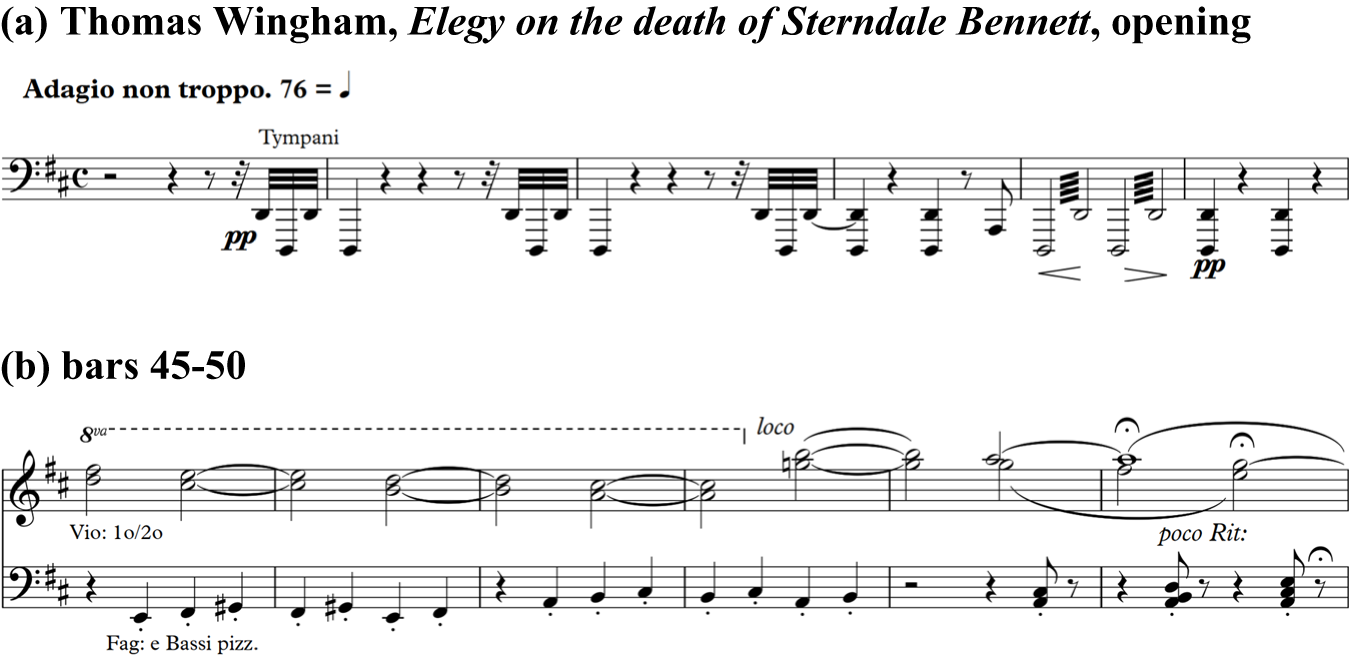
The title page of the piano reduction is striking (Figure 1) – illustrating the door of a country church (where details of the background to the work, written ‘in reverence’, and its premiere are provided), suggestive of religious consolation offered in elegies such as Milton’s Lycidas or Tennyson’s In Memoriam. The sketchy quality of the outer perspective, combined with the overgrown foliage at the door’s base, suggests a hidden, spiritual treasure. Although only 122 bars long, the Elegy incorporates some of the features of the poetic elegy highlighted by Sacks (see the structural overview in Table 1). The work begins by establishing a funereal march rhythm on the tympani (Example 1a); if its striking punctuation by silence reflects how Bennett ‘impressed upon [Wingham] the importance of the opening of a composition’,Footnote 104 the frequent interpolation of this music (at bars 29, 73, and in the coda) ensures that a sense of processional is at the heart of the Elegy, underpinned by the scalic patterns at bars 27–9 and 45–50 (in bassoons, with either cello or bass pizzicato) that augment the music’s funereal pacing (Example 1b).
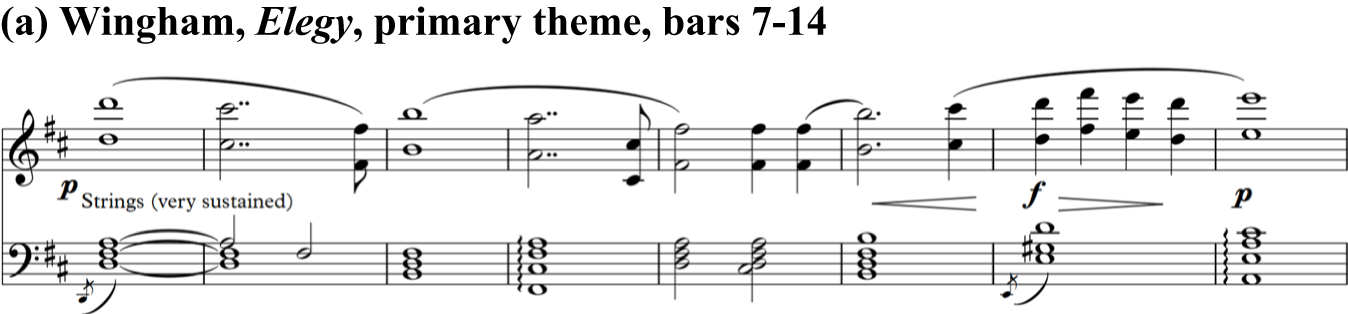
The thematic material of the A and B sections has a different function. The slow scalic progress of the primary theme (Example 2a) is increasingly dominated by repetitive sighing figures that are suitably redolent of mourning. Combined with a string tone, this almost suggests a slower-paced allusion to some of Bennett’s own musical shapes in the same key, such as the string-focused opening of The Naiades overture (Example 2b). Given that major tonalities are unusual in a musical elegy, the use of D major not only underlines this potential reference to the overture, but also strengthens the sense of consolation suggested by the title page image. Rather than solace being typically the end goal of an elegiac progress from a state of grief, therefore, in Wingham’s musical refiguring it is temporarily established from the start. However, although the reiteration of D major in Wingham’s opening paragraph seems to offer tonal reassurance (beginning with the tonic chord, and ending with a clear perfect cadence), any sense of easy consolation is subsequently undermined at the upbeat to bar 33. Here the sudden interpolation by the wind ushers in the contrasting Agitato B section that presents a division in the mourning voices,Footnote 105 as the wind semiquaver flutters are answered by the more stately octave reiterations in the horns; the dissonance of the initial wind chord – a third inversion of a B minor seventh chord – is suggestive of Sacks’s idea of questioning, particularly as it only resolves to a half-diminished seventh chord on G sharp in bar 43 that is left hanging (Example 3). Although the extended descending scalic sigh in the violins (Example 1b) offers some resolution of this local conflict, the move to a dominant pedal serves to set up a more convincing response – a return of the primary theme in the cellos in bar 51, now incorporating a violin counterpoint, suggestive of two mourning voices working in tandem; the tympani beats round off this reorchestrated A section.
Thomas Wingham, Elegy on the Death of Sir Sterndale Bennett, structural overview

Table 1 Long description
Columns list Bar, Event, and Key for a structural outline divided into Section A, Section B, Section A prime, and Section A double prime. Section A begins with bar 1, processional, Adagio non troppo, 4 4 in D, followed by bar 7, primary theme, strings in D, and bar 29, processional in D. Section B starts at bar 33 with questioning and division of mourning voices, Agitato in b moving toward another key, then bar 45, scalic processional in D with a V marking. Section A prime includes bar 51, primary theme with counterpoint in D, bar 73, processional in D, bar 77, interruptive musical memory in F, (incorporating a barcarole, Andante cantabile, 6/8). Bar 84 lists link, Moderato, 4 4 in D with a V marking. Section A double prime gives bar 92, primary theme, full orchestra, Tempo Imo in D, and bars 114 to 22, coda incorporating processional in D.
(a) Thomas Wingham, Elegy on the death of Sterndale Bennett, opening and (b) bars 45–50.

Example 1. Long description
Two excerpts of printed musical notation. Excerpt (a) shows a single staff labeled, Tympani. The staff uses a bass clef. A key signature with two sharps is shown at the start. A time signature is shown as common time. The tempo text reads, Adagio non troppo. 76 equals a quarter note. The music begins with rests, then repeated short note groups and isolated low notes. The dynamic marking, pp, appears near the start. Several measures show repeated patterns separated by bar lines. Later in the excerpt, two hairpin markings appear, one opening and one closing, placed under sustained notes. Near the end, the dynamic marking, pp, appears again. Excerpt (b) is labeled, bars 45 to 50. It shows two staves joined as a system. The upper staff uses a treble clef and the lower staff uses a bass clef. The upper staff begins with an octave marking written as, 8va, shown with a dashed line above the notes and later the text, loco, appears above the staff. The upper staff contains long held notes under curved slurs across bar lines, including a sustained note pair at the start and later sustained notes that continue into the final measures. Near the end of the upper staff, the text, poco Rit., appears. The lower staff includes short notes spaced across the measures, with several notes marked by staccato dots. Text under the lower staff includes, Vio: 1o/2o and, Fag: e Bassi pizz. In the final measures, the lower staff shows stacked note clusters and rests between them, aligned under the sustained notes in the upper staff.
Wingham, Elegy, primary theme, bars 7–14.

Example 2a. Long description
Two labeled musical excerpts. Excerpt (a) is from Wingham′s Elegy, covering bars 7 to 14. It features two staves with a treble clef and a key signature of two sharps. The dynamics range from piano to forte, with instructions for strings to be very sustained. The notation includes slurs, dotted notes and crescendos. The melody line consists of quarter notes and dotted half notes, with pitches such as E, F sharp and G. The accompaniment includes chords with pitches like D and A. Excerpt (b) is from Sterndale Bennett′s The Naiades overture, covering bars 5 to 11. It features a single staff for violins with a treble clef and a key signature of two sharps. The dynamics are marked as pianissimo with molto legato articulation. The melody includes eighth notes and quarter notes, with pitches such as A, B and C sharp. The rhythmic pattern includes ascending and descending sequences, creating a flowing melodic line. Both excerpts are clearly labeled with their respective titles and bar numbers, providing a structured layout for the musical content.
Sterndale Bennett, The Naiades overture, bars 5–11.

Example 2b. Long description
The scanned copy shows three systems of an instrumental score, each containing a treble staff above a bass staff arranged as a grand staff layout. Instrument labels visible in the image include Wind, Corn and Viol, indicating a multi-part arrangement. The tempo marking Agitato appears at the top left of the first system. A second tempo direction, a Tempo, appears at the lower right of the final system. Additional performance directions include Crescendo e accel and piu allegro, placed beneath the staves in the third system. Dynamic markings visible across the systems include fp, p, ff and mf, positioned below the relevant staves. The treble staves contain dense passages of sixteenth notes grouped in beamed runs, suggesting rapid melodic movement. Triplet groupings appear in the upper treble staff in the first system, marked with the numeral 3 above the beams. The bass staves contain sustained notes and longer rhythmic values, providing a contrasting accompaniment texture. Ties and slurs connect notes across bar lines in multiple passages. Staccato markings appear on individual notes in the treble staff passages. A crescendo hairpin spans several measures in the lower portion of the third system beneath the bass staff. Bar lines divide each system into measures throughout the score. The notation follows standard five-line Western staff convention. No lyrics are present. The key signature and time signature are not clearly legible at the resolution of the image.
Wingham, Elegy, bars 32–43, division of voices and elegiac questioning.

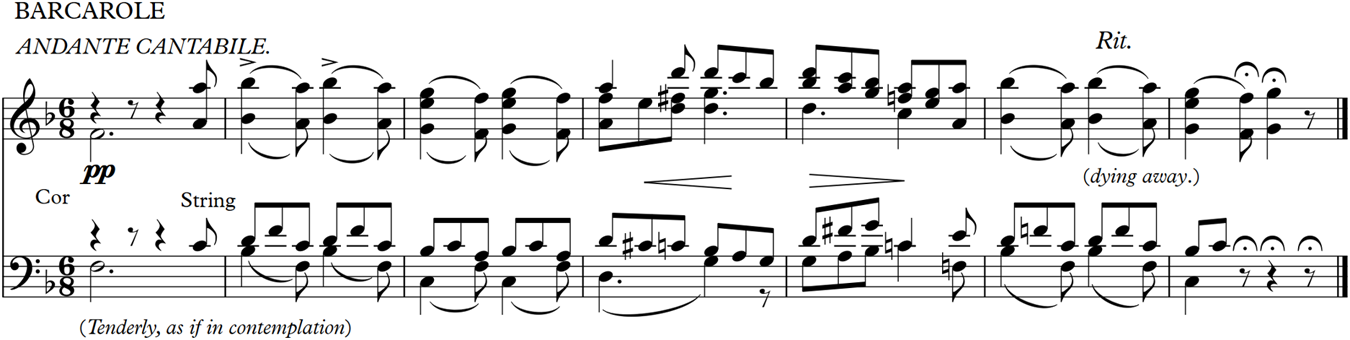
Example 3. Long description
Title text at the upper left reads, Barcarolle. A tempo marking near the top reads, Andante cantabile. The music is set on a grand staff with a treble clef staff above a bass clef staff, joined by a brace at the left. A dynamic marking, p, appears near the start of the treble staff. The first visible system shows continuous notation across the page. The treble staff begins with a beamed melody line and several slur arcs spanning groups of notes. The melody includes repeated noteheads and stepwise motion, with occasional small chord shapes where two or more noteheads are stacked vertically. Several accent like wedge marks appear above some notes in the treble staff. The bass staff begins with broken chord accompaniment patterns made of repeated beamed notes. The left hand part shows alternating low notes and higher notes within the same staff, forming an arpeggiated pattern across successive measures. Slur arcs also appear in the bass staff over some groups of notes. Text directions appear above the staves in several places. One short text marking near the middle reads, Rit. Another text marking appears later above the treble staff but is not fully legible at this resolution. Bar lines divide the music into measures. No lyrics are present.
A sudden change of mood follows, with Wingham’s seven-bar quotation from the opening of Bennett’s second-movement barcarole from his Fourth Piano Concerto Op. 19 in F minor (Example 4), a strategy commented on approvingly by critics.Footnote 106 This barcarole was one of Bennett’s most popular movements, spawning a plethora of arrangements for solo piano, piano duet, organ, violin and piano, and vocal trio and piano.Footnote 107 For The Musical World it ‘[appeared] to soothe and console; it is as balm to the wound, as fresh water to the burning thirst’, and the Morning Post described a ‘movement … of such exquisite melodious loveliness that it can have been nothing else than an inspiration’.Footnote 108 The quotation’s appearance in its original key of F major (also adopting its original orchestration) creates an arresting tonal contrast in the context of the Elegy’s D major;Footnote 109 its impact is heightened by the performance direction ‘Tenderly, as if in contemplation’ and the thematic disintegration and pauses in the seventh bar (‘dying away’) that create the impression of a fading musical memory. Eight bars of a dominant pedal Moderato subsequently re-establish the 4/4 metre, and after a con passione replaying of the primary theme by the full orchestra, the descending scale in the bass line and final tympani funeral rhythms bring the work to a close.
Wingham, Elegy, bars 77–83, musical memory of Bennett’s barcarole.

Despite the initial lacklustre responses to the Elegy, it was reassessed in Wingham’s obituary as ‘containing some of his most earnest and beautiful musical ideas’.Footnote 110 He also went on to compose another elegiac work – his sixth concert overture (also in D major), Mors Janua Vitae; written in memory of his father, this was premiered in Leeds on 15 October 1880, and described as a ‘clever piece of orchestral writing’.Footnote 111 More poignantly, Stanford’s Mass in G, Op. 46 (1892), commissioned by and dedicated to Wingham ‘in sincere regard’, attained the status of a musical memorial to its dedicatee at the Brompton Oratory premiere, just two months after Wingham’s death.Footnote 112
Macfarren’s Idyll in Memory of Sterndale Bennett
Wingham’s Elegy was not the only musical tribute to Bennett.Footnote 113 George Macfarren (1813–1887) has already been highlighted as Bennett’s successor as Principal of the RAM and Professor of Music at Cambridge, one of Bennett’s pall-bearers, and one of those who petitioned the Dean of Westminster to allow a Westminster Abbey burial. He had a close relationship with Bennett. As students at the Academy (Bennett entered in 1826, Macfarren in 1829) they collaborated on the first movement of a Concerto for Two Pianos in C,Footnote 114 they later became colleagues at the same institution, and Macfarren wrote the Preface to Bennett’s 1862 edition of J. S. Bach’s St Matthew Passion; along with his brother Walter he was a member of Bennett’s Testimonial Committee in 1872, helping to inaugurate the Academy’s Sterndale Bennett Scholarship and ‘an annual prize to a female student of the institution’.Footnote 115 Macfarren’s RAM addresses also made frequent reference to Bennett, whether in relation to his symphonic legacy alongside Spohr, Mendelssohn and Schumann, or the impact of his funeral; Bennett’s tombstone was ‘a memorial upon which we will not drop tears of regret, but of heartfelt thanks for the love he engendered, the good he did, and for the emulation he inspired’.Footnote 116 Like Wingham, therefore, Macfarren was an ideal candidate to memorialize Bennett via a musical composition – hence the commission from the Philharmonic Society.Footnote 117
Macfarren’s Idyll was premiered at the end of the first half of a Philharmonic Society concert on 5 July 1875 that included Haydn’s Symphony No. 99 in E flat, Vieuxtemps’s Fifth Violin Concerto in A minor with Henryk Wieniawski as soloist, and extracts from Fidelio and Euryanthe (with Beethoven’s Fifth Symphony, Schumann lieder and Weber’s Jubilee Overture in the second half).Footnote 118 The choice of title is striking. In drawing on Theocritean poetic models that were associated with the simplicity of rural life and the ‘foreground[ing] of “ordinary” people’, the Victorian idyll has often been undervalued as being ‘excessively and falsely sweet, something incapable of giving a trenchant account of modern experience’.Footnote 119 However, as Thomas Hughes and Emma Merkling argue, despite surface ‘experiences of calm and pleasure’, the idyll had the capacity to contain ‘ambivalent and frequently unresolved undercurrents relating to contestations over gender and sexuality, temporality, the urban, and the colonial’, creating ‘a consciousness that it [the idyll] is never a perfect escape from a social reality’.Footnote 120 Hence the way that ‘small and enclosed spaces are precariously braced against a vast edgeless openness’ in Tennyson’s poem ‘Enoch Arden’ (1864), or how John Millais’s painting An Idyll: 1745 (1884) contains an ‘uncomfortable … juxtaposition’ of three lower-class Scottish girls and two English soldiers.Footnote 121 Macfarren’s musical refiguring of the idyll might simply have been an invocation of the heroic associations of Tennyson’s Arthurian Idylls of the King, given the music’s lack of overt connection with Arcadian pastoral.Footnote 122 However, we might use Kate Flint’s identification of ‘time suspended’ as an important feature of the idyllic mode – and particularly her suggestion that this encourages ‘a reflective attentiveness’ – to understand the idea behind Macfarren’s Idyll.Footnote 123 As Henry Banister noted (mirrored in accounts in the Monthly Musical Record and Sunday Times), Macfarren’s programme note explained that the composition contained ‘the points in [Bennett’s] character and career that have been foremost in the recollection of his friend’, akin to an obituary:
[Bennett’s] inborn genius; his early orphanhood; the expansion of his powers under kindly nurture; his entry on the active life of the metropolis; his transplantation to a foreign land, where the musical uses and the social surroundings were a new soil and climate for the cultivation of his artistry; the ripening of his strength under these influences; his scholastic offices in England, with their duties; the resumed exercise of his productive ability; his later visit to Germany, when some of his artist friends were no more; his gently falling into the everlasting sleep; the triumphant homage to his manes, when the heart of England beat with pride in her honoured son; the feeling of the mourners that himself was present among them, when his own strain was sung; and the glorification of art in men’s acknowledgement of her representation.Footnote 124
In distilling Bennett’s 58 years into a relatively short musical work, Macfarren’s musical obituary certainly recalibrates temporality (if not necessarily ‘suspending’ it), and obviously offers listeners the opportunity for the ‘reflective attentiveness’ as part of the idyllic mode. And despite the primarily positive, consolatory and idealized nature of the paratext,Footnote 125 there are moments of personal crisis or deflection (‘his early orphanhood’; ‘his scholastic offices’) that undercut this mood – paralleling the tension-ridden undercurrents of literary and pictorial models of the idyll.Footnote 126
The structure of Macfarren’s Idyll (see Table 2) can be understood broadly as a sonata design – an expository space outlining a move from B flat major to D major, a central episode in G minor, a recapitulatory space where some of the expository material returns primarily in the tonic, and, after an interruptive passage in E flat major, a closing tonic coda. However, in attempting to represent the challenging paratext, Macfarren’s Idyll relied on the symbolic use of theme and tonality, and the replaying of selected materials, as well as musical quotation.Footnote 127 The tonal deflections from B flat major (the same key as Macfarren’s own Sixth Symphony) are significant: the ‘foreign’ tonal region of D major reflects the ‘new soil and climate’ of Bennett’s studies abroad, and G minor symbolizes both his orphanhood and death as well as his ‘scholastic offices’ – although The Examiner could not see ‘what inspirations the heaven-born muse can have derived from the miserable and in this particular case self-chosen drudgery which moreover proved fatal to the late composer’s creative power’.Footnote 128 The tonal deflection to E flat major in the recapitulatory space is particularly striking, given that this is combined with a change of metre at bar 291 with a quotation from Bennett’s ‘God is a Spirit’ in its original key (Example 5) – one of the ‘strains’ that ‘was sung’ at Bennett’s funeral, reliving the feeling that Bennett was among the mourners. Macfarren uses muted strings to suggest a musical memory of the solo vocal quartet, but rather than Wingham’s thematic disintegration, he extends the thirteenth bar of Bennett’s original music and provides a three-bar link to prepare for the coda.
George Macfarren, Idyll in Memory of Sterndale Bennett, simplified structure

Table 2 Long description
Columns list Bar, Event, and Key for a sequence of musical events. Expository Space begins with an unlabeled bar row for Expository Space, then bar 1, Bennett’s inborn genius in B flat; bar 16, narrative interruption, his early orphanhood in g; bar 21, inborn genius continues in B flat; bar 25, the expansion of his powers in B flat; bar 32, his entry on the active life of the metropolis in B flat to D; bar 57, a new soil and climate in D; and bar 97, the ripening of his strength with inborn genius replayed in D. Central Episode has bar 122, his scholastic offices in g. Recapitulatory Space includes bar 185, the resumed exercise of his productive ability replaying inborn genius and his entry on the active life of the metropolis in B flat to E flat to g; bar 226, his gently falling into the everlasting sleep replaying a new soil and climate in g to B flat; bar 260, Bennett’s death replaying his early orphanhood in g; bar 269, the triumphant homage to his manes replaying inborn genius in B flat to E flat; and bar 291, interruptive musical memory of mourners feelings when his own strain was sung, Andante in three four in E flat. Coda lists bars 307 to 316, the glorification of art, Maestoso in four four in B flat.
George Macfarren, Idyll in Memory of Sterndale Bennett, bars 291–294, quotation of ‘God is a Spirit’.

Macfarren, Idyll, thematic repurposing of the opening theme.

Example 6. Long description
A composite page of four separate sheet music excerpts labeled (a), (b), (c) and (d), each printed with a bar range and a quoted phrase above the notation. (a) The heading reads, bars 1 to 8, followed by the quoted phrase, inborn genius. A tempo marking reads, Allegro tranquillo. One system is shown with multiple staves. The left margin shows instrument abbreviations including, fl, ob and cl and a separate staff marked, vln. The opening shows stacked noteheads forming chords on the upper staff, followed by repeated chord attacks separated by barlines. Curved slur markings appear over groups of notes. A dynamic marking, pp, appears near the start. The violin staff shows a short passage with noteheads spaced across several measures. (b) The heading reads, bars 97 to 100, followed by the quoted phrase, the ripening of his strength. Three staves are shown as a grouped system. The top staff is labeled, vlns and shows long sustained notes with curved ties or slurs spanning across measures, with occasional chordal note stacks. The middle staff is labeled, wind and shows repeated vertical stacks of notes aligned with the top staff, plus a continuous moving line of shorter notes underneath. Triplet brackets with the number 3 appear repeatedly under the moving notes, grouped in even patterns across the measures. The bottom staff shows low-register notation with repeated triplet groupings marked by 3, aligned under the middle staff figures. Instrument abbreviations at the left include, vla, hn, vc and db. A dynamic marking, ff, appears near the left of the system. (c) The heading reads, bars 185 to 188, followed by the quoted phrase, the resumed exercise of his productive ability. Two staves are shown. The upper staff has instrument abbreviations at the left including, cl and vln 1. The notation shows a sequence of repeated rhythmic figures with alternating noteheads, with curved slurs spanning pairs and short groups of notes. Several notes are tied or slurred across barlines. A dynamic marking, p, appears near the left. The lower staff shows a slower-moving bass line with separated note attacks under the upper staff, with instrument abbreviations including, bn and hn. (d) The heading reads, bars 269 to 272, followed by the quoted phrase, the triumphant homage to his manes. Two staves are shown. The upper staff has multiple instrument abbreviations at the left including, vln, fl, ob and tbns and shows repeated vertical stacks of notes forming thick chords, aligned in regular rhythmic placements across the measures. A passage includes triplet brackets marked 3 under a short run of notes and an octave marking appears as 8va with a dashed line extending to the right. The lower staff shows a repeating bass pattern of shorter notes grouped into measures, with a long dashed bracketed marking spanning part of the line. Additional instrument abbreviations appear at the left including, vla, vc, db, bn and cl. Near the right side, a small text note reads, etc.
Macfarren, Idyll, additional thematic materials.

Example 7. Long description
The heading, bars 16 to 20, followed by the text, his early orphanhood. Two staves are shown as a short system with a treble staff above and a bass staff below. Instrument cues at the left include, str., bn. The passage shows mostly single notes and some stacked notes, with long slur arcs spanning groups of notes. A dynamic marking, f, appears near the start and the text, cresc., appears under the upper staff. Near the end, the marking, ffp, appears. The heading, bars 25 to 26, followed by the text, the expansion of his powers. Two staves are shown as a short system with a treble staff above and a bass staff below. Instrument cues at the left include, vln 1, bns, hns. A dynamic marking, pp, appears near the left. The upper staff contains a run of closely spaced notes under a long slur that stretches across much of the excerpt. The lower staff shows long sustained notes tied across the barline. At the right, several stacked chords appear in the upper staff, with short vertical alignment to notes in the lower staff. The heading, bars 32 to 34, followed by the text, his entry on the active life of the metropolis. Two staves are shown as a short system with a treble staff above and a bass staff below. A dynamic marking, ff, appears near the left. The upper staff alternates between short beamed note groups and chordal figures, with repeated slur arcs over the beamed groups. The lower staff shows repeated broken chord patterns with multiple notes in quick succession, aligned under the upper staff. Midway through the excerpt, the upper staff shows repeated accented chord clusters, followed by a return to beamed notes. The heading, bars 57 to 60, followed by the text, a new soil and climate. Two staves are shown as a short system with a treble staff above and a bass staff below. Instrument cues at the left include, vc, hn, ob, vla, bn and the text, db pizz. A dynamic marking, p, appears with the text, dolce. The upper staff shows a sustained note at the start followed by separated notes under slur arcs. The lower staff shows spaced notes and rests, with the pizz marking associated with the bass cue. Near the right, the upper staff shows stacked chords under a slur and the text, etc., appears in brackets. The heading, bars 122 to 125, followed by the text, his scholastic offices. Two staves are shown as a short system with a treble staff above and a bass staff below. Instrument cue at the left includes, str. A dynamic marking, ff, appears near the left. The upper staff shows repeated notes and short slurred figures, including a beamed triplet marked with the number, 3. The lower staff shows repeated chordal notes aligned with the upper staff rhythm. Near the right, a dynamic marking, sf, appears and the text, etc., appears in brackets. The heading, bars 307 to 309, followed by the text, the glorification of art. The tempo text, Maestoso., appears above the system. Two staves are shown as a short system with a treble staff above and a bass staff below. Instrument cues include, tpts and, vlns. A dynamic marking, ff, appears near the left. The opening shows stacked chords, followed by a long slur spanning a rising and falling line of beamed notes in the upper staff. The lower staff shows sustained notes and rests under the upper staff. The text, etc., appears in brackets near the right.
The thematic connections and representations are also thoughtfully conceived. The opening theme in B flat major (Bennett’s ‘inborn genius’), for example, returns several times in a modified form (see Example 6) to represent the ‘ripening of his strength’ under D major foreign influences at the end of the expository space, and, in the tonic in the recapitulatory space, his ‘resumed … productive ability’ (prefacing his re-admission to the ‘life of the metropolis’) and the ‘triumphant homage to his manes’ after his death. Of the remaining thematic materials (Example 7), the reuse of Bennett’s ‘early orphanhood’ at bar 260 to mark his own demise highlights the death trope effectively, and the incorporation of the ‘new soil and climate’ material to represent Bennett’s descent into ‘everlasting sleep’ marks his progression towards an ‘other’ world. If the sense of growth from bar 25 (‘the expansion of his powers’) creates a suitable preparation for Bennett’s ‘entry on the active life of the metropolis’, and the four-square repetitions of the ‘scholastic offices’ are effective in suggesting the weariness of Bennett’s administrative burdens, the final B flat Maestoso (bar 307) offers a clear representation of the ‘glorification of art’ with which the work ends. The only unresolved issue is the place of ‘his later visit to Germany, when some of his artist friends were no more’ in the design; although this could relate to bars 216–25, this material simply replays bars 47–56 in a transposed form – precluding any firm conclusions concerning its musical representation in contrast to the clear connections between musical text and paratext elsewhere in the work.
Macfarren’s musical tribute was received more positively in general than Wingham’s. Highlighting its ‘artistic worth’, critics noted the ‘triumphant’ reception of a work ‘not lacking in the tenderness and pathos requisite for the illustration of such a subject’ with a ‘treatment of the theme … as completely individual as it is artistic’, ‘replete with genuine feeling’, and ‘remarkable for the brightness and clearness of its orchestration’; the Sunday Times was relieved that it was not repeated, however, as this would have transported the audience ‘painfully close’ to Bennett’s funeral – ‘a most painful though glorious occasion’.Footnote 129 As with Wingham’s Elegy, it was the use of musical quotation that was highlighted – whether the way that ‘God is a Spirit’ was ‘brought in, almost as a whisper, by the instruments’, or in paralleling Wingham’s general strategy.Footnote 130 However, there was some comment on the nature of the musical representation. The Monthly Musical Record suggested that ‘defined as a short and highly-wrought descriptive poem’, ‘Idyll’ explained the connection between the musical text and its paratext, although the designation of ‘symphonic poem’ might have been more appropriate.Footnote 131 The Musical Standard agreed with this suggestion, but despite the ‘key of B flat’ being suitable as ‘the tonality of distance’ and the effective ‘plaintive utterances’ of the oboe, found the complex design and programme problematic:
The Idyll might be called a ‘Symphonic Poem’; it is splendidly scored; but how express in musical tones … the Professor’s ‘later visit to Germany?’ Perhaps, however, Mr. Macfarren intends to depict the episode by the deep note of the bassoon! The only idea conveyed to our mind by this rather vague rhapsody is an active and energetic life.Footnote 132
The Sunday Times (who had missed the reference to the ‘later visit to Germany’ in their report) appreciated the clarity of the distinctive paratext associated with Macfarren’s compositional tribute, however; it was ‘not often that a tone-poet gives such an index of his intention as this’, having the ‘manifest advantages’ of ‘preventing gratuitous supposition’ as well as ‘afford[ing] a clue to the animus of the work’.Footnote 133
Conclusion
Although the scale of Bennett’s funeral, the detailed nature of the reportage and wider responses to his death can therefore be explained in part by developing models and conventions of public mourning during the Victorian period, combined with his significant institutional reach and international networks, aspects of his commemoration (whether the sheer number of funeral carriages in his cortège, or the nature and scope of the memorial concerts) were clearly exceptional – especially when compared to contemporary British composers. Particularly striking is the plethora of elegiac poetry for Bennett – a feature of his memorialization apparently unmatched by British responses to both native and international composers of the period, and reflective of the esteem in which he was held (despite some dissenting views in his obituaries). In this context, the orchestral sonorities of Wingham’s and Macfarren’s musical memorials (rare examples of highlighting a deceased composer overtly in their titles) conveyed effectively a suitable sense of the significance of Bennett’s passing. Wingham’s attempt can be reassessed as a musical refiguring of the conventions of the poetic elegy, incorporating the strategies of processional, repetition, elegiac questioning and the division of mourning voices. Whilst the more ambitious sonata-based musico-rhetorical design of Macfarren’s Idyll encouraged the ‘reflective attentiveness’ of the idyllic mode,Footnote 134 its representation of selected details of Bennett’s life and career demonstrates how the model of the literary obituary (rather than Wingham’s poetic stimulus) might be refigured in a musical context. If the potential for the reworking of different literary models as part of an elegiac mode might be explored more widely in nineteenth-century musical repertoire, so might the idea of an elegiac intertextuality. Wingham’s quotation of Bennett’s barcarole was not only fitting as a mirroring of the elegiac tradition of referencing the works of a deceased artist, but its disintegrating texture (a fading memory not only of Bennett’s composition, but perhaps also of his performances, given his associations with the work in the concert hall from the late 1830s to the early 1850s) also represented a striking metaphor for the composer’s death.Footnote 135 Macfarren’s Idyll also explored musical memory – this time invoking the ubiquitous ‘God is a Spirit’ that featured in all of Bennett’s memorial concerts, and which was one of the most moving features of the funeral service itself. Ultimately, Wingham’s Elegy and Macfarren’s Idyll can be understood not only as personal commemorations by former pupils and friends. More widely, they can be seen in the complex, multi-layered context of attempts to memorialize Bennett via concert events, artistic objects (sculpture, memorial tablets, paintings), educational and financial legacies, journalistic, poetic and musical texts that characterized meaningful commemorative strategies as part of the processes of public mourning in Victorian Britain.
Michael Allis is Professor of Musicology at the University of Leeds. As well as his recent books on the music critic Herbert Thompson (2024) and the symphonic poem in Britain (2020), co-edited with Paul Watt, his publications have included studies of British music in the long nineteenth century, connections between music and literature (whether Holbrooke and Poe, William Wallace and Rossetti, music-related travel writing, or the representation of Peter Warlock in Robertson Davies’ novels), Granville Bantock’s letters, Aldous Huxley’s music criticism, Wagner and tempo, Liszt reception, and editions of Parry’s chamber music. His book Granville Bantock and the Orchestral Refiguring of Literature has just been published by The Boydell Press.








 Open access

