Introduction
Major depressive disorder (MDD) and generalized anxiety disorder (GAD) are prevalent and debilitating (Kessler et al. Reference Kessler, Chiu, Demler, Merikangas and Walters2005; Wittchen et al. Reference Wittchen, Jacobi, Rehm, Gustavsson, Svensson, Jonsson, Olesen, Allgulander, Alonso, Faravelli, Fratiglioni, Jennum, Lieb, Maercker, van Os, Preisig, Salvador-Carulla, Simon and Steinhausen2011). The conditions are strongly connected, as their symptoms frequently co-occur and show strong overlap (American Psychiatric Association, 1994; Cramer et al. Reference Cramer, Waldorp, van der Maas and Borsboom2010). Consequently, co-morbidity rates between the disorders have been reported to be as high as 40–60% (Hettema, Reference Hettema2008).
Previous studies have shown that MDD and GAD are associated with higher levels of somatic symptomatology (Henningsen et al. Reference Henningsen, Zimmermann and Sattel2003; Haug et al. Reference Haug, Mykletun and Dahl2004; Rosmalen et al. Reference Rosmalen, Tak and de Jonge2011; Bekhuis et al. Reference Bekhuis, Boschloo, Rosmalen and Schoevers2015). A study of our own group, for example, demonstrated that patients with MDD or GAD have a 1.5–3 times higher risk of suffering from certain clusters of somatic symptoms than persons without those disorders (Bekhuis et al. Reference Bekhuis, Boschloo, Rosmalen and Schoevers2015). However, as these studies have mainly used instruments based on diagnoses or scale scores, it is unclear whether individual MDD/GAD and somatic symptoms contribute equally to this association. It could be that only specific symptoms of MDD/GAD are related to somatic symptoms and vice versa. Such symptoms are called bridging symptoms (Borsboom & Cramer, Reference Borsboom and Cramer2013) and they may be a valuable focus for future research in order to disentangle the general co-occurrence of MDD/GAD with somatic symptomatology. In addition, targeting treatment to bridging symptoms may help to improve the outcomes of MDD/GAD patients with somatic symptoms.
MDD/GAD symptoms are often classified into symptoms that are physical in nature (i.e. neurovegetative symptoms such as fatigue and insomnia) and symptoms that refer to cognition or mood (i.e. cognitive/affective symptoms such as depressed mood or anxiety). Neurovegetative symptoms are well known to be associated with somatic symptomatology as these types of symptoms can be the result of the same somatic diseases or physical dysregulations (e.g. heart failure can cause fatigue as well as shortness of breath). In addition, neurovegetative symptoms show strong reciprocal relations with somatic symptoms (e.g. insomnia can cause headache and vice versa) (Uhlig et al. Reference Uhlig, Engstrom, Odegard, Hagen and Sand2014). Cognitive/affective symptoms, however, are more strongly related to mental processes (Lux & Kendler, Reference Lux and Kendler2010) and, consequently, could show only weak connections to somatic symptomatology (Wesley et al. Reference Wesley, Gatchel, Polatin, Kinney and Mayer1991). Despite these general patterns, individual symptoms of MDD/GAD as well as individual somatic symptoms may also be differentially related with one another. Of neurovegetative MDD/GAD symptoms, for example, psychomotor agitation may be associated with somatic symptoms such as palpitations and excessive perspiration, whereas hypersomnia may not be connected to any somatic symptom.
The network approach is a conceptualization of psychopathology and related conditions that concentrates on individual symptoms and their associations (Borsboom & Cramer, Reference Borsboom and Cramer2013). In this approach, symptoms are represented as nodes and the associations between them as edges. Symptoms of multiple diagnoses or domains can be combined into one network structure, which, consequently, offers the opportunity to study the patterns in which these symptoms co-occur (Cramer et al. Reference Cramer, Waldorp, van der Maas and Borsboom2010). In a recent study, for example, Boschloo et al. (Reference Boschloo, Schoevers, van Borkulo, Borsboom and Oldehinkel2016a ) presented the network structure of emotional and behavioural symptoms in preadolescents and revealed that depressive, anxiety and somatic symptoms were related via a complex constellation of connections. While specific depressive and anxiety symptoms were strongly associated with somatic symptoms, others showed no connections at all, and individual somatic symptoms showed similarly differential associations. Although Boschloo et al. (Reference Boschloo, Schoevers, van Borkulo, Borsboom and Oldehinkel2016a ) did not include Diagnostic and Statistical Manual of Mental Disorders (DSM) symptoms of MDD/GAD and the number of somatic symptoms was limited, their findings indicate that combining MDD/GAD and somatic symptoms in a network structure could help to identify the bridging symptoms in their co-occurrence.
This study aims to examine the relationships between individual MDD/GAD symptoms and somatic symptoms in a large sample (n = 2704) using the network approach. First, we explore the general structure of the network. Then, we specifically focus on associations between individual MDD/GAD symptoms and somatic symptoms. It is hypothesized that neurovegetative symptoms are more strongly interconnected with somatic symptoms than cognitive/affective symptoms. However, associations between the MDD/GAD and somatic symptom domain may differ across individual symptoms.
Method
Sample
Data were derived from the baseline assessment of the Netherlands Study of Depression and Anxiety (NESDA), an ongoing cohort study aimed at examining the long-term course and consequences of depressive and anxiety disorders in adults (18–65 years). A total of 2981 participants were included for the baseline assessment in 2004–2007, consisting of 652 (22%) healthy controls with no lifetime depressive and/or anxiety disorder, 1411 (47%) participants with a past-month diagnosis of a depressive and/or anxiety disorder and 918 (31%) participants with a prior history of a depressive and/or anxiety disorder [diagnoses were established with the Composite International Diagnostic Interview (CIDI) version 2.1; Wittchen et al. Reference Wittchen, Robins, Cottler, Sartorius, Burke and Regier1991]. Recruitment took place in the community (19%), primary care (54%) and specialized mental health care (27%). Community-based participants had previously been identified in a population-based study, and primary care participants were identified through a three-stage screening procedure (involving the Kessler 10 scale; Kessler et al. Reference Kessler, Andrews, Colpe, Hiripi, Mroczek, Normand, Walters and Zaslavsky2002; and the short-form CIDI by telephone) conducted among a random sample of consulting patients of 65 general practitioners. Mental health care participants were recruited consecutively when newly enrolled at one of the 17 participating mental health organization locations. Persons with insufficient command of the Dutch language or a primary clinical diagnosis of psychotic disorder, obsessive–compulsive disorder, bipolar disorder or severe substance use disorder were excluded. The research protocol was approved by the ethical committee of the three participating universities and all participants gave written informed consent. A detailed description of the NESDA study design can be found elsewhere (Penninx et al. Reference Penninx, Beekman, Smit, Zitman, Nolen, Spinhoven, Cuijpers, De Jong, Van Marwijk, Assendelft, Van Der Meer, Verhaak, Wensing, De Graaf, Hoogendijk, Ormel and Van Dyck2008).
For the present study, participants with any missing data on MDD/GAD or somatic symptoms (n = 277, 9.3%) were excluded, resulting in a total sample of 2704 persons. Participants with complete data were younger [41.7 (s.d. = 13.1) v. 43.5 (s.d. = 12.6) years, p = 0.03], received education for a longer period [12.2 (s.d. = 3.2) v. 11.5 (s.d. = 3.5) years of education, p = 0.001] and were less likely to have past-month MDD (25.8% v. 37.9%, p < 0.001) or GAD (12.7% v. 19.1%, p = 0.004), but did not differ with respect to gender (66.1% v. 69.3% female, p = 0.29) from participants with missing data.
DSM, fourth edition (DSM-IV) symptoms of MDD/GAD
The frequency/severity of 14 DSM-IV MDD and/or GAD symptoms (American Psychiatric Association, 1994) during the past week was assessed with the Inventory of Depressive Symptomatology self-report version (IDS-SR30; Rush et al. Reference Rush, Giles, Schlesser, Fulton, Weissenburger and Burns1986, Reference Rush, Gullion, Basco, Jarrett and Trivedi1996). As in prior studies (van Borkulo et al. Reference van Borkulo, Boschloo, Borsboom, Penninx, Waldorp and Schoevers2015; Boschloo et al. Reference Boschloo, van Borkulo, Borsboom and Schoevers2016b ; Fried et al. Reference Fried, Epskamp, Nesse, Tuerlinckx and Borsboom2016), the criteria weight/appetite change, sleep change and psychomotor change were disaggregated in an increase (i.e. weight/appetite increase, hypersomnia and psychomotor agitation) or decrease (i.e. weight/appetite decrease, insomnia, psychomotor retardation). In addition, the symptoms loss of interest/pleasure, weight/appetite increase, weight/appetite decrease and insomnia were composed from multiple items (Boschloo et al. Reference Boschloo, van Borkulo, Borsboom and Schoevers2016b ; Fried et al. Reference Fried, Epskamp, Nesse, Tuerlinckx and Borsboom2016). Based on dimensions identified in previous studies (Wardenaar et al. Reference Wardenaar, van Veen, Giltay, den Hollander-Gijsman, Penninx and Zitman2010; Duivis et al. Reference Duivis, Vogelzangs, Kupper, de Jonge and Penninx2013), all symptoms were classified as either neurovegetative (i.e. physical in nature) or cognitive/affective (i.e. mental in nature). An overview of all neurovegetative and cognitive/affective symptoms and their corresponding IDS items is included in online Supplementary Table S1.
Symptoms were scored from 0 (absent) to 3 (frequent and/or severe) based on clearly stated anchors. However, the assumption of normality, which network estimation techniques for polytomous items (e.g. those based on partial correlations) rely on, was not satisfied in our data. Therefore, we dichotomized item-scores into either absent (score 0) or present (scores 1–3) and used a network estimation technique for binary data. The symptoms composed from multiple items were considered present when at least one of these symptoms was scored with ⩾1.
Somatic symptoms
The frequency of 16 somatic symptoms (e.g. cardiopulmonary, musculoskeletal and gastrointestinal symptoms) during the past week was scored from 1 (never) to 5 (often) with the somatization scale of the Four-Dimensional Symptom Questionnaire (4DSQ; Terluin et al. Reference Terluin, van Marwijk, Ader, de Vet, Penninx, Hermens, van Boeijen, van Balkom, van der Klink and Stalman2006). Similar to the MDD/GAD items, the somatic items were recoded as absent (score of 1) or present (scores 2–5) as they were not normally distributed.
Statistical analysis
Main analyses
To estimate the network structure of the binary MDD/GAD and somatic symptoms, eLasso (available as the package ‘IsingFit’ in R; van Borkulo et al. Reference van Borkulo, Borsboom, Epskamp, Blanken, Boschloo, Schoevers and Waldorp2014) was used. eLasso uses l1-regularized logistic regression to identify associations between symptoms, adjusted for all other symptoms in the network. In this procedure, logistic regression analyses are performed to determine associations between items and, then, an l1-penalty is imposed on the regression coefficients to identify models with an optimal balance between parsimony and goodness of fit (Tibshirani, Reference Tibshirani1996). To find the best-fitting model, the extended Bayesian information criterion is used to assess goodness of fit (Chen & Chen, Reference Chen and Chen2008). As a result, eLasso identifies an accurate estimate of the network structure while it avoids multiple testing problems that would arise with significance testing in networks with many nodes (van Borkulo et al. Reference van Borkulo, Borsboom, Epskamp, Blanken, Boschloo, Schoevers and Waldorp2014).
Based on the estimated symptom associations, a weighted, undirected graph was visualized using the package ‘qgraph’ (Epskamp et al. Reference Epskamp, Cramer, Waldorp, Schmittmann and Borsboom2012) in R. In a network structure, nodes (circles) represent symptoms and edges (lines) represent associations between symptoms. Solid edges indicate positive associations and dotted edges represent negative associations (online: green edges indicate positive associations and red edges represent negative associations). The thickness of lines indicates the connection weight estimated by eLasso. The layout of the graph was based on the Fruchterman–Reingold algorithm, which iteratively computed the optimal layout; symptoms with stronger and/or more connections were placed closer to each other (Fruchterman & Reingold, Reference Fruchterman and Reingold1991).
First, we explored the general structure of the network. To examine the general connectivity of the network, the density of the network was calculated by determining the proportion of actual connections over the number of potential connections between all symptoms (Kolaczyk, Reference Kolaczyk2009). Subsequently, we focused on associations connecting the MDD/GAD symptom domain with the somatic symptom domain. To examine the strength of all connections from an individual symptom to all symptoms of the opposite symptom domain (i.e. for an MDD/GAD symptom, all connections to the somatic symptom domain and vice versa), the weights of these connections were summed for all symptoms (Barrat et al. Reference Barrat, Barthelemy, Pastor-Satorras and Vespignani2004). In addition, we examined whether neurovegetative and cognitive/affective MDD/GAD symptoms differed with respect to their connectivity to the somatic domain by calculating their mean summed weight of associations to the somatic domain. To test whether these means differed significantly, we used a permutation test described in Fried et al. (Reference Fried, Epskamp, Nesse, Tuerlinckx and Borsboom2016) that compares the observed difference with a distribution of possible differences between the groups of symptoms. To create this distribution, MDD/GAD symptoms were assigned randomly to two groups 100 000 times, and each time the groups were compared by calculating the difference in their mean strength of associations to the somatic domain. If the observed difference between neurovegetative and cognitive/affective symptoms was within the 2.5% on either side of this distribution (i.e. p ⩽ 0.05), it was considered significant.
Sensitivity analyses
For our main analyses, we had dichotomized all items as the assumption of normality was not satisfied in our data. This, however, naturally results in a loss of information on the frequency and/or severity of symptoms. We examined whether dichotomization had influenced our conclusions by estimating the network structure of the non-dichotomized MDD/GAD and somatic symptoms with partial correlations using qgraph (Epskamp et al. Reference Epskamp, Cramer, Waldorp, Schmittmann and Borsboom2012). Similar to eLasso (for the dichotomized symptoms), an l1-penalty (Tibshirani, Reference Tibshirani1996) and the extended Bayesian information criterion (Chen & Chen, Reference Chen and Chen2008) were used.
Results
Sample characteristics
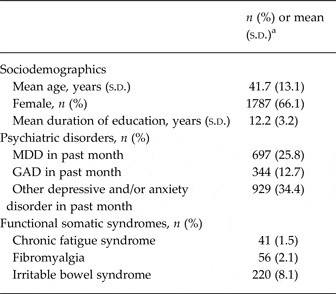
The mean age of the sample was 41.7 (s.d. = 13.1) years, 66.1% of participants were women, and participants received education for an average period of 12.2 (s.d. = 3.2) years (see Table 1). Online Supplementary Table S2 shows that prevalence rates of MDD/GAD symptoms varied from 26.7% (psychomotor retardation) to 79.5% (insomnia), while rates for somatic symptoms ranged between 3.3% (fainting) and 64.8% (muscle pain).
Sample characteristics (n = 2704)

s.d., Standard deviation; MDD, major depressive disorder; GAD, generalized anxiety disorder.
a Based on descriptive statistics.
General network structure of MDD/GAD and somatic symptoms
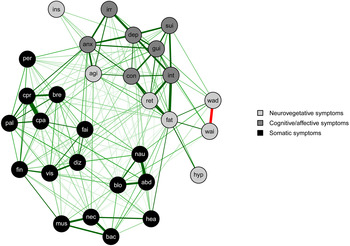
The estimated network structure of MDD/GAD and somatic symptoms is presented in Fig. 1 (for connection weights, see online Supplementary Table S3). All symptoms were directly or indirectly associated and the network had a high density (i.e. 44.1% of potential connections were observed in the network), indicating that the symptoms were highly connected. All connections were positive, except for the association between weight/appetite increase (wai) and weight/appetite decrease (wad). Symptoms tended to form two clusters of highly connected MDD/GAD symptoms (the grey symptoms, Fig. 1) and somatic symptoms (the black symptoms, Fig. 1). In the MDD/GAD domain, neurovegetative and cognitive/affective symptoms were strongly interconnected, although the neurovegetative symptoms referring to weight/appetite change and sleep change had more peripheral positions. Between the MDD/GAD domain and somatic domain, numerous associations were observed.
Network structure of neurovegetative and cognitive/affective symptoms of major depressive disorder/generalized anxiety disorder and somatic symptoms. Symptoms are represented by nodes (shading refers to type of symptom) and their associations by edges (lines) (solid line = positive association, dotted line = negative association; online: green = positive association, red = negative association). Thicker edges represent stronger associations. ins, Insomnia; irr, irritable; anx, anxiety; dep, depressed mood; sui, suicidality; gui, guilt/worthlessness; agi, psychomotor agitation; con, concentration problems; int, loss of interest/pleasure; ret, psychomotor retardation; fat, fatigue; wad, weight/appetite decrease; wai, weight/appetite increase; hyp, hypersomnia; per, excessive perspiration; cpr, pressure/tight feeling in chest; bre, shortness of breath; pal, palpitations; cpa, chest pain; fai, fainting; diz, dizziness/feeling lightheaded; vis, blurred vision/spots in front of eyes; fin, tingling in fingers; nau, nausea; blo, bloated feeling in abdomen/stomach area; abd, abdominal pain; hea, headache; mus, muscle pain; nec, neck pain; bac, back pain. For the colour figure, see the online version of the paper.

Connections between MDD/GAD symptoms and somatic symptoms
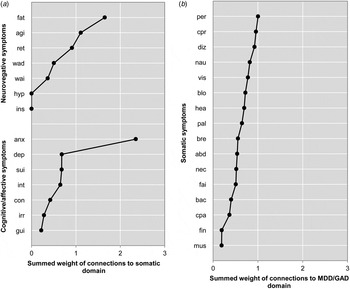
To unravel the co-occurrence of MDD/GAD with somatic symptoms, we focused on associations between the MDD/GAD domain and the somatic domain. Neurovegetative symptoms were as strongly connected to somatic symptoms as cognitive/affective symptoms (mean b = 0.75 v. mean b = 0.65, p = 0.77). Individual MDD/GAD symptoms, however, varied widely in their strength of associations to the somatic domain (see Fig. 2 a); that is, some symptoms showed strong and multiple connections, while others were not connected to any somatic symptom. The MDD/GAD symptom with the highest summed weight of connections to somatic symptoms (b = 2.35) was the cognitive/affective symptom anxiety (anx). It showed 10 connections, of which the association with pressure/tight feeling in chest (cpr) (b = 0.50) and palpitations (pal) (b = 0.38) were the strongest. Next, the neurovegetative symptom fatigue (fat) had the highest summed weight of connections to somatic symptoms (b = 1.65). Of its 10 connections, the association with headache (hea) (b = 0.43) and back pain (bac) (b = 0.28) were the strongest. In contrast, the neurovegetative symptoms hypersomnia (hyp) and insomnia (ins) were not connected to any somatic symptom.
Summed weight of all connections from specific symptoms to the opposite symptom domain. (a) Summed weight of connections from major depressive disorder/generalized anxiety disorder (MDD/GAD) symptoms to the somatic symptom domain. (b) Summed weight of connections from somatic symptoms to the MDD/GAD symptom domain. Symptoms are ordered based on the strength of their connections. fat, Fatigue; agi, psychomotor agitation; ret, psychomotor retardation; wad, weight/appetite decrease; wai, weight/appetite increase; hyp, hypersomnia; ins, insomnia; anx, anxiety; dep, depressed mood; sui, suicidality; int, loss of interest/pleasure; con, concentration problems; irr, irritable; gui, guilt/worthlessness; per, excessive perspiration; cpr, pressure/tight feeling in chest; diz, dizziness/feeling lightheaded; nau, nausea; vis, blurred vision/spots in front of eyes; blo, bloated feeling in abdomen/stomach area; hea, headache; pal, palpitations; bre, shortness of breath; abd, abdominal pain; nec, neck pain; fai, fainting; bac, back pain; cpa, chest pain; fin, tingling in fingers; mus, muscle pain.

Similarly, individual somatic symptoms differed substantially in their associations with MDD/GAD symptoms (see Fig. 2 b). The somatic symptom with the highest summed weight of connections to MDD/GAD symptoms (b = 1.00) was excessive perspiration (per). This symptom showed seven associations, of which the strongest were with anxiety (anx) (b = 0.34), guilt/worthlessness (gui) (b = 0.16) and psychomotor agitation (agi) (b = 0.14). Pressure/tight feeling in chest (cpr) was also strongly related to MDD/GAD symptoms as it showed five connections with a summed weight of b = 0.96. Its strongest connection was to anxiety (anx) (b = 0.50). Interestingly, all somatic symptoms were related to the MDD/GAD symptom domain, but some somatic symptoms showed only weak associations. Muscle pain, for example, showed three weak connections with a summed weight of b = 0.19 to loss of interest/pleasure (int) (b = 0.08), irritable (irr) (b = 0.07) and fatigue (fat) (b = 0.04). Tingling in fingers (fin) was also weakly associated with MDD/GAD symptoms (summed weight of connections b = 0.19) as it was only connected to psychomotor retardation (ret) (b = 0.14) and psychomotor agitation (agi) (b = 0.06).
Sensitivity analyses
Finally, we performed a set of sensitivity analyses to examine if the dichotomization of our data had affected the network structure. Online Supplementary Fig. S1 shows the network structure of the polytomous MDD, GAD and somatic symptoms. The network had a somewhat higher density than the network based on the dichotomized items (53.8% v. 44.1%), but the general structure was similar. In addition, although some variation was observed in the strength of individual symptoms to the opposite symptom domain compared with the network of dichotomized items (e.g. polytomous insomnia was moderately associated with somatic symptoms whereas dichotomized insomnia was not), the patterns of associations with the other symptoms domain were comparable. That is, anxiety (anx) and fatigue (fat) showed the strongest associations with the somatic domain, and excessive perspiration (per) and pressure/tight feeling in chest (cpr) were among the somatic symptoms with the strongest associations with the MDD/GAD domain.
Discussion
This study presented the complex network structure of individual MDD/GAD symptoms and individual somatic symptoms. In contrast to our hypothesis, neurovegetative symptoms of MDD/GAD did not differ with respect to their strength of associations to somatic symptoms from cognitive/affective symptoms of MDD/GAD. In addition, specific MDD/GAD symptoms such as anxiety and fatigue showed strong associations whereas hypersomnia and insomnia were not connected to the somatic domain at all. Somatic symptoms with many and/or strong connections to MDD/GAD symptoms included excessive perspiration and pressure/tight feeling in chest, while muscle pain and tingling in fingers showed limited and weak associations.
This exploratory study is the first in applying a network estimation technique to data on MDD/GAD and somatic symptomatology, which enabled us to provide insight into the unique contributions of individual symptoms in this co-occurrence. Another strength of this study is the use of the recently developed method eLasso to infer the network structure from the observed data, since this technique is not based on often untenable assumptions about psychopathology such as linearity and normality (van Borkulo et al. Reference van Borkulo, Borsboom, Epskamp, Blanken, Boschloo, Schoevers and Waldorp2014). In addition, the technique does not rely on arbitrary cut-offs to determine the presence of connections in the network, as opposed to other network estimation techniques based on correlation or partial correlation (van Borkulo et al. Reference van Borkulo, Borsboom, Epskamp, Blanken, Boschloo, Schoevers and Waldorp2014). Third, this study included a large sample (n = 2704) of persons with and without depressive and/or anxiety disorders, which ensured variability in symptom ratings and, consequently, prevented the network estimation to suffer from floor and ceiling effects.
Several limitations should also be discussed. First, MDD/GAD symptoms were assessed with the IDS, whereas somatic symptoms were assessed with the 4DSQ. Since these questionnaires had varying response categories, this might have made an impact on the empirical network structure of symptoms; that is, clustering of symptoms may have occurred based on these questionnaires. However, we recoded all items into either absent (the first response category in all instruments) or present (combining all other response categories) to create comparable response categories across instruments. In addition, although most DSM-IV criteria of MDD/GAD were included in the IDS, two criteria of GAD (i.e. criterion B: difficulty controlling worry and C5: muscle tension) were not assessed. Third, the network estimation technique eLasso has high specificity but moderate sensitivity (van Borkulo et al. Reference van Borkulo, Borsboom, Epskamp, Blanken, Boschloo, Schoevers and Waldorp2014). This implies that the reported connections are most probably correct, but some weak connections in reality might have been missed. Fourth, the NESDA mainly recruited participants with a lifetime DSM diagnosis of a depressive and/or anxiety disorder (2081 of the 2704 participants in our sample), who were selected for participation if they reported multiple DSM symptoms. Participants in our sample therefore probably had a higher number of DSM symptoms than persons from the general population, which could have led to stronger associations among these symptoms in our network structure. Generalization of our results may also be impaired as 9.3% of participants of the original NESDA were excluded due to missing data, leading to a younger, higher-educated sample with better mental health.
The classes of neurovegetative symptoms and cognitive/affective symptoms showed similar strengths of associations with somatic symptoms. This is in line with a study by Fried et al. (Reference Fried, Epskamp, Nesse, Tuerlinckx and Borsboom2016) reporting that the most central symptoms in a network structure of depressive, anxiety and some somatic symptoms included both neurovegetative and cognitive/affective symptoms. This indicates that these symptoms are equally important in their co-occurrence with somatic symptomatology and, therefore, highlights the importance of considering neurovegetative as well as cognitive/affective symptoms in persons with somatic symptoms. Additionally, these findings suggest that the strict mind–body dichotomy proposed in previous research might not apply for MDD/GAD symptoms (Whisman et al. Reference Whisman, Perez and Ramel2000; Manian et al. Reference Manian, Schmidt, Bornstein and Martinez2013), which was supported by the strong clustering of these symptoms in the network structure. Rather, the symptoms may be conceptualized as a dynamic system of related symptoms. A recent study (Bringmann et al. Reference Bringmann, Lemmens, Huibers, Borsboom and Tuerlinckx2015), for example, demonstrated that neurovegetative and cognitive/affective depressive symptoms were intimately connected through patterns of temporal influence.
In addition, individual symptoms of MDD/GAD as well as somatic symptoms differed considerably in the number and the strength of their associations in the network and, as a result, the MDD/GAD domain and somatic domain were connected via specific symptom pairs. This corroborates findings of an earlier study reporting that individual symptoms of depression and anxiety were associated with unique sets of somatic symptoms and vice versa (Boschloo et al. Reference Boschloo, Schoevers, van Borkulo, Borsboom and Oldehinkel2016a ). Similar to our results, anxiety symptoms were more strongly related to somatic symptoms than symptoms such as guilt and suicidal ideation, and dizziness showed more connections to depressive and anxiety symptoms than symptoms like nausea and headache (Boschloo et al. Reference Boschloo, Schoevers, van Borkulo, Borsboom and Oldehinkel2016a ). These findings imply that studying the co-occurrence of these symptom domains by using sum scores obfuscates important differences in the patterns of associations shown by specific symptoms (Fried & Nesse, Reference Fried and Nesse2015). Consequently, they stress the relevance of an approach focusing on individual symptoms and their connections.
Concentrating on individual symptoms is especially important as the connectivity of symptoms in a network may have important implications for prognosis. A recent study, for example, showed that MDD symptoms with a higher connectivity in a similar cross-sectional network more strongly predicted the onset of a full-blown MDD during 6 years of follow-up than MDD symptoms with a lower connectivity (Boschloo et al. Reference Boschloo, van Borkulo, Borsboom and Schoevers2016b ). This indicates that bridging MDD/GAD and somatic symptoms, which show strong connections to the other symptom domain, may be more central in the mechanisms leading to and/or maintaining the co-occurrence of MDD/GAD and somatic symptomatology than non-bridging symptoms (Borsboom & Cramer, Reference Borsboom and Cramer2013). Consequently, a decrease of a bridging symptom is likely to result in a deactivation of symptoms of the other symptom domain, whereas change in a non-bridging symptom may have little effect on these symptoms. Hence, it could be valuable to target prevention and intervention strategies specifically to the bridging symptoms in our network.
As the network approach focuses on specific associations between individual symptoms, it could also help to formulate hypotheses regarding the mechanisms behind the association of MDD/GAD with somatic symptomatology. For instance, some associations in the network structure might be causal (e.g. weight/appetite increase → bloated feeling in abdomen; dizziness → concentration problems), whereas common causes may underlie others (e.g. hypothalamic–pituitary–adrenal axis disturbances could explain the strong associations of anxiety and psychomotor agitation with cardiopulmonary symptoms; Smith & Vale, Reference Smith and Vale2006; Abelson et al. Reference Abelson, Khan, Liberzon and Young2007). Although these suggestions are speculative, they indicate that different mechanisms may underlie associations between specific symptom pairs in the network. Longitudinal data from ecological momentary assessments that record individual symptoms repeatedly over time might aid in unraveling the dynamic relationships between MDD/GAD and somatic symptoms.
The general structure of the network is also of relevance for the ongoing discussion on the validity of the current classification of MDD/GAD and somatic symptomatology in the DSM. First, in line with other studies (Krueger, Reference Krueger1999; Cramer et al. Reference Cramer, Waldorp, van der Maas and Borsboom2010), we found that symptoms of MDD and symptoms of GAD formed one cluster in the network. This raises the question whether symptoms of MDD and GAD should be conceptualized as expressions of separate disorders, which was addressed in the DSM-5 by adding an anxiety distress specifier to the diagnosis of MDD (American Psychiatric Association, 2013). In addition, it has repeatedly been argued that somatic symptomatology should be included in the diagnostic criteria of MDD/GAD as they are important features of depressed and anxious states (Fava, Reference Fava2002; Kapfhammer, Reference Kapfhammer2006; Chakraborty et al. Reference Chakraborty, Avasthi, Kumar and Grover2012). Our network, however, showed separate domains of MDD/GAD symptoms and somatic symptoms. This is also in accordance with a factor analysis in depressed patients showing that MDD items loaded on other factors than pain symptoms (Hong et al. Reference Hong, Novick, Montgomery, Aguado, Duenas, Peng and Haro2015) and may imply that somatic symptomatology should not be part of the DSM criteria of MDD/GAD.
This study demonstrated the differential associations of individual symptoms in the co-occurrence of MDD/GAD diagnoses and somatic symptomatology. We would like to encourage other researchers to consider the contributions of individual symptoms to this co-occurrence in longitudinal studies and to focus on the bridging symptoms found in this study. In addition, targeting interventions to bridging symptoms may help to improve outcomes of patients with MDD/GAD and/or somatic symptomatology.
Supplementary material
The supplementary material for this article can be found at http://dx.doi.org/10.1017/S0033291716001550
Acknowledgements
The infrastructure for the NESDA (www.nesda.nl) is funded through the Geestkracht programme of the Netherlands Organization for Health Research and Development (Zon-Mw, grant no. 10-000-1002) and is supported by participating universities and mental health care organizations [VU University Medical Center, GGZ inGeest, Arkin, Leiden University Medical Center, GGZ Rivierduinen, University Medical Center Groningen, Lentis, GGZ Friesland, GGZ Drenthe, Scientific Institute for Quality of Health Care (IQ Healthcare), Netherlands Institute for Health Services Research (NIVEL) and Netherlands Institute of Mental Health and Addiction (Trimbos)].
Declaration of Interest
L.B. has received a speaking fee and an unrestricted grant from Astra Zeneca. No other authors report competing interests.