Introduction
Stenosis or occlusion of systemic-to-pulmonary shunts often becomes a problem early after surgery, though some cases occur several years later. Balloon dilation and stent implantation of stenosed shunts are reported to be feasible and essential treatments,Reference Lee and Chiu1–Reference Tanaka, Kawakita and Shiraishi3 although, to the best of our knowledge, limited reports on stenosis related to infection that needs an interventional procedure exist. A case of systemic-to-pulmonary shunt stenosis caused by a bacterial abscess is reported. It was successfully dilated by stent implantation followed by antibiotic therapy.
Case presentation
A 13-year-old female patient was born with a single ventricle, pulmonary atresia, and major arterial-pulmonary collateral arteries. She had undergone construction of a left-sided modified systemic-to-pulmonary shunt of 3.5 mm in diameter 1 month after birth, and eventually a same sized right-sided shunt was added due to progressive hypoxia 1 month later. When she reached 8 years of age, stent implantation (3.5 × 30 mm; Integrity, Medtronics, Minnesota, United States of America) to the left-sided shunt was performed due to stenosis, followed by shunt replacement of the 5-mm-diameter shunt 5 months later. The right-sided shunt was replaced with a 6-mm shunt at 12 years of age. The patient had been judged a high-risk candidate for any further surgical repair because of the morphology and the pressure of the pulmonary arteries. Her oxygen saturation was 80–85% under nasal cannula oxygen at 2 L/min.
She was admitted to our hospital for sustained fever due to influenza. Her weight was 28 kg, and her height was 134 cm. Blood pressure was 87/45 mmHg. Heart rate was 115 beats/min, and her respiratory rate was 22 breaths/min. The oxygen saturation rate was 78% with nasal oxygen at 2 L/min, and haemoglobin was 16.3 g/dl. She had been prescribed oral aspirin 100 mg per day and warfarin for the patency of the shunts, though the aspirin was stopped due to the onset of influenza. Instead, heparin was administered to ensure effective anticoagulation therapy in addition to continuing warfarin. The blood culture taken on admission was reported to be positive for methicillin-sensitive Staphylococcus aureus. Cefotaxime had been given by infusion since admission and was changed to cefazolin after the blood culture result was confirmed.
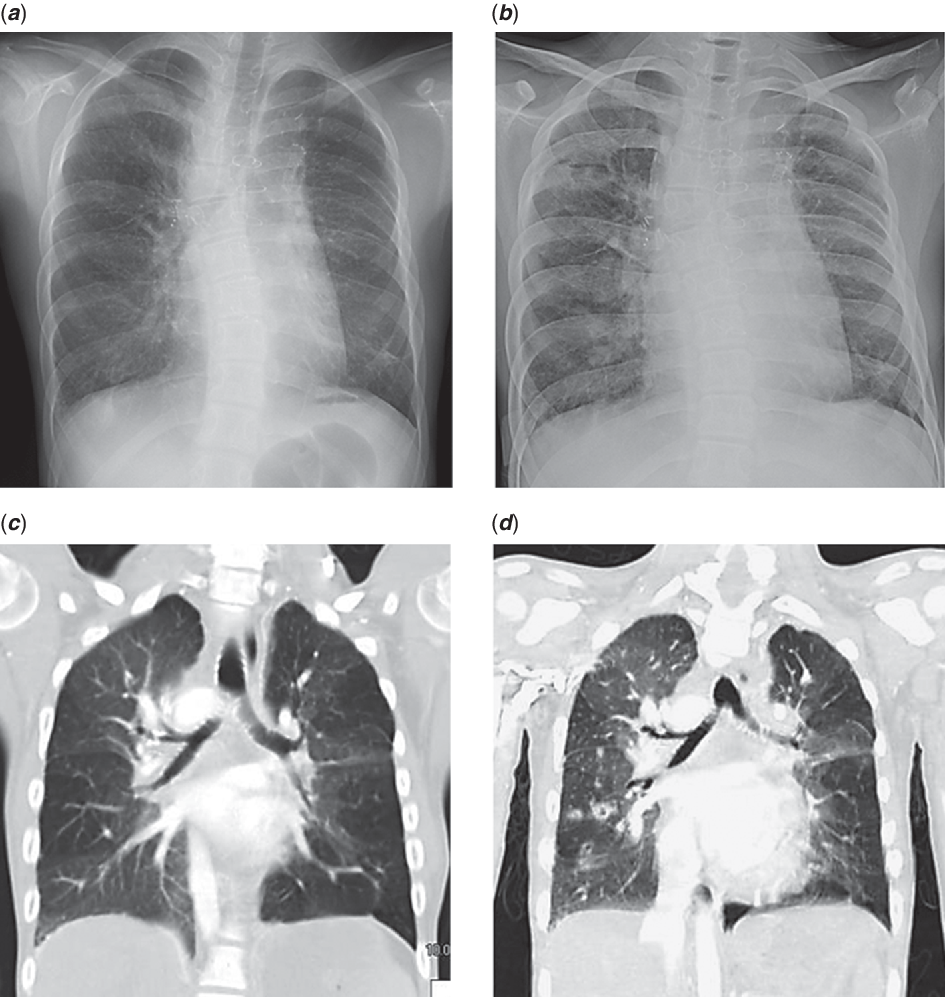
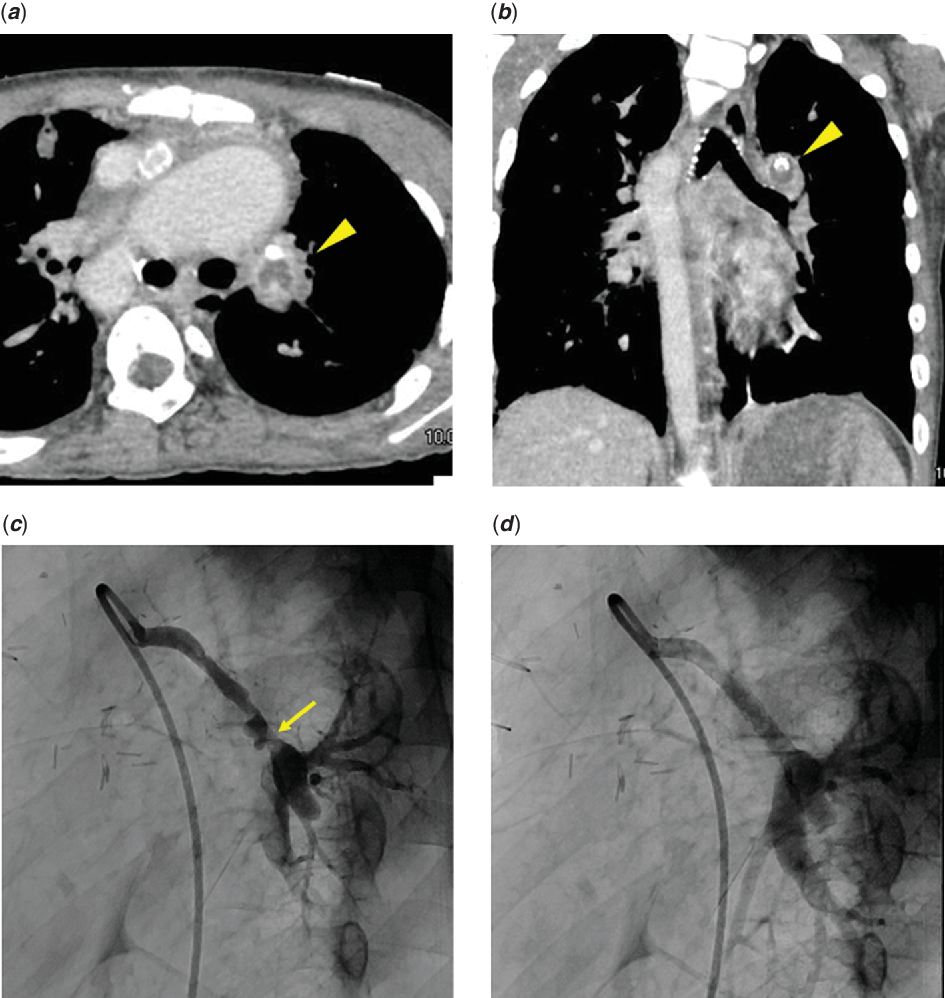
The chest X-ray at admission showed no apparent signs of pneumonia (Fig 1a). Three days after admission, the oxygen saturation suddenly dropped temporarily to 50 to 60% during rest. The saturation soon recovered gradually, but it remained lower than usual with a diminishing shunt murmur on the left side of the chest. The chest X-ray on the same day showed multifocal opacities (Fig 1b). Compared to the CT scan performed 3 months earlier (Fig 1c), the CT images showed more detailed focal opacities and ground-glass attenuation in both lungs (Fig 1d). Based on her laboratory findings, she was diagnosed as having sepsis and pneumoniae due to methicillin-sensitive Staphylococcus aureus. White blood cell counts were elevated to 10,400/μl, and C-reactive protein was increased to 15.62 mg/dl. The CT scan showed the left-sided systemic-to-pulmonary shunt stenosis encapsulated by a low-density area suggesting the abscess around the shunt (Fig 2a,b), and this was suspected to be responsible for the oxygen saturation drop. The cause of the stenosis was considered the possible abscess due to methicillin-sensitive Staphylococcus aureus infection. Emergency catheterisation definitely diagnosed the stenosis of the left-sided shunt, as suspected (Fig 2c). Stent dilatation (4.0 mm × 18 mm; Palmaz Genesis, Cordis, Cardinal Health Inc., Ohio, United States of America) was performed to distend the stenotic shunt and the anastomosis to the native pulmonary artery due to the compression of the abscess. After the stent implantation, a percutaneous transluminal angioplasty balloon (SHIDEN® 5 mm × 2 cm; Kaneka Medical Products, Osaka, Japan) was used for further dilation (Fig 2d). The procedure was performed successfully leading to improvement of the oxygen saturation to its usual level. Gentamycin and rifampicin were added to the cefazolin, and the abscess was treated with the three antibiotic intravenous drips for 6 weeks. The abscess around the shunt diminished in size compared to the size before the treatment. She had an uneventful course without developing any complications during her hospital stay, and she had no recurrence after completion of the antibiotic infusion and discharge.
The chest X-ray at admission (a) and three days after admission when the sudden oxygen saturation drop occurred (b). Coronal view of the CT scan performed 3 months before admission (c), and the images after the drop in oxygen saturation (d). Focal opacities and ground-glass attenuation in both lungs are seen.

Axial and coronal view of CT scan showing the left-sided systemic-to-pulmonary shunt encapsulated by a low-density area suggesting the abscess (a, b). Lateral view of the left-sided shunt before and after stent implantation (c, d). The yellow arrowheads indicate the abscess around the shunt, and the arrow indicates the stenosis of the shunt and the distal anastomosis to the native pulmonary arteries.

Discussion
A case of a single ventricle patient with systemic-to-pulmonary shunts who suffered from hypoxia due to shunt stenosis caused by a methicillin-sensitive Staphylococcus aureus abscess was presented. Stent implantation to the shunt and the distal anastomosis to the native pulmonary arteries with administration of appropriate antibiotics was crucial treatment to dilate and improve shunt patency. Stent implantation is known to be a useful alternative to surgical reconstruction to treat acute and late obstruction of systemic-to-pulmonary shunts in patients with CHDs.Reference Kaestner, Handke and Photiadis4 It has been noted that there is a very low incidence of shunt-related infection that can lead to rapid and catastrophic thrombosis. The cause of the shunt stenosis in the present case was considered to be an abscess, which is quite rare. First, it was important to treat the shunt stenosis to improve the decrease of oxygen saturation immediately, and then it was necessary to manage the source of infection by antibiotic infusion until it completely resolved. A previous study reported that children with Staphylococcus aureus co-infection with influenza were more likely to have pneumonia and acute respiratory distress syndrome than those who were not co-infected.Reference Finelli, Fiore and Dhara5 Streptococci and staphylococci are known to account for approximately 80% of cases of infective endocarditis.Reference Holland, Baddour and Bayer6 In the present case, influenza involvement may help to explain the co-infection of Staphylococcus aureus pneumonia, and in addition, the artificial vessel implantation could have been the predisposing factor for staphylococcal infection.
Fortunately, in the present case, the stent implantation successfully relieved the shunt stenosis and the infection responded to the antibiotic therapy. The implantation of artificial vessels or devices is known to be associated with a high risk of infections that are resistant to medical therapy. However, if the shunt stenosis due to such infection is life-threatening, it is important to not hesitate to perform an interventional procedure for dilation and provide antibiotic therapy for a sufficient duration. Surgical replacement of systemic-to-pulmonary shunts had been already performed four times in this case. Since the patient was judged as a high-risk candidate for any further surgical repair, we considered that the stent implantation is more appropriate and less invasive than the surgical replacement in this serious clinical state. However, it should be noted that the stent implantation itself could cause another stenosis or worsening the infection. Therefore, in case that the stent implantation is not effective, the surgical treatment should be performed immediately.
Conclusion
This case illustrates successful stent implantation to maintain patency of a stenosed systemic-to-pulmonary shunt due to infection. In addition to precise stent implantation, determining the cause of the stenosis and its cure is also important. It cannot be overemphasised that definitive surgical repair should be considered in cases of recurrent abscess or no response to medical therapy.
Financial support
This research received no specific grant from any funding agency, commercial or not-for-profit sectors.
Conflict of interest
None.
Ethical standards
Not applicable.