




No CrossRef data available.
9. TRENDS IN TEACHING STANDARD VARIETIES TO CREOLE AND VERNACULAR SPEAKERS
Published online by Cambridge University Press: 15 June 2004
Abstract
This chapter discusses some approaches used to teach a standard variety to creole and vernacular speakers. It focuses attention on issues related to the use of creoles and vernaculars in instruction to help creole speakers develop literacy in a second language. Research has shown that literacy development, academic skills, and learning strategies transfer from the first language to the second and that literacy in the first language is a crucial base for literacy development in the second language. Advocacy for vernacular literacy as a means of facilitating the learning of a standard language differs in situations where creole has the same lexical base as the second (standard) language as opposed to situations in which the creole has a different lexical base than the second language. The policy literature as well as that describing approaches to second language learning by creole and creole-influenced vernacular speakers is discussed primarily with relevance to the Caribbean region. The chapter then surveys the literature describing approaches used in similar contexts elsewhere. Outcomes resulting from the implementation of specific policies and approaches in the contexts presented, to the extent that such outcomes have been documented, are also explored.
Information
- Type
- TEACHING LANGUAGE IN SPECIFIC SETTINGS
- Information
- Copyright
- © 2004 Cambridge University Press
Explicit recommendations for incorporating creoles and vernaculars in language education programs for purposes of helping speakers of these varieties learn a second language began to appear around the mid- to late 1960s. Before then, in schools in the Caribbean, the common practice was to prohibit and suppress the use of Creole on school premises. Native speakers of creoles found themselves in ‘immersion’ situations in which the goal was monolingualism in English but that often lacked much of the scaffolding that immersion contexts usually provide. A result of this was that many learners completed primary schooling without having achieved required levels of proficiency in the official, standard language; many were not functionally literate,1
Defined in the sense of having fundamental skills as described by Williams and Snipper, for example, “Now functional literacy is often used to denote the ability to read and write well enough to understand signs, read newspaper headlines, fill out job applications, make shopping lists, and write checks” (1990, p. 4).
The plight of creole speakers within education systems across the region became the subject of discussion in several articles (Carrington 1968, 1969; Carrington, Borely, & Knight, 1972a, 1972b; Craig, 1966, 1976, 1983; Le Page, 1968). At the same time, in the United States, educators and linguists were drawing attention to the problems that speakers of what was then called Black English were experiencing in schools2
The terms used to refer to the vernacular spoken by African Americans in the United States of America have changed over time. In the 1960s and 70s, Black English Vernacular (BEV) was widely used. This was replaced by the term African American Vernacular English (AAVE) which is now used variably with the controversial term “Ebonics.” In this chapter, the term AAVE will be used.
Cited in Sutcliffe, 1982, p. 73.
Awareness of these difficulties resulted in the development and use of instructional programs that were intended to help the creole and CIV speaker to learn and use the standard language variety that was in use for academic purposes. In the Caribbean there were efforts to design and use programs tailored to meet the needs of creole and creole-influenced vernacular speakers. Craig (1999) cited as examples of such programs those emerging from the work of the Language Materials Workshop at the University of the West Indies and the subsequent Caribbean-wide Primary Education Project in the mid 1970s. Around the same time, the UNESCO Language Arts Project was launched in the Eastern Caribbean. This consisted of carefully prepared and graded materials that used the audiolingual approach to teach English as a second language to creole and CIV speakers in primary schools. Unfortunately, no formal research was done to determine whether the latter program had achieved its objectives before it was discarded some three or four years after it had been introduced. Teacher reports indicated that students had become bored with the drills, which they found to be repetitive.
Across the Caribbean in the Francophone territory Haiti, French Creole had been permitted, by decree in 1979, to be used in schools for communication in the classroom and also as a subject of instruction. Valdman reported that in 1982 there was “a fierce verbal war” being waged in the media over the merits of the educational reform strategy being promoted “vigorously” by the then Minister of Education; the reform advocated the use of French Creole as “the main classroom vehicle for the first four years of primary education” (1988, p. 67). The arguments put forward for and against the use of the Creole were similar to those expressed elsewhere in the Caribbean and recently in the United States with regard to “Ebonics.”
During the same period, programs were designed in the United Kingdom to address the needs of students who spoke creole or CIV varieties from the Caribbean. An example of one such program overtly contrasted dialect with standard English utterances and required the learner through the use of different types of drills to discriminate or identify the difference between or to translate from one variety to the other (Feigenbaum, 1975). This approach was intended to help students become aware of the differences between the standard and nonstandard without involving them in grammatical explanation. Dalphinis (1985) presented information on other programs in existence in the 1970s.
Progress has been made in some territories regarding the use of creole and CIVs in education. In the Seychelles and the Netherlands Antilles, for example, changes in education policy led to the inclusion of CIV in schools. Most Caribbean territories have been more tentative or perhaps reticent regarding the role of Creole and CIV for education purposes. It is possible that theoretical and social perspectives on what is appropriate in certain contexts may have influenced both policy and practice. Several of the articles included in Tabouret-Keller, LePage, Gardner-Chloros, and Varro (1997) present a global perspective of the political, social, and pedagogical factors affecting vernacular literacy in countries where such programs have been introduced. The next section presents an overview of policy positions on the use of Creole and CIV in education.
Teaching Standard to Creole and CIV Speakers: Policy Issues and Program Models
Historically, education systems and education policy in the Caribbean were patterned on those of the countries that colonized the various territories in the region. In the Anglophone territories, English was the language of instruction, and the approaches used to teach were those normally used for teaching native speakers of English regardless of whether a high percentage of learners were Creole or CIV speakers. The situations in the Francophone territories such as Haiti, Martinique, and Guadeloupe were similar. In the case of the latter two overseas departments of France, legislation was passed to allow the use of CIV in the classroom for specified purposes, but the number of programs incorporating the vernacular was negligible and could not be sustained. Included among the reasons given for the lack of success of these programs were lack of parental enthusiasm and children dropping out (Carrington, 1997). Perhaps the overriding factor in these territories was political; while it may have been fashionable to agitate against the establishment for recognition of the vernacular, as long as these islands remained departments of France, French as the official language would continue to be perceived as the language of success and upward mobility.
In the case of Haiti, the majority of the populace speaks French Creole and a small number (5%) are considered to be balanced bilinguals (Valdman, 1988, p. 67). Among reasons given for the lack of success of the reform initiative to incorporate Creole in instructional programs in schools were, first, that “the privileged classes do not wish to change the order of the society. They prefer to maintain the language filter that restricts entry to their class and access to the control systems of the society” (Carrington, 1997, p. 86), and, second, it would be impossible to achieve bilingualism in a society that is over 90% monolingual in Creole. As DeJean put it “For the economically weakest country in the Americas, already burdened with a rate of illiteracy that is one of the highest in the world, to undertake the project of creating from the whole cloth a bilingual society out of a population that is massively monolingual would be foolish because it can't be achieved” (1993, p. 78). DeJean went on to observe that “Scorn and disdain for Creole [and the] conviction of the inferior and inadequate character of the popular speech would be, in the whole of the population, the basis of a popular resistance to the establishment of the experimental classes and the reform programs” (1993, p. 79). Although in Haiti, as in the other territories in the Caribbean, there has been agitation for the use of Creole and CIV in education as a vehicle for speakers of these varieties to acquire literacy, the point is that without political will and social motivation such reform programs will be difficult to implement with success. As Carrington has pointed out “Neither the political directorate nor the masses who might be empowered by vernacular literacy appear to recognize the point of it” (1997, p. 86).
Calls for the use of Creole and CIV in education have come mainly from linguists, some of whom have delineated conditions to guide policymaking for introducing vernacular literacy in certain contexts while being careful to point out that the business of policymaking was the responsibility of the state (e.g., Craig, 1980; Devonish, 1986a/b). One of the earliest suggestions was made by Midgett who proposed, in the case of St. Lucia, that Patois (i.e., French Creole) be used “interchangeably with less formal more colloquial English” as a means of establishing English “in the minds of students as a functional equivalent of Patois” (1970, p. 167). Carrington (1976) presented six principles that described conditions considered favorable for the use of Creole as a language of instruction. Roberts suggested that an “integrative approach” which allows for the use of Creole in an “integrative, appropriate way in the school system” be used. Such an approach, in his view, would “give confidence to pupils who, as they (got) older, (would) feel secure enough to use the full range of their linguistic competence to full effect in their speech and writing” (1993, pp. 12–14). Devonish referred to two policy papers4
Papers presented by Devonish “The question of what medium of instruction should be used in education” and Kephart “Some background for language planning in Grenada” to the National Seminar on Education held in Grenada in July, 1979.
Craig (1980) described a typology of educational models that presented the linguistic, socioeconomic, and cultural factors that should be considered in determining which model would be best in a given context. These were as follows: (1) school monolingualism in the dominant language, which ignores the home language of the child; (2) transitional bilingualism, which allows use of the child's home language only to the extent that the child can learn enough of the school language to use it for academic purposes in school; (3) monoliterate bilingualism, which develops literacy in the language that is dominant in the community but permits development of both languages for oral–aural skills; (4) partial bilingualism, which develops literacy and oral–aural fluency in the child's home language only for “certain types of subject matter that have to do with the immediate society and culture” (1980, p. 248); (5) full bilingualism, which allows development of all skills in both languages in all domains; and (6) monolingualism in the home language in which the objective is to develop literacy in the home language of the child.
The model most widely implemented in the Anglophone territories of the Caribbean was school monolingualism, which promoted literacy in the official language English. In other territories such as the Netherlands Antilles and Haiti, a bilingual model, which promoted the use of Papiamentu and Haitian French Creole respectively, in grades 1 through 6, was implemented for some time. Based on general reports (e.g., DeJean, 1993; Valdman, 1988) on the Haitian situation, it is possible to infer that the success of the vernacular programs has been below expectations, while research reports on the situation in the Netherlands Antilles are rare. Siegel reported on research done on three types of instructional programs, namely, instrumental, accommodation and awareness that incorporate a Creole or CIV. He explained that, in instrumental programs, the “stigmatized variety”5
Siegel uses the term “stigmatized variety” to refer to the nonstandard variety. Here the terms “Creole and “Creole-Influenced Vernacular” are used to refer to the same entities.
He acknowledged Wiley, 1996, for “accommodation programs.”
Bryan and Burnette reported that in Dominica teachers are using Kwéyòl (French Creole) “to aid understanding among children in the primary and secondary sector” (2003, p. 151) which suggests that an accommodation program may be in use in that territory. Winer reported an increased acceptance of Trinidadian Creole (TC) in schools in Trinidad and Tobago. She observed: “Although few would advocate the use of TC as the primary educational medium, even in primary education, there is a widely recognized need, from teachers and community, for its use in education as complementary, additive, and transitional to standard English” (1990, p. 245). The increased acceptance to which Winer refers is also the experience in most other Anglophone territories in which the Caribbean Secondary Examination Certificate, administered by the Caribbean Examination Council (CXC), is taken by students at the end of secondary school. The examination allows for the use of Creole in creative writing in presenting the dialogue of characters, for example, in situations where use of the Creole variety would be natural and realistic. However, for all other purposes, the examination does stress that responses be written in standard English.
In St. Lucia, the official policy is that English should be used as the language of instruction, but teachers, especially in the rural areas, sometimes use Kwéyòl to new students who are native speakers of that variety to facilitate their understanding of classroom procedures. That many Creole and CIV native speakers have not fared as well as their English-speaking counterparts in examinations like the Common Entrance7
Also referred to as the 11+ Examination, this is given to children at the end of primary school and determines selection for secondary (high) school.
The children of immigrants to the United Kingdom, Canada, and North America, and students who migrated to these countries, have experienced difficulties learning English, which has led to consultations among linguists and educators regarding the approaches that should be used to facilitate their learning of the standard language. An example would be the International Creole Workshops organized by Florida International University, which sought the input of linguists and educators in the formulation of approaches for instructing French Creole speakers, primarily from Haiti, who had migrated to the United States. Siegel referred to another consultation organized in Toronto to consider “educational inequities faced by the large number of Caribbean immigrants living in Ontario, Canada” (1999b, p. 512). He reported that out of that consultation a committee was formed to produce a resource book for teachers of Caribbean students. Winer, writing about Caribbean immigrants in North America, suggested that “any approach to the teaching of students whose first language is English Creole, recognized or not, must include knowledge about and acceptance of the language and its culture, contrasted specifically with English language and culture varieties” (1993, p. 195). Kephart, considering the fact that many children on Carriacou speak a variety different from metropolitan English, suggested that learning to read Carriacou Creole English (CCE) might “assist” their learning of metropolitan English (2003, p. 238).
An interesting development in the United Kingdom is reflected in the efforts of Morris and Nwenmely to teach Kwéyòl to St. Lucian and Dominican immigrants and their children as a means of developing their literacy skills. The Kwéyòl project emerged as an offshoot of the national literacy campaign launched in the United Kingdom in 1975. The aim of that campaign was to teach English-speaking people who had difficulty reading and writing. Morris and Nwenmely (1993) explained that the organizers were concerned that they were unable to meet the needs of students from the Eastern Caribbean. The Kwéyòl project was launched to help them address those needs:
The Kwéyòl Project was financed through Tower Hamlets Institute of Adult Education to enable a young St. Lucian medical student … to co-ordinate the launching of the first phase of the (Patwa) Project classes …. This ran parallel with the development of a Black Studies course. It was felt important to develop the two courses in parallel, in order to enhance and encourage an Afrikan educational and cultural perspective which would in turn facilitate understanding of the historical development of the Kwéyòl language in the Caribbean (Morris & Nwenmely, 1993, p. 261).
In this context, instruction in Kwéyòl was seen as a means of preserving the home language and culture of Eastern Caribbean migrants to Britain. Morris and Nwenmely reported: “A great many people see the advantages of being able to read and write the mother tongue as a way of affirming cultural pride, roots and increasing self-worth and confidence” (1993, p. 267). In their view, the study of Kwéyòl also rekindled interest in academic study for adults as well as young people.
Other models have focused not exclusively on Creole speakers but on CIV and speakers of a standard variety who interact as a heterogeneous group in a classroom. Such heterogeneous classrooms are the norm in most schools in St. Lucia and Dominica as well as other territories. Simmons-McDonald (1996) outlined the principles for a model that would tailor instruction to the needs of heterogeneous groups comprising Kwéyòl, CIV, and standard English8
In St. Lucia, Kwéyòl, an English-lexicon vernacular, St. Lucian English vernacular (SLEV), and standard English are widely spoken. Classrooms, particularly in rural areas, would consist of a mix of students who speak either or a combination of these varieties as (a) first language(s). (Also see Aceto and Williams, 2003, for descriptions of other contact situations.)
Some attempts were made in the French West Indian island of Guadeloupe to use French Creole in school to help students learn standard French. Durizot (1996) reported that in 1977 two schools9
In 1957 the “Association Guadeloupéenne de l'éducation populaire,” was formed by a primary school teacher, Gérard Louriette. It was his initiative that promoted the use of French Creole in the two schools. He prepared materials for the program and also wrote books promoting literacy in French Creole and its use in teaching French.
Prior to the inclusion of Creole in education, student performance in the acquisition of the standard languages was poor. Bollée reproduced a report from the newspaper which read as follows: “Nearly half of the school leavers could not properly write, read or express themselves in French or English after nine years of primary education” (1993, p. 88). Creole was taught in an instrumental program as part of an integrated curriculum in the first four years of primary school (grades P1 to P4). Over the next three years (grades P5 to P7) it was taught as a subject and up to P9 as “the language medium for political education, creative arts, family life education and extracurricular activities” (Bollée, 1993, p. 89). The results emerging from the reforms in the Seychelles indicate that some success was achieved in terms of student performance. Quoting from a contemporary newspaper, Bollée made the following report:
Nearly three-quarters of P3 pupils in 1984 “could read and write in Creole anything that can be expected of children of that age and intellectual development.” As to the positive effects of the introduction of Creole on other subjects, teachers of mathematics reported “very encouraging results,” and the English section, an “excellent overall performance of P3 pupils in English.” (Seychelles Nation of April 26, 1985, p. 2, quoted in Bollée, 1993)10
The article from the Seychelles Today of April 26, 1985, was reporting on the situation before the reforms were introduced. Bollée (1993, p. 88) commented that prior to the 1981 reform “a large percentage of illiterates continued to be produced.”
It is clear from the report that there was some resistance to the introduction of Creole as the primary medium of education and that acceptance of it was slow. However, the political will and the valuation of the language in the society appear to have influenced its successful implementation within the education system. Systematic research on student performance has been rare; however, Siegel (1999b) cited two studies, the first done by Ravel and Thomas (1985) and the second by Bickerton (1988) that reported some measure of success in the performance of the students. For example, Siegel highlighted the finding from the Ravel and Thomas study that showed better performance by Creole-educated students in grade 3 in 1984 than that of their predecessors in 1983 who had been instructed in English. Reports such as these, as well as research findings that show positive effects of mother tongue instruction, have encouraged continued interest in the implementation of Creole and CIV as varieties for instruction in the Caribbean and elsewhere. A brief summary of the main findings of this research is presented in the following section.
The Influence of Research
Research on second language learning in certain mainstream contexts has influenced, to some degree, models that advocate the use of creole and CIV in education for the purpose of helping native speakers of these varieties learn a standard variety. Some findings in bilingual, bidialectal contexts have revealed that the acquisition of two or more languages has positive effects on metalinguistic development (Bialystok, 1991). Comparisons of children who had acquired literacy in two languages indicated better performance by these children when they attempted to acquire a third language than by monolingual or bilingual children who had not acquired literacy in their home language (Swain & Lapkin, 1991). Cummins (1991) reviewed studies that showed that “the better developed children's L1 conceptual foundation, the more likely they are to develop similarly high levels of conceptual abilities in their L2” (cited in Cummins, 1994, p. 38). He further reported that the “positive results of programs that continue to promote literacy in L1 throughout elementary school can be attributed to the combined effect of reinforcing students' cultural identity and their conceptual growth” (1994, p. 39). Ovando and Collier made the point that “cognitive and academic development of a student's first language provides especially crucial and academic support for second-language acquisition” (1998, pp. 88–89). They explained further that if cognitive and academic success in L2 is to be assured, both the oral and written aspects of a student's first language system must be “developed to a high cognitive level” through the years of elementary school. Their comment on this particular point is worth noting:
It is extremely important that cognitive development continue through a child's first language at least through the elementary school years. Extensive research has demonstrated that children who reach full cognitive development in two languages (generally reaching the threshold in L1 by around age 11 to 12) enjoy cognitive advantages over monolinguals. (Ovando & Collier, 1998, p. 90)
Craig examined test results for students in the Anglophone West Indian territories (excluding the Bahamas) and concluded that “the creole-influenced majority student population of the Caribbean experiences a magnitude of difficulty in acquiring English language and literacy which is at least equivalent to that experienced by the African American Vernacular English (AAVE) student population in the USA” (1999, p. 29). The point of Craig's statement is that, regardless of the students' first language (i.e., AAVE or English Creole or French Creole), or the differences in the relationship between the first language and the respective standard, the learning outcomes and the language learning difficulties experienced by Creole and CIV speakers are startlingly similar. Comparisons of West Indian students and student groups in the United Kingdom also led Craig (1999) to conclude that the performance of CIV speakers in the West Indies is significantly lower than the equivalent age cohorts in the United Kingdom. A key issue is that populations of Creole and CIV speakers experience similar problems when they are in a formal language-learning situation in which they are required to learn a standard variety as a second language. A comparison of selected works shows that this is not a trivial coincidence (e.g., Rickford, 1999; Simmons-McDonald, 2001; Winch & Gingell, 1994).
Ovando and Collier (1998) summarized several other studies that had reported cognitive benefits experienced by learners who acquire two languages in early childhood. One such benefit is that the subsequent acquisition of a third language is much easier. Others included “cognitive advantages over monolinguals on measures of cognitive flexibility, linguistic and metalingusitic abilities, concept formation, divergent thinking, and creativity” (Ovando & Collier, 1998, p. 256). Research also showed that literacy skills learned in a first language transfer to a second language (e.g., Cummins, 1993). The evidence provided by these studies also dismissed concerns that learners' first language would interfere with the learning of a second. Winch and Gingell compared the writing of Creole and CIV speakers in primary schools in St. Lucia with that of students in the United Kingdom who had had no Creole influence. They attributed most of the errors to “a misunderstanding of the relationship between speech and writing” rather than to interference (1994, p. 177). Some of the errors they identified indicated the learners' inability to handle the features of formal English, and they were identical to errors made by native speakers of English attending school in the United Kingdom. The error types they listed fell into the following categories: (1) context dependent, (2) topicalization, (3) genre difficulties, (4) repetition, and (5) errors due to ambitious constructions (p. 178).
Other research done with creole and CIV groups also provided evidence that the first language of the learner could help and not hinder the learner in the acquisition of a second language. Siegel (1997) reported on an evaluation undertaken in 1989 of a pre-school program in Papua New Guinea to teach initial literacy using Tok Pisin. He examined the term test results of “ex prep” students who had gone through the prep-school program and those who had not gone through the program. He also used interviews and questionnaires, the results of which showed that community schoolteachers had reported that there were no “special problems of interference” and that the influence of the home language, Tok Pisin, could “only be seen sometimes in spelling and pronunciation” (1997, p. 92). The results of that study also showed that the “ex prep” students learned the second language, English, “more easily” than the “no prep” students, that they did better academically, participated more in class, and had a lower dropout rate. Additional, and perhaps the most important, finding was that the students who had been involved in the prep-school program (the ex-prep) “scored significantly higher, not lower, in term tests than those who had not been involved … the higher achievements were in English, as well as in Maths and General Subjects” (p. 94). Siegel concluded that preliminary formal instruction in a pidgin language was better than none at all and that it was not a hindrance to students' later academic achievement. In the same article, Siegel cited a prior study (Murtagh, 1982) conducted with children whose mother tongue was Kriol and who were learning English as a second language. The students in a bilingual program, using Kriol and English, had “greater Englishlanguage proficiency” than the Kriol-speaking students who were in a monolingual English program (1997, p. 98).
In another paper, Siegel (1999a) sought to answer the question of whether or not “there is evidence for the assumption that working with a stigmatized variety in the classroom is detrimental to the acquisition of the standard. He examined available evidence from instrumental, accommodation, and awareness programs and concluded that the studies demonstrated “various positive results of making use of the students' own varieties of language in education (such as) greater participation rates, higher scores on tests measuring reading and writing skills in standard English, and increases in overall academic achievement”(1999a, p. 710). In summary, research done in both mainstream second language-learning situations in which the learners' native language may have been a standard variety and in other situations in which learners' native language was either a Creole or a CIV has provided evidence showing that nurturing and developing a child's first language and teaching literacy in it first did not hamper the learning of a second (standard) language, but was beneficial to the learner in many ways.
Recent Programs, Approaches, and Research
In Caribbean territories with English-lexicon vernaculars, CIV speakers have generally been taught as though English were their native language, and all that was required was for their errors to be corrected. This “correction” approach was widely used and still is today by less experienced teachers in several schools. This approach simply meant that teachers would correct vernacular utterances (or sentences) as being wrong and would reinforce the English equivalent through repetition. Researchers have pointed out that this approach only served to give learners the impression that their language was inferior and that it failed to move learners beyond the vernacular. In the case of St. Lucian speakers of French Creole, Simmons-McDonald (1998) showed that Kwéyòl-speaking children learning English in school first acquired an English-lexicon vernacular, then slowed down in their learning of standard English because the vernacular was widely spoken in their communities and met their communicative needs adequately. They seemed to see no point in acquiring the standard when they could get by with using St. Lucia English-lexicon vernacular (SLEV). She pointed out that approaches that identified the vernacular structures as errors in need of eradication would not be successful, and that the standard had to be considered not as an extension of SLEV, but as a third alternative lect, the acquisition of which would need to be facilitated through the implementation of “a carefully thought-out program of instruction.”
The early systematic approaches to teaching a standard variety to Creole and CIV speakers in the Caribbean are those that were referred to earlier in this discussion, namely, the materials and teachers' guides that were produced by the Language Materials Workshop in Jamaica, the UWI/USAID Primary Education Project, which, we are told, had a “specially designed Language Arts component” intended to cater to the needs of Creole-influenced children across the Caribbean (Craig, 1999, p. 33) and the UNESCO Language Arts Project in the Eastern Caribbean that used audiolingual methods to teach English. Now, many of the ideas for teaching Creole and CIV learners are presented in resource manuals for teachers. These vary as regards the inclusion of theory and the scope of coverage of topics.
One resource for Jamaican teachers prepared by Velma Pollard appeared in 1993. The approach advocated in this manual is contrastive. It is organized in four sections that focus on words with similar sounds but different meanings, words that are different but mean the same things, different grammatical structures that convey the same meaning in the two varieties, and idiomatic speech and writing. The text presents teachers with concrete examples on how to teach the differences, including the use of literature selections as stimuli. Teachers are directed to the relevant theory through a list of references in an appendix. The manual is used in Jamaica, but it was not possible to determine whether any systematic research had been done to assess teachers' responses to it or whether it met its objective of helping teachers “help their students move from being able to use only one language JC (Jamaican Creole) to being able to use the two languages … [needed] to operate successfully in the Jamaican situation” (Pollard, 1993, p. v).
Another program developed by Craig (1999) is also designed as a resource for teachers. This program, Teaching English to Speakers of a Related Variety (TESORV), is intended to help teachers teach language and literacy to CIV speakers. It provides a theoretical perspective as well as practical teaching activities and resources. Craig contends that certain prerequisites related to learner needs must be considered before teaching programs are designed. These are: (1) making provision for continuity in the learners' cognitive growth (in the vernacular) and (2) developing language awareness. In TESORV, the teaching and learning experiences that are suggested by the prerequisites require recognition of “the difference between using the vernacular and using English and (keeping) the two separate,” using the “life experiences of learners and the vernacular culture and environment in integration with the culture of the wider world,” and insistence on “clarity of goals and objectives in the use of the vernacular and of English” (Craig, 1999, pp. 44–45). The teaching approach promotes the development of language awareness, direct procedures that focus on “perception/reception … of the form and meaning of new language elements (in English), on internalization or understanding and recomposing what has been perceived/received and creative utilization of what has been internalized” (1999, p. 45).
TESORV uses an eclectic approach that incorporates selected foreign language methods, and use of the vernacular in carefully designed activities that develop the learners' language awareness and literacy abilities within a language experience framework. A major emphasis is on active student participation in language learning. Craig made the following assertion with regard to TESORV:
It seems clear that the necessary teaching/learning orientation for vernacular speakers synthesizes the accumulated wisdom of the major approaches to language teaching, while at the same time rejecting such practices as ignore the specific needs and characteristics of vernacular speakers and the sociolinguistic factors relevant to both their use of the vernacular and their use of the official language English (Craig, 1999, p. 82).
In some ways, TESORV is not new because it uses approaches and methods in existence for some time. However, in its pulling together of the various methodological strands and in its provision of detailed guidelines for the incorporation of the vernacular, it provides a comprehensive approach to vernacular instruction. The program includes sample activities, procedures to be used, scheme of work and syllabus resources, and a wealth of information about language and differences between vernacular structures and English. In this way, it attempts to fill a gap not usually addressed in most teacher training programs, namely, the linguistic background that is essential to teachers who work in a creole and creole-influenced context.
TESORV is grounded in the findings of research on language acquisition/learning conducted over decades within and outside of the Caribbean region, and it is used by many teachers across the territories. As far as I am aware, its introduction within the Caribbean was not linked to a research program that could provide information on its efficacy in helping creole and CIV speakers learn the standard variety. In fact, precisely because TESORV uses such a range of methods, it would be useful to determine its success as a teaching approach within the context of a well-designed research study. Unfortunately, the research study component of many programs implemented within and outside the Caribbean has been missing and this constitutes a severe lack in the literature on vernacular literacy. This lack has been noted elsewhere in the literature; for example, Siegel observed that “very little research has been done on the use of Creoles and minority dialects in education” (1999b, p. 519). This remains an area of vital importance for applied linguists and educators to address.
Other recent programs, though not excluding contrasts between the Creole/CIV and the standard variety as an activity that can be judiciously employed in the classroom, have not used a contrastive approach as central but have focused instead on the use of literature as a means of developing literacy in the standard variety. These programs vary with regard to their overt use of the vernacular in the classroom. One study by Wilson, Smikle, and Grant (2001) used a literature-based approach to develop early literacy skills in the early primary grades in selected Jamaican schools. The authors did not mention vernacular speakers explicitly in the exposition of the study, but they referred to a Ministry of Education study, which had shown that “more than two-thirds of grade six pupils had scores considered to be below acceptable levels in English language skills” (2001, p. 1). The use of Jamaican Creole (JC) is so widespread in Jamaica that it would be unusual if those students who had low scores did not include a proportion of JC speakers. Similarly, it would be very unlikely that the sample used in this study did not include JC speakers. It is only in one concluding statement that the authors made direct reference to Creole speakers, thus implying that the sample included JC speakers.
Wilson et al. developed and implemented a literature-based program of work and used evidence from emergent literacy studies to justify their choice of this approach. They selected approximately 121 titles from the following categories: informational books, folktales, realistic fiction, nonfiction, traditional literature, and fantasy. Their selections also included multicultural literature. The approach was implemented within the context of a carefully monitored research experiment that sought to answer six questions, including whether the literature-based language approach to reading would affect the learners' reading attitude and reading comprehension. The study was conducted in 14 primary schools with students in grades 1 and 2 and consisted of a sample of 120 in the experimental groups and 109 in the control groups. The researchers used Literature-Based Language Arts Project (LBLAP) assessment instruments to test word recognition, comprehension, reading interest/attitude and orientation to book print. The main approach comprised teachers reading aloud to students and using a set of classroom activities that included story retelling, choral reading, paired reading, and whole class discussion, among others. The data gathering instruments included close observation of lessons and administration of the LBLAP tests. The study found that the experimental groups had higher gain scores than the control groups on all the measures and that the difference was significant. The investigators found that reading attitudes improved with grade level and that the higher attitude scores were found in the experimental group. The researchers concluded that LBLAP “is a means of fostering language acquisition for Creole-speaking children, enabling children who do not come to school speaking English to acquire grammatical patterns of that language” (Wilson et al., 2001, p. 54).
Within the St. Lucian context, Simmons-McDonald (2000) conducted an experiment that explored the effects of an integrated approach in a tripartite model tailored to the needs of children who were native speakers of either St. Lucian French Creole (SLFC/Kwéyòl), a (French) Creole-influenced English-lexicon vernacular (SLEV), or St. Lucian Standard English (SLSE). The model promoted Kwéyòl for its native speakers in initial literacy development, while they acquired English for communicative purposes as well as literacy in English. It also promoted Kwéyòl as a subject for study and for communication purposes by CIV and English speakers for cultural reasons. The principles of the model were summarized as follows:
The model is developed within the context of an integrated program that incorporates a rich literature selection that promotes the acquisition of literacy through literature. The model allowed for a treatment that would expose learners to one-and-a-half hours of instruction in Kwéyòl and three-and-a-half hours in English on a daily basis. During the time devoted to Kwéyòl instruction learners would be exposed to a programme that in the early grades (K–grade I) would focus on emergent literacy in Kwéyòl. As literacy in Kwéyòl developed and learners acquired communicative skills in English the focus through Grades II to VI would shift increasingly to the development of literacy in English but with continuing literacy development in their native language. An integrated programme of study would provide the framework for the introduction of rich reading selections, including narrative choices in which the characters expressed themselves in vernacular varieties as well as English, thereby providing a natural context for the judicious comparison of varieties. (Simmons-McDonald, in press)
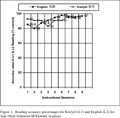
The experiment implemented a modified version of the French Creole model, using a small group of learners in grades 5 and 6 identified by their teachers as having severe reading problems. The experiment was conducted in six intensive sessions each of one week's duration over three terms, and was modified to allow for 45 minutes of instruction in Kwéyòl and one hour of English in each instructional session. A single subject research design (Neuman & McCormick, 1995) was used in the experiment because it allowed for the subjects to be used as their own controls. Included in the experiment were two boys and a girl, all native speakers of Kwéyòl, drawn from a larger group who had been found to be reading two to four grade levels below their required age. By the end of the experiment, two of the children who had been beginning readers were reading at grade 1 level; the oldest boy, Ado, who had been reading at grade 1 level with an accuracy rate of 85.5% in English at the start of the study was reading grade 3 materials fluently and had a 97% accuracy score in the last recorded session, as shown in Figure 1. Results for Kwéyòl literacy were also very encouraging. All the children could read several of the Kwéyòl folk tales included in the reading selection independently.

Reading accuracy percentages for Kwéyòl (L1) and English (L2) for Ado (from Simmons-McDonald, in press)
The concluding statement pointed to the fact that, although only a scaleddown version of the French Creole model had been implemented, “all the subjects who had been listed as being at risk at the start of the study and who had only limited word recognition abilities at the kindergarten level developed fluency in reading texts at least one grade level higher than their levels of proficiency at the start of the study. In the case of the oldest child, gains in accuracy in both languages exceeded expectations, as this subject was able to read texts at grade 3 level by the end of the experiment” (Simmons-McDonald, in press). It was clear that the integrated and culturally rich literature base advocated by the model fully engaged the learners and encouraged development across language varieties.
Elsewhere, experiments have used literature-based approaches in vernacular literacy programs. One experiment with African American Vernacular English (AAVE) speaking students and other students from different minority groups who were considered to be at risk was reported by Rickford (1999). Rickford proposed two “essential means” for helping schools succeed in the teaching of reading to African American and other minority populations. These were “increased use of culturally congruent literature … the inclusion of more tests in which students can see characers like themselves portrayed,” and modification of the “teaching and testing of reading comprehension … to make it more engaging and challenging” (1999, p. xii). Among other benefits, Rickford reported positive results in the literacy development of the students in her study.
The shift toward other approaches such as those used in the studies discussed in this section is not uncommon. Gerbault reported that such a shift in practice reflected the shift in pedagogical theory “from a focus on teaching to a focus on learning and ‘learner-centredness’ that had implications for a number of theoretical positions regarding the pedagogy of literacy” (1997, p. 147). She pointed out that this pedagogy “borrowed principles from a variety of pedagogical theories,” and that it “also developed its own principles to cope with specific challenges in the practice of teaching vernacular literacy” (1997, p. 144). Some of these principles include the use of approaches that focus more on learners and on their active participation in lessons; on the integration of reading, writing, and numeracy skills; and on teaching initial literacy in the language that the learner can speak. Gerbault noted that these approaches have also been used in adult programs as well.
The selection of articles included in Tabouret-Keller et al. (1997) gave indications of some similar developments in adult programs in global contexts; Siegel (1999b) provided a listing of comparable programs that have been reported on in formal and nonformal education. As noted earlier, Siegel commented on the scant research available and observed that most of the studies done, including some discussed in the foregoing sections, have been done on instrumental programs that used Creole as the medium of instruction. The absence of research data on some programs and approaches as well as scant descriptions of the procedures used in some programs make it difficult to compare the effects of these programs on different groups of Creole and CIV speakers and also make replication of the studies in different contexts impossible. Further, the lack of published evidence showing the benefits of selected pedagogical approaches on speakers of Creoles and CIV makes the task of promoting the inclusion of Creole and CIV in formal education systems more difficult when it is precisely in that context—in which the majority of Creolespeaking children are enrolled—that such programs are likely to have a positive and lifelong impact. Governments in the Caribbean and possibly elsewhere remain skeptical about the efficacy of vernacular literacy or vernacular education programs. It is only by providing evidence about program efficacy based on experiments using different approaches to literacy instruction, describing these approaches carefully, and collecting data on their relative benefits to creole and CIV groups, that informed decisions will be made. Applied linguists have much to contribute to these ongoing efforts.
ANNOTATED BIBLIOGRAPHY
Craig, D. (1999). Teaching language and literacy: Policies and procedures for vernacular situations. Georgetown, Guyana: Education and Development Services Inc.
This book is a rich resource for teachers of students who speak Creole and CIV as a native language and who are learning a standard language in school. Craig carefully presents issues related to the development of vernacular education in the Caribbean and elsewhere, and he does a close analysis of the results of regional examinations to show that Creole and CIV speakers within the region are at a disadvantage. One of the strengths of the text is its careful explication of the theoretical positions on which the TESORV model is based. Each of the teaching and learning principles that are discussed in the earlier section of the book is elaborated and exemplified in the second part in the syllabus resources. The text also presents and explains procedures for primary, post-primary, and secondary education levels. It presents an eclectic approach that embraces, explicates, and provides suggestions for using contrastive approaches to show morphological and syntactic differences between internationally accepted English (IAE) and CIVs. It presents word formation principles with a wealth of examples; explains and provides examples and teaching points on syntax. A very useful syllabus resource is one titled “The Vernacular in our Lives,” that provides help on how to include the vernacular in the classroom for purposes of maintaining the home language and culture of the children and for strengthening their language awareness. This much-needed text fills a large gap in the teacher training repertoire in the Caribbean by presenting valuable background on linguistics and the practice of teaching language that student teachers need to help them cater to the needs of Creole and CIV speakers.
Rickford, A. (1999). I can fly. Lanham, MD: University Press of America.
This text exemplifies one approach that uses culturally relevant literature to motivate adolescent AAVE-speaking students and students from other minority groups to read, discuss literature and engage in critical thinking at a high level. Written as a dissertation, the book in all its aspects presents the kind of careful exposition and analysis that allows authorities to evaluate the principles and procedures of an approach and make informed decisions about it. The first part presents the conceptual framework and a description of the situational contexts and sample for the study. The second part focuses on the analysis of the narratives that were used. The results, presenting both qualitative and quantitative analyses, provide interesting insights into the responses of the students to the experiment itself. This text is included because it presents a practical approach to dealing with the problems of AAVE speakers and other minority students within the school system and the positive results provide the hope and certitude that inequalities in education can be addressed and can produce positive outcomes for speakers of minority dialects.
Tabouret-Keller, A., Le Page, R., Gardner-Chloros, P., & Varro, G. (Eds.). (1997). Vernacular literacy: A re-evaluation. Oxford: Clarendon Press.
This text provides a global perspective of the issues related to vernacular literacy and a review of some programs that have been undertaken in several countries. The contributions in the first part of the text focus on broad issues related to vernacular literacy, including political, social, economic and pedagogical concerns in different contexts. The case studies in the second section provide a basis for comparison of different programs that have been done in different nations. The comprehensive coverage of theoretical and practical issues makes this text an important reference for researchers and practitioners in the field of vernacular literacy.
References
Aarons A.,
Gordon B. &
Stewart W. (Eds.).
(1969, Spring/Summer).
Linguistic Cultural Differences in American Education: Special Anthology Issue.
Florida Foreign Language Reporter.
Abrahams R. D. &
Gay G.
1975
Talking black in the classroom.
In P. Stroller (Ed.),
Black American English: Its background and its usage
(pp. 158–
167).
New York:
Dell.
Aceto M. &
Williams J. (Eds.).
2003
Contact Englishes of the Eastern Caribbean.
Amsterdam:
Benjamins.
Bialystok E. (Ed.).
1991
Language processing in bilingual children.
Cambridge:
Cambridge University Press.
Bollée A.
1993
Language policy in the Seychelles and its consequences.
International Journal of the Sociology of Language,
102,
85–
99.Google Scholar
Bryan B. &
Burnette R.
2003
Language variation and language use among teachers in Dominica.
In M. Aceto &
J. Williams (Eds.),
Contact Englishes of the eastern Caribbean
(pp. 141–
153).
Amsterdam:
Benjamins.
Carrington L.
1968
English language learning problems in the Caribbean.
Trinidad & Tobago Modern Language Review,
No. 1.Google Scholar
Carrington L.
1969
Deviations from standard English in the speech of primary school children in St. Lucia and Dominica.
IRAL,
7
(3),
165–
184.Google Scholar
Carrington L.
1976
Determining language education policy in Caribbean sociolinguistic complexes.
International Journal of the Sociology of Education,
8,
127–
143.Google Scholar
Carrington L.
1997
Social contexts conducive to the vernacularization of literacy.
In A. Tabouret-Keller,
R. LePage,
P. Gardner-Chloros, &
G. Varro (Eds.),
Vernacular literacy: A re-evaluation
(pp. 82–
92).
Oxford:
Clarendon Press.
Carrington L.,
Borely C., &
Knight H.
1972a
‘Away Robin run’: A critical description of the teaching of the Language Arts in the primary schools of Trinidad and Tobago.’
St. Augustine, Trinidad:
University of the West Indies Institute of Education.
Carrington L.,
Borely C., &
Knight H.
1972b
The linguistic exposure of Trinidad children.
St. Augustine, Trinidad:
University of the West Indies Institute of Education.
Craig D.
1966
Teaching English to Jamaican Creole speakers: A model of a multidialect situation.
Language Learning,
16
(1 & 2),
49–
61.Google Scholar
Craig D.
1976
Bidialectal education: Creole and standard in the West Indies.
International Journal of the Sociology of Language,
8,
93–
134.Google Scholar
Craig D.
1980
Models for educational policy in creole-speaking communities.
In A. Valdman &
A. Highfield (Eds.),
Theoretical orientations in creole studies
(pp. 245–
266).
New York:
Academic Press.
Craig D.
1983
Teaching standard English to nonstandard speakers: Some methodological issues.
Journal of Negro Education,
52
(1),
65–
74.Google Scholar
Cummins J.
1993
Bilingualism and second language learning.
Annual Review of Applied Linguistics,
13,
51–
70.Google Scholar
Cummins J.
1994
Knowledge, power and identity in teaching English as a second language.
In F. Genessee (Ed.),
Educating second language children
(pp. 33–
58).
Cambridge:
Cambridge University Press.
Dalphinis M.
1985
Caribbean and African languages.
London:
Karia Press.
Dalphinis M.
1986
Language and communication: Problems and resolutions of the Creole question within the British educational system.
In A. Saakana &
A Pearse (Eds.),
Toward the decolonization of the British educational system.
(pp. 79–
94).
London:
Frontline Journal/Karhak House.
DeJean Y.
1993
An overview of the language situation in Haiti.
International Journal of the Sociology of Language,
102,
73–
83.Google Scholar
Devonish H.
1986a
The decay of neo-colonial official language policies. The case of the English-lexicon Creoles.
In M. Görlach &
J. Holm (Eds.),
Focus on the Caribbean
(pp. 23–
51).
Amsterdam:
Benjamins.
Devonish H.
1986b
Language and liberation: Creole language and politics in the Caribbean.
London:
Karia Press.
Durizot P.
1996
La question du Créole à l'école en Guadeloupe.
Paris:
L'Harmattan.
Edwards V.
1976
Effects of dialect on the comprehension of West Indian children.
Educational Research,
18
(2),
83–
95.Google Scholar
Edwards V.
1979
The West Indian language issue in British schools.
London:
Routledge & Kegan Paul.
Fasold R. W.
1971
What can an English teacher do about nonstandard dialect?
In R. Jacobson (Ed.),
Studies in English to speakers of other languages and standard English to speakers of a non-standard dialect
(pp. 82–
91).
New York State English Council.
Feigenbaum I.
1975
The use of nonstandard English in teaching standard: Contrast and comparison.
In P. Stroller (Ed.),
Black American English, its background and its usage
(pp. 143–
167).
New York:
Dell.
Fishman J., &
Leuders-Salmon E.
1972
What has the sociology of language to say to the teacher? On teaching the standard variety to speakers of dialectal or sociolectal varieties.
In J. Cazden &
D. Hymes (Eds.),
Functions of language in the classroom
(pp. 67–
83).
New York:
Teachers College Press.
Gerbault J.
1997
Pedagogical aspects of vernacular literacy.
In A. Tabouret-Keller
R. Le Page,
P. Gardner-Chloros, &
G. Varro (Eds.),
Vernacular literacy: A re-evaluation
(pp. 142–
185).
Oxford:
Clarendon Press.
Jacobson R. (Ed.)
1971
Studies in English to speakers of other languages and standard English to speakers of a non-standard dialect.
New York State English Council.
Kephart R.
2003
Creole English on Carriacou: A sketch and some implications.
In M. Aceto &
J. Williams (Eds.),
Contact Englishes of the Eastern Caribbean
(pp. 227–
239).
Amsterdam:
Benjamins.
Kochman T.
(1969, Spring/Summer).
Social factors in the consideration of teaching Standard English.
In A. Aarons,
B. Gordon, &
W. Stewart (Eds.),
Linguistic and cultural differences in American education: Special anthology issue.
Florida Foreign Language Reporter,
pp. 87–
92.
Kochman T.
1972
Black American speech events, and a language program for the classroom.
In C. Cazden,
V. John, &
D. Hymes (Eds.),
Functions of language in the classroom
(pp. 211–
261).
New York:
Teachers College Press.
Labov W.
1967
Some sources of reading problems for speakers of the Black English vernacular.
In A. Frazier (Ed.),
New directions in elementary English
(pp. 140–
167).
Champaign, IL:
National Council of Teachers of English.
Le Page R. B.
1968
Problems to be faced in the use of English as the medium of instruction in four West Indian territories.
In J. Fishman (Ed.),
Language problems of developing nations
(pp. 431–
443).
New York:
Wiley.
Midgett D.
1970
Bilingualism and linguistic change in St. Lucia.
Anthropological Linguistics,
12,
158–
170.Google Scholar
Morris C., &
Nwenmely H.
1993
The Kwéyòl language and literacy project.
Language and Education,
7
(4),
259–
270.Google Scholar
Neuman S., &
McCormick S. (Eds.).
1995
Single-subject experimental research: Applications for literacy.
Newark, DE:
International Reading Association.
Ovando C., &
Collier P.
1998
Bilingual and ESL classrooms: Teaching in multicultural contexts.
Boston:
McGraw-Hill.
Pollard V.
1993
From Jamaican Creole to standard English: A handbook for teachers.
New York:
Caribbean Research Center, Medgar Evers College.
Roberts P.
1993
Affective factors in the use of creole in the classroom: The resolution of a paradox.
Paper presented at Society of Pidgin and Creole Linguistics conference. Amsterdam.
Siegel J.
1997
Using a pidgin language in formal education: Help or hinderance?
Applied Linguistics,
18
(1),
86–
100.Google Scholar
Siegel J.
1999a
Stigmatized and standardized varieties in the classroom: Interference or separation?
TESOL Quarterly,
33
(4),
701–
728.Google Scholar
Siegel J.
1999b
Creoles and minority dialects in education: An overview.
Journal of Multilingual and Multicultural Development,
20
(6),
508–
531.Google Scholar
Simmons-McDonald H.
1996
Language education policy: The case for Creole in formal education in St. Lucia.
In P. Christie (Ed.),
Caribbean language issues old and new
(pp. 120–
142).
Barbados:
University of West Indies Press.
Simmons-McDonald H.
1998
Developmental patterns in the acquisition of English negation by speakers of St. Lucian French Creole.
In P. Christie,
B. Lalla,
V. Pollard, &
L. Carrington (Eds.),
Studies in Caribbean language II
(pp. 75–
99).
Trinidad and Tobago:
Society for Caribbean Linguistics.
Simmons-McDonald H.
(2000, August).
Language education and the vernacular speaker: A model for multilingual competence.
Paper presented at the 13th Biennial conference of the Society for Caribbean Linguistics, Mona, Jamaica. Forthcoming.
Simmons-McDonald H.
(2001, February).
Vernacular literacy: Influencing policy through pedagogical experimentation.
Paper presented at the annual conference of the American Association for Applied Linguistics Conference, St. Louis, MO.
Simmons-McDonald H.
(in press).
The effects of vernacular instruction on the development of bi-literacy abilities of native speakers of French Creole.
In I. Robertson &
H. Simmons-McDonald (Eds.),
Exploring the boundaries of Caribbean creole languages.
Barbados, Jamaica, Trinidad & Tobago:
University of West Indies Press.
Stroller P.
1975
Black American English, its background and its usage.
New York:
Dell.
Sutcliffe D.
1982
British Black English.
Oxford:
Basil Blackwell.
Swain M., &
Lapkin S.
1991
Heritage language children in an English-French bilingual program.
Canadian Modern Language Review,
47
(4),
635–
641.Google Scholar
Valdman A.
1988
Diglossia and language conflict in Haiti.
International Journal of the Sociology of Language,
71,
67–
80.Google Scholar
Wiley T.
1996
Literacy and language diversity in the United States.
McHenry, IL:
Center for Applied Linguistics/Delta Systems.
Williams J., &
Snipper G.
1990
Literacy and bilingualism.
New York:
Longman.
Wilson D.,
Smikle J., &
Grant N.
2001
Using children's literature to improve literacy skills in early primary grades: A study of the literature-based language arts project 1998–2000.
Kingston, Jamaica:
University of the West Indies.
Winch C., &
Gingell J.
1994
Dialect interference and difficulties with writing: An investigation in St. Lucian primary schools.
Language and Education,
8
(3),
157–
182.Google Scholar
Winer L.
1990
Orthographic standardization for Trinidad and Tobago: Linguistic and sociopolitical considerations.
Language Problems and Language Planning,
14
(3),
237–
268.Google Scholar
Winer L.
1993
Teaching speakers of Caribbean English Creoles in North American classrooms.
In W. A. Glowka &
C. D. Lance (Eds.),
Language variation in North American English: Research and teaching
(pp. 191–
198).
New York:
Modern Language Association of America.
Reading accuracy percentages for Kwéyòl (L1) and English (L2) for Ado (from Simmons-McDonald, in press)
 You have
Access
- 17
- Cited by