Introduction
Sociality confers many benefits, particularly with respect to antipredatory defences (Krause and Ruxton, Reference Krause and Ruxton2002; Sansom et al. Reference Sansom, Lind and Cresswell2009). Group formation can, however, be counterintuitive by increasing competition for scarce resources, mating opportunities, and the conspicuousness of prey to predators, all of which can directly impede fitness (Alexander, Reference Alexander1974; Sherman et al. Reference Sherman, Lacey, Reeve and Keller1995). Most notable is increased disease susceptibility owing to chronic stress induced by social competition (Glaser and Kiecolt-Glaser, Reference Glaser and Kiecolt-Glaser2005; Proudfoot and Habing, Reference Proudfoot and Habing2015; Schneider et al. Reference Schneider, Scharffetter, Wagner, Boesch, Bruchhaus, Rimbach and Roeder2016), and the close proximity of conspecifics facilitating disease propagation amongst hosts (Côté and Poulin, Reference Côté and Poulin1995). This often results in more intense, prevalent infections as group size increases (reviewed in Patterson and Ruckstuhl, Reference Patterson and Ruckstuhl2013).
At a population level, a significant determinant of a disease transmission pathway is a group's social structure, which arises from consistent interaction patterns between conspecifics (Whitehead, Reference Whitehead1997; Wey et al. Reference Wey, Blumstein, Shen and Jordán2008). The rate of disease transmission depends on the ‘socialness’ and infection status of group members. Well-connected individuals, for example, are at greater risk of acquiring infections (Bell et al. Reference Bell, Atkinson and Carlson1999; Danon et al. Reference Danon, Ford, House, Jewell, Keeling, Roberts, Ross and Vernon2011), and can subsequently act as superspreaders of disease (Lloyd-Smith et al. Reference Lloyd-Smith, Schreiber, Kopp and Getz2005; Craft, Reference Craft2015). As infection becomes more prevalent within a population, conspecifics often respond to visual and/or chemical cues indicative of infection by modifying their associative preferences to reduce their infection risk. Such behavioural avoidance has been documented in a number of taxa, including amphibians (Kiesecker et al. Reference Kiesecker, Skelly, Beard and Preisser1999; Koprivnikar and Penalva, Reference Koprivnikar and Penalva2015), fish (Ward et al. Reference Ward, Duff, Krause and Barber2005) and mammals (Curtis, Reference Curtis2014; Poirotte et al. Reference Poirotte, Massol, Herbert, Willaume, Bomo, Kappeler and Charpentier2017).
Infected hosts often show remarkable adaptive behavioural traits aimed at combatting disease. Infected fish, for example, frequent warmer thermal conditions outside the thermal tolerance of their associated pathogens to ‘self-medicate’ against infection (see Mohammed et al. Reference Mohammed, Reynolds, James, Williams, Mohammed, Ramsubhag, van Oosterhout and Cable2016). Alternatively, infected hosts can isolate themselves to protect the integrity of a group. Extreme forms of altruistic behaviour, such as ‘altruistic suicide’, have been observed within social insects including ants and honeybees; upon acquiring infection, these hosts remove themselves from a colony to prevent disease epidemics (Heinze and Walter, Reference Heinze and Walter2010; Rueppell et al. Reference Rueppell, Hayworth and Ross2010). Conversely, by forming larger groups, parasite ‘attacks’ can become diluted amongst group members (Duncan and Vigne, Reference Duncan and Vigne1979; Rätti et al. Reference Rätti, Ojanen and Helle2006), with such encounter-dilution effects mitigating parasite-mediated costs of sociality (Mooring and Hart, Reference Mooring and Hart1992).
Whether or not infected individuals increase their contact rates with uninfected conspecifics remains questionable. Indeed, ‘offloading’ parasites onto conspecifics could be beneficial in terms of alleviating parasite burdens and their associative costs, whilst also serving to ‘vaccinate’ recipients against subsequent infections (Faria et al. Reference Faria, van Oosterhout and Cable2010). Using the well-studied social Trinidadian guppy and its directly transmitted ectoparasite, Gyrodactylus turnbulli, we investigate how parasitism drives adaptive behavioural responses in hosts, which could aid in alleviating parasite burdens. Specifically, we investigate: (a) if association times and direct contact patterns between fish change depending on infection status, (b) assess the significance of these behavioural responses in determining successful parasite transmission, and (c) assess how the parasite infrapopulation influences transmission dynamics, irrespective of behaviour.
Materials and methods
Ethics statement
All applicable institutional and/or national guidelines for the care and use of animals were followed. Procedures and protocols were conducted under UK Home Office license (PPL 302876) with approval by the Cardiff University Animal Ethics Committee.
Host and parasite origin
Experimental Trinidadian guppies (Poecilia reticulata) were laboratory-reared descendants of a wild stock caught from the Lower Aripo River, 2012. Fish were initially housed at Exeter University, before being transferred to Cardiff University in October 2014. Here, fish were maintained in 70 L dechlorinated water tanks under standard conditions of 24 ± 1 °C on a 12 h light: 12 h dark photoperiod (lights on 07:00–19:00), and fed daily with Aquarian tropical fish flakes subsidized with Daphnia magna and Artemia spp.
Experimental fish were infected with G. turnbulli (strain Gt3), originating from, and subsequently maintained on, an inbred ornamental guppy stock since 1997. A single parasite was isolated onto a naïve ‘culture’ fish, and following successful establishment reproduced forming a highly inbred parasite population. This population has since been maintained under standard conditions in culture pots; each containing a minimum of four naïve culture fish collectively infected with ca. 30 G. turnbulli worms. Naïve fry were added to the culture pots biweekly to prevent parasite extinction.
Experimental design
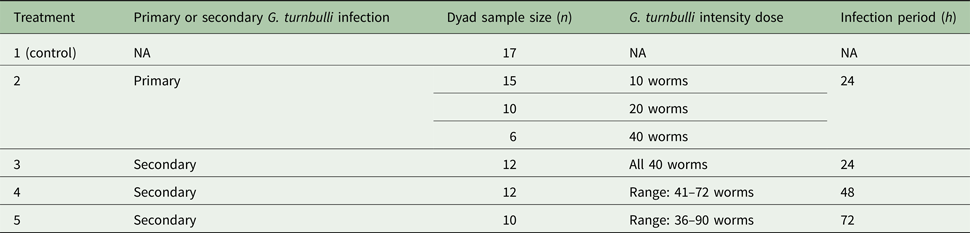
Only female guppies were used during experimental trials due to their increased propensity to shoal compared with males (Griffiths and Magurran, Reference Griffiths and Magurran1998). In the wild, females typically form small shoals (2–20 individuals), between which males move in search of mating opportunities (Croft et al. Reference Croft, Krause and James2004). Thus, by excluding males we eliminated potentially confounding factors associated with mating attempts in influencing parasite transmission. Unfamiliarized female guppies were size-matched according to their standard length (SL; ±4·1 mm) into pairs (n = 50), and individually housed in 1-L-dechlorinated water under standard conditions. As infection histories of these fish differed, we categorized dyads into five treatments summarized in Table 1. Treatment 1 utilized parasite naïve guppies and formed a control group. During trials these fish were sham infected to account for handling time but never exposed to parasites. Naïve guppies were also used for treatment 2, which were experimentally infected with a predetermined dose of G. turnbulli worms (‘Primary infection’: see Table 1), and tested 24 h post-infection. Treatments 3–5 comprised dyads that had experienced G. turnbulli infection in a previous experiment (ranging from 20 to 40 worms), but had been clear of parasites for a minimum of three months prior to this experiment. During a trial, one fish in each dyad was experimentally infected with 40 G. turnbulli worms (‘Secondary infection’), and tested 24 (treatment 3), 48 (treatment 4) and 72 h (treatment 5) post-infection.
A summary of the experimental treatments (1–5) including Gyrodactylus turnbulli exposure status (primary or secondary infection), dyad sample size (n), G. turnbulli dose administered and infection time before a behavioural trial

Behavioural trials took place in a partitioned glass tank (30 × 30 × 45 cm3) filled with 7 L-dechlorinated water and maintained at 24 ± 1 °C. A removable translucent barrier separated dyads prior to a trial, allowing visual but not physical contact. The tank was placed in an experimental chamber surrounded by white fabric on three sides to prevent external disturbance, with one side left open for behavioural observations. A 2 cm2 grid attached to the sides of the tank enabled visual estimation of the distances between conspecifics. The arena was lit from above using daylight mimicking strip lights (Sylvania T5 F13W/54-765 G5 Luxline Standard Daylight bulb) diffused by white fabric.
Experimental procedure
Each dyad underwent a two-stage trial comprising behavioural and parasite transmission procedures. On day 1, dyads were placed into the partitioned experimental tank for a 24 h acclimation period. On day 2, both guppies were transferred from the tank to individual 1-L-dechlorinated water pots using a plastic container. One fish in each dyad was then infected with a predetermined number of G. turnbulli worms (see Table 1 for G. turnbulli dose and sample sizes). Experimental infections entailed sacrificing a heavily infected culture fish, and placing it in close proximity to a temporarily anaesthetized recipient fish (using 0·02% buffered MS222), allowing direct transmission of worms. The infection process was observed continuously under a dissection microscope with fibre optic illumination, and once infected a recipient was revived in 1-L-dechlorinated water. Its uninfected conspecific was sham infected to control for handling time and each pair returned to the partitioned tank for a subsequent 24 h, thus ensuring fish were familiar with this environment to minimize exploratory behaviour during a subsequent trial.
On day 3, both fish were removed from the partitioned tank, as above, temporarily anaesthetized and screened under a dissection microscope to quantify the starting G. turnbulli intensity of a donor, and confirm the uninfected status of their conspecific. The number of individual worms was counted three times to ensure exact intensities were recorded. Variability in G. turnbulli start intensity, particularly for treatments 4 and 5 (see Table 1) were observed given the parasites 24 h reproductive potential (Bakke et al. Reference Bakke, Cable and Harris2007). Fish were returned to the partitioned tank for 10 min prior to removal of the translucent barrier, which allowed dyads access to one another. A 10 min behavioural trial began when one guppy crossed the central partition line. During a trial, the proportion of time dyads spent associating was quantified (seconds) using a stopwatch based on direct observation. An association was defined as when fish were ⩽ four body lengths from one other; a standard measure of shoaling (Pitcher, Reference Pitcher1983). Additionally, the number of direct contacts initiated by the infected fish was tallied. Infected guppies exhibit clamped fins (Cable et al. Reference Cable, Scott, Tinsley and Harris2002), and appear to ‘rub-up’ against conspecifics, although previously only anecdotal evidence of such behaviour exists (Croft et al. Reference Croft, Edenbrown, Darden, Ramnarine, van Oosterhout and Cable2011; Stephenson et al. Reference Stephenson, Young, Fox, Jokela, Cable and Perkins2017). This unique behavioural response of infected fish coupled with pathological symptoms of infection made the identity of each fish obvious during a trial. A direct contact was therefore defined as when an infected fish instigated skin–skin contact (typically lasting <1 s) with an uninfected conspecific, which is particularly important for facilitating G. turnbulli transmission (Bakke et al. Reference Bakke, Cable and Harris2007). Following a behavioural trial, both fish were again individually removed from the partitioned tank, temporarily anaesthetized and screened to quantify successful transmission of individual G. turnbulli worms.
To assess the significance of G. turnbulli infrapopulation intensity on potential G. turnbulli transmission dynamics, guppies remained anaesthetized following screening, and were placed in the same Petri dish submerged in 1 cm depth dechlorinated water. Using a pipette tip, fish were manipulated so that they were in direct contact with one another. The number of G. turnbulli worms to transmit from a donor to a recipient fish was then monitored for a 5 min period. At the end of a trial, guppies were chemically treated using 0·1% levamisole and screened clear of infection, on three consecutive inspections, before returning to stock tanks.
Statistical analysis
Statistical analyses were performed in R (3.0.2; R Development Core Team, 2009). Using the lme4 library (Bates et al. Reference Bates, Maechler, Bolker and Walker2014), two Generalized Linear Mixed Effects Models (GLMMs), fitted with binomial family and ‘logit’ error structures, were used to assess variables influencing the proportion of time dyads spent associating (the dependent term in both models). The first model included donor G. turnbulli intensity, dyad mean SL, treatment and interactions between each variable, as independent terms. Treatment 1 data were excluded from this model, as there was no possible relationship between the uninfected control dyads and parasite intensity. To address differences in dyad association time between treatments (including treatment 1), a second GLMM was performed whereby dyad mean SL, treatment and an interaction between these terms were included in a model as independent terms, with dyad association time the dependent term. Parasite intensity was excluded from this model. Both models included dyad ID as a random term to account for repeated measures.
Using the glmmADMB package (Bolker et al. Reference Bolker, Brooks, Clark, Geange, Poulsen, Stevens and White2008) a negative binomial GLMM was used to investigate the effects of dyad mean SL, donor G. turnbulli intensity, association time and treatment on the total number of direct contacts observed between dyads, instigated by an infected donor. Interactions between association time × G. turnbulli intensity and treatment × G. turnbulli intensity were incorporated into the model. A final negative binomial GLMM investigated the significance behavioural trials, transmission trials, dyad mean SL, treatment and donor G. turnbulli intensity had on determining total G. turnbulli transmission. Dyad ID was incorporated into each model as a random term to account for repeated measures. Models were refined via the sequential removal of non-significant terms to minimize Akaike Information Criterion (Pinheiro and Bates, Reference Pinheiro and Bates2000; Bates et al. Reference Bates, Maechler, Bolker and Walker2014), and model robustness assessed using residual plots.
Results
Behavioural trials
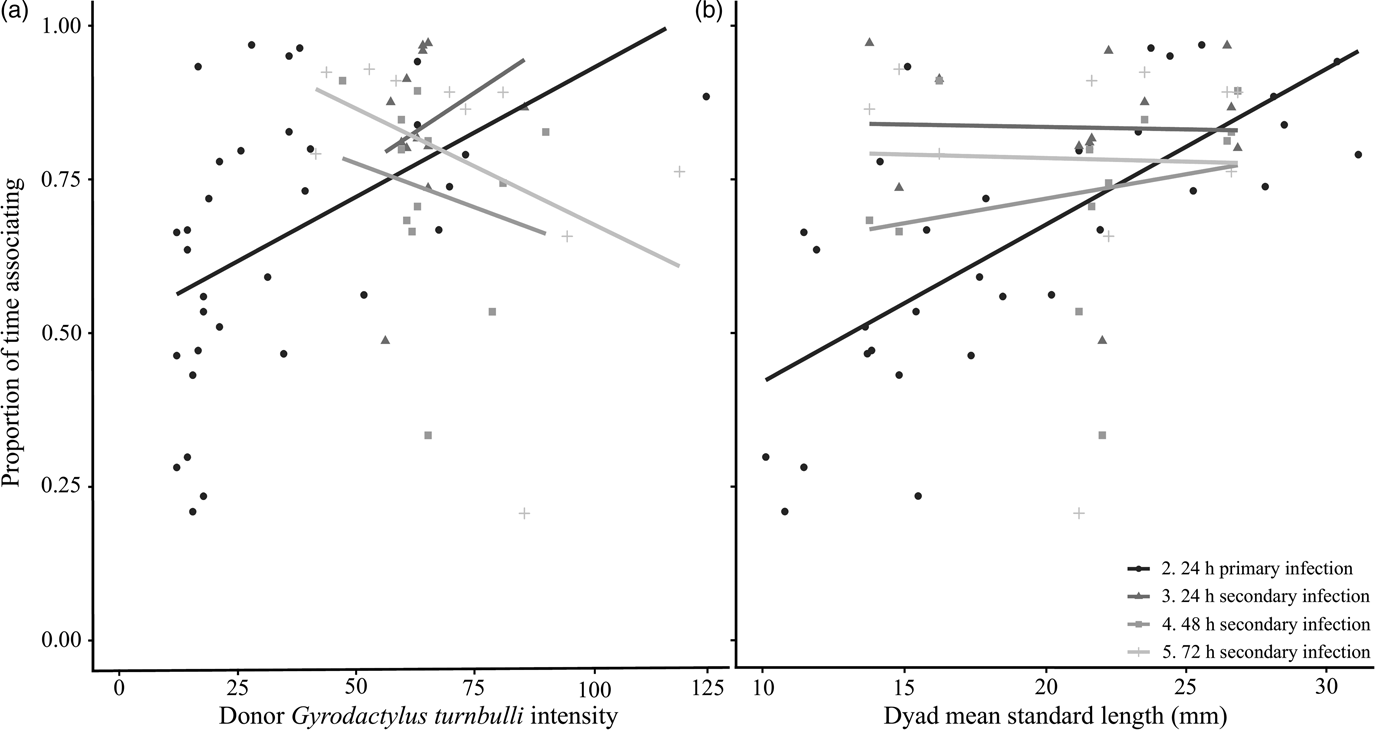
Infection with G. turnbulli significantly influenced the proportion of time dyads spent associating (GLMM: z = −7·27, s.e. = 0·022, P < 0·001), which also differed between experimental treatments (GLMM: z = −4·33, s.e. = 0·189, P < 0·001). For fish infected with G. turnbulli up to 24 h (Treatments 2 and 3), the time dyads spent associating increased with parasite intensity (Fig. 1a). Conversely, for dyads experiencing secondary infections of 48 and 72 h, association time decreased as a donor infection intensified (Treatments 4 and 5, respectively: Fig. 1a). Dyad mean SL significantly influenced association time, which also depended on treatment (Dyad mean SL × Treatment interaction, GLMM: z = −10·48, s.e. = 0·004, P < 0·001). For control dyads and naïve fish enduring a 24 h primary G. turnbulli infection (treatment 2), larger dyads spent more time associating (Fig. 1b). For fish infected with 24, 48 and 72 h secondary infections (treatments 3–5, respectively), the relationship between dyad shoaling time and mean SL was less pronounced (Fig. 1b).
The relationship between the proportions of time dyads spent shoaling and (a) Gyrodactylus turnbulli intensity of the donor fish and (b) dyad mean standard length (SL; mm). The solid lines represent the regression between the proportion of time dyads spent associating on (a) donor G. turnbulli intensity and (b) dyad mean SL.

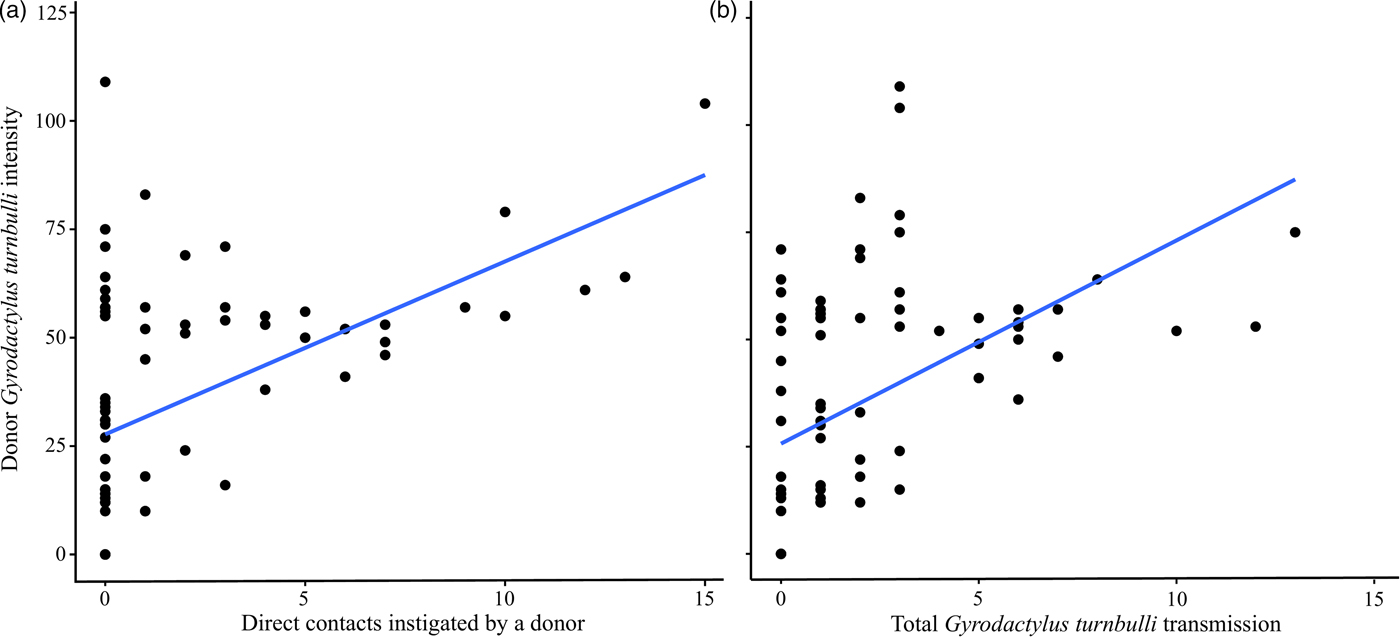
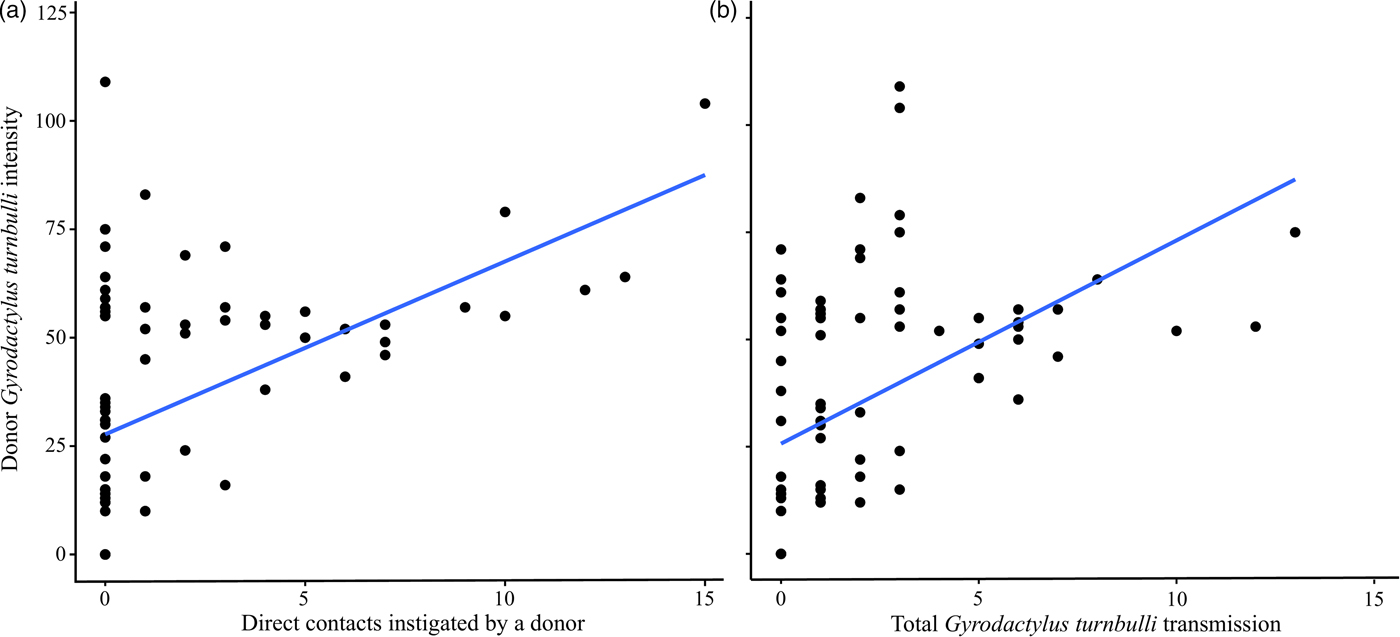
Association time and G. turnbulli intensity significantly influenced the number of direct contacts initiated by an infected donor towards its uninfected conspecific. Specifically, more direct contacts occurred the longer dyads spent associating (GLMM: z = 1·98, s.e. = 0·767, P < 0·005), and as a donors parasite intensity increased (GLMM: z = 2·80, s.e. = 0·029, P = 0·0309; Fig. 2a). However, only on two occasions did successful G. turnbulli transmission occur as a consequence of host behaviour.
Positive association between donor Gyrodactylus turnbulli intensity (a) the number of direct contacts instigated by an infected donor fish, and (b) the number of parasites to transmit to an uninfected recipient over a 5-minute duration when both fish were anaesthetized and placed in direct contact. The solid line represents the regression between a donor's G. turnbulli intensity on (a) the number of direct contacts instigated by a donor, and (b) the number of worms transmitted to an anaesthetized recipient host.
Gyrodactylus turnbulli transmission
When investigating the potential for G. turnbulli transmission following host behavioural trials (i.e. placing an anaesthetized donor fish in direct contact with an uninfected recipient for a 5 min period), we found that the total number of G. turnbulli to transmit was significantly influenced by a donors’ parasite intensity (GLMM: z = 2·09, s.e. = 0·006, P = 0·037). As parasite intensity increased, the number of parasites transmitting to a recipient also increased (Fig. 2b). The duration of infection did not affect total G. turnbulli transmission (treatment main effect: GLMM: z = 1·08, s.e. = 0·10, P = 0·278).
Discussion
Here we show that infected fish significantly increase direct contact rates with conspecifics. As uninfected fish did not perform such behaviour, we speculate that this parasite-driven host behavioural response attempts to reduce parasite burdens. Additionally, we show that association times between fish exposed to secondary G. turnbulli infection was less than those experiencing infection for the first time. We speculate that fish build an infection cue repertoire, enabling them to rapidly identify and subsequently avoid infectious conspecifics.
Our results are consistent with Croft et al. (Reference Croft, Edenbrown, Darden, Ramnarine, van Oosterhout and Cable2011), who provided anecdotal evidence of infected guppies initiating direct body contact with conspecifics. Although gyrodactylid infections do cause host behavioural modifications (see Bakke et al. Reference Bakke, Cable and Harris2007), these are merely by-products of infection (e.g. Kolluru et al. Reference Kolluru, Grether, Dunlop and South2009). Behavioural manipulation by G. turnbulli would imply host neurochemical interference (Adamo and Webster, Reference Adamo and Webster2013), which has previously never been shown by these ectoparasites. Furthermore, G. turnbulli worms did not exhibit a strong transmission propensity during behavioural trials, indicating that increased contact rates are likely an adaptive behavioural response of the host as opposed to parasite manipulation.
Alleviating ectoparasite burdens often involves hosts participating in interspecific, intraspecific and/or self-grooming behaviours (reviewed in Hart, Reference Hart2011). Intraspecific grooming is particularly evident in higher animal taxa, most notably mammals such as ungulates. Reciprocal allogrooming in impala (Aepyceros melampus), for example, significantly reduced tick infestations by up to 95% that of controls (Mooring et al. Reference Mooring, McKenzie and Hart1996). Fish also engage in grooming activity, whereby cleaners including gobies, wrasse or shrimps remove clientele ectoparasites, which provides nutritional and health benefits for both parties, respectively (Grutter, Reference Grutter1996; Whiteman and Côté, Reference Whiteman and Côté2002; Titus et al. Reference Titus, Vondriska and Daly2017). Cleaning services are typically concentrated to tropical coral reefs (Côté, Reference Côté2000), although freshwater intraspecific examples do exist (e.g. Common carp; Soto et al. Reference Soto, Zhang and Shi1994). For fishes that do not engage in cleaning services, alternative parasite removal strategies are employed. For example, physical dislodgement of parasites through skin abrasion against substrata (Urawa, Reference Urawa1992), behavioural fever (Reynolds et al. Reference Reynolds, Casterlin and Covert1976; Mohammed et al. Reference Mohammed, Reynolds, James, Williams, Mohammed, Ramsubhag, van Oosterhout and Cable2016) or as observed here increasing contact frequencies with uninfected conspecifics in the early stages of infection. The number of direct contacts instigated by infected guppies towards their uninfected conspecifics significantly increased with G. turnbulli intensity. Direct contact between hosts governs G. turnbulli transmission dynamics (see Johnson et al. Reference Johnson, Lafferty, van Oosterhout and Cable2011), and it could be expected that parasite transmission increase linearly with direct contact frequencies. Contrary to our predictions, successful G. turnbulli transmission only occurred twice during behavioural trials, irrespective of the number of direct contacts between infected and uninfected fish. This indicates that such behavioural responses adopted by a host were ineffective in reducing parasite burdens, at least in the initial stages of infection.
Transmission dynamics are mediated by a complexity of factors from both host and parasite perspectives (see Stephenson et al. Reference Stephenson, Young, Fox, Jokela, Cable and Perkins2017). Ectoparasites adopting a direct transmission strategy risk dislodgment and subsequent mortality. Dislodged G. turnbulli, for example, have a maximal off-host survival of 31 h at 25 °C (Schelkle et al. Reference Schelkle, Snellgrove and Cable2013). In the initial stages of infection when the parasite infrapopulation is low, worms do not compete for host resources and therefore the transmission risk outweighs the cost of remaining on an initial host. Although not examined here, in the later stages of infection competition for resources due to a greater parasite density, coupled with activation of the host's immune response (Buchmann and Bresciani, Reference Buchmann and Bresciani1998), may prompt parasite transmission away from unfavourable host microhabitats (Boeger et al. Reference Boeger, Kritsky, Pie and Engers2005; Pie et al. Reference Pie, Engers and Boeger2006).
For parasite naïve controls, dyad association time increased with mean SL. Similarly, this trend was observed for dyads experiencing a 24 h primary G. turnbulli infection, although a slight decrease in association time was evident. Larger fish generally have greater shoaling tendencies than smaller, younger individuals (Pitcher et al. Reference Pitcher, Magurran and Allan1983; Paxton, Reference Paxton1996; Rodgers et al. Reference Rodgers, Ward, Askwith and Morrell2011). This may be associated with ‘safety in numbers’ as large individuals are more conspicuous to predators. Fish experiencing secondary infections, however, only associated when infection intensities were low. These individuals may have developed a chemical cue repertoire of infection, which overrides their social preferences irrespective of size. During development, individuals imprint on both behavioural and chemical cues of conspecifics to build a ‘phenotypic template’, which is important for social decisions later on in life (see Mateo, Reference Mateo2004). Using these templates, individuals decipher between normal and abnormal cues emitted from conspecifics, to which they can respond accordingly. Such cues important in communicating the infection status of individuals could be associated with a host's immune response.
Fish exhibit both innate and acquired immune responses to gyrodactylid infections (e.g. Scott and Robinson, Reference Scott and Robinson1984; Scott, Reference Scott1985; Cable and van Oosterhout, Reference Cable and van Oosterhout2007), which are directed to the hosts’ epidermis (Richards and Chubb, Reference Richards and Chubb1996). Here, immune by-products, including host complement (Buchmann, Reference Buchmann1998), changes in mucosal secretion composition (Moore et al. Reference Moore, Kaattari and Olson1994), and cortisol release into the surrounding water (Stoltze and Buchmann, Reference Stoltze and Buchmann2001) translate into chemical cues indicative of infection. Additionally, fish may also perceive excretory compounds of ectoparasites, although to date this remains unknown. Detection of these cues subsequently mediates avoidance behaviours to reduce infection risk, particularly in the late stages of infection (Stephenson and Reynolds, Reference Stephenson and Reynolds2016). Furthermore, the combination of both innate and acquired immunity during secondary infections could have emitted stronger ‘infection cues’ resulting in a significant reduction in the association times between infected and uninfected fish exposed to 48 and 72 h secondary G. turnbulli infections. It should be noted, however, that acquired resistance diminishes post-recovery (Scott, Reference Scott1985; Cable and van Oosterhout, Reference Cable and van Oosterhout2007), and as our experimental fish had previously been uninfected for over 3 months, it is unlikely that acquired immune responses of infected fish contributed to the production of cues indicative of infection. Alternatively, the development and retention of a chemical cue repertoire of infection during primary parasite exposure may have been important in instigating evasive fish behaviours during subsequent infection exposure. Such parasite-mediated avoidance behaviour is particularly beneficial considering the severe pathological costs of gyrodactylid infection (reviewed in Bakke et al. Reference Bakke, Cable and Harris2007).
To conclude, this study shows that in the early stages of infection, parasite-driven behavioural modifications of infected hosts are not an effective strategy for reducing parasite burdens. Such behavioural responses may have greater significance in determining parasite transmission during the later stages of infection, when infra-parasite competition and the host's immune response are more pronounced. However, as infection progresses the benefits may be short-lived, particularly if the parasite's reproductive rate outweighs a host's offloading ability. Successful transmission as a consequence of increased contact rates would also be costly to conspecifics, and is counterintuitive to the evolutionary theory of sociality. Although we provide the first quantified example of such behaviour, it may be more widespread within the Animal Kingdom as infected hosts attempt to alleviate their infections. Finally, this study provides evidence that fish exposed to secondary parasite infections may have developed infection repertoires, enabling them to instigate evasive behaviours towards infectious conspecifics sooner than fish experiencing infection for the first time.
Acknowledgements
We thank Darren Croft for providing the original fish for the experiment and Dayna Lea for technical assistance. MR designed the study; MR, EAA and DL collected the data; MR performed statistical analysis and drafted the manuscript; JC made extensive comments on the manuscript.
Financial support
This research received no specific grant from any funding agency, commercial or not-for-profit sectors.