Significant outcomes
-
∙ The study highlights the important role of peripheral MMP genes in depression and cognitive functions.
Limitations
-
∙ The number of patients and healthy subjects may result in the lack of statistical significance in some cases, which is the limitation affecting the conclusions of our study.
Introduction
Matrix metalloproteinases (MMPs) belong to the group of enzymes that play a particular role in the human body. They are involved in cell migration during development and in the construction of supporting tissue for all internal organs; moreover, they stimulate the growth of neurites. They are active in the production of new blood vessels and are indispensable for the correct development of the skeleton and connective tissue regeneration (Reference Yong, Krekoski, Forsyth, Bell and Edwards1,Reference Romi, Helgeland and Gilhus2). Their pathologic activity was, however, observed in many diseases such as autoimmune disorders, Alzheimer’s disease (AD) (Reference Stomrud, Björkqvist, Janciauskiene, Minthon and Hansson3), multiple sclerosis (SM) (Reference Kurzepa, Bartosik-Psujek, Suchozebrska-Jesionek, Rejdak, Stryjecka-Zimmer and Stelmasiak4), amyotrophic lateral sclerosis (Reference Demestre, Parkin-Smith, Petzold and Pullen5), cancers (e.g. multiple myeloma, malignant melanoma, mammary tumour), hepatic cirrhosis or myocardial infarction (Reference Rosenberg, Sullivan and Esiri6–Reference Yang, Hill and Rosenberg8).
Among the 28 metalloproteinases described so far, 23 can be found in the human organism (Reference Kowalski, Walczak and Majsterek9,Reference Agrawal, Lau and Yong10), but only few are expressed in the human brain. These include both matrix metalloproteinase 2 (MMP-2) and matrix metalloproteinase 9 (MMP-9), the expression of which was found in the frontal cortex, the CA1–CA3 regions of the hippocampus and in the cerebellum (Reference Kaczmarek, Lapinska-Dzwonek and Szymczak11). It is possible to find the tissue inhibitor of MMP 2 (TIMP-2) mRNA in all parts of the brain, though with lower levels in the cerebellum (Reference Kaczmarek, Lapinska-Dzwonek and Szymczak11,Reference Michaluk and Kaczmarek12).
As an object of our analysis we have selected the MMPs which – due to the profile of their activity – may be significant in the aetiology and course of recurrent depressive disorders (rDD). It seems that MMPs have the ability to stimulate numerous proinflammatory mediators such as chemokine CXCL-8, interleukine 1β (IL-1β) or tumour necrosis factor α (TNF-α) (Reference Yong, Krekoski, Forsyth, Bell and Edwards1). MMP-2 and MMP-9 are active in pathologic processes in the peripheral and central nervous system (CNS) (Reference Renaud, Erne and Fuhr13,Reference Mannello and Medda14). They probably have an impact on increased blood–brain barrier permeability (Reference Rascher, Fischmann, Kroger, Duffner, Grote and Wolburg15,Reference Candelario-Jalil, Thompson and Taheri16). The presence of active forms of MMP-2 and MMP-9 was observed in the nuclei of neuronal and glial cells (Reference Wójcik-Stanaszek, Sypecka and Szymczak17). The two metalloproteinases are assigned a special role in the process of neurogenesis and neuroplasticity (Reference Wójcik-Stanaszek, Sypecka and Szymczak17). MMP-2 and MMP-9 have been critically implicated in synaptic circuit remodelling – including structural changes in axon/dendrite structures and dendritic spines – in both healthy subjects (HS) and the affected (Reference Pawlak, Rao, Melchor, Chattarji, McEwen and Strickland18). Moreover, the level of MMP-9 in the cerebrospinal fluid of the patients with SM is considered a potential indicator of disease activity, which may serve as a confirmation of an ongoing inflammatory process (Reference Fainardi, Castellazzi and Bellini19). On the other hand, TIMP-2 demonstrates antiapoptotic properties (Reference Agrawal, Lau and Yong10).
The main aim of this study was to analyse MMP-2 (gelatinase A), MMP-9 (gelatinase B) and TIMP-2 genes on both mRNA and protein levels in patients suffering from rDD as well as to investigate the relationship between MMP-2, MMP-9 and TIMP-2 gene expression and cognitive performance. We provided a hypothesis that MMP-2, MMP-9 and TIMP-2 gene expression levels are higher in the rDD group, which might have an influence on cognitive functions.
Material and methods
Subjects
The study was carried out on a group of 234 subjects aged 20–67 (M=40.61 years, SD=13.76), comprising both patients with rDD (n=139) and control HS (n=95).
The patients were chosen for the experiment based on the ICD-10 inclusion criteria (F 32.0–F 32.2, F 33.0–F 33.8) (20). All the subjects were examined during hospitalisation. Axis I and II disorders (however not depressive episodes) as well as somatic diseases diagnosed and injuries of the CNS, which could have had an impact on cognitive performance, were considered exclusion criteria. Before carrying out the main procedure, case history was obtained for each single case using the standardised Composite International Diagnostic Interview (CIDI) (Reference Patten21).
The HS was composed of HS without any cases of psychiatric disorders in family members. The healthy controls included community volunteers who were accepted to take part in the study on the basis of the psychiatric CIDI interview criteria (Reference Patten21). Subjects with other psychiatric diseases, axis I and II disorders, neurological disorders, or suffering from substance abuse or dependence, were excluded from the experiment.
Based on the diagnostics, interviews and medical data, none of the participants had been diagnosed with any relevant intellectual deficit or a mental disability. At the onset of the experiment, all the subjects were not taking any medications. Neither, did they suffer from any medical illnesses, including inter alia infections and inflammatory or allergic reactions. The control subjects or depressed patients were not treated with the use of the drugs known to influence lipid metabolism, immune responses or endocrine functions. The control subjects had not been taking any medications for at least 2 months before blood sampling. None of the participants was overusing alcohol or smoked excessive amounts of cigarettes; neither had any of them ever taken psychotropic drugs.
Methods
Neuropsychological assessment and severity of depression
The neuropsychological assessment was conducted by trained and qualified neuropsychologists. A comprehensive neuropsychological test battery – that is the Trail Making Test (TMT), the Stroop Test, the Verbal Fluency Test (VFT) and the Auditory Verbal Learning Test (Polish version, AVLT) – was used to evaluate the full scope of cognitive functions. An assessment of depression severity was conducted using the 17-item Hamilton Depression Rating Scale (HDRS). Part A of TMT was conducted to evaluate psychomotor speed, while part B was used to assess visuospatial performance, working memory and executive functions. The Stroop Test measured the effectiveness of verbal working memory, executive functions and attention processes. The VFT evaluated the ability to form and fluently utter words compatible with the given criteria. In the case of evaluating auditory–verbal memory – both direct and delayed – and the effectiveness of learning processes, the Polish equivalent of the Rey AVLT, the so-called AVLT, was applied. A thorough description of the tests can be found in (Reference Lezak22) and (Reference Talarowska, Gałecki, Maes, Bobińska and Kowalczyk23).
The HDRS, Stroop Test, TMT, AVLT and VFT were performed at the onset of the therapy in the case of the patients with rDD. All of them were examined on admission during the symptomatic phase. At that time, the patients were not taking any drugs that would have had an influence on their cognitive functions. The neuropsychological tests were performed during a single examination in the HS group. The patients were examined by the same practitioner and the same psychologist was in charge of the neuropsychological tests, including results evaluation. The HDRS test was carried out by the same psychiatrist.
Gene expression on the mRNA and protein level was evaluated for MMP-2, MMP-9 and TIMP-2 in both groups.
RNA extraction and reverse transcription
A reagent used in RNA extraction, referred to as TRIZOL (Invitrogen Life Technologies, Life Technologies Corp., Grand Island, NY, USA), was used for the extraction of total RNA from the blood samples according to the standard acid-guanidinium-phenol-chloroform method. After extraction, RNA was analysed by means of agarose gel electrophoresis. The study was carried out only in the cases with preserved 28 S, 18 S and 5 S ribosomal RNA bands, with good RNA quality. DnaseI (GIBCO, Life Technologies Corp., Grand Island, NY, USA) was utilised to digest total RNA at room temperature for a period of 15 min. A quantity of 5 μg of digested RNA underwent the process of reverse transcription at the temperature of 42°C for 60 min (total reaction volume of 20 ml) using the ImProm-IITM Reverse Transcription System kit (Promega Corp., Madison, WI, USA). The resulting cDNA was applied in a real-time PCR reaction.
Detecting gene expression based on the method of real-time RT-PCR
TaqManTM technology-based real-time PCR was performed using a master mix, prepared in compliance with the FastStart Universal Probe Master (ROX) from Roche Applied Science (Basel, Switzerland). The online Universal ProbeLibrary (www.universalprobelibrary.com) was used to design primers and probes. The following primer sequences and probe numbers were applied: MMP-2 (forward, 5'-ACTGTTGGTGGGAACTCAGAAG-3', reverse, 5'-CAAGGTCAAT GTCAGGAGAGG-3', probe: #1), MMP-7 (forward, 5'-CGGATGGTAAGCAGTCTAGGG-3', reverse, 5'-AGGTTGGATACATCACTGCA3TTAG-3', probe: #49), MMP-9 (forward, 5'-TGGGTGTACGACGGTGAAAA-3' , reverse, 5'-CATGGGTCTCTAGCCTGATA-3' probe: #31), TIMP-2 (forward 5'-TCTGGAAACGACATTTATGG-3', reverse 5'-GTTGGAGGCCTGCTTATGGG-3' and 18sRNA (forward 5'-CCGATAACGAACGAGACTCTGG-3', reverse 5'-TAGGGTAGGCACACGCTGAGCC-3' probe: #29); they facilitated internal control for real-time PCR.
A final volume of 50 μl was used for real-time PCR, with 0.05 μg of cDNA, 25 μl of FastStart Universal Probe Master 2×, 250 nM of probe and 1 μM of each primer. The amplification process lasted 10 min at the temperature of 95°C and the purpose was to activate FastStart Taq DNA polymerase. The amplification and analysis of the signals constituted the objective of 40 15-s-long rounds at 95°C and 1-min rounds at 60°C. The ABI Prism 7000 Sequence Detection System (Applied Biosystems, Life Technologies Corp., Grand Island, NY, USA) was used to calculate amplification values. Every sample was assayed in triplicate in the course of independent reactions. Real-time PCR data were calculated automatically based on the data analysis module. The recorded results were subject to an analysis in accordance with the
 $$2^{{\minus \Delta \Delta c_{t} }} $$
method. PCR efficiency validation was performed with a standard curve. Standard curves were prepared for each gene by serial dilution.
Determination of serum MMP-2,-9, TIMP-2 levels with the use of enzyme-linked immunosorbent assay (ELISA)
The RayBio® Human ELISA from RayBiotech (Norcross, GA, USA) made it possible to perform a quantitative analysis of circulating human MMP-2,-9 and TIMP-2 in serum. Each serum sample was assessed three times. The recommendations worked out by the manufacturer enabled to define instructions and calculate results. The standards and samples were first pipetted into wells with immobilised antibodies specific for human MMP-2,-9, TIMP-2 and incubated afterwards. Then, after the incubation phase and washing, biotinylated antihuman MMP-2,-9, TIMP-2 antibody was added. Having washed away all unbound substances, biotinylated antibody, the horseradish peroxidase-conjugated streptavidin was pipetted into the wells, which were washed once again. Tetramethylbenzidine substrate solution was added to the wells. Colour developed proportionally to the amount of MMP-2,-9, TIMP-2 bound. Colour development stopped (Stop Solution) and its intensity was measured using the Thermo Labsystems Multiskan Ascent 354 (Lab Recyclers, Frederick, MD, USA) at 450 nm (Reference Winer, Jung, Shackel and Williams24,Reference Luz Sampieri, Pena, Ochoa-lara, Zeneto-Cuevas and Leon-Cordoba25).
Statistical analysis
The statistical analysis of the collected material involved the calculation of both descriptive and inferential data. A two-tailed critical region was employed in the testing of the statistical hypothesis.
The qualitative features of the study and control groups are expressed as frequencies (shown as percentage values). The arithmetical mean (M) was calculated to determine the average values for quantitative characteristics. Statistical dispersion measures included the range of values between the minimum and the maximum, and standard deviation.
The following tests were used in the comparison of the nonparametric variables in the examined groups: the Pearson χ2 test for qualitative variables and the Mann–Whitney U-test for two independent groups to determine the coincidence of distributions. Spearman’s R rank order correlation coefficients were estimated in order to evaluate the relationships between the variables. For all the analyses, statistical significance was defined as p<0.05 (Reference Kirkwood and Sterne26). All data analyses were conducted in STATISTICA PL, version 10.
Ethics
The patients were all native Poles, inhabitants of central Poland. They were unrelated to one another. The individuals were selected to the test group at random; replacement sampling was excluded. The experimental group was randomly chosen among patients of the Babinski Memorial Hospital in Lodz, Poland. The HS group included selected staff members working in this hospital.
Before agreeing to take part in the experiment, the subjects were informed that participation was voluntary and the purpose of the study was explained. In addition, the participants were assured that any and all personal data and results of the tests would be kept confidential. Written informed consent was obtained from each subject according to the study protocol, which had been approved by the Bioethical Committee of the Medical University of Lodz (No NN/469/11/KB).
Results
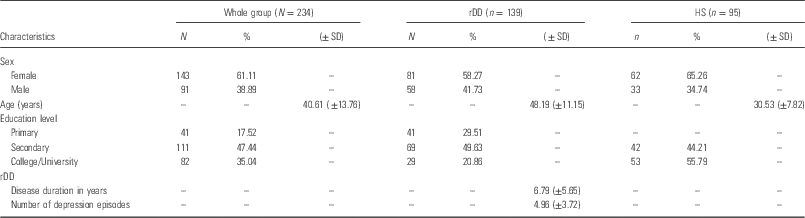
The characteristics of the study group in terms of sex, age, education (number of years of education) and the course of the disease (rDD group) are presented in Table 1. No statistically significant differences in terms of sex were discovered between the examined groups (χ2=1.16, p=0.281); the only differences considered the age (Z=9.91, p=0.001).
Demographic characteristics of the group with rDD in comparison to the HS group, and data concerning the course of the disease

%, percentage; ±SD, standard deviation; HS, healthy subjects; n, number of samples; rDD, recurrent depressive disorders.
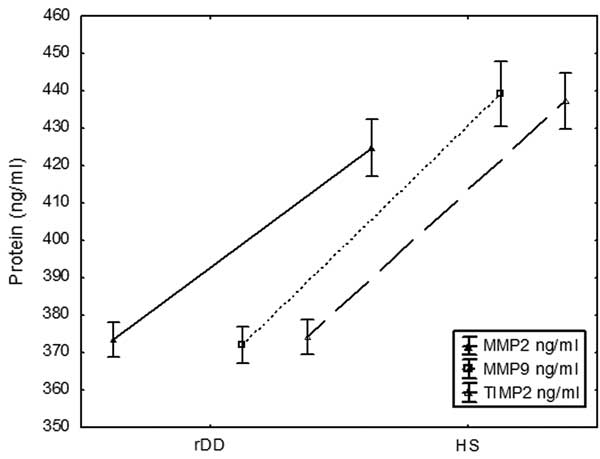
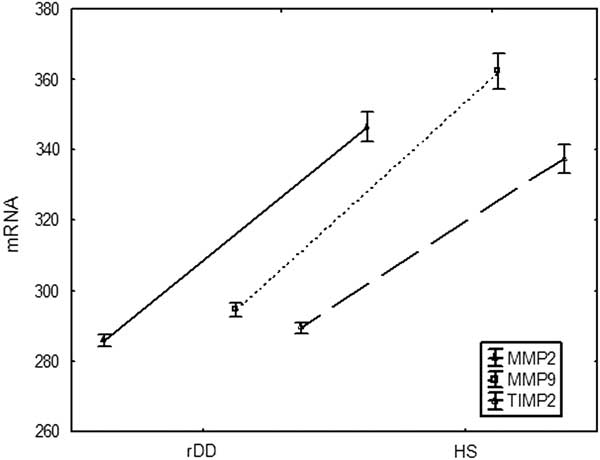
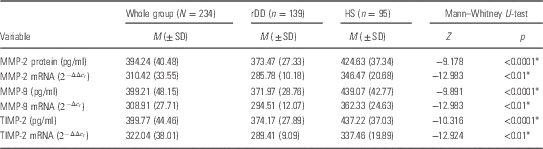
Average values of expression on the mRNA and the protein level for MMP-2, MMP-9 and TIMP-2 genes in the examined group (N=234) are shown in Table 2 and in Figs 1 and 2, and the analysed variables are compared in the rDD group (n=139) and the group of healthy individuals (n=95).
Average values and confidence interval (95.00%) for the analysed variables. rDD, recurrent depressive disorders; HS, healthy subjects; MMP-2, matrix metalloproteinase 2; MMP-9, matrix metalloproteinase 9; TIMP-2, tissue inhibitor of MMP 2.

Average values and confidence interval (95.00%) for the analysed variables. rDD, recurrent depressive disorders; HS, healthy subjects; MMP-2, matrix metalloproteinase 2; MMP-9, matrix metalloproteinase 9; TIMP-2, tissue inhibitor of MMP 2.

Expression on the protein level and on the level of mRNA for MMP-2, MMP-9 and TIMP-2 genes in the examined group

HS, healthy subjects; M, mean; MMP-2, matrix metalloproteinase 2; MMP-9, matrix metalloproteinase 9; rDD, recurrent depressive disorders; SD, standard deviation; TIMP-2, tissue inhibitor of MMP 2.
*p statistically significant.
Differences of statistical significance were observed between the patients with rDD and the HS in relation to all of the analysed variables (Table 2). The expression of MMP-2, MMP-9, TIMP-2 genes on the mRNA level and the protein level was significantly greater in the HS as compared with the rDD group.
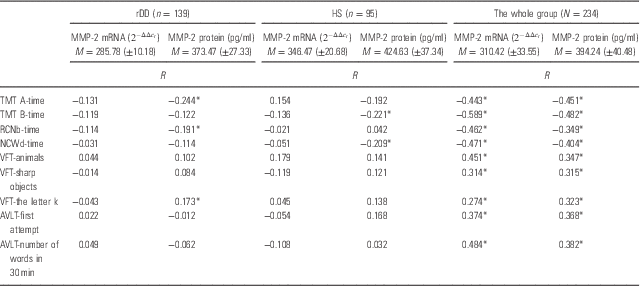
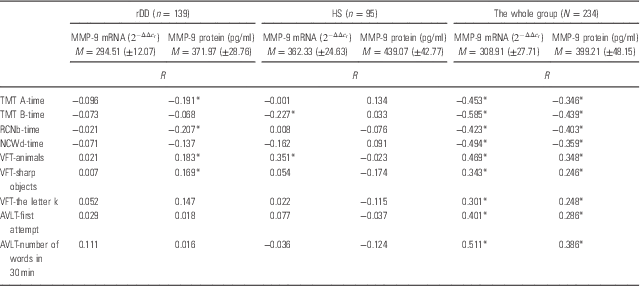
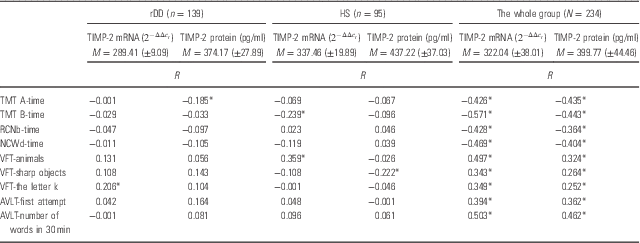
The correlation between MMP-2, MMP-9, TIMP-2 mRNA and protein expression levels and the results of the neuropsychological tests – separately for the rDD and HS test group – are shown in Tables 3–5, which also include the results of the correlation between the MMP-2, MMP-9, TIMP-2 mRNA and protein expression levels and the neuropsychological tests for the entire group.
Spearman’s rank correlation coefficients(R) for the variables tested – MMP-2

AVLT, Auditory–Verbal Learning Test; HS, healthy subjects; MMP-2, matrix metalloproteinase 2; NCWd, naming colour of word – different; RCNb, reading colour names in black; rDD, recurrent depressive disorder; TMT, Trail Making Test; VFT, Verbal Fluency Test.
*p statistically significant.
Spearman’s rank correlation coefficients(R) for the variables tested – MMP-9

AVLT, Auditory–Verbal Learning Test; HS, healthy subjects; MMP-9, matrix metalloproteinase 9; NCWd, naming colour of word – different; RCNb, reading colour names in black; rDD, recurrent depressive disorder; TMT, Trail Making Test; VFT, Verbal Fluency Test.
*p statistically significant.
Spearman’s rank correlation coefficients(R) for the variables tested – TIMP-2

AVLT, Auditory–Verbal Learning Test; HS, healthy subjects; NCWd, naming colour of word – different; RCNb, reading colour names in black; rDD, recurrent depressive disorder; TIMP-2, tissue inhibitor of MMP 2; TMT, Trail Making Test; VFT, Verbal Fluency Test.
*p statistically significant.
Having analysed the entire experimental group (N=234), significant interrelations were found between the expression of the genes and the results of the tests that measured cognitive functions. Increased expression on both the mRNA and the protein level was associated with better performance of all the tests conducted in each case.
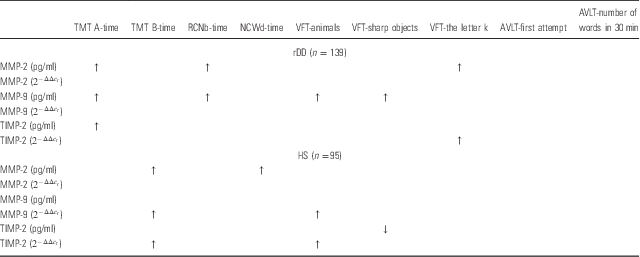
After carrying out a separate analysis for the individuals from the rDD group and the HS group, similar dependencies were still observed; however, they were not that numerous. A summary of the results for the rDD group and HS can be found in Table 6.
Summary of the results for the rDD group and HS

AVLT, Auditory–Verbal Learning Test; HS, healthy subjects; MMP-2, matrix metalloproteinase 2; MMP-9, matrix metalloproteinase 9; NCWd, naming colour of word – different; RCNb, reading colour names in black; rDD, recurrent depressive disorders; TIMP-2, tissue inhibitor of MMP 2; TMT, Trail Making Test; VFT, Verbal Fluency Test.
Discussion
Chronic stress is considered one of the significant factors in the aetiology and course of depressive disorders (Reference Maes, Lambrechts and Bosmans27). Its impact on the hyperactivity of the hypothalamic–pituitary–gonadal axis and on the inhibition of the immune system is emphasised (Reference Maes, Lambrechts and Bosmans27). The research studies conducted by Lutgendorf et al. (Reference Lutgendorf, Lamkin and Jennings28) revealed that MMP-9 was found to be elevated in macrophage cells of the depressed patients, particularly in combination with high stress levels. In the paper cited, depressed patients demonstrated significant elevations of MMP-9 in CD68(+) cells, adjusted for stage. Substantially greater levels of MMP-9 in CD68(+) cells were also observed in the patients with higher levels of current stress, life stress over the last 6 months and general negative affect. On the other side, higher social support was linked with lower levels of MMP-9 and the vascular endothelial growth factor in tumour cells (Reference Lutgendorf, Lamkin and Jennings28). The expression of MMP-2 by macrophages or tumour cells was not associated with any of the bio-behavioural factors examined to a significant extent (Reference Lutgendorf, Lamkin and Jennings28). The mechanisms underlying these associations most probably involve stress hormones such as norepinephrine (NE) and cortisol (hydrocortisone). In vitro stimulation of isolated human macrophages with NE and hydrocortisone improved the production of MMP-2 and MMP-9 (Reference Lutgendorf, Cole and Costanzo29).
The obtained results do not confirm the revelations quoted above and the hypothesis made in the introduction was confirmed only partially. We demonstrated a significant influence of MMPs on the efficiency of cognitive processes in both patients with rDD and the group of HS. It turned out that the increased expression of each of the analysed genes enhanced the efficiency of many cognitive functions: attention, immediate and delayed memory, working memory and executive functions. Increased expression of MMP-2, MMP-9 and TIMP-2 was, however, confirmed in the HS.
Do the results recorded by our team confirm the role of MMPs in neurogenesis and neuroplasticity? This is a far-reaching conclusion, yet it does not seem to be random. Structures of the frontal lobes as well as the hippocampus were involved in each cognitive function analysed by us (Reference Gałecki, Talarowska, Anderson, Berk and Maes30), while structural and functional changes in their scope were confirmed many times in the people suffering from rDD (Reference Gałecki, Talarowska, Anderson, Berk and Maes30).
Based on the experiments conducted, Bjerke et al. (Reference Bjerke, Jonsson and Nordlund31) suggests that the MMP-9 enzyme is engaged in the degeneration of the white matter (46 patients without any symptoms of dementia and with small vessel disease diagnosed were evaluated). Moreover, according to Mizoguchi et al. (Reference Mizoguchi, Takuma and Fukuzaki32), an increase in MMP-9 expression in the hippocampus affects the development of cognitive impairment in mice. The treatment with the inhibitors of MMP-2 or MMP-2/9 prevented BBB breakdown in the hippocampus and the treatment with inhibitors of MMP-2, MMP-9 or MMP-2/9 prevented BBB breakdown in the cortex (Reference Barichello, Generoso and Michelon33). Meanwhile, a team of scientists led by Li et al. (Reference Li, Wu and Keating34) recorded results that were compatible with the ones obtained by our team. The authors examined 52 HIV carriers and 21 seronegative individuals. Plasma MMP-2 levels were significantly reduced in an early HIV infection and correlated with the altered white matter integrity and atrophic brain changes. What is more, MMP-9 levels were higher in the treated subjects than in the naive HIV subgroup (Reference Li, Wu and Keating34). In the experiments carried out with the use of an animal model, it was possible to determine that TIMP-2 deficient mice show a defective memory function (Reference Jaworski, Boone and Caterina35). In addition, Jaworski et al. (Reference Jaworski, Boone and Caterina35) revealed that neither male nor female mice deficient in TIMP-2 (knock-out) exhibited prepulse inhibition of the startle reflex, which may suggest deficits in preattentional sensorimotor gating. Knock-out mice and mice expressing a mutant truncated TIMP-2 (knock-down) demonstrated deficits in fear-potentiated startle. Moreover, the use of MMP-9 inhibitors reduces the efficiency of the visuospatial memory (Reference Wright, Brown and Harding36). In recent years, the participation of MMP-9 in the phenomenon of long-term potentiation (LTP) has been confirmed (Reference Nagy, Bozdagi and Matynia37). MMP-9 plays a critical role in LTP maintenance in the Schaffer collateral-CA1 pathway and in the acquisition of the hippocampus-dependent memory. Recent studies have revealed that in the mossy fibre-CA3 (MF-CA3) projection, where LTP induction and expression are largely presynaptic, MMPs blockade disrupts LTP maintenance, and that LTP induction is associated with increased MMP-9 expression (Reference Wiera, Wozniak, Bajor, Kaczmarek and Mozrzymas38). Martín-Aragón et al. (Reference Martín-Aragón, Bermejo-Bescós and Benedí39) did not find any differences in the activity of MMP-2 and MMP-9 in the plasma of patients with AD and mild cognitive impairment, and in the plasma of HS selected taking age and sex into account.
From the perspective of the results recorded by us, the impact of chronic stress on the reduction of hippocampal volume is also significant (Reference Anacker, Scholz and O’Donnell40). The hippocampus is one of the brain regions which display substantial vulnerability to chronic stress, marked structural changes in dendritic complexity and spine volume and number (Reference Donohue, Gabbott and Davies41). The studies by van der Kooij et al. (Reference van der Kooij, Fantin and Rejmak42) showed that MMP-9 activity is implicated in the reduction in perisynaptic nectin-3 expression specifically in the CA1 region. The authors demonstrated the involvement of MMP-9 in chronic stress-induced alterations in social behaviours (including reduced sociability and social memory) and CA1-mediated cognition.
Summary
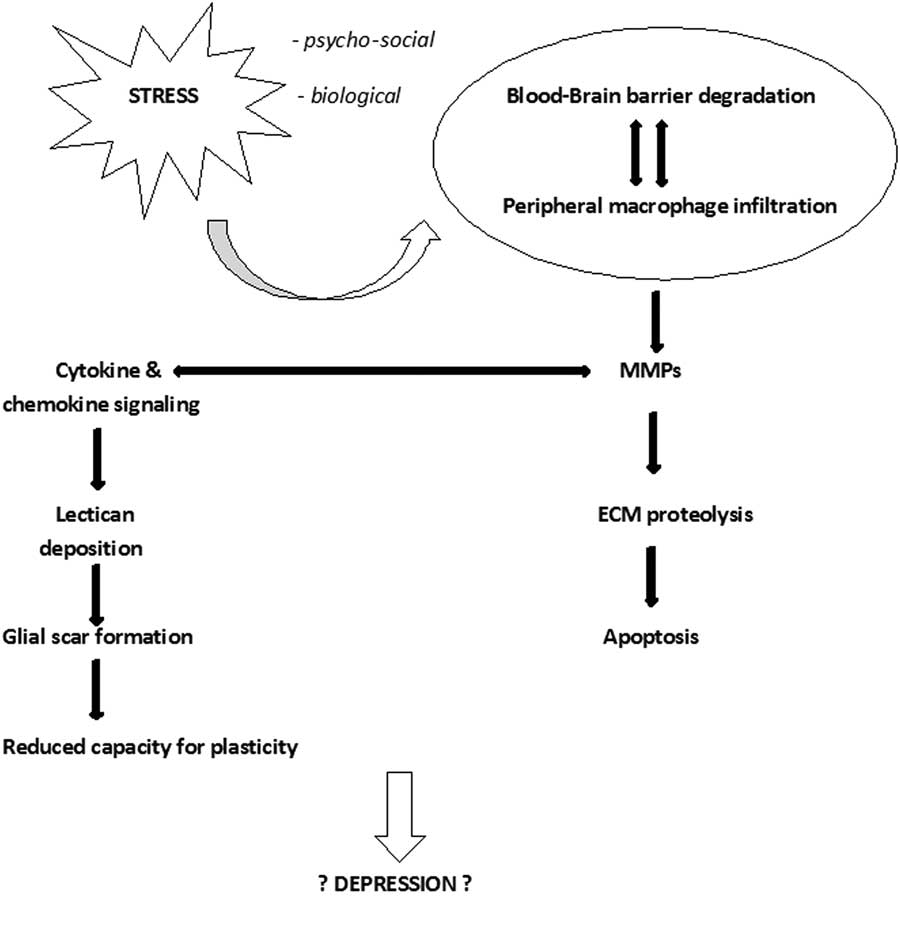
The mechanism of MMPs influence on the efficiency of cognitive functions in the subjects with rDD has not been thoroughly examined yet. The results of the studies conducted so far do not provide a clear answer to the question about the positive or negative impact of MMPs on the cognitive efficiency in both HS and the patients suffering from somatic or mental diseases. Nevertheless, we may propose a hypothesis based on the results of the experiments conducted in a group of patients treated due to schizophrenia (Reference Bienkowski, Samochowiec and Pelka-Wysiecka43,Reference Chopra, Baveja and Kuhad44). According to Chopra et al. (Reference Chopra, Baveja and Kuhad44), the overexpression of MMPs and the imbalance between MMP and tissue inhibitors of metalloproteinase are associated with various disturbances of the extracellular matrix in the schizophrenic brain. What is more, degradation of cell adhesion molecules is one of the main mechanisms, whereby MMPs are shown to affect neural plasticity (Reference Wright and Harding45), control synaptic activity in the hippocampus and impact learning and memory (Reference Ethell and Ethell46). Figure 3 presents possible paths of engagement of MMPs in the aetiology of depression (Reference Leonardo and Pennypacker47).
MMPs and depression aetiology. MMPs, matrix metalloproteinases; ECM, extracellular matrix.

Conclusions
-
1. The results of our study show decreased expression of MMP-2, MMP-9 and TIMP-2 genes on both mRNA and protein levels in depression.
-
2. Elevated expression of MMP-2, MMP-9 and TIMP-2 positively affects cognitive efficiency: working memory, executive functions, attention functions, direct and delayed auditory–verbal memory, the effectiveness of learning processes and verbal fluency.
-
3. The study highlights the important role of peripheral MMPs genes in depression and cognitive functions.
Acknowledgements
Authors’ contribution: K.B. – has made substantial contributions to conception and design, or acquisition of data, or analysis and interpretation of data; has been involved in the drafting of the manuscript or revising it critically for important intellectual content; has given the final approval of the version to be published; agrees to be accountable for all aspects of the work and ensuring that the questions related to the accuracy or integrity of any part of the work are appropriately investigated and resolved. J.S. – has made substantial contributions to the analysis and interpretation of data; has been involved in the drafting of the manuscript or revising it critically for important intellectual content. P.G. – has made substantial contributions to conception and design; has been involved in the drafting of the manuscript or revising it critically for important intellectual content; has given the final approval of the version to be published. M.T. – has made substantial contributions to conception and design, or acquisition of data, or analysis and interpretation of data; has been involved in the drafting of the manuscript or revising it critically for important intellectual content; has given the final approval of the version to be published.
Financial Support
This study was supported with scientific research grants from Medical University of Lodz, no. 503/5-062-02/503-51-005 and no. 503/5-062-02/503-51-006.
Conflicts of Interest
None.