Introduction
Histories of international humanitarian law (IHL)Footnote 1 have concentrated on Europe and the USA. While this is not a phenomenon unique to IHL, it is worth researching how IHL has developed in other parts of the world, not only as an un-Eurocentric endeavour, but also as a way of finding new relationships, casual connections and entanglements between core IHL and “semi-peripheral States”.Footnote 2 These relationships could reveal new characteristics in the dynamics of IHL concerning the production and exchange of legal knowledge and, most importantly, how each State's particular position on the international stage could have moulded the way they applied, interpreted and produced norms of the law of war.Footnote 3
In this article, the case of Mexico will be presented, as an example of how the context and conditions of the nineteenth century paved the way for a truly different path of codifying and enforcing the law of war. The contribution of the Mexican Criminal Code (MCC) to IHL is of great importance, as it widens the historical record of the discipline. It proves that original legal thinking towards systemizing, codifying and, with it, universalizing the laws of war not only emerged from Western countries but also from newly independent ones, like Mexico. The MCC of 1871 incorporated the laws of war, taking its form in Article 1139 as “violations of the duties of humanity”. The crime was directly rooted in international law and punished acts against prisoners, the wounded, hostages of war and field hospitals. In 1871, with domestic law setting out criminal sanctions for violations of the law of war, a giant leap was taken. This is especially so, if we take into consideration that, at the time, the tendency to codify the laws of war was already in place, but had not quite reached the objectives it aimed for.Footnote 4 Unlike the established narrative of “humanizing” the laws of war, the Mexican case shows that there were other purposes at play in the second half of the nineteenth century. That is, by criminalizing violations of the laws of war, the Mexican lawmakers did not pursue a “humanitarian” goal in the sense that they did not have the intention of imposing their civilisatory values on others, but rather they aimed to be treated as equals amongst the “league of civilized nations”. The Mexican lawmakers intended to limit the actions of the great powers by using and incorporating in domestic law the language of powerful States, such as “the laws of war”, “humanity” and “civilization”. As it was the case with the trial against Maximilian of Habsburg in 1864, the new Republic of Mexico proved that violations of the law of nations were committed by the very nations who were their apologists. Additionally, a main feature of the Latin American republics was popular sovereignty.Footnote 5 The Mexican lawmakers extended popular sovereignty to the laws of war and, with it, acts of war were no longer acts of State, and as a result accountability would follow.
Surprisingly, the case of the MCC has not yet been meaningfully explored. Among other reasons, this could be due to the cultural background of the principal figures that promoted the regulation and humanization of warfare in the second half of the nineteenth century. Firstly, if we take a look at the biographies of the main protagonists – Caspar Bluntschly (Swiss national and philo-Prussian), Francis Lieber (born in Prussia who migrated to the USA) and finally Friedrich Martens (Russian jurist at the service of the Russian Empire) – they could not be further away from the new republics liberated from Iberian colonial rule. Secondly, these same publicists had a particular view of how war was to be conducted and this excluded the participation of civilians, as war was, in their view, only conducted by States.Footnote 6 In contrast, Mexican officials encouraged the population to defend their independency from the American and later French invasion; even the constitution of 1857 made it a duty of every Mexican citizen to defend the State's independency, territory, rights and interests.Footnote 7 So, even if the major promoters of “humanized” warfare knew about developments of international and criminal law in the newly independent States of Latin America, they would not take them to account as these developments contradicted their views of “civilized war” and emerged from lesser “civilized States”.Footnote 8 Finally, the nineteenth century was full of dramatic changes, not only in the legal field but also technologically and culturally. Maybe even Mexicans lost track of their own novel legal production, as they entered a new form of government in the last quarter of the nineteenth century – from republicanism to dictatorship under Porfirio Díaz (1876–1911).
So how did the Mexican drafters take the giant step of punishing violations of the laws of war not only in international armed conflicts but also in internal ones? In order to find out, this article explores different historical sources and reviews two events that serve as genealogy to the crime “violations of the duties of humanity”. These events are the Mexican–American warFootnote 9 and the French Intervention. The review of these two conflicts provides unique angles on how “peripheral States” like Mexico dealt with the question of intervention by Western powers and serve as historical background to the already established narratives. For example, the experience the Americans had with Mexican guerrilla warfare shaped the contents of General Orders No. 100 (the Lieber Code),Footnote 10 a code that later served as a blueprint for the Prussians to disqualify French guerrillas during the Franco-Prussian war (1870–1871). Interestingly enough, the French also fought Mexican guerrilla warfare during the French Intervention (1861–1867).Footnote 11 Surely, these experiences echoed in the European discussions of regulating warfare. After all, Geoffrey Best has already shown how the military had direct influence in counselling the representatives of the States, when deliberating how to limit war.Footnote 12
Followed by the historical review, the notion of “duties of humanity” in Article 1139 of the MCC will be analysed. In order to find a genealogy of the concept, historical sources such as the “explanatory memorandum” of the MCC, and the doctrinal work of Andrés Bello will also be reviewed. As this paper focuses on Article 1139 of the MCC, the definition of the crime – as rooted in international law – will be presented, as well as its implications, such as transforming “humanity” into a legal category and individual criminal responsibility. As the MCC regulated other fields of interest to IHL such as superior orders, combatant immunity and extraterritoriality, these will be analysed in detail.
A brief consideration will also be made of the debates on humanizing warfare and how Article 1139 of the MCC fits into this framework, although, as we will see, the Mexican lawmakers approached it differently compared with their European counterparts. In addition, a short comparison between the dispositions concerning the laws of war in the MCC and General Orders No. 100 (hereinafter, the Lieber Code) will be made. This might be unorthodox as the Lieber Code is not a criminal code but “military orders” that regulate the conduct of soldiers. The comparison is, however, justified by the fact that the Lieber Code has been referred to as the first attempt to codify the rules of war, to “humanize” them and, ultimately, criminalize some of them. As we will see, confronting the MCC with the Lieber Code will challenge this assumption. The comparison is also a useful tool to see how law evolves differently depending on each State's context. Most of all, it shows how each State had particular problems and interests during this process and how this is reflected in their own set of norms.
The article will conclude with some remarks on how the Mexican case offers a unique angle in the development of IHL domestically, internationally and, most importantly, how it contributed to the systematization of the laws of warfare by being, in 1871, the only country to adopt an individual criminal responsibility model, similar to what we define today as a “war crime”. Finally, it will be revealed how the MCC of 1871 is the missing piece in the history of criminalizing violations of the laws of war.
Historical overview to the 1871 MCC
Nineteenth-century Mexico was characterized by being overwhelmed by civil wars and interventions. The independence war (1810–1821) and then the American Intervention (1846–1848)Footnote 13 were followed by internal battles between conservatives and reformists (Guerra de Reforma, 1858–1861) and, finally, the second French Intervention (1861–1867). The continuous internal conflict for power between the liberales and the conservadores ended with the liberal victory (1861). Once peace was established, the building of the justice system started.Footnote 14
A central piece of the project of the liberal movement (also known as the “Reforma” movement) was the creation of laws. The liberal leader of the newly established government was Benito Juárez, born in Oaxaca to Zapotec parents and anti-imperialist par excellence, who had fought the war against the French during the already mentioned second French Intervention. Juárez was also a secularist and, like most of the liberals of the time, convinced of the power of the law. This conviction was also influenced by practical reasons. Juárez reckoned that the rule of law would provide the new Republic with legitimacy against foreign powers. In 1861 and 1862, when Spain and France deployed forces in Mexico, he stressed – in two separate letters to the nation – how foreign powers had referred to the “new Mexican nation” as backward and uncultivated.Footnote 15 For this reason, he encouraged all to abide by the law and further guaranteed that, in the case of war, the law of nations would be respected by the army and the authorities of the Republic.Footnote 16
As we can see from the previous account, law and compliance with the law were central to the liberals. Most of all, the law was understood as a means to show “civilisatory” progress and with it be part of the group of civilized nations. The 1871 MCC was drafted within this understanding of the law. In addition, what the historical account reveals to us is that the series of events that took place from 1810 to 1871 drove the Mexican drafters to elaborate radical solutions concerning the conduct of war, both internal and between States. As we will see, the issues that the drafters wanted to tackle were: foreign intervention, conducting war with foreign powers and making foreign powers comply with international and domestic law. Under Juárez's leadership, the new Mexican Republic began its process of building a legal code. Part and parcel to that project was the development of the MCC – the very subject of this paper. In this section it will be discussed how various historical factors influenced the development of the MCC as the Republic took shape.
Influence of the Mexican–American war in the conception of Article 1139 of the MCC
More than two decades before the MCC was drafted, Mexico was embroiled in the Mexican–American war (1846–1848). During the war, Mexican authorities faced some practical problems that could have led to the creation of the crime “violations of the duties of humanity” and to the provision concerning extraterritorial jurisdiction. These practical problems concerned are: (a) the treatment by American forces of civilians, military, church members, property and non-regular armies; (b) the application of General Scott's Order No. 20 to Mexican nationals. In the following lines these two elements will be explored briefly.
Correspondence between the warring parties during that period sheds some light on how Mexican authorities dealt with the conduct of the American Army and how this further echoed in the drafting of the MCC. As early as 1847, in their correspondence with their adversaries, the Mexican authorities invoked the conduct of war “… according to the law of nations”.Footnote 17 They also stressed that, if Americans would continue to devastate and attack civilians, the Mexican Army would have no other option but to conduct war the same way. However, they always underlined that the Mexican nation was in favour of behaving as a civilized nation.Footnote 18
As the above correspondence claimed, the US Army had a problem with the conduct of their volunteers with respect to the Mexican population. The volunteers were undisciplined and had been known to have attacked civilians and church property.Footnote 19
In order to mitigate the situation, General Winfield Scott enacted a law in Tamaulipas: General Order No. 20 (1847).Footnote 20 This order punished crimes such as murder, rape, assault and robbery. The general order also established a “humanitarian interest” in punishing the crimes severely, with “military commissions” created by the law. It also had the objective of controlling the actions of the non-regular Mexican armies, understood as those not belonging to the professional army.Footnote 21 It is known from different sources that Mexicans fought the American Intervention through a guerrilla war. Guerrilla formation was supported by the Mexican government and forces were under the command of professional generals or organized as local militias.Footnote 22 That the involvement of civilians was also encouraged by the Mexican government is understandable if taken into account that the country was heavily indebted and did not have the resources to pay a large professional army, uniforms and, most of all, equip them with the latest weaponry.Footnote 23 As such, General Order No. 20 was addressed to Mexicans who committed crimes against US citizens or US property and was also addressed to US forces who committed crimes against Mexican nationals.Footnote 24 The jurisdiction established by General Order No. 20 could be held as an antecedent to the “passive personality principle”, where States assert jurisdiction over an act committed by an individual outside of its territory because the victim is a national of that State. In addition, it punished conduct that was not ordered by a superior, meaning that the immunity of acts of war was retained.Footnote 25
The law was also published in Spanish and probably had some influence on how, twenty years later, the drafters of the 1871 MCC conceived of war and its conduct. This was especially so regarding the jurisdictional problem, since it surely diminished Mexican sovereignty if a foreign power was to prosecute nationals within Mexican territory. Finally, one could presuppose that the experience with the American Army somehow pushed the Mexican liberal jurists to look for solutions that could protect them against the excesses of foreign armies.
The French Intervention
In this section, it will be explored how the French Intervention also served as a formative experience that fed the contents of the MCC. Most of all, as it was also the case during the Mexican–American war, the Mexican Republic faced a war against a strong power. As such, the independence and integrity of the Mexican Republic was endangered, and the civilians experienced first-hand the effects of war. As such, these experiences surely made patent the need to limit excesses from the counterpart in war and, most of all, guarantee through law a right to self-defence when being invaded.
The intense interaction of the Mexican officials with their French and English counterparts, during the so-called “second French Intervention”, surely served as inspiration for the later development of the MCC. First and foremost, Mexican officials witnessed how, for the French, there was no legal ground to act according to the laws of war, as for France it was a “war of barbarism versus civilization”, and France was accomplishing a “civilizing” mission in Mexico. As a result, Mexican lawyers strived for a legal framework valid for everyone, not just the “civilized”, by which foreigners and nationals should comply to the same set of rules if war occurred in national territory. As we will see in the following sections, this was done in the most liberal sense, since through the provisions of the MCC, the drafters achieved that, if violations occurred, the responsible had to be put before trial with the guarantee of procedural rights.
A great example of how the conduct of warfare related to civilizationFootnote 26 or to barbarism is a note written by French Marshall Bazaine, in which he refers to the war between France and Mexico as a “war of barbarism versus civilization”.Footnote 27 As a result, Marshall Bazaine concluded that no quarter should be given to the enemy and that both parties should kill and let be killed. He also adds that all enemies were outlaws and would be executed by imperial decree.Footnote 28
The incursion of the French Army was followed by the reign of Archduke Maximilian of Habsburg. After Napoleon III's troop withdrawal and failure to consolidate his reign, Maximilian of Habsburg was captured and imprisoned in 1867. Instead of being summarily executed, he was tried according to the due process guarantees established in the 1857 Mexican Constitution.Footnote 29 Relevant is the fact that he was accused on the grounds of a martial law that criminalized acts against the independence and safety of the Republic and, most importantly, against the law of nations.Footnote 30 Interestingly enough, charge no. 7 of his accusation consisted of two acts: (a) issuing a “barbaric” law and with it breaching the “laws of war”; and (b) ordering executions on grounds of this law and with it also violating the laws of war.Footnote 31 The law issued by Maximilian consisted of enabling the execution within twenty-four hours of members of regular and irregular forces of the Republican Army, as well as all those who accompanied them and aided them. Additionally, he was charged of conducting war without the formalities imposed by civilized nations.Footnote 32 In his allegations, the prosecutor, basing his arguments with citations of Vattel, concluded that capital punishment could not be dispensed with, since those who committed serious offences against the law of war (faltas graves contra el derecho de guerra) do not enjoy this privilege.Footnote 33 Important here to note is how a “peripheral State”, such as Mexico, used Vattel's doctrine to legitimate the execution of Maximilian of Habsburg. Overall, it could be said that the trial was a good attempt towards the enforcement of international law. As such, the objectives were twofold: (a) they could show the European powers that they were civilized enough to apply the law; and (b) they were willing to enforce the laws of war through a legal procedure – excluding reprisals or blunt execution for that matter.
The example of the trial of Maximilian of Habsburg shows clearly how criminalizing violations of the laws of war was not something that happened in a vacuum, but was a result of the experiences of conducting warfare with foreign powers. As such, the trial was a formative experience that paved the path to criminalize violations of the laws of war. In 1871, the drafters already knew what it was like to try someone for violating international law and they probably had this experience in mind when incorporating the “duties of humanity” in the criminal code. Finally, it was also a highly symbolic experience, as “humanity” was materialized in the act of providing Maximilian a legal trial instead of plainly executing him on the spot.
Finally, the French Intervention illustrates how asymmetrical the application of the laws of war was. It is also plausible that due to this reason, Mexican lawmakers understood the urgency of incorporating and enforcing the laws of war. A contemporary account of the French “counter-guerrilla tactic” brings this to the point. Eugene Lefévre, a French journalist, who in 1869 wrote a book on the French Intervention, noted: “… if the Prussians were to invade Alsace and Lorraine, according to what has been said by the defenders of all the atrocities committed in Mexico, … the Prussians would have the right to shoot and hang the peasants who would rise up against them with old rifles and gibbets as the right of war would only apply with respect to the regular forces!”Footnote 34
Violations of the duties of humanity in the 1871 MCC
In the following section the crime “violations of the duties of humanity” will be analysed in depth. The drafting history will shed some light on how the idea of criminalizing violations of the laws of war evolved and what were the main objectives of the drafters. The definition of the crime will dwell on the actus reus, as well as the scope of protection. Finally, other regulations of the MCC that relate to the crime “violations of the duties of humanity” will be analysed. These are: combatant immunity, superior orders and extraterritorial jurisdiction.
The drafting of the Code
The MCC took ten years to draft and, as this section will show, the provisions concerned with the regulation of warfare, especially Article 1139 of the MCC, pursued very specific aims. Overall, we will see how the drafters mastered the art of using law as a device to solve, at least formally, urgent problems and needs of the newly established Mexican Republic.
The drafting of the MCC began in 1862 and was interrupted by the second French Intervention (1862–1867). The MCC was commissioned by the “Reforma” leader Benito Juárez to a group of notable jurists of the time. The project was commanded by Antonio Martínez de Castro who also belonged to a community of jurists that believed in the power of law to assure equal treatment and to erase distinctions between class or race.Footnote 35 Let us also not forget that Benito Juárez was born to indigenous parents, so it is very probable that his emancipation ideas and motivations were driven by this background.
Exactly in the year that the draft was commissioned, President Benito Juárez issued the “Law to punish crimes against the nation, order, public peace and individual guarantees” (Ley para castigar los delitos contra la nación, el orden, la paz pública y las garantías individuales).Footnote 36 This law defined several acts as “crimes against the laws of nations”, such as piracy, the slave trade, slavery and attempts against the life of foreign ministers. However, no mention is made of the crime “violations of the duties of humanity” – a crime defined in the MCC just nine years later. It can be assumed that the experience of Mexican liberals fighting against the French Intervention, along with their exposure to European ideas like the codification of the laws of war,Footnote 37 led them to incorporate them in the MCC (at the standard available in 1871). Overall, the Mexican achievement can be understood better when the difficulty of achieving a consensus in Europe regarding the criminalization of the violations of the laws of war at the time is considered.Footnote 38
Even though little is known about the explicit intentions of the drafters in criminalizing violations of the laws of war, some conclusions can be drawn from the “explanatory memorandum” (exposición de motivos). Penned by Martínez de Castro to justify the Code and its provisions,Footnote 39 it is an important document to understand the influences and intentions behind the norms of the MCC. Martínez de Castro underlines in the “explanatory memorandum” the importance of achieving the rank of “civilized nations”,Footnote 40 through a Code that, in his view, would instill confidence among the population.Footnote 41 Although there are no explicit references as to why the drafters decided to enforce the laws of war through criminal law, some conjectures can be made. As stated before, the “Reforma” movement pursued the ideal of erasing all differences of class and race through law. It can be interpreted that, in their view, international law offered a path vis-à-vis their European and North American counterparts.
As to the emancipatory goals of the MCC, Martínez de Castro stated that the new nation needed laws adequate to its republican character, as opposed to the monarchies in Europe. Regarding international law and the conduct of war, the memorandum just states that the violation of international law was very common and, therefore, required enforcement. Finally, Martínez de Castro stressed that the means to achieve the longed-for peace wished by the Mexican nation was through a modern criminal code. For Martínez de Castro the construction of a modern criminal code was a work in progress, as there was still much to learn from the “civilized nations”. However contradictory, these assumptions might be trapped in the dilemma between being emancipated from the European powers and at the same time longing to be like them. The explanatory memorandum delivers the message that they wanted to achieve peace through law. In this sense, for the drafters the MCC represented a manifestation of their willingness to abide by international law and at the same time claim from the European powers adherence to it, specifically to the laws of war within the national boundaries. This was extremely important as this could be used as an argument against the payment of claims. It also was a way in which Mexicans could uphold the same treatment from the USA and Europe as they upheld international law principles among themselves.
To enforce the laws of war through criminal law was a remarkable innovation. It is easier to understand these developments in nineteenth-century Mexico if we imagine the project of Mexico being a blank canvas as a sovereign State, while Europe was more like an already rendered painting. That is to say, the ground was fertile for innovation, the building of a brand-new State meant the construction of legal categories, and so, the Mexican drafters created the crime violaciones a los deberes de humanidad (Art. 1139 MCC), which the drafters classified under the category “crimes against the law of nations”. This category enclosed four other crimes, namely: piracy, violations of immunity to diplomats, slavery and the slave trade. Since criminal law was also then considered the ultima ratio, it can be concluded that for the Mexican drafters, the legal interests that were protected through the crimes of: (a) violations of the duties of humanity, (b) piracy, (c) violations of immunity to diplomats, (d) slavery and (e) slave trade were the most valuable for the “civilized nations”.
Definition of the crime: Violations of the duties of humanity (Art. 1139 MCC)
The crime “violations of the duties of humanity” was a huge innovation, as it established individual criminal responsibility for violations of the laws of war as early as 1871. At the time, Europe was immersed in the idea that acts of war were acts of State and, as such, individuals could not be held responsible for their State's actions. The Oxford Manual of 1880 tried to push States to incorporate criminal sanctions for violations of the laws of war; however, the Manual had no binding effect. This section will present the wording and the general features of the crime.
In his explanatory memorandum, Martínez de Castro described that, of the twenty-something codes and projects that were examined, only the Spanish Code and the Portuguese project contained any “crimes against the law of nations”.Footnote 42 The projects examined were somehow insufficient, as Martínez de Castro stressed that some development was needed concerning piracy, slave trade and “duties to humanity”, and added that the drafting commission dealt with these crimes, as their perpetration was very common.Footnote 43
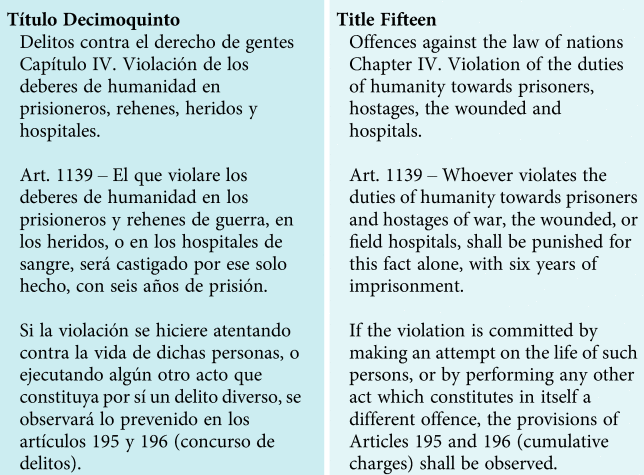
The wording of the crime can be seen in Table 1.
The crime: “Offences against the law of nations“ - ”Violation of the duties to humanity”

Article 1139 of the Criminal Code of 1871 does not define what amounts to duties of humanity, but it does set the frame of protected persons and objects during wartime as including: prisoners of war, hostages, the wounded (without specifying whether civilian or not) and field hospitals. Important to note is that individual criminal responsibility is not based on the status of belligerents (e.g. with punishment just for being a member of an irregular army), but based on acts. As we can see, the scope of protected persons and objects scarcely deviates from the ones established in the Geneva Conventions of 1949.
As the 1871 provision makes no difference between the wounded, then it could even be argued that the MCC also protected wounded civilians during armed conflict. Additionally, the punishment is addressed to anyone that violates the duties of humanity, independent of whether the infractor is a member of a regular or irregular army. There is also no punishment for being a member of an irregular army compared with, for example, the Lieber Code, which punishes with death “war rebels” (Art. 85). The idea of protecting the members of all kinds of armies is coherent with the recognition of combatant immunity given by the MCC which will be explored in the sections below.
Nevertheless, one could wonder why the explicit mention of civilians was spared from this rule. The explanatory memorandum does not elucidate any further. However, if we follow the evolution of Mexican domestic law – the Law of 1862 – and the developments in the international arena, it can be deduced that the drafters of 1871 followed the standard given by the Geneva Convention of 1864. Robert Kolb and Geoffrey Best offer an explanation as to why civilians were not considered subjects of protection. The reasons behind the absence of civilians in the Geneva Convention of 1864 is that they were not considered to be party to a war.Footnote 44 Civilians were to remain at their homes and not engage in combat; therefore, they did not need protection in the way that the wounded, the sick or shipwrecked did. Further, war was considered to be a matter of the military.Footnote 45 Finally, the concept of “prisoners of war” was broader than it is today, as the status of combatant was given not only to combatants but to a full array of actors that performed a public function.Footnote 46
Main features of Article 1139 of the MCC
Article 1139 of the MCC – “violations of the duties of humanity” – can be classified as a crime in its own right, since its second paragraph foresees criminal responsibility for all other conduct committed jointly or, if as a result of the “violation” the life of the victim was threatened. Thus, any nuisance (molestía) committed against prisoners of war, hostages or the wounded would be punished with six years’ imprisonment. The criminalization of acts against prisoners of war truly “humanized” the conduct of war, especially if we take into account that the Lieber Code permitted retaliation against prisoners of war.Footnote 47
If, however, the nuisance (molestía) produced a harm of any of the legal interests protected by the MCC, a separate punishment would be applicable and the accused would be subject to accumulative charges (concurso de delitos). This open clause gives room to punish all kinds of conduct committed against prisoners of war, hostages or the wounded. Most importantly, through this legal technique the drafters achieved what Bluntschli years later (1895) would advocate, i.e. that the right to liberty, honour and individual security should be unalienable and protected, even in times of war.Footnote 48 Through Article 1139, the MCC was also guaranteeing vis-à-vis foreign powers the protection of legal interests even during a war.
Another interesting trait is that the provision is not only applicable during hostilities. For practical reasons, this could be useful during an armistice, since after the conclusion of hostilities abuses to the wounded in war could also occur – as was the case after the signing of the armistice of the Mexican–American war.Footnote 49
Without a doubt, the most interesting feature is that by transforming violations of the laws of war into crimes, individuals would be accountable before Mexican law, and those protected by the norm (prisoners, hostages or the injured) could also theoretically file an accusation.Footnote 50
Finally, it can also be argued that, even though the MCC does not refer explicitly to these violations as “war crimes”, they can technically be considered as such. At this point, it is worth pointing out that, in Daniel Marc Segesser's view, the first person to coin the term “war crime” was Johann Caspar Bluntschli in 1872.Footnote 51 Jessica Laird and John Fabian Witt, by contrast, deem that it was Francis Lieber who came up with the phrase in 1865.Footnote 52 Regardless of who used the term first, Article 1139 of the MCC is, in fact, a war crime, as it punishes under domestic criminal law conduct considered violations of the laws of war under the standard applicable in the year 1871.
Additional MCC provisions of relevance to Article 1139
Article 1139 of the MCC should also be read in relation to the rules regarding combatant immunity, superior orders and extraterritorial jurisdiction. Overall, it can be said that the MCC built a system to regulate armed conflict through a criminal enforcement model. That is, the drafters could have opted for incorporating the available usages and customs of war of the “civilized nations” in the Mexican Constitution – as Colombia did in Article 91 of the 1863 Constitution.Footnote 53 However, they chose to incorporate it in the Criminal Code. If these provisions are read altogether, it can be concluded that the drafters did not differentiate between internal and international armed conflict. As it will be further discussed, this allowed the combatants of civil war to also gain protection under the MCC. As for those who executed the punishable acts, they were also to be held responsible along with their superiors. As will be discussed below, the conditions for superior orders as defence are quite similar to Article 33 of the Rome Statute. Finally, the MCC adopted what today is known as the “passive personality principle”, which triggers the Mexican jurisdiction, when Mexican nationals are injured by a foreign national in foreign territory. As for why extraterritorial jurisdiction was adopted, it can be interpreted that, in the case of an international conflict, the Mexican drafters wanted to ensure that national armies were also protected abroad. As we will see, this provision was radical for its time as it was applicable to the commission of all crimes, not just “crimes against the law of nations”.
Combatant immunity
As was previously discussed, Article 1139 of the MCC makes no distinction between international or non-international armed conflicts. However, as it is classified under ‟violations of the law of nations” it can be concluded that it referred to acts of war between States. In the year of 1871, war was still considered as an act between States. The drafters of the MCC reckoned, however, that nationals also could resort to arms in the case they wished to change the government, abolish or reform the Constitution or even to impede the election of Supreme Court judges. According to the MCC, the aforementioned were the motives to rebellion. Articles 1095–122 regulate rebellion and they sketch the scope of allowed conduct during combat.
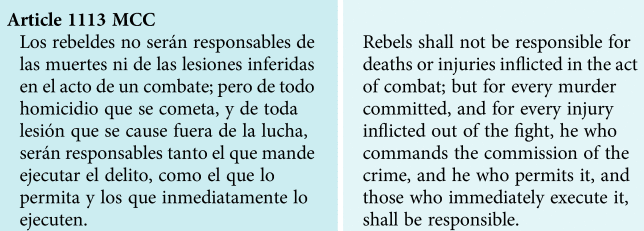
From Table 2, we can see that Article 1113 of the MCC grants combatant immunity to all those who rebel. As to who is considered a rebel, Article 1095 of the MCC draws the hypotheses of rebellion and defines as rebels all those who rise up publicly and in open hostility. Among the hypotheses of rebellion enumerated by Article 1095 of the MCC are: to vary the form of government of the Nation, to abolish or reform its political Constitution, or to remove from office the President of the Republic. Granting combatant immunity to the rebels meant that all actions committed during combat were unpunishable. This immunity ceased after combat. It is not clear, however, if the immunity was activated only in the beginning of each combat or during the whole rebellion. However, if we look at the hypotheses of rebellion it is clear that the acts are not spontaneous, but the expression of some plan or resolution; therefore, it is plausible to conclude that “combatant immunity” applied for the whole rebellion. After conducting hostilities, rebels would be punished for all acts outside of combat as well as for the act of rebelling. The punishment for rebelling was proportionate to the rank the rebel had. For example, the chief command was punished with six years and the corporal with one year of imprisonment. Interestingly enough, within the article that grants combatant immunity, a “mini system” of individual responsibility can be found, establishing command responsibility and excluding superior orders as defence. The provision orders that those responsible would be: (a) those who order the crime; (b) those who allow the commission of the crime; and (c) those who execute the crime.
Combatant immunity
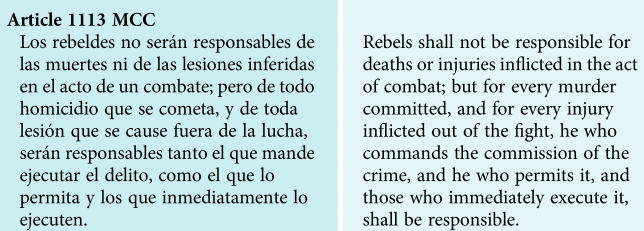
Since Article 13 of the 1857 Mexican Constitution prohibited the death penalty for political crimes; rebels were spared from this penalty. However, if rebels killed prisoners of war, they would then be punished with the death penalty as the act was equivalent to aggravated homicide (this is another expression of how, in the understanding of the MCC drafters, violations of the laws of war were grave offences to the law of nations).
In the explanatory memorandum, Martínez de Castro explains that a rebel could not be treated as an ordinary criminal, as the acts could be driven by “political fanaticism”.Footnote 54 He also adds that as rebels were not common criminals, they would enjoy the privilege of having a separate cell from the majority of the prisoners. This benefit in treatment could be attributed to the fact that rebels were seen as heroic in the republican sense. Finally, the Constitution of 1857 which was republican in its ideals established in its Article 39 that “the people have at all times the inalienable right to alter or modify their form of government”.
It could be said that, by granting combatant immunity to rebels, the drafters of the MCC achieved a sort of regulation of non-international armed conflict that surely resembles some of the features of Additional Protocol II of the Geneva Conventions. In overall terms, as Article 1139 construes a system of responsibility in which all “violations to humanity” which constitute crimes under the MCC are punished, it can be said that the MCC broadly protects civilians and property. It also grants humane treatment to rebels as they were given the right to participate in hostilities and in the case of a prosecution, it would be according to due process guarantees. In addition, the death penalty was barred for political prisoners.
As the crime “violations of the duties of humanity” makes no distinction between international and internal armed conflicts, it can be concluded that the said provision can also be interpreted as an obligation to the military in the case of rebellion, while the prohibitions within the crime of rebellion were addressed to civilians who took up arms. Evidently this system also offered an innovative solution towards the numerous claims of damage to alien property during wars, since it guaranteed to foreign governments that, in the case of rebellion, damages to property would be criminally punished.Footnote 55
It should also be recalled that granting combatant immunity also relates to the early Latin American tradition of recognizing belligerency in the context of independence wars.Footnote 56
Superior orders
As already drawn in the previous section, the crime of rebellion set up a system of criminal responsibility where the superior and the subordinate were responsible as perpetrators for crimes committed outside hostilities. It should, however, not be forgotten that this provision was addressed to civilians that rebelled. On the other hand, as “violations of the duties of humanity” were classified under violations of the law of nations, it can be interpreted that they were primarily addressed to military forces, foreign or national. Maybe that is the reason the drafters did not include expressly command responsibility.
Regarding superior orders, it is telling that a nineteenth-century code already banned the application of the respondeat superior principle as a defence, especially since it was widely applied by States in the mid-nineteenth century. Major discussions of its abrogation followed until 1943 when allied powers sought to prosecute German war criminals.Footnote 57
As an example, the British War Office abrogated the superior orders defence in April 1944.Footnote 58 In this vein, the Nuremberg tribunal interpreted that “… among the criminal law of most nations it was not the existence of the order that mitigates punishment but whether moral choice was in fact possible”.Footnote 59 Finally, the expedition of the Rome Statute ended with the debate of superior orders as defence.
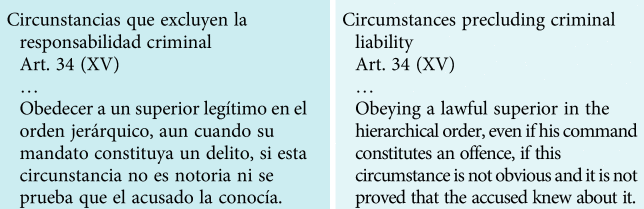
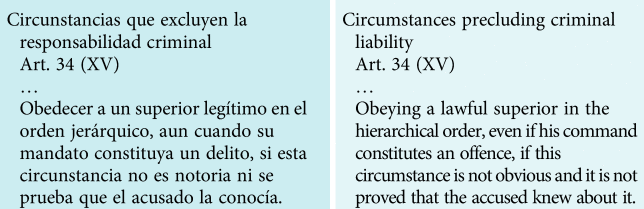
Going back to the MCC, the drafters of the code considered that in order to exclude criminal responsibility on the grounds of obeying superior orders, it was important to distinguish the cases when obedience was legitimate and obligatory.Footnote 60 Article 34, paragraph XV, of the MCC established that obeying superior orders is an excuse if: (a) the person did not know the order was unlawful; and (b) the conduct was not manifestly unlawful (see Table 3). The reasons expressed by Martínez de Castro were quite innovative, as he explained that excluding criminal responsibility for the subordinate who obeys an order “… is to regard the agent as a real automaton. It enables many crimes, for in knowing that anyone who obeys is not responsible, it allows the subordinate to commit the wildest crimes as mere and vile instruments of their leaders, being also assured of impunity.”Footnote 61 The idea of Martínez de Castro is in line with what much later, in 1961 the District Court of Jerusalem in the Eichmann case argued against – the superior order excuse, which the Court called “blind obedience”.Footnote 62 In a broader interpretation and related to the “automaton” notion, a connection can also be found between Martínez de Castro's dismissal of superior orders and the International Military Tribunal (IMT), in the sense that the acts of individuals cannot be shielded or excused as being acts of States, since they are committed by individuals.Footnote 63 With this rule, the MCC farewelled the sovereignty principle related to the notion that war was only conducted by States and that war criminals were un-prosecutable. It is fair to say that European nations hung on to this principle until 1945.Footnote 64
Circumstances precluding criminal liability
Extraterritorial jurisdiction
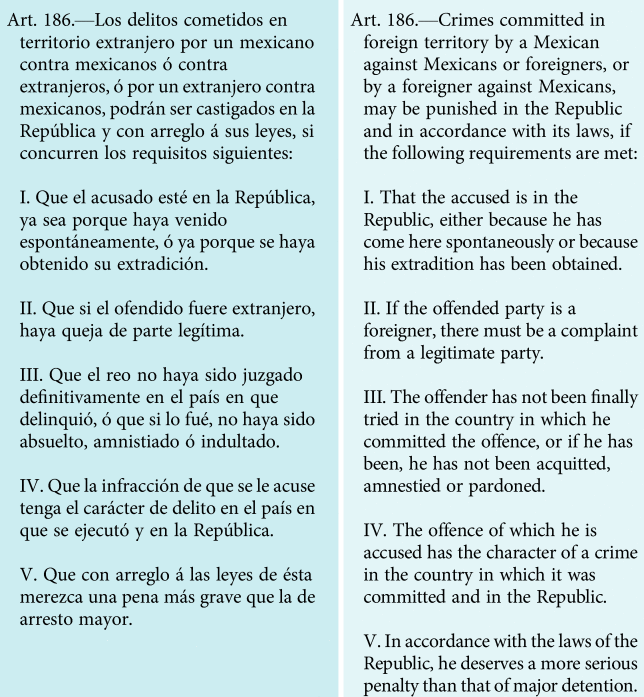
Article 186 of the MCC (see Table 4) provided the jurisdiction for prosecution of crimes committed against Mexican nationals by foreigners in Mexican and foreign territories. In a sense, this extraterritorial principle resembles the idea of General Winfield Scott, since with his General Order No. 20 he provided for prosecution of Mexican nationals for infringements against American persons or property.
Extraterritorial jurisdiction
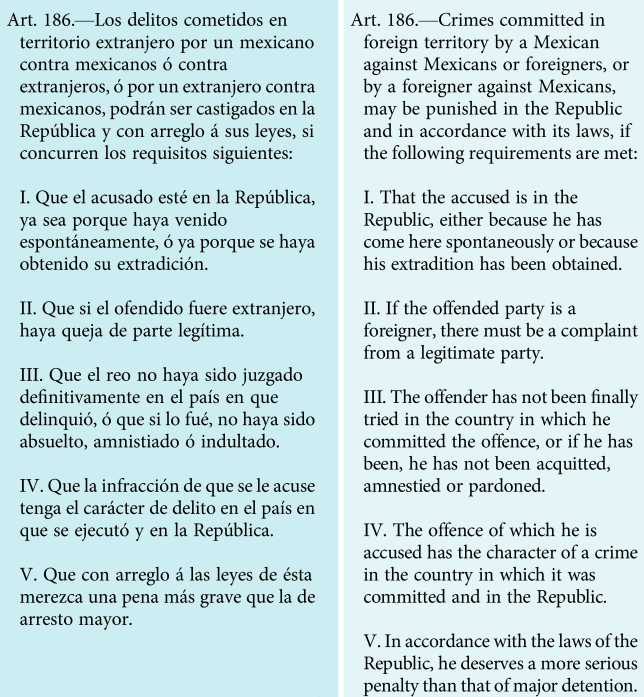
Most criminal codes of the nineteenth century accepted only territorial jurisdiction as valid for the prosecution of crimes. Jurisdiction based on the passive personality principle was not spared from debate. In 1886 an American with the name Cutting printed a libel in the USA against a Mexican citizen. As soon as Cutting was on Mexican soil, he was arrested for prosecution as, according to Article 186 of the MCC, foreigners outside Mexican territory that committed crimes under the MCC were also punishable. The USA claimed an attack on its sovereignty and ordered the release of Cutting. Lassa Oppenheim refers in the second edition of his treaty that the USA even demanded that Article 186 of the MCC be altered.Footnote 65 However, Mexicans refused to comply. Oppenheim added in 1912 that the practice was not settled if States could extend their jurisdiction for acts of foreigners committed in foreign territories. In a sense, however, the provision of the MCC stands for what Argentinian jurist Calvo argued as a condition against intervention, being the equality of States. As such, aliens in Mexican territory and abroad would be subject to local laws and institutions in the case of harming a Mexican national. In this vein Article 186 of the MCC could also be read as an indirect message to foreign powers, since several causes for their reparations claims were the harm done to their nationals on Mexican soil. In a sense, the MCC was offering an alternative model of criminal punishment instead of claims and intervention.
Finally, in the hypothetical case of Mexico being at war with a foreign power, it could exercise its jurisdiction if violations of the duties of humanity were committed against Mexican nationals. The legitimacy of Mexican jurisdiction in the prosecution of war crimes then became based on international law, as it was enforcing the law of nations. After decades of suffering from civil and foreign wars, this was a crucial move, as it protected the country's own nationals against excesses committed by foreign armies. Additionally, it also guaranteed that nationals of other States would be protected against violations of international law.Footnote 66 This is especially important for two reasons: on the one hand States could claim reparations for harm done to its nationals during riots or civil war and, on the other, it had already been the case that in 1862 France, Britain and Spain agreed to take military action in order to “ensure protection of the person and the property of their subjects”.Footnote 67 In this sense, the drafters of the MCC achieved protection of alien individuals and property through criminal law. It is also plausible that they thought of criminal punishment as an alternative to the payment of reparations. In any case, they guaranteed foreign powers that in the case violations of international law occurred, for example to the laws of war, the responsible would be criminally punished.
Effects of criminalizing violations of the laws of war
“Duties of humanity” as a legal category
An important effect of Article 1139 of the MCC is that it transforms the notion of “duties of humanity” into a legal category. It is, however, intriguing to know where this term originated and in which respects it differed from the European stance. The fact that the term “humanity” was used as a way of denoting certain conducts during warfare can be found in the various official documents and correspondence during the French Intervention (1862–1867) and during the civil war between liberales and conservadores (1857–1860).Footnote 68 A note written by the Mexican Ministry of War addressed to national rebels of the State of Puebla following a capitulation of the year 1856 states, in its last paragraph, that the “duties of humanity” have been accomplished and followed by respecting the rules of capitulation and by commuting the prisoners’ death penalty.Footnote 69 In another document from 1862, General Zaragosa, a member of the liberal army, also refers to the “duties of humanity” having been accomplished by allowing all wounded French soldiers to recover from their injuries in a hospital safeguarded by the Mexican Army.Footnote 70 These two documents indicate that the term “duties of humanity” was already circulating during the civil war and French Intervention and was used in the context of warfare regarding the treatment of combatants.
From a doctrinal standpoint, the Latin American tradition of invoking humanitarian values can also be traced to Andrés Bello's work.Footnote 71 In his treaty on the Law of Nations, the term “humanity” has even different usages, for example, as a way of referring to European nations,Footnote 72 and as a quality (“humanely”).Footnote 73 He also calls the violation of the promise of a prisoner of war not to escape or to resort to arms, as such an act provokes more calamities in war, a “crime against humanity”.Footnote 74 Furthermore, by reading Andrés Bello, it is clear that humanity is also a property that is characteristic of the “civilized nations”, as he relates inhuman acts to those committed by barbarians or “los naturales”.Footnote 75
So, according to early-nineteenth-century scholars like Bello, humanity was a quality among civilized nations – i.e. those who knew and obeyed the law – and, at the same time, this quality imposed duties.Footnote 76 In this context, “the duties of humanity” in Article 1139 of the MCC can be interpreted as those “imposed” by humanity (civilized countries), which require certain conduct, such as refraining from attacking those already engaged in war along with institutions that help diminish the calamities of war, such as field hospitals. By adopting these duties as their own and incorporating them in the Criminal Code, the drafters carried out what Becker Lorca describes as an appropriation of international law by a semi-peripheral State. Each of these appropriations produced different outcomes depending on the context.Footnote 77 In this case, the appropriation of the civilized usages of war was codified and transformed into crimes.
Finally, by incorporating the notion of humanity in the Criminal Code, the notion becomes universal, whereas under the European conception, humanity was an exclusive categoryFootnote 78 and, as such, only the members of the civilized world could benefit from humane treatment during war.Footnote 79 The universalist approach can be presupposed by the liberal affiliation of the drafters, as they believed all men to be equal before the law,Footnote 80 with “duties of humanity” to be granted for all and for protection by criminal law, just as life or property, for that matter.Footnote 81
Individual criminal responsibility
Making individuals criminally responsible for violations of the laws of war offered a substitute for other enforcement measures that were in force at least until the last quarter of the nineteenth century. These measures were: retaliation, reprisals and outlawry.Footnote 82 Compared to retaliation and reprisals, criminal sanctions had a humane character, since they were not collective punishments, but specifically targeted ones.Footnote 83 Retaliation and reprisals, by contrast, were not only suffered by armies but also by populations.Footnote 84 In a sense, the whole population of an enemy State held a collective responsibility in war.Footnote 85 Retaliation was seen as a justified response to an enemy's unjustifiable attack, usually consisting of the same or harsher treatment to the enemy's army and civilians.Footnote 86
In the case of outlawry, those who disobeyed the laws of war were stripped of their rights, they were put outside the law and could be executed.Footnote 87 The fact that Article 1139 of the MCC replaced these enforcement methods signified a giant leap, since retaliation and outlawry depended on the subjective perception of the counterpart and, as a party to the conflict, it lacked impartiality.Footnote 88
Regarding the principle of necessity, individual criminal responsibility limits this principle through the notion of “duties of humanity”. As a result, it is possible to say that Article 1139 of the MCC prioritizes humanity over necessity.Footnote 89
The adoption of individual criminal responsibility by the Mexican drafters is fairly logical if we recall the liberal ideals that they represented. In this sense, the conduct of warfare would follow the liberal paradigm that individuals are free and should be responsible for their actions, and this responsibility had to be proven at trial. At this point, it is worth recalling that by 1871, the laws of war were understood as a body of law only applicable to States. As such, Article 8 of the Geneva Convention of 1864 left it to governments to instruct their militaries to implement the content of the Convention.Footnote 90
According to Ronen Steinberg, “individual responsibility” was a creation of the French Revolution, defined as “… a legal obligation to answer for one's actions”.Footnote 91 After transferring sovereignty from the king to the nation, individual accountability was made possible and it was democratized. This change allowed, for example, the trial against Louis XVI. In this regard, a continuity can be identified within the MCC and the French Revolution,Footnote 92 as it shifted the paradigm that acts of war were acts of State and, therefore, unprosecutable.
By criminalizing conduct that was considered exceeding the limits of necessity test during war, the drafters also solved the dilemma later faced at the Nuremberg Trials, which raised the questions of the principle of legality. By implementing international law through domestic law, the Mexican drafters were guaranteeing that if prosecution followed, the group of “civilized nations” would recognize the validity and legality of such an act. If members of a foreign power's army violated the laws of war, they would be prosecuted and punished under criminal law. The legitimacy of this action was derived from “crimes against the law of nations”. By choosing the individual accountability model, Mexican authorities guaranteed third parties that the laws of war would be abided by and that, most importantly, the members of an enemy's army could be held accountable under Mexican law. As we have seen above, prosecuting violations of the law of nations was not entirely new for liberals, as they had already taken this course of action against Archduke Maximilian.
The MCC within the framework of nineteenth-century efforts to regulate warfare
Historians Geoffrey Best and Daniel Marc Segesser have rightly pointed out that even though a doctrine of war can be traced from the sixteenth century onwards, it was in the late Enlightenment period when it became clear that definitions in written law had to be made for the sake of relations between States.Footnote 93 In this sense, the rationalization tendencies evolved from the Enlightenment and influenced the humanitarian approach of warfare.Footnote 94 The notion that war had to have limitations through law – with the principle of “humanity” as the centrepiece to achieving this goal – gained more and more acceptance after the second half of the nineteenth century. This reckoning met with the codification spirit of the nineteenth century, in which law aspired to have a scientific character in order to end arbitrariness and uncertainties.Footnote 95 In summary, efforts to regulate warfare met with the spirit of codification.
In parallel with the regulation of warfare, the humanizing movement emerged, as represented by Herny Dunant, Gustave Moynier and Guillaume Henri-Dufour. Much has been written about the works of these jurists,Footnote 96 and their achievements (or failures) are crystallized in the Geneva Convention of 1864 and the St Petersburg Declaration of 1868. At this point, it is fair to say that the project of codifying the laws of war by nineteenth-century humanists met with the goals of Mexican liberals to erase uncertainties through legal categories, being applied to individuals equally.Footnote 97 Further, the achievements of the Mexican drafters on the criminalization of the violations of the laws of war were in tune with Gustave Moynier's project.Footnote 98 Even though motivated by different factors, both group of jurists (the European humanists and the Mexican liberals) strived for the codification of the laws of war and their enforcement through criminal law. The available findings do not offer any evidence if the group of international European lawyers like Moynier or Bluntschli knew about the developments of the MCC. Retrospectively, the Mexican Code was in fact the materialization of what they aimed for: codification and punishment. In this regard, in order to broaden the historization of IHL, it would be worth enquiring if there was any exchange of ideas and achievements in the development of the laws of war between Europe and Latin America. However, as already mentioned in the introduction of this article, it might be the case that these novel developments were disregarded for being a product of a not “fully civilized nation”.
Notwithstanding the efforts of, for example, Gustave Moynier, the path for a new consensus to be reached among European powers was not an easy one and the efficiency of a code to limit war was seen with scepticism.Footnote 99 Witt argues that the Lieber Code offered an alternative to the impasse. It was neither openly pacifist nor openly militaristic and, most of all, it offered solutions to practical problems, such as the treatment of guerrilla warfare.Footnote 100 According to Kolb, it was due to the predominance of municipal law over international law during the nineteenth century that domestic codes took the lead in regulating warfare.Footnote 101 The most prominent example here was the Lieber Code,Footnote 102 which established the “principle of humanity” as a restriction to warfare.Footnote 103 The Lieber Code inspired other European codes, with countries such as France (1877) and Serbia (1878) also issuing military manuals.Footnote 104 In parallel with these developments, the Institute of International Law at Oxford drafted a Manual in 1880Footnote 105 that was intended to serve as a framework for national legislation and included penal sanctions, albeit rather broadly.Footnote 106
Within this framework, it is also worth recalling that as early as 1844, Andrés Bello, in his Principios de Derecho de Gentes, made an effort to systematize the conduct of war as a legal doctrine. He divided the conduct of hostilities into two major groups: those against persons and those against the objects of the enemy. Most importantly, as Bello stresses in the introduction of his work, his objective was to make available for the new independent nations the laws and doctrine of the law of nations, especially since, for some works, there was no translation available.Footnote 107
Considering the doctrinal development in Europe and in Latin America, it can be concluded that the creation of the crime “violations of the duties of humanity” was influenced by a broad framework. It is also fair to say that the Mexican example of criminalizing violations of the laws of war proves that the ideas of “humanizing” and regulating warfare were not only circulating in Europe or the USA. In this regard, Colombia is also a very good example.Footnote 108 The Colombian Military Code of 1881 did not criminalize violations of the laws of war, but it did develop a set of rules regarding the conduct of warfare based on international law.Footnote 109 So, in a sense, regulating warfare was not just an important matter for Europeans, but also for the nascent Latin American countries, and this is only logical if read within the context of the violence suffered during the wars of independence, intervention and civil war. Finally, if – as Becker Lorca argues – semi-peripheral States used international law as a strategy to gain recognition of the core States, then it should not be a surprise that States like Mexico actually applied international law and, with it, the laws of war.
The Lieber Code and the MCC as two sides of the same coin
In this section the MCC will be compared against the Lieber Code. While each law is of a different nature – the former a criminal code, the latter a set of military orders – both incorporate the laws of war. The comparison is useful as it will reveal each State's concerns and how they codified the laws of war to pursue and defend their interests, while also solving various problems.Footnote 110 Most of all, the comparison reveals the position held by each nation: the USA as the invading and Mexico the invaded State. Common to both regulations is that the interests pursued were a result of the experiences that Mexico and the USA shared, such as the Mexican–American war. That is why the main argument is that the two laws are different sides of the same coin.
In particular, we will see how the dispositions regarding occupation reveal that the USA saw itself as an “occupier”, whereas Mexico pursued the objective of defending itself from occupation or, at the very best, gaining some juridical advantage and protection in the case it suffered occupation. At the time, there was no law of occupation; thus, we see the subjectivity in which the laws of war developed and were applied.Footnote 111
There are at least three features by which the Lieber Code and the MCC differ substantially: the applicability of domestic law in the case of an occupation; the severity of punishments; and the granting of combatant immunity to rebels.
Domestic law and occupation
Rotem Giladi and Karma Nabulsi have already argued that the main objective of the Lieber Code regarding occupation was to maintain the occupants’ authority and order.Footnote 112 According to Articles 1–3, the occupying army would proclaim martial law and with it the suspension of the military authority, and civil and criminal law of the occupied country. Additionally, Article 41 foresees that “all municipal law of the ground on which the armies stand, or of the countries to which they belong, is silent and of no effect between armies in the field”. In sum, what the Lieber Code aimed for was the imposition of the occupants’ law. Nonetheless, Article 40 recognizes that the only authoritative rule between hostile armies is the law of nature and nations.Footnote 113 In this line of thinking, the dispositions of the MCC would put the Lieber Code into a predicament as it incorporated the law of nations in the Criminal Code. With it, the law of nations was turned into a legal interest to protect and would have to be complied with by occupants and occupiers.Footnote 114 It seems that Francis Lieber did not foresee the possibility that a nation incorporate international law as domestic law and, with it, exercise some sort of defence against the occupier. Finally, as the MCC provides jurisdiction for “crimes against the duties of humanity”, which are classified under violations of the laws of nations, an American citizen could not contend the jurisdiction.Footnote 115
Severity of punishments
The Lieber Code encompasses a set of rules which limits warfare and adopts the position that unnecessary destruction should be avoided.Footnote 116 It was not intended to be a criminal code, as for Francis Lieber the laws of war were not penal law.Footnote 117 However, in some cases, the code allows violations of the laws of war to be either “rigorously”, “severely” or “highly” punishable as criminal offences.Footnote 118 In other cases, it directly establishes the death penalty, with no mention of a trial or martial court.Footnote 119 The severity of punishments contrasts with the invocation made of humanitarian values.Footnote 120 For example, violence against persons, robbery or pillage are punished with the death penalty, and a culprit could even be lawfully killed on the spot.Footnote 121 A prisoner of war who escapes could be killed in his flight.Footnote 122 In this regard, it is possible that the MCC diverged from this model of killing belligerents or those who violated the laws of war on the spot, due to the experiences of the Maximilian Empire. As mentioned in the sections above, in 1865 a law was issued by Maximilian of Habsburg which stipulated capital punishment within twenty-four hours for all those who resisted the imperial government.Footnote 123
Finally, the Lieber Code does not systematize cases in which an offender would suffer a summary execution or the benefit of a trial, whether under martial court or a military commission.Footnote 124 In this regard, the sanctions of the MCC are more humane, as potential punishments can be foreseen by the offender at trial.
Rebellion
The Lieber Code makes a distinction between rebels in a civil warFootnote 125 and rebels within an occupied territory who raise arms against the occupying army.Footnote 126 Of relevance are the dispositions concerning rebels of the occupied territory. As a reminder, these dispositions were probably written in view of the American experience during the Mexican–American war and their experience with guerrilla warfare. Therefore, it is understandable that the Lieber Code bans resistance to the invader in the form of levée en masse,Footnote 127 collaborationFootnote 128 or rising against the occupying army. Furthermore, the Code demands submission to the occupant, classifying enemy non-combatants as “disloyal”, with the term “loyal citizen” reserved for those who do not take up arms and give aid to the occupier.Footnote 129 In contrast, the MCC has no criminal provisions in the case of invading a country; instead it punishes those who aid a foreign power to invade.Footnote 130 The detailed criminal provision in the case of aiding a foreign invaderFootnote 131 attests to the specific problems that the drafters wanted to tackle.Footnote 132
The contents of the Lieber Code and the MCC regarding occupation (invasión) clearly reveal that they are different sides of the same coin. While the Lieber Code prohibits resisting the invader, the MCC prohibits collaboration with the invader.Footnote 133 It can be concluded that, in the form of rules (Mexican and American), we can observe the discussions around invasion and occupation. On the one hand, the Lieber Code represents what Geoffrey Best denominates “the arch occupier” position and, on the other, the MCC represents the position of the occupied. It is also a reflection of the subjective approaches determined by each party and its position in power. Terminologically, the Lieber Code refers to “occupation”, while the Mexican code uses the word “invasion”.
As a final remark, the comparison between the MCC and the Lieber Code delivers an interesting ideological representation, since both parties saw themselves as representatives of different traditions: the former a Hispanic American Catholic project, while the latter was an Anglo Protestant project.
This point was reinforced by Francis Lieber's German cultural background, as opposed to the Liberal reformists, who saw themselves as ideological descendants of the French Revolution.Footnote 134
The differences between the Lieber Code and the MCC also reveal the interests behind the regulation of warfare and the possible outcomes they wanted to avoid, should a similar conflict happen again.
Conclusion
From the previous account, it can be concluded that the creation of the crime “violations of the duties of humanity” did not happen ex nihilo, but was the result of a combination of factors, including: (a) the experience of combatting civil wars and foreign interventions; (b) the liberal conviction of the drafters; (c) their interplay with the US and European powers; and (d) their exposure to European ideas involving the humanization of war.
From the sources consulted, it is also clear that as early as the Mexican–American war, Mexican authorities were well versed in the contents of the laws of war and used them as a recourse against their foreign counterparts during war. The Mexican experience of foreign intervention and civil war probably led to the creation of the “Law against the Independence of the Nation” issued in 1862, which punished those who disobeyed the law of nations. This law was not as specific as the MCC would later be, but it certainly shows the intention of the liberal government to incorporate the customs and usages of war in domestic law. Maximilian of Habsburg was tried for waging war against the usages of civilized nations and even Emmerich de Vattel was cited in order to justify his sentence. After analysing this chapter of Mexican history, it is clearer that making individuals criminally responsible for violations of the law of nations (under which the law of war was classified) could be then attributed to the experience of trying Maximilian of Habsburg. Additionally, the high exposure to armed conflicts could have posed questions such as the protection of belligerents and the need of criminalization, as opposed to retaliation.
The drafters of the 1871 MCC transformed the laws of war into penal law. In this sense, the codification movement converged with the aims to codify international lawFootnote 135 and, more importantly, with the efforts to regulate the conduction of warfare; however, the Mexicans adopted a universalist approach.Footnote 136 If the new nation State was able to draft a criminal code and criminalize certain conduct, it meant it was a sovereign State, with codification considered a part of the civilization process.Footnote 137 In this regard, adopting individual criminal responsibility was certainly a strategic choice and, in a way, a device to ensure emancipation and recognition as a member of the “civilized nations”.Footnote 138 This proved to be crucial as the conduct of warfare from the European counterpart depended on this standard. As we recall, the justification from the French to retaliate in excess was openly due to the “uncivilized” character of the Mexican combatants.Footnote 139
In nineteenth-century terms, it could also be argued that civilized combat belonged to a civilized nation, and by drafting Article 1139 of the MCC it was enforced through criminal law. In this sense, the Mexican legislator entered into what David Pendas called the “legalist paradigm of war”. For Pendas, the “legalist paradigm of war” has two central aspects: it asserts the possibility of State criminality and individual responsibility by not excluding individual actors for their responsibility in State-sponsored crimes.Footnote 140
The story of Article 1139 of the MCC proves that the “war crime” was not an invention of one country, but rather a phenomenon that developed differently, depending on the geographical and political context. It can also be argued that, even though the MCC does not refer explicitly to these violations as “war crimes”, technically they are, since Article 1139 punishes conduct considered violations of the laws of war within the standard available in the year 1871 under domestic criminal law.
In the overall framework of the development of IHL, it can be concluded that Article 1139 of the MCC contributed to its development by: (a) transforming into written law the consensus of not causing unnecessary harm to certain actors and objects during war; (b) contributing to the uniformity and universality of customary international law; (c) unifying and systematizing the laws of war as a part of the law of nations, and with it contributing to the developing doctrine of international law;Footnote 141 (d) defining the subjects and objects of protection during warfare; (e) enforcing the rules by criminalizing them; (f) elevating humanity as a legal interest to protect; (g) resolving a jurisdictional problem in the case Mexico was again at war with a Western power, or in the event it was invaded.
Further research is needed to explore the exchange of juridical knowledge between the emerging Latin American countries of the nineteenth century and Europe.Footnote 142 Additionally, the Mexican case might just be an example of a wider pattern in the Latin American region that needs to be explored. Most importantly, it shows how criminalizing violations of the laws of war as early as 1871 was a novel intent to remediate through law the asymmetries of conducting warfare against powerful States. So, maybe with the Mexican case we could begin to draw an arc between 1871 and 1977 when anti-colonial struggle tried to make its way through the signing of the Geneva Additional Protocols I and II.Footnote 143 These historical legal findings might be of great interest for the history of international law, IHL and international criminal law.
As a final remark, getting to know in detail the provisions of 1871 and the motivations and historical considerations behind them gives a striking contrast to the stagnation that incorporation and implementation of IHL has suffered in Mexico during the twentieth and twenty-first centuries. This is evident most of all with the crime “violations of the duties of humanity”, which is still in force in Article 149 of the current Mexican Federal Criminal Code.Footnote 144 As such, the historical framework is a good starting point when searching for a legal definition to the situation of continued violence in Mexico today.