On every side death stared us in the face; no human skill could avert it any longer. We saw the moment approach when we must bid farewell to earth, yet without feeling that unutterable horror which must have been experienced by the unhappy victims at Cawnpore. We were resolved rather to die than to yield, and were fully persuaded that in twenty-four hours it would all be over. … Suddenly I was aroused up by a wild unearthly scream close to my ear; my companion [Jessie Brown] stood upright beside me, her arms raised, and her head bent forward in the attitude of listening. A look of intense delight broke over her countenance, she grasped my hand, drew me towards her, and exclaimed, ‘Dinna ye hear it? Dinna ye hear it? Ay, I'm no dreamin’, it's the slogan o’ the Highlanders! We're saved, we're saved!’ Then, flinging herself on her knees, she thanked God with passionate fervour. I felt utterly bewildered: my English ears heard only the roar of artillery, and I thought my poor Jessie was still raving; but she darted to the batteries, and I heard her cry incessantly to the men, ‘Courage! Courage! Hark to the slogan – to the Macgregor, the grandest of them a’. Here's help at last’. … Never surely was there such a scene as that which followed. … All, by one simultaneous impulse, fell upon their knees, and nothing was heard but bursting sobs and the murmured voice of prayer. Then all arose, and there rang out from a thousand lips a great shout of joy which resounded far and wide, and lent new vigour to that blessed pibroch.Footnote 1
***
The scene recalled above is an extract from Britain's Jersey Times that was reprinted in an 1858 edition of the British Colonist, a newspaper published in Halifax, the small capital city of Nova Scotia, one of Britain's North American colonies. The incident described is the remarkable story of Jessie Brown, a Scottish Highland maiden who was said to be trapped along with other women, children and soldiers in the British Residency during the 1857 siege of Lucknow, India. Believing that the garrison's demise was imminent, Jessie had fallen into a feverish sleep and dreamt that a Scottish regiment had arrived to rescue Lucknow. As the story's narrator explains, Jessie's dream did indeed come true: she awoke to discover that she could actually hear the peal of the advancing army's bagpipes over the noise of battle. Her cries of ‘Dinna ye hear it?’ briefly revived the besieged Britons’ spirits, but their hope dissipated when no one other than Jessie could hear the bagpipes. Jessie, though, staunchly insisted that the Highlanders were on their way. Eventually, others began to hear the faint strains of bagpipes, signalling that the British relief force led by General Henry Havelock had indeed arrived.
The relief of Lucknow was one of the major battles of the Indian Mutiny, a military conflict of 1857–58 fought between British soldiers and ‘sepoys’ (European-trained Indian soldiers serving in the British army). Word of this conflict and its atrocities flowed quickly back to the metropole and ‘the Mutiny’ became one of Britain's most pressing concerns. Military tactics dominated foreign news, while stories such as the one above captivated the popular imagination. Mutiny news thus became entertainment, and infiltrated the commercial culture of not only Britain but Anglo communities around the globe. The story of Jessie Brown, for instance, inspired several plays, including Jessie Brown; or, the Relief of Lucknow by the internationally popular playwright Dion Boucicault, which premiered in New York City in February 1858.Footnote 2 Jessie's heroics were also recounted musically, most notably by the English composer John Blockley. Blockley wrote a parlour ballad called ‘Jessie's Dream, A Story of the Relief of Lucknow’, with words by Grace Campbell, as well as a piano fantasia on that subject, both of which were published in 1857 and remained popular well into the century. A similar score entitled ‘Jessie's Dream, or The Relief of Lucknow’, composed by Thomas Crawford to the words of Mrs. Weir, was published in 1858 by Russell & Richardson of Boston in conjunction with A & S Nordheimer of Toronto and A. W. Murdoch of Kingston, Ontario.Footnote 3
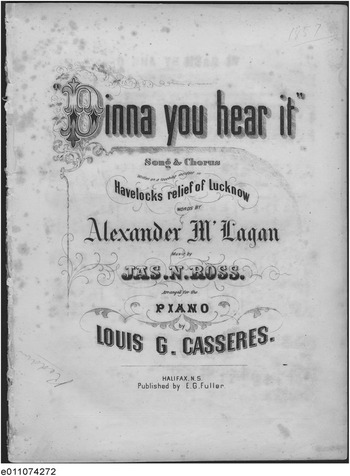
A third – and lesser-known – piece of Jessie Brown sheet music was published around 1858 in Halifax. ‘Dinna You Hear It: Song & Chorus, written on a touching incident in Havelocks [sic] relief of Lucknow’ is a setting of Scottish poet Alexander MacLagan's ‘Dinna Ye Hear It’, written for soprano soloist with chorus and piano accompaniment. As the title page indicates (see Fig. 1), the music was written by James N. Ross and arranged for piano by Louis G. Casseres. The score was published by E.G. Fuller, a Halifax merchant who sold American-produced sheet music at his bookstore and occasionally dabbled in music publication himself. He published at least 21 scores, including ‘Dinna You Hear It’.Footnote 4 Nothing is currently known about Ross, and the possibility remains that he was not a resident of Nova Scotia and that his music was acquired from elsewhere; however, approximately three years earlier in 1855, Fuller (acting as a subsidiary of Oliver Ditson of Boston) published a work of sheet music listing J.A. Ross as a composer. This piece – ‘The Malakoff Polka’, in honour of the Crimean War – was arranged by E.C. Saffery, a known Halifax musician. Typographical error or miscommunication could easily explain the difference in middle initial; given the coincidence of the two Fuller publications it seems likely that this Ross was the same composer and that he was living in Halifax. Even more compelling evidence is that a J.N. Ross was included on the membership list of the Halifax Harmonic Society in 1858.Footnote 5 Casseres, meanwhile, was definitely an active participant in Halifax's music scene. A former musician with the Jamaican Operatic Company, he resided in Halifax between 1852 and 1858 and was the city's leading pianist during that time. Casseres composed music for Oliver Ditson of Boston, as well as at least one other score for E.G. Fuller in addition to ‘Dinna You Hear It’.
Title Page of ‘Dinna You Hear It’ (MUSCAN B-33 #7, Library and Archives Canada)

A simultaneously shocking and horrifying yet fascinating incident when it happened, the Mutiny has since receded into the depths of British imperial history. The appeal of Mutiny literature and entertainments has likewise faded, leaving even Boucicault's and Blockley's once-popular play and song unknown to all but a limited and specialized audience. Written and arranged by obscure musicians and published by a small-time publisher in a small-time colonial town, the retelling of the Jessie Brown story presented by ‘Dinna You Hear It’ hardly stands at the forefront of commercial artefacts produced in the Mutiny's wake. Only two copies of have been located to date, one in the collections of Library and Archives Canada and one at the Dalhousie University Archives, suggesting that it did not have a particularly wide distribution. ‘Dinna You Hear It’ is, in many ways, simply one of countless examples of the nineteenth century's ubiquitous parlour music.
Sheet music publishing, though, was not ubiquitous in nineteenth-century Nova Scotia; from this perspective alone this score stands as a significant and remarkable work. The juxtaposition of the words ‘written on a touching incident in Havlock's relief of Lucknow’ and ‘published in Halifax, Nova Scotia’ on the song's cover page is also striking. Given the geographical and cultural distance separating Halifax and Lucknow, it may be difficult to imagine what interest the residents of Nova Scotia's capital city could possibly have in a remote settlement in northern India to prompt Haligonians to compose and publish a parlour ballad – especially given that music publication was a financially risky enterprise, and sheet music published by the era's largest British and American firms was already readily available in Halifax. By unravelling the historical factors that led to the composition of ‘Dinna You Hear It’, this article seeks an understanding of the commercial appeal this Mutiny tale held for Halifax audiences. Ross, Casseres and Fuller may have resided in a remote corner of the British Empire – and an opposite corner from Lucknow – but their location did not prevent them from being, in the words of Mutiny author Hilda Gregg, ‘up-to-date writers who knew how to utilise the flowing tide of popular excitement to their own advantage’.Footnote 6 A study of Nova Scotian newspapers published between 1857 and 1858 reveals that ‘Mutiny mania’, as elsewhere, captured the Nova Scotian popular imagination; however, in addition to its fantastical and patriotic overtones, the legend of Jessie Brown held special significance for Nova Scotian audiences. Moreover, ‘Dinna You Hear It’ also narrates a colonial subtext about the global network that connected an empire through the exchange of news, ideas and commercial goods – a network to which Nova Scotia belonged, and in the existence of which music could play a formative role.
The Indian Mutiny and Imperial News
Between 1857 and 1858, northern India was thrown into chaos as Indian soldiers serving in the British army fought against their former officers in an effort to release their homeland from British rule. What is now called India's First War of Independence, Victorian Britons referred to as a ‘mutiny’, or the ‘Sepoy Rebellion’.Footnote 7 While the fighting was unquestionably fierce for the initial months of the Mutiny's outbreak, following the final recovery of Lucknow in March 1858, the British army largely resumed control of northern India. The Mutiny entered into a ‘prolonged guerrilla phase’ which gradually subsided until reaching a complete halt with the elimination of three significant ringleaders (one was killed, one was captured and the third fled).Footnote 8 Even by contemporary standards the death toll was not high; the casualty lists at the preceding Crimean War (1854–56) and the subsequent American Civil War (1861–65) far surpassed those of the British Army in India. Nonetheless, while imperial histories today treat the Mutiny as a minor injury sustained through the course of the Empire's expansion, horrified Victorian Britons regarded it an epochal crisis.Footnote 9
The troubles in India had escalated into full-scale conflict by the time news of its initial stirrings had only begun to reach Britain's public. Nonetheless, the time lag did not prevent word of the Mutiny from reaching the far corners of the Empire. Julie Codell observes that newspapers created a transnational network that enabled ‘versions and revisions of accounts of imperial events [to be] obsessively reiterated and disseminated around the globe;’Footnote 10 this network operated at full capacity during 1857–58. The Mutiny also inspired a nearly immediate surge in the commercial production and sale of witnesses’ biographies, diaries and letters, and also of novels, poems, theatrical pieces, sheet music and other ‘merchandise’ that vicariously enacted, retold and commented upon the atrocities in India. The Mutiny quickly became one of the most prevalent topics in Victorian popular culture, prompting Hilda Gregg to remark in 1897 that ‘before Lucknow had been reluctantly evacuated, and while the blood stains were still wet in the slaughter-house at Cawnpore, we [found], side by side with advertisements offering family mourning or special terms … announcements of songs dealing with those very events’.Footnote 11 Christopher Herbert writes that Mutiny stories ‘were recounted over and over, in one stylistic inflection and literary register after another, in various journalistic media’; consequently, he refers to the Mutiny as being a literary and a fictive event as much as it was geopolitical one.Footnote 12 Aside from the small percentage of Britons in northern India who actually experienced the conflict, for most Victorians, whether at home or in the colonies, the Indian Mutiny existed somewhere between the real and the imaginary: a distant conflict they experienced, interpreted and reified through literature, spectacle and song.
Emerging from the ruins of the first siege of Lucknow, the legend of Jessie Brown became one of the most popular texts for such commercial artefacts.Footnote 13 Lucknow was one of two English garrisons to fall under siege at the Mutiny's outset. Beginning in May, the army stationed there, along with their families, barricaded themselves behind the walls of the British Residency. As soldiers fell and defences crumbled, the garrison's defeat appeared inevitable until the relief forces under the command of General Henry Havelock – including the 78th Highland Regiment – arrived to rescue the survivors on 26 September 1857.
On 8 October, only weeks after Lucknow's relief, the Parisian paper Le Pays printed the remarkable story of Jessie Brown. It was then picked up by Britain's Jersey Times and subsequently was widely distributed. Although the story supposedly originated from a letter by Monsieur de Banneroi, a French physician working in Calcutta who had heard it first-hand from another female survivor of Lucknow, many doubted that events had actually transpired as described. Nonetheless, despite the story's suspect validity – and the questionable existence even of the heroine herself – Jessie Brown's dream assumed a life of its own within the artistic and commercial artefacts produced in the mutiny's wake.
‘Mutiny Mania’ in Nova Scotia
It took nearly two months for word of the Mutiny to reach Nova Scotia. The first reports printed in the July newspapers were short – no more than a paragraph per issue – and were usually nestled amongst the other concise bulletins in the foreign affairs section. As the weeks passed, information increasingly began to trickle into the colony through the imperial channels. For the most part, Nova Scotia relied on British newspapers – typically about two to three months old by the time they reached North America – for the latest word on India, which would be reprinted for the consumption of the general public by Halifax's local presses. Often the arrival of a British cargo ship in Halifax Harbour heralded news of the Mutiny. For a week or two after such a ship's docking, the Nova Scotian presses would be supplied with a sufficient volume of Mutiny news to warrant independent sections within the papers. These progress reports were often given large-font headings, such as ‘The Latest from India’ or ‘The Indian Affair’, and ranged in length from a column to nearly a page.Footnote 14
Just like their compatriots in the British Isles, Nova Scotians were both worried and intrigued by the gruesome happenings in India, and they expressed their support for the British cause.Footnote 15 As international news extracts began filling the Halifax papers, the presses also included locally authored editorials, revealing concern for the situation in India, both in terms of its consequences for Britons trapped in the fighting and its broader implications for their empire. One author for the British Colonist expounded on Haligonians’ reaction to the Mutiny:
The unheard of atrocities that have been perpetrated upon British subjects since the mutinous outbreak in India, are familiar to all our readers, and we believe that but one sentiment pervades the breast of every man, woman and child in this city, – that of horror and execration of the fiendish Sepoys, and the most sincere commiseration for those who have suffered at their hands.Footnote 16
Both patriotic rhetoric and, as demonstrated in the above newspaper extract, humanitarian concern for fellow British subjects pervaded the press coverage.
With imperial news reports bringing India ever closer to home in the Nova Scotian imagination, general interest in that far-off and exotic country was also piqued. On 26 January 1858, the British Colonist informed its readers that the Rev. O. R. Bacheler, M.D., would be delivering a lecture on India the following evening at Temperance Hall.Footnote 17 The papers also began including ‘general interest’ stories – a biography of Delhi's Mughal king, a short summary of the army's precautionary measures against tropical climate-induced illness, and so on – alongside the military progress reports, undoubtedly in an effort to satisfy Nova Scotians’ growing fascination with India. The Mutiny also seeped into the literary pages of the local press, making both locally authored and ‘imported’ stories and poems available to the Halifax readership. Notably, the British Colonist printed the original story describing Jessie Brown's dream on 4 January 1858, and ‘Dinna Ye Hear It’ – MacLagan's poetic rendition of the tale – on 27 February 1858.
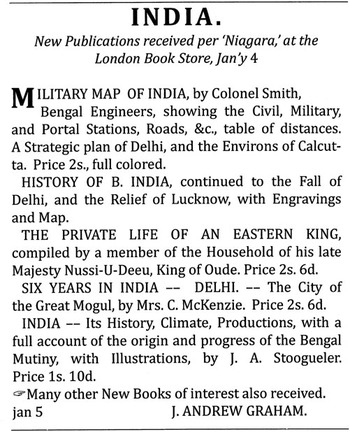
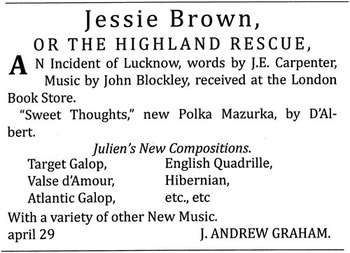
This fascination also extended into Haligonians’ pocketbooks. In November of 1857, a letter from London urged Nova Scotians to donate to the Mutiny Relief Fund; however, while Halifax's aldermen canvassed the city to collect subscriptions for the Fund other Haligonians recognized an opportunity for their own financial gain.Footnote 18 Projit Mukharji attributes the proliferation of songs, novels and plays based on the Jessie Brown legend to the rise of the Victorian era's commodity-based culture;Footnote 19 the availability of such memorabilia reveals that the Indian Mutiny was commoditized in Nova Scotia as well. While it is difficult to assess whether Nova Scotian consumers actually purchased ‘Mutiny merchandise’, newspaper advertisements from this time indicate that merchants certainly believed – or at least hoped – that the topic of India was popular enough to generate sales. In particular, J. Andrew Graham, the owner of the London Bookstore, attempted to capitalize on the local fascination, and recognized that strategic marketing of Mutiny literature, or India-themed literature in general, could potentially entice customers to his store. As he received stock, Graham would advertise in the local papers that he had acquired new books. The advertisements would list titles of select new arrivals, presumably the books Graham thought would have the most appeal to his customers. The arrival of the ship ‘Niagara’ in January 1858 brought the first crates of Mutiny-themed literature into Halifax. For weeks afterwards, Graham's advertisements were headed with ‘India’ in bold letters and listed five books for sale on that topic, two of which addressed the progress of the Mutiny (Fig. 2).Footnote 20 Such advertisements continued throughout the winter and into the spring, and by 29 April 1858, Nova Scotians could purchase Blockley's ‘Jessie's Dream’ at Graham's store (Fig. 3).Footnote 21
Reproduction of advertisement from British Colonist, 4 January 1858

Reproduction of advertisement from British Colonist, 29 April 1858

On the same day Graham's advertisement for Blockley's sheet music appeared in the British Colonist, a large notice in the adjacent column announced the opening of a panorama entitled ‘The Great Exhibition of India and the Sepoy Rebellion’ at Halifax's Temperance Hall.Footnote 22 This entertainment ran nightly for the entire week and featured performances by the ‘eminent soprano and vocalist’, Miss Lizzie Chapman. A subsequent review in the Halifax Morning Sun praised the managers for ‘their efforts to interest and instruct the public of Halifax on the subject of India and its Mutiny’.Footnote 23 The Acadian Recorder, however, acknowledged that public interest in the panorama may have been stimulated by its musical element: ‘Not the least attractive part of the entertainment – indeed the greatest attraction to many visitors – is the singing of Miss Lizzie Chapman, who accompanies the Exhibition and who possesses rare talents as a vocalist’.Footnote 24 Both reviews commented on the good attendance, and emphasized that Halifax's most prominent citizens were amongst the panorama's audience.
Although neither the British Colonist nor the Acadian Recorder indicated what Miss Chapman sang, the 3 May review in the Halifax Morning Sun announced that she would perform, for the first time, ‘a song written expressly for her by a gentleman of Halifax, entitled “Jessie Brown, the Angel of Lucknow”‘ in the evening's entertainment. Given that MacLagan's poem had been printed in the British Colonist several months previously, it is highly plausible that this event was the premiere of ‘Dinna You Hear It’ and that Ross was ‘the gentleman of Halifax’ referred to in the review. The advertisements do not mention any other musicians besides Miss Chapman, a singer who was likely from Boston, but the participation of a choir at such an event would not be unexpected. The names of the men and women who sang the chorus may have been omitted due to lack of space or because they were amateurs, or perhaps the chorus part was added at a later date. If this song was indeed ‘Dinna You Hear It’, the omission of Casseres's name is slightly curious, since his name was frequently mentioned in the papers, but again this discrepancy could be the result of the advertisement's size or because Casseres became involved in the song's arrangement at a later date. Similarly, the discrepancy in title could be attributed to advertising practices: perhaps the alternate title of ‘Jessie Brown, Angel of Lucknow’ was used so that newspaper readers would more readily recognize the song's basis. Or, the decision to retain MacLagan's original title may have been made closer to the song's publication date. Of course, the possibility does exist that the song Miss Chapman premiered is not ‘Dinna You Hear It’, and that there were two, or even more, Nova Scotian musical adaptations of the Jessie Brown legend. Halifax's ‘Mutiny mania’, after all, did not end with the Great Exhibition. The well-received Halifax performance of Dion Boucicault's celebrated play, Jessie Brown; or, the Relief of Lucknow, on 22 July 1858, for instance, could well have inspired the composition and subsequent publication of ‘Dinna You Hear It’.Footnote 25
On 8 November 1858 The Evening Express, another Halifax paper, printed a review of a concert Casseres gave in Saint John, New Brunswick at which he performed ‘Jessie of Lucknow’.Footnote 26 Again there is a discrepancy in title, but given Casseres's involvement it is reasonable to assume that this work would be the same song that he had arranged for Ross. Halifax advertisements indicate that Casseres occasionally sang in concerts, so he may have performed the vocal part as he accompanied himself on the piano, with or without the support of a choir. In any case, it is likely that even if ‘Dinna You Hear It’ had not yet been published, the work was composed before November 1858.
Sensation, Heroics and Highlanders
Regardless of whether ‘Dinna You Hear It’ had been performed in a Halifax concert or not, the Nova Scotian public's seeming interest in Mutiny tales and the availability of Mutiny-themed artefacts undoubtedly encouraged Fuller to invest in the production of his own work of ‘Mutiny merchandise’. Ross and Casseres's musical setting of the Jessie Brown legend may have seemed particularly viable to Fuller, given the great public interest the story had aroused. Beyond general interest, though, Fuller may have recognized an even deeper source of appeal – both creative and commercial – embedded in the song he chose to publish. One of the first authors to address the Mutiny's hold on the popular imagination, Hilda Gregg suggested that it was the embedded ‘[elements] of romance’, the ‘valour and heroism, cruelty and treachery, sharp agony and long endurance, satiated vengeance and bloodthirsty hatred’ of the Mutiny that served as the fount of its appeal.Footnote 27 Although Christopher Herbert has since argued that the Mutiny's hold on Victorian society was far more complex, the reported tales of cruelty, treachery and bloodthirsty hatred emanating from India unquestionably did trigger fascination.Footnote 28 The gruesome reports of the massacres at Meerut, Delhi and Cawnpore circulated in a culture that was becoming increasingly fascinated with the sensational: scandal, intrigue, royalty and, of course, murder.Footnote 29 Like the rest of the Empire, residents of Halifax read about brutal murders and torture, about the infamous ‘slaughter-house’ discovered at Cawnpore, and about the bloody bodies of women and children stuffed into a well. If the publication of these reports in the newspapers is any indication, Haligonians were captivated even as they were horrified by the atrocities of the Indian Mutiny.Footnote 30
Tales of valour and heroism were also popular. Nova Scotians read about Judith Wheeler, for example, the tragic heroine who killed herself to prevent defilement, but not without first killing several sepoys.Footnote 31 Other heroic tales included the mother who escaped with her baby by crawling through a garden;Footnote 32 the young lady at Delhi who sacrificed her life for her father;Footnote 33 and the British soldiers who pledged to kill one sepoy for every hair on Miss Wheeler's head to avenge her death.Footnote 34 An author for the Acadian Recorder explained Haligonians’ interest in the Mutiny as follows:
The fact is that any human being, no matter who, or what he may be, who is capable of admiring the most noble characteristic of man and who has watched the courage of events in India, for the last few months, must have felt his soul elevated by a sense of the sublime rarely experienced, and his heart throb with emotions which the term admiration cannot sufficiently describe, as he saw, in his minds [sic] eye, the heroic deeds and saint-like fortitude of the British men and women who have fought, and suffered, and died in that blood soaked land.Footnote 35
When available, the Nova Scotian papers included extracts from letters written by Britons caught in the Mutiny's midst. These letters brought a heightened sense of reality to the far-off conflict, and often provided readers with vivid accounts of astonishing heroism – and astonishing luck!
Another facet of the Jessie Brown legend's particular appeal was the fact that both the heroine and her rescuers were Scottish Highlanders. According to Kenneth McNeil, Mutiny discourse was fixated with the image and idea of the Highland soldier. Accounts of the Mutiny emphasize the Highlanders’ exceptional fighting skills (against which the Indian soldiers stood no chance), and describe the sepoys’ reaction to Highlanders as one of bewilderment.Footnote 36 The common source of their confusion was the sight of the soldiers’ kilts and the sound of their bagpipes – the very symbols of Scotland. Such accounts found their way into the Nova Scotian papers: following the Relief of Lucknow, for instance, the Acadian Recorder printed an article describing the confusion caused by the sight of kilted Highlanders, while the British Colonist included an amusing anecdote of a Highland bagpiper who outsmarted an enemy sepoy by holding his set of pipes as if it were a gun.Footnote 37 The fierce Highland warrior, clothed in a tartan kilt and armed with bagpipes, was the embodiment of Britain's military superiority – ‘the metonymic sign of British fighting prowess’ – and consequently became a figure of intense national pride.Footnote 38
In a recent study of Mutiny plays, Marty Gould finds that the ideology surrounding the Highland soldier was a central theme of theatrical adaptations of Jessie Brown.Footnote 39 Scotland – or more aptly, the memory of Scotland – features prominently in these plays, serving as the wellspring from which Jessie and the rest of the Scots at Lucknow draw their courage, loyalty and moral fortitude.Footnote 40 The necessarily shorter length of a song naturally limits the development of such ideas, but nonetheless Scottish imagery and idealism also permeate the texts of Jessie Brown parlour ballads. ‘Dinna You Hear It’, as well as the songs by Crawford and especially Blockley, begin nostalgically with Jessie either yearning for (as in ‘Dinna You Hear It’) or dreaming of (as in Crawford's and Blockley's versions) her Highland home. Blockley's text extols the Highlanders’ virtue, calling them ‘the bravest o’ the brave’, while ‘Dinna You Hear It’ testifies to their military prowess by way of Jessie's faith that the sepoys’ ‘death mists’ will be no match for her rescuers’ claymores. The thrice-repeated chorus also testifies to the Highlanders’ near-legendary ability: their bagpipes’ ‘slogan’ can penetrate even the noise of battle to foster pride and cheer (see Appendix).
The Scottish nostalgia and pride underlying Jessie Brown texts dovetailed with the more generalized romanticization of Scottish culture that blossomed in the Victorian era. Sir Walter Scott's novels had created a popular but mythologized image of Scotland that equated Scottishness with the culture of its northern region. Queen Victoria's 1842 visit to the Highlands popularized Scotland as an escapist tourist destination. Her hearty praise of Scottish people and culture – she even hired her own personal piper – further advanced romantic notions of Scotland. The commercialization of Scottish music had begun even earlier in the eighteenth century, and by the 1850s both newly composed ‘Scottish’ songs and those based on altered existing melodies were favourites of the drawing room as well as the concert stage on both sides of the Atlantic.Footnote 41 Concert advertisements and reviews in Nova Scotian newspapers indicate that Scottish songs were also a favourite of Nova Scotian audiences. For example, although Mr. Ferguson – who performed in Halifax on 2 September 1858 – did sing a few of ‘the bold, national airs of Scotland’, he apparently did not sing enough: his reviewer suggested that ‘a few more of these excellent selections from the lands of old Scotia would be a decided improvement’.Footnote 42 Casseres himself had been praised in the Nova Scotian papers for his public performances of Scottish songs.
MacLagan's poem consequently provided Ross with opportunity to compose – and Casseres to arrange and Fuller to publish – a parlour song that could likewise capitalize on the appeal of Highland imagery. Regarding the similarity of many American parlour ballads to Scottish songs, Nicholas Tawa argues that it is often impossible to determine if this resemblance is an unconscious by-product of America's Scottish heritage or the composer's intended goal.Footnote
43
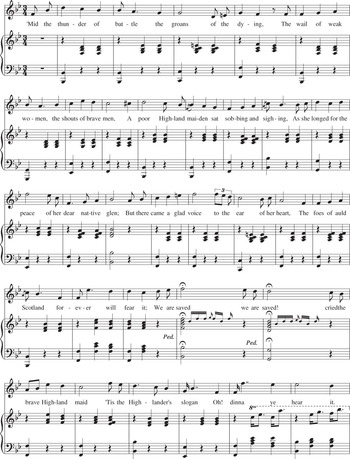
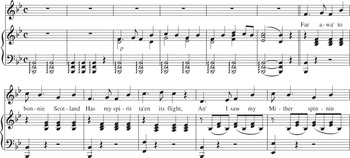
In the case of ‘Dinna You Hear It’, though, it seems likely that the composer and arranger were deliberately attempting to imbue this song with Scottish flavour. The melody of ‘Dinna You Hear It’ is frequently enlivened with lombardic rhythms: Example 1 features the use of both
 and
 , two versions of the so-called ‘Scottish snap’. Even more striking are the decorative grace notes found throughout the soprano soloist's line. Such melodic decoration was another staple gesture of ‘Scotch’ songs, imitating the embellished style of Scottish folk singing.Footnote
44
The pianist is even given a chance to imitate the bagpipes at the end of the first verse, when Jessie first hears the faint strains of the Highlanders’ slogan (see bars 25–26 of Ex. 1).
‘Dinna You Hear It’ (Verse 1)

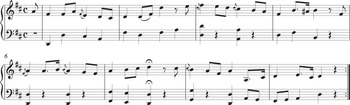
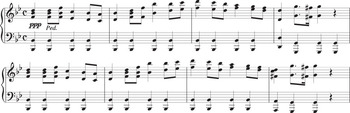
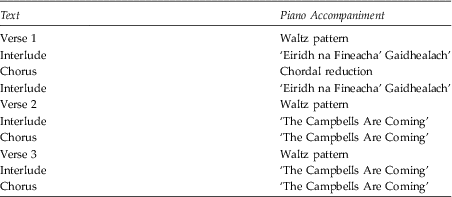
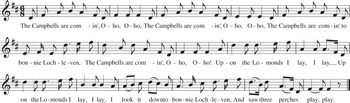
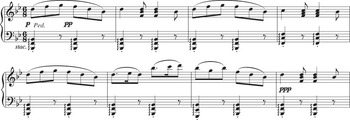
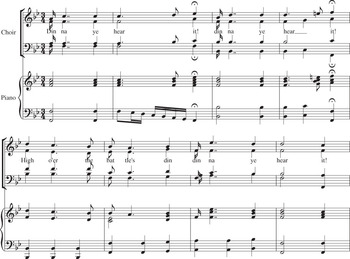
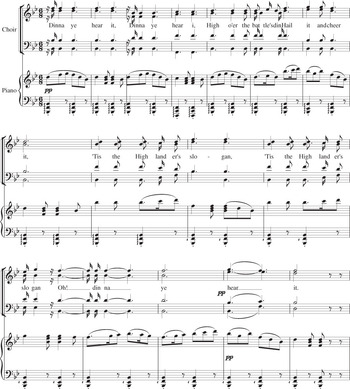
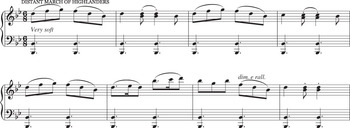
The Scottish quality of Ross's melody is further enhanced by the use of borrowed Scottish melodies throughout the piano accompaniment. These quotations have a programmatic function, representing the ‘slogans’ Jessie heard the Highlanders pipe as they advanced toward Lucknow. The piano interlude that separates the first verse from the chorus features the opening phrase of a Scottish tune called ‘Eiridh na Fineacha’ Gaidhealach’ (also known as ‘The Jacobite War Song’ or ‘The Rebel War Song’ – see Ex. 2a for the original tune and Ex. 2b for the piano interlude) in the right hand. The steady octaves played by the left hand give this interlude a martial affect, suggesting the distant army's approach, while the stasis of pitch hints at the bagpipes’ drone. This tune is repeated after the chorus as the second interlude (see Table 1). Following the second verse, when Jessie hears the war pipes ‘pealing the Campbells are Coming’, the piano responds with a new interlude that quotes from the tune of ‘The Campbells are Coming’ (see Ex. 3a and 3b). Again, the bass part, now rolled chords, outlines a steady beat to simulate a march. This interlude then becomes the accompaniment for the second chorus, replacing the chordal reduction that accompanied the first iteration (see Ex. 3c and 3d). The piano repeats this quotation for the third, and final, interlude and chorus.
‘Eiridh na Fineacha’ Gaidhealach’. From Simon Fraser, The Airs and Melodies Peculiar to the Highlands of Scotland (Edinburgh: John Gow, 1812), 12, bars 1–8

‘Dinna You Hear It’ Piano Interlude, quoting ‘Eiridh na Fineacha’ Gaidhealach’

Order of Borrowed Melodies in ‘Dinna Ye Hear It’

‘The Campbells are Coming’. From Robert Chambers, ed., The Songs of Scotland Prior to Burns (Edinburgh & London: W. & R. Chambers, 1862; reprinted New York: AMS Press, 1976), 70–72

‘Dinna You Hear It’ Piano Interlude, quoting ‘The Campbells are Coming’

‘Dinna You Hear It’ Chorus 1 (excerpt)

‘Dinna You Hear It’ Chorus 2 (complete)

‘Dinna You Hear It’ is not unique in its programmatic use of ‘authentic’ Scottish melodies woven throughout the ballad: Blockley's and Crawford's Jessie Brown songs also animate the text with ‘bagpipe’ interludes played by the pianist. Both of these versions quote ‘The Campbells are Coming’, as shown in Table 2. They also each use ‘Auld Lang Syne’ for one interlude, and close with a piano-only rendition of ‘God Save the Queen’. These commonalities undoubtedly derive from the fact that the account of the Jessie Brown legend distributed in the papers mentioned that the besieged sang ‘God Save the Queen’ once they heard the relief forces arrive, to which the army bagpipers then replied with ‘Auld Lang Syne’. Also, the newspaper quotes Jessie as saying ‘the Campbells are comin’! D'ye hear, d'ye hear!’ when she was still trying to convince the other Britons that help was on the way.Footnote 45 In this respect, ‘Dinna You Hear It’ is somewhat curious, since it only references one of the bagpipe ‘slogans’ described in the original story.Footnote 46
Borrowed Melodies in Blockley's and Crawford's songs

Aside from the piano quotations, Blockley's and Crawford's Jessie Brown songs have little in common. Crawford's arrangement alternates between two themes – a chorale-like tune in A minor, and a more jaunty one in A Major – whereas Blockley uses the same B-flat Major melody for all three verses. While Blockley's piano accompaniment is largely independent of the vocal melody, Crawford's is homophonic and reiterates the singer's line in the upper right hand. ‘Dinna You Hear It’, however – aside from the absence of ‘Auld Lang Syne’ and ‘God Save the Queen’ – bears noticeable similarities to Blockley's ‘Jessie's Dream’. First, ‘Dinna You Hear It’ is also in B-flat Major. Although ‘Jessie's Dream’ is in the more martial time signature of  , both versions feature similar accompaniment patterns (compare Ex. 4a with Ex. 1). The same rolled chords Blockley uses at the opening to imitate the marching pattern of military snare drums appear in ‘Dinna You Hear It’ to accompany the ‘Campbells Are Coming’ interlude, which is in an almost identical setting to Blockley's arrangement of that tune (compare Ex. 4b with Ex. 3b). The
 syncopation is also featured in Blockley's melody, although less prominently than in ‘Dinna You Hear It’. These similarities suggest that the Halifax musicians might have modelled their composition on the Englishman's, a definite possibility since Graham sold Blockley's sheet music at the London Bookstore.
Opening of Blockley's ‘Jessie's Dream’

Blockley's ‘The Campbells Are Coming’ Piano Interlude

Other aspects of ‘Dinna You Hear It’, though, are distinct from Blockley's ‘Jessie's Dream’, most noticeably the former's use of a chorus. Neither Blockley's vocal line nor piano accompaniment are embellished with grace notes; instead, his text is the predominant source of the verse's ‘Scottish flavour’. Blockley quotes each borrowed melody only once, and only during piano interludes. In ‘Dinna You Hear It’, however, both of the ‘bagpipe’ tunes are repeated, and ‘The Campbells are Coming’ is integrated with the text as the accompaniment to the chorus. The inclusion of ‘Eiridh na Fineacha’ Gaidhealach’ is also curious: perhaps it was a tune either Ross or Casseres had heard performed by one of the Highland Regiments stationed in Halifax?Footnote 47 Furthermore, Graham's advertisement for Blockley's sheet music appeared in the paper at the same time as the notice for the Great Exhibition of India; if ‘Dinna You Hear It’ was indeed the song Miss Chapman sang as part of the Exhibition at the 3 May 1858 performance, it is possible that Ross composed it and Casseres completed the piano arrangement without knowing of Blockley's version. The similarities may simply be the coincidental result of three musicians versed in a common musical language, responding to common textual cues.
Colonial Pride and a Native Son
Beyond making engrossing stories for newspapers, the sensational tales of heroics and Highlanders – as made available to the public through merchandise like ‘Dinna You Hear It’ – served the even greater function of providing a much-needed boost to Britain's wounded morale. The ease with which the sepoys overpowered their commanding officers and threw the entire British establishment in northern India into utter chaos not only exposed the vulnerability of the British army but, according to Gautam Chakravarty, revealed the fragility of the Empire itself.Footnote 48 Chakravarty, along with Christopher Herbert, Marty Gould and other scholars of Mutiny literature describe this conflict as a moment of trauma for the British Empire.Footnote 49 If Britishness was intertwined with the nation's image as a military power, as Linda Colley has argued, then the ease with which a group of so-called ‘rebels’ overturned the Imperial establishment in northern India came as a tremendous shock, and was deeply disrupting for British national identity.Footnote 50 The string of crushing defeats publicized in newspapers around the world cast doubt on the strength and sustainability of the Empire itself. Consequently, the discourse arising from Havelock's Relief of Lucknow elevated it from the military rescue operation that it was to a great and victorious British military triumph.
In this light, there is little wonder that the legend of Jessie Brown appealed so strongly to commodity authors like Boucicault and Blockley – and Ross, Casseres and Fuller – for it boasted all the elements of the perfect Mutiny tale: a larger-than-life story supposedly recorded in a first-hand account; a community on the brink of despair; a courageous and steadfast woman with remarkable perception (and hearing!); and an amazing rescue executed by Britannia's heroes. Moreover, whether it was fact or fable, it remained an inspiring tale of British steadfastness and determination. Jessie Brown emerged from the ruins of Lucknow as a salve to a wounded nation, renewing the faith of Britons everywhere, including Halifax, in the success of their empire.
For Haligonians, though, and indeed Nova Scotians in general, the relief of Lucknow did more than incite national pride: it put the small colony onto the international stage. A report in the British Colonist on 25 February 1858 listed the names of British North Americans serving in the army.Footnote 51 Second on the list was Brigadier John E. Inglis. Born in Nova Scotia in 1814, he was the grandson of Charles Inglis, the first Bishop of Nova Scotia. His father, John, had also served as Nova Scotia's bishop from 1825 until his death in 1850. Inglis was stationed in Lucknow under the command of Sir Henry Lawrence at the Mutiny's outbreak, and found himself amongst the rest of the army besieged in the Residency. On 2 July 1857, Lawrence was mortally wounded. He appointed Inglis to succeed command of the regiment, and consequently it was Inglis who maintained the Residency's defences until the arrival of Havelock's reinforcements on 26 September. While Lucknow's success under long-term siege was largely attributed to Lawrence's careful preparations, Inglis played an integral role in the Residency occupants’ survival. His bravery and leadership earned him a promotion to Major-General, and he was knighted in 1858.
Although Inglis had left the Maritimes over 20 years before (he had joined the army in 1833), Nova Scotians still claimed him as their own and exalted him as their native hero. Even British newspaper reports referenced Inglis's birthplace, so it was known both at home and abroad that a Nova Scotian had distinguished himself in war.Footnote 52 Ian Ross Robertson observes ‘an intense sense of local pride’ blossoming in Nova Scotia throughout the 1850s, which was greatly bolstered by the worldwide recognition of one of their own as a military hero.Footnote 53 ‘Nova Scotians may indulge in feelings of just pride in the reflection that Colonel Inglis is one of themselves’, wrote the editor of the British Colonist on December 22, 1857.Footnote 54 The same author further remarked:
Too much importance can scarcely be attached to circumstances which are calculated to force upon the mind of the British Government and people, the conviction that in the Colonies may be found men capable of shedding lustre upon any position, however commanding and critical that position may be.Footnote 55
Inglis became the subject of a lengthy debate at Nova Scotia's Legislative Assembly, as some members wanted to honour him with a sword but others believed the current economic situation was too dire to afford such a gift.Footnote 56 The pro-gift party prevailed and Sir John Inglis was presented with a ceremonial sword, the steel blade of which was forged from Nova Scotian iron.
Inglis may even have inspired ‘Dinna You Hear It’: newspaper advertisements state that the song premiered by Miss Chapman at the Great Exhibition of India was dedicated to ‘one of Nova Scotia's bravest sons, Sir John Inglis’.Footnote 57 Whether or not it was written for Inglis, Nova Scotians likely would have associated ‘Dinna You Hear It’ with their local military hero; after all, if the story were true, Inglis would have been in Lucknow with the famous Highlander. One speaker at the Legislative Assembly's sword debate even compared Inglis with Jessie Brown:
He who has studied the lives of the great military and naval commanders of England must known that in the hour of danger – when death stared them in the face – their thoughts were of home; and sir, I have no doubt that many a day, when the beseiging [sic] forces pressed the little garrison of Lucknow, and threatened their annihilation, the thoughts of its brave commander reverted to his native land; that the old familiar scenes of his childhood – the faces of those he had known in youth – the fragrance of his country's spruce tree, and the perfume of its flower, rose unbidden and were present to his mind. Just as Jessie Brown heard the slogan of her country which sent a thrill of joy to her heart, and inspired the soldiery with new spirit, hours before those whose ears were unaccustomed to the sound, could distinguish it, – so the murmur of his country's streams – and the recollection of his native land, let us fondly hope, lent to Colonel Inglis fortitude to endure the vicissitudes of that protracted siege – and the indomitable courage which in the end enabled him to secure to those who were dependent upon his energy, forsight [sic], and unwearying [sic] vigilance, their lives and persons inviolate.Footnote 58
Undoubtedly the third verse of ‘Dinna You Hear It’ – which begins ‘The heroes of Lucknow[,] fame crowns you with glory/ Love welcomes you home with glad songs in your praise’ – resonated strongly with Nova Scotians, offering the entrepreneurial Fuller an excellent opportunity to capitalize on Nova Scotian pride.
Conclusion: Implications of a ‘Touching Incident’
Was ‘Dinna You Hear It’ a commercial success, or did Fuller misjudge his target market's interest in a song about a ‘touching incident’ in faraway Lucknow? Unfortunately, other than the two extant scores residing in Canadian archives, there is no evidence to suggest how Ross and Casseres's song fared on the shelves of Fuller's store. What ‘Dinna You Hear It’ does suggest, though, is why and how a small-time publisher like Fuller might attempt to profit from the sheet music industry, despite the fact that the music market was already saturated with publications from much larger and more successful companies: by publishing fashionable music that addressed current topics, but with a distinct appeal to local interests. ‘Dinna You Hear It’ featured a musical formula proven marketable, with the extra advantage of being a local product, which likely would have appealed to the hometown pride coursing through Halifax at that time. The song's text narrated a story that was already beloved by consumers on both sides of the Atlantic, but Inglis's connection to Jessie Brown undoubtedly enhanced its appeal to the Halifax market. Ross's melody enlivened that tale with a Scottish lilt, enhanced by the ‘bagpipe’ interludes that were already parlour favourites in their own right. These pianistic renditions of the ‘Highlanders’ slogan’, though, were not simply quotations of popular tunes; they were the sonic emblems of a great nation and its colony, the sound of which sparked patriotic pride in Britannia's heroes and Nova Scotia's own native son. Whether or not ‘Dinna You Hear It’ was modelled after Blockley's ‘Jessie's Dream’ probably mattered little to Fuller – or to the consumers who purchased it. Rather, its similarities to Blockley's popular song, whether intentional or coincidental, would have enhanced its commercial potential, by providing the Nova Scotian public with a local opportunity to experience the musical culture that their fellow Britons enjoyed.
‘Dinna You Hear It’ also has much to tell about the processes of cultural exchange at work in mid-nineteenth-century Nova Scotia, and indeed, the rest of North America. As a response to both local and global phenomena, this song's very existence exemplifies Nova Scotia's connectedness within larger social, political and economic networks. Nova Scotia may have been only a minor holding within a vast empire, but neither its small size nor its remote location diminished its desire to establish its connection to the metropole. Journalism was certainly a major factor in forging this link, but art, entertainment and commercial merchandise also made a significant contribution. While distance and the limits of communication certainly impacted the speed of this cultural exchange, the Atlantic Ocean's great expanse prevented neither the tales of Lucknow nor the fashions of Britain's metropolis from washing over to Nova Scotia's rocky shores.
Moreover, ‘Dinna You Hear It’ stands as a reminder of music's important role in the Nova Scotian colonization project. Parlour ballads and other sheet music – whether imported or locally composed – were both product and catalyst in the process of transplanting Britishness to North America. The arrival of British sheet music in Nova Scotia was a natural consequence of the commercial trade that was itself an inevitable result of settling the North American frontier; purchasing, performing and even publishing such music bridged the cultural expanse that separated the two coasts of the Atlantic. In the case of ‘Dinna You Hear It’, Ross, Casseres and Fuller's musical setting of the Jessie Brown legend afforded Nova Scotians opportunity to share in Britain's horror at the Mutiny, to mourn the tragic loss of life, to rejoice when the threat to their nation was subdued, and even to sing of their own success and to celebrate the role that Nova Scotia could play in a transatlantic empire.
Appendix Lyrics for ‘Dinna You Hear It’
First Verse
‘Mid the thunder of battle the groans of the dying,
The wail of weak women, the shouts of brave men,
A poor Highland maiden sat sobbing and sighing,
As she longed for the peace of her dear native glen;
But there came a glad voice to the ear of her heart,
The foes of auld Scotland forever will fear it;
We are saved, we are saved! Cried the brave Highland maid
‘Tis the Highlander's slogan, Oh! Dinna ye hear it.
Chorus
Dinna ye hear it! Dinna ye hear it!
High o'er the battle's din, dinna ye hear it!
High o'er the battle's din, hail it and cheer it,
‘Tis the Highlander's slogan, Oh! Dinna ye hear it!
Second Verse
A moment the tempest of battle was hushed,
But no tidings of help did that moment reveal;
Again to their shot-shatter'd ramparts they rushed
Again roar'd the cannon, again flash'd the steel;
Still the Highland maid cried, let us welcome the brave,
The death mists are thick, but their claymores will clear it;
The war pipes are pealing the Campbells are coming
They are charing and cheering, Oh! Dinna ye hear it.
Chorus
Third Verse
The heroes of Lucknow fame crowns you with glory,
Love welcomes you home with glad songs in your praise,
And brave Jessie Brown with her soul stirring story,
Forever will live in the Highlander's lays;
Long life to our Queen and the hearts who defend her!
Success to our flag and when danger is near it,
May our pipes be heard playing the Campbells are coming,
And an angel voice crying Oh! Dinna ye hear it.
Chorus