


The famed mystical poet Farid al-Din ʿAttār (d. c. 1221) worked in an array of literary forms, but his four didactic masnavis are generally considered to be the highlight of his oeuvre.Footnote 1 Similar to the earlier masnavis of Sanāʾi (d. c. 1130) and Nezāmi (d. c. 1209), ʿAttār’s masnavis contain hundreds of short, edifying anecdotes featuring prophets, spiritual heroes, wise fools, and historical and legendary kings. These short narratives are accompanied by interpretive exhortations urging the audience to piety, and the resulting narrative‒exhortation pairs are grouped together into loose thematic chapters. Unlike those of his models, however, three of ʿAttār’s four masnavis are structured through overarching allegorical frame-tales; their narratives and exhortations are uttered by fictional teacher-figures as they admonish various student-addressees within the narrative frame.
Most of the scholarship on ʿAttār’s masnavis concerns itself with the allegorical frame-narratives—and perhaps one or two of the longer tales—but ignores the mass of short anecdotes and exhortations that comprise the bulk of his poems.Footnote 2 The few studies that do focus on the anecdotes tend to approach them as vehicles for bits of metaphysical, ethical, or psychological dogma that together comprise ʿAttār’s personal belief system. This methodology is exemplified in the ground-breaking work of Hellmut Ritter, whose magisterial Ocean of the Soul aims at nothing less than the elucidation of the Persian sufi “thought world” of the twelfth century.Footnote 3 Ritter extracts several hundred anecdotes from across ʿAttār’s four masnavis, reorders them according to his own thematic rubric, translates them, and explains their didactic points; as he readily admits, however, his interpretations do not always match up with ʿAttār’s own homiletic explanations.Footnote 4 A similar approach is used by Kermani in his Terror of God, although in the service of a somewhat narrower aim: he collects anecdotes from across the masnavis, especially the Mosibat-nāmeh, on the basis of which he seeks to reconstruct ʿAttār’s theodicy and attitude towards divine culpability for human suffering.Footnote 5 Both of these studies attempt to distill these anecdotes’ religious meanings and then arrange them into a systematic set of beliefs and attitudes.
By treating the anecdotes as static modules to be decoded and rearranged, this brand of scholarship abstracts ʿAttār’s narratives from readers’ temporal experience of the text. Scholars such as Ritter do not examine how the anecdotes dramatically unfold in time, or how clusters and sequences of anecdotes are formally and conceptually linked as readers move progressively through the poems. These temporal characteristics of the literary encounter, however, are critical to the poems' pedagogical aims. As J. T. P. de Bruijn has insightfully observed, ʿAttār’s verse can be considered a species of “homiletic poetry,” a mode of discourse that recalls a preacher’s address in that it seeks to inculcate a pious ethos in its audience and motivate them to reform their lives. In this sense, homiletic poetry aims not merely to describe, but to persuade.Footnote 6 Such persuasion, however, is an inherently audience-directed, temporal project; the poet attempts to instigate a change of state in his imagined readers, and to thereby provoke them to renew their commitment to a pious mode of life. And in ʿAttār’s case, much of this persuasive force derives from his readers’ progress through his tightly structured, dramatic anecdotes. At the beginning of these anecdotes, readers are subtly invited to identify with certain common-sense religious positions or attitudes, but over the course of their short narratives, those positions are nuanced, altered, or radically overturned, forcing readers to confront the inadequacy of their beliefs and judgments.
When we consider how readers would have consumed ʿAttār’s masnavis, we find that the anecdotes are not, in fact, modular and self-contained, but participate in larger dynamic structures. Although no text can completely control its own reception, ʿAttār’s masnavis lend themselves to a linear, progressive style of reading: by virtue of the frame-tale, each thematic chapter is cast as a unitary discourse that represents a single step in a structured, sequential journey. Furthermore, adjoining narratives form “clusters” that share themes, imagery, or topoi, and the reader is guided from one anecdote to the next by a variety of formal, lexical, and thematic transitions. Readers who move through the poem consecutively would notice these interlocking structures and the resulting webs of “inter-signification” through which the various anecdotes amplify, nuance, and sometimes even contradict one another. Unfortunately, because most of the scholarship on ʿAttār’s masnavis cherry-picks anecdotes from across the entire oeuvre, it misses these localized complexities.
In this article, by contrast, I provide a contextualized reading of the fourth chapter of ʿAttār’s Mosibat-nāmeh, focusing on the pedagogical function of the embedded anecdotes, individually and as part of larger structures, as they unfold temporally for an imagined reader.Footnote 7 The fourth chapter of this poem is representative in terms of style, and it deals with themes of mortality, death, and eschatology, all of which are dominant concerns in ʿAttār’s works; it thus serves as an ideal case study.Footnote 8 Its anecdotes can be loosely divided into three thematic clusters, sequentially arranged—one focused on the exploits of wise fools, one related to issues of theodicy, and one devoted to the prophets’ attitudes towards death. We will begin by examining how the chapter as a whole is conditioned by the frame-tale, and we will then move through these three clusters, paying attention to how their short, dramatic narratives—in conjunction with each other, the chapter as a whole, and the frame-tale—disrupt common-sense attitudes towards death and provoke a renewed appreciation for the stakes of the mortal condition.
Textual Frame, Oral Discourse
Three of ʿAttār’s masnavis, including the Mosibat-nāmeh, are structured around frame-narratives that allegorically depict the mystical path towards God. Beyond their specific allegorical significance, however, these frame-narratives also influence how readers encounter the masnavis’ embedded anecdotes: they encourage a linear form of reading by endowing the poem with a progressive motion and, in the case of the Mosibat-nāmeh, organizing its forty thematic chapters into a gradated pedagogical program.
The Mosibat-nāmeh’s frame-narrative recounts the visionary journey of a sufi wayfarer (sālek) through the cosmos as he searches for relief from an existential pain brought on by human mortality, contingency, and ontological separation from the divine. Over the course of this journey, he visits forty different beings (one per chapter), beginning with the archangels and elevated metaphysical entities such as the pen and the tablet, before descending to the four constituent elements that comprise the sub-lunar world. He then re-ascends through a sequence of compound beings of increasing complexity, including gemstones, plants, birds, and wild animals. He next encounters an archetypal human being and then passes through a series of seven prophets from Adam to Muhammad. He explains his afflicted condition to each of these interlocutors and begs them for their aid; most of them, however, are just as confused and afflicted as he is, and they turn him away empty-handed. The prophets, however, urge him towards the final prophet, Muhammad, who in turn directs him to turn inwards into himself. Following the Prophet’s advice, the sālek passes through five internal faculties including sense, imagination, and intellect before plunging into the “ocean of the soul” where he is effaced in the divine. After every stage, from the first archangel to his final encounter with soul, the sālek reports back to his spiritual guide (pir), who elaborates on that particular interlocutor’s role in the universe and delivers a series of related edifying anecdotes and homilies; these framed anecdotes and exhortations form the bulk of the poem.
The frame-tale’s allegorical significance has been widely alluded to in the scholarship: it constitutes an inverted ascent to heaven (meʿrāj) and functions as a synecdoche of the entire mystical path, with significant implications for the sufi understanding of the self, the cosmos, and the relationship between the two.Footnote 9 Much less remarked upon, however, is the frame-tale’s construction of an imagined performance context for the embedded narratives. At the beginning of the poem, ʿAttār suggests that the sufi’s cosmic journey should be understood as a vision experienced in the chelleh, the forty-day retreat practiced by certain sufi groups from at least the twelfth century onwards.Footnote 10 According to the extant sufi manuals’ description of the practice, practitioners would retreat to a secluded cell where they would perform ascetic exercises under the supervision of a pir, with whom they would meet to discuss any visions they might witness.Footnote 11 In the Mosibat-nāmeh, too, after each of his forty visions, the sālek returns to the pir, who briefly comments on the nature of his imaginal interlocutor and then delivers a set of related stories and homilies. Each visionary encounter thus becomes an opportunity for the kind of informal teaching discourse that was key to the master‒disciple relationship.
This fictional performance setting underscores the embedded anecdotes’ didactic purpose and their sequential character. By virtue of the frame-tale, each chapter is cast as a discourse delivered by the pir on a specific day of the chelleh, and thus represents a single component in a larger forty-day ascetic program. Such a structure encourages a sequential style of reading: the forty chapters each represent one step on a progressive march into the soul, and the readers’ temporal movement through the forty-part poem mirrors the sālek’s passage through the forty-day retreat. As I have argued elsewhere, the work’s forty-part structure and approximately equal-length chapters lend themselves to a daily reading practice, such that the reading process itself becomes the performance of a metaphorical forty-day retreat.Footnote 12
The frame-tale also highlights the didactic purpose of the work, since readers are guided to approach the embedded anecdotes as the contents of a pir’s edifying conversations with his disciple.Footnote 13 All of the poem’s anecdotes seem to be, in the first instance, delivered by this fictional spiritual guide, and a number of them are introduced with the phrase “he said...,” explicitly marking them as quoted speech.Footnote 14 At the same time, because pre-modern Persian lacks quotation marks, it can be difficult to understand when the pir’s discourse ends and where ʿAttār’s commentary begins. Both ʿAttār and the pir speak as didactic authority figures, and the two voices easily bleed into one another. Through the narratorial slippage of the frame-tale, the pir becomes an extension of ʿAttār’s authorial persona, while readers are invited to identify with the sālek as recipients of pedagogical discourse.Footnote 15
With these global effects in mind, let us turn to the fourth chapter of the Mosibat-nāmeh, in which the sālek encounters ʿAzrāʾil, the angel of death.Footnote 16 The sālek first praises the angel—as he does with all of his interlocutors—extolling him as the one who delivers the soul (jān) to the divine beloved (jānān), and begging him to take his life and thereby relieve him of his pain. In verses dense with poetic antithesis, the sālek claims that his heart is dead in life, but that it might live again in death, when he will be reunited with God. The angel does not comply with this request, however. Instead, ʿAzrāʾil proclaims that he himself is wracked by an even greater pain, having been forced to take the lives of every living being since the beginning of time. He then criticizes the sālek for not having fully realized the terror of death, proclaims him “no man of the way,” and orders him to be off. The wayfarer takes this rebuff to his spiritual guide, who explains that ʿAzrāʾil is “the maw of destruction” and that death is too terrible for most people to confront directly.Footnote 17 He then launches into a series of anecdotes and homilies that aim to reveal the reality of death and its terrors.
The pir’s discourse contains a total of twelve anecdotes, accompanied by interpretive exhortations, that can be loosely divided into three thematic clusters and a brief introduction. Although they all touch on issues of death, mortality, or eschatology, the first cluster consists exclusively of anecdotes of wise fools, the second is devoted to theodical themes, and the third cluster features stories of the prophets:
Introduction
Narrative: Hasan al-Basri passes a burial
Exhortation: Embark on the path before it is too late!
Cluster 1: Wise Fools
Narrative: Bohlul refuses to leave the graveyard until a dead man finishes his oath
Narrative: A fool refuses to leave the graveyard since everyone else is headed there
Narrative: A dying fool wishes to have never been born
Exhortation: Why commit injustice when the fire lies before you?
Narrative: Bohlul seeks to warm himself by the grave of a tyrant
Exhortation: Injustice leads to perdition
Cluster 2: Theodicy
Narrative: A fool says God is not a tyrant but has many tyrannical servants
Exhortation: Everything you unjustly acquire in this life will be taken from you
Narrative: A man sells water mixed with milk
Exhortation/Interjection: Sometimes I fear death, sometimes I long for it
Narrative: A fool reproaches a bereaved mother
Exhortation: The soul is superior to the body and connected to the divine beloved
Narrative: Noah refuses God’s orders to break the wine vessels of a wine seller
Exhortation: How terrible was the destruction Noah called down!
Cluster 3: Prophets
Narrative: Jesus sweats when he thinks of death
Narrative: God tells Abraham of the terror of eschatological torment
Exhortation: Embark on the path before it is too late!
Narrative: Alexander orders his hand to be hung outside his coffinFootnote 18
The chapter’s structure thus exhibits a digressive, additive quality that, according to Walter Ong, is characteristic of oral discourse.Footnote 19 Rather than following the course of a pre-planned argument, the anecdotes and homilies are clustered together on the basis of thematic and formal similarities, and the transitions between them proceed through trigger-words and repeated formulae. Unfortunately, our sources have not preserved any sufi masters’ discussions with their disciples during the chelleh, but some texts do purport to summarize spiritual teachers’ informal discourses with their disciples in other contexts, such as Rumi’s Fihi mā fih and the Favāʾed al-foʾād of Nezām al-Din Owleyāʾ. Both texts display the same aggregative, digressive structure that we find in the Mosibat-nāmeh, relying on clusters of anecdotes bound together by thematic and/or formal concerns: for example, in one typical assembly, Nezām al-Din Owleyāʾ narrates two anecdotes about sufis and book-learning; then two stories of dream interpretation; then two more accounts of dream interpretation, both of which were reported by Ghazzālī and feature Ibn Sīrīn, a legendary eighth-century oneirocritic; then, finally, he concludes with a discussion on the medicinal and theurgic uses of certain Quranic verses.Footnote 20 This is not to imply that the Mosibat-nāmeh realistically transcribes an actual conversation between a pir and his disciple, but rather to point out certain structural similarities between the poem and what we know of pre-modern, oral homiletic discourse. Readers’ experiences in informal teaching assemblies, or their idealized knowledge of them, are invoked as a significant component of the horizon of expectations against which the text can be meaningfully engaged.
The pir begins with a short anecdote that is more like a contextualized quotation; it recounts how the early spiritual hero Hasan al-Basri once passed before a burial and cried out, “How difficult it is / That in this world the grave is the final station / And in that world, the first station is the very same / The first and the last are both beneath the earth!”Footnote 21 The pir takes this saying as a starting point for his own homiletic discourse, amplifying the message of death’s long shadow and urging his addressee to remain unattached to temporal phenomena. As previously mentioned, the pir’s voice is not entirely separable from ʿAttār’s, and this metalepsis engenders a mise en abyme that draws readers into the text:

The grave is the fulcrum of individual existence, coloring both that which precedes it (a human being’s allotted life span) and that which follows it (the afterlife). In response to this fact, the pir derives certain ethical attitudes, on the basis of which he admonishes his audience. Because life is so short, one should not bind one’s heart to the things of this world, and because the afterlife is so painfully imminent, one should fear it and prepare for its advent. There is, however, a potential route of salvation, but time is of the essence: death comes fast, and one must “walk the path” before it is too late:
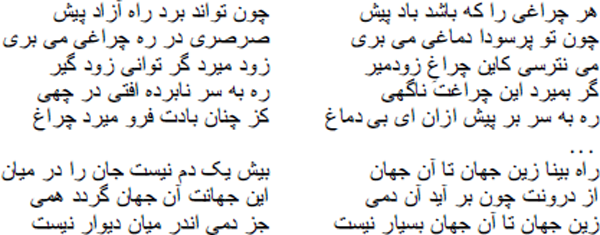
This “path” suggests both the “journey of life” and the “path” (tariqat) of sufi piety, which, according to other parts of the poem, leads to proximity with the divine and the recovery of a supra-personal self in and through God. Here, however, the pir stresses not the destination, but the urgency engendered by death’s fast approach. One must hurry to tread the sufi path before death, just as the night traveler hurries to reach his destination before a cold wind extinguishes his exposed light. With this homily, the pir (and through him, ʿAttār) aims not to elaborate a sophisticated eschatology or theology, but to motivate his audience by presenting the fact of death in a fresh, rhetorically forceful manner. The analogy of the lamp and the path, close to the “life-world” of a popular audience, renders the metaphysical stakes of death concrete and immediately understandable, while the subsequent injunction to hurry along the path urges spiritual action on the basis of this fact.Footnote 24 “This world” can become “that world” in an instant, and we must press quickly onwards, before the sudden expiration of breath that divides the living from the dead. The anecdote—or contextualized quotation—of Hasan al-Basri thus serves as a jumping off point for the pir’s (and ʿAttār’s) own homiletic elaboration. The story grounds the homily in the realm of human action by tying it to an authoritative statement of a celebrated spiritual virtuoso, and the homily, in turn, translates Hasan al-Basri’s observation into a generalizable injunction to religious action.Footnote 25
The Wisdom of Fools
Immediately after this opening exhortation, the pir launches into a cluster of anecdotes that all feature “wise fools,” a character type of which ʿAttār was especially fond. Here we will examine the dramatic structures of these wise-fool anecdotes and the paratactic transitions that bind them together, powerful rhetorical features that are obscured in the more atemporal and atomizing approaches to ʿAttār’s works.
In some ways reminiscent of the Greek cynics, ʿAttār’s wise fools flaunt social conventions, religious norms, and even reason, but their strange behavior belies a hidden wisdom. Such characters, comprising a set of interrelated literary types, have a long history in Islamicate letters.Footnote 26 For example, two centuries before ʿAttār, a scholar by the name of al-Naysābūrī—the two share a hometown—compiled a book of anecdotes devoted to the wit, wisdom, and eloquence of “the wise fools” (ʿuqalāʾ al-majānīn).Footnote 27 Although the wisdom of al-Naysābūrī’s fools is not usually explicitly religious, such figures soon came to be associated with mystical forms of Islamic piety: Ibn al-Jawzī’s hagiographical collection, for example, features several saintly characters in the wise-fool mold.Footnote 28 ʿAttār, for his part, was clearly attracted to stories of these figures. According to Foruzānfar, ʿAttār’s Mosibat-nāmeh alone boasts sixty-four anecdotes of their exploits, and his oeuvre as a whole contains one hundred and fifteen.Footnote 29 Given ʿAttār’s obvious interest, this class of stories has also attracted a fair amount of scholarly attention. For example, wise-fool anecdotes are central to Kermani’s investigation of ʿAttār’s theodicy: much like Ritter before him, he sees them as surrogate mouthpieces through which ʿAttār can safely criticize an omnipotent and unjust God.Footnote 30 Others understand these anecdotes primarily as vehicles of social criticism and political resistance, carnivalesque transgressions of a hegemonic reason, or embodiments of the soul’s alleged mystical superiority over the intellect.Footnote 31 These approaches all have their merits, but they tend to miss the anecdotes’ rhetorical function within ʿAttār’s larger homiletic project: the manner in which, through them, ʿAttār calls his reader-listeners to a more religiously valuable form of life. As we shall see, the wise-fool anecdotes in this section of the pir’s discourse are neither neutral vehicles for pre-formed dogma, nor content-less transgressive gestures, but rather strategic homiletic performances, designed to invoke—and then disrupt—readers’ complacent attitudes towards their own mortality.
There are a total of four wise-fool anecdotes in this cluster, and although our analysis will focus more heavily on two of them (numbers two and four), they are all translated below in order to illustrate the paratactic links between them:
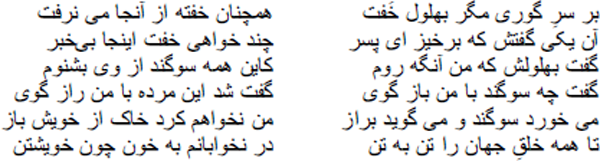
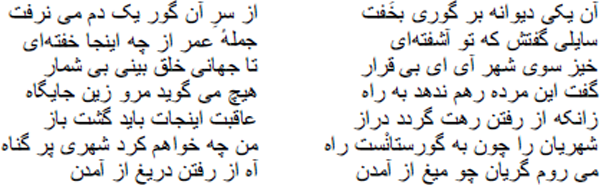
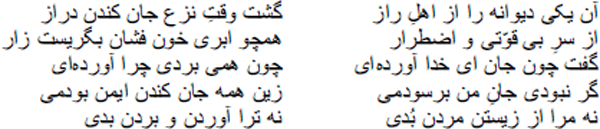


All four of these anecdotes illustrate a particular aspect of death and mortality: the first two focus on the inevitability of death, the third on the pain it engenders, and the fourth on the possibility of eschatological torment (especially for unjust rulers, and it thus carries theodictic and political implications as well). But beyond their shared thematic concerns, these anecdotes are also linked by various formal elements, including lexical parallelism, formulae, and key-word triggers. They are neither completely independent nor totally interwoven; as readers move through the chapter, they find them strung loosely together, proceeding through digression, amplification, and addition instead of any discernible pre-planned hierarchy. As we have already mentioned, such an arrangement evokes the paratactic structure of oral discourse, which accords with the poem’s frame as the imagined discourse of a pir to his disciple.
For example, the initial hemistichs of the first two anecdotes both contain the word “grave” (gur) and end with the verb “to sleep” (khaftan);Footnote 33 it seems this combination of terms in the first anecdote—along with the narremes of the fool sleeping in the cemetery and reported speech from beyond the grave—brought the second anecdote into the poet’s mind. Likewise, anecdotes two and three both begin with the formula, “This one fool” (ān yeki divāneh). Moreover, the final verse of each anecdote or homily usually contains a particular word or image that triggers the subsequent narration, which may or may not make a conceptually similar didactic point. For instance, in the second anecdote a fool explains why he will not travel to the city; his explanation ends with an exclamation, “Ahh, this going; woe, this coming!,” which foreshadows the next anecdote, in which another fool, on his deathbed, bemoans his own birth (i.e. his “coming” to this world), since it renders his death (i.e. his “going”) inescapable.Footnote 34 That anecdote, in turn, is followed by a homily that not only amplifies its themes but also includes an admonition to remember the fire and avoid injustice, which then segues into the story of Bohlul seeking to warm himself by the hellfire that fills the grave of an unjust tyrant. Although such transitions can seem a little forced, and they may be products of ʿAttār’s later revisions to the poem, they nonetheless evoke the digressive structure of a semi-improvised oral homily, like those delivered by Nezām al-Din Owleyāʾ in his sessions. These paratactic linkages strengthen the simulated orality engendered by the frame-tale, which casts the anecdotes as the content of a homiletic address, and thereby further underscore the poem’s perlocutionary aims.
In addition to the anecdotes’ paratactic ordering, their internal dramatic rhythm also contributes to their rhetorical force. They generally adhere to a simple, tripartite narrative structure: First, a fool engages in some sort of caustic, irreligious, or otherwise unexpected activity or speech. Next, he is questioned or rebuked, usually quite sensibly, by an interlocutor who evokes and embodies a common-sense response to the fool’s antics. This interlocutor stands in for the audience, giving voice to their puzzlement and inability to make sense of the fool’s behavior. Finally, the fool answers these objections in a way that, even if it confirms his skewed understanding, nonetheless exemplifies a sincerity and commitment that calls the audience’s own piety and devotion into question. The anecdotes’ rhetorical function, then, is not to illustrate an abstract theological point, but to force the audience to reevaluate their own behavior in light of their coming deaths.
The fools justify their behavior through category mistakes and hyper-literal understandings of religious dogma, leading to meta-linguistic plays similar to those found in a good joke. Like jokes, the narratives were clearly meant to entertain and perhaps even to provoke laughter, but this entertainment also carries an ethical call to attend to the mortal condition and its implications. Through their humorously disconcerting behavior and speech, these characters trouble human social and political hierarchies, undermine common-sense attitudes and ways of life, and raise the uncomfortable question of who is truly “insane,” by means of which ʿAttār aims to shock his reader-listeners out of their comfortably lackadaisical—and entirely foolish—complacency in the face of coming death. In this case, humor is not only the proverbial spoonful of sugar that helps the bitter medicine of memento mori go down, but it is also constitutive of the anecdotes’ didactic significance.
For example, in the second anecdote translated above, a fool has taken up residence over a grave in the cemetery. An interlocutor appears who calls him “disturbed” and asks why he does not come to live in the bustling city with the living. The audience would certainly find this question to be a reasonable one; at the same time, however, if they are familiar with the genre, they would also anticipate that the fool will somehow turn the tables on the questioner—and on the audience themselves—by destabilizing the values behind this common-sense inquiry. Indeed, the fool replies that he has been counseled against moving to the city by the deceased person buried beneath him: since the city is far away, and he will have to come back to the graveyard eventually, there is no reason to leave in the first place. Even beyond the fact that this message was allegedly delivered by a dead man, there is a certain naiveté to the objection, as if the fool’s posthumous “return” to the graveyard would be a bothersome, but ultimately quotidian relocation, just like moving from one city to another. His refusal seems motivated more by laziness than pious fear: he does not want to bother making the long trip to the city only to be brought back to the cemetery. There is thus a certain uncanniness to his relationship to death: he takes a well-known pious injunction—remember that you will die!—but acts it out in an unusually exaggerated form based on an uncompromising literalism in accordance with an oddly practical logic.
The unusual behavior and speech of these wise fools constitutes what we might consider a particular kind of Foucauldian “truth-telling”; they do not directly rebuke their interlocutors so much as obliquely unsettle their assumptions from a liminal position.Footnote 35 ʿAttār’s fools inhabit graveyards, deserts, dumps, and other areas on the periphery of human social geography; some are driven to such marginal locations by abuse suffered at the hands of children or those agitated by their antics, while others consciously choose withdrawal on the basis of an exaggerated piety and disgust with human society. Often naked, they flaunt social conventions but are judged exempt from the religious law by virtue of their alleged lack of reason.Footnote 36 Their didacticism seems unintentional, as they are generally unconcerned with those around them; they answer only when provoked, and explain their actions as they pertain to themselves alone.Footnote 37 In short, although necessarily a part of society, these wise fools simultaneously resist its structures and its codes, and they are presented as unencumbered by human hierarchies and attachments.Footnote 38 But precisely because they have withdrawn (or have been excluded) from the social realm, they remain uncontaminated by the threat of hypocrisy and self-aggrandizement that so troubled mystical thinkers and preachers.Footnote 39 They thus inhabit a privileged space from which to perceive the truth, which they communicate in uncanny hyperbole or transgressive humor, as their liminality also implies a withdrawal from “normal” modes of plain discourse and conceptualization. The fool who refuses to leave the graveyard is hardly a direct exemplar of conventional mystical piety; nevertheless, his hyperbolic behavior functions to indirectly unsettle the presumed worldliness of ʿAttār’s audiences and indict them for their inattention to their own mortality.
Similarly, in the final anecdote of the cluster, the famous fool Bohlul, who is often portrayed haranguing the caliph Hārun al-Rashid, heads out one winter night drunk and barefoot, carrying his shoes in his hands. A questioner quite sensibly inquires what he is up to; Bohlul replies that he is off to the graveyard, where he will warm himself by the grave of a tyrant, since it must be full of hellfire. Again, his mission is clearly at odds with a common-sense understanding of the world; hellfire does not physically fill the gravesites of those it torments, at least not in a manner perceptible to the living.Footnote 40 But rather than mocking Bohlul for his patent misunderstanding, the pir (and through him, ʿAttār), presents the story as emblematic of a certain truth, which he explicitly articulates in a more conventional homiletic rebuke: “Since there is death and fire before you / How much more injustice will you commit? / Death, you should say, is not the end for your soul / Since it must suffer in the fire of injustice for eternity.”Footnote 41 The implicit targets of this reproach are those who forget or ignore God’s threat: Bohlul may operate according to a simplistic theology or be subject to delusions, but at least he accepts the truth of hellfire in an immediate, visceral way, and he navigates the world with the certainty of its existence. The anecdote thus destabilizes the assumed binary between sane and insane and poses the question of who is ultimately more foolish: Bohlul, who recognizes the reality of eschatological torment, albeit a little too literally, or the allegedly reasonable people who live their lives without much thought of the afterlife. Readers are thereby challenged to do better: to learn a thing or two from the “foolish” Bohlul and to attend more carefully to the truth of eschatological torment as they act in the world.
The stories of Bohlul and other wise fools are performative dramas, and their temporal unfolding is critical to their rhetorical effect. When moving through these anecdotes, the audience is first invited—guided by the questioning interlocutor—to react with puzzlement to the fool’s actions or to dismiss them as deranged. These attitudes are undercut, however, when the fool explains his actions in a way that, although hardly rational or expected, nonetheless reveals a commitment to piety that indirectly implicates the audience’s laxity. The anecdotes thus do not merely transmit knowledge, but effect a process of destabilization though which the audience is provoked to reflect on their own cavalier attitude towards death and the mortal condition.
The Joy of Death
Because the anecdotes proceed on the basis of loose paratactic transitions instead of a tightly planned argumentative structure, they provide readers with a flexible, multi-perspectival treatment of death and mortality. The anecdotes nuance, reinforce, and sometimes even contradict each other, forming a dynamic network of homiletic stories rather than elaborating a single, coherent philosophical stance. This is particularly evident in the chapter’s second cluster of anecdotes, all of which speak to the issue of theodicy, but which present vastly different strategies for making sense of the presence of evil in the world. The first narrative involves a fool (bi-del) who explains that God is not himself a tyrant (zālem), even though he has many tyrannical servants. Structurally, the anecdote is an easy outgrowth from the previous narrative about Bohlul and the tyrant in hellfire; theologically, it suggests that injustice cannot be attributed to God himself, but rather to his “servants,” the humans whom he has created. Such a formulation is not particularly satisfying, and it was likely intended to provoke more questions than it answers; at other points ʿAttār uses fools to accuse God quite directly of unjust behavior.Footnote 42 The next story presents God very differently, however, as the ultimate guarantor of justice in the world: it tells of a dairy farmer who would sell milk fraudulently mixed with water, only to have God wash away his cow in a flood. Another anecdote echoes the theodical attitude of the first: it explains that the prophet Noah, because he prayed to God to destroy the infidels, is morally responsible for the flood’s death and destruction, and God himself is to be held blameless. The narrative that we will focus on here, however, falls in the middle of the cluster and involves a fool’s address to a bereaved mother: it suggests that death, seemingly one of the greatest injustices of human existence, is actually a blessing in disguise, and it thus runs counter to the dominant thematics of the chapter.
It begins with the pir (who, again, is somewhat difficult to disentangle from ʿAttār’s own poetic persona) explaining that he experiences a range of affective responses to death: sometimes it frightens him, but at other times the thought of death brings on a joyous rapture because it heralds his release from this “prison of earth”:

Dread of death is here contrasted with an attitude of joyous anticipation, which causes the speaker to tremble in excitement like new foliage in the spring breeze. This promise of rebirth in death is consistent with the Neoplatonic habits of thought that infuse ʿAttār’s work. The sub-lunar world is, according to this perspective, a terrestrial prison in which human souls—sparks of light that originate in the celestial realm—are held in exile. Death signals not the soul’s demise, but (assuming its proper purification during life) a return to its transcendent origin.Footnote 44 Death is thus not something to be feared, but a joyful homecoming.
This more hopeful attitude towards death, along its attendant Neoplatonic ontology, is illustrated in the anecdote of the bereaved mother, which features yet another instance of the wise-fool character type and serves as a sort of comedic proof-text for the pir’s preceding address:

As in the previous anecdotes, the contrarian fool’s utterance upends common-sense modes of thought: here, however, ʿAttār’s targets are not those who ignore death, but those who fail to understand its salvific potential as a release from the material world. In particular, the fool’s exclamation calls into question the conventional metonymical association between death and earth in contradistinction to life and light. The fool inverts and reinterprets this binary metaphorically: it is the living, according to the fool, who are truly “dead,” as they are trapped in the “earth” of the sub-lunar world. And the dead, although their bodies are in the ground, have been freed from this terrestrial plane and become pure light of the soul.
This particular anecdote, with its more hopeful attitude towards death, represents a departure from much of the rest of the chapter, which stresses eschatological terrors and existential despair. ʿAttār, however, never intended to outline a completely coherent system of thought: the Mosibat-nāmeh is not a work of systematic theology, but a “textualization” of an oral homiletic discussion, framed as an allegorical journey of sufi progress. Like the informal homily of a spiritual guide, the anecdotes and exhortations of ʿAttār’s masnavis are meant to present heuristic rules of thumb for pious living, not to rigorously elaborate a philosophical, ethical, or theological system. Given this context, its digressive style is no surprise, nor is the attendant propensity of anecdotes and exhortations to present a range of attitudes, sometimes conflicting, towards their subjects. The anecdotes inform, temper, and even work against each other, and this indeterminacy is responsible for both the poem’s richness and its flexibility: even as readers move sequentially through the totality of the poem, they can focus on those particular stories and homilies that meet their specific needs.Footnote 46 In short, this particular anecdote’s more hopeful, Neoplatonic vision of death in no way invalidates the dominant fire-and-brimstone thematic strand that drives the chapter, but rather nuances it by presenting an alternative way to conceptualize the mortal condition. The anecdotes of the Mosibat-nāmeh exist in a dynamic flux—sometimes consistent, sometimes contradictory—providing readers with a flexible set of sufi teachings.
Call to Conversion
In the chapter’s final cluster, ʿAttār moves on from theodicy to recount a series of stories exploring the prophets’ attitudes towards mortality. These stories, much like the wise-fool anecdotes found earlier in the chapter, buck readers’ expectations in order to inculcate a pious fear of death. In addition to their rhetorical structures, we will also examine how the accompanying exhortations imply a particular periodization of readers’ lives, imagining them as standing at a critical ethical juncture. Although ʿAttār intended his poem for an audience that was already familiar with—and committed to—mystical modes of piety, his harangues nevertheless cast readers as complete neophytes, calling on them to “convert” to a sufistic way of life. Within the context of ʿAttār’s didacticism, the remembrance of death, along with other ethical injunctions, is thus presented not simply as a matter of incremental spiritual reform, but as a complete existential reorientation.
The cluster is composed of three anecdotes from the lives of Abraham, Jesus, and the pseudo-prophet Alexander; as we have seen, the final anecdote of the previous cluster also recounts an event from the life of the prophet Noah, which links the two clusters together. Throughout the Islamic world, pre-Islamic prophets were widely taken as exemplars of ethical conduct, and stories of their spiritual feats and wise sayings circulated in sermons, homiletic collections, and works of exegesis. One might assume, given the prophetic gifts bestowed on them by God, that the prophets would be less disturbed by death than ordinary believers; on the contrary, however, their fear is often expressed in hyperbolic terms. For example, the first of these anecdotes recounts Jesus’ intense bodily and psychic reaction to the thought of his own death:

In the Islamic tradition, Jesus is associated with life, breath, and regeneration. His sobriquet is the “Breath of God” (Ruh Allāh), and, according to the Quran, he allegedly brought clay pigeons to life, reanimated the dead, and ascended into heaven without dying.Footnote 48 Consistent with Islamic representations, the above anecdote describes him as possessed of a generally joyous character, with his heart usually subsisting in an easy state of mystical “expansion” (bast), in contrast with the pain and fear of mystical “contraction” (qabz). Nevertheless, whenever Jesus recalled the fact of his coming death, he would be gripped by terror; fear would enter his heart, and he would react by sweating blood in extreme anguish and distress. In short, this prophet, who was known for life and joy, was terrified by his own mortality—how much more terrified, then, ought ʿAttār’s own readers, ordinary believers a far cry from Jesus’ exalted state, be of their mortal condition?
A more dramatic anecdote recounts a dialogue between the prophet Abraham and God: like the previous narrative of Jesus, it too stresses the terror of death, but it highlights how eschatological suffering exceeds the pain of expiration. According to this narrative, after Abraham died, God asked him, “What was the hardest thing in your life?” Abraham replied that it was not sacrificing his own son, seeing a vision of his polytheist father in hell, or being thrown into the furnace by Nimrod; rather it was the moment of death itself: “Next to death,” he says, “these were all nothing.”Footnote 49 God, however, responds that the moment of death will seem a comfort compared to the eschatological punishment that may follow:

Death may be painful, but the suffering of the grave and hell, is, according to an authority no less than God himself, even more terrible.
Following this anecdote, the pir delivers an exhortation that interprets and amplifies its didactic point—and it is at moments like these, as previously mentioned, that the pir’s address to the sālek bleeds into ʿAttār’s own extra-diegetic address to his audience. The exhortation takes the fact of death’s terror, as exemplified in the narratives of Jesus and Abraham, and translates it into an injunction for ethical action:

The proper reaction to death’s terror, according to the exhortation, is not simply to passively fear it, but to actively prepare for its advent. Indeed, death—properly understood—is a guiding motivation for spiritual advancement. One must live piously and do good works, and thereby collect “provisions” (barg) for the journey into the afterlife. Recalling the chapter’s opening homily, ʿAttār tells his audience that in order to prepare for death, they must “start following its way-stations”—an allusion to ethical stages (maqām) that comprise the sufi path—and “leave aside the world” (tark-e donyā).Footnote 52 The specific practices and attitudes that “leaving aside the world” might entail are not explicitly enumerated here, but in other locations in his oeuvre ʿAttār implies that it is tied to the practice of contentment, poverty, and humility, as well as a renunciation of political authority.
But even in ʿAttār’s more extended treatments of the subject, he never provides a systematic guide to ascetic practice. Rather, he attempts to motivate spiritual reform by presenting generally accepted truths in a rhetorically more forceful light.Footnote 53 As a homiletic poet, he aims not so much to teach his audience new content, but to refocus their attention on principles that they already accept. He targets readers already committed to sufi piety—referring to them as “possessors of mystical taste” (ashāb-e zowq)—and assuming some familiarity with technical sufi terms.Footnote 54 In this context, it is useful to recall the distinction made by scholars of classical rhetoric between protrepsis and paraenesis; whereas the former attempts to convert an audience to a completely new way of life, the latter encourages those who have already converted to make further ethical progress.Footnote 55 In this scheme, ʿAttār’s works would seem to fall closer to the paraenetic end of the spectrum than the protreptic: they seek to remind a sufistic audience of their mystical ideals and urge them forward on the spiritual path.
Nevertheless, even though the Mosibat-nāmeh as a whole serves a paraenetic function, it often takes on the trappings of a protreptic call, in which the addressee is cast as a neophyte or an outsider. In the exhortation quoted above, for instance, the addressee is castigated as “ignorant” and urged to set out on the path as if he or she had not yet departed; the contrast between the addressee’s alleged ignorance and the wisdom offered by ʿAttār is cued not as distance along a spectrum, but as a binary opposition. In this way, exhortations to ethical reform are synecdochically collapsed into the call for an initial “conversion” (towbeh) to sufi piety. ʿAttār’s poems were not intended to introduce sufistic principles for the first time, but rather to strengthen their readers’ already existing commitments; nonetheless, through the language of conversion, imagined as a complete and instantaneous pivot, ʿAttār’s exhortations are framed as crucial turning points in the religious lives of their addressees. Instigated by ʿAttār’s haranguing speech, every ethical realization and every step forward on the path becomes a total reorientation towards the truth.
Conclusion
The existing studies on ʿAttār tend to approach the anecdotes in his masnavis as modular and static; they aim to extract dogmatic propositions from his narratives and then arrange those propositions into a coherent system. Such an approach, however, is removed from the experience of most readers, who, guided by the frame-tale, would not have encountered the anecdotes as self-contained modules, but as links in a digressive, discursive chain that recalls the additive structure of an informal, oral teaching session. Such a discourse does not easily lend itself to systemization or classification, and ʿAttār himself seems to have been much less concerned with elaborating a coherent system than with manipulating his readers’ expectations and assumptions so as to provoke spiritual reform. The narratives do not just transmit an ethical message (i.e. everyone dies) but rather seek to destabilize readers’ understandings of this mundane fact in order to force them to confront their mortality in a more robust fashion. The poem is thus not just didactic, but homiletic: in the manner of the perlocutionary speech acts famously described by Austin, it aims to change minds and influence the behaviors of its recipients.Footnote 56 At the same time, however, readers are not merely passive recipients of ʿAttār’s rhetoric. As we have seen, the anecdotes, although dominated by certain familiar sufi themes, resist complete systemization. When taken together, they present a dynamic web of interlocking nudges to piety: some anecdotes reinforce each other, others nuance or complement those around them, and still others present starkly contrasting views of death and dying. Readers are thus endowed with some interpretive agency; as they move through ʿAttār’s web of stories, they can privilege those nodes or strands that resonate with their own concerns and anxieties. Seen in this light, ʿAttār’s didactic masnavis do much more than just encode sufi dogma; they function as pedagogical sites of religious self-fashioning, through which engaged audiences can spiritually transform themselves.


