


Over six years have passed since China first announced its Belt and Road Initiative (BRI) in late 2013.Footnote 1 The initiative bears serious geopolitical consideration by the Chinese leaders. Specifically, by strengthening economic relationships with countries along the belt (or the road), China aims at deepening their political relationships. This way, Beijing can counterbalance US containment and bolster its status as a rising power (Rolland Reference Rolland2017; Zhou and Esteban Reference Zhou and Esteban2018; Nordin and Weissmann Reference Nordin and Weissmann2018).Footnote 2 The political impact of the BRI, however, is assumed rather than evidence-based.Footnote 3 Surprisingly, little work has been done in terms of empirically evaluating the project's political effects, despite the fact that most work today assumes the project can reduce tensions and promote cooperation with target countries.Footnote 4 In this regard, investigating whether the BRI has actually changed target countries’ interactions with China is critical for advancing the existing studies of the BRI.
To be clear, cooperation does not necessarily imply a lack of conflict. As Keohane (Reference Keohane1984) points out, “intergovernmental cooperation takes place when the policies actually followed by one government are regarded by its partners as facilitating realization of their own objectives, as the result of a process of policy coordination.” Examples of intergovernmental cooperation can include praising other countries, engaging in economic cooperation, offering aid, and signing formal agreements. In terms of conflict, Nincic (Reference Nincic1982) defines international conflict as states imposing costs on others, which “need not involve armed violence, as such costs can be imposed in various ways and imply deprivations of different sorts and magnitudes.” Examples of conflict can run the gamut from low-intensity ones, such as accusing other governments of human rights violations, protesting others’ policies, and halting negotiation, to high-intensity ones such as using (un)conventional military force. Applying these definitions, we can see that states can engage in both cooperative and conflictual interactions simultaneously. As an example, in September 2014 the Chinese President visited India and signed 12 agreements promising to invest $20 billion in the latter's infrastructure. At the same time, however, the two countries’ troops faced off along their disputed border and the Indian Prime Minister Narendra Modi made “some of the most pointed remarks about the border uncertainty that any Indian leader has uttered in decades” (Harris Reference Harris2014).
With this context in mind, I study the question of whether the BRI money can help China purchase friendship abroad. Specifically, I apply theories of commercial liberalism to examine how the BRI affects target countries’ cooperation and conflict with China. First, deeper economic relations create more opportunities and rewards for states to interact positively (Hirschman Reference Hirschman1980; Stein Reference Stein and Tetlock1993). Thus, we should expect BRI countries to interact more cooperatively with China. Second, heavier economic dependence means states may become economically vulnerable, which in turn incentivizes coercive policies and retaliation (Dafoe and Kelsey Reference Dafoe and Kelsey2014; Peterson Reference Peterson2014; Gartzke and Westerwinter Reference Gartzke and Westerwinter2016). This incentive to coerce and retaliate becomes stronger when the conflictual interactions are within a low level of intensity that will not disrupt normal economic exchanges (Crescenzi Reference Crescenzi2003; Pevehouse Reference Pevehouse2004). Third, when the conflictual interactions exceed a certain level, the economic disruption would be substantial. This is especially the case for conflict involving the use of military force, or the risk thereof (Polachek Reference Polachek1980; Oneal and Russet Reference Oneal and Russet1997; Gartzke, Li, and Boehmer Reference Gartzke, Li and Boehmer2001). Taken together, the latter two points suggest if the BRI is effective we should expect target countries to engage in more low-intensity conflict and less high-intensity one with China.Footnote 5 Finally, given the initiative's short history the above effects could vary across different BRI countries. In particular, neighboring countries typically have more opportunities for interactions (Starr Reference Starr2013). Also, since the initiative involves many infrastructure deals aiming at expanding China's existing infrastructure network, countries that are closer to China are expected to be more proactive than those that are far away. In this regard, I further hypothesize that the above effects are stronger for countries that are contiguous with China.
To test these expectations, I use Seemingly Unrelated Regressions (SUR) to examine how the BRI changes target countries’ interactions with China. The method allows me to account for the correlation between different conflictual and cooperative engagement. In terms of data, I use the Integrated Conflict Early Warning System (ICEWS) events dataset (Lautenschlager, Shellman, and Ward Reference Lautenschlager, Shellman and Ward2015) to code countries’ monthly cooperative and hostile interactions with each other from 1995 to 2017. I use the IMF's Direction of Trade Statistics (DOTS) dataset to code target countries’ trade dependence on China.
The effects of the BRI are mixed. First, controlling for the existing level of economic ties, yields only suggestive evidence that the initiative can improve target countries’ cooperation with China. The effect, to date, has been driven primarily by neighboring countries that are significantly more likely to initiate cooperation. Second, contrary to the predictions of commercial liberalism, BRI countries tend to engage in less low-intensity conflict with China, driven largely by non-neighboring countries who also have a lower level of cooperation with China. This result suggests that non-neighboring BRI countries are still economically less dependent on China, resulting in a lower level of both cooperative and conflictual interactions.Footnote 6 Third, there is no evidence so far that the initiative or deeper economic dependence affect target countries’ high-intensity conflict. Returning to the broad question of whether money can buy friends, my study offers a mixed answer: in the short run money can help purchase friendly gestures, but that may not necessarily lead to a genuine friendship.
This article makes a number of contributions. First, it bridges the BRI literature with trade-conflict studies. While the latter subject has been heavily studied in a cross-national setting, the potential relationship between money and political affinity has not been tested in a specific country or project.Footnote 7 Relatedly, although studies of the BRI assumes it can improve target states’ political relationship with China, the more nuanced relationship has not been empirically examined. This paper shows both the benefits of bringing the two fields together and the need for additional work.
Second, this study suggests the BRI has not fundamentally changed target countries’ political relationships with Beijing. There is a substantial amount of variation across different BRI countries. In particular, only countries that are contiguous with China display a strong inclination to improve their cooperation with China. In this regard, although some scholars and pundits are worried about China buying Central and Eastern European countries “on the cheap,” the results appear to suggest that these countries are still much less economically dependent on China and are less proactive toward a stronger political relationship (Hutt and Turcsányi Reference Hutt and Turcsányi2020). For scholars of the BRI, the results suggest the initiative, to date, has not fully realized China's geopolitical goals. For policymakers, the results could indicate more intense competition in countries and regions that are closer to China.
The article proceeds as follows. I first discuss the existing studies on the BRI and theories of commercial liberalism. Based on this survey literature, I derive hypotheses about the expected effects of the initiative. In the research design section, I discuss the method and data for testing these hypotheses. After discussing the tests’ results, I conclude with implications and limitations of the paper.
STRATEGIES OF THE BRI
Research on the BRI has focused on the strategic calculations of China. Three primary areas of consideration have been identified. First, China is motivated by the need to deal with the recent economic downturn. As the Chinese economy slows down, finding new ways of boosting the economy is on top of the leaders’ agenda. The BRI provides plenty of opportunities, including developing infrastructures abroad which alleviates the problem of overcapacity (Hillman Reference Hillman2018), and bridging its western regions with other Eurasian countries which expands both natural resource supplies and foreign markets (Zhou and Esteban Reference Zhou and Esteban2018). Second, the BRI is also a response to the rise of nationalism and the pursuit of the Chinese dream. As China becomes more responsive to popular nationalist calls (Zhao Reference Zhao2013), invocations of historical glory (i.e. the silk road) serve to magnify this pride (Yu Reference Yu2017). In return, the BRI can strengthen domestic support and consolidate the party's ruling status (Ye Reference Ye2019).
Third, China seeks to solidify and improve political relationships with target countries. A recent Pentagon report suggests the BRI is intended to “develop strong economic ties with other countries, shape their interests to align with China's, and deter confrontation or criticism of China's approach to sensitive issues.”Footnote 8 This way, China can better counter the containment by the US (e.g. the ‘pivot to Asia’ policy) and build up its status as a rising power (Rolland Reference Rolland2017; Zhou and Esteban Reference Zhou and Esteban2018). Additionally, the initiative enables China to project its soft power, set agendas of global governance, and even transform the existing international system (Nordin and Weissmann Reference Nordin and Weissmann2018; Zhou and Esteban Reference Zhou and Esteban2018). It has been argued that although the initiative may further complicate regional geopolitical rivalry, China's influence in Eurasia has been enhanced and the initiative has helped China ease tensions with some countries (Cai Reference Cai2018; Li Reference Li2020). It has also been shown that the geopolitical impact across different countries within a region may also vary, depending on each country's strategic importance to China (Kamel Reference Kamel2018).
Although research on the incentives of the Chinese government is abundant, there is relatively less emphasis on the BRI's actual impact. Among existing studies the focus is along the economic dimension. Scholars have argued that the BRI can help cut logistics costs, reduce carbon emission, promote foreign direct investment and trade, and boost China's GDP and global welfare gains, and may even help reform the existing international economic system (Huang Reference Huang2016; Schinas and Graf von Westarp Reference Schinas and von Westarp2017; Du and Zhang Reference Du and Zhang2018; Zhai Reference Zhai2018). However, as pointed out previously, there are multiple layers of strategic consideration for the BRI; the geopolitical incentive is of no less importance than the economic one. Despite its importance, the exact political impact of the BRI is often assumed rather than evidence-based. Granted, there is some anecdotal evidence pointing to China's improved relationship with certain countries. But to my knowledge there is no systematic analysis across time and countries that evaluates the initiative's political impact. From the perspective of furthering the research of the BRI, then, investigating its political repercussions is in order.
CAN MONEY BUY FRIENDS?
Theories of commercial liberalism suggest that stronger economic ties can help promote peace.Footnote 9 As countries’ economic interdependence increases, they would be less likely to fight against each other. This is because states have the incentive to avoid opportunity costs brought by conflict and economic disruption (Oneal and Russet Reference Oneal and Russet1997; Reference Oneal and Russett1999). Compared with conquest, trade is a cheaper substitute for states to acquire wealth (Rosecrance Reference Rosecrance1986; Gartzke Reference Gartzke2007; Brooks Reference Brooks2007). Also, commerce helps foster a security community, where a shared identity can suppress conflict in the first place (Oneal and Russet Reference Oneal and Russet1997; Reference Oneal and Russett1999).
Given the pacifying effects of commerce, most studies agree that deeper economic ties can help promote cooperation. Some scholars regard cooperation as the reverse of conflict, arguing the restraining effect of trade would naturally lead to more cooperation (Polachek Reference Polachek1980; Polachek and Xiang Reference Polachek and Xiang2010). Others contend cooperation is not necessarily the opposite of conflict; states can engage in conflict and cooperation at the same time. They argue there are both beneficial and costly aspects of trade. While the latter can give rise to tensions, the former can help promote cooperation (Gasiorowski Reference Gasiorowski1986; McMillan Reference McMillan1997). Despite their differences, both strands of literature agree deeper economic relations can create more opportunities and rewards for states to cooperate with each other (Hirschman Reference Hirschman1980; Stein Reference Stein and Tetlock1993; Pevehouse Reference Pevehouse2004). Applying this reasoning to the BRI, if the project does improve Beijing's political relationships with target countries, then we should expect an increase in their cooperative interactions with China. As the potential benefits of cooperation rise, target countries will be more responsive to Beijing's entreaties. Therefore, I have the following hypothesis:
Hypothesis 1 A target country will engage in more cooperation with China after the proposal of the BRI.
It should be noted that this hypothesis is not necessarily self-evident since it is possible that the BRI may not have substantially changed target countries’ political and economic relationship with China. It should also be noted that I emphasize the proposal of BRI as I expect China's effort to deepen economic exchanges with target countries should begin around that time. I opt not to use other alternatives such as the signing of BRI agreements due to the concern of endogeneity. That is, countries that sign the agreements tend to be in (or are moving to) a closer relationship with China. If so, using the signing of agreements would conflate the effects of the BRI with the underlying changes of political affinity. In comparison, using the proposal of the BRI can allow us to examine whether China's effort works or not. This is important in that target countries’ attitude toward the BRI does vary substantially. For instance, India has not endorsed the BRI to date while Kazakhstan has been participating actively. If we count India as a BRI country only after it endorses the initiative or signs an agreement with China, that would strongly bias our results.Footnote 10
Unlike cooperation, economic dependence's impact on international conflict can be more nuanced. Earlier studies have indicated increased trade could give rise to more interstate tensions (Gasiorowski Reference Gasiorowski1986; Barbieri Reference Barbieri1996). Recent studies suggest that as states become economically more reliant on a country, they would also be facing more coercion aimed at exploiting the vulnerability (Crescenzi Reference Crescenzi2003; Peterson Reference Peterson2014). This can, in turn, incentivize target states to resist or even retaliate to demonstrate their resolve (Morrow Reference Morrow1999). The incentive to coerce and resist becomes stronger if the conflictual interactions are within a low level of intensity, since these typically will not substantially disrupt the economic exchanges (Crescenzi Reference Crescenzi2003; Pevehouse Reference Pevehouse2004). Taking a strong stance can also demonstrate a leader's competence to both domestic and international audiences (Smith Reference Smith1998; Schultz Reference Schultz2001). We should, therefore, expect a higher probability of ‘at least occasional conflict,’ especially when these low-intensity disputes will not expand into extended violence (Gartzke and Zhang Reference Gartzke, Zhang and Martin2015). In the context of the BRI, foreseeing China's intentions to ‘sell’ the project, target countries would find it strategically beneficial to bargain harder and push back against Beijing. Recall, for instance, the previous example where India's prime minister criticized China during the Chinese president's visit in 2014. Analogously, facing China's policy demands or economic coercion, target countries would be more inclined to resist. For instance, in 2016 the Philippine government, facing China's economic pressure, kept on pursuing the lawsuit against Beijing at the Permanent Court of Arbitration involving the South China Sea dispute.Footnote 11 Taken together, the theory suggests that as the BRI strengthens target countries’ economic ties with China, it also provides them with more opportunities and greater incentives to engage in low-intensity conflict.
Hypothesis 2 A target country will engage in more low-intensity conflict with China after the proposal of the BRI.
Despite their differences, variant theories of commercial liberalism agree countries will be less likely to engage in high-intensity conflict involving the use of force to avoid the opportunity costs of economic disruption (Oneal and Russett Reference Oneal and Russett1999; Gartzke, Li, and Boehmer Reference Gartzke, Li and Boehmer2001; Polachek and Xiang Reference Polachek and Xiang2010). Armed conflict increases the expected “transportation, transaction, and production costs” of firms resulting in substantial economic losses for both sides of belligerents (Long Reference Long2008; Glick and Taylor Reference Glick and Taylor2010). Therefore, I have the following hypothesis:
Hypothesis 3 A target country will engage in less high-intensity conflict with China after the proposal of the BRI.
Finally, given the initiative's relatively short history, we may also expect the above effects to vary across different BRI countries. It typically takes more time for the effects to kick in for countries that are far away from China and are latecomers to the initiative. Given BRI involves many infrastructure deals aiming at expanding China's existing infrastructure network, countries that are closer to China tend to expect Chinese trade and investment to increase sooner. In addition, neighboring countries have more opportunities of interaction (Starr Reference Starr2013). They are also more likely to have territorial disputes with China (Cai Reference Cai2018). In this regard, I have the following hypothesis:
Hypothesis 4 The effects of the BRI are stronger for countries that are contiguous with China.
RESEARCH DESIGN
To examine whether the BRI improves China's political relationships with target countries, we need to examine both the cooperative and conflictual interactions, which are inherently related. I choose to use Seemingly Unrelated Regressions (SUR), which allows me to account for the potential correlation among low-intensity conflict, high-intensity conflict, and cooperation. To alleviate concerns about endogeneity, I lead the outcome variable by one month (equivalent to lagging all independence variables).
DEPENDENT VARIABLES
To measure BRI countries’ cooperation and conflict with China, I use the Integrated Crisis Early Warning System (ICEWS) dataset, which is one of the largest event data in social science.Footnote 12 It is a machine-coded event dataset developed by Lockheed Martin and others for the US Defense Advanced Research Projects Agency and the Office of Naval Research. Among others, the dataset records interstate events for about 250 countries and territories. Compared with other alternatives, the ICEWS data have three advantages. First, the dataset has been around for several years and enjoys great success and popularity in the operational community. In fact, its success led the US government to reverse the policy of making the data freely available to the public in 2010.Footnote 13 Secondly, it assigns Conflict and Mediation Event Observations (CAMEO) scale values, ranging from −10 to +10, to each event. These CAMEO codes were motivated by the Goldstein scale for World Event/Interaction Survey (WEIS) coding and aimed at measuring the hostility or cooperation level of an event. While this coding scale does not consider the issue of magnitude and can be simplistic at times, in practice, the deficiency can be partly addressed by more reports and attention associated with large-scale events. Lastly, the system applies a modern filtering mechanism, which can effectively weed out a large number of unrelated stories or repeated reports. Compared with other event data, this filtering mechanism, though not perfect, is a great improvement.Footnote 14
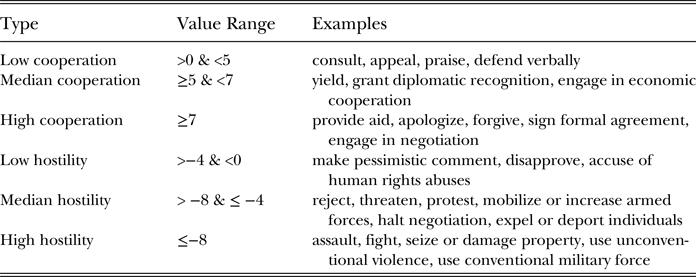
The ICEWS data are compiled by searching through a huge number of newspapers in English and machine-coding daily interactions between different actors. Cooperative events include expressing intent to cooperate, engaging in diplomatic cooperation, and providing aid, among others. Hostile events include threats, coercion, using force. A cooperative (hostile) event is assigned a positive (negative) value, with a higher absolute value indicating more intensity. Table 1 provides values and related examples of the CAMEO scale.Footnote 15 The third column in the table provides examples of interactions that are coded in the ICEWS data, with the first two columns showing the respective value range and levels of interactions. Note that the events data are directed. For instance, if a government praises the Chinese government, the interaction will be coded as praise from the respective country to China and assigned a value of 3.4 (since it is between 0 and 5 this action is coded as low-intensity cooperation). For another example, if China threatens to use military force toward a country, the action will be coded as threaten to use force and assigned a value of −7 (median hostility). In this case, China will be coded as the initiator and the respective country as the target. As a sidenote, actual use of force is coded as −10 (high hostility).
CAMEO scale and examples.

To test Hypothesis 1, I aggregate all levels of cooperation. To test Hypothesis 3, I aggregate only the values of high hostility events identified by the ICEWS data (shown also in Table 1). The rest of hostility events are counted as low-intensity conflict and tallied in a similar fashion to test Hypothesis 2.Footnote 16
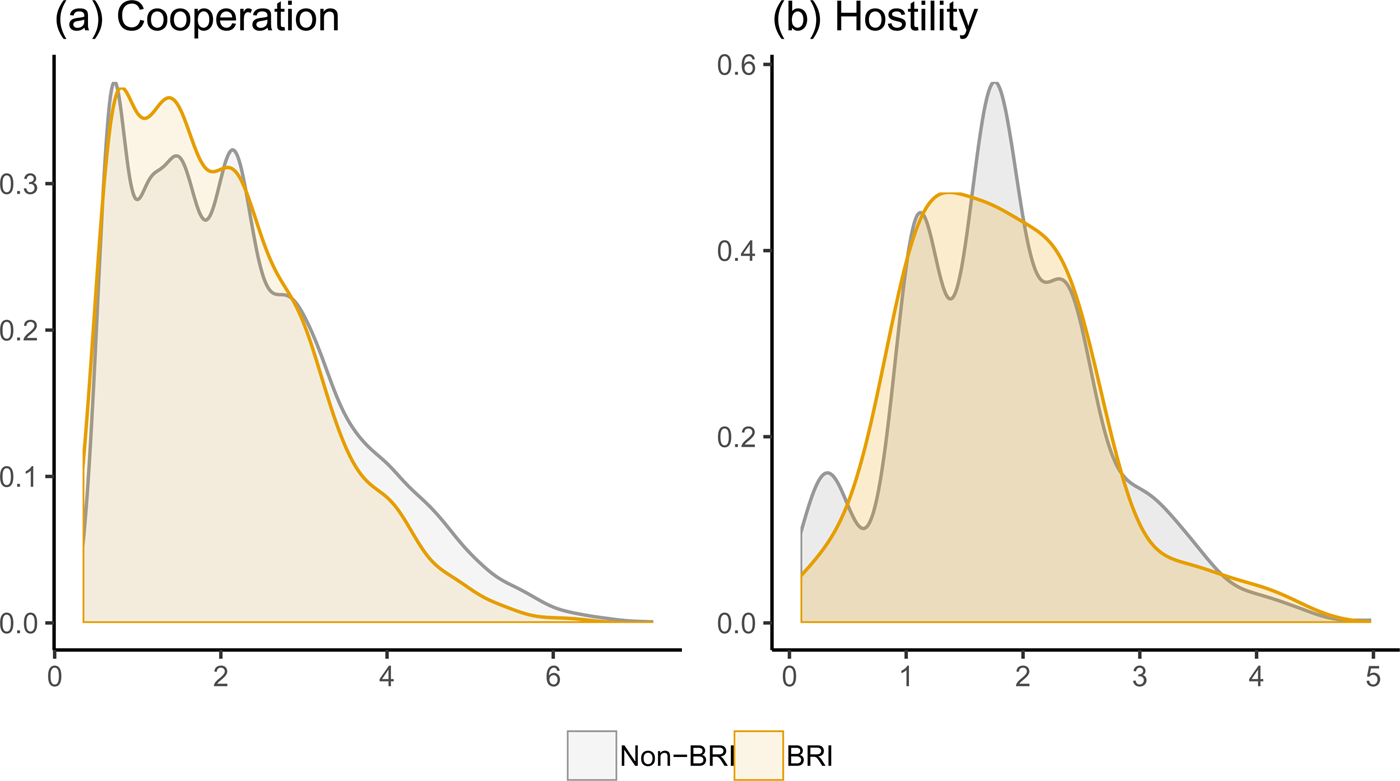
Currently, the dataset covers the period between January 1995 and October 2018.Footnote 17 In the main models, I restrict the sample to 2017, given the the trade war between China and the US could cause further noise to the estimation.Footnote 18 I sum the government to government events’ cooperative and hostile values by month. Since the dataset is of directed dyad-month format, I have four pairs of events for a given country: its cooperation toward China, its hostility toward China, cooperation from China, and hostility from China. Given the skewness of the data, I take the log of their absolute values plus 1. The dependent variables are a country's monthly (log values of) cooperation and hostility toward China respectively. Figure 1 plots the distributions of cooperation and hostility for BRI and non-BRI countries. The distributions for both types of countries appear to be similar and approximately normal. There is still some remaining skewness, but it is already a huge improvement over the original values without taking the log. In addition, it should be noted we cannot tell whether BRI countries are more likely to engage in cooperative or hostile interactions with China from these plots.
Density Plots of Cooperation and Hostility: BRI vs Non-BRI Countries. This figure is plotted without the zero values.

INDEPENDENT VARIABLES
The key independent variable is BRI status. Given the BRI was announced in late 2013, I assign a country BRI status if it is on the official list of the 65 countriesFootnote 19 and the year is after 2013 (i.e. 2014–present). The key consideration, as mentioned previously, is to avoid using endogenous variables such as whether a country chooses to sign a BRI agreement with China. What I seek to examine here is whether or not the BRI target countries systematically behave in a different way than non-BRI countries.
That being said, one may be concerned about the potential confounding effect of economic exchanges: BRI countries are responding to the fact that they have received more investment from and are trading more with China. To measure the level of economic exchanges, I use bilateral trade data. I choose not to use foreign direct investment or the values of announced BRI projects because (1) they can miss the daily economic exchange between states as it typically takes a long time to negotiate and complete a project and (2) many of the projects are either not transparent or delayed.Footnote 20 Some Chinese outbound investments are branded BRI just to facilitate the approval process. Moreover, given that many of the big projects are related to infrastructure, trade volume (Chinese export in particular) can be a better indicator. For instance, Chinese export to Pakistan increases by 77 percent between 2012 and 2015, thanks mainly to the increase of infrastructure projects under the BRI.Footnote 21
For my data source I use the IMF's Direction of Trade Statistics (DOTS) dataset, a primary source of trade data in conflict studies. I choose this dataset over some conventional choices such as the Correlates of War's trade data (Barbieri and Keshk Reference Barbieri and Keshk2012) because it offers monthly records. Also, the DOTS dataset contains comprehensive bilateral import and export data, including export and import reported on a free on board (FOB) scheme as well as import data on a cost, insurance, and freight (CIF) basis. The main issue with DOTS is missingness.Footnote 22 Systematic missing data can produce sample bias, in that countries with poor reporting standard tend to “[be] less democratic, have lower power, and [be] less developed” (Boehmer, Jungblut, and Stoll Reference Boehmer, Jungblut and Stoll2011). It should be noted that IMF has tried to attenuate this concern by estimating the missing data of a country with its partners’ record (country A's import from country B can be estimated by B's export to A, and vice versa). Also, given the purpose of the data is to investigate the political effects of the BRI and the improved data quality over time, the potential problems of missingness should be less of a concern.
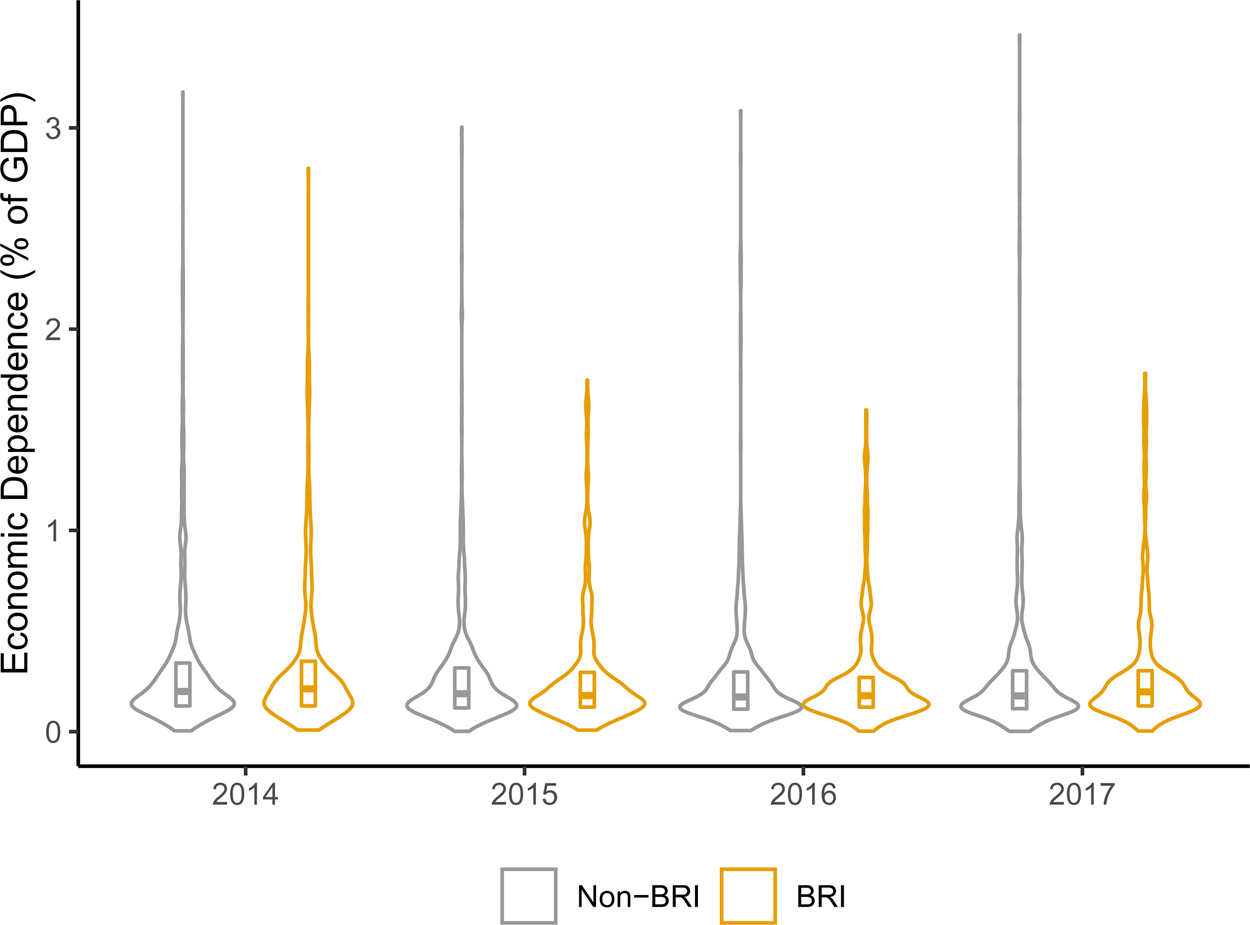
As an illustration, I plot the level of economic dependence (i.e. total trade volume divided by GDP)Footnote 23 for BRI and non-BRI countries in Figure 2. To facilitate a more substantial interpretation of economic dependence's impact, I rescale the values in percentage. For instance, a value of 1 represents the trade volume is worth 1 percent of the GDP. In the figure, the x-axis represents time, while the y-axis captures the level of economic dependence: higher values indicate more dependence. The violin shape captures the distribution and the boxplot within the violin plot shows the interquartile range (twenty-fifth to seventy-fifth percentile) and the median. It is worth pointing out that there appear to be no systematic differences between BRI and non-BRI countries’ economic dependence on China.Footnote 24 That said, there is a substantial amount of variation within both types of countries. For instance, Pakistan's economic dependence (yearly average) on China increases by 19.8 percent in 2014, 3.4 percent in 2015, and 10 percent in 2016. Brazil, a non-BRI country, has witnessed its dependence upon China declining overtime: -8.8 percent in 2014, -12.6 percent in 2015, and -10.3 percent in 2016. In this regard, controlling for economic dependence can help us better examine the variation.
Economic Dependence BRI vs Non-BRI Countries. For illustration purpose, this figure is plotted with two outliers (Liberia and Marshall Islands) removed.

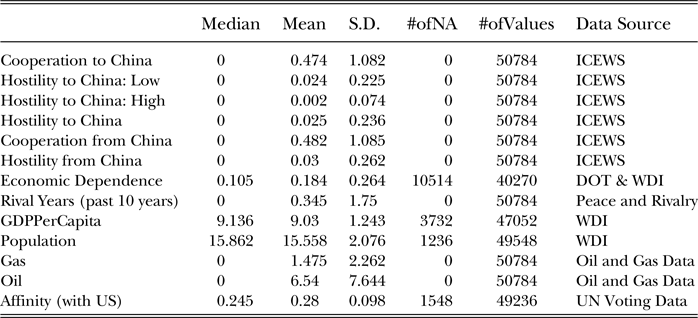
For other covariates, I include each country's hostility toward and cooperation with China in the previous month. I also include cooperation and hostility from China. I include a number of factors that have been proposed by scholars as affecting of inter-government cooperation and hostility. These include (a) whether a country is a democracy by using the Polity IV measurement (polity score greater than 5) (Marshall, Jaggers, and Gurr Reference Marshall, Jaggers and Gurr2002) as countries within the democratic community tend to have stronger and more peaceful relations with each other (Crescenzi and Kadera Reference Crescenzi and Kadera2016; Bell and Quek Reference Bell and Quek2018), (b) GDP and populationFootnote 25 as large and wealthy countries tend to interact more, (c) oil and gas production (Ross and Mahdavi Reference Ross and Mahdavi2015) since natural resources can give rise to conflict (Koubi et al. Reference Koubi, Spilker, Böhmelt and Bernauer2014) and have been attracting Chinese investment (Ramasamy, Yeung, and Laforet Reference Ramasamy, Yeung and Laforet2012), (d) the number of years in the previous decade a country is identified as a strategic rival of China using the Peace and Rivalry data by Goertz, Diehl, and Balas (Reference Goertz, Diehl and Balas2016) and (e) a country's political affinity with the US, using the United Nations General Assembly Voting Data.Footnote 26 The summary statistics for all continuous variables are shown in Table 2.Footnote 27 I also further differentiate the BRI countries by whether they are contiguous with ChinaFootnote 28 given that neighboring states have more opportunities of interaction (Starr Reference Starr2013).Footnote 29
Summary Statistics of All Continuous Variables.

RESULTS
The SUR models are specified as follows.
 $$\matrix{ {{\rm Outcom}{\rm e}_{t + 1} = \beta _0} & { + \ \beta _1{\rm BR}{\rm I}_t + \beta _2{\rm Trade/GD}{\rm P}_t\qquad } \hfill & {} \hfill & \qquad \hfill \cr {} \hfill & { + \mathop \sum \limits_{i = 1}^k \alpha _i{\rm Events\;Control}{\rm s}_{it}\qquad } \hfill & {} \hfill & \qquad \hfill \cr {} \hfill & { \hskip-2.9pc+ \ \beta _3{\rm Rival\;Years\;( past\;10\;years}) _t + \beta _4{\rm Democrac}{\rm y}_t} \cr \hfill & {+\,\, \beta _5{\rm Affinity\;( with\;US}) _t+ \mathop \sum \limits_{i = 1}^k \gamma _i{\rm Gravity\;Control}{\rm s}_{it} + \epsilon\qquad }\cr } $$
where the outcomes are respectively low-intensity hostility, high-intensity hostility, and cooperation (that is, there are three equations to estimate simultaneously). The events controls include target countries’ hostility and cooperation toward China and the cooperation and hostility from China in the previous month. Gravity controls include GDP per capita, and population.
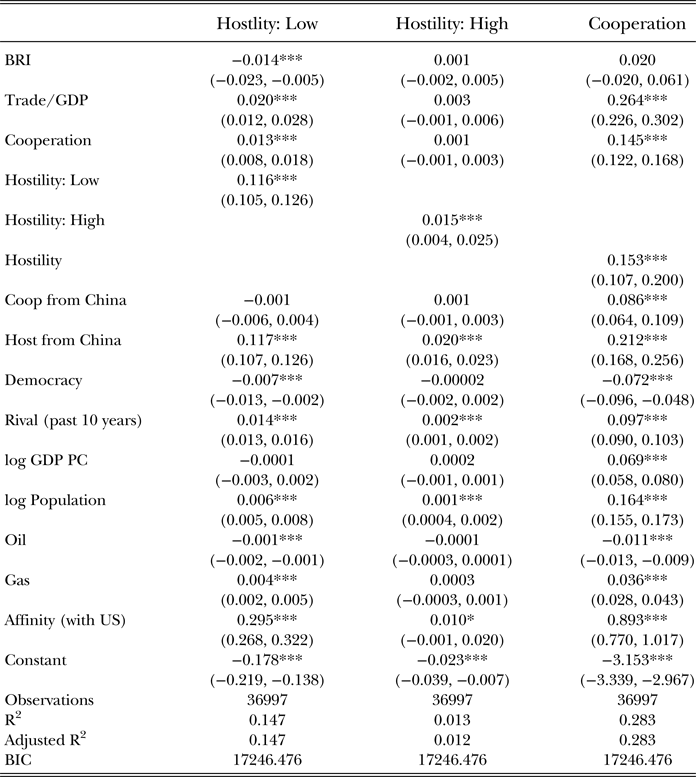
The results are shown in Table 3. To be clear, in line with commercial liberalism a higher level of economic dependence is positively and significantly correlated with more cooperation and low-intensity conflict with China (though the effect on high-intensity conflict is insignificant). However, the effects of the BRI are mixed. The coefficient estimate for BRI is negative and statistically significant for low-intensity conflict, which is the opposite of Hypothesis 2. The coefficient estimate for cooperation is positive but not statistically significant. Given the 95 percent confidence interval mostly falls on the positive side, we have at least some suggestive evidence that the initiative can promote cooperation. There is no systematic evidence for high-intensity conflict as the coefficient estimates for BRI and Trade/GDP are both insignificant.
SUR results (with 95 percent confidence interval), 1995–2017

Note: *p<0.1; **p<0.05; ***p<0.01
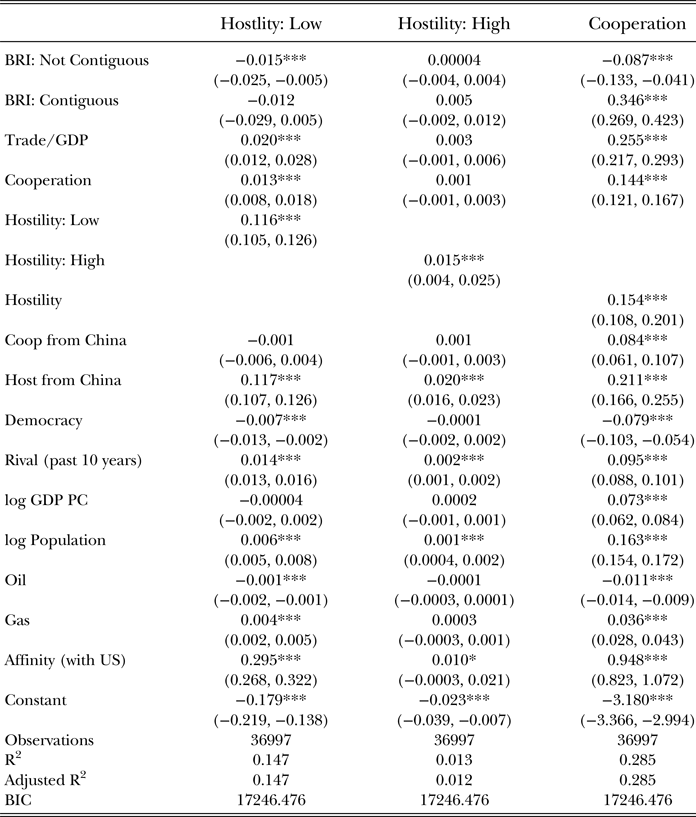
That said, the effects of BRI can vary across different countries. To examine this possibility, I rerun the analysis differentiating whether a BRI country is contiguous with China or not.Footnote 30 The results are shown in Table 4.
SUR results (with 95 percent confidence interval), 1995–2017

Note: *p<0.1; **p<0.05; ***p<0.01
We can see that cooperation promoting effect of BRI is largely driven by neighboring countries, indicated by the positive and significant estimate of the contiguous BRI country variable for cooperation. The respective effect for low-intensity hostility is negative and insignificant. However, for BRI countries that are not contiguous with China, they initiate significantly less cooperation and low-intensity conflict toward China. Finally, similar to the previous model, there is no systematic evidence that BRI reduces or increases high-intensity conflict.
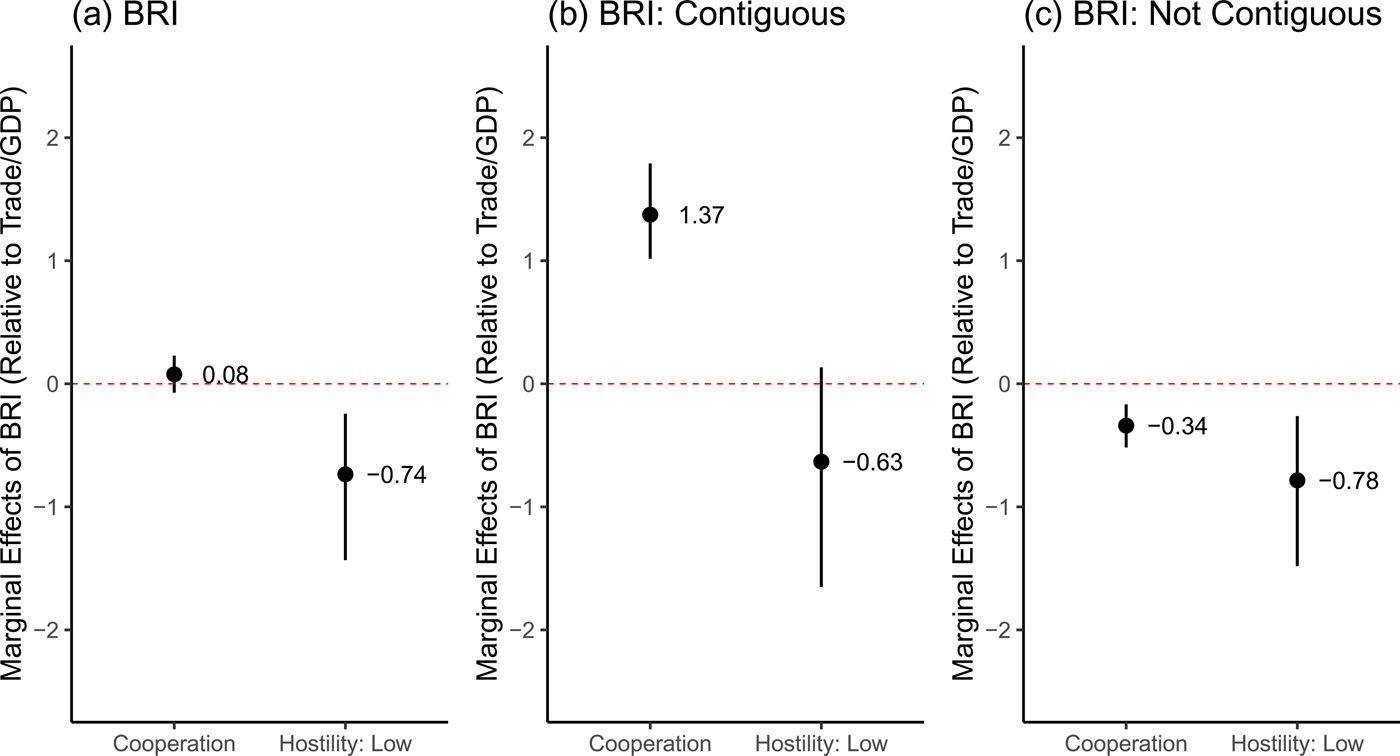
To demonstrate more substantially the effects of BRI, I plot its effects on cooperation and low-intensity hostility in Figure 3. I leave out the effect on high-intensity hostility as it is statistically insignificant across both models. Panel (a) plots the results from the first model while panel (b) and (c) plot the results from the second model.
Marginal effects (with 95 percent confidence interval) of BRI relative to one unit increase of Trade/GDP. The x-axis denotes the outcomes
Note: For illustration purpose, confidence intervals are capped between −2.5 and 2.5. High hostility is not shown here as it is not significant across all models and its confidence intervals are too wide. The y-axis denotes the marginal effects of BRI proportional to the effects of 1 unit increase in Trade/GDP (i.e. bilateral trade increased by the volume of 1 percent of GDP).

The goal of Figure 3 is to demonstrate the effects of BRI relative to economic dependence (i.e. Trade/GDP). As mentioned previously, the economic dependence variable has been rescaled into percentages. Therefore, one unit's increase represents an increase in bilateral trade that is equal to 1 percent of GDP. The y-axis in the figure represents the marginal effects of BRI relative to one unit's increase in Trade/GDP. In compiling this graph, I use the bootstrapping techniques to draw from the results of both models. I draw 1,000 samples for the coefficient estimates for BRI and Trade/GDP variables. This way, I can account for the variance and covariance across the three different equations in each model. I divide the BRI variable by the Trade/GDP variable and calculate the means and respective 95 percent confidence intervals. I can, therefore, interpret the marginal effects of BRI as proportional to the change of bilateral trade (as a share of GDP).
Panel (a) suggests that, on average, BRI countries interact more cooperatively with China. The average impact is equal to around 0.08 percent increase of bilateral trade as a share of GDP. Meanwhile, BRI also reduces target countries’ low-intensity hostility toward China, which is equal to around 0.74 percent reduction in bilateral trade as a share of GDP.Footnote 31 As we further account for the variance within BRI countries, we see that the cooperation promoting effect is largely driven by neighboring countries. Panel (b) shows that BRI countries that are contiguous with China increase their cooperation by a degree relative to an increase of 1.37 percent increase of bilateral trade as a share of GDP. The restraining effect for low-intensity hostility also becomes smaller (−0.63 percent), though not statistically significant.
Intriguingly, the effect of BRI for cooperation from non-contiguous countries is negative (−0.34) and significant. That does not necessarily mean that if a BRI country is not a neighbor with China she will reduce her cooperative interactions. However, it shows that on average BRI countries that are not contiguous with China do reduce their cooperation (compared with non-BRI countries). Given the significant effects of economic dependence in the model, one possible explanation is that the appeal of BRI is still limited at this stage and these countries are economically less dependent on China than others.
To ensure the above results are not driven by arbitrary choices in data or operationalization, I perform the following robustness checks: (1) use a higher benchmark to code high-intensity conflict (i.e. CAMEO scale lower than -9 (use of force)); (2) use a lower benchmark to code low-intensity conflict (i.e. exclude the median hostility events shown in Table 1); (3) exclude cases where a country does not interact with China within a year to alleviate the concerns about selection effects; (4) exclude countries that are contiguous with China but not counted as BRI; (5) exclude the two outliers (Liberia and Marshall Islands) with extreme values of economic dependence; (6) use only import data (i.e. Chinese export to other countries); (7) use the previous five years’ rivalry status instead of 10 years; (8) include only the events control variables; (9) exclude the oil and gas control variables; (10) use data beyond 2017; (11) recode the events into binary data and use logistic regressions. The results remain substantially similar and are shown in the appendix.
CONCLUSION
This article studies the question of whether money of the BRI can buy political affinity for China. It shows some suggestive evidence that the initiative can improve the level of cooperation between China and target countries. However, in contrast to the theories of commercial liberalism, the initiative does not make target states engage in more low-intensity conflict with China. Finally, I do not find systematic evidence that the BRI can rein in high-intensity conflict. It should be noted that the lack of restraining effect for high-intensity conflict can be partially attributed to the features of hostility data.Footnote 32 With more data accumulated, future studies may be able to find a stronger result. Relatedly, these results speak to a relatively short period: four years after the initiative. In the long run, the effects may fluctuate not least due to the challenges of implementation and interactions with local governments.Footnote 33
Importantly, this article also reveals how the impact of BRI vary between contiguous and non-contiguous countries. The results show that the cooperation-promoting effect is primarily driven by neighboring BRI countries. This result echoes recent studies emphasizing the variance across countries and China's strategic focus on neighboring countries (Blanchard Reference Blanchard2019; Gong Reference Gong2019). It is intriguing to see that on average BRI countries that are not contiguous with China engage in less cooperation. While I offer some conjectures in the article, the results are not necessarily definitive and additional research is in order.
My study also introduces a way to automatically process a vast amount of information on governments’ interactions. Relying upon machines to “read” all the newspapers available is a cost-efficient first step in the information age. Importantly, there can be coding errors, especially for rare events. And scholars need to exert caution in interpreting the results. However, this method allows us to find patterns of behavior and identify interesting cases more efficiently. Aside from governments’ interactions, the ICEWS data also provide information on non-government actors and events such as civil protests and terrorist attacks. Future studies can utilize the data to explore other topics of interest.
For policy practitioners, my study offers several implications. To begin with, the enthusiasm for the BRI appears to have simmered down in recent years. Whether this trend will persist remains to be examined. However, it does provide suggestive evidence that Beijing cannot expect all countries to remain with the same responsiveness toward the initiative. In this regard, China should focus on countries that are more responsive and strategically important. For instance, there is evidence that despite recent economic difficulties and move to seek help from the West, Pakistan is moving toward closer and even defense-related cooperation with China (Ali-Habib Reference Abi -Habib2018).
Second, the US and other countries (such as India) may counteract China's initiative. From the results in this paper, we also know that although countries that are closer to the US engage in more cooperation with China, they are also more likely to engage in both low-intensity and high-intensity conflict with China. In particular, two strong predictors of high-intensity conflict with China are countries’ rivalry history with China and affinity with the US. In this regard, China has been downplaying the geopolitical consideration recently. Instead of focusing solely on Eurasia, Beijing emphasizes the initiative's role in promoting global cooperation. Finally, the impact of the BRI is contingent heavily upon its implementation (Blanchard Reference Blanchard2019; He Reference He2019; Liu and Lim Reference Liu and Lim2019; Zhao Reference Zhao2019). As is shown in this article, BRI countries do not systematically trade more with China (see Figure 2 and note 24). However, the results of this article suggest economic ties with China are strong predictors of their interactions. If in the long run target countries build stronger economic ties with China, they may become more responsive to China's entreaties.
SUPPLEMENTARY MATERIAL
The supplementary material for this article can be found at https://doi.org/10.1017/jea.2020.34
ACKNOWLEDGMENT
The author wishes to thank Jack Zhang, attendees of the 2018 AACS meeting and the 2019 MPSA meeting, and the editors and reviewers of Journal of East Asian Studies for reading over the manuscript and offering insightful suggestions. All errors remain mine. The dataset and R code for the empirical analysis in this article can be found at the author's website (https://yulengzeng.weebly.com) or requested via email.
CONFLICTS OF INTEREST
The author declares none.