Introduction
Fertilization is a fundamental step in the life cycles of all sexually reproducing animals. Thus, the efficiency of fertilization is a critical determinant of the success and survival of these species. Many sessile marine invertebrates release their gametes into the water column. In such cases, gametes are rapidly diluted, reducing the frequency of sperm–egg collisions (Levitan & Peterson, Reference Levitan and Petersen1995). Thus in the case of sessile marine invertebrates, such as corals, fertilization is more likely to occur during a relatively short time window when sperm concentrations remain high (Oliver & Babcock, Reference Oliver and Babcock1992) although fertilization may continue at a low rate while any sperm remain viable. Many reef-building corals participate in synchronous mass spawning events around the time of the full moon. This synchrony is almost certainly related to the need to maximize the probability of fertilization success (Harrison et al., Reference Harrison, Babcock, Bull, Oliver, Wallace and Willis1984; Babcock et al., Reference Babcock, Bull, Harrison, Heyward, Oliver, Wallace and Willis1986; Hayashibara et al., Reference Hayashibara, Shimoike, Kimura, Hosaka, Heyward, Harrison, Kudo and Omori1993).
Acropora is one of the most widespread, abundant, and species rich (113–180 species) of coral genera (Wallace, Reference Wallace1999; Veron, Reference Veron2000), and has been the subject of a number of studies on fertilization. Acropora spp. release their gametes as buoyant bundles into the water column and fertilization occurs at the sea surface. Fertilization experiments have been performed with gametes of Acropora to examine the possibility of hybridization (Willis et al., Reference Willis, Babcock, Harrison and Wallace1997; Hatta et al., Reference Hatta, Fukami, Wang, Omori, Shimoike, Hayashibara, Ina and Sugiyama1999), stress tolerance of fertilization (Negri & Heyward, Reference Negri and Heyward2000; Mercurio et al., Reference Mercurio, Negri, Burns and Heyward2004; Negri et al., Reference Negri, Vollhardt, Humphrey, Heyward, Jones, Eaglesham and Fabricius2005, Reference Negri, Marshall and Heyward2007), and the molecular mechanisms of fertilization (Iguchi et al., Reference Iguchi, Márquez, Knack, Shinzato, van Oppen, Willis, Hardie, Catmull and Miller2007). However, in most cases, fertilization experiments involve exposure of eggs to unrealistically high concentrations of sperm for several hours (typically 1 × 10⁵–106 sperm/ml, 4–8 h). In contrast, fertilization in the field involves simultaneous exposure to a complex mixture of (homologous and heterologous) gametes at lower concentrations than those employed in vitro, and occurs more rapidly. Therefore, in vitro experiments are likely to have seriously overestimated the efficiency of fertilization of Acropora spp. (Márquez et al., Reference Márquez, van Oppen, Willis and Miller2002). To address this issue, and to determine optimal conditions for in vitro manipulations, the kinetics of conspecific fertilization were examined.
Materials and Methods
Gravid coral colonies were collected from a fringing reef near Oku fishery port on Okinawa Island, Japan. Five crosses using six colonies of Acropora digitifera were performed at Sesoko Island, Okinawa, Japan. Gametes were collected and prepared following Willis et al. (Reference Willis, Babcock, Harrison and Wallace1997). The reciprocal of each sperm–egg combination was considered to be a separate cross. All crosses were performed in 1 ml volumes in 1.5 ml Eppendorf tubes and replicated three times. Between 24 and 250 eggs were incubated at room temperature for at least 15 min with each treatment before the sperm were added. An optimal concentration of 1 × 10⁶ sperm/ml (Willis et al., Reference Willis, Babcock, Harrison and Wallace1997) was used for each cross. To remove sperm completely, gametes were washed with filtered seawater several times for 10 min, 30 min, 1 h, 3 h and 6 h after adding sperm. Eggs were fixed with 3–4% formalin 6 h after addition of sperm, and the number of unfertilized eggs and developing embryos was counted under a dissecting microscope and fertilization rates were estimated. Hierarchical (nested) analysis of variance (ANOVA) was used to examine effects of treatments and colony combinations nested in treatments on fertilization rates.
Results and Discussion
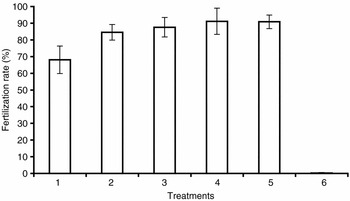
The very low fertilization rates (<2%) detected in some self crosses are probably due to low levels of cross contamination occurring during removal of sperm from each treatment (Fig. 1). Significant differences were detected among combinations (Nested-ANOVA, F24, 60 = 15.64, p < 0.05), and among treatments (Nested-ANOVA, F5, 60 = 570.96, p < 0.05). When sperm were removed within 10 min, the number of eggs fertilized was much lower (68.1 ± 8.21%) than those of other treatments (over 80%, Tukey's HSD, p < 0.05; Fig. 1) while significant difference was not detected between 30 min and 1 h treatments (Tukey's HSD, p > 0.05). Significant differences among combinations are most likely due to differences in gamete compatibility between each pair of individuals. For example, a few combinations showed high fertilization rates (about 90 %) even in 10 min treatment.
Fertilization rates (%) of Acropora digitifera eggs washed in each time after addition of sperm. Bars show average fertilization rates and standard errors for five crosses (n = 15). Each treatment was repeated three times per cross. Sperm were added at a concentration of 106 sperm/ml. (a) Eggs and sperm washed 10 min after addition of sperm. (b) Eggs and sperm washed 30 min after addition of sperm. (c) Eggs and sperm washed in 1 h after addition of sperm. (d) Eggs and sperm washed 3 h after addition of sperm. (e) Eggs and sperm were fixed 6 h after addition of sperm. (f) Eggs without addition of sperm.

These results suggest that in the case of Acropora spp., conspecific fertilization is essentially complete within 30 min under the experimental conditions used. As sperm concentrations in nature decrease significantly 1 h after coral spawning (Omori et al., Reference Omori, Fukami, Kobinata and Hatta2001), these results suggest that incubation periods shorter than those used to date (i.e. complete exclusion of sperm 1 h after their addition) may be more appropriate for the estimation of fertilization rates in corals.
Acknowledgements
We gratefully acknowledge the support of the Australian Research Council (ARC) both directly to DJM (Grants A00105431, DP0209460 and DP0344483) and via the Centre for the Molecular Genetics of Development and the Centre of Excellence for Coral Reef Studies. AI acknowledges receipt of scholarships from the Okinawa International Exchange & Human Resources Development Foundation. We also acknowledge Ms K. Koga, Ms N. Morimoto for their help in collecting coral gametes.