Introduction
Natural events, such as severe storms, floods, and hurricanes, cause a large number of deaths in the United States each year.Reference Thacker, Lee and Sabogal 1 , Reference Diaz 2 Review of US National Center for Health Statistics data showed that 13% (2,741) of 21,491 “natural-disaster deaths” that occurred between 1979 and 2004 were due to storms and floods, including blizzards, tornados, and hurricanes.Reference Thacker, Lee and Sabogal 1 Hurricane-related mortality has decreased over the years due to implementation of early warning systems and improved evacuation and sheltering polices.Reference Shultz, Russell and Espinel 3 , Reference Ragan, Schulte and Nelson 4 Despite the decline in deaths, it is important to collect hurricane-related mortality information to allow further understanding of the epidemiology of such deaths, some of which may be preventable. Active mortality surveillance is essential for collecting accurate and reliable information on the causes and circumstances of hurricane-related deaths in order to allow for development of timely prevention strategies for mortality in future events.
Active hurricane-related mortality surveillance provides timely information on the nature and the number of deaths, while it determines the relatedness of the death to the hurricane. To the authors’ knowledge, there are only a few such surveillance systems in the United States (e.g., Florida,Reference Ragan, Schulte and Nelson 4 Texas, the American Red Cross). The Texas Department of State Health Services’ (DSHS) active mortality surveillance system for disasters, called the Disaster-Related Mortality Surveillance (DRMS) system (hereafter called active mortality surveillance), was established in 2007. The active mortality surveillance is integrated into Texas's incident emergency management system. The DRMS collects statewide data on disaster-related fatalities for a limited time (usually 6-8 weeks) following the precipitating event with the help of regional and local health departments, medical examiners (MEs), justices of the peace (JPs), and other reporting sources (e.g., hospitals). The main objectives of the active mortality surveillance system are to: (1) identify the number of deaths related to the disaster and provide basic mortality information about the deceased for public health and emergency officials in affected jurisdictions; (2) identify high-risk groups that could benefit from immediate public health interventions; (3) evaluate the direct and indirect impacts of the disaster and its human toll in affected communities; and (4) provide information about disaster-related mortality to public health and emergency officials to assist them in future planning and mitigation efforts.
This active mortality surveillance system was activated for the first time during Hurricane Ike in 2008. Hurricane Ike was the third most destructive hurricane in the United States. When it made landfall in Galveston, Texas on September 13, 2008, the Category 2 hurricane was the largest ever observed in the Atlantic Ocean basin. 5 The storm surge equaled that of a Category 4 hurricane, because the hurricane had a diameter of 550 miles, with a 10- to 15-foot-high tide and sustained winds of 110 miles per hour; it caused more than 10 inches of rainfall in the affected areas. 5 The Federal Emergency Management Agency (FEMA) declared 34 counties in Texas as disaster areas five days before the hurricane's landfall. Hurricane Ike directly affected 34 counties, including the cities of Galveston and Houston. As a result of the storm, nearly 1.9 million people were evacuated and more than 4.5 million were without electrical power for several weeks. 6
This paper describes a formal evaluation of Texas's active mortality surveillance as conducted by Texas DSHS and CDC. The key attributes, strengths, and limitations of Texas's active mortality surveillance implemented during Hurricane Ike were evaluated, and recommendations to the state are made here to help improve its active surveillance system.
Methods
Active Mortality Surveillance System
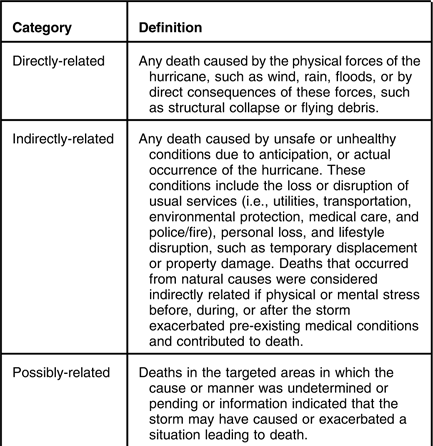
The Texas DSHS used a one-page surveillance form that captures preliminary information about the deceased's demographics, circumstances related to death, the relationship of the death to disaster, and the probable cause and date of death. Using surveillance guidelines, MEs and JPs identify any deaths that meet the hurricane-related mortality definition, complete the form accordingly, and submit it to the local and/or regional health department, which then forwards it to the disaster-related mortality surveillance team at DSHS. A hurricane-related death is defined as any death that is directly, indirectly, or possibly associated with the hurricane among evacuees, residents, or rescue personnel in the declared disaster counties.Reference Combs, Quenemoen and Parrish 7 Detailed hurricane-related mortality definitions are in Table 1. In response to Hurricane Ike, surveillance was activated by DSHS in 44 counties from September 8, 2008 through October 13, 2008. Thirty-four of these counties were affected directly by the hurricane, and 10 counties were included because they had shelters for evacuees. The active mortality surveillance system was active for four days before Hurricane Ike made landfall, to capture any deaths that may be associated with anticipation of or preparation for the hurricane (i.e., indirectly related deaths).
Definitions of Hurricane-Related Deaths Used by Active Mortality Surveillance System, Texas 2008.Reference Combs, Quenemoen and Parrish 7

Vital Statistics Data
The Vital Statistics Unit at DSHS is responsible for managing vital records in Texas. Each record includes birth, death, fetal death, divorce, and marriage certificate data, along with reports of adoption. Death certificate information is a part of the vital statistics system in Texas. There are over 164,000 deaths annually in the state. The process of death registration in Texas is a cooperative effort between the funeral director (accepting responsibility for body disposition), the certifier of the cause of death (who may be a physician, a medical examiner, or a justice of the peace/coroner), and the informant (who provides personal, non-medical information about the deceased). When a death involves injury or unusual or suspicious circumstances, the cause, manner, and circumstances of death typically is investigated, certified, and reported by a medical examiner, or a justice of the peace/coroner. Texas has implemented an electronic system for death registrations. As of September 1, 2008, all funeral service providers and medical certifiers are required to file death certificates by use of the Texas Electronic Death Registration System.
Evaluation Design
Texas's active mortality surveillance system was evaluated by use of CDC's Updated Guidelines for Surveillance System Evaluation. 8 Using these guidelines, the evaluation was designed to gather credible evidence about active mortality surveillance system performance, including its usefulness, simplicity, flexibility, data quality, acceptability, representativeness, timeliness, and stability. The active mortality surveillance system was reviewed for simplicity, and stakeholders were interviewed for the purpose of assessing flexibility, acceptability, timeliness, and stability of the system. Data from vital statistics were compared with active mortality surveillance data for the purpose of assessing data quality, representativeness, and timeliness.
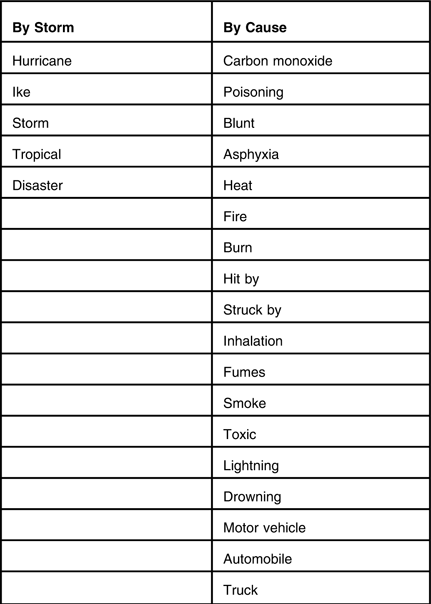
To examine the number of deaths captured by surveillance, data with information from death certificates filed in Texas and maintained by DSHS were compared. First, death certificate data were obtained on all deaths (15,898) in all counties (254) in Texas from September 8, 2008, to through October 13, 2008. Second, vital records were reviewed to identify deaths that met the surveillance case definition. The list of keywords used to search for the Hurricane Ike-related deaths in the vital statistics dataset is in Table 2. Six descriptive variables in the vital statistics records were searched by use of the text string keyword method. The six descriptive variables were: immediate cause of death (cause of death A); condition leading to immediate cause of death (causes of death B, C, and D); description of injury; and other significant conditions contributing to death. Next, active surveillance data were compared to vital statistics data to link records by use of personal identifying information, such as name, date of death, and county of residence.
List of Keywords Used for Text String Search of Texas Vital Statistics Data

Finally, in order to determine the completeness of reporting of hurricane-related deaths during Hurricane Ike, the method described by Chandrasekaran and Deming (capture-recapture method)Reference Robles, Marrett and Clarke 9 , Reference Chandrasekaran and Deming 10 to estimate the total number of deaths related to Hurricane Ike was used.Reference Chandrasekaran and Deming 10 , Reference Cates, Smith and Rochat 11 This method compares the results of two independent systems used to estimate the total number of deaths for the same event.
This evaluation was conducted as part of an epidemiologic investigation. No human research administration approvals were required.
Stakeholders
Stakeholders included DSHS (e.g., DSHS staff, commissioner, community preparedness), medical examiners, and the local health departments. Support staff of DSHS who implemented the active mortality surveillance system were interviewed. Interviews were to ensure that the evaluation addressed appropriate questions, assessed pertinent attributes, and produced acceptable and useful findings. The information collected during these interviews was used to assess the simplicity, acceptability, flexibility, and timeliness of data-sharing with stakeholders, and the stability of the DRMS.
Results
Operating Active Mortality Surveillance During Hurricane Ike
The active mortality surveillance system was implemented on September 17, 2008, four days after Hurricane Ike's landfall. Because the assigned staff had not been identified previously in the DSHS preparedness plans, the lack of staff to operate the system delayed activation of the system. Once the staffing was established, hurricane-related mortality data were collected retrospectively for deaths that occurred from September 8, 2008, through September 16, 2008, and prospectively through October 13, 2008, in 44 counties using the active mortality surveillance system.
A three-member data manager team coordinated the active mortality surveillance system at the state level. This team provided pre-established guidelines, case definitions, and surveillance forms to regional health departments, as well as to MEs and JPs in affected counties via e-mail. These guidelines helped to classify deaths as being directly, indirectly, or possibly related to Hurricane Ike. During the event, the data managers used newspaper reports and Google News alerts to identify deaths that might be related to Hurricane Ike. These sources helped to trigger retrospective hurricane-related mortality data collection, and then data managers contacted MEs or JPs to determine whether deaths in their counties identified by triggering sources (i.e., initial sources that provided information about Hurricane Ike-related deaths) were hurricane-related. Medical examiners or JPs faxed completed forms for each death meeting the DRMS case definition to data managers daily. If necessary, data managers contacted the MEs or JPs for clarification or additional information. Once forms were received, data were entered into the pre-established database and analyzed to generate daily situational reports.
Evaluation of Active Mortality Surveillance System
Usefulness—Texas's active mortality surveillance system was useful because it identified and characterized hurricane-related deaths. The DSHS shared a daily report developed from this system with state officials to provide updated information about the number of deaths and the leading cause of mortality. Active mortality surveillance system data indicated that carbon monoxide (CO) poisoning due to generator use was the leading cause of death after Hurricane Ike, a finding that helped to identify priority prevention messages. Daily reports of active mortality surveillance findings provided situational awareness to state officials, CDC's Emergency Operations Center, and FEMA. Local health departments in 44 counties used active mortality surveillance data to respond to media and missing-person inquiries.
Simplicity—Implementing the active mortality surveillance system during Hurricane Ike was simple because the system had pre-existing guidelines, a pre-established database, and a standardized one-page data collection tool. Operating the active surveillance system was simple, because modalities such as e-mail or fax for information exchange between the data managers and MEs and JPs in affected counties were used. Additionally, although data managers received no formal training in implementing the system, they were able to implement the system in a short time. Conversely, data managers reported that some MEs and JPs initially had difficulty in understanding and applying the indirectly- and possibly-related case definitions. During this evaluation, neither MEs nor JPs (data reporters) were interviewed; therefore, the simplicity of the active mortality surveillance system guidelines for data reporters could not be assessed.
Acceptability — The active mortality surveillance system was an acceptable system, as evidenced by the participation of all MEs and JPs in counties affected by hurricane-related deaths.
Flexibility—Implementing the active mortality surveillance system was a combined effort of various departments, coordinated by the three-member data manager team. Data managers identified additional sources of information, such as hospitals and forensic centers, to better track hurricane-related deaths. Data managers also used triggering sources (newspaper and Google news) after the system was activated, further evidence of its flexibility, as these sources were not in the initial guidelines. The system was implemented in 44 affected counties after Hurricane Ike, and was scalable, depending upon the size of the affected area. Additionally, this active mortality surveillance system can be used not only for hurricanes, but also for any other type of natural or man-made disaster.
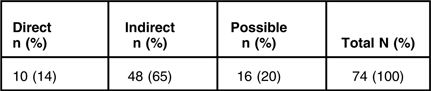
Data Quality—A review of 10% of randomly-selected surveillance forms indicated that 98% of the fields were complete. Results showed that the active mortality surveillance system had identified more deaths as hurricane-related than did the vital statistics system. The active surveillance system reported 74 Hurricane Ike-related deaths in 16 of the 44 counties where the system was implemented during the five-week period. Forty-eight (65%) of the total deaths were indirectly related, 10 (14%) were directly related, and 16 (20%) were possibly related (Table 3).
Number of Deaths and Their Relationship to Hurricane Ike—Texas, September 8, 2008, through October 13, 2008.Reference Zane, Bayleyegn and Hellsten 16

All 74 deaths captured by the active mortality surveillance system were identified in vital statistics data by use of personal identifier information. However, the retrospective review of the de-identified vital statistics data (15,898 death records) through use of the text string search identified only four deaths possibly related to Hurricane Ike. Only one of these four was a possibly-related death not previously captured by the active mortality surveillance system. Reviewing deaths in the vital statistics records by use of active mortality surveillance system's case definitions to assess deaths related to Hurricane Ike was difficult because of the lack of detailed information in vital statistics data.
Sensitivity and Positive Predictive Value—No gold standard mortality surveillance system exists with which to compare the active mortality surveillance system implemented during Hurricane Ike, as no other system collects disaster-related mortality information. Therefore, sensitivity and predictive value positive were not calculated. However, the active mortality surveillance systems were compared to the vital statistics, a traditional source of mortality data. Information about deaths related to Hurricane Ike generally was not collected by vital statistics, as the main objective of vital statistics is to record data on deaths (such as date, cause of death). For example, vital statistics data during Hurricane Ike identified deaths as due to drowning. However, information about the circumstance, such as “drowning was a result of Hurricane Ike flooding,” was not recorded. This lack of detailed information in traditional vital statistics systems made it challenging to categorize a death related to Hurricane Ike, thus highlighting the limitation of vital statistics data for disaster surveillance.
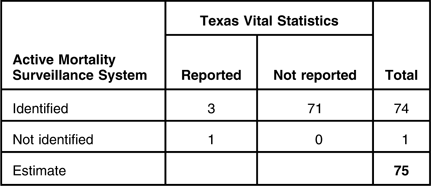
Only one disaster-related death was missed by the active mortality surveillance system, whereas by using the text string search, only four disaster-related deaths in the vital statistics were identified (Table 4). Using the Chandrasekaran-Deming method,Reference Chandrasekaran and Deming 10 75 disaster-related deaths were estimated, and the completeness of the active mortality surveillance system reporting was 98% (74 of 75 disaster-related deaths), while the completeness of vital statistics reporting was calculated to be 5.3% (4 of 75 disaster-related deaths).
Estimate of Total Number of Hurricane-Related Deaths During Hurricane Ike, Texas, by the Chandrasekaran-Deming Method

Representativeness — The active mortality surveillance system data were representative because the system was implemented in all 44 counties affected by Hurricane Ike.
Timeliness—Although active mortality surveillance system guidelines encourage daily reporting by data sources, the average time of reporting a death to the active mortality surveillance system was 14 days (number of days from date of death to date of reporting). The timeliness of reporting these deaths may have been affected by the delayed start of the system, as it was implemented five days after Hurricane Ike made landfall. However, for those deaths captured during the prospective surveillance period (September 17, 2008, through October 13, 2008), the average time of reporting was also 14 days.
Discussion
Hurricanes damage infrastructure and public utilities; they also have a major impact on public health. In addition to increased injuries, hurricanes also frequently result in mortality.Reference Bayleyegn, Wolkin and Oberst 12 - Reference Lugosi 15 Active mortality surveillance not only provides robust data, but it also provides timely information regarding the number and characterization of deaths during a disaster. Texas's active surveillance system is one of the few existing active mortality surveillance systemsReference Ragan, Schulte and Nelson 4 that are designed to assess hurricane-related mortality. During Hurricane Ike, this active mortality surveillance identified and characterized hurricane-related deathsReference Zane, Bayleyegn and Hellsten 16 that would not have been identified by vital statistics.
The surveillance was useful because it identified and characterized hurricane-related deaths, and the data derived from its results were used to respond to media and missing-person inquiries. Such use demonstrated the importance of actively exchanging mortality information during a public health emergency and also served as an early warning alert system to detect mortality patterns in which public health action might be initiated at the local, regional, or state levels.
The active mortality surveillance system's simple one-page surveillance form with guidelines was used to collect detailed information on probable cause and circumstances related to death. This information helped to classify the probable relationship of the death to the hurricane (e.g., direct, indirect, possible, or unrelated). This classification that uses standard case definitions helps in the assessment of disaster-attributed mortality, and it is useful during development and implementation of effective policies to prevent disaster-attributed mortality.Reference Combs, Quenemoen and Parrish 7 In contrast, reviewing vital statistics records by use of surveillance case definitions to identify deaths related to Ike was difficult due to the lack of detailed narrative information on the death certificate. Consequently, active mortality surveillance helped to classify substantially more deaths as “hurricane-related” than vital statistics.
Staff had not been identified previously for this task in the DSHS preparedness plans, and this delayed implementation of the active mortality surveillance system and affected timeliness of the system. In addition to the delayed start of the surveillance, the reports may have been affected by the date of discovery of death, which may not be the same as the date of death. The information on the date of body recovery was not captured by the active mortality surveillance system and, therefore, could not be evaluated. Although a delay occurred in reporting deaths to active mortality surveillance, data were disseminated promptly via daily reports for situational awareness. It also is important to consider that the average time to complete a death record in the vital statistics system is approximately 16 days, but initially only limited information is recorded. Therefore, as compared with the vital statistics data, the active mortality surveillance system was collecting timely information on hurricane-related deaths. The experience gained with conducting surveillance during Hurricane Ike will enable public health officials to activate surveillance in a more timely manner in response to future hurricanes. This system has been incorporated into DSHS’ disaster preparedness plan, and staff are now preidentified, so as to allow for timely implementation of active mortality surveillance.
Completeness of reporting is an important attribute by which surveillance systems are judged. 8 During disaster conditions, it is important that reporting of disaster-related deaths be complete and accurate. Even though the data quality of Texas's active mortality surveillance system was excellent, with 98% of the fields complete, this system may not have captured all Hurricane Ike-related deaths due to lack of reporting.
Strengths of the active mortality surveillance are that it acquired the number of deaths related to Hurricane Ike and collected detailed information on how deaths were related to the hurricane. In addition, the system was implemented rapidly by use of a standardized form and guidelines. The pre-established guidelines also facilitated categorization of deaths. Additionally, active mortality surveillance reflects the collaborative effort of multiple stakeholders, such as DSHS, MEs and JPs, and local health departments.
One major challenge posed by the active mortality surveillance during Hurricane Ike was that staff members needed to coordinate the active surveillance were not pre-identified, an omission that led to a delay in activating the system. The case definition of possibly-related deaths captures those deaths where information on cause or manner of death was pending or undetermined. However, the active surveillance system's guidelines did not suggest follow-up, particularly for those deaths classified as “possibly-related.” Deaths classified as “possibly-related” might be re-categorized as “directly or indirectly related” when the information is complete. In addition, both the active mortality surveillance system and the vital statistics system do not include deaths indirectly attributable to Hurricane Ike—deaths that occurred outside the investigation's geographical and temporal scope. This problem might have resulted in an underestimation of the total number of deaths related to Hurricane Ike.
Conclusions
The evaluation of Texas's active mortality surveillance was undertaken because of the need to have accurate statistics on hurricane-related deaths in order to strengthen prevention efforts. This evaluation shows that surveillance was successful in identifying and classifying Hurricane Ike-related deaths in Texas. Active mortality surveillance is needed to improve situational awareness during disasters; surveillance data provide specific information that can be used to develop targeted interventions (e.g., CO poisoning deaths due to generator use). Active mortality surveillance is an essential tool for local, regional, and state health departments during hurricanes. The vital statistics system alone is not a robust enough system to provide the detailed data necessary to create comprehensive prevention strategies, so that the local health departments can increase awareness about CO poisoning and how to use generators safely. Local, regional, and state public health officials need good situational awareness in order to implement prevention activities and to allocate public health resources appropriately.
The opportunity to assess the two systems—vital statistics and surveillance—was possible because of the recent establishment of DSHS surveillance procedures in Texas. To ensure that problems of public health importance are being monitored efficiently and effectively, officials should arrange for the periodic evaluation of surveillance systems, and the evaluation should include recommendations for improving quality, efficiency, and usefulness. This comparison of surveillance data with vital statistics data indicates that surveillance data are of high quality and provide a strong foundation upon which to make public health recommendations regarding hurricane-related deaths. Additionally, on the basis of recommendations made from this evaluation, the active mortality surveillance system and its guidelines have been incorporated into the DSHS’ fatality management operational response guidelines.
Abbreviations
- CDC:
-
US Centers for Disease Control and Prevention
- CO:
-
carbon monoxide
- DRMS:
-
disaster-related mortality surveillance
- FEMA:
-
US Federal Emergency Management Agency
- JP:
-
justice of the peace
- ME:
-
medical examiner
- DSHS:
-
Texas Department of State Health Services
Acknowledgements
The authors gratefully acknowledge the contributions of John Hellsten, Ryan Beal, Tracy Haywood, Priscilla Boston, Lyuda Baskin, Albert Rivera, Sandra Lackey, and Richard Taylor from the Texas Department of State Health Services, Austin, TX.