Background
Ebstein’s anomaly is a rare congenital cardiac defect characterised by the failure of delamination of the leaflets of the tricuspid valve, resulting in the downward displacement of the tricuspid valve into the right ventricle. In addition, the right ventricle is myopathic and poorly functional.Reference Epstein 1 – Reference Dobell 3 The functional part of the right ventricle is often small and ill-equipped to maintain a full cardiac output. This is especially relevant in the severe form of Ebstein’s anomaly, which presents at birth at a time when the pulmonary vascular resistance is still elevated. The clinical picture in these critically ill neonates is one of gross cardiomegaly, severe tricuspid regurgitation, intractable cardiac and respiratory failure, and cyanosis, resulting in almost universal mortality without early surgical intervention.Reference Celermajer, Cullen, Sullivan, Spiegelhalter, Wyse and Deanfield 4 – Reference Knott-Craig, Overholt, Ward and Razook 6 Even in those symptomatic neonates who are haemodynamically stable and who are initially managed conservatively, the early mortality is as high as 25%.Reference Goldberg, Jones and Boston 7 , Reference McElhinney, Salvin and Colan 8 Half of these neonates require surgery within the first 6 months of life.Reference Celermajer, Cullen, Sullivan, Spiegelhalter, Wyse and Deanfield 4 , Reference Celermajer, Dodd, Greenwald, Wyse and Deanfield 5
StarnesReference Starnes, Pitlick, Bernstein, Griffin, Choy and Shumway 9 was the first to report surgical success with symptomatic neonates with Ebstein’s anomaly in 1991. He advocated a single-ventricle palliation in these neonates and later reported 76% early survival in a series of 16 neonates.Reference Reemtsen, Fagan, Wells and Starnes 10 Others have also reported good early survival with single ventricle palliation.Reference Shinkawa, Polimenakos and Gomez-Fifer 11 , Reference Sano, Shino and Kawada 12 In 2009, Bove et alReference Bove, Hirsch, Ohye and Devaney 13 reported their series of 24 surgically treated neonates with Ebstein’s anomaly and suggested simply placing a Blalock–Tausig shunt unless there was significant congestive heart failure. They had a 15% early mortality with this simplified approach and 75% mortality (3/4) among those having a biventricular repair.
In 2000, we first reported a series of complete two-ventricle repair in eight critically ill symptomatic neonates with Ebstein’s anomaly operated on since 1994 with a 16% early mortality.Reference Knott-Craig, Overholt, Ward and Razook 6 We subsequently advocated complete repair in a larger series with 70–80% early survival with these patients.Reference Knott-Craig, Overholt, Ward, Ringewald, Baker and Razook 14 – Reference Knott-Craig, Goldberg, Ballweg and Boston 17 The medium-term follow-up suggested that the repairs were durable, and the functional status was excellent in the majority of patients.Reference Boston, Goldberg and Ward 18
There is still no consensus on the surgical management of these critically ill neonates, despite the fact that ∼100 babies are born each year in the United States with Ebstein’s anomaly.Reference Goldberg, Jones and Boston 7 , Reference Davies, Pasquali, Jacobs, Jacobs, Wallace and Pizarro 19 Surgical recommendations vary from performing a Blalock–Taussig shunt or Starnes palliationReference Bove, Hirsch, Ohye and Devaney 13 to a single-ventricle palliation for allReference Starnes, Pitlick, Bernstein, Griffin, Choy and Shumway 9 – Reference Shinkawa, Polimenakos and Gomez-Fifer 11 to doing a complete two-ventricle repair.Reference Knott-Craig, Overholt, Ward and Razook 6 , Reference Goldberg, Jones and Boston 7 , Reference Knott-Craig, Overholt, Ward, Ringewald, Baker and Razook 14 – Reference Boston, Goldberg and Ward 18 In a recent review of surgical practice in the United States, approximately one-third of the patients underwent a Blalock–Taussig shunt, one-third had a Starnes single-ventricle palliation, and one-third had a two-ventricle repair.Reference Davies, Pasquali, Jacobs, Jacobs, Wallace and Pizarro 19
As part of our ongoing self-appraisal of our two-ventricle repairs of neonates with Ebstein’s anomaly, we identified that the presence of anatomical pulmonary atresia was associated with significantly higher early mortality in our experience.Reference Knott-Craig and Goldberg 16 – Reference Boston, Goldberg and Ward 18 The purpose of this study was to further evaluate our results with these patients, that is, Ebstein’s anomaly with anatomical pulmonary atresia with respect to the type of surgical repair they received, for example, one-ventricle versus two-ventricle repairs, and identify whether the type of surgical repair was associated with a difference in the early outcome.
Methods
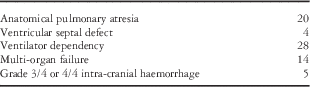
Between 1994 and July, 2013, 32 severely symptomatic neonates with Ebstein’s anomaly underwent operation by a single surgeon. This constitutes the study group. Most of the neonates were ventilator-dependent (n=28) and all required significant inotropic support at the time of surgery. All patients had a Great Ormond Street Echo score of Grade 3 (n=2) or 4 (n=30).Reference Celermajer, Cullen, Sullivan, Spiegelhalter, Wyse and Deanfield 4 , Reference Celermajer, Dodd, Greenwald, Wyse and Deanfield 5 , Reference Celermajer, Bull and Till 20 The cardiothoracic ratio of the patients ranged from 0.8 to 1.0, and the degree of tricuspid regurgitation was moderate in 2 patients and severe in the remaining 30 patients. The 2 patients had cyanosis as their predominant symptom, and the 30 patients had congestive heart failure (see Table 1). The patients’ operative notes and discharge data were reviewed and form the basis for this manuscript. Dichotomous variables were compared using the Fisher’s exact test, and a difference of 0.05 was considered significant. The end-point of the study was early mortality, defined as death before hospital discharge, or within 30 days of surgery. The study was approved by the University of Tennessee Institutional Review Board.
Preoperative comorbidity associated with neonates with Ebstein’s anomaly needing operation (n=32).

Surgical technique
Details of our surgical technique have been well documented.Reference Knott-Craig, Overholt, Ward and Razook 6 , Reference Goldberg, Jones and Boston 7 , Reference Knott-Craig, Overholt, Ward, Ringewald, Baker and Razook 14 , Reference Knott-Craig, Goldberg, Overholt, Colvin and Kirklin 15 The goal was to achieve a two-ventricle repair in all patients. The tricuspid valve was usually repaired using a modification of the Danielson technique, creating a monocusp valve based on the anterior leaflet of the tricuspid valve. The Sebening stitch was also used to approximate the major anterior papillary muscles to the interventricular septum to support the tricuspid valve repair.Reference Augustin, Schmidt-Habelmann, Wottke, Meisner and Sebening 21 A fenestrated closure of the atrial septal defect was performed and all associated cardiac defects were repaired. Right atrial reduction was carried out to reduce the cardiothoracic ratio and allow more room for the lungs to expand after surgery. In one patient, a modified cone repair was performed.Reference Da Silva, Baumgratz and da Fonseca 22
When anatomical pulmonary atresia was present, the right ventricular outflow tract was repaired with a transannular patch of glutaraldehyde-treated autologous pericardium (n=9) or Cormatrix (n=1). More recently, a valved aortic or pulmonary homograft (8–10 mm diameter) was used to repair the right ventricular outflow tract (n=6). In four neonates with Ebstein’s anomaly with anatomical pulmonary atresia, a single-ventricle palliation was carried out either by performing a Starne’s single-ventricle repair (n=2) or just a Blalock–Tausig shunt (n=2). In one of the patients who underwent a Starne’s repair we used a modification; the cavity of the functional right ventricle was mostly obliterated by suturing the anterior free wall of the right ventricle to the interventricular septum with multiple interrupted horizontal pledgetted sutures, before closing the tricuspid valve with a fenestrated patch. This seemed to importantly benefit the diastolic compliance of the left ventricle, resulting in excellent left ventricular function postoperatively.
Indications for surgery
The indications for surgery included inability to wean from the ventilator, severe congestive cardiac failure, persistent cyanosis, anatomical pulmonary atresia, and/or a prostaglandin-dependent circulation.
Results
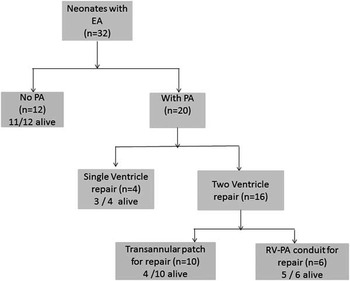
The mean weight of the patients at the time of surgery was 2.9±0.6 kg, ranging from 1.9 to 3.4 kg, and the mean age of the group at the time of surgical intervention was 7±3 days. A total of 12 neonates (12/32, 37.5%) had either a normal right ventricular outflow tract (n=10) or mild-to-moderate pulmonary valve stenosis (n=2), and most of these had functional pulmonary atresia at some point before surgery. Of the neonates, 20 (20/32, 62.5%) had anatomical pulmonary atresia. A two-ventricular repair was performed in 87.5% (28/32) of the patients, and single-ventricle palliation in 12.5% (4/32). Early mortality for the whole group was 28% (9/32). For patients with no anatomical pulmonary atresia, this was 8.3% (1/12) compared with 40% (8/20) for patients with Ebstein’s anomaly with anatomical pulmonary atresia (p=<0.05; see Fig 1).
Survival of neonates with Ebstein’s anomaly and pulmonary atresia following surgery. EA=Ebstein’s anomaly; PA=pulmonary atresia (anatomical); RV–PA=right ventricle to pulmonary artery.

Early survival for Ebstein’s anomaly and no anatomical pulmonary atresia
All patients with normal right ventricular outflow tract or only pulmonary valve stenosis had complete two-ventricle repairs (n=12). Hospital mortality for these neonates was 8.3% (1/12).
Early survival for Ebstein’s anomaly and pulmonary atresia having two-ventricle repair
Hospital mortality for patients with Ebstein’s anomaly with anatomical pulmonary atresia was 40% (8/20). Of the patients, 16 (80%, 16/20) underwent a two-ventricle repair, with a hospital mortality of 44% (7/16). For patients having a transannular patch as part of their two-ventricular repair, the early mortality was 60% (6/10) in contrast with 16.6%(1/6) for those having a valved homograft conduit (p<0.05).
Early survival for Ebstein’s anomaly and pulmonary atresia having a single-ventricle palliation
The early mortality was 25% (1/4) for patients undergoing a single-ventricle palliation. Of the four patients with Ebstein’s anomaly with anatomical pulmonary atresia undergoing a single-ventricle palliation, two patients had mild tricuspid regurgitation; these patients had a modified Blalock–Tausig shunt without mortality. Whereas one patient underwent a successful Starnes’ single ventricle palliation, the second patient did not survive the Starne’s repair. This patient was transferred late with severe end-organ failure and had a serum lactate of 16 at the time of transfer. He had overt renal and hepatic failure and diffuse coagulopathy before the surgery – the patient had an emergency laparotomy for suspected bowel ischaemia with perforation immediately before cardiac surgery. In retrospect, he would have benefitted from a staged single-ventricle palliation.Reference Tsukimori, Morihana, Fusazaki, Takahata, Oda and Kado 23
Discussion
Severely symptomatic neonates with Ebstein’s anomaly have an early mortality ∼100% without surgical intervention.Reference Celermajer, Cullen, Sullivan, Spiegelhalter, Wyse and Deanfield 4 – Reference Knott-Craig, Overholt, Ward and Razook 6 The surgical management of these critically ill neonates has evolved over the last 20 years and it is still unclear as to which surgical strategy is the best option. For all surgical procedures, the early mortality is around 25%.Reference Davies, Pasquali, Jacobs, Jacobs, Wallace and Pizarro 19
In 1991, Starnes reported the first series of six neonates with a single-ventricle palliation with a 75% early survival.Reference Starnes, Pitlick, Bernstein, Griffin, Choy and Shumway 9 During this operation, the tricuspid valve was closed with a patch, an atrial septectomy was performed, and a Blalock–Tausig shunt added. This technique was later modified to include a 4 mm fenestration on the patch used to close the tricuspid valve.
In 2000, we reported our initial results with complete biventricular repair in eight neonates with 87% survival.Reference Knott-Craig, Overholt, Ward and Razook 6 All the patients underwent repair of their tricuspid valve using a modification of the Danielson technique,Reference Tsukimori, Morihana, Fusazaki, Takahata, Oda and Kado 23 – Reference Dearani and Danielson 25 fenestrated closures of the atrial septal defect, reduction atrioplasty, and repair of all associated cardiac defects.Reference Boston, Dearani, O’Leary, Driscoll and Danielson 24 – Reference Danielson, Maloney and Devloo 26 Subsequently, this experience expanded to surgically treated 26 neonates and 9 young (<4 months old) infants. Among these patients, the early survival was 80%, and the survival among neonates was 73%.Reference Knott-Craig, Goldberg, Ballweg and Boston 17 Of the patients, 91% (32/35) underwent a complete two-ventricle repair. In this cohort, there was one neonate with a modification of the Starnes’s palliation, and two patients with Blalock–Tausig shunts. We subsequently proposed an algorithm for the surgical management of symptomatic neonates with Ebstein’s anomaly and included the Starnes’ single-ventricle palliation in our recommendations for certain patients with Ebstein’s anomaly with anatomical pulmonary atresia.Reference Knott-Craig, Goldberg, Ballweg and Boston 17
On the basis of our experience, we believe that a complete two-ventricular repair can be predictably and successfully performed in the overwhelming majority of neonates with Ebstein’s anomaly who have a functional right ventricle outflow tract. Among these patients we have achieved a 91% early survival and most patients have a good intermediate life expectancy.Reference Knott-Craig, Overholt, Ward, Ringewald, Baker and Razook 14 The first of these patients is currently a running back on his high school football team. We would anticipate that some of these patients may require the addition of a bidirectional Glenn anastomosis at some point to unload the right ventricleReference Malhotra, Petrossian and Reddy 27 or require reoperation on their tricuspid valve. With the increased experience gained with the Cone repair, this may also be an option for the patients as their follow-up extends. This has been successfully carried out by DearaniReference Dearani, Said, O’Leary, Burkhart, Barnes and Cetta 28 at the Mayo clinic.
For the patients with Ebstein’s anomaly and anatomical pulmonary atresia, a predictable two-ventricle repair has been more elusive. After the initial success, it became clear to us that repairing the anatomical pulmonary atresia with a transannular patch was associated with a prohibitively high early mortality of 50–60%. Recognising this, Bove advocated a more conservative surgical approach for these patients and suggested simple placement of a modified Blalock–Taussig shunt and ligation of patent ductus arteriosus if the patient was cyanotic and single-ventricle palliation for those with severe congestive cardiac failure.Reference Bove, Hirsch, Ohye and Devaney 13 We have treated two patients in our series and both have survived and have subsequently undergone a successful Fontan operation. Certainly, avoiding cardiopulmonary bypass and performing an aorto-pulmonary shunt is a sound strategy, perhaps adding a reduction atrioplasty to enable the lungs to better expand postoperatively. This is particularly applicable if there is only mild tricuspid regurgitation present. The downside side to this strategy is that the distended right ventricle with associated severe tricuspid regurgitation very often results in significant left ventricular dysfunction and persistent intractable cardiac failure. Both patients in our series who had undergone Blalock–Taussig shunts had only mild tricuspid regurgitation, which we believe is a surrogate for a very small functional right ventricle. We were therefore encouraged with the initial 100% survival (3/3) in the patients with Ebstein’s anomaly and anatomical pulmonary atresia having a single-ventricle palliation, which seems better than the two-ventricular repair using a transannular patch.
In our more recent experience in managing neonates with Ebstein’s anomaly with anatomical pulmonary atresia, we started using a small valved conduit to replace the atretic right ventricular outflow tract. Generally, we use an 8–10 mm homograft, either an aortic or pulmonary homograft, depending on availability. Adding a valved conduit to the right ventricular outflow tract was associated with improved early survival compared with transannular patch (5/6 versus 4/10, p=0.05), and negated the advantage of a single-ventricle palliation (early survival 5/6 versus 3/4, p=ns), although the numbers are too small to have any significance. Whether these improved early survival results translate into better longer term at follow-up is yet to be established. The prohibitive early mortality, however, seems to have been improved with this strategy. In the follow-up of these patients, we anticipate that the remodelling of the right ventricle may be delayed, and as a result, the right ventricle may not be able to develop a significant gradient over the right ventricle to pulmonary artery conduit. This will require vigilance to determine at what point the conduit needs to be replaced other than relying simply on the gradient. In addition, the fenestration in the patch used to close the atrial septal defect needs to be larger to ensure that it does not close prematurely before the right ventricle has adequately remodelled.
Nevertheless, we still recommend a single-ventricle approach to neonates with Ebstein’s anomaly and anatomical pulmonary atresia if the degree of tricuspid regurgitation is less than severe, if the functional right ventricle is small or marginal in size, or if there is significant left ventricle dysfunction. We believe that our modification to the Starnes’ palliation may help with the left ventricular dysfunction. Ultimately, longer follow-up is required before superiority of one strategy over the other can be assumed in these critically ill patients.
Acknowledgements
None.
Financial Support
This research received no specific grant from any funding agency, commercial or not-for-profit sectors.
Conflicts of Interest
None.
Ethical Standards
The authors assert that all procedures contributing to this work comply with the ethical standards of the Helsinki Declaration of 1975 as revised in 2008 and has been approved by the Institutional Review Board of Le Bonheur Children’s Hospital.