Introduction
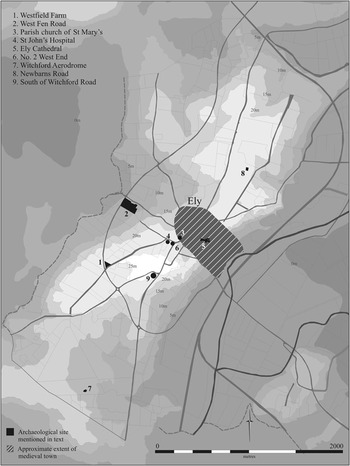
Late in 2006, the Cambridge Archaeological Unit (CAU) undertook the excavation of a small Anglo-Saxon inhumation cemetery, in advance of housing development, on a parcel of land located between the A10 bypass and Witchford Road, to the south west of Ely city centre. The site lies at an approximate height of 24.5m OD on a geology of Lower Greensand, Glacial Till and Kimmeridge Clay. A natural ridge was originally present, running south west to north east across the area, but this has now been almost entirely denuded by post-medieval ploughing; this ridge was probably 0.5m to 1m higher than the present ground surface.
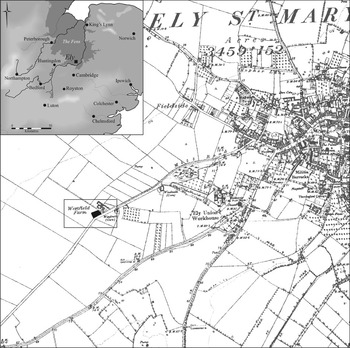
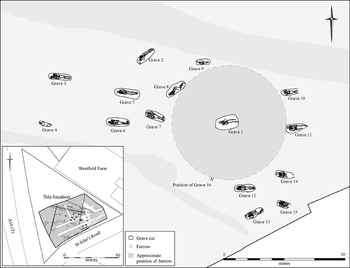
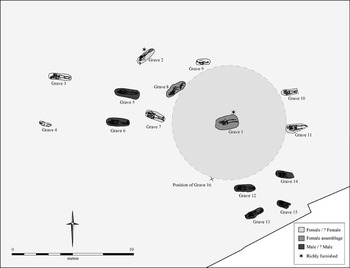
Four definite graves of probable seventh-century date were identified here during an archaeological trench evaluation in May 2006.Footnote 1 Commissioned by Taylor Woodrow Developments Ltd, the subsequent excavation was centred on tl 526799, covering an area of approximately 0.16ha (fig 1). A further eleven graves were identified, along with concrete evidence for a later seventh-century date (fig 2). This paper will first present the details of these graves, before exploring the patterning visible in the skeletal and isotopic data, look in more detail at the evidence for cemetery dating, examine the cemetery rites and layout and assess the significance of the grave-good assemblages. An attempt will then be made to set the site into its contemporary archaeological and historical context. (SL and RN)
Site located on first edition Ordnance Survey map 1886

Site plan showing cemetery features

Grave Catalogue
The cemetery comprised fifteen known graves (with a further grave inferred from human remains recovered during soil stripping). These were apparently arranged around a central burial, Grave 1, which may well have originally been covered by a barrow; although there was no extant archaeological evidence for this, the arrangement of other graves around it, and its high-status grave-good assemblage, provides some support for the existence of such a mound. Heads were generally to the west, with some variation; discussion of potential age and sex patterning in grave goods and burial position can be found below, together with a table detailing visible pathologies. The age of the adults was determined using the degree of epiphyseal fusion,Footnote 2 the extent of dental wearFootnote 3 and, where possible, changes to the pubic symphysis and auricular surface.Footnote 4 Unfortunately, the ages attributed to this population are broad, as the pubic symphysis survived in only one instance and the auricular surface, where it did survive, was abraded and damaged. Immature individuals were aged using the stage of dental and skeletal development.Footnote 5 The following age categories were used: infant (0–4 years), juvenile (5–12), sub-adult (13–18), young adult (19–25), middle adult (26–44) and mature adult (45+ years).
The sex of adults was determined by sexually diagnostic characteristics in the pelvis and skull.Footnote 6 A ‘five sexes’ classification (F, ?F, ?, ?M, M) was used in recording. Although no attempt was made to sex immature remains, two older sub-adults exhibited very strong sexually dimorphic traits in the pelvis and skull, and so have been assigned a ?sex. The dentition was recorded using the accepted inventory and symbols;Footnote 7 stature was calculated using the standard regression formulae.Footnote 8
The skeletons were generally well preserved, despite being interred in a heavy clay soil. Unless otherwise stated, the graves were backfilled with a relatively firm deposit of mid- to pale brown sandy silty clay, with a distinct orange tinge and occasional poorly sorted sub-angular gravel inclusions. There was no inter-cutting of graves, but all had been truncated by ploughing and/or machine stripping. The graves were generally shallow, ranging in depth from 0.03 to 0.37m, with just under half being less than 0.15m deep. The completeness of each skeleton was assessed during recording: four of the skeletons were recorded as being 50 to 75 per cent complete and eleven were recorded as being greater than 75 per cent complete. Loose epiphyses were often absent, as were many of the small bones from the hands and feet. The condition of the surviving bone was generally good, although some of the cortical bone is abraded and many of the auricular surfaces have a weathered appearance. On the dentitions of several individuals (those in Graves 2, 8 and 14), much of the enamel is obscured by a white mineral deposit (not calculus) that is etched with insect/root lesions.Footnote 9
Grave 1 (Older juvenile, c 10–12 years, F17; fig 3)
Sub-oval grave, with steeply sloping sides and relatively flat base, partially truncated at one end by a field drain, 1.87+ × 1.11m and 0.24m+ deep, aligned west to east (258 degrees). The skeleton was extended and supine, with the arms partially flexed so that the hands rested on the pelvis; the head lay to the west. The skeleton is well preserved, although most of the unfused epiphyses and small hand and foot bones are missing. Enamel hypoplasias were noted on the maxillary central incisors. Small (1mm) pits were recorded on the buccal aspects of the mandibular molars and lingual aspects of the right maxillary molars. They are not pathological but, had this individual lived, carious lesions may have been more likely to develop at these sites. The black/purple staining on the buccal surfaces of the right mandibular premolars and the bone immediately below the teeth is the result of direct contact with silver objects (see below).
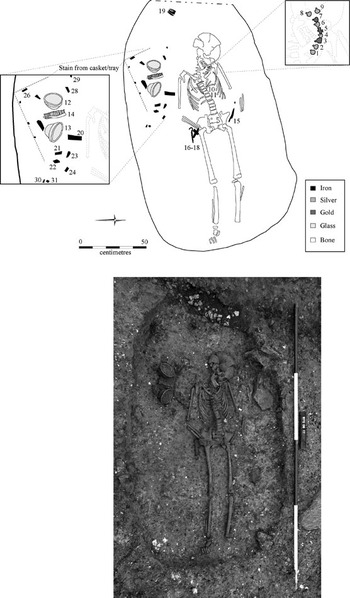
(a) Grave 1: grave plan and grave goods

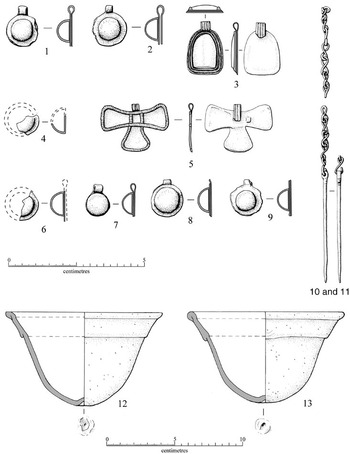
(b) Grave 1: grave goods

(b) Grave 1: grave goods (continued)


Although there is room in the jaw for the third mandibular molar, without an X-ray one cannot say if the tooth is congenitally absent or has yet to erupt.
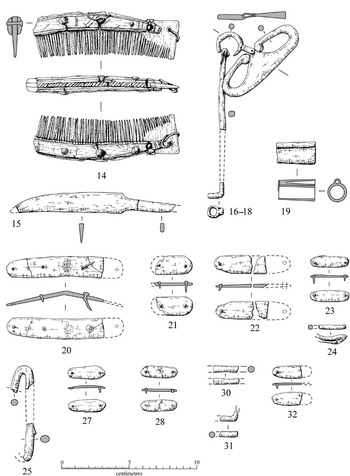
The body was accompanied by a wooden casket, represented by both a soil stain and its numerous iron fittings. This contained a matching pair of glass palm cups and a single-sided composite comb. The upper part of the casket had been disturbed, and its associated padlock was found above the head. Around the neck of the skeleton was a necklace, whilst a silver pin with chain lay horizontally across the chest. From the belt were suspended an iron girdle-group at the right hip and an iron knife, point upwards, at the left hip. The grave backfill contained rare residual flint and pottery fragments.
Associated grave goods
1–9. Necklace of silver, gold and gold-and-garnet pendants, comprising (in order from right to left shoulder) two silver hemispherical pendants, a gold pendant with a stirrup-shaped cabochon garnet setting, a silver hemispherical pendant, a cross-shaped gold pendant, another silver hemispherical pendant, a gold hemispherical pendant and two further examples in silver; the whole creates a symmetrical pattern.
1. Silver hemispherical pendant; complete, with hinged backplate. Diam: 11mm (SF53).Footnote 10
2. Silver hemispherical pendant; complete, with hinged backplate. Diam: 11mm (SF54).
3. Gold pendant with stirrup-shaped cabochon garnet setting; the garnet has a rounded profile and is set deep within the upstanding gold edge; surrounding this is a very fine edging of filigree. The suspension loop is ribbed. L: 19mm; W: 13mm; D: 5mm (SF52).
4. Silver hemispherical pendant; fragmentary, detached backplate. Diam: 11mm (SF55).
5. Cross-shaped gold pendant. The top ‘arm’ consists of a simple ribbed attachment loop; the side arms together comprise a single kidney-shaped gold plate, bordered with a single strip of filigree. The bottom arm mimics the half-kidney shape, and is similarly bordered with filigree, extending up across the middle plate to form a square central setting. No trace remains of any settings; it is possible that the cells were intended to remain empty. L: 25mm; W: 18mm; Th: 2mm (SF56). Plant matter visible in the lower cell has probably grown in since burial.
6. Silver hemispherical pendant; fragmentary, with hinged backplate. Diam: 11mm (SF57).
7. Gold hemispherical pendant; complete, with hinged backplate. Diam: 9mm (SF58).
8. Silver hemispherical pendant; complete, detached backplate. Diam: 11mm (SF59).
9. Silver hemispherical pendant; complete, with hinged backplate. Diam: 11mm (SF60).
10–11. Silver pin and chain. Pin has a simple looped head; chain is in two parts, but comprised eleven whole S-shaped loops and fragments of two more. Pin L: 41mm; Diam: 2mm; Chain L: 59mm+ (SF51).
12–13. Two blue-green glass palm cups, plain with out-folded rim; almost identical (SF42–43).
12. Pale blue-green convex, hemispherical-shaped bowl with thick base, showing the scar of where it was detached from the pontil. The rim is formed by rolling outwards, leaving a tubular hollow at the rim itself, and overlapping on the outside, to give a deeper thickened rim. Horizontal lines of striation can be seen on the outer surface of the vessel. The glass metal is full of air bubbles and a few impurities (probably iron), but this adds to the translucent effect. A minimal amount of scratching on the rim and lower body suggests a general lack of use (although the vessel is stable when empty). Diam: 121mm; Ht: 70mm (SF42).
13. Description as no. 12. Diam: 119mm; Ht: 70mm (SF43).
14. Single-sided composite comb consisting of six tooth segments and an end segment, fastened to two connecting plates by four iron rivets, and fractured across a fifth rivet hole. Connecting plates have a lightly curved baseline and curved back, tapering to one surviving narrow end. Decorated by paired framing lines and pairs of vertical lines forming sequence of panels, each containing an iron rivet. End segment rises from back in a straight line to pointed apex, back edge straight and near-vertical. Extensive curved graduation of teeth, poorly cut. Most teeth survive to their original length with slight traces of wear. End segment includes a suspension hole with a copper-alloy wire suspension ring. Top of tooth segments rise above curved back, lightly crested with saw-cut hatching cut diagonally in one direction. L: 109mm; estimated original L: 175mm; Th: 13mm; teeth per cm: 6 (SF48).
15. Iron knife, with tip broken off. Centrally set tang, of rectangular section, broken at end (L: 34mm), splaying sharply into blade with straight cutting edge and curving back and broken tip (Evison type 4; seventh century). Blade L: 92mm; W: 14mm; Th: 5mm (SF50). On both faces of blade, patches of fully mineralized leather, up to 2mm thick, interpreted as sheath.
16–18. Girdle-group comprising an attachment ring, a firesteel and a padlock key (SF49).
16. Iron attachment ring. Diam: 19mm; Th: 4mm.
17. Iron firesteel, attached to ring by folded-over and riveted copper-alloy clip (L: 10mm; W: 4mm). Firesteel has a pronounced triangular centre with arms looped inwards to meet it. L: 70mm; W: 25mm; Th: 5mm.
18. Iron padlock key, looped at the top to attach to ring. Rectangular section, broken mid-shaft, but the key end was also recovered, and comprised a simple right-angled attachment with central hole. Min L: 76mm; Shaft W: 4mm.
Organic material in association with 16–18 (SF49), as follows:
(i) in close parallel folds running across upper face of firesteel and associated objects, medium–fine textile of uncertain weave and spin; fibres 15–30 microns diameter, not identified;
(ii) on back of firesteel, thin layer(s) of animal skin;
(iii) on back of firesteel, below (ii), a medium–coarse textile of uncertain weave and spin; fibre identified as wool from range of diameters, 15–50 microns, and surviving areas of irregular mosaic scale pattern.
19–33. Iron fittings from casket. A similar casket-fitting (no. 33) was recovered from the area of the girdle-group, and is assumed to have been disturbed.
19. Iron barrel padlock. X-radiography shows some internal fittings survive; other iron strip fragments recovered from the soil block may represent the remains of the shackle. L: 30mm; Diam: 14mm (SF47).
20. Rectangular iron casket-fitting, with rounded ends (one broken) and slight curvature; three of four original rivets (max L: 14mm) still in situ. L: 73mm; W: 15mm; Th: 4mm (SF45).
21. Oval iron casket-fitting; one end broken, but the two rivets remain in situ (max L: 8mm). L: 23mm; W: 14mm; Th: 3mm (SF32).
22. Parts of an oval iron casket-fitting. Larger piece with one surviving rivet, together with a non-joining fragment. L: 28mm; W: 15mm; Th: 3mm (SF28).
23. Oval iron casket-fitting; complete, with two rivets in situ (max L: 7mm). L: 24mm; W: 9mm; Th: 2mm (SF44).
24. Fragment of corroded iron, of square section, folded back on itself. L: 22mm; Diam: 3mm (SF30).
25. Fragmentary iron round-sectioned rod, bent back on itself; possibly the broken and corroded remains of a casket handle. Max L: 30mm; Diam: 5mm (SF35).
In association with finds 16–18 and on the back of casket-fittings 20, 21 and 27, mineral-preserved ring porous hardwood, such as Fraxinus excelsior L (ash), Quercus spp (oak species), Ulmus spp (elm species), or Acer campestre L (maple). Further hardwood, less well preserved, on back of casket-fitting 23 and in association with padlock 19. Full report in archive.
26. Fragmentary iron casket-fitting observed as partial stain on excavation, but now disintegrated.
27. Oval iron casket-fitting with one of two rivets still in situ (L: 5mm). L: 23mm; W: 11mm; Th: 2mm (SF36.)
28. Oval iron casket-fitting (now in three fragments), with two in situ rivets (max L: 5mm). L: 27mm; W: 9mm; Th: 2mm. (SF46).
29. Fragmentary iron casket-fitting observed as partial stain on excavation, but now disintegrated.
30. Fragment of round-section iron rod. L: 20mm; Diam: 6mm (SF29).
31. Fragment of bent iron rod, probably of round section; possibly joins no. 29. L: 15mm; Diam: 4mm (SF31).
32. Oval iron casket-fitting, broken at one end, one rivet in situ (L: 4mm). L: 22mm; W: 10mm; Th: 2mm (SF33).
33. Oval casket-fitting, broken at one end, one rivet in situ (L: 4mm). L: 22mm; W: 15mm; Th: 3mm.
Grave 2 (?female, older sub-adult, c 15–17 years, F8; fig 4)
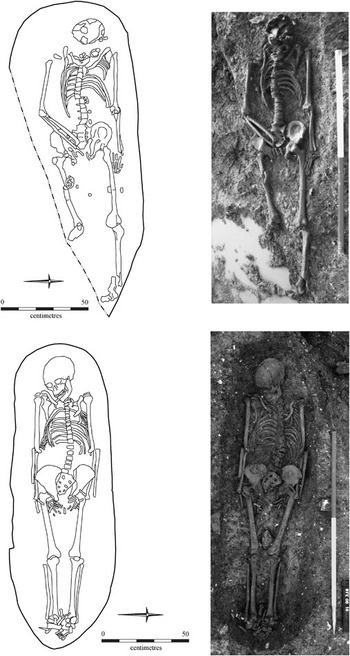
Sub-oval grave, 1.74 × 0.59 m and 0.12m+ deep, with steeply sloping sides and a shallowly concave base, aligned south west to north east (230 degrees). The skeleton lay tight against the north-west side, with the head (displaced) to the south. The body has been badly displaced: originally interred in a supine, extended position, not only does it appear to have been dragged to the side of the grave but the skull, found in the fill and not on the base of the cut, is now close to the pelvis, the mandible (right side only) is disarticulated and up against the south-western edge of the cut and the upper vertebra and ribs have been displaced. The left upper side of the body (ribs, arm and scapula and ilium) have been inverted so that they look prone. The left arm is tightly flexed so that the hand touches the shoulder. This displacement could be the result of grave robbing or later ploughing (see discussion below). Much of the skull, including part of the maxilla, is missing, as is the left foot. The surviving skeleton is well preserved, although the cortical bone and tooth enamel have root and insect damage. Both orbits exhibit worm-like lesions characteristic of cribra orbitalia. Flecks and moderate deposits of calculus were recorded on the dentition.
Grave 2: grave plan and grave goods


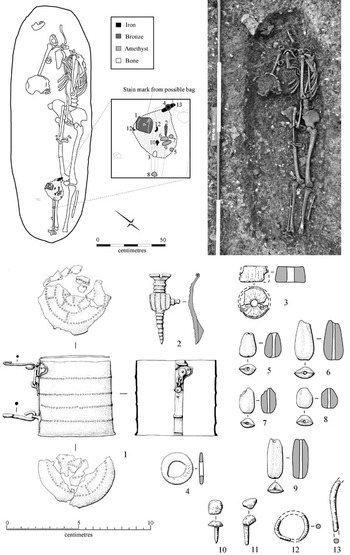
A bag had been placed by the right leg; fastened by a copper-alloy ring, it contained a copper-alloy workbox, a curated Roman copper-alloy brooch, five amethyst beads, a spindle whorl, two hobnails, iron ring fragments and some iron nail fragments.
Associated grave goods
1. Copper-alloy workbox. Cylindrical; the body is formed from a single rectangular sheet wrapped round and secured to itself using at least four rivets, with an overlap of 5mm. The bottom edge was slightly everted, but the top edge flat. The base was a simple disc with a rolled edge that just encompassed the bottom edge of the workbox. The lid was formed from a similar decorated disc, but with an additional lip 14mm deep (now absent, except for at the hinge), which overlapped the body of the box when closed. This had a hinged attachment, with riveted plates attached to the body, the lid and each other; an S-shaped link formed part of the chain. A further S-shaped link was attached to the bottom of the workbox via a simple riveted loop. The body of the workbox was decorated with four lines of repoussé dot decoration; although these were an unequal distance apart, and undulating, care had been taken to line up the rows at the sheet-join. The lid was decorated with three concentric circles of similar repoussé design, with additional lines of four dots creating zones within the rings (but not forming a cross). The base, although more fragmentary, seems to have been decorated in the same way. Ht: 57mm; Diam: 53mm (SF15).
2. Copper-alloy Hod Hill brooch with gently arched bow; grooved and lugged upper panel, with cross-ribs above and below; plain foot. Mid-first century ad.Footnote 11 L: 50mm; W: 22mm; Th: 3mm (SF23).
3. Small antler spindle whorl of cylindrical shape, surviving in poor condition, now in two pieces. No trace of decoration on surviving fragments. Possible organic material retained in central perforation. Diam: 20mm; Ht: 11mm; Perforation diam: 6mm (SF17).
4. Copper-alloy flat ring; possible bag fastener, with irregular central perforation. Diam: 22mm; Th: 3mm (SF18).
5–9. Amethyst, five beads (SF11–14, 26).
5. Amethyst bead, very long, teardrop-shaped, slightly broken at top; highly polished. L: 27mm; W: 13mm; Th: 8mm; central perforation diam: 2mm (SF11).
6. Amethyst bead, long, oval, slightly broken at top; highly polished. L: 17mm; W: 11mm; Th: 6mm; central perforation diam: 2mm (SF12).
7. Amethyst bead, very long, teardrop-shaped in plan, but triangular in section, slightly broken at top; highly polished. L: 23mm; W: 11mm; Th: 8mm; central perforation diam: 2mm (SF13).
8. Amethyst bead, long, teardrop-shaped in plan, but oval in section, slightly broken at top; highly polished. L: 16mm; W: 11mm; Th: 9mm; central perforation diam: 2mm (SF14).
9. Amethyst bead, long, oval in plan and section but with flattened ends, slightly broken at top; highly polished. L: 14mm; W: 11mm; Th: 8mm; central perforation diam: 2mm (SF26).
10–11. Two iron hobnails. L: 17mm; Diam: 10mm and L: 22mm; Diam: 7mm; probably Roman (SF19, 21.1).
12. Fragments of an iron ring. L: 12mm and 13mm; Diam: 2mm and 3mm (SF20, 22).
13. Iron nail fragments, square section. Max L: 36mm (SF21.2–4).
Remains of textile, possibly the fabric of the bag, are caught between finds 4 and 12, but no technical details could be recorded.
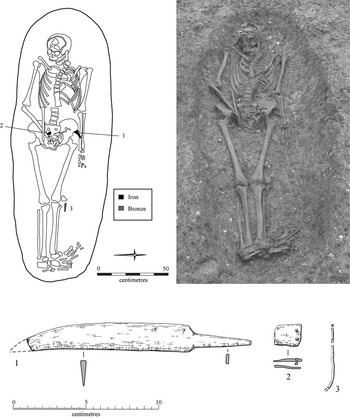
Grave 3 (older sub-adult, c 14–16 years, F11; fig 5)
Sub-oval grave, 1.87 × 0.50m and 0.16m+ deep, with near vertical sides and a relatively flat base, aligned west to east (282 degrees). The skeleton was laid in an extended and supine position with the left arm flexed across the chest and the head at the west end. The skeleton was well preserved, with most loose epiphyses surviving. However, the skull was fragmentary and the cortical bone was abraded. Flecks of calculus were recorded on the surviving dentition and hypoplasias were noted on the incisors and canines.
Grave 3: grave plan and grave goods


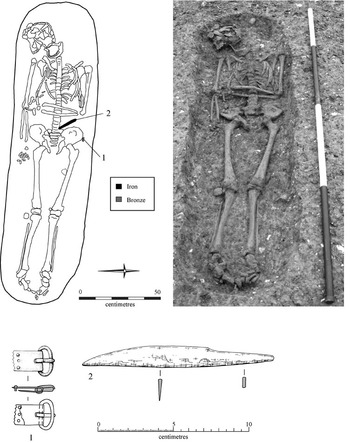
The skeleton was accompanied by an iron knife, located partially beneath the pelvis, which had most probably been suspended from a belt, and a copper-alloy buckle on the left hip.
Associated grave goods
1. Copper alloy, small buckle (SF3). Oval loop, of oval section, rectangular plate folded over loop, three copper-alloy rivets fastening short ends, one missing, zigzag end. Incised cross-hatch decoration on upper buckle-plate. Marzinzik type ii.24a (seventh to eighth century). L: 28mm; W:20mm; Th: 6mm.
2. Iron knife. Rectangular-section bottom-set tang (L: 47mm) splays sharply into blade with straight cutting edge and curving back (Evison type 4; seventh century). Blade L: 86mm; W: 15mm; Th: 6mm (SF24).
There is a layer of poorly preserved organic material, probably remains of a leather or skin sheath, on both faces of the blade.
Grave 4 (unsexed young adult, F14; fig 6, top)
Irregular sub-oval grave (very heavily disturbed by later ploughing), 1.37+ × 0.43m and 0.04m+ deep, with a relatively flat base (the sides were almost entirely truncated away), aligned west north west–east south east (286 degrees). The skeleton lay in an extended and supine position with the head at the west end; it was extremely fragmentary, represented only by fragments of the skull, shoulder girdle, incomplete upper and lower limb shafts, an ischium and a few vertebrae and ribs. The anterior mandible is quite square and masculine. No pathological changes were observed.
Plans of Graves 4 (top) and 5 (bottom)


b = root only; recent break
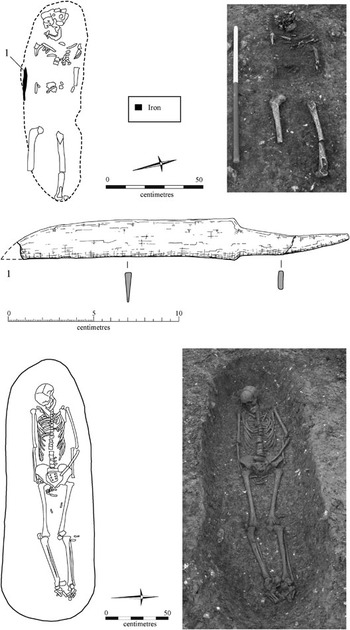
It was accompanied by a large iron knife, which was placed beside the right upper arm, with the point towards the head end of the grave.
Associated grave goods
1. Iron knife. Centrally set rectangular-section tang (complete but bent; L: 65mm) splays sharply into blade (broken at tip) with straight but worn cutting edge and curving back (Evison type 4; seventh century). Blade L: 140mm; W: 25mm; Th: 5mm (SF8).
On one face of blade, raised above blade surface, imprint in earth, 15 × 10mm, of a textile woven in either 2/1 twill or a distorted 2/2 twill, approximately 12–14 × 12–14 threads per cm; fibre and spin not identified.
Grave 5 (?male, older sub-adult/young adult, F22; fig 6, bottom)
Sub-oval grave, 2.09 × 0.74m and 0.37m+ deep with steeply sloping sides and a relatively flat base, aligned west–east (276 degrees). The skeleton lay in an extended and supine position with the head to the west and the hands resting on the pelvis; it is in excellent condition. Small holes and worm-like lesions, characteristic of cribra orbitalia, were recorded on the roof of both orbits. Enamel hypoplasias were visible on all the incisors and canines. Flecks of calculus were observed on most of the dentition and a small caries was recorded on the occlusal aspect of the right first maxillary molar.

The body was unaccompanied, although the excavator recorded a smear of degraded but potentially worked bone above the level of the skull and right shoulder.
Grave 6 (male, older middle adult, F21; fig 7)
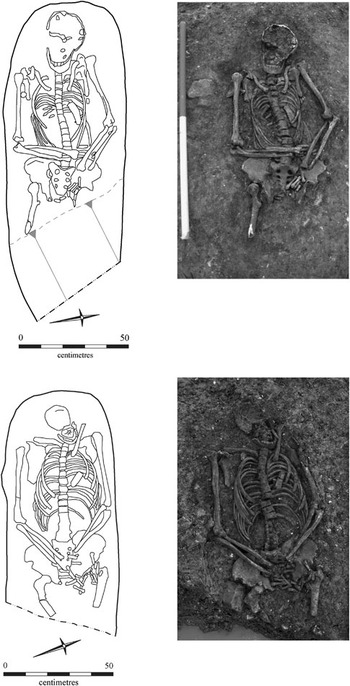
Sub-oval grave, 1.94 × 0.71m and 0.24m+ deep, with steeply sloping sides and a relatively flat base, aligned west–east (272 degrees). The skeleton lay in an extended and supine position, with the right arm partially flexed so that the hand lay on the pelvis; the head was at the west end. The skeleton is extremely well preserved with only parts of the frontal bone and face missing. Schmorl’s nodes were recorded on the lower thoracic vertebrae with an increase in porosity and marginal osteophytes on the fifth lumbar, which also exhibits a compression fracture: the centre and posterior part of the body are compressed. Flecks to moderate deposits of calculus were recorded on all the surviving teeth. Dental wear was considerably heavier on the left side of the jaw, the result of an uneven bite.
Grave 6: grave plan and grave-goods


The body was accompanied by an iron knife behind the left hip and an iron belt-fitting on the right side of the pelvis, whilst a copper-alloy pin was located by the left knee.
Associated grave goods
1. Iron knife. Centrally set rectangular-section tang (L: 40mm) splays sharply into blade with straight cutting edge and curving back (tip broken). Evison type 4; seventh century. Blade L: 125mm; W: 22mm; Th: 8mm (SF63).
2. Iron belt-fitting. Two rectangular plates attached at one end by two in situ rivets; perhaps a buckle plate or strap-stiffener. L: 19mm; W: 17mm; overall Th: 8mm (SF62).
3. Copper-alloy pin, in two fragments. Head and foot missing, type unknown. L: 35mm+; Diam: 2mm (SF61).
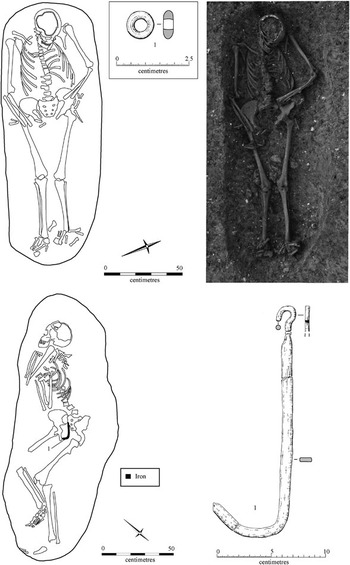
Grave 7 (female, older middle/mature adult, F20; fig 8, top)
Sub-oval grave, 1.68 × 0.66m and 0.25m+ deep with near vertical sides but a moderately sloping side to the east, and a relatively flat base, aligned west north west–east south east (293 degrees). The skeleton lay in an extended and supine position with the head forced forward on to the chest, and the hands resting on the pelvis, with the grave barely large enough to contain it. Part of the maxilla is missing and although most of the remaining skeleton survives, it is fragmentary, and all of the long bones have fresh post-mortem breaks. A minimum of three teeth had been lost ante-mortem and medium deposits of sub-gingival calculus were recorded on the surviving molars. Marginal osteophytes and a small area of eburnation and porosity were recorded on the distal end of the left humerus. Porosity and osteophytes extending up to 10mm were recorded on the body of the fifth lumbar vertebra, with lesser changes to the costal facets. A single blue glass bead was found attached to an upper rib bone during washing, and may have been worn as a pendant.
Graves 7 (top) and 8 (bottom): grave plans and grave goods


Associated grave goods
1. Annular translucent blue glass bead, short cylinder (dating mainly to Brugmann phase A1). Ht: 4mm; Diam: 10mm; Perforation diam: 5mm <149>.
Grave 8 (female, middle adult, F9; fig 8, bottom)
Irregularly sub-oval grave, 1.90 × 0.73m and 0.15m+ deep with irregular sides and shallow concave base, aligned south west–north east (230 degrees). The skeleton lay on its right side in a flexed position, with the arms brought up tightly against the chest and the head at the south-west end. The skeleton is well preserved, although most of the elements have suffered post-mortem breaks and several of the joint surfaces are missing or damaged. The third molars are congenitally absent. Flecks of calculus were recorded on all teeth. The lower vertebral bodies exhibit an increase in porosity and there is unilateral spondylolosis of the fifth lumbar vertebrae (right side) associated with a compression fracture.

The body was accompanied by an iron latch-lifter that was located beneath the pelvis and had most probably been suspended from the belt at the right side of the waist. The backfill contained rare residual worked flint flakes.
Associated grave goods
1. Iron latch-lifter of rectangular section, in five fragments and heavily corroded; L-shaped. One fragment (found when cleaning the vertebrae) comprises the top loop, while the others make up the shaft. Max L: 152mm; W: 11mm; Th: 4mm (SF25).
In close folds on upper face of latch-lifter, over area 20 × 12mm, textile of uncertain weave, approximately 16 × 16 threads per cm; fibre not identified. On opposite face, traces of a coarser fabric, probably wool.
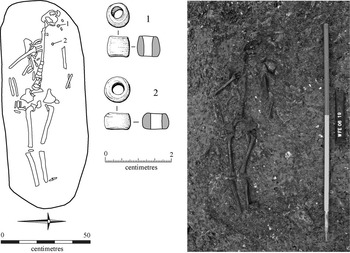
Grave 9 (unsexed, older infant/younger juvenile, F19; fig 9)
Sub-oval grave (heavily disturbed by later ploughing), 1.20 × 0.48m and 0.04m+ deep, aligned west–east (268 degrees); the sides were almost entirely truncated, and the base was partially concave. The skeleton of a young child was laid in an extended and supine position with the head at the west end. The skeleton is generally poorly preserved, with most of the skull and left side of the upper body missing. The majority of small bones from the hands and feet and loose epiphyses are also missing. Although neither jaw survived, two loose teeth were recovered; a deciduous molar and a permanent canine, the latter with flecks of calculus. The body was accompanied by two glass beads, one red and one green, which were found in the area of the head and had most probably been worn around the neck.
Grave 9: grave plan and grave goods

Associated grave goods
1. Opaque red bead, wound spiral (Brugmann phase C). Diam: 8mm; Ht: 5mm; central perforation: 4mm (SF40).
2. Opaque green bead, wound spiral (Brugmann phase C). Diam: 7mm; Ht: 6mm; central perforation: 3mm (SF41).
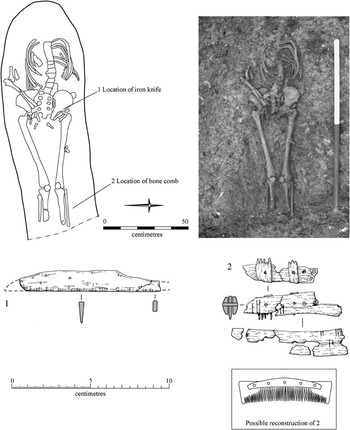
Grave 10 (female, young adult, F10; fig 10)
Sub-oval grave (partially truncated by machining during the evaluation phase), 1.37+ × 0.50m and 0.04m+ deep, with gently sloping sides and a shallow concave base, aligned west–east (266 degrees). The skeleton lay in an extended and supine position with both hands resting on the pelvis; the head was not present, having most probably been removed by later ploughing, but would have lain at the west end. The upper torso, shoulder girdles, left arm, distal lower limbs and feet have also been truncated. The surviving bone is in excellent condition. No pathological changes were observed. The body was accompanied by an iron knife, which appears to have been suspended from the belt at the left hip, and a single-sided composite antler comb, which had been placed by the left tibia. These were both lifted during the evaluation stage.
Grave 10: grave plan and grave goods

Associated grave goods
1. Iron knife. Bottom-set rectangular-section tang (broken; L: 24mm) splays gradually into blade with straight cutting edge and curving back; tip broken (Evison type 4; seventh century). Blade L: 74mm; W: 15mm; Th: 4mm (SF65).
A fold of textile runs diagonally across the blade, but no technical details could be recorded.
2. Antler single-sided comb fragment, consisting of two tooth segments and parts of two connecting plates, fastened by four iron rivets and three of antler. In poor condition, fractured into numerous pieces, with no teeth surviving. Closely spaced riveting, less than 10mm apart in some cases, with the narrow tooth segments fastened through their centres by antler rivets, probably as a repair. Traces of vertical paired lines, suggesting possibly decorated in panels. L: 69mm; teeth per cm: 6 (SF1/64).
Grave 11 (female, middle/mature adult, F12; fig 11, top)
Sub-oval grave (partially truncated by machining during the evaluation phase), 1.80+ × 0.71m+ and 0.16m+ deep, with near vertical sides and a relatively flat base, aligned west–east (268 degrees). The skeleton lay in an extended and supine position with the right arm partially flexed so that the hand rested on the pelvis; the head was at the west end. Most of the face, including the maxilla, was missing, as were the right fibula and foot (these latter bones truncated by the evaluation trench). The cortical bone of the surviving elements is very abraded. Slight deposits of sub-gingival calculus were recorded on the surviving mandibular first premolar and molar. Two mandibular molars had been lost ante-mortem, although their sockets had not fully resorbed. The bodies of the lower thoracic and lumbar vertebrae exhibit marginal osteophytes, an increase in porosity and Schmorl’s nodes. An area of eburnation was recorded on the atlas. These are all changes characteristic of osteoarthritis.
Plans of Graves 11 (top) and 12 (bottom)


There was also a loose maxillary central incisor. The body was unaccompanied. The backfill contained three residual sherds of Romano-British pottery.
Grave 12 (male, younger middle adult, F18; fig 11, bottom)
Sub-oval grave, 1.80 × 0.63m and 0.20m+ deep with steeply sloping sides and a relatively flat base, aligned west–east (269 degrees). It was barely large enough to accommodate the skeleton, which was laid in an extended and supine position, with the hands resting on the femurs and the head at the west end. The skeleton is in excellent condition, although the cortical bone is abraded. The lower thoracic and upper lumbar vertebrae exhibit marginal osteophytes, a slight increase in porosity and Schmorl’s nodes. There is a well-healed, transverse fracture on the mid-shaft of the left clavicle. Slight to moderate deposits of calculus were recorded on all of the teeth.

The body was unaccompanied.
Grave 13 (?male, older middle adult, F16; fig 12)
Sub-oval grave (partially truncated by later ploughing), 1.59 × 0.57m and 0.05m+ deep, with moderately sloping sides and a partially concave base, aligned west south west–east north east (243 degrees). The skeleton lay supine but partially flexed with its knees to the right, in order to fit into the grave. The right arm was crossed above the sacrum and the head lay at the west end. Some stones at the head end may have acted as a marker or pillow arrangement. The left arm was missing, as was the skull, except for the mandible and occipital portion. The surviving skeleton is in good condition, although the cortical bone is abraded. The lower thoracic and lumbar vertebrae exhibited an increase in porosity and Schmorl’s nodes. Flecks of calculus were recorded on the surviving molars.
Grave 13: grave plan and grave good


There was also one loose maxillary third molar. The body was accompanied by a badly degraded iron knife that appears to have been suspended from a belt at the right hip.
Associated grave goods
1. Iron knife. Centrally set rectangular-section tang, broken at end (L: 26mm) splays gradually into blade (broken at tip) with straight cutting edge and curving back (Evison type 4; seventh century). Blade L: 64mm; W: 14mm; Th: 5mm (SF27).
Grave 14 (male, younger middle adult, 31–35 years, F13; fig 13, top)
Sub-oval grave (partially truncated by the evaluation trench), 1.45+ × 0.56m in extent and 0.10m+ deep, with moderately sloping sides and a partially concave base, aligned west–east (277 degrees). The skeleton lay in an extended supine position with the right arm crossed above the sacrum, the left hand lying on the pelvis and the head at the west end. The right side of the face and most of the maxilla are missing and the left leg and right lower leg had been machined away earlier and were not available for analysis. The surviving skeleton was in good condition, although the long bones of the arms had suffered post-mortem breaks. Slight marginal osteophytes and Schmorl’s nodes were recorded in the thoracic vertebrae. The metopic suture was retained.
Plans of Graves 14 (top) and 15 (bottom)


The body was unaccompanied.
Grave 15 (male, young adult, F15; fig 13, bottom)
Sub-oval grave (partially truncated by a later ditch), 1.06+ × 0.51m and 0.04m+ deep with near vertical sides and a relatively flat base, aligned west north west–east south east (288 degrees). The skeleton lay in an extended and supine position with the arms partially flexed, the hands resting on the sacrum and the head at the west end. The grave had been truncated by a later ditch; this had removed both feet and the legs below the thighs. Of the skull, only the mandible and occipital portion survived, the rest having been ploughed away. The remaining skeleton was fragmentary. The bodies of the lower thoracic vertebrae exhibited an increase in porosity and Schmorl’s nodes.

The body was unaccompanied.
The Skeletal Remains
Of the fifteen burials identified, ten are adult, one is an older sub-adult/young adult and four are immature (under eighteen years of age). Most of the adults fall into the middle adult category although – given the problems with ageing these skeletons and the small sample size – this is probably not significant. Two individuals died before the age of twelve; the youngest person to be identified in this cemetery was skeleton [57] in Grave 9, who died aged between four and six years old. The under-representation of younger burials is common in all archaeological periods and, whilst taphonomic factors are usually cited for their absence, it is possible that children’s bodies may have been disposed of in a different way from adult remains, or buried in a different location.Footnote 12 Neonates and younger infants dying in the early Anglo-Saxon period in Cambridgeshire are sometimes found in the same burial grounds as their elders – for example, at Burwell and MelbournFootnote 13 – although there is some evidence that they may have been confined to particular areas of a cemetery – for example at Edix Hill.Footnote 14 Whilst the absence of neonates and infants at Westfield Farm may be due to different burial practices, it is probable that immature individuals have been ploughed away, given the relative shallowness of all the graves.
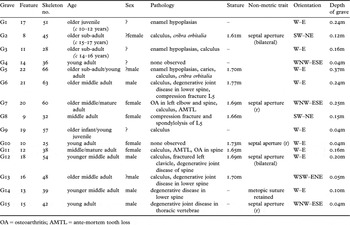
Of the ten adults, five were identified as male or ?male and four as female or ?female (table 1). Two of the older sub-adults show adult sexually dimorphic features: the older sub-adult/young adult in Grave 5 was identified as ?male and that in Grave 2 as ?female. Although the latter is counted as an immature individual, it should be stressed that the ‘adult’ boundary of eighteen years is arbitrary and that the ‘age of majority’ at this time would have been considerably lower.Footnote 15
Details of burials

OA = osteoarthritis; AMTL = ante-mortem tooth loss
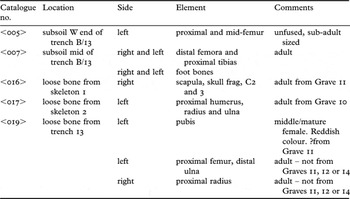
In addition to the fifteen excavated graves, disarticulated bone recovered during the evaluation phase of the excavation suggests that a further two (possibly three) bodies were originally buried in this area (table 2). The lower limbs and foot bones identified during machining in the middle of Evaluation Trench 13 (to which the grave number 16 has been assigned) derive from a single individual; their robusticity and the bicondylar width of the femur are suggestive of a male adult. The stage of epiphyseal union of a disarticulated left femur (proximal and mid-shaft) recovered from the west end of Trench 13 suggests that it derives from an individual aged between fourteen and nineteen. As it does not derive from the individuals in Graves 2 or 3 (the only sub-adults in the burial population), there is likely to have been another sub-adult interred close by. Most of the loose adult bone recovered from Trench 13 and catalogued as <019> cannot be attributed to any of the known skeletons in that area and so probably derives from a third unrecognized grave.
Disarticulated human bone from the cemetery excavations

Stature is a good reflection of nutritional status, and the heights recorded in this population are similar to those seen in nearby Anglo-Saxon cemeteries. Stature could be calculated for eight adults and (because of the degree of epiphyseal fusion), one older sub-adult (Grave 2). Amongst the males (n = 4) heights ranged from 1.69 to 1.77m (5′7″–5′10″), with a mean of 1.72m (almost 5′8″). Average male heights at Edix Hill were 1.73m; at Melbourn they were 1.72m and at King’s Garden Hostel 1.75m.Footnote 16 Amongst the females at Westfield Farm (n = 5), stature ranged from 1.61 to 1.73m (5′3″–5′8″), with a mean height of 1.67m (almost 5′6″). This is somewhat higher than the averages recorded for females at Edix Hill (1.64m), Melbourn (1.63m) or King’s Garden Hostel (1.60m), but similar to that recorded at Oakington (1.67m).Footnote 17
Dental disease is a reflection of dietary quality and dental hygiene, and the skeletons from Westfield Farm show remarkably good dental health for the period. Only one carious lesion was observed (Grave 5). This true prevalence of only 0.38 per cent (one of 265 tooth crowns affected) suggests a low consumption of starch and/or sugars (in the form of fruit or honey). Rates of caries in the Anglo-Saxon period are known to have been low,Footnote 18 but here the rate is lower than those observed at the Cambridgeshire sites of Edix Hill (3.2 per cent), Melbourn (3.5 per cent) and King’s Garden Hostel (3.3 per cent).Footnote 19 Dental hygiene was, however, far from perfect, as deposits of calculus (mineralized plaque) were recorded on many of the dentitions, including those of immature individuals. Even so, ante-mortem tooth loss was recorded in only two individuals: the middle/mature adult females in Graves 7 and 11. Of the observable adult tooth sockets (213) five teeth had been lost ante-mortem, giving a true prevalence rate of only 2.3 per cent. Again this is lower than Edix Hill (7.1 per cent), Melbourn (11.2 per cent), King’s Garden Hostel (10.4 per cent) and the pooled site data for this period data (8 per cent).Footnote 20 No dental abscesses were observed. Whilst the low figures for various dental pathologies may indicate good diet and dental hygiene, the small number of elderly individuals identified may equally account for these.
One individual, the adult male in Grave 12, had a fractured left clavicle that had healed well. Compression fractures, where the vertebral body wedges antero-posterior, were recorded on the fifth lumbar vertebrae of a female and male in Graves 8 and 6. The former also had spondylolysis of L5, a condition associated with repeated bending and lifting, combined with an underlying congenital weakness in the neural arches. Osteoarthritis was observed in the spines of the two elderly female skeletons in Graves 7 and 11.Footnote 21 The former also had osteoarthritic changes in the left elbow joint. All of the adult males showed varying degrees (in visual terms) of degenerative changes to the spine, particularly in the lower thoracic and lumbar region. These changes included marginal osteophytes, Schmorl’s nodes and an increase in porosity on the joint surfaces.
Two types of stress indicators were recorded. Cribra orbitalia is generally thought to result from a metabolic disorder associated with iron-deficiency anaemia in childhood, though there may be an association with intestinal parasites and vitamin C. The two individuals in Graves 2 and 5 had the sieve-like lesions in their orbital roofs characteristic of this condition. Developmental defects in tooth enamel, enamel hypoplasia, resulting from episodes of severe dietary deficiency or high fever in childhood, were visible in the teeth of skeletons in Graves 1, 3 and 5.
Non-metric variables occurred in a number of individuals. The skeleton in Grave 14 had an open metopic suture, and five (in Graves 2, 7, 10, 12 and 15) had septal apertures. Two individual third molars are congenitally absent from the skeletons in Graves 8 and 14. These traits can be hereditary and, whilst the occurrence of septal apertures appears high, it is perhaps not surprising, given that there are likely to be familial relationships between individuals within this cemetery. The graves of individuals with these traits are not clustered together. (ND)
Burial position of Grave 2
The position of the skeleton in Grave 2 and the disarticulation and rotation of skeletal elements are curious and could result from delayed burial, grave robbing, disturbance by plough or a combination of these factors. The body occupied only half of the available space in the cut and was wedged tight against one side, with the left shoulder, arm and pelvis turned in on themselves such that they were prone. On the right side of the body several of the ribs had also rotated to the prone position. This movement might be explained by a time-delay between death and burial (perhaps the result of death some distance from the cemetery) and by the body beginning to decompose before it was interred. Similar patterns of disarticulation in burials have been reported at Raunds, Northamptonshire, and the Jewbury cemetery in York.Footnote 22
Alternatively, it is possible that the body was rolled over on to its side soon (?weeks) after burial in order to search for grave goods that were believed to be around the neck/chest area or even below the corpse. That the bag containing amethyst beads is untouched is interesting and may suggest that the robbers were unaware of it. However, moving the corpse would have been extremely hard, especially if the body was covered in packed earth, and there was no evidence for a robber cut.
The disarticulation, particularly the ‘lengthening’ of the right arm and the displacement of the hand, suggests dragging, again possibly by a plough. However, the articulation of the bones in the right hand suggests that this movement must have occurred before the body had totally decomposed, and ploughing of the cemetery area so soon after burial seems improbable. Later medieval ploughing might account for the displacement of the skull, mandible and upper vertebrae. The skull lay to the right of the body within the grave fill (ie not on the base of the cut) and this, combined with the position of the cervical vertebrae ‘following’ the skull, suggests that the body and skull were articulated at burial and that the skull and upper vertebrae have been dragged with some force. Whatever the cause(s) of the strange body position, at least some of the disturbance of the body occurred when it was still partially articulated. The position of this body closely resembles a number of other graves where disturbance has been interpreted as near-contemporary grave robbing, such as Worthy Park G41 (a male) and Finglesham graves 139 and 162 (both female).Footnote 23 (ND)
Isotopic Analysis
Carbon, nitrogen, and oxygen stable isotope analyses were conducted on the human remains. The isotope values from bone collagen and tooth carbonate, indicative of diet and of place of childhood residence, contribute to our understanding of the people who used this site. Bone samples from fifteen individuals were sampled for carbon and nitrogen isotope analyses, and of these, fourteen individuals were sampled for oxygen isotope analysis. Both sexes and a range of ages from young juvenile to elderly adult were represented in all analyses.
Stable carbon and nitrogen isotopes and indications of diet
Dietary reconstruction using stable carbon and nitrogen isotopes is dependent on the fact that different food sources differ in isotopic ratios and that they can be distinguished.Footnote 24 Due to bone turnover rates, stable isotope analysis of bone collagen reflects the average isotopic composition of dietary protein consumed by an individual over their adult life.Footnote 25 Carbon isotope ratios differentiate between diets based on C3 plants (trees, shrubs and temperate/shady grasses) and C4 plants (sub-tropical grasses), as well as marine versus terrestrial resources.Footnote 26 Nitrogen isotopes reflect trophic level – that is, where an individual is placed in the food chain – because the nitrogen isotopic values of consumer tissues are enhanced relative to diet.Footnote 27 Like δ13C, nitrogen isotope ratios can also be used to identify the consumption of marine resources, but, when examined in conjunction with carbon isotope ratios, δ15N can also indicate consumption of freshwater resources.Footnote 28 Studies show that δ15N ratios can also be affected by physiological factors such as breastfeeding/weaning and pregnancy/lactation.Footnote 29
Stable oxygen isotopes and indications of mobility
In archaeology, stable oxygen isotopic analysis has been successfully applied to understanding past climatic and environmental conditions and the movement of animals and humans.Footnote 30 Oxygen isotopes in water vary systematically based on differences in climate and geography.Footnote 31 For example, it has been seen that the δ18O of precipitation decreases with decreasing temperature, distance from the coast, increasing altitude, latitude and atmospheric relative humidity.Footnote 32 These climatic and geographic factors result in variation in the δ18O in local water sources (eg groundwater and recycled water sources such as springs, wells, rivers and lakes) where meteoric water accumulates.Footnote 33
Animals and humans ingest local meteoric water both directly, through drinking water, and indirectly, through food consumption, but the isotopic composition of body water is predominantly determined from drinking water.Footnote 34 Any contribution from fresh food, as long as it is sourced locally, will be similar to that from drinking water. Teeth are formed at particular stages of life and the enamel is not remodelled once formed. Therefore, the oxygen isotopic ratio found in a tooth sample represents only the specific time when that tooth was formed.Footnote 35 If an individual’s early childhood was spent in a region that has a different oxygen isotope signal from that of the region where they died, this will be apparent through comparative oxygen isotope analysis of teeth.
Materials and methods
Where available, both ribs and femurs were sampled from the human remains for carbon and nitrogen isotopic analysis. The teeth chosen for sampling were, by preference, second pre-molars, but if one was not available, then a first pre-molar. Teeth from the left maxilla were preferred over the right maxilla, which were preferred over teeth from the mandible.
The bone collagen samples were prepared in the McDonald Institute for Archaeological Research, University of Cambridge, following the method described in PrivatFootnote 36 with a few modifications (see archive report). Stable isotope concentrations are measured as the ratio of the heavier isotope to the lighter isotope relative to an internationally defined scale – VPDB for carbon and AIR for nitrogen.Footnote 37 Isotopic results are expressed as ‘δ’ values (δ13C and δ15N) in units of ‘permil’ (‰). Based on replicate analyses of international and laboratory standards, measurement errors for δ13C and δ15N are less than ±0.2‰.
The tooth samples were similarly prepared, following the protocol of Balasse,Footnote 38 and analysed in the Godwin Laboratory, Department of Earth Sciences, University of Cambridge (see archive report). Results are reported with reference to the international standard VPDBFootnote 39 and the measurement precision is ±0.08‰ for δ13C and ±0.10‰ for δ18O. Tooth carbonate oxygen isotope results were converted to drinking water oxygen isotope values using the conversion equations as given in table 3.
Carbon, nitrogen and oxygen isotope results

The tooth carbonate oxygen results were converted to drinking water isotopic values using the following equations for use in the results and discussion.
From O-CO3 PDB to O-CO3 SMOW (Hoefs Reference Hoefs1997): δ18OSMOW = 1.03091 δ18OPDB + 30.91.
From O-CO3 SMOW to O-PO4 SMOW (Iacumin et al Reference Iacumin, Bocherens, Mariotti and Longinelli1996): δ18OPO4 = 0.98 δ18OCO3 − 8.5.
From O-PO4 SMOW to O-drinking water (dw) SMOW (Levinson et al Reference Levinson, Boaz and Kolodny1987): δ18ODWsmow = (δ18OPO4 − 19.4)/0.46.
Results and discussion
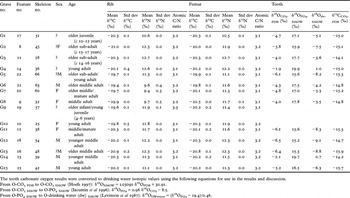
The isotopic results of all human samples with relevant excavation data are shown in table 3. Rib and femur samples were analysed in triplicate. Collagen from every sample was successfully extracted and produced a sufficient yield (>3%) to be analysed.Footnote 40 The ribs gave a higher collagen yield (mean rib collagen yield = 9%) than the femurs (mean femur collagen yield = 5%). The atomic C/N ratios calculated for all samples are within 3.11–3.27, well within the 2.9–3.4 range indicative of well-preserved collagen.Footnote 41 Tooth samples were analysed once, and all but one produced a successful mass spectrometer analysis (a total of thirteen).
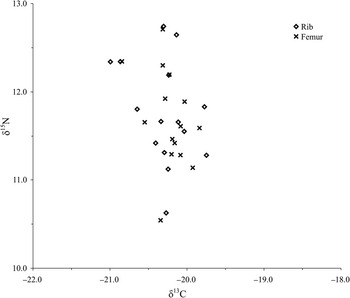
The carbon and nitrogen isotopic values of the individuals at Westfield Farm cluster tightly, with a δ13C range of between −21.0‰ and −19.7‰, and a δ15N range of 10.5–12.7‰ (table 3 and fig 14). There is no obvious patterning in either carbon or nitrogen isotopic values with age or sex. The group of males and possible males (n = 6) has a slightly wider range of carbon and nitrogen isotopic values than the females and possible females (n = 5), but as a whole, the two groups have similar mean carbon and nitrogen isotopic values. The small sample size hinders any such sex or age comparison.
δ13C versus δ15N of bone collagen for Westfield Farm individuals

Two of the individuals, Graves 1 and 2, were buried with significant grave goods, suggesting a high degree of wealth. Both were on the fringes of the group isotopically: Grave 1 had the lowest δ15N of the whole group; Grave 2 had the lowest δ13C. However, neither was obviously an isotopic outlier, suggesting that wealth did not have a significant isotopically visible impact on daily diet.
Rib and femoral samples from each individual were analysed to explore whether that individual’s diet had changed over his or her lifetime. Owing to differing bone turnover rates (slower for femurs, faster for ribs), an isotopic change in diet should be visible as a difference between the carbon and nitrogen isotopic values of the rib and femur. For all but three individuals, there was no significant carbon or nitrogen isotopic difference between the two samples, but for Graves 2, 4 and 10 there was a difference in carbon, nitrogen or both isotopic values of 0.5‰ or more (table 3). These were not systematic differences, and thus it is hard to conclude what such differences represent. But since all three are young adults, a dietary change most probably occurred in early adolescence. Grave 2 has significant grave goods, Grave 4 contained a knife, and Grave 10 contained a knife and a bone comb, but these were not the only graves to contain grave goods.
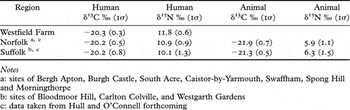
Since it is a cemetery site, there were no fauna at Westfield Farm with which to compare the human values, so we have used the faunal data from the Anglo-Saxon sites of Berinsfield, Oxfordshire, Bloodmoor Hill, Carlton Colville, Suffolk, and West Stow/Westgarth Gardens, Suffolk, as a baseline for comparison.Footnote 42 At Berinsfield the δ13C values for herbivorous animals (pig, horse, cow, sheep or goat) range between −21.0‰ and −22.5‰, whilst the δ15N values were 4.5–6.0‰ (with one outlier at 7.5‰). At Carlton Colville, the fauna (cow, pig, sheep) all have δ13C values between −23.1‰ and −20.3‰ and δ15N values of 1.4–6.7‰. The sites of West Stow/Westgarth Gardens and Spong Hill, Norfolk, are relatively close to Ely, not in the Fenlands but more towards the east in chalk hills. The δ13C values of the herbivorous fauna at West Stow/Westgarth Gardens are between −23‰ and −20‰, with δ15N values of 3.5–8‰. For Spong Hill, the δ13C values of herbivorous animals range between −22.7‰ and −21‰ and the δ15N values are 4–6.5‰. Whilst there are small inter-regional differences in animal carbon and nitrogen isotopic values across southern Britain (Hampshire, Thames Valley, East AngliaFootnote 43), these are of the order of 1‰ in both carbon and nitrogen, so we do not expect any major differences between measured isotopic values for East Anglian Anglo-Saxon fauna, and those of the fauna available for consumption to the individuals buried at Westfield Farm.
When comparing the isotopic values of the individuals at Westfield Farm with the available East Anglian faunal data, we find a difference between herbivorous fauna and humans of approximately 1–2‰ in δ13C and 5–7‰ in δ15N. Typical human–faunal δ15N differences of 4–6‰ are observed for populations consuming only terrestrial diets, and the Westfield Farm humans are at the upper extreme of this value.Footnote 44 In comparison with other East Anglian Anglo-Saxon human populations, those from Westfield Farm typically have higher δ15N, but not δ13C values (table 4).Footnote 45 Our interpretation of these results is that these people primarily had a C3 terrestrial plant- and animal-based diet, probably with a small amount of freshwater resource input. Freshwater resource consumption is less common than might be expected in Britain, even for sites in riverine locations,Footnote 46 but has been proposed as an explanation for the isotopic results of some individuals from the early Anglo-Saxon site of Berinsfield.Footnote 47 There is little other evidence, isotopic or otherwise, for freshwater resource use in the early Anglo-Saxon period.Footnote 48 Yet some freshwater fish consumption at Westfield Farm fits with the isotopic data and the fenland location, and suggests that the fish were caught and consumed locally, rather than imported as dried marine fish. Since Westfield Farm is an early Anglo-Saxon site, it pre-dates the general increase in fish exploitation that has been noted at many locations around the North Sea from the ninth century ad (and that has been attributed to the development of a market economyFootnote 49), which is the likely cause of higher nitrogen and carbon isotopic values observed in the middle Saxon populations of sites such as Caistor-by-Yarmouth and South Acre.
Westfield Farm isotopic results in comparison with East Anglian human and animal isotope data

Notes
a: sites of Bergh Apton, Burgh Castle, South Acre, Caistor-by-Yarmouth, Swaffham, Spong Hill and Morningthorpe
b: sites of Bloodmoor Hill, Carlton Colville, and Westgarth Gardens
c: data taken from Hull and O’Connell forthcoming
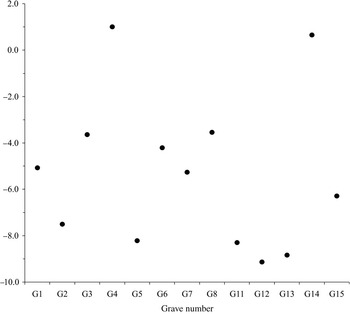
The oxygen isotopic values of the tooth carbonate samples from Westfield Farm have a wide degree of scatter ranging from −6.5‰ to −1.9‰ (table 3), with a mean of −4.8‰ (1 s.d. of 1.5‰). The δ13Ccarbonate(PDB) ratios vary between −15.9 and −14.1‰ (mean of −15.0 ± 0.5‰). For the oxygen isotopic values, this converts to a δ18Ophosphate(SMOW) mean of +17.0 ± 1.5‰ (range of 15.2 to 19.9‰), which in turn translates to drinking water δ18OSMOW values ranging from −9 to +1‰ (fig 15). Drinking water δ18OSMOW values for Britain are currently between c −4.0 and −9.0‰, with Cambridgeshire having δ18OSMOW values of −7.0‰ to −8.0‰. According to Budd and colleagues,Footnote 50 the climate in Britain during the Anglo-Saxon period was similar to that of the modern era and thus the oxygen isotope values obtained from modern drinking water are thought to be comparable with Anglo-Saxon period values. Although the amount of intra-population variation in δ18O values that might be expected in an indigenous population is unclear,Footnote 51 for individuals buried at the Roman necropolis in Isola Sacra, Italy, Prowse and colleagues interpret a population with a range of 2‰, clustering round the mean δ18OSMOW of expected drinking water as indicative of local origins.Footnote 52 In a small study of a Roman population at the site of Babraham, Cambridgeshire, the mean drinking water δ18OSMOW value calculated from tooth enamel carbonate measurements was −7.1 ± 1.6‰ (n = 24), within the expected range for Cambridgeshire and cautiously interpreted to indicate that the majority of the population was comprised of locals who were buried in the region where they were born.Footnote 53
Results for δ18OdwSMOW for all individuals measured

If a similar range is used for the Westfield Farm population (−6.5‰ to −8.5‰), it appears that the values observed are more widely scattered than the expected range for individuals born and brought up locally. Only three fall within this range (Graves 2, 5 and 11); two fall just below it (Graves 13 and 12, at −8.8 and −9.1‰); six just above the upper limit (−3.5 to −6.3‰); and two have very high values (Graves 4 and 14, at +1.0 and +0.7‰). A possible interpretation is that the majority of the population came from outside the local area, and at least four from outside Britain, with the two individuals with the highest isotopic values from a very warm area such as North Africa. An alternative explanation is that the analyses are flawed. Unlike those available for collagen, there are no independent techniques to assess the preservation condition of enamel samples prior to, or during, sample preparation and analysis, and when the data are as scattered as we have found, there is a strong possibility that they are incorrect, due to the diagenetic alteration of the teeth. Repeat analyses may yield acceptable results, and other methods of investigation could be explored to assess the possibility that the oxygen isotope values are correct.
Conclusions
This brief study indicates that the population at Westfield Farm subsisted predominantly on terrestrial C3-plants and herbivores, with some consumption of freshwater fish. We suggest that the population subsisted on local resources, with little incorporation of traded foods, such as marine fish. In this, the population differs from other early Anglo-Saxon sites, where little evidence of fish consumption has been found. The tooth carbonate oxygen isotopic analyses at first glance indicate that a large proportion of the population may be non-local, but there is a chance that the data is flawed, and hence we cannot speculate further here on the origins and mobility of this population. (MD and TO’C)
Artefacts
The glass palm cups (Grave 1)
The most striking find from the cemetery was a pair of blue-green glass palm cups, both complete and undamaged. Glass is in general an unusual find in burials, and is usually interpreted as a sign of wealth. To find two items is rare; that they were complete and unbroken is even more so. These vessels belong to Evison’s phase ii, ad 550–700; within that they can be assigned to group 57: plain with out-folded rim, dated seventh century and later.Footnote 54 Of thirty-four vessels in group 57, sixteen are from Kent, five unprovenanced, with others widely scattered from Northamptonshire to Hampshire. There are also five from Suffolk, from two cemeteries near Ipswich, at Hadleigh Road and Buttermarket. Pairs of palm cups (though not group 57) were found in the rich female burials at Swallowcliffe Down, Wiltshire, and Kingston Down, Kent (grave 146).Footnote 55 Each of the Ipswich cemeteries, however, includes a pair of group 57 (as does a burial – though not the rich burial with elaborate necklace – at Desborough, NorthamptonshireFootnote 56). Those in grave 85 from Hadleigh Road, found at the feet of a female skeleton, were probably stacked one inside the other (and were both smashed by the workman’s pick); the skeleton also had a buckle at her waist, two small double-toothed combs on either side of her feet and a ‘pot hook’ (ie girdle-hanger) hanging from the waist; two slip-knot rings and fragmented pottery are also noted.Footnote 57 At the Buttermarket cemetery a pair of palm cups (again, one inside the other) came from a well-equipped male grave, grave 1306, which also contained a seax, shield boss, two spearheads and a buckle set of continental type. Continental chronologies put this grave into the period Franken AG Phase 8 (ad 640/50–670/80).Footnote 58 A third palm cup of the same kind was found in grave 4955. The Westfield palm cups are remarkably similar to the pair from Buttermarket, although the former are very slightly deeper, and perhaps slightly finer in quality. Plain palm cups such as these fall into Geake’s group D, dated to between ad 650 and 725. They may possibly have been manufactured in Kent.Footnote 59 (SL and CH)
Necklace components and composition (Grave 1)
Hemispherical bulla pendants are widespread across England, and have been dated most commonly to the second half of the seventh century.Footnote 60 Gold examples are rare, however: in a recent study just two gold examples in a study group of seventy-one were reported, and were said to be ‘not out of place on the finest necklaces known from Anglo-Saxon England’.Footnote 61 The silver bulla pendants from Buttermarket grave 4275 were part of a necklace that also included coins with a suggested terminus post quem of ad 660/680.Footnote 62
Gold and garnet pendants have been found in many other seventh-century burials, especially in Kent, but also in East Anglia – for example at Boss Hall, Ipswich, where they were associated with a sceatt of around ad 700.Footnote 63 Their chronology suggests use throughout the seventh century, and they tend to be found in high-wealth graves, being associated only with females and children.Footnote 64
The cross-shaped pendant is missing the fourth arm, but otherwise takes the shape of a ‘Celtic’, or tau-like, cross, similar to other more elaborate gold and garnet pendants, such as that from Ixworth (although without its expanded terminals).Footnote 65 Cross pendants are usually taken as indicators of the Christianity of their owner and so dated by association with historical accounts of the date of conversion of the relevant region of England. There are several weak points in this argument, but it is clear that most such pendants do belong to the seventh century, and that some, if not all of them, had an original connection with Christianity.
There are a number of parallels for these various pendant types that have been dated by coin evidence or association with other datable objects. As well as the Buttermarket and Boss Hall parallels cited above, at St Mary's Stadium, Southampton, grave 4202 contained a necklace similar to that from Westfield, with four silver bulla pendants, a few glass beads and crescent-shaped pendants that, though not like the cross from Ely, would none the less have presented a similar composition; this grave was dated from coin evidence to around ad 685–90.Footnote 66 At Bloodmoor Hill, Suffolk, grave 11 contained a simpler necklace, comprising five silver bulla (hemispherical) pendants and a silver foil cross (all of which may have been gilded). This grave was dated no earlier than ad 675 on the basis of the silver composition of the bar and disc in the same grave.Footnote 67 At Winchester, a more complex necklace was found, comprising silver rings and glass beads as well as one gold and two silver bullae, and also three other gold pendants, two with garnet settings, similar to the gold/garnet pendant from Grave 1 at Westfield Farm.Footnote 68 At Butler’s Field, Lechlade, grave 187, a female in a seventh-century grave surrounded by a ring-ditch had a necklace with a silver equal-armed cross.Footnote 69
The most elaborate necklace yet recorded from Anglo-Saxon England is that from Desborough.Footnote 70 This is far more elaborate and complete than the others mentioned here, but one feature it shares with Westfield Farm Grave 1 is the central gold cross pendant. At Desborough this was a simple gold cross, while at Ely it is a pendant that may have once had settings in its arms and centre. The symmetrical nature of both necklaces also invites comment. While the Desborough cross is clearly surrounded by alternating bullae and cabochon garnet pendants, the Westfield necklace also displays clear patterning, at least in the material composition of its pendants. At each end of the necklace are two silver bullae; next come the gold and cabachon garnet pendant on the left half and the unedged gold bulla pendant on the right, then further single silver bullae either side of the central cross pendant. It seems that the gold bulla pendant was being used as an equivalent for the cabochon pendant; this perhaps supports arguments for a decline in the availability of garnets in the later seventh century.Footnote 71 (SL and CH)
Silver pin and chain (Grave 1)
Silver or copper-alloy pins linked by chains are known from mid- to later seventh- and eighth-century burial and settlement contexts.Footnote 72 At Harford Farm, linked pins were found in grave 18, together with a workbox, pendants and coins dating to ad 690–710, while a single pin with a remnant of a chain was found in grave 1, demonstrating that these sets were sometimes broken up before burial.Footnote 73 This seems to have been the case at Westfield, where its location on the chest suggests that it may have been used to fasten an overdress or head-covering, perhaps attaching the latter to the former, as argued for Bloodmoor Hill grave 22.Footnote 74 (SL and CH)
The casket (Grave 1)
The hardwood casket was represented by iron bindings, an iron handle and a displaced iron barrel padlock, all with associated mineral-preserved wood remains. The form of the casket is difficult to reconstruct, as it had suffered considerable disturbance (the padlock – with preserved wooden remains – was found near the head of the skeleton, having presumably been displaced either by ploughing or by animal activity). While little can be interpreted of its superstructure, the distribution of the lower fittings, along with a distinct stain in the grave base, suggests dimensions of approximately 400 × 220mm. The nature of the fittings – generally oval plates with a rivet in each end – might suggest construction from smaller pieces of wood, although it is equally likely that the plates were decorative. The length of the rivet shanks suggests a wood thickness of up to 8mm. There was no evidence for any metal hinges (unlike the elaborate copper-alloy hinges from the caskets in Bloodmoor Hill grave 15 and at Swallowcliffe Down).Footnote 75 This seems to have been one of the plainer caskets with iron fittings, assumed to have flat lids, examples of which are known from other seventh-century cemeteries in Cambridgeshire.Footnote 76 It may, however, have had an angled, rather than flat, lid, to judge by the form of fitting no. 20. It is uncertain whether the padlock had locked the casket, but this is assumed to be the case, especially as the padlock key formed part of the girdle-group.
Remains of caskets and/or their fittings have been found in a number of seventh-century burials; these are generally wooden caskets with iron fittings, measuring on average 300 × 200 × 200mm.Footnote 77 Sometimes grave goods are contained in the casket, as in Grave 1 here, with combs a common inclusion, along with jewellery, beads, tools, shells and other personal items; textiles are also sometimes in evidence.Footnote 78 Barrel padlocks are found more rarely,Footnote 79 but are all dated to the middle or later seventh or early eighth century when found in Anglo-Saxon graves. The inclusion of the padlock key with the girdle-group emphasizes, along with the locking of the casket, the personal ownership of the items buried inside it; this is also possibly seen at Harford Farm, where grave 18 may have had a padlock key (8f) as part of the girdle complex, and at Bloodmoor Hill, where the exact location of the padlock key (whether inside or just outside the casket) could not be definitively established.Footnote 80 (SL and CH)
Combs (Grave 1 and Grave 10)
Two single-sided composite combs came from separate graves. The comb from Grave 1 is incomplete and survives in poor condition, but the principal elements of its design can be recognized. The end segment has straight edges and rises to a sharp point. Its outer edge is angled slightly inwards. The tooth segments are set a little above the line of the back of the comb and are scored with a continuous diagonal line pattern, whilst the connecting plates are sparsely decorated with paired framing lines and double vertical lines, defining a series of panels. These particular elements of design are characteristic of a series of combs from East Anglia of late seventh- to early eighth-century date. They include examples from Burwell grave 121, Ipswich and Bloodmoor Hill, Suffolk.Footnote 81 In each case the connecting plates are decorated in a series of panels, which contain little except for iron rivets. The upper edges of the tooth segments are decorated either with scored diagonal lines or hatching, and the end segments are winged, with a long, curved graduation in the length of the teeth. This comb includes a suspension hole drilled through the end segment, which retains a copper-alloy wire ring. Suspension holes are rarely found on Anglo-Saxon combs, although there are several on combs of seventh- to eighth-century date, including single-sided composites from Barrington, Burwell (grave 83), Ipswich, Polhill and York.Footnote 82 It is very rare to find a suspension hole with a copper-alloy wire loop still present.
The second comb, from Grave 10, survives only as several fragments forming a segment located towards one end. In some respects it is quite unlike any other comb of this date. It includes no less than seven rivets spaced across the extant 69mm, three of which are antler, whilst four are iron. There are faint traces of paired vertical lines at several points, as well as an indication of paired framing lines, but it is not possible to identify the original decorative scheme with certainty. However, it does appear to be another example of a comb with a series of panels defined by vertical lines. The closely spaced antler rivets fasten two antler tooth segments at their centres. The comb was a single-sided composite, which may or may not have been winged.
Antler rivets are not a feature of Anglo-Saxon combs, virtually all of which are fastened by rivets of iron. This is the case, for example, with all of the combs from excavations at Coppergate in York.Footnote 83 A middle Saxon single-sided composite comb from Westgate Street in Ipswich includes a single antler rivet and several occur on a double-sided composite comb from Whitby.Footnote 84 They can also be seen on two late Saxon combs from Hereford.Footnote 85 They are much more commonly seen on combs of Irish origin, particularly those of the early Christian period, several of which have been found in England, including a fragmentary comb from Thetford.Footnote 86 At the same time it has to be noted that the only single-sided composite combs to be produced in Ireland before the Viking period are those with distinctive high backs rising above the connecting plates, which are quite different in shape from this comb.Footnote 87 It is more likely that in this case the closely spaced antler rivets represent a repair to the comb. The surviving tooth segments are unusually narrow and each is fastened by an antler rivet through its centre. At one end of the comb a tooth segment with an antler rivet appears to have been a direct replacement for a previous example. Further along, two narrow tooth segments fastened in the same way may have replaced a single tooth segment.
Repairs to composite combs are not unduly common, but can be seen across the Anglo-Saxon period. A double-sided composite comb from Hamwic has been shortened and repaired with a copper-alloy rivet, whilst a similar comb from Ipswich has had all of the teeth of one side removed, effectively reducing it to a single-sided composite. The antler rivet on the comb from Westgate Street in Ipswich may also be a repair.Footnote 88 The use of antler rivets in this way, quite possibly influenced by Irish practice, as well as the presence of replacement tooth segments, indicates that the repair was carried out by a comb maker. Antler rivets are unobtrusive, unlike iron rivets, and are almost undetectable on some combs. (IR)
Spindle whorl (Grave 2)
The fragmentary antler object is cylindrical in form and the surviving pieces are undecorated. Its shape is redolent of spindle whorls of Walton Rogers type B1,Footnote 89 but its diameter is half of that recorded for the smallest antler spindle whorl from Ipswich, and its original weight would only have been around 10g. It could therefore be described as a bead, but is more likely to have been a spindle whorl, given that it is comparable in terms of its material, shape and size with several antler whorls from Spong Hill.Footnote 90 Moreover, it came from the grave of a probable female, which also included a workbox. The association of spindle whorls and workboxes has been previously noted by Geake.Footnote 91 Both antler beads and spindle whorls came from Spong Hill, but the former are largely confined to cremation burials and tend to be earlier in date, belonging largely to the sixth century. The weight of a spindle whorl can be related in general terms to the fineness of yarn spun on it, and small, lightweight whorls would have been used to spin wool or linen intended for fine fabrics.Footnote 92 (IR)
Beads (Grave 2, 7 and 9)
Amethyst beads, as found in Grave 2, occur in Kent from the late sixth century and continue throughout the seventh century, but probably were most popular towards the end of that century.Footnote 93 At Dover Buckland, they were found in graves from Phases 5 to 7 (the second half of the seventh to the eighth century).Footnote 94 Such beads are most common in Kent, with scattered finds elsewhere; outside Kent usually just one or two are found in a grave,Footnote 95 so a collection of five as here is unusual. This would currently appear to be the highest number of amethyst beads found in a single grave in the east of England.Footnote 96 These were definitely beads, pierced longitudinally, and would have been worn on a necklace or festoon, although they were clearly part of a bag collection when buried in Grave 2. They seem to be associated only with female graves, and it is possible that they carried symbolic associations: amethyst is traditionally used in episcopal rings, and Audrey Meaney has suggested that such beads may have been worn ‘by Christian ladies who thought of them as amulets appropriate to the new religion’.Footnote 97
Opaque glass wound spiral beads such as those found in Grave 9 belong to Brugmann’s Phase C (ad 650–725),Footnote 98 while the monochrome blue glass bead from Grave 7 is not closely datable. Their location in both graves suggests use as pendants (strung singly or as a pair around the neck), as is typical of the later seventh century.Footnote 99 (SL and CH)
Workbox (Grave 2)
The copper-alloy workbox is a type of artefact that has been variously interpreted as a relic box/reliquary or as a practical workbox, partly based on recorded finds of textiles and pins inside the boxes, although the example here yielded no such finds (even on sieving). They are small cylindrical copper-alloy boxes decorated either (as here) with rows of punched dots, or with more elaborate linear and even zoomorphic designs. The lids of some have cruciform patterns that could be of Christian significance, while one from Burwell has Style ii animals. They have been dated mostly to the second half of the seventh century.Footnote 100 Recently excavated examples in association with sceattas put their deposition (if not manufacture) towards the end of that century or even into the early eighth century. Recently published examples include that from Harford Farm, south of Norwich, which was decorated with rows and zigzag lines of punched dots.Footnote 101 It was found in grave 18, associated with two coins (sceattas struck around 690 and likely to have been deposited not later than 710), box-fittings, a bracelet, a purse mount, a gold and garnet pendant and a complex of objects inside the workbox, including silver pins. A second example comes from burial 4202 at St Mary’s Stadium in Southampton,Footnote 102 which was accompanied by two sceattas of c 685–90, a box or casket, a silver disc, a knife, gold and silver bulla pendants and glass beads. Both of these graves are good parallels for Westfield Farm Grave 1 (although the workbox itself comes from Grave 2). Both have coins that provide secure dating for deposition in the late seventh or early eighth century. The closest parallel for the Westfield workbox currently seems to be that from grave 121 at Burwell, Cambridgeshire – of very similar construction, and closely related decorationFootnote 103 – but that in grave 14 at Butler’s Field, Lechlade is also very similar.Footnote 104 Meaney has argued strongly for their identification as Christian reliquaries (suggesting that the scraps of textile recovered are saintly relics), possibly associated with healing.Footnote 105 They are invariably found with adult females. (SL and CH)
Bag-group (Grave 2)
The only clear bag-group from the cemetery came from Grave 2, associated with a flat copper-alloy ring, which probably served as a bag-ring. Along with the workbox, antler spindle whorl and amethyst beads (discussed above), the bag in Grave 2 contained a number of other items, as is typical. In this case, the collection also comprised a copper-alloy Hod Hill brooch, dating to the mid-first century ad, two iron hobnails (presumably also of Roman date) and some iron ring and nail fragments. This represents quite a typical mixture of materials and artefacts: Meaney has suggested that such collections comprise: ‘A piece of broken glass. Rings of iron and bronze, often linked. Something at least a hundred years old. Something of animal substance. A mixture of materials.’Footnote 106 Even the inclusion of an early Roman brooch is not unique: the female burial in G53 at Polhill, Kent, also carried a bag containing one.Footnote 107 (SL and CH)
Latch-lifter (Grave 8)
In seventh- and eighth-century graves, latch-lifters (found both on chatelaines and, as here, suspended from a belt) seem to be functional, and to be made of iron. This is in contrast to girdle-hangers of sixth-century date, which tended to be of copper alloy, decorated, and were presumed to be symbolic artefacts.Footnote 108 Artefacts similar to this were recovered from later seventh-century graves at Shudy Camps, Cambridgeshire, and Polhill, Kent,Footnote 109 with that in grave 179 at Butler’s Field, Lechlade, dated from coin evidence to the 670s or later.Footnote 110 (SL and CH)
Firesteel (Grave 1)
The tool in Grave 1 appears to be a functional ‘firesteel’;Footnote 111 it is clearly triangular, with no associated buckle. Those with pronounced loops, as here, tend to be later seventh century in date.Footnote 112 Although its attachment to a ring might be thought to imply use on its own, rather than as part of the framing of a tinder pouch, textile evidence here stands to the contrary. Penelope Walton Rogers adds: ‘Underneath the firesteel there was at least one layer of a mineral-preserved skin product, probably the remains of a tinder pouch. The skin resembled parchment and was considerably finer than the deerskin pouch found with a firesteel at Snape grave 32, Suffolk.’Footnote 113 Firesteels are found with both male and female graves.Footnote 114 (SL, PWR and CH)
Knives (Graves 1, 3, 4, 6, 10 and 13)
Small iron knife blades are a long-lived artefact type, mostly not diagnostic as to date. However, the six knives found at Westfield are all typical seventh-century types.Footnote 115 There appears to be some correlation of size with the age and gender of the person buried. The younger individuals in Graves 1 and 3 were both accompanied by knives in Härke’s ‘small’ category, as was the young adult female in Grave 10 and the older middle adult ?male in Grave 13, while the older middle adult male in Grave 6 had one of ‘medium’ size. The ‘large’ blade with a length of 140mm in Grave 4 would strongly suggest that this burial was of a male, as knife blade lengths in excess of 130mm would appear to be exclusively male-related.Footnote 116 All six knives seem to have been worn at the waist, as is often seen. (SL and CH)
Buckle (Grave 3)
The solitary buckle from the site belongs to a type commonly found in seventh-century Anglo-Saxon burials, one that is often associated with a knife. These small simple buckles are the most popular type in conversion-period burials.Footnote 117 In use throughout the seventh century, these are distributed widely across England. A recent classification would identify this buckle as type ii.24a, with a date range of the late sixth to early eighth centuries.Footnote 118 (SL and CH)
Cemetery date
All the artefacts found at Westfield Farm are known from other burials dated to the seventh century ad. Geake’s recent seriation of finds from conversion-period graves identifies five groups (A–E).Footnote 119 Group D, distinguished clearly from preceding groups and dated ad 650–720/30, includes several of the artefact types found at Westfield: the hump-backed comb, bulla pendants, plain palm cups, workboxes and linked pins. On Geake’s classification these burials are likely to belong to the later part of the seventh century, and the independent dating for individual artefact types discussed above confirms that. Provisional results from the new Anglo-Saxon chronologyFootnote 120 would place the bulla pendants and linked pin in Grave 1, the workbox in Grave 2 and the beads in Grave 9 into a phase broadly spanning the three decades either side of the mid-seventh century. We would argue for the very latest part of that range, based on the wider coin associations of similar graves discussed above. (CH and SL)
Costume
The costume of seventh-century Anglo-Saxon women has been reconstructed as a full-length, long-sleeved dress, fastened by a woven girdle or sash, and a long veil or mantle reaching to the hip or below.Footnote 121 Men will have worn either a wrap-over warrior jacket or a knee-length, long-sleeved tunic over close-fitting trousers.Footnote 122 Although the textiles in the Westfield graves were poorly preserved, and few technical details could be recorded, folds of fabric and different weights of cloth could be recognized in Graves 1, 4, 8 and 10, and the position of costume accessories in Graves 1, 3 and 6 helps to amplify the picture.
The costume evidence in Graves 1, 8 and 10 was typical of female burials of the period. In Grave 1, the metalwork at the right hip was sandwiched between a lightweight fabric, almost certainly a long veil or mantle, and a heavier wool textile, probably the fabric of a dress. The lightweight textile was arranged in close folds, although it was not as tightly pleated as some of the veil/mantle fabrics found in other seventh-century graves in East Anglia.Footnote 123 The purpose of the short silver pin with chain on the upper chest is uncertain, but it may have been to secure the veil/mantle. There was a similar combination of fabrics in Grave 8, where the latch-lifter below the waist lay between a fine textile, 16 × 16 threads per cm, and a heavier one in wool, while in Grave 10 there were fine folds of material running across the knife at the left hip.
The pendants in Grave 1 lie in an arc at the front of the neck, which suggests that they were mounted on a cord or thong that passed around the back of the neck, the cord being hidden by the veil. This arrangement had been used for earlier strings of bucket pendants and contrasts with the necklace from the barrow burial at Desborough, Northamptonshire, where the pendants would have encircled the whole neck.Footnote 124
Buckled belts were mostly the preserve of men in the seventh century, but small buckles sometimes appear low down on the hip in women’s burials (cf Grave 3), where they may have been used to attach accessories. A buckle-plate at the centre pelvis of the man in Grave 6 probably represents the remains of a belt, although there was no textile to indicate the quality of the garment it clasped. A medium-weight twill on a knife from the right waist in Grave 4 possibly comes from a man’s tunic, since the length of the blade, over 130mm, is typical of men’s knives, and supports the tentative identification of male sex in the skeleton.Footnote 125 (PWR)
Cemetery Composition And Layout
The arrangement of the Westfield graves suggests they were buried around a central grave of very high status, and were probably roughly contemporary with it, although the focus of burial around Grave 1 does indicate a chronological ordering. This is not a complete cemetery but the group seems to be reasonably intact. The scale of wealth is not as great as, for example, at Swallowcliffe Down or Roundway Down (these both in barrows, which may also be the case for Westfield Farm Grave 1), but is still significant in its range of gold, silver, imported amethysts and glass vessels.
The ageing and sexing data reveal a mixed population, with broadly similar numbers of (probable/possible) males and females. The youngest individual (in Grave 9) was aged four to five years, and the cemetery population as a whole tends towards the younger age ranges, with few obvious pathological conditions. There is some variability in grave orientation, with Graves 2, 8 and 13 having heads to the south west, while the remainder tend more to the west or slightly north west. This does not appear to be related to the provision of grave goods, or to age or sex, although these are the only three graves with bodies that have not been laid out in a strictly extended and supine position (although the burial in Grave 2 seems to have been disturbed from its original position).
The layout of graves around central Grave 1 does show some potential patterning: graves of females (or those with female-associated assemblages), those of individuals aged under twenty years, and those with grave goods are all more likely to be found to the north west of Grave 1, while unfurnished graves and burials of males are more likely to be found to its south east (fig 16). This intriguing suggestion of social and/or gender differentiation through grave position does not, however, seem to be reflected in any other aspect of the burial rite. No clear patterning in the isotopic data appears to relate to cemetery layout, although the only grave without elevated nitrogen levels is Grave 1, suggesting perhaps a less fish-rich diet than the other people buried. (SL)
Gender of burials

Anglo-Saxon Archaeological And Historical Background
The burials excavated at Westfield Farm, Ely, fall into a pattern of seventh-century cemeteries originally recognized by T C Lethbridge and described by LeedsFootnote 126 as ‘final phase’ in relation to the end of furnished Anglo-Saxon burial, a time when conversion to Christianity might have been assumed to have had an impact on burial rites. The idea was developed further in relation to burials from Leighton Buzzard and Winnall.Footnote 127 More recently, Helen Geake has reviewed the material from these burials, under the title ‘conversion period’.Footnote 128 It is now clear that the arrival of Christianity did not at once signal the end of grave goods, or even always the abandonment of earlier cemeteries; it is apparent that the relationship between religion and burial rite in this period is complex. The Church seems not, initially, to have taken control of burial, and churchyard burial did not become the norm until the late Anglo-Saxon period.Footnote 129
During the seventh century there was a range of different burial practices: inhumation was the norm, although cremations have recently been radiocarbon-dated to the seventh or early eighth century at Southampton.Footnote 130 In some cases large cemeteries in use during the sixth century continued into the seventh century: for example, Barrington (Cambridgeshire), Dover Buckland (Kent) and Butler’s Field, Lechlade (Gloucestershire).Footnote 131 In other places new, often short-lived, cemeteries were founded. There are also instances of rich burials within barrows: not just Sutton Hoo at the start of the seventh century, but also later, for example, at Swallowcliffe Down.Footnote 132 What characterizes these cemeteries is the general decline in the incidence of grave goods (which means that many burials of this date may remain unrecognized), together with a relatively large number of burials furnished only with a knife and a small simple buckle. Each cemetery also usually contains some well-equipped graves. Spectacular male assemblages such as Sutton Hoo mound I, Taplow or Prittlewell mostly give way to rich female graves by the mid-seventh century, but there are also some rich male graves at this later date. One example would be Ipswich Buttermarket grave 1306, which was buried with a seax, spearheads, shield boss, elaborate buckle suite and two palm cups; this grave is dated by Scull through continental parallels to ad 640/50–670/80.Footnote 133 The recent finds from St Mary's Stadium, Southampton, also include male weapon graves, as well as females with jewellery, of the mid-seventh to eighth century. Here, a sample of a larger cemetery produced twenty-three inhumations and eighteen cremations. Nineteen of the inhumations had grave goods, including two females with gold pendants, and several weapon burials. Burials in Ipswich, London, Winchester and Southampton seem to fall into the same pattern, but because these sites all saw later urban development – indeed were the sites of emporia or minsters at the time of the burials – they are often incompletely excavated. At Lower Brook Street, Winchester, for example, just four burials were excavated, one with an elaborate necklace.Footnote 134
Cemeteries of this type are known from East Anglia, for example, Burwell and Shudy Camps.Footnote 135 A recently published example is Harford Farm, Norfolk.Footnote 136 This is a rural site, completely excavated in advance of road construction. The burials were in two groups: area A had thirty-one graves – ten without grave goods, eight with knife and buckle only, and three with rich assemblages – while area C/D had fifteen, mostly with knife and buckle, but one well equipped. At Ipswich Buttermarket, burials were disturbed by later use of the site.Footnote 137 A total of seventy-seven inhumations were recovered, thirty-two of which were accompanied by grave goods, but most only with a single knife. A few were well equipped, including items such as silver bulla pendants and weapons.
Historical context
In the most recent summary of the historical evidence for Anglo-Saxon settlement on the Isle of Ely,Footnote 138 the first documentary reference records the foundation of a monastery by Etheldreda (or Æthelthryth) around ad 673; this was a double house (for both monks and nuns) and she was its first abbess. The history of the monastery and of the church at Ely, from its foundation until the tenth century, is given in Book i of Liber Eliensis,Footnote 139 a work compiled between 1131 and 1174 by one of the monks of Ely. This records that Etheldreda established her monastery on a new site a mile away from an existing settlement at Cratendune, where ancient objects and coins were still being found. The locations of Cratendune and of this first monastery have both been the subject of much debate,Footnote 140 but the best candidate remains the area to the south of Ely, near Bedwell Hay Farm and Ely Fields Farm, in the vicinity of which early Anglo-Saxon burials (at Witchford Aerodrome) and evidence of Roman and later settlement have been recovered (fig 17).Footnote 141
Westfield Farm and surrounding sites. Reproduced by permission of Ordnance Survey on behalf of HMSO; © Crown copyright 2009–10. All rights reserved. Ordnance Survey Licence no. 100048686

No direct archaeological evidence of Etheldreda’s monastery has yet been found. One possibility is, of course, the location of the present cathedral, but the parish church of St Mary’s and the site of St John’s Hospital are both viable options.Footnote 142 The arguments in favour of any of these are weak, however. Recent excavations in the cathedral grounds uncovered a pit containing an extensive deposit of mid-Saxon pottery of the eighth century and later, but no earlier material was recovered.Footnote 143 There is no archaeological evidence for an early date for St Mary’s, but it does occupy an unusually dominant position adjacent to the cathedral. An Anglo-Saxon origin for the St John’s hospital site (now St John’s Farm) rests primarily on the discovery of a fragment of stone sculpture in one of the barn walls, which has been tentatively identified as part of an eighth-century frieze, and therefore possibly a remnant of the first stone church at Ely.Footnote 144 This site also lies at the highest point on the Isle of Ely,Footnote 145 and has been noted as unusual, as it saw the amalgamation of the two hospitals of St Mary Magdalen and St John the Baptist, in c 1240, and was clearly significant when the open fields were laid out.Footnote 146 The Bedwell Hay Farm site lies approximately 2.5km to the south south west, which might strengthen this argument.
Recent archaeological work has revealed a number of settlements and cemeteries belonging to this period, which can help set the Westfield Farm cemetery in context. While the settlement at West Fen Road was probably not established until the second quarter of the eighth century,Footnote 147 a small number of possibly early Anglo-Saxon sherds was found to the east, at 2 West End.Footnote 148 Otherwise, the early Anglo-Saxon settlement record from Ely is rather blank. A small number of cemeteries is known: at Witchford Aerodrome a cemetery of around thirty skeletons was observed being levelled during construction work;Footnote 149 grave goods recovered (including saucer brooches, a square-headed brooch, an annular brooch, spearheads and a sword) suggest that it dated to the sixth century. This could be the cemetery associated with the Bedwell Hay Farm site (and, indeed, the finds were labelled ‘Cratendune’ at the time of discovery). To the north of the city, further probable sixth-century burials were recorded during the construction of the Newbarns Road housing estate in 1959.Footnote 150 Nearer to the site, excavation in 2003 to the south of Witchford Road revealed a mass of disarticulated and partly articulated human bone, together with a range of artefacts suggestive of ploughed-out sixth-century burials.Footnote 151
It is worth attempting greater precision in dating the Westfield Farm cemetery because of the historical accounts relating to Ely. Bede records that Etheldreda, wife of Ecgfrith of Northumbria, left him to become a nun, and founded a monastery at Ely, her home province.Footnote 152 This was in the 670s, and she died in 679, from a tumour on her neck that, Bede says, she regarded as punishment for having worn necklaces when younger. The search for a suitable sarcophagus in which to re-inter her (seventeen years after first burial) led the monks to the ‘civitatulum … desolatum … Grantacaestir vocatur’, a statement that is usually interpreted as the first documentary reference to Cambridge.Footnote 153 Do the Westfield Farm burials belong to the 670s, in which case they would have been contemporary with Etheldreda, or to the end of the seventh century, a generation after her death? In either case the burials took place close to a Christian community living on a limited area of land in the fens. This is known to have been a mixed-sex community with a nucleus of nuns residing under a royal abbess, with continental contacts with Frankish religious communities near Paris, as well as strong links with the Kentish, Northumbrian and East Anglian royal houses.Footnote 154
We might expect members of the monastic community to have been buried near the church, which these seem not to be (although they do lie just a few hundred metres south west of the possible monastic site at St John’s Farm), but, given the variety of burial forms and locations current at the time, even that cannot be ruled out. We should remember that there is no evidence from England, outside of Kent and Northumbria, that the Christian laity expected burial in holy ground near churches before the 670s, at the very earliest. This only became common from the 680s (and perhaps accounts for the documented translation of Etheldreda herself).Footnote 155 Palm cups have been reported from minster cemeteries at Peterborough, Faversham and Minster-in-Thanet,Footnote 156 perhaps suggesting that such vessels were thought appropriate for burials with ecclesiastical associations. Those buried in Graves 1 and 2 were elite females, the type of women who joined nunneries founded by royalty, one of them wearing a necklace of the kind Etheldreda blamed for her illness, which included a Christian cross pendant. One of the most intriguing aspects of this cemetery is the youth of both of these burials: Grave 1 is aged between ten and twelve years of age, while the ?female in Grave 2 is a little older, at fifteen to seventeen years old.
The elaborate burial of young (presumably female) members of the community, while other older female and male individuals are barely furnished, or are buried unaccompanied, is intriguing, but not without parallel. At the sixth- to seventh-century settlement at Bloodmoor Hill, Suffolk,Footnote 157 a small mid- to later seventh-century cemetery was established in the middle of the occupied area. This contained a variety of grave furnishings, including one grave with an elaborate casket and another with a silver foil cross pendant on a necklace with silver bulla pendants; the graves were ordered into rows and orientated west–east. Well-furnished female graves at Bloodmoor Hill did not, however, have a male counterpart: these were accompanied at most by a tool and knife, even though other contemporary cemeteries see highly furnished male graves.Footnote 158 One interpretation considered for the Bloodmoor Hill cemetery is that it represented an establishment housing a small, short-lived, religious female community.Footnote 159 A possible intriguing parallel comes from Kent, where a tradition relating to Minster-in-Thanet relates that the late seventh-century princess Eormengyth chose her own place of burial a mile to the east of the minster; it has been argued that this tale is simply too odd to represent hagiographical invention, and that perhaps she could not bring herself to forsake a traditional barrow burial for the sake of her abbess sister.Footnote 160 John Blair has argued that these late seventh-century burial practices mark a transitional stage, being both a Christianization of the princely barrow and a prelude to elite minster burial.Footnote 161
It seems highly likely that the burials excavated at Westfield Farm represent people associated with the religious community in later seventh-century Ely. The lack of high-status male graves, and the burial wealth displayed in Grave 1, and to a lesser extent Grave 2, suggest aristocratic connections with the monastic institution. The skeletal and isotopic results are particularly intriguing. Evidence for fish consumption is higher than the norm for early Anglo-Saxon populations, and this was an unusually ‘healthy’ population for the time, with very low rates of dental decay. No infants are represented (although this in itself is not unusual). Although the oxygen isotopic results have been identified as possibly flawed by Dekker and O’Connell (see above), purely on the basis of their diversity, it is not beyond the bounds of possibility that they reflect a real pattern of diverse childhood origin for the population buried here. Aristocratic and ecclesiastical connections in the later seventh century were far-reaching, extending across Europe and beyond, and early documentary sources depict people constantly on the move, between kingdoms, countries and continents.Footnote 162 Bede reports, for example, that Abbot Hadrian, a North African, came to Canterbury from Italy via the Frankish kingdom in ad 664.Footnote 163 Moreover, two of Etheldreda’s own sisters became abbesses of the Frankish nunnery of Faremoutiers in Brie, to the west of Paris.Footnote 164
Whether or not we accept the isotopic results at face value, the high-status graves evident at Westfield Farm must surely give added weight to the arguments for the early religious establishment at Ely being located on the higher ground to the south of the current cathedral (fig 17). Excavations at other early religious sites – such as Hartlepool (and perhaps Brandon, Suffolk) – suggest that such establishments were diverse in nature, extensive, and often possessed more than one area for burial; indeed, historical and archaeological sources for Whitby suggest that seventh- to ninth-century occupation, presumably monastic, spread right across the headland.Footnote 165 The natural topography of hills and islands may, indeed, have been one of the ways in which some monastic precincts were defined.Footnote 166 It could conceivably be the case that the monastic precinct at Ely occupied the hilltop, with an extensive settled area (perhaps even encompassing the site of the present cathedral) and multiple cemetery areas, for both lay and ecclesiastical members of the community. The Westfield Farm cemetery may represent one such cemetery. (SL and CH)
Acknowledgements
Our thanks must go first to the site team – Rachel Causier, Bryan Crossan, Tim Vickers, David Klingle and Dave Webb – who, together with the Site Director, Richard Newman, missed the Cambridge Archaeological Unit (CAU) Christmas Dinner in December 2006 in order to complete the cemetery excavation. The project was variously managed by Robin Standring and Christopher Evans, FSA, of the CAU, and the fieldwork and preparation of the publication text was funded by Taylor Woodrow Developments Ltd.
Sam Lucy would like to thank Penelope Walton Rogers for her helpful comments on a draft text; John Hines for commenting on the implications of the new Anglo-Saxon chronology for the dating of the site, and for his constructive referee’s comments; Chris Scull for supplying pre-publication information on the Buttermarket cemetery; and John Blair, Martin Carver, Rosemary Cramp, John Hines, Richard Morris, Chris Scull, Ian Wood and Barbara Yorke for very helpful and informative discussions on the nature of early monasticism. Natasha Dodwell would like to thank Ian Hanson (University of Bournemouth), Ali Klevnas (University of Cambridge) and Corinne Duhig for their input into the interpretation of skeletal positioning in Grave 2.
Thanks are also due to Mike Hall and James Rolfe (Godwin Laboratory, Department of Earth Sciences, University of Cambridge) and Rhiannon Stevens and Catherine Kneale (McDonald Institute for Archaeological Research, University of Cambridge) for help with isotopic analyses. The isotopic work was primarily done for an MPhil dissertation by Michiel Dekker in the Department of Archaeology, University of Cambridge, as part of a Masters thesis at the Vrije Universiteit, Amsterdam.
All the illustrations are the work of Vicki Herring (figs 1, 16 and 17 and the line drawings and grave plans in figs 3–13), Bryan Crossan (fig 2 and the grave plans in figs 3–13) and Andrew Hall (figs 1, 2 and 17) of the CAU; the photographs in figs 3–13 are by Dave Webb.