Introduction
Dementia is a growing public health concern with worldwide prevalence rates of 35.6 million and it is expected to double to 66 million by 2030 and more than triple to 115 million by 2050 (Wortmann, Reference Wortmann2012). However, it is largely under-recognized in elderly primary healthcare patients (Iliffe et al., Reference Iliffe2009). Despite awareness of the high rates of undiagnosed dementia in primary healthcare, routine screening for dementia in the general primary healthcare population has not been recommended due to insufficient evidence (Lin et al., Reference Lin, O’Connor, Rossom, Perdue and Eckstrom2013). By comparison, there remains substantial evidence that strongly recommends the detection of dementia in older adults for early interventions (Budd et al., Reference Budd, Burns, Guo, L’Italien and Lapuerta2011; Borson et al., Reference Borson2013).
Several brief performance-based cognitive screening instruments such as the Mini-Cog, the Memory Impairment Screen, and the General Practitioner Assessment of Cognition were recommended for cognitive screening in primary healthcare (Brodaty et al., Reference Brodaty, Low, Gibson and Burns2006; Ismail et al., Reference Ismail, Rajji and Shulman2010). However, these tests are limited in their utility due to education and cultural constraints (Galvin et al., Reference Galvin, Roe, Xiong and Morris2006). By comparison, a brief informant-based 8-item dementia screening instrument, the AD8, has great potential for dementia case finding due to its brevity (<3 minutes), excellent discriminant ability and biological validity (Galvin et al., Reference Galvin2005; Reference Galvin, Fagan, Holtzman, Mintun and Morris2010). Furthermore, the informant AD8 has been validated for cognitive screening in tertiary healthcare settings (Galvin et al., Reference Galvin, Roe, Xiong and Morris2006; Ryu et al., Reference Ryu, Kim and Han2009; Koski et al., Reference Koski, Xie, Konsztowicz and Tetteh2010; Yang et al., Reference Yang, Galvin, Morris, Lai, Chou and Liu2011; Dong et al., Reference Dong2013) and community settings (Correia et al., Reference Correia2011).
The informant AD8 has strong internal reliability (Cronbach's α ≥ 0.70) (Galvin et al., Reference Galvin, Roe, Xiong and Morris2006; Ryu et al., Reference Ryu, Kim and Han2009; Correia et al., Reference Correia2011; Dong et al., Reference Dong2013). Furthermore, the informant AD8 has an acceptable inter-rater reliability (ICC of 0.67) in the original validation study, and subsequent studies (AD8-Brazil, AD8-Korea) reported stronger inter-rater reliability (ICC ≥ 0.80) (Galvin et al., Reference Galvin, Roe, Xiong and Morris2006; Ryu et al., Reference Ryu, Kim and Han2009; Correia et al., Reference Correia2011). Excellent test–retest reliability (weighted κ ≥ 0.80) was also reported across different studies (Galvin et al., Reference Galvin, Roe, Xiong and Morris2006; Ryu et al., Reference Ryu, Kim and Han2009; Correia et al., Reference Correia2011).
In addition to good reliability, the informant AD8 also demonstrated good concurrent validity evidenced by strong correlations with performance-based cognitive screening assessments such as the MMSE and MoCA; clinical assessments such as the CDR; and formal neuropsychological assessments (Galvin et al., Reference Galvin, Roe, Xiong and Morris2006; Ryu et al., Reference Ryu, Kim and Han2009; Koski et al., Reference Koski, Xie, Konsztowicz and Tetteh2010; Correia et al., Reference Correia2011; Yang et al., Reference Yang, Galvin, Morris, Lai, Chou and Liu2011). In regards to construct validity, individual items of the informant AD8 were reported to correlate well with cognitive domains of memory (daily problems with memory, repeating statements, trouble remembering appointments), orientation (trouble remembering month or year), executive abilities (problems with judgment, trouble handling finances), and complex function (loss of interest, trouble learning new appliances) (Correia et al., Reference Correia2011). Construct validity was considered acceptable with a convergent validity of moderate to strong correlations (R ≥ 0.4) between individual AD8 items and the corresponding CDR domains and neuropsychological tests (Galvin et al., Reference Galvin, Roe, Xiong and Morris2006). Conversely low correlations (R ≤ 0.3) were considered as an evidence for divergent validity or no relationship (Galvin et al., Reference Galvin, Roe, Xiong and Morris2006). These studies reported good psychometric properties of the AD8 in a tertiary setting and community setting but not a primary healthcare setting, which is the front line of dementia case finding in the healthcare system.
In view of the superiority of the informant AD8 to the participant AD8 in detecting cognitive impairment (CDR ≥ 0.5) (Dong et al., Reference Dong2013) and its feasibility for dementia case finding in primary healthcare (Dong et al., Reference Dong, Cheng, Tsou, Chan and Chen2014); we examined the validity and reliability of the informant AD8 to detect cognitive dysfunction in primary healthcare. We aimed to establish the concurrent and construct validity of the informant AD8, and examine its internal consistency, inter-rater reliability, and test–retest reliability.
We hypothesized that the informant AD8 would have good internal consistency, inter-rater reliability, and test–retest reliability. It would demonstrate good concurrent validity and correlate well with performance-based cognitive measures such as the MMSE (Folstein et al., Reference Folstein, Folstein and McHugh1975), MoCA (Nasreddine et al., Reference Nasreddine2005), and global cognition and cognitive domain composite scores of a locally validated formal neuropsychological battery (Yeo et al., Reference Yeo, Gabriel, Chen, Lee, Loenneker and Wong1997). Additionally, it would have strong correlation with the CDR (Morris, Reference Morris1997). Finally, the informant AD8 would have good construct validity evidenced by acceptable correlations between individual AD8 items and domains of the CDR and cognitive domain composite scores of a formal neuropsychological battery.
Methods
Participants
This study was conducted in two phases. Phase 1 (feasibility) was conducted at two government subsidized primary healthcare centers, the Choa Chu Kang, and Clementi districts in Singapore. Phase 2 (validation) was conducted in the Memory Aging and Cognition Center at the National University Hospital of Singapore. This study was approved by the Domain-Specific Review Board (DSRB) of the National Healthcare Group (2013/00577). Informed consent was obtained from all patients and their informants in phase 1 and 2. Recruited patients were aged 60 years and above and attending the primary healthcare centers. They had at least one available informant who had sufficient language skills in English, Chinese Malay, and Tamil to complete the AD8. Additionally, these patients and their informants provided informed consent for study participation. The AD8 was administered to the informant of consenting patient-informant dyads in the waiting areas of the primary healthcare centers or, over the telephone if the informant was not present, from November 2013 to August 2014. Patient-informant dyads that completed phase 1 were invited to participate in phase 2 but were excluded if they had a major active psychiatric illnesses and/or significant physical disabilities that would impede cognitive testing.
Neuropsychological assessments
Patients who attended phase 2 completed the MMSE, MoCA, Geriatric Depression Scale (GDS) (Van Marwijk et al., Reference Van Marwijk, Wallace, de Bock, Hermans, Kaptein and Mulder1995), Neuropsychiatric Inventory (NPI) (Cummings et al., Reference Cummings, Mega, Gray, Rosenberg-Thompson, Carusi and Gornbein1994), and neuropsychological assessments of the formal neuropsychological battery. The formal neuropsychological battery consists of the following domains: (1) executive function (Dubois et al., Reference Dubois, Slachevsky, Litvan and Pillon2000); (2) attention (Lewis and Rennick, Reference Lewis and Rennick1979; Wechsler, Reference Wechsler1997); (3) language (Isaacs and Kennie, Reference Isaacs and Kennie1973; Mack et al., Reference Mack, Freed, Williams and Henderson1992); (4) memory (combination of verbal and visual memory subtests) (Sahadevan et al., Reference Sahadevan, Tan, Tan and Tan1997; Wechsler, Reference Wechsler1997); (5) visuoconstruction (Wechsler, Reference Wechsler1981; Sunderland et al., Reference Sunderland1989; Wechsler, Reference Wechsler1997); and (6) visuomotor speed (Porteus, Reference Porteus1959; Diller et al., Reference Diller, Weinberg, Gordon, Goodkin, Gerstman and Ben-Yishay1974; Smith, Reference Smith1982). The AD8 was re-administered to informants in person or over the phone to establish test–retest reliability. Inter-rater reliability was assessed by performing the AD8 on a second informant if available.
Diagnosis of dementia
Research consensus meetings were conducted on a weekly basis by a multidisciplinary team of neurologists, psychologists, and research personnel to determine diagnoses of cognitive impairment and dementia, which were based on the clinical and neuropsychological assessments conducted in phase 2. The DSM-IV criteria and global CDR scores were used to determine the presence of dementia and dementia severity. CDR = 0 indicates no dementia, CDR = 0.5 indicates questionable dementia and CDR≥1 indicates the presence of definite dementia. Patients who received a CDR score of 0.5 and above were referred to a specialist memory clinic for further clinical evaluation and management. Dementia subtypes were determined by neuropsychological profiles and neuroimaging characteristics for those who accepted referrals. Previously diagnosed dementia was determined from patient medical history.
Statistical analyses
Descriptive statistical analyses were conducted to examine the demographics of all patients including mode of administration, ethnicity, gender, age, education, mean AD8 score, and average time taken for AD8 administration. Independent samples t-test was used to compare demographic differences between those who participated in phase 2 and those who did not. Phase 2 study sample characteristics were analyzed using a one-way analysis of variance (one-way ANOVA) to compare demographic differences between three CDR score groups (CDR = 0, CDR = 0.5, and CDR≥1). Pearson's χ 2 analyses were used to compare categorical variables. Cronbach's α was used to assess internal consistency of the AD8. ICC was used to analyze inter-rater reliability. The ICC was calculated based on consistency among raters rather than absolute agreement (Fleiss and Chilton, Reference Fleiss and Chilton1983). Quadratic weighted κ was used to analyze test–retest reliability (Brenner and Kliebsch, Reference Brenner and Kliebsch1996). Composite z-scores were calculated for every cognitive domain of the formal neuropsychological battery. The global cognitive composite z-score of the formal neuropsychological battery was obtained from the sum of cognitive domain composite z-scores. Spearman's correlation coefficients were used to assess concurrent validity by examining the association between the total score of the informant AD8 and the CDR Global, CDR sum of boxes (CDR-SB), MMSE, MoCA, global cognitive, and cognitive domain composite z-scores of the formal neuropsychological battery. For construct validity, the strength of association was assessed between individual items of the informant AD8, CDR domains and cognitive domain composite z-scores of the formal neuropsychological battery. Construct validity was considered acceptable if there were moderate to strong correlations (R ≥ 0.4) demonstrating convergent validity between similar AD8 items, CDR, and cognitive domains. Low correlations (R ≤ 0.3) supported divergent validity for dissimilar AD8 items, CDR, and cognitive domains. All statistical analyses were conducted using SPSS version 20.0 and MedCalc version 14.8.1 (Tanboga et al., Reference Tanboga, Ekinci, Isik, Kurt, Kaya and Sevimli2011).
Results
Sample characteristics
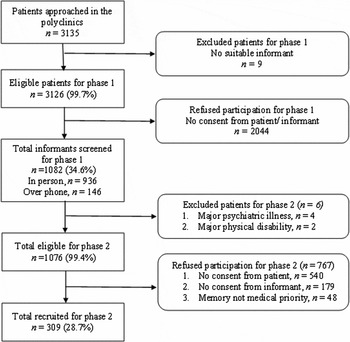
The flow diagram of participant recruitment is shown in Figure 1. A total of 3,126 patients were eligible for this study. Of those who were eligible, 1,082 (34.6%) patient-informant dyads provided consent to participate in phase 1. Of those who participated, 936 (86.5%) informants were assessed at the polyclinic waiting areas and 146 (13.5%) were assessed via phone. Significant differences were found for participants’ informant AD8 scores between the different modes of administration (p < 0.001). Higher mean informant AD8 scores were obtained in face-to-face administrations (1.94 ± 2.39) than in phone administrations (1.28 ± 2.39). This may be due to patients who have more functional decline and hence higher AD8 scores requiring accompaniment by an informant on visits to primary care. A majority of the sample were Chinese (n = 788, 72.8%) and female (n = 685, 63.3%) with a mean age of 74.0 ± 8.6 years (range 60–107 years) and educational attainment of 5.7 ± 5.1 years (range 0–22 years). The informants were mainly their adult children (n = 597, 55.2%) followed by spouses (n = 383, 35.4%) and others such as siblings, close relatives and friends (n = 102, 9.4%). The mean informant AD8 score for the entire sample was 1.9 ± 2.3 (range 0–8, skewness 1.23 ± 0.074) with a mean administration time of 2.3 ± 1.0 minutes (range 1–10 minutes). Of the total number of patients assessed in phase1 with the informant AD8, 309 (28.6%) consented for phase 2, 243 (78.6%) were CDR = 0; 22 (7.1%) were CDR = 0.5; and 44 (14.2%) were CDR≥1. As shown in Figure 1, reasons for patients who did not participate in Phase 2 include: (1) meeting the exclusion criteria for major psychiatric illnesses and physical disability (n = 6, 0.6%); (2) no consent from patient (n = 540, 49.9%); (3) no consent from informants (n = 179, 16.5%); and (4) memory was not a medical priority at the time of screening (n = 48, 4.4%). Independent samples t-test revealed patients who did not participate in phase 2 to be significantly older (74.9 vs. 71.6 years, p < 0.001) with lower educational attainment (4.8 vs. 8.0 years, p < 0.001) as compared to those who participated in phase 2. However, there were no significant differences in their informant AD8 scores (p = 0.91). Furthermore, significant differences were also observed for gender (χ 2 (df = 1) = 14.88, p < 0.001) indicating females to have a higher tendency to reject further diagnostic evaluations.
Study inclusion flow chart.

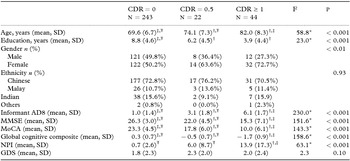
Of the 66 patients with CDR≥0.5, 31 (47.0%) accepted referrals for further clinical evaluations and management. Of these patients, 9 (31.3%) were diagnosed with Cognitive Impairment No Dementia (CIND), 10 (32.3%) were diagnosed with Alzheimer's disease (AD), 7 (22.6%) were diagnosed with AD with Cerebrovascular Disease (AD+CVD), and 5 (16.1%) were diagnosed with Vascular Dementia (VaD). Of the 35 patients who declined referrals for specialist memory clinic services, 10 (28.6%) had previously diagnosed dementia ascertained by their medical history, 10 (28.6%) indicated that memory problems were manageable by the family and 15 (42.9%) indicated memory problems were not their highest medical priority. Patient characteristics of those who participated in phase 2 are shown in Table 1. Compared to patients with CDR = 0, patients with increasing dementia severity (CDR ≥ 0.5) were significantly older (79.3 ± 8.7, p < 0.001), with lower educational attainment (4.7 ± 4.5, p < 0.001), increased neuropsychiatric symptoms (11.3 ± 15.4, p < 0.001) and were more likely to be female (χ 2 (df = 2) = 10.25, p < 0.01). Furthermore, patients with more severe dementia had higher scores on the informant AD8 (5.1 ± 2.2, p < 0.001) and worse performance on the MMSE (17.5 ± 7.1, p < 0.001), MoCA (12.6 ± 7.1, p < 0.001), and the global cognitive composite z scores of a formal neuropsychological battery (−1.3 ± 1.0, p < 0.001).
Participant characteristics according to CDR status

MMSE = Mini-mental state examination; MoCA = montreal cognitive assessment; NPI = neuropsychiatric inventory; GDS = geriatric depression scale.
Post-hoc tests significantly different from CDR = 0†, CDR = 0.5‡, and CDR ≥ 1Ŧ (p < 0.05).
*df = 2, 306.
Reliability of the informant AD8
The Cronbach's α values for internal reliability of the informant AD8 at phase 1 was 0.85 (95% CI 0.83 to 0.86), and at phase 2 it was 0.91 (95% CI 0.89 to 0.92) indicating good internal consistency. A total of n = 161 patients were able to provide a second informant for inter-rater reliability. A strong inter-rater reliability was found between the two different informants (ICC = 0.85; 95% CI 0.79 to 0.89). The weighted κ coefficient for the informant AD8 (n = 300) was 0.80 (95% CI 0.75 to 0.85), supporting strong test–retest reliability and stability of AD8 scores over a test interval between two to four weeks.
Concurrent validity of the informant AD8
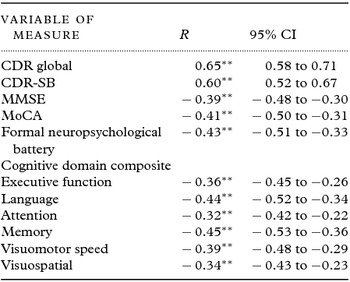
Correlations between the informant AD8 and cognitive tests are shown in Table 2. The total score of the informant AD8 was significantly correlated with the CDR global (R = 0.65, p < 0.01), CDR-SB (R = 0.60, p < 0.01), MMSE (R = −0.39, p < 0.01), MoCA (R = −0.41, p < 0.01), and the global cognitive composite z-score of the formal neuropsychological battery (R = −0.43, p < 0.001). Furthermore, the total score of the informant AD8 was significantly correlated with all cognitive domain composite z-scores of the formal neuropsychological battery such as executive function (R = −0.36, p < 0.01), attention (R = −0.33, p < 0.01), language (R = −0.44, p < 0.01), memory (R = −0.45, p < 0.01), visuoconstruction (R = −0.34, p < 0.01), and visuomotor speed (R = −0.39, p < 0.01).
Concurrent validity of the informant AD8

CDR = clinical dementia rating; CDR-SB = CDR sum of boxes; MMSE = mini-mental state examination; MoCA = montreal cognitive assessment.
Construct validity of the AD8
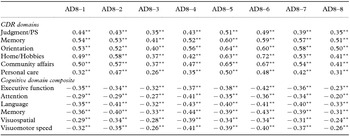
Correlations between individual items of the informant AD8 and domains of the CDR and cognitive domains of the formal neuropsychological battery are shown in Table 3. Item 1 (problems with judgment) was convergent with almost all CDR domains (R (range) = 0.44–0.54, p < 0.001) except personal care (R = 0.32, p < 0.001) and divergent with the attention (R = −0.29, p < 0.001) and visuoconstruction (R = −0.29, p < 0.001) domains of the formal neuropsychological battery. Item 2 (loss of interest) was convergent with all CDR domains (R (range) = 0.43–0.58, p < 0.001) and the language (R = −0.41, p < 0.001) and memory (R = −0.40, p<0.001) domains of the formal neuropsychological battery but divergent with attention (R = −0.29, p < 0.001). Item 3 (repeating statements) was convergent with the memory (R = 0.41, p < 0.001) and orientation (R = 0.40, p < 0.001) domains of the CDR but divergent with personal care (R = 0.26, p < 0.001) and the attention (R = −0.27, p < 0.001), visuoconstruction (R = −0.28, p < 0.001), and visuomotor speed (R = −0.26, p < 0.001) domains of the formal neuropsychological battery. Items 4 (trouble learning appliances, was convergent with almost all CDR domains (R (range) = 0.42–0.54, p < 0.001) and cognitive domains of the neuropsychological battery (R (range) = 0.41–0.43, p < 0.001) except personal care (R = 0.35, p < 0.001), executive function (R = −0.37, p < 0.001), and visuoconstruction (R = −0.39, p < 0.001). Item 5 (forgetting the current month and year) was convergent with all CDR domains (R (range) = 0.51–0.65, p < 0.001) and the language domain (R = −0.40, p < 0.001) of the formal neuropsychological battery. Item 6 (trouble handling finances) was convergent with all CDR domains (R (range) = 0.48–0.72, p < 0.001) and executive function (R = −0.42, p < 0.001), language (R = −0.42, p < 0.001), memory (R = −0.43, p < 0.001), visuomotor speed (R = −0.40, p < 0.001) domains of the formal neuropsychological battery. Item 7 (trouble remembering appointments) was convergent with almost all CDR domains (R (range) = 0.42–0.58, p < 0.001) and the language domain (R = −0.42, p < 0.001) of the formal neuropsychological battery. Item 8 (consistent memory problems) was convergent with almost all CDR domains (R (range) = 0.41–0.51, p < 0.001) except judgment/problem solving (R = 0.35, p < 0.001) and personal care (R = 0.31, p < 0.001) and divergent with all domains of the formal neuropsychological battery (R (range) = −0.20 to −0.26, p < 0.001) except language (R = −0.33, p < 0.001) and memory (R = −0.31, p < 0.001).
Construct validity of the informant AD8

CDR = clinical dementia rating; AD8–1 = problems with judgment; AD8–2 = loss of interest; AD8–3 = repeating stories and statements; AD8–4 = learning how to use a new appliance; AD8–5 = forgets correct month or year; AD8–6 = difficulty handling finances; AD8–7 = difficulty remembering appointments; AD8–8 = consistent problems with thinking or memory.
**p < 0.001.
Discussion
To the best of our knowledge, the present study is the first to examine the validity and reliability of the informant AD8 to detect cognitive dysfunction in primary healthcare. We have shown that the brevity of the informant AD8 is ideal for the detection of cognitive dysfunction in busy primary healthcare centers. Finally, we have demonstrated that the informant AD8 has excellent internal consistency, inter-rater reliability, test–retest reliability, good concurrent, and construct validity. Therefore, the reliable and valid psychometric properties of informant AD8 established in the present study further support a recent study on the clinical utility of the informant AD8 for dementia case finding in the primary healthcare setting (Chan et al., 2015).
The short administration time (< 3 minutes) of the informant AD8 is consistent with previous studies (Galvin et al., Reference Galvin, Roe, Xiong and Morris2006; Ryu et al., Reference Ryu, Kim and Han2009; Correia et al., Reference Correia2011; Dong et al., Reference Dong2013). This is more desirable than the MoCA which was reported to have an average administration time of 12 minutes (Wong et al., Reference Wong2009) and the MMSE which requires an average administration time of 6–10 minutes (Lin et al., Reference Lin, O’Connor, Rossom, Perdue and Eckstrom2013). Moreover, the informant AD8 demonstrated excellent internal consistency, inter-rater reliability, and test–retest reliability for routine administration in primary healthcare. Therefore, the informant AD8 seems to be more fitting as a quick and reliable instrument to detect cognitive dysfunction in the primary healthcare settings.
Further to the brevity and reliability of AD8, the present study also established the concurrent validity of the informant AD8 in primary healthcare. The significant correlations between the total score of the AD8 and CDR global, CDR-SB, MMSE, MoCA, and neuropsychological domain performance were consistent with previous findings in tertiary healthcare and community settings (Galvin et al., Reference Galvin, Roe, Xiong and Morris2006; Ryu et al., Reference Ryu, Kim and Han2009; Koski et al., Reference Koski, Xie, Konsztowicz and Tetteh2010; Correia et al., Reference Correia2011; Yang et al., Reference Yang, Galvin, Morris, Lai, Chou and Liu2011) and thus support the use of the informant AD8 for the detection of cognitive dysfunction in primary healthcare. The informant AD8 may also be used for follow-up evaluation on patients who refuse specialist memory clinic services. This is a novel utility of the AD8 as the present study demonstrated a refusal rate of 71.3% in primary healthcare patients for further evaluations. Given that comprehensive clinical assessments are unlikely to be conducted in primary healthcare settings due to time constraints, functional changes in patients who refuse cognitive evaluations may go undetected if there is an over reliance on performance based instruments alone (Galvin et al., Reference Galvin, Fagan, Holtzman, Mintun and Morris2010). Commonly used tests such as the MMSE are influenced by education and culture and are insensitive to the early signs of dementia (Galvin et al., Reference Galvin, Roe, Xiong and Morris2006). By comparison, the informant AD8 is more advantageous because it is designed to measure functional decline and has a stronger association with the CDR global as compared to performance-based tests (Koski et al., Reference Koski, Xie, Konsztowicz and Tetteh2010).
In addition to the good concurrent validity, the informant AD8 demonstrated acceptable construct validity in primary healthcare setting. First, this was demonstrated by significant associations with all CDR domains and cognitive domains of a formal neuropsychological battery. The significant correlations between individual items of the informant AD8 and all domains of the CDR are consistent with the findings of the Korean-AD8 in a memory clinic setting (Ryu et al., Reference Ryu, Kim and Han2009). Second, individual AD8 items demonstrated convergent validity with almost all CDR domains. This suggests that primary healthcare physicians may consider the informant AD8 for the monitoring of the functional decline in screened positive patients who refuse follow-up evaluation at specialist memory clinic. Third, items 2 (loss of interest), 4 (trouble learning new appliances), 5 (forgetting month and year), 6 (trouble handling finances), and 7 (trouble remembering appointments) were the only informant AD8 items which demonstrated convergent validity with the cognitive domains in formal neuropsychological battery. Each item was associated with at least a memory domain or language domain or both. These associations are supported by extensive evidence which demonstrates memory and language impairments to be present in the early stages of AD and throughout its progression (Stopford et al., Reference Stopford, Thompson, Neary, Richardson and Snowden2012; Verma and Howard, Reference Verma and Howard2012). Furthermore, item 6 (trouble handling finances) was the only item convergent with executive function and visuomotor speed was associated with both item 6 and item 4 (trouble learning new appliances) alone. However, in the original validation study conducted by Galvin and colleagues, only item 1 (problems with judgment) was identified as a measure of executive deficits (Galvin et al., Reference Galvin, Roe, Xiong and Morris2006). Executive function is considered to be a reflection of an individual's cognitive reserve (Tucker and Stern, Reference Tucker and Stern2011). Cognitive reserve has been shown to delay the progression of dementia and there is extensive evidence that indicates higher educational attainment as one of the standard proxies for building cognitive reserve (Tucker and Stern, Reference Tucker and Stern2011). Hence, given that the population of the original validation study had higher mean educational attainment (13.7 ± 3 years) than the population of the present study (5.7 ± 5.1 years), it is possible that patients in previous study had larger cognitive reserve which allowed them to retain more functional executive abilities such as the handling of personal finances and learning. Furthermore, the lack of convergent validity between items 1 (problems with judgment), 3 (repeating statements), and 8 (daily problems with memory) with neuropsychological tests seems to suggest that informants of the present study do not perceive these symptoms as signs of cognitive decline. Similarly, in a previous study involving different cultural groups in the UK, patients and informants who believed that dementia was due to normal aging showed less treatment seeking behaviors despite the recognition of early symptoms (Mukadam et al., 2011). Hence, in combination with the detection of cognitive dysfunction, primary healthcare centers service providers should educate patients and their informants regarding the importance of detecting dementia to facilitate treatment seeking behaviors in screened positive patients (Mukadam et al., 2011).
Several limitations in the present study should be acknowledged. First, the low response rate found in this study may be due to the lack of understanding of the benefits and risks associated with cognitive screening. Furthermore, the social stigma associated with dementia may have influenced the decisions of older adults in this study to be followed up at a specialist memory clinic. The rate of refusal and ineligibility in the present study was consistent with previous studies conducted in a different primary healthcare centers (Boustani et al., Reference Boustani2005; Dong et al., Reference Dong, Cheng, Tsou, Chan and Chen2014). Second, a large number of participants who were screened did not consent to participate in a follow-up formal neuropsychological evaluation in phase 2. High rate of refusal for follow-up assessment implies that a substantial number of individuals remain unevaluated. Primary healthcare settings should take this limitation into account by encouraging screened positive patients to attend follow-up assessments at a specialist memory clinic. Third, as our sample is largely Asian, it is unknown whether these results are generalizable to the primary healthcare settings in the West due to different cultural practice and beliefs regarding aging. Future studies could examine if the AD8 has inter-cultural equivalence in detecting cognitive dysfunction in primary healthcare centers in the West.
In conclusion, the informant AD8 demonstrated good concurrent and construct validity and is a reliable measure to detect cognitive dysfunction in primary healthcare.
Conflict of interest
None.
Description of author's roles
M. A. Shaik participated in data acquisition, data analysis, drafting, and revising the manuscript. X. Xu provided inputs for writing and data analysis of the paper and revised the manuscript for intellectual content. Q. L. Chan participated in data acquisition and revised the manuscript for intellectual content. R. J. Y. Hui provided onsite supervision and revised the manuscript for intellectual content. S. S. T. Chong provided onsite supervision and revised the manuscript for intellectual content. C. L-H. Chen was responsible for the study concept and design, provided overall supervision of study conduct and provided inputs for drafting and revising the manuscript. Y. Dong designed the study, secured the funding, supervised study operation and the drafting of this manuscript, as well as provided critical revision of this manuscript.