Implications
We have documented that the milk content of specific potential health-affecting compounds may be manipulated in a predicted direction by diet composition. This implicates that milk can be designed to contain defined levels of specific compounds transferred from the diet. Examples of this are that phyto-oestrogens are transferred to milk when cows are fed high amounts of leguminous plants like clover.
Introduction
In order to increase the sale of organic milk, new specially produced organic milk types with improved taste and potential health benefits are developed. This can be done through feeding of cows with legumes or herbs containing flavour and components with possible positive impacts on health that are transferred to the milk. As for health components phyto-oestrogens are of interest.
Phyto-oestrogens are a large group of naturally occurring non-steroidal plant-derived compounds with a diverse structure. Phyto-oestrogens have been shown to behave as weak oestrogen agonists/antagonists in both animals and humans (Benassayag et al., Reference Benassayag, Perrot-Applanat and Ferre2002) and studies in humans, animals and cell cultures suggest that dietary phyto-oestrogens may play an important role in the prevention of menopausal symptoms, osteoporosis, hormone-dependent cancers and heart disease (Kurzer and Xu, Reference Kurzer and Xu1997). Hence, milk with an increased content of phyto-oestrogens could be of significant interest.
Cows mainly ingest phyto-oestrogens from legumes. Among the legumes, red clover has the highest total concentration of phyto-oestrogens varying from 1% to 2.5% of dry matter (DM), while the concentration of phyto-oestrogens in white clover is 0.02% to 0.06% of DM (Saloniemi et al., Reference Saloniemi, Wähälä, Nykänen-Kurki, Kallela and Saastamoinen1995). Both red and white clovers primarily contain isoflavones such as formononetin, genistein, daidzein and biochanin A (Steinshamn et al., Reference Steinshamn, Purup, Thuen and Hansen-Møller2008). Lucerne only contains small quantities of isoflavones (Saloniemi et al., Reference Saloniemi, Wähälä, Nykänen-Kurki, Kallela and Saastamoinen1995). Lignans are primarily found in cereals, legumes and oilseed used in concentrates (Thompson et al., Reference Thompson, Robb, Serraino and Cheung1991), and occur in somewhat higher concentrations in white clover compared to red clover (Steinshamn et al., Reference Steinshamn, Purup, Thuen and Hansen-Møller2008).
In bovine milk, the concentration of the isoflavones, formononetin, biochanin A, daidzein and genistein, have been found to range from 0.1 to 7.7 μg/l, the concentration of the isoflavone metabolite equol between 45 and 364 μg/l and the lignan enterolactone between 19 and 96 μg/l (Antignac et al., Reference Antignac, Cariou, Le Bizec and André2004; Steinshamn et al., Reference Steinshamn, Purup, Thuen and Hansen-Møller2008; Andersen et al., Reference Andersen, Hansen-Møller, Weisbjerg and Sejrsen2009). In general, organic milk has a higher concentration of isoflavones than conventionally produced milk due to the more widespread use of leguminous plants in organic feeding (Antignac et al., Reference Antignac, Cariou, Le Bizec and André2004; Purup et al., Reference Purup, Hansen-Møller, Sejrsen, Christensen, Lykkesfeldt, Leffers and Skakkebæk2005; Hoikkala et al., Reference Hoikkala, Mustonen, Saastmoinen, Jokela, Teponen, Saloniemi and Wähälä2007). Steinshamn et al. (Reference Steinshamn, Purup, Thuen and Hansen-Møller2008) found that milk from cows fed red clover silage had a significantly and several times higher concentration of isoflavones compared to milk from cows fed white clover silage. For example, the concentration of biochanin A, equol and formononetin in the milk was on average 5.0, 4.3 and 2.4 times higher, respectively, in cows fed red clover v. white clover silage. In contrast, milk from cows fed white clover silage had the highest concentration of the lignans enterodiol and enterolactone (on average 1.75 and 1.37 times higher, respectively). The effects of silage type on the concentration of the individual phyto-oestrogens in the milk were related to the intake of the compound or its precursor, which implies that it is possible to influence the concentration of the phyto-oestrogens in bovine milk. However, there is limited knowledge on the concentration of phyto-oestrogens in milk from cows on different diets and at different time periods throughout the year.
In this study, the concentrations of phyto-oestrogens in milk from cows grazing red clover, white clover, lucerne or chicory-rich swards were measured during two summer months. Our hypothesis was that the milk content of phytoestrogens can be manipulated by diet composition. No literature exists on phyto-oestrogens in chicory, but chicory was included in the study due to its flavour components. However, only the concentration of phyto-oestrogens is included in this article as the taste of the milk is reported elsewhere.
Material and methods
Pasture
A grazing study was performed in the summer 2006 at the organic research station Rugballegaard (55°52′N, 9°47′E), Denmark, with four treatment diets: white clover, red clover, lucerne and chicory-rich swards.
Swards with lucerne (Medicargo sativa L., Pondus), red clover (Trifolium pratense L., Rajah), white clover (Trifolium repens L., Milo) and white clover together with chicory (Cichorium intybus L., Puna), respectively, were established in 2005 together with perennial ryegrass (Lolium perenne L.), 35% Calibre (medium tetraploid), 30% Sameba (late diploid) and 35% Tivoli (late tetraploid) in two replicate paddocks. The swards were unfertilized and irrigated at high drought stress. The paddocks were approximately 1.8 ha each (see Eriksen et al. (Reference Eriksen, Søegaard, Kristensen, Fretté, Wiking and Nielsen2007) for further details).
Before grazing, the area in each paddock was adjusted with a fence to ensure the same amount of herbage per cow in all paddocks. As little social contact as possible between the groups was ensured during allocation to the paddocks.
The cows were on pasture 20 h daily, supplemented with 6.2 kg DM/cow per day (oats 82%, hay 16%, mineral mix 2%), fed twice daily after milking (0500 h and 1600 h).
Before each experimental period the cows grazed a traditional white clover/perennial ryegrass field, and from five days before the start of each period, cows were fed the experimental concentrates in the stable.
Animals and experimental design
Forty-eight lactating Holstein dairy cows, 140 ± 98 days in milk (mean ± s.d.), with milk yield 30.4 ± 5.7 kg energy corrected milk were, before each of the two periods, blocked according to milk yield and parity (1, 2 and >2), randomly within block allocated to one of the four treatments. The cows grassed the paddocks in two periods (May and June). Each period lasted 14 days with start on day 1 after morning milking and finishing on day 15 after morning milking. The cows grazed the two statistical replicates in relation to crop production alternately with one day in each paddock.
Data collection
Individual milk samples were collected on day 15 during morning milking in the experimental period. One sample from June was missing. The milk samples were frozen immediately after collection and stored at −20°C until analysis for phyto-oestrogens.
Individual milk yield was measured and concentration of fat and protein analysed three times during the period. Sward productivity was estimated indirectly in an area fenced off during the period. In the beginning and after one week of grazing the herbage mass and the botanical composition were determined in 0.5 m2 samples in the grazed area and in the fenced area (Eriksen et al., Reference Eriksen, Søegaard, Kristensen, Fretté, Wiking and Nielsen2007).
Prior to each grazing period, samples of herbage were collected by tearing off plant parts above stubble height (5 to 6 cm) by hand. This was to get a sample more representative for animal intake than the samples cut at the soil surface. Approximately 2 kg of fresh plant material was sampled. A sub-sample of 1 kg was frozen at −20°C within 15 min and used for analysis of phyto-oestrogens. Botanical composition was assumed similar in both samples. The stubble height was approximated to the lowest grazing height of the cows in the individual paddocks. Samples were collected separately in the two paddocks. The botanical composition was determined by hand separation in sub-samples, drying and weighing.
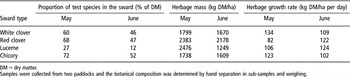
Registrations made on herd and sward productivity and botanical composition for May and June, respectively, are shown in Table 1. Generally, the proportion of legumes and chicory was high in the mixtures. However, the proportion of lucerne in both periods was considerably lower than the other three mixtures and only 12% in June caused by a too short rest period from May. The proportion of clover, lucerne and chicory was considerably higher in May compared with June.
Proportion of the test species in the sward and herbage mass at the beginning of each period, and growth rate during the first week of the 2-week experimental period

DM = dry matter.
Samples were collected from two paddocks and the botanical composition was determined by hand separation in sub-samples and weighing.
Analysis of phyto-oestrogens in herbage and milk samples
Herbage mixture samples from the first day of the experimental period were analysed in single measurements and milk samples were analysed in duplicate for the concentration of chrysin, naringenin, biochanin A, formononetin and glycitein. The milk samples were also analysed for the concentration of daidzein, equol, enterodiol and enterolactone. Standards for daidzein, naringenin, genistein, apigenin and formononetin were purchased from Extrasynthese (Genay, France). All other standards were purchased from Sigma-Aldrich (Brøndby, Denmark).
The flavonoids in the herbage mixture samples were extracted by dipping 50 g frozen aerial parts of pasture sample in liquid nitrogen and immediately placing it in a kitchen blender, resulting in a fine (particle size < 0.5 mm) homogeneous powder. One gram of this powdered grass sample was homogenized in a centrifuge tube (40 ml) for 1 min together with 20 ml 80% aqueous MeOH followed by extraction for 2 h at room temperature. After extraction, the sample was centrifuged (2700 × g for 10 min) and the precipitate discarded. The supernatant was then evaporated to dryness under nitrogen stream. The dried extract was re-solubilized in distilled water and was added 100 μl of β-glucuronidase. The mixture was placed in an oven at 37°C for 1 h and shaken vigorously every 15 min. Post-processing of grass samples after enzymatic hydrolysis is similar to milk samples.
Milk samples (4 ml) were equilibrated to room temperature before addition of 25 μl prunetin (120 ng/ml) as internal standard and 100 μl β-glucuronidase in order to extract aglycones of phyto-oestrogens. The mixture was placed in an oven at 37°C for 1 h and shaken vigorously every 15 min. After centrifugation (10 min at 2700 × g), both the creamy layer and the precipitate were discarded, while the liquid phase was recovered and submitted to solvent extraction with hexane (3 × 3 ml) followed by ethyl acetate (3 × 3 ml). The ethyl acetate extract was evaporated to dryness under a flow of nitrogen. The residue was then re-suspended in 500 μl acetonitrile, filtered in Mini-Uniprep Amber 0.2 μm PTFE (polytetrafluoroethylene) vials from Whatman, VWR Internationals ApS (Herlev, Denmark) and analysed by LC-MS.
Liquid Chromatography-Mass Spectrometry analyses were performed on an Agilent (Waldbronn, Germany) HPLC-DAD-MS station equipped with an HPLC series 1100 comprising a model G1312A binary pump, a model G1379A micro vacuum degasser, a model G1327A thermostated autosampler, a model G1316A thermo stated column compartment, a model G1315B diode-array detector and a model G2707DA LC/MSD SL detector fitted with a model G1948A atmospheric pressure electrospray ionization source (AP-ESI). The station was controlled and the results were monitored with Agilent’s ChemStation software (Rev. A.10.02).
Sample separations were carried out on a Purospher STAR RP-18e column (Merck, Darmstadt, Germany), 250 × 4.0 mm i.d., 5 μm particle size, operated at a temperature of 35°C and with a 0.5 ml/min flow. The solvents used were (A) aqueous 1% formic acid and (B) 1% formic acid in acetonitrile, using a linear gradient programme as follows: 55% B isocratic (10 min), 55% B to 70% B (5 min), 70% B isocratic (5 min), 70% B to 98% B (5 min), 98% B isocratic (5 min), 98% B to 55% B (1 min), 55% B isocratic (10 min). The total time of a run thus was 41 min. The injection volume was 20 μl.
UV spectra were recorded in the range 200 to 600 nm at a rate of 1.25 scans/s. Simultaneously selected wavelengths were monitored separately at 200, 260, 300 and 360 nm. MS spectra of samples were recorded in positive (ESI (electrospray ionisation)) SIM (selected ion-monitoring) mode. The acquisition parameters were as follows: fragmentor 70 V, gain 1 electron multiplier voltage; Spray chamber parameters; Nitrogen was used as drying gas at a flow of 9 l/min and as mobilizing gas at a pressure of 290 kPa and a temperature of 315°C. A potential of +3000 V was used on the capillary.
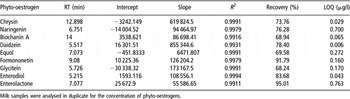
Retention times (RT), regression equations, R 2, recovery % and values for limit of quantitation (LOQ) are shown in Table 2. LOQ was calculated according to Simonsen (Reference Simonsen2006).
Retention times (RT), regression equations (slope and intercept), R 2, recovery (%) and limit of quantitation (LOQ) for analyses of milk samples

Milk samples were analysed in duplicate for the concentration of phyto-oestrogens.
Unfortunately, the MS peak for ion m/z 271 (ion generated in API-ES pos. (atmospheric pressure interface-electrospray positive) for genistein molecular weight (MW) 270) with the RT of genistein actually received the contribution of another compound with the same MW, probably apigenin. Therefore, it was not possible to measure the concentration of genistein. Furthermore, the concentration of daidzein could not be measured in herbage samples.
Statistical analysis
All data were analysed using the GLM procedure of SAS (SAS Institute, 1999). The following statistical model was used:

where: Y = dependent variable, μ = mean, α = fixed effect of period i (May, June), β = fixed effect of diet j (white clover, red clover, lucerne, chicory); random residual variation εijkl ∼ N(0, σ 2). For the analysis of phyto-oestrogens in herbage mixtures the fixed effect of period was excluded. The results are presented as least squares means.
Results
Milk yield
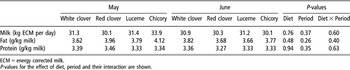
The milk yield, fat and protein concentration, reported in Table 3, show no overall effect of dietary treatment or period.
Effect of dietary treatment on milk yield, fat and protein from 48 lactating Holstein dairy cows in two 15-day periods in May and June, respectively

ECM = energy corrected milk.
P-values for the effect of diet, period and their interaction are shown.
Phyto-oestrogens in herbage samples
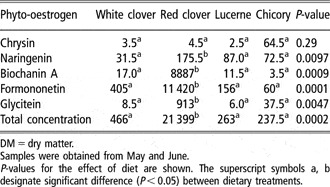
The concentrations of phyto-oestrogens in the herbages are reported in Table 4. The total concentration of phyto-oestrogens was 45 to 90 times higher in red clover mixture compared to the other three herbage mixtures. In particular, the concentration of naringenin, biochanin A, formononetin and glycitein was significantly higher in red clover mixture than in the other herbage mixtures. However, although not significant, the concentration of chrysin was many times higher in the chicory mixture. The total level of phyto-oestrogens in the other three herbage mixtures was similar. In the red clover mixture both biochanin A and formononetin occurred in high concentrations compared to the other phyto-oestrogens. In the white clover mixture the by-far most quantitative phyto-oestrogen was formononetin. In the lucerne and chicory mixtures none of the phyto-oestrogens occurred in relatively high concentrations compared with the mixtures.
Concentration of phyto-oestrogens (mg/kg DM) in pasture mixtures in relation to dietary treatments

DM = dry matter.
Samples were obtained from May and June.
P-values for the effect of diet are shown. The superscript symbols a, b designate significant difference (P < 0.05) between dietary treatments.
Phyto-oestrogens in milk samples
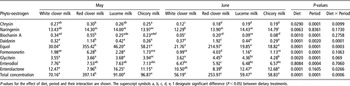
The concentration of phyto-oestrogens in the milk is shown in Table 5 with equol, naringenin and enterolactone being the quantitatively most important phyto-oestrogens. The total concentration of phyto-oestrogens was 4 to 5.6 times higher in milk from the red clover diet compared with the other treatments and more or less comparable for the other three treatments. The concentration of equol, daidzein and formononetin was 6.1 to 11.8, 2.7 to 6.6 and 2.7 to 4 times higher (P < 0.001), respectively, in milk from cows fed the red clover mixture compared with the other treatments, whereas there were no significant differences between white clover, chicory and lucerne. The concentration of biochanin A was significantly higher for red clover compared to the other treatments in May, while no differences were observed in June. For naringenin and glycitein the concentrations were similar across treatments in May but significantly lower for white clover compared to the other treatments in June. The concentration of chrysin was significantly lower for white clover in June compared with the other treatments. Enterolactone was 1.3 to 2 times lower for red clover compared with the other treatments in both periods. Treatment had no effect on the concentration of enterodiol but overall the concentration was lower in June compared with May.
Concentration (μg/l) of phyto-oestrogens in milk in relation to dietary treatments

P-values for the effect of diet, period and their interaction are shown. The superscript symbols a, b, c, d, e, f designate significant difference (P < 0.05) between dietary treatments.
When looking at the effect of period, the total concentration of phyto-oestrogens was significantly decreased from May to June, mainly because of a significant decrease of phyto-oestrogens in milk from cows fed the red clover mixture.
Discussion
Phyto-oestrogens in herbage
To our knowledge only two previous studies have related the concentration of phyto-oestrogens in bovine milk to the concentration of phyto-oestrogen in the diet. Steinshamn et al. (Reference Steinshamn, Purup, Thuen and Hansen-Møller2008) used two diets based on either white clover or red clover silages while Andersen et al. (Reference Andersen, Hansen-Møller, Weisbjerg and Sejrsen2009) among other had one diet based on lucerne silage. When comparing the concentration of phyto-oestrogens in red and white clover mixtures in this study to the red and white clover silages used by Steinshamn et al. (Reference Steinshamn, Purup, Thuen and Hansen-Møller2008), the concentration of formononetin in this study was considerably higher (3.6 to 4 and 2.5 to 3 times, respectively). For biochanin A, the concentration was more or less the same for white clover but considerably higher for red clover. The concentration of formononetin was considerably higher and the concentration of daidzein considerably lower in the lucerne mixture in the present study compared to the lucerne silage in Andersen et al. (Reference Andersen, Hansen-Møller, Weisbjerg and Sejrsen2009). Thus, there was an overall higher concentration of isoflavones in the pastures used in this study than the silages fed in the other two studies. This is likely to reflect a higher concentration of phyto-oestrogens in fresh grass than in silage. Supporting this, Sivesind and Seguin (Reference Sivesind and Seguin2005) found that the concentration of phyto-oestrogen was more or less similar among cultivars of red clover, but that the concentration of total isoflavones was 22% higher in fresh herbage compared to silage and hay. However, it is important to note that ensiling is a dynamic process dependent on many factors (pH, microbial population, temperature, initial herbage composition) that fluctuate, and therefore these factors potentially influence the concentration of isoflavones in silage.
Phyto-oestrogens in milk
Comparing the phyto-oestrogen level in this study to commercial milk samples analysed by Antignac et al. (Reference Antignac, Cariou, Le Bizec and André2004), the concentration of enterodiol was higher for all dietary treatments, but for white clover, lucerne and chicory the concentration of biochanin, daidzein, equol and enterolactone was lower. Thus, white clover, lucerne and chicory pastures do not seem effective in increasing the concentration of phyto-oestrogens in milk. However, for red clover there was an increased concentration of formononetin and equol compared to the commercial milk samples analysed by Antignac et al. (Reference Antignac, Cariou, Le Bizec and André2004). A high concentration of equol has also been observed in other studies with milk from cows fed red clover pastures or in organic milk production where the high concentration of equol seems to be linked to the frequent use of leguminous plants, probably specifically the use of red clover (Antignac et al., Reference Antignac, Cariou, Le Bizec and André2004; Purup et al., Reference Purup, Hansen-Møller, Sejrsen, Christensen, Lykkesfeldt, Leffers and Skakkebæk2005; Hoikkala et al., Reference Hoikkala, Mustonen, Saastmoinen, Jokela, Teponen, Saloniemi and Wähälä2007).
Equol appeared to be the most abundant phyto-oestrogen in milk regardless of the dietary treatment and period. This is in accordance with previous findings (Antignac et al., Reference Antignac, Cariou, Le Bizec and André2004; Hoikkala et al., Reference Hoikkala, Mustonen, Saastmoinen, Jokela, Teponen, Saloniemi and Wähälä2007; Steinshamn et al., Reference Steinshamn, Purup, Thuen and Hansen-Møller2008). The very high concentration of equol in milk from especially cows grazing red clover was expected, since red clover has a high concentration of formononetin (0.8 to 11 mg/g DM) but also biochanin A (0.8 to 5 mg/g DM) depending on the part (flower, stem or leaves) and maturity of the plant, cultivar and environment (Sivesind and Seguin, Reference Sivesind and Seguin2005; Booth et al., Reference Booth, Cassia, Ping, Totura, Deng, Hedayat, Bolton, Pauli and Farnsworth2006). Formononetin is metabolized by microbes in the rumen via daidzein to equol which is the major isoflavone absorbed to the blood circulation after feeding red clover/grass silage, whereas biochanin A is demethylated to genistein to form mainly p-ethyl phenol (Lundh, Reference Lundh1995). Unfortunately, the concentration of daidzein in herbage, and genistein in herbage and milk, could not been analysed in this experiment as previously described.
The concentration of enterodiol was high while the concentration of equol, enterolactone and formononetin was low in the white clover milk compared to results obtained by Steinshamn et al. (Reference Steinshamn, Purup, Thuen and Hansen-Møller2008). The red clover diet resulted in a lower concentration of enterolactone and biochanin A compared to Steinshamn et al. (Reference Steinshamn, Purup, Thuen and Hansen-Møller2008). For the lucerne diet, the concentration of enterodiol and equol was much higher in the present study than observed in milk from cows fed lucerne silage (Andersen et al., Reference Andersen, Hansen-Møller, Weisbjerg and Sejrsen2009). In contrast, this study found a lower concentration of enterolactone and a slightly lower concentration of biochanin A and daidzein. The variation between experiments in the concentration of phyto-oestrogen in the milk is likely to reflect initial differences in the concentration of phyto-oestrogens in the diet but could also be due to differences in the metabolism between pasture and silage.
The concentration of naringenin and chrysin in feedstuffs and milk has not been reported before. Similarly, there are no previous studies on phyto-oestrogens in chicory. The concentration of glycitein in red clover has been reported by Tsao et al. (Reference Tsao, Papadopoulus, Yang, Young and McRae2006) who found similar levels as those found in this study. The concentration of glycitein in the other herbages and milk has not been reported previously.
Compared to sources rich in phyto-oestrogens like soy milk (5 to 10 mg isoflavones/kg) and tofu (13.5 to 67 mg isoflavones/kg) (Committee on Toxicity of Chemicals in Food, 2003), the concentration of phyto-oestrogens in bovine milk is low. Nevertheless, the mixture of many phyto-oestrogens could have an additive or synergistic effect and thus a biological effect. For instance, a recent experiment showed that soy extract is more potent than genistein, the most potent phyto-oestrogen in soy, in inhibiting tumour growth. This is presumably due to the synergistic effect of the various bioactive components in the soy extract (Kim et al., Reference Kim, Jeong and Kim2008). Future studies will have to investigate if there is a biological effect of phyto-oestrogens in bovine milk. This study verifies that it is possible to affect the concentration of phyto-oestrogens in the milk through the feeding and that red clover diets seem to be the most effective way of increasing the concentration of phyto-oestrogens in bovine milk.
Acknowledgements
This work was supported by the Ministry of Food, Agriculture and Fisheries (project No. 3304-F0J0-05-38-01).