

Introduction
Streptococcus suis is widely considered as one of the most important pathogens causing an economic impact in the swine industry. A survey conducted in the USA on common diseases in large commercial swine operations (producing greater than 150,000 pigs per year) found that S. suis was the fourth most significant pathogen in the breeder and weaner site, and the tenth in the finisher site (Holtkamp et al., Reference Holtkamp, Rotto and Garcia2007). The US National Animal Health Management Survey (2006) reported confirmed cases of S. suis infection in 39 and 50% of sites with pre-weaned and nursery-age pigs, respectively. This pathogen is frequently isolated in cases of arthritis, encephalitis, meningitis, pneumonia, polyserositis, and septicemia (Osweiler, Reference Osweiler2003; National Animal Health Monitoring System, 2006). The costs of a potential S. suis outbreak in a farrow-to-finish operation can include (1) associated neonatal septicemia or ‘fading piglet syndrome’ (Sanford et al., Reference Sanford, Schultz and Straw1988), (2) involvement in porcine respiratory disease complex (PRDC) (Higgins et al., Reference Higgins, Gottschalk, Mittal and Beaudoin1990; Gottschalk et al., Reference Gottschalk, Higgins, Jacques, Beaudoin and Henrichsen1991a), (3) post-weaning meningitis or septicemia causing mortality of approximately 20% in untreated animals (Cloutier et al., Reference Cloutier, D'Allaire, Martinez, Surprenant, Lacouture and Gottschalk2003), (4) extra carcass trim as a result of arthritis, which can mean losses in excess of $20,000 per year for a 300-sow operation (Keenliside et al., Reference Keenliside, Gamroth, Bystrom and Perry2006), (5) a 15% decrease in farrowing rate in 3 months (Sanford et al., Reference Sanford, Schultz and Straw1988), and (6) costs associated with animal welfare actions such as treatment of meningitis and arthritis, hospital pen management, and euthanasia for poor-doers surviving septicemia (Blackwell, Reference Blackwell2005; Keenliside et al., Reference Keenliside, Gamroth, Bystrom and Perry2006). Sporadic human cases of infection resulting from contact with swine have been reported in North America (Michaud et al., Reference Michaud, Duperval and Higgins1996; Willenburg et al., Reference Willenburg, Sentochnik and Zadoks2006; Haleis et al., Reference Haleis, Alfa, Gottschalk, Bernard, Ronald and Manickam2009).
S. suis is a capsulated, Gram-positive facultative anaerobic coccus. Capsular type 2, the most common of 35 known serotypes, is associated with disease and is the serotype most likely to express virulence (Gottschalk and Segura, Reference Gottschalk and Segura2000; Higgins and Gottschalk, Reference Higgins and Gottschalk2000; Gottschalk, Reference Gottschalk2004; Messier et al., Reference Messier, Lacouture and Gottschalk2008). Virulence of European and Asian strains, but not North American strains, has been associated with the genes mrp, epf and sly, which encode muramidase-released protein (MRP), extracellular factor (EF), and suilysin (SLY), respectively (Smith et al., Reference Smith, Vecht, Wisselink, Stockhofe-Zurwieden, Biermann and Smits1996; Wisselink et al., Reference Wisselink, Reek, Vecht, Stockhofe-Zurwieden, Smits and Smith1999, Reference Wisselink, Smith, Stockhofe-Zurwieden, Peperkamp and Vecht2000).
The spectrum of disease caused by S. suis includes the asymptomatic carrier state, clinical infection and peracute fatal disease (Higgins and Gottschalk, Reference Higgins, Gottschalk, Straw, D'Allaire, Mengeling and Taylor1999; Gottschalk, Reference Gottschalk, Zimmerman, Karriker, Ramirez, Schwartz and Stevenson2012). S. suis is the most common inhabitant of the tonsils of healthy pigs, with isolation rates as high as 98% (Brisebois et al., Reference Brisebois, Charlebois, Higgins and Nadeau1990; MacInnes et al., Reference MacInnes, Gottschalk, Lone, Metcalf, Ojha, Rosendal, Watson and Friendship2008; Gottschalk, Reference Gottschalk, Zimmerman, Karriker, Ramirez, Schwartz and Stevenson2012). Pigs harboring S. suis in their nasal cavities and tonsils play the most important role in airborne transmission to other pigs (Berthelot-Herault et al., Reference Berthelot-Herault, Gottschalk, Labbe, Cariolet and Kobisch2001). A rise in rectal temperature (up to 42 °C) is typically the earliest clinical sign of S. suis infection, accompanied by inappetence, depression, and lassitude. More severe clinical signs follow, which may include abortion, ataxia, erythema, meningitis, pneumonia, shifting lameness, septicemia, and tremors (Clifton-Hadley et al., Reference Clifton-Hadley, Alexander, Enright and Guise1984; Staats et al., Reference Staats, Feder, Okwumabua and Chengappa1997; Higgins and Gottschalk, Reference Higgins, Gottschalk, Straw, D'Allaire, Mengeling and Taylor1999; Keenliside et al., Reference Keenliside, Gamroth, Bystrom and Perry2006). In peracute cases, sudden death may occur with no previous signs. Arthritis, endocarditis, meningitis, pneumonia and septicemia with sudden death are usually observed in pigs under 12 weeks of age, although the disease has also been reported in pigs up to 32 weeks of age (MacInnes and Desrosiers, Reference MacInnes and Desrosiers1999; Reams et al., Reference Reams, Harrington, Glickman, Thacker and Bowersock1996; Gottschalk, Reference Gottschalk, Zimmerman, Karriker, Ramirez, Schwartz and Stevenson2012).
Pathological manifestations of S. suis are usually limited to the brain, heart, lungs, and joints (Reams et al., Reference Reams, Glickman, Harrington, Thacker and Bowersock1994). S. suis has been recognized as the dominant agent for porcine endocarditis, a sequel to bacteraemia, with bacteria lodging on the valvular endothelium (Jones, Reference Jones1981; Jensen et al., Reference Jensen, Gyllensten, Hofman, Leifsson, Agerholm, Boye and Aalbaek2010; Karstrup et al., Reference Karstrup, Jensen, Aalbaek, Leifsson, Boye and Agerholm2011). Other predominant lesions include arthritis, endocarditis, myocarditis, pericarditis, and suppurative bronchopneumonia (Reams et al., Reference Reams, Glickman, Harrington, Thacker and Bowersock1994). Presumptive diagnosis is based on clinical signs and pathological lesions. Diagnosis is confirmed by biochemical and serological characterization of S. suis isolated from affected pigs (Higgins and Gottschalk Reference Higgins, Gottschalk, Straw, D'Allaire, Mengeling and Taylor1999; Neumann et al., Reference Neumann, Ramirez, Schwartz, Neumann, Ramirez and Schwartz2009; Gottschalk, Reference Gottschalk, Zimmerman, Karriker, Ramirez, Schwartz and Stevenson2012).
S. suis is not only a major problem in the swine industry (Holtkamp et al., Reference Holtkamp, Rotto and Garcia2007): but it has also been recognized as an emerging zoonotic pathogen (Lun et al., Reference Lun, Wang, Chen, Li and Zhu2007; Smith et al., Reference Smith, Capuano, Boese, Myers and Gray2008; Feng et al., Reference Feng, Shi, Zhang, Zhang, Ma, Zheng, Han, Lan, Tang, Cheng, Gao and Hu2009). After the first reports of zoonosis in the Netherlands and England in the early 1950s (Jensen and Dorseen van, Reference Jensen and Dorseen van1957), the disease has been documented worldwide (Walsh et al., Reference Walsh, Williams and Satsangi1992; The Government of the Hong Kong Special Administrative Region, 2005; Lun et al., Reference Lun, Wang, Chen, Li and Zhu2007; Gottschalk et al., Reference Gottschalk, Segura and Xu2007, Reference Gottschalk, Xu, Calzas and Segura2010). S. suis has been recognized as a sporadic cause of human meningitis and septicemia, with significant hearing loss a common sequel (Wertheim et al., Reference Wertheim, Nghia, Taylor and Schultsz2009a; Feng et al., Reference Feng, Zhang, Ma and Gao2010). Outbreaks in Asia have been widely reported, with occupational exposure a common risk factor (Wertheim et al., Reference Wertheim, Nghia, Taylor and Schultsz2009a, Reference Wertheim, Nguyen, Taylor, Lien, Ngo, Nguyen, Nguyen, Nguyen, Nguyen, Nguyen, Dao, Nguyen, Fox, Farrar, Schultsz, Nguyen, Nguyen and Horbyb). In North America, sporadic cases resulting from contact with swine have also been reported (Michaud et al., Reference Michaud, Duperval and Higgins1996; Willenburg et al., Reference Willenburg, Sentochnik and Zadoks2006; Haleis et al., Reference Haleis, Alfa, Gottschalk, Bernard, Ronald and Manickam2009).
Highly effective measures to control S. suis do not exist; thus, interventions to minimize the impact and spread of the disease and to improve response to treatment should be considered. Management practices such as all-in/all-out pig flow, with emphasis on age segregation, proper ventilation, avoiding overcrowding, and strict sanitation of facilities and fomites, are recommended (Staats et al., Reference Staats, Feder, Okwumabua and Chengappa1997; Higgins and Gottschalk, Reference Higgins, Gottschalk, Straw, D'Allaire, Mengeling and Taylor1999; Neumann et al., Reference Neumann, Ramirez, Schwartz, Neumann, Ramirez and Schwartz2009). The objective of this review is to describe antimicrobial resistance patterns and measures to reduce the impact and spread of resistant S. suis strains in swine.
Antimicrobial resistance in S. suis
Antimicrobial resistance patterns
The emergence of resistance to macrolides and lincosamides and the use of these antimicrobial agents in animal husbandry were connected for the first time in Denmark, where the prevalence of antimicrobial resistance among S. suis isolates increased from 0 to 20% over a 15-year period (Aarestrup et al., Reference Aarestrup, Rasmussen, Artursson and Jensen1998). In contrast, no resistance to macrolides or lincosamides was reported in Sweden, where the use of antibiotics as growth promoters had been banned since 1986 (Aarestrup et al., Reference Aarestrup, Rasmussen, Artursson and Jensen1998). After introduction of the macrolide tylosin into the Danish swine industry in 1982, it became the most widely used swine growth promoter in Denmark (Aarestrup, Reference Aarestrup1999). The difference in bacterial resistance observed between Danish and Swedish isolates suggests a link between antibiotic resistance and antibiotic use and points to selective pressure specific for the type of antibiotic used and the bacterial species (Kolar et al., Reference Kolar, Urbanek and Latal2001). Resistance to macrolides and lincosamides has also been observed among S. suis isolates from other countries. In Quebec, Canada, up to 91 and 82% of S. suis isolates were resistant to clindamycin and erythromycin, respectively (Cantin et al., Reference Cantin, Harel, Higgins and Gottschalk1992). Lower resistance rates were found in western Canada: 40 and 27% of S. suis isolates were resistant to clindamycin and erythromycin, respectively (Cantin et al., Reference Cantin, Harel, Higgins and Gottschalk1992). In the USA, a retrospective study of 256 cases over a four-year period (1985–1989) reported that 42 and 45% of 65 serotype 2 isolates were resistant to clindamycin and erythromycin, respectively (Reams et al., Reference Reams, Glickman, Harrington, Bowersock and Thacker1993). In Spain, more than 87% of S. suis isolates were resistant to tetracycline and oxytetracycline, sulphadimethoxine and sulphathiazole, the macrolides erythromycin and tylosin tartrate, and clindamycin (Vela et al., Reference Vela, Moreno, Cebolla, Gonzalez, Latre, Dominguez and Fernandez-Garayzabal2005). In France, 70% of 110 S. suis isolates from healthy and diseased swine were shown to be resistant to erythromycin, spiramycin, tylosin, and lincomycin (Marie et al., Reference Marie, Morvan, Berthelot-Hérault, Sanders, Kempf, Gauthier-Bouchardon, Jouy and Kobisch2002). A slightly lower rate of resistance (71%) was reported among isolates from the Netherlands (Martel et al., Reference Martel, Baele, Devriese, Goossens, Wisselink, Decostere and Haesebrouck2001). In a European study, the percentage of resistance among 2553 S. suis isolates from six countries ranged from 29% in Denmark to 75% in Portugal (Hendriksen et al., Reference Hendriksen, Mevius, Schroeter, Teale, Jouy, Butaye, Franco, Utinane, Amado, Moreno, Greko, Stark, Berghold, Myllyniemi, Hoszowski, Sunde and Aarestrup2008). Macrolide and lincosamide resistance is also prevalent in S. suis isolates from clinically healthy pigs, where rates up to 67% have been reported (Zhang et al., Reference Zhang, Ning, Zhang, Song, Qiu and Gao2008). In humans, resistance of clinical S. suis isolates to clindamycin and macrolides has also been acknowledged, with higher prevalence in recent studies in Asia (approximately 20%) (Ma et al., Reference Ma, Chung, So, Wong, Choi, Cheung, Kam, Chuang and Tsang2008; Hoa et al., Reference Hoa, Chieu, Nghia, Mai, Anh, Wolbers, Baker, Campbell, Chau, Hien, Farrar and Schultsz2011) than in an older study in Canada (8%) (Cantin et al., Reference Cantin, Harel, Higgins and Gottschalk1992). In contrast, S. suis strains isolated from healthy German workers occupied in the pig slaughtering, pork dissecting, and processing industries were highly susceptible to most antibiotics tested, including erythromycin (Strangmann et al., Reference Strangmann, Froleke and Kohse2002).
Tetracycline resistance among S. suis isolates is well documented worldwide. In Denmark, the proportion of isolates resistant to this antimicrobial increased by 39% between 1981 and 1997, while considerably lower levels of resistance were found among isolates from Sweden, where use of tetracycline as a growth promoter for livestock has been prohibited since 1986 (Aarestrup et al., Reference Aarestrup, Rasmussen, Artursson and Jensen1998). Recent studies reported higher levels of tetracycline resistance among S. suis isolates from Europe, ranging from 52% of 557 isolates in Denmark (Hendriksen et al., Reference Hendriksen, Mevius, Schroeter, Teale, Jouy, Butaye, Franco, Utinane, Amado, Moreno, Greko, Stark, Berghold, Myllyniemi, Hoszowski, Sunde and Aarestrup2008) to 95% of 151 isolates in Spain (Vela et al., Reference Vela, Moreno, Cebolla, Gonzalez, Latre, Dominguez and Fernandez-Garayzabal2005). In North America, levels of resistance to tetracycline range from 95% of 65 serotype 2 isolates in the USA (Reams et al., Reference Reams, Glickman, Harrington, Bowersock and Thacker1993) to 100% in some capsular types among 92 isolates in Canada (Cantin et al., Reference Cantin, Harel, Higgins and Gottschalk1992). In Asia, tetracycline resistance in S. suis isolates from both diseased and healthy pigs is also common (up to 92%) (Kataoka et al., Reference Kataoka, Yoshida and Sawada2000; Zhang et al., Reference Zhang, Ning, Zhang, Song, Qiu and Gao2008). High levels of tetracycline resistance (up to 90%) have also been reported among S. suis isolates from diseased and clinically healthy persons (Strangmann et al., Reference Strangmann, Froleke and Kohse2002; Ma et al., Reference Ma, Chung, So, Wong, Choi, Cheung, Kam, Chuang and Tsang2008; Hoa et al., Reference Hoa, Chieu, Nghia, Mai, Anh, Wolbers, Baker, Campbell, Chau, Hien, Farrar and Schultsz2011). In contrast, a 1992 report showed that only 8% of 12 S. suis isolates from human cases in the Netherlands were resistant to tetracyclines (Cantin et al., Reference Cantin, Harel, Higgins and Gottschalk1992).
The prevalence of penicillin resistance among S. suis isolates from pigs varies among countries, but is generally low. S. suis isolates were reported to be 100% susceptible to penicillin in Denmark (120 strains), Sweden (13 strains) (Aarestrup et al., Reference Aarestrup, Rasmussen, Artursson and Jensen1998), the Netherlands (87 and 762 strains isolated in 2000 and 2003, respectively) (Martel et al., Reference Martel, Baele, Devriese, Goossens, Wisselink, Decostere and Haesebrouck2001; Hendriksen et al., Reference Hendriksen, Mevius, Schroeter, Teale, Jouy, Butaye, Franco, Utinane, Amado, Moreno, Greko, Stark, Berghold, Myllyniemi, Hoszowski, Sunde and Aarestrup2008), western Canada (15 strains) (Cantin et al., Reference Cantin, Harel, Higgins and Gottschalk1992), North and West Japan (303 strains) (Kataoka et al., Reference Kataoka, Yoshida and Sawada2000), England and Wales (87 strains), and France (711 strains) (Hendriksen et al., Reference Hendriksen, Mevius, Schroeter, Teale, Jouy, Butaye, Franco, Utinane, Amado, Moreno, Greko, Stark, Berghold, Myllyniemi, Hoszowski, Sunde and Aarestrup2008). In contrast, 0.9 to 13% of isolates were reported resistant to penicillin in Denmark (357 strains), Poland (412 strains), Portugal (24 strains) (Hendriksen et al., Reference Hendriksen, Mevius, Schroeter, Teale, Jouy, Butaye, Franco, Utinane, Amado, Moreno, Greko, Stark, Berghold, Myllyniemi, Hoszowski, Sunde and Aarestrup2008), Spain (151 strains) (Vela et al., Reference Vela, Moreno, Cebolla, Gonzalez, Latre, Dominguez and Fernandez-Garayzabal2005), Quebec (15 strains) (Cantin et al., Reference Cantin, Harel, Higgins and Gottschalk1992), Central Japan (386 strains) (Kataoka et al., Reference Kataoka, Yoshida and Sawada2000), and China (421 strains) (Zhang et al., Reference Zhang, Ning, Zhang, Song, Qiu and Gao2008). In a US study, 25% of 65 isolates of S. suis were resistant to penicillin (Reams et al., Reference Reams, Glickman, Harrington, Bowersock and Thacker1993). Human studies report that S. suis isolates from both diseased and clinically healthy persons are highly susceptible to penicillin, with 0% resistance (Cantin et al., Reference Cantin, Harel, Higgins and Gottschalk1992; Strangmann et al., Reference Strangmann, Froleke and Kohse2002; Ma et al., Reference Ma, Chung, So, Wong, Choi, Cheung, Kam, Chuang and Tsang2008; Hoa et al., Reference Hoa, Chieu, Nghia, Mai, Anh, Wolbers, Baker, Campbell, Chau, Hien, Farrar and Schultsz2011).
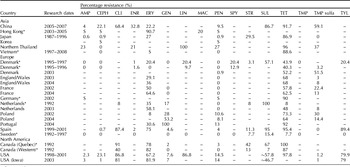
A detailed listing of resistance patterns for S. suis isolates from different countries for the most commonly used antimicrobial agents in pig production is shown in Table 1.
A detailed listing of resistance patterns for S. suis isolates from various countries for the most commonly used antimicrobial agents in pig production

* : Serotype 2.
-: No data available; S: Reported as sensitive but no percentage provided.
Abbreviations: AMP=ampicillin; CEPH=cephalosporins (ceftiofur); CLI=clindamycin; ENR=enrofloxacin; ERY=erythromycin; GEN=gentamicin; LIN=lincomycin; MAC=macrolides (erythromycin, spiramycin, and tylosin); PEN=penicillin; SPY=spiramycin; STR=streptomycin; SUL=sulphonamides; TET=tetracycline; TMP=trimethoprim; TMPsulfa=trimethoprim/sulphamethoxazole; TYL=tylosin.
Many antimicrobials used in veterinary medicine belong to the same classes as antimicrobials used to treat humans (McEwen and Fedorka-Cray, Reference McEwen and Fedorka-Cray2002). Use of antimicrobials in livestock may allow transfer of resistant bacteria among animals, and resistance genes may be transferred to both commensal organisms and animal or human pathogens (McEwen and Fedorka-Cray, Reference McEwen and Fedorka-Cray2002). Increased human morbidity and mortality associated with failure of standard treatments are indirect costs associated with antimicrobial resistance. Treatment failure also initiates a need for newer, typically more expensive, antibiotics to replace those that become ineffective (Hawkey, Reference Hawkey2008). It has been suggested that S. suis may act as an antibiotic resistance reservoir contributing to the spread of resistance genes to streptococcal human pathogens such as Streptococcus pyogenes, Streptococcus pneumoniae, and Streptococcus agalactiae (Palmieri et al., Reference Palmieri, Varaldo and Facinelli2011). Thus, occurrence of relatively high levels of resistance of S. suis to some antimicrobials (e.g. macrolides, lincosamides, tetracyclines, and sulphonamides) may represent a human health concern.
Mechanisms of resistance
Resistance of S. suis to lincosamides (lincomycin and clindamycin), macrolides (erythromycin, spiramycin, and tylosin), tetracycline, and sulphonamides has been acknowledged in many countries, with reporting rates up to 85% (Strangmann et al., Reference Strangmann, Froleke and Kohse2002; Vela et al., Reference Vela, Moreno, Cebolla, Gonzalez, Latre, Dominguez and Fernandez-Garayzabal2005; Zhang et al., Reference Zhang, Ning, Zhang, Song, Qiu and Gao2008; Hoa et al., Reference Hoa, Chieu, Nghia, Mai, Anh, Wolbers, Baker, Campbell, Chau, Hien, Farrar and Schultsz2011). Although mechanisms of resistance of S. suis have not been well documented, recent studies have reported on the determinants that may be involved in resistance of S. suis to different antibiotics. For instance, S. suis resistance to tetracycline is most often mediated by ribosomal protection genes tet(M) and tet(O) and less frequently by tet(Q), tet(T), tet(W) and by efflux pump genes tet(K) and tet(L) (Hoa et al., Reference Hoa, Chieu, Nghia, Mai, Anh, Wolbers, Baker, Campbell, Chau, Hien, Farrar and Schultsz2011; Palmieri et al., Reference Palmieri, Varaldo and Facinelli2011). The mechanisms of resistance to macrolides are modification of the methylase-mediated target site by the product of erm(B) and less frequently active efflux by products of mef (A) and mef (E) (Palmieri et al., Reference Palmieri, Varaldo and Facinelli2011). Resistance to fluoroquinolones is mainly due to single-point mutations in the quinolone-resistance determining regions parC and gyrA (Escudero et al., Reference Escudero, San Millan, Catalan, de la Campa, Rivero, Lopez, Dominguez, Moreno and Gonzalez-Zorn2007, Reference Escudero, San Millan, Gutierrez, Hidalgo, La Ragione, AbuOun, Galimand, Ferrandiz, Dominguez, de la Campa and Gonzalez-Zorn2011; Palmieri et al., Reference Palmieri, Varaldo and Facinelli2011), and to satAB, encoding an efflux pump (Escudero et al., Reference Escudero, San Millan, Gutierrez, Hidalgo, La Ragione, AbuOun, Galimand, Ferrandiz, Dominguez, de la Campa and Gonzalez-Zorn2011). The mechanism of S. suis resistance to penicillin, a ß-lactam, is modification of penicillin-binding proteins, either altered molecular weight or decreased affinity for penicillin or both (Cain et al., Reference Cain, Malouin, Dargis, Harel and Gottschalk1995). The relatively low levels of penicillin resistance in S. suis strains may be related to this unusual mechanism (Gottschalk et al., Reference Gottschalk, Turgeon, Higgins, Beaudoin and Bourgault1991b; Cain et al., Reference Cain, Malouin, Dargis, Harel and Gottschalk1995). Recent studies (Hu et al., Reference Hu, Yang, Zhang, Wu, Chen, Hua, Yu, Chen, Xiao and Jin2011; Ge et al., Reference Ge, Wu, Xia, Yang, Xiao and Yu2012) have shown that resistance of S. suis multi-drug resistant strain R61 to cefuroxime, a ß-lactam and second generation cephalosporin, is mediated by mutations in key sites of the penicillin-binding protein PBP2x. Limited information exists on the genetic bases of resistance to other classes of antimicrobials, including aminoglycosides, trimethoprim-sulfamethoxazole, and chloramphenicol (Palmieri et al., Reference Palmieri, Varaldo and Facinelli2011).
Prudent drug use and measures to reduce the impact and spread of antimicrobial-resistant S. suis in swine
Specific strategies to ensure prudent use of antimicrobials in swine do not exist. Approaches to reduce the impact and spread of S. suis and antimicrobial resistance should be focused on measures that improve the management and environment of the pigs, together with strategic medication of clinically diseased animals (Amass et al., Reference Amass, Wu and Clark1996b). The main goal of prudent use of antimicrobials in agriculture is to ‘maximize therapeutic efficacy while minimizing bacterial resistance’ (Health Canada, 2002). The ‘choice’ and the ‘use’ of the right antimicrobial are two important aspects of this principle. Choice of the right antimicrobial should be based on an accurate diagnosis, including clinical evaluation, past experience, farm epidemiological status, and sensitivity testing. The selected antimicrobial should be approved for the species and indicated for the disease of concern. In addition, drug pharmacokinetic parameters, immune system of the diseased animal (e.g. bactericidal antimicrobials preferred for immune-suppressed patients), and spectrum of activity should be considered (i.e. broad-spectrum antimicrobials exert selection pressure for resistance on more non-target bacterial species) (Federation of Veterinarians of Europe, 2012). The appropriate use of the right antimicrobial depends on carefully following the label instructions together with veterinarian prescription and advice regarding dosage regimen, duration of treatment, group of animals to be treated (sick only versus both sick and healthy animals), withdrawal time, and disposal of unused antimicrobials and containers (Federation of Veterinarians of Europe, 2012).
Preventive measures for optimization of management and the environment of pigs are described under five categories.
Good environmental and handling practices
Implementation of good environmental and handling practices are encouraged to reduce stress caused by excessive temperature fluctuation, high relative humidity, crowding, and mixing pigs differing by ≥2 weeks of age (Dee et al., Reference Dee, Carlson, Winkelman and Corey1993). Co-infection with PRRS virus results in more severe clinical S. suis disease (Thanawongnuwech et al., Reference Thanawongnuwech, Brown, Halbur, Roth, Royer and Thacker2000). Thus, strategies that prevent introduction of PRRS virus into a herd or reduce incidence of clinical signs of PRRS may reduce incidence and severity of clinical S. suis.
Continuous-flow facilities, fomites (surfaces in contact with manure), rodents, flies, and nutritional deficiencies have been associated with farms carrying high rates of S. suis (Dee et al., Reference Dee, Carlson, Winkelman and Corey1993). All-in/all-out pig flow schemes help to reduce the microbial load in an existing facility when appropriate disinfectants and hot water, power washer equipment are used (Dee and Corey, Reference Dee and Corey1993). Periodic disinfection of mechanical vectors, use of unique needles in the stoppers of bottles containing drugs or vaccines, prompt removal and appropriate disposal of dead pigs (Dee and Corey, Reference Dee and Corey1993), and fly and rodent control strategies are recommended, together with supplementation of pigs with selenium and vitamin E.
Creating S. suis-free herds
Several strategies have been investigated, including deriving pigs via caesarean section, which is effective (Amass et al., Reference Amass, Struve, Clark and Wu1996a) but impractical for the swine industry. Removal of pigs from dams at birth is ineffective (Amass et al., Reference Amass, SanMiguel and Clark1997). Absence of clinical signs due to S. suis serotype 2 has been considered successful in eradicating the organism. However, several antimicrobial regimens were unable to eliminate the carrier state (Amass et al., Reference Amass, Wu and Clark1996b), and the lack of sensitive tools to monitor for S. suis serotype 2 in tonsils of clinically healthy pigs is problematic.
Prophylactic antimicrobial therapy at times of potential stress
Factors to be considered when initiating prophylactic antimicrobial therapy in a herd with a history of clinical S. suis include prior or concurrent efforts to reduce risk factors and pharmaco-kinetic considerations such as bioavailability, route of administration, and serum concentration of the drug required to kill S. suis (Amass et al., Reference Amass, SanMiguel and Clark1997; Gottschalk, Reference Gottschalk2004). Given the reported prevalence of susceptible isolates, penicillins may be considered for prophylaxis. Historically, in-feed procaine penicillin significantly reduced prevalence of S. suis meningitis in an affected herd (McKellar et al., Reference McKellar, Baxter, Taylor and Bogan1987). This is noteworthy, since studies in swine suggest that absorption of penicillin G is very limited when administered orally, and that penicillin V is the only form sufficiently absorbed to achieve therapeutic serum levels (McKellar et al., Reference McKellar, Baxter, Taylor and Bogan1987; Friendship, Reference Friendship, Giguere, Prescott, Baggot, Walker and Dowling2006). However, there is no commercially available form of penicillin V for oral administration in animals in Canada. Water-soluble penicillin G at a dose of 40,000 IU kg−1 body weight continues to be successfully used, possibly as a result of achieving therapeutic levels on the tonsils where colonization first occurs (P. Dowling, personal communication). Other water solubles such as tetracyclines (tetracycline, chlortetracycline, or oxytetracycline at a dose of 55–110 mg L−1) or sulphamethazine (80–130 mg L−1) may be used if recent on-farm culture and susceptibility results suggest that resident potentially pathogenic strains are sensitive (Friendship, Reference Friendship, Giguere, Prescott, Baggot, Walker and Dowling2006).
Vaccination
After several decades of investigation, the limited acceptance of S. suis vaccines is noteworthy, given the prevalence and burden of the pathogen. The National Animal Health Monitoring System (2006) has reported that less than 7% of US herds use a vaccine. Although a few S. suis vaccines are licensed and commercially available in Canada, most published studies investigate use of autogenous vaccines and report inconsistent findings (Reams et al., Reference Reams, Harrington, Glickman, Thacker and Bowersock1996; Halbur et al., Reference Halbur, Thanawongnuwech, Brown, Kinyon, Roth, Thacker and Thacker2000; Gottschalk, Reference Gottschalk2004). Possible explanations include weak antigenicity of the capsulated bacteria (del Campo Sepulveda et al., Reference del Campo Sepulveda, Altman, Kobisch, D'Allaire and Gottschalk1996), deterioration of antigenicity during heat or formalin processing (Holt et al., Reference Holt, Enright and Alexander1990), and interference of maternal antibodies with the immune response (Lapointe et al., Reference Lapointe, D'Allaire, Lebrun, Lacouture and Gottschalk2002). While multiple serotypes are frequently present in a herd, all of them may not be pathogenic. Diligent sampling and diagnostics, preferably including identification of virulent strains, are required to select the strains needed in the farm's vaccine (J. Gallant, personal communication). The most common population studied has been piglets (Holt et al., Reference Holt, Enright and Alexander1990; Busque et al., Reference Busque, Higgins, Caya and Quessy1997; Amass et al., Reference Amass, Stevenson, Knox and Reed1999); however, immunization of sows has also been reported as an effective control strategy in reducing depression and neurological signs in weaned pigs (Amass et al., Reference Amass, Stevenson, Bryan, Vyverberg, Huxford, Knox and Grote2000).
Capsular polysaccharides have been investigated as immunogens with variable results (del Campo Sepulveda et al., Reference del Campo Sepulveda, Altman, Kobisch, D'Allaire and Gottschalk1996; Wisselink et al., Reference Wisselink, Stockhofe-Zurwieden, Hilgers and Smith2002). Bacterial MRP and EF proteins (Wisselink et al., Reference Wisselink, Stockhofe-Zurwieden, Hilgers and Smith2002) have protected piglets against challenge; however, Jacobs et al. (Reference Jacobs, van den Berg and Loeffen1996) reported that only the suilysin protein offered effective protection. Complicating matters, multiple investigators report that suilysin proteins are not present in all virulent strains, especially North American strains (Quessy et al., Reference Quessy, Dubreuil, Caya, Letourneau and Higgins1994; Galina et al., Reference Galina, Vecht, Wisselink and Pijoan1996; Gottschalk et al., Reference Gottschalk, Lebrun, Wisselink, Dubreuil, Smith and Vecht1998). Li et al. (Reference Li, Martinez, Gottschalk, Lacouture, Willson, Dubreuil, Jacques and Harel2006) reported that the Sao protein elicited good humoral antibody response, but piglets challenged endotracheally with a virulent strain were not protected.
Other control measures
Other S. suis control measures include prompt treatment of both sick and clinically healthy animals, as S. suis infection is an invasive disease that can kill pigs very quickly (MacInnes and Desrosiers, Reference MacInnes and Desrosiers1999). Every farm should have established treatment protocols, with specific guidelines of when and how to treat ailments and whether it is appropriate to remove an affected pig to a hospital pen, together with strict instructions regarding medication and appropriate nursing care (Blackwell, Reference Blackwell2005). For instance, pigs affected with meningitis may die of dehydration if adequate water is not offered during the treatment period; it may appear that treatment failed, when in fact the cause of death was dehydration (Blackwell, Reference Blackwell2005). Rules for stopping treatments and culling and euthanizing pigs should also be included in the protocols (Blackwell, Reference Blackwell2005).
Individual pigs affected with S. suis infection should be treated with injectable antibiotics (Neumann et al., Reference Neumann, Ramirez, Schwartz, Neumann, Ramirez and Schwartz2009). In-feed or in-water medication is recommended to treat a group of sick pigs, at the same time medicating others in the group to prevent the disease (Neumann et al., Reference Neumann, Ramirez, Schwartz, Neumann, Ramirez and Schwartz2009). As sick pigs are more likely to drink than to eat, in-water medication is preferred over in-feed medication. Penicillin G, amoxicillin, trimethoprim/sulfa, gentamicin, and ceftiofur (a third generation cephalosporin) have been recommended as the antimicrobials of choice to treat diagnosed or suspected cases (MacInnes and Desrosiers, Reference MacInnes and Desrosiers1999; Halbur et al., Reference Halbur, Thanawongnuwech, Brown, Kinyon, Roth, Thacker and Thacker2000; Done and Burch, Reference Done and Burch2007). Antimicrobial treatment based on bacterial culture and sensitivity is recommended (Reams et al., Reference Reams, Glickman, Harrington, Bowersock and Thacker1993; Gottschalk et al., Reference Gottschalk, Lebrun, Wisselink, Dubreuil, Smith and Vecht1998), with the understanding that treatment is unlikely to eliminate the carrier state (Amass et al., Reference Amass, Wu and Clark1996b). In a study conducted on a commercial farrow-to-finish operation with a history of S. suis serotype 2 infection, mortality and tonsillar carriage of S. suis were significantly reduced with in-water treatment with potassium penicillin G (Byra et al., Reference Byra, Gadbois, Cox, Gottschalk, Farzan, Bauer and Wilson2011). A close second choice is amoxicillin, followed by trimethoprim/sulfa and ceftiofur (Done and Burch, Reference Done and Burch2007). Complementary therapy should be considered, such as anti-inflammatories for treatment of S. suis meningitis (MacInnes and Desrosiers, Reference MacInnes and Desrosiers1999) and analgesics for severe arthritis, together with encouragement to eat, drink, and move while infection is resolving (Blackwell, Reference Blackwell2005). In addition, regular monitoring of antimicrobial resistance of S. suis isolates provides valuable data for prescribing practices and prudent use recommendations.
Disease prevention and growth promotion are common goals for antimicrobial use in farm animals. In these instances, development of resistance is a major concern, as is the potential transfer of resistant bacteria from animals to humans through the food chain or direct animal contact (McEwen and Fedorka-Cray, Reference McEwen and Fedorka-Cray2002).
Conclusions
(1) S. suis, a zoonotic pathogen causing significant economic loss in the swine industry, represents a threat to human health. S. suis infection causes a spectrum of diseases in pigs, including an asymptomatic carrier state, clinical infection, and peracute fatal disease.
(2) Resistance to macrolides, lincosamides, tetracyclines, and sulphonamides has been reported, with up to 85% of strains resistant. S. suis isolates are uniformly sensitive to penicillin and ampicillin. Relatively low levels of resistance are reported when resistance is observed.
(3) It has been suggested that the unusual mechanism by which resistance to penicillin is acquired (modifications in the structure of penicillin-binding proteins) is the reason that low levels of resistance are observed in S. suis isolates from various countries.
(4) Prudent use of antimicrobials in agriculture is important to preserve the therapeutic efficacy of antibiotics used in animals and humans. Strategies to control S. suis infection in pigs should be focused on the right choice of antimicrobial and its appropriate use, together with preventive measures intended to improve the management and environment of pigs.