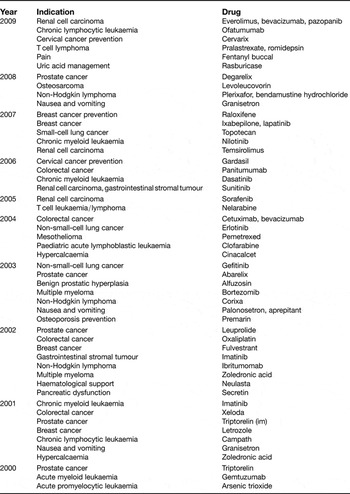
Progress in preventing or treating many types of cancer has been slow. Table 1 shows the drugs that have been approved in the past ten years for the prevention or treatment of cancer. Although age-adjusted mortality from cancer decreased in the USA by 11% in men and 6% in women between 1970 and 2006, there are still over half a million cancer deaths each year in the USA alone and most metastatic solid tumours remain incurable (Ref. Reference Jemal, Ward and Thun1). The public, although continuing to strongly support cancer research, can be excused for questioning when progress in basic research will be translated into greater patient benefit. Why is success always around the corner? Why do the breakthroughs in basic research so rarely translate to breakthroughs in treatment? Although there are many reasons for optimism about the future, in order to move forward effectively it is important to look backward critically and identify key problems.
Oncology drugs approved by the US Food and Drug Administration 2000–2009

Defining translational research
Translational research, in the sense used here, is about translating progress in basic research into products and procedures that benefit patients. Some individuals use the phrase to denote the process of ensuring that medical methods and products of proven value actually reach patients or populations and are implemented correctly. Others implicitly use a third definition: translational research for them is clinical research in which biological measurements on patient tissues are made in an attempt to understand the nature of the disease. Sawyers points out that ‘Human subjects are an essential early component in the evaluation of new drug candidates and should be studied at a level of scientific detail comparable to that used for nonhuman preclinical model systems.’ (Ref. Reference Sawyers2). However, the measurements should be in service of maximising the effectiveness of the new drug being studied in order to qualify as translational research.
Bridging the gap between basic research and patient benefit
Some of the roadblocks to effective translational research are listed in Box 1. The first two items have received considerable attention (Refs Reference Nathan and Varmus3, Reference Sung4, Reference Hawk5) and are not the main focus of this article. The first point includes the numerous and diverse complexities of trying to bring a new drug to the clinic, including regulatory issues, human subject approvals, intellectual property issues, lack of funding, lack of patients, lack of training for physician-investigators and fragmented infrastructure.
Box 1 Barriers to effective translational research
1 Complexity of research with human subjects
Regulatory issues, human subject protection, intellectual property issues, lack of funding, fragmented infrastructure, shortage of trained investigators and shortage of resources for including sufficient patients
2 Goal-oriented, high-risk, team research is difficult to sustain in academic settings
3 Lack of focus on key high-risk translational barriers and opportunities
4 Limitation in understanding oncogenesis and lack of identification of key molecular targets
5 Need for new clinical trial designs appropriate for predictive personalised medicine
The second point in Box 1 includes the importance of sustained team research in exploiting basic research findings. Clearly, clinical research requires talented people with many different areas of expertise, and this is also true today of basic research where developments in whole-genome biotechnology have made biologists more in need of collaboration with statisticians and information scientists than ever before. But effective translational research often requires a deeply collaborative sustained effort to tackle high-risk problems (Ref. Reference Marincola6). The disincentives in academic medicine for top laboratory scientists and clinical investigators to commit to the long-term team research necessary for effective translational research are formidable. Although the need for ‘team research’ is often discussed, and in the USA the National Institutes of Health (NIH) has made funding available to encourage the establishment of ‘infrastructure’ that supports team research, it is not clear whether this is sufficient to change the culture and bring about the type of commitment necessary for real synergistic trans-disciplinary translational research. Zerhouni argues that ‘Effective scientific teams of the future require closer working relationships among basic, translational and clinical scientists. Traditional disciplinary, departmental and other artificial organizational barriers will have to be breached in an era of scientific convergence…’ (Ref. Reference Zerhouni7). To really achieve this, however, may require the creation of new organisations based on new models.
The third point in Box 1 involves the wide gap that often exists between where basic research leaves off and where clinical research can begin. It also involves the need for translational research to do much more than bringing inhibitors of easily druggable targets to the clinic. There is a large overlap in the molecular targets of interest to industry: these tend to be highly druggable targets whose credentials are well established based on publicly funded basic research. However, p53 (TP53) and Rb (RB1) mutations, for example, are prevalent and important in many types of cancer, but neither tumour suppressor gene product is easily druggable and neither industry nor academic medicine has developed promising approaches for exploiting these mutations. Developing feasible pharmacological ways of exploiting mutated p53 or Rb in tumours represents difficult, long-term, high-risk endeavours that are not adequately addressed either by industry or by the culture of the NIH investigator-initiated grant system. The current approach to funding investigator-initiated basic research has been effective and is itself underfunded. But the broad gap between basic research and clinical development will not likely be breached with the current approach. Progress in exploiting developments in basic research may require focusing major project teams on key translational opportunities, utilising a more targeted approach such as used by the US Defense Advanced Research Project Agency.
What are the key molecular targets?
Our very limited understanding of the oncogenesis of cancer (point 4 in Box 1) is a key roadblock to effective translational research. When the basic research enterprise identifies a key step of oncogenesis and a druggable molecular target, the pharmaceutical and biotechnology industries are usually adept at developing potent inhibitors of that target. The fact that these key steps to oncogenesis in human tumours have not been identified, however, is a major obstacle. It can be argued that we do not fully understand the steps of development and progression of any type of cancer. In rare cases, such as chronic myeloid leukaemia (CML), our knowledge of oncogenesis has been sufficient to support the development of effective treatment (Refs Reference Druker8, Reference Lydon9). In most cases, we do not know the key molecular lesions.
Major tumour genome sequencing projects have been undertaken to identify the genes mutated in cancer. It has been found, however, that many tumours contain numerous mutations and the mutations found differ among tumours of the same primary site (Ref. Reference Stratton, Campbell and Futreal10). Efforts are being made to distinguish ‘driver’ from ‘passenger’ mutations, but numerous ‘driver’ mutations may occur and be selected for in the late stages of tumour development. After many hundreds of generations of cell replication in tumour development, many late mutations will be detected that will be present in only a subset of the tumour cells. Targeting the protein products of those mutated genes might lead to transient antitumour effects followed by overgrowth of tumour clones not containing those target mutations. The early oncogenic mutations should be present in all tumour cells and effectively targeting them might lead to more substantial effects.
Workman points out, ‘Surprisingly, perhaps, there are several published examples in which correction of a single oncogenic abnormality can bring about a therapeutic effect, even in the context of multiple genetic abnormalities. Examples include knockout of oncogenes such as RAS or MYC, or reintroduction of a lost tumor suppressor gene such as P53, APC, or PTEN.’ (Ref. Reference Workman11). Weinstein and Joe give experimental model and clinical examples of this in their discussion of why tumours are sometimes addicted to a specific oncogene (Ref. Reference Weinstein and Joe12). They point out that ‘Currently, several empiric approaches can be used to help identify the Achilles’ heel of [a] cancer…oncogenes that are mutated early in the multistage process of tumor development might be favored candidates because they had a critical role in determining subsequent aspects of the abnormal circuitry in the evolving cancer cells. Oncogenes that are mutated, and not simply overexpressed, might also be more likely targets for therapy since they reflect the ‘hard-wiring’ of cancer cells…Mutated oncogenes might therefore be more likely to be present in the stem-cell population of tumors rather than just in the progeny cells.' (Ref. Reference Weinstein and Joe12). Workman also offers the ‘house of cards’ model for why inhibiting a single oncogene that is a target of a key early oncogenic mutation can have a major therapeutic effect. ‘In the house of cards model, the tumor requires each of the molecular abnormalities to power up the malignancy; remove any one of the molecular batteries and the cancer cell collapses like a house of cards.’ (Ref. Reference Workman11). Of course, one would have to be able to treat with sufficiently high doses and sufficiently early that there are no subclones that are resistant to binding of the drug. This is, however, a very stringent condition. By the time there are 109 tumour stem cells, each replication of the stem cell compartment produces on average one stem cell containing a mutation for any base position selected in the tumour genome. Consequently, even if the house of cards model is correct, early treatment with a combination of drugs targeting each of the early oncogenic mutations would probably be required for cure. Experience in the treatment of CML would seem to support this conclusion (Ref. Reference Sawyers13). It is also possible that the house of cards model is not correct for some (or most) tumours. One might alternatively hypothesise a ‘barn door’ model in which the early oncogenic mutations bring about the expansion and invasion of the malignant clone, but then are no longer key targets because the subsequent mutations activate alternative oncogenic pathways.
How many key early oncogenic mutations does it take to make a tumour? Knudson showed that the age–incidence curve for retinoblastoma was explained by a two-stage model, in which the two events are mutation of one Rb allele and loss of the other allele (Ref. Reference Knudson14). The age–incidence curve is bimodal because early incidence occurs for patients who inherit a germline Rb mutation. Moolgavkar analysed data for a variety of solid tumours and found that two-stage models with clonal expansion of intermediate cells fit the data well (Ref. Reference Moolgavkar15). Zhang and Simon analysed age–incidence data for breast cancer using a model that included clonal expansion and age-dependent dynamics of breast tissue. We found that models with two or three rate-limiting events occurring at approximately the point mutation rate in mammalian cells fit the data (Ref. Reference Zhang and Simon16). Furthermore, analysis of age–incidence data for women carrying germline mutations in BRCA1 or BRCA2 indicated that the data were best accounted for by a model involving loss of the wild-type BRCA allele plus one other rate-limiting event (Ref. Reference Simon and Zhang17). The original Armitage and Doll model based on six to eight stages of oncogenesis did not permit clonal expansion of intermediate cells, and their subsequent two-stage model with expansion fit their data equally well (Ref. Reference Armitage and Doll18).
There is thus substantial evidence indicating that many solid tumours originate from two or three rate-limiting mutations. These rate-limiting events might in some cases include genes involved with DNA repair, cell-cycle checkpoint control, apoptosis or chromosome integrity and provide the small neoplasm or preneoplasm with a mutator phenotype that enables it to rapidly accumulate additional genomic changes that facilitate invasion and dissemination (Ref. Reference Loeb19). A mutator phenotype is not necessary, however, for oncogenesis. If the two or three rate-limiting events provide a sufficient selective advantage in growth to enable clonal expansion to 106–107 clonogenic cells, then the effective mutation rate per unit time for the expanding clone, even at the normal mutation rate per cell division, is sufficient to enable the small neoplasm or preneoplasm to accumulate numerous additional genomic changes in a non-rate-limiting manner (Ref. Reference Tomlinson and Bodmer20). Consequently, human age–incidence data that imply the existence of two or three rate-limiting events are consistent with both the six to eight hallmarks of cancer described by Hanahan and Weinberg (Ref. Reference Hanahan and Weinberg21) and with the identification in recent sequencing studies of tumours that have large numbers of mutations. This two-phase model of oncogenesis is consistent with current mathematical models, such as that of Beerenwinkel et al. (Ref. Reference Beerenwinkel22), and with experimental models, such as that of Elenbaas et al. (Ref. Reference Elenbaas23), who demonstrated that introduction of three genes encoding the SV40 large-T antigen, the telomerase catalytic subunit and an HRAS oncoprotein into primary human mammary epithelial cells results in cells that form tumours when transplanted into immunocompromised mice.
Biomarkers and new clinical trial designs for predictive personalised medicine
The final point in Box 1 relates to the challenge of identifying important genomic biomarkers and clinical trial designs that can move us into an age of reliable predictive and personalised oncology. We are in transition from the age of ‘correlative science’ to that of ‘predictive medicine’. Phase III clinical trials have in the past been generally conducted with broad eligibility based on the implicit assumption that relative treatment benefit (new treatment versus control) is unlikely to vary among subsets of the target population. This has resulted in the use of clinical trial designs with broad eligibility criteria, and in the use of analysis strategies that focus on comparing average effects between the treatment groups to yield conclusions that are taken to apply to the broad target population. The current approach has resulted in a wide use of cytotoxic drugs to which many patients do not benefit.
The current paradigm is in important ways unsuited to the development of molecularly targeted drugs. One of the major messages of the past 25 years of tumour biology research is heterogeneity of tumours of the same primary site. For many primary sites, tumours are heterogeneous with regard to the mutations that appear to drive their pathogenesis, and their sensitivity to therapy. This will generally require the development of companion diagnostics to be used as predictive biomarkers. Sawyers states that ‘One of the main barriers to further progress is identifying the biological indicators, or biomarkers, of cancer that predict who will benefit from a particular targeted therapy.’ (Ref. Reference Sawyers24). This increases the complexity of drug development. In addition to just finding the maximum tolerable dose, Phase I trials must establish that the drug is shutting down the target deregulated pathway in the tumour. Phase II trials must provide data for determining predictive biomarkers that identify patients whose tumours are driven by deregulation of the target protein. Such predictive biomarkers must be developed using preclinical data and Phase II trials so that companion diagnostic tests can be developed and analytically validated before launching the Phase III clinical trials. This increases the complexity of early-phase clinical development considerably. Not only do Phase II trials need new kinds of designs and larger sample sizes (Refs Reference Pusztai25, Reference Pusztai, Anderson and Hess26, Reference Hess27), but sponsors need to work actively with diagnostics partners to develop companion diagnostics in early development.
Targeted or enrichment designs
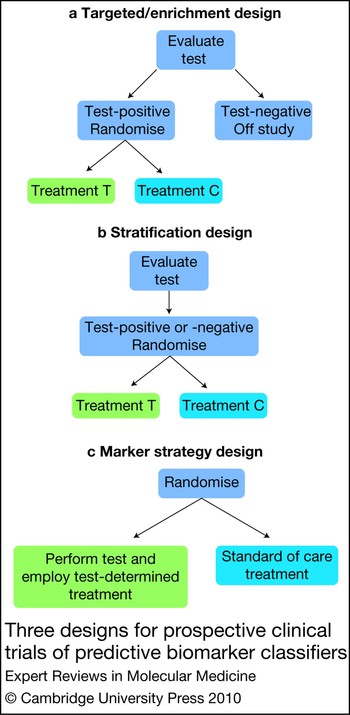
One would like to have the companion diagnostic test available early so that it can be used prospectively in the design of the Phase III clinical evaluation of the new drug. The prospective approaches that have been proposed fall into three general categories (Fig. 1). The first is the ‘targeted design’ or ‘enrichment design’ in which the companion diagnostic is used either to restrict eligibility to patients most likely to benefit from the new drug or to exclude patients least likely to benefit. The Phase III clinical trial in this case is a randomised clinical trial comparing a regimen containing a new drug to a control regimen. Simon and Maitournam (Refs Reference Simon and Maitournam28, Reference Simon and Maitournam29, Reference Maitournam and Simon30) studied the efficiency of this approach relative to the standard approach of randomising all patients without using the test at all. The efficiency of the enrichment design was found to depend on the prevalence of test-positive patients and on the effectiveness of the new treatment in test-negative patients. When fewer than half of the patients are test-positive and the new treatment is relatively ineffective in test-negative patients, the number of randomised patients required for an enrichment design is often dramatically smaller than the number of randomised patients required for a standard design. Web-based tools to plan targeted enrichment trials and to evaluate their efficiency as a function of test accuracy and treatment specificity for binary and time-to-event endpoints are provided at http://brb.nci.nih.gov.
Three designs for prospective clinical trials of predictive biomarker classifiers. (a) Targeted or enrichment design. A predefined binary classifier is used to restrict entry to a randomised clinical trial of a new treatment T versus a control C. (b) ‘Stratification’ design, in which one or more classifiers are measured at baseline but are not used to restrict entry. The protocol for the study defines a primary analysis plan for how the classifier(s) will be used in the comparison of new treatment T to control C. The analysis should preserve overall type I error (i.e. the probability of a false-positive conclusion of superiority of T over C overall or for any subset should not exceed the 5% level usually used solely for the overall comparison). (c) Marker strategy design, in which patients are randomised to be tested or not with the new classifier. Those not tested receive standard-of-care treatment, which might vary based on standard prognostic factors. Those tested receive treatment based on the results of the test.

Hoering et al. (Ref. Reference Hoering, LeBlanc and Crowley31) concluded that a targeted enrichment design is most efficient when there is an underlying true predictive marker and the cut-point for determining the marker status is well established. Mandrekar, Sargent and colleagues (Refs Reference Mandrekar32, Reference Mandrekar and Sargent33) also pointed out the efficiency of the enrichment design and suggested that the enrichment design is appropriate when: (Reference Jemal, Ward and Thun1) the new treatment has a modest absolute benefit in unselected patients but causes significant toxicity; (Reference Sawyers2) an unselected design is ethically impossible based on previous studies; (Reference Nathan and Varmus3) there is compelling preliminary evidence to suggest that patients without that marker profile do not benefit from the treatment; and (Reference Sung4) assay reproducibility and accuracy are well established.
Biomarker stratified designs
The enrichment design is appropriate when there is such a strong biological basis for believing that test-negative patients will not benefit from the new drug that including them would raise ethical concerns, as was the case for the development of trastuzumab. The enrichment design does not provide Phase III data on the effectiveness of the new treatment compared with control for test-negative patients. Consequently, unless there are Phase II data on the clinical validity of the test for predicting response or compelling biological evidence that the new drug is not effective in test-negative patients, the enrichment design may not be adequate to support approval of the test.
When a predictive test has been developed but there are no compelling biological or Phase II data that test-negative patients do not benefit from the new treatment, it is generally best to include both test-positive and test-negative patients in the Phase III clinical trials comparing the new treatment with the control regimen. In this case it is essential that an analysis plan be predefined in the protocol for how the predictive test will be used in the analysis. It is not sufficient to just stratify (i.e. balance) the randomisation with regard to the classifier without specifying a complete analysis plan. The purpose of the Phase III trial randomising both test-positive and test-negative patients is to evaluate the new treatment overall and in the subsets determined by the prespecified test. Several specific primary analysis plans have been described in detail elsewhere (Ref. Reference Simon34). The primary analysis plan should stipulate in detail how the predictive biomarker will be used in the analysis, and how the overall 5% type I error (i.e. the chance of any false-positive claims of any type) will be distributed among the several parts of the primary analysis. I have previously discussed various specific analysis strategies in greater detail (Refs Reference Simon34, Reference Simon35), and a web-based tool for sample size planning with these analysis plans is available at http://brb.nci.nih.gov.
Marker strategy design
The third type of Phase III clinical trial design that has been used is the ‘marker strategy design’. With this design patients are randomised to be tested or not. For those who are not tested, their treatment is determined based on practice standards. For those randomised to be tested, the results of the test can be used in conjunction with standard prognostic factors to inform treatment decisions. The marker strategy design is inefficient in settings where many patients may receive the same treatment regardless of which group they are randomised to (Refs Reference Hoering, LeBlanc and Crowley31, Reference Mandrekar32, Reference Sargent36, Reference Mandrekar and Sargent37, Reference Freidlin, McShane and Korn38). To have reasonable statistical power to detect differences in outcome among the two randomisation groups as a whole, a very large number of patients may have to be randomised. Although the marker strategy design seems to ‘test the test’, it may confound marker effects with treatment effects (Ref. Reference Freidlin, McShane and Korn38). Pusztai and Hess have also discussed the stratified design and the marker-based strategy (Ref. Reference Pusztai and Hess39).
Adaptive biomarker designs
Because of the complexity of cancer biology, it is often difficult to have the right predictive biomarker completely identified, cut-point specified and analytically validated before the launch of the Phase III clinical trials. Novel Phase II designs useful for biomarker development have been developed (Refs Reference Pusztai, Anderson and Hess26, Reference Zhou40, Reference McShane, Hunsberger and Adjei41). Here I discuss Phase III designs that provide adaptiveness and statistical rigour in identification of the subset of patients who might benefit from the new treatment.
Jiang et al. (Ref. Reference Jiang, Freidlin and Simon42) reported on a ‘biomarker adaptive threshold design’ for situations where a specific predictive index, or biomarker score, is available at the start of the trial but a cut-point for converting the score to a binary classifier is not established. Tumour specimens are collected from all patients at entry, but the assay value is not used as an eligibility criterion. A cut-point is then defined for which the treatment versus control difference in outcome (i.e. the treatment effect) is maximised when the comparison is restricted to patients with assay values above that cut-point. The statistical significance of that maximised treatment effect is determined by generating the null distribution of the maximised treatment effect under random permutations of the treatment labels. This approach of using a global test to account for the several target populations examined can also be applied for evaluating several binary predictive biomarker candidates rather than for optimising the cut-point for a single biomarker.
Freidlin and Simon (Ref. Reference Freidlin and Simon43) proposed a flexible design for a Phase III trial that can be used when no classifier is available at the start of the trial. The design provides for development of the classifier and evaluation of treatment effects in a single trial while preserving the principle of separating the data used for developing a classifier from the data used for evaluating treatment in subsets determined by the classifier. At the conclusion of the trial, the new treatment is compared with the control overall using a reduced threshold of significance such as 0.03. If the overall treatment effect is not significant at the reduced level, then the patients are divided into a training set and a testing set. The data for patients in the training set are used to define a single subset of patients who are expected to most likely benefit from the new treatment compared with the control. Freidlin and Simon used a machine learning algorithm based on screening thousands of genes for those with expression values that interact with the treatment effect, but the design can be used with other algorithms and even with candidate classifiers that do not involve gene expression. When that subset is explicitly defined, patients in the testing set are classified using this classifier developed on the training set. Patients in the testing set are classified as ‘sensitive to the new treatment’ – that is, likely to benefit more from the new treatment relative to the control regimen – or as ‘insensitive’. Finally, the outcomes for sensitive patients in the test set who actually received the new treatment are compared with the outcomes for sensitive patients in the test set who received the control regimen. The comparison of new treatment to control for the sensitive subset is restricted to patients in the test set in order to preserve the principle of separating the data used to develop a classifier from the data used to test treatment effects in subsets defined by that classifier. The comparison of treatment to control for the sensitive subset uses a threshold of significance of 0.02 to ensure that the overall chance of a false-positive conclusion is no greater than 0.05.
Freidlin et al. (Ref. Reference Freidlin, Jiang and Simon44) subsequently improved the statistical power of the adaptive signature design by using k-fold cross-validation instead of simply splitting the patients in the clinical trial into a single training and a single testing set. This powerful analysis strategy can be used more broadly than in the context of identifying de novo gene expression signatures. It can be used with traditional clinical and pathological prognostic factors or with single gene/protein candidate markers (Ref. Reference Simon45).
Archived tissues and prospective–retrospective studies
For evaluating a predictive biomarker for the effectiveness of a widely used treatment, it may be very difficult to perform a randomised clinical trial that involves withholding that treatment from some patients. Simon et al. (Ref. Reference Simon, Paik and Hayes46) discuss the use of ‘prospective–retrospective studies’ in which a detailed protocol is used to guide a focused re-analysis of specimens archived from key previously conducted clinical trials that evaluated the effectiveness of the treatment. The key clinical trials are analysed with regard to a single candidate predictive biomarker. If specimens are archived for the large majority of patients, if the size and structure of the clinical trials are sufficient, and if the analysis plan is adequately focused, then Simon et al. argue that evidence from such a prospective–retrospective study can constitute Level I evidence for the medical utility of the marker. This approach was successfully used for evaluation of the role of KRAS mutations in the effectiveness of antibodies against the epidermal growth factor receptor (EGFR) for patients with advanced colorectal tumours.
Summary
Many human tumours might develop in a two-phase manner. The first phase consists of the development of a small number (Refs Reference Sawyers2, Reference Nathan and Varmus3) of rate-limiting genomic changes. These mutational events put in place a non-rate-limiting process that provides the additional genomic and epigenetic changes necessary for invasion and metastatic dissemination. Clonal expansion of the initial small neoplasm or preneoplasm provides ample numbers of cell divisions to account for numerous additional mutations even at normal mammalian mutation rates. Nevertheless, the initial two or three rate-limiting changes might deregulate the fidelity of DNA replication and inhibit the elimination of cells with aberrant DNA.
Effective treatment of solid tumours is likely to require characterisation of the key mutations driving the pathogenesis of the individual tumour and treatment with a sufficient number of drugs to overcome the resistance of subclones to treatment by any single drug. Such resistance is generally established by hundreds of generations of tumour cells before clinical detection.
Progress in translational research is limited by an inadequate understanding of the process of tumour development and a lack of identification of the early oncogenic rate-limiting mutations. Traditional investigator-initiated basic research has led to great improvements in our knowledge of tumour development, and is today being effectively complemented by major tumour genome sequencing studies. The pharmaceutical and biotech industries are very active and effective for developing inhibitors of druggable oncogenes that have strong credentials as molecular targets. Support for investigators to carry out proof-of-concept clinical studies of targets with lesser credentials is warranted. Many key oncogenic mutations are of the tumour suppressor type and are not easily druggable (Ref. Reference Jones47). The inability to treat such targets is a key bottleneck to progress in the treatment of cancer patients. Investigator-initiated grant mechanisms do not provide effective programmes for developing the organisations and teams necessary to make progress on such high-risk projects.
New clinical trial designs are needed to accommodate the genomic heterogeneity of tumours of a given primary site. Ideally, Phase III clinical trials of new drugs will be prospectively designed with analytically determined companion diagnostics. Diagnostics will be based on characterisation of the driver mutations in individual tumours as well as epigenetic and functional characterisations. New designs will have to accommodate the complexity of cancer biology in which several agents, selected on the basis of genomic characterisation of individual tumours, are evaluated. The need for new designs does not replace the need for prospective planning, rigour in statistical analysis and the use of randomisation in Phase III clinical trials. New emphases on predictive methods should, however, replace some aspects of the existing paradigm in which emphasis is restricted to testing a single null hypothesis that the treatment is uniformly ineffective.
Acknowledgements and funding
I am grateful to the reviewers for valuable suggestions that helped improve the manuscript.