INTRODUCTION
Seven out of the 105 alien fish species in the Mediterranean are gobies (Galil & Goren, in press) all of which have been reported from the Levant basin. Six species (Coryogalops ochetica (Norman, 1927), Papillogobius melanobranchus (Fowler, 1934), Oxyurichthys petersi (Klunzinger, 1871), Silhouetta aegyptia (Chabanaud, 1933), Vanderhorstia mertensi Klausewitz, Reference Klausewitz1974, Trypauchen vagina (Bloch & Schneider, 1801)) are of Red Sea origin, while Tridentiger trigonocephalus (Gill, 1859) may have arrived in ballast waters (Kovacic & Golani, Reference Kovacic and Golani2007; Goren et al., Reference Goren, Gayer and Lazarus2009; Salameh et al., Reference Salameh, Sonin and Golani2010).
Vanderhorstia mertensi, alone among the Erythraean alien gobies, had been first reported from Fethiye (Figure 1) on the westernmost Mediterranean coast of Turkey (Bilecenoğlu et al., Reference Bilecenoğlu, Yokeş and Eryigit2008), rather than at the south-eastern Levant, nearer the Suez Canal. Bilecenoğlu et al. (Reference Bilecenoğlu, Yokeş and Eryigit2008) documented, between June and September 2008, its flourishing population in the Bay of Fethiye. In October 2008 it was reported from Güvercin Island, midway along the Mediterranean coast of Turkey, and genetic analysis proved its presence in trawl catches taken in Iskenderun Bay, on the south-eastern coast of Turkey in May–June 2008 (Figure 1; Yokeş et al., Reference Yokeş, Bilecenoğlu, Goren, Galil and Diamant2009). Later it was recorded in Antalya Bay and in Gökova Bay, on the southern Aegean coast of Turkey (Figure 1; Çinar et al., Reference Çinar, Bilecenoğlu, Öztürk, Katağan, Yokeş, Aysel, Dağli, Açik, Özcan and Erdoğan2011; Gökoğlu et al., Reference Gökoğlu, Özbek, Kebapçioğlu, Balci and Kaya2011). In the present paper we report the finding of a single specimen of V. mertensi off the Israeli Mediterranean coast, collected by a commercial bottom trawler.
Map of known Mediterranean sites colonized by Vanderhorstia mertensi.

Abbreviation: fish collection of the Zoological Museum at Tel Aviv University (TAU-P).
RESULTS
SYSTEMATICS
Vanderhorstia mertensi Klausewitz, Reference Klausewitz1974
(Figure 2)
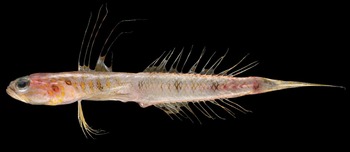
Vanderhorstia mertensi from Haifa Bay, Israel, TAU P-15009 (photograph: Oz Rittner).

Vanderhorstia mertensi Klausewitz, Reference Klausewitz1974. Senckenbergiana Biologica 55: 210, figures 5–7.
TYPE LOCALITY
Marsah Murach, Red Sea.
MATERIAL EXAMINED
TAU P-15009, 1 specimen of total length 64.3 mm and standard length 48.3 mm, Haifa Bay, Israel, coordinates: 032°54.632N 035°01.034E, depth 30 m, 18 November 2012, coll. N. Stern.
DESCRIPTION
Body elongate and compressed. Head compressed with dorsal profile convex. Mouth oblique. Maxilla reaches to below hind margin of eye. Several rows of teeth on each jaw. Tongue rounded. Posterior nostril, a pore, close to eye. Anterior nostril, in a tube, at midway between the posterior nostril and upper lip. Gill opening wide, reaches to below mid opercle. Isthmus narrow. Gill rakers on anterior gill arch 2 + 1 + 9 (rudiments).
Cephalic sensory system: nasal pores (a pair) slightly above the level of posterior nostril, at level of 2/3 eye. A single anterior interorbital pore above 1/4 anterior of eye. Posterior interorbital pore, above posterior 1/8 of eye. Five pores above the opercle, three pores on hind preopercular margin. Posterior and anterior oculoscapular canals interconnected.
Selected proportions: standard length of total length: 75%; head length of standard length: 23.8%; body depth of standard length: 11.7%; distance: snout—first dorsal fin of standard length: 28.6%; distance: snout—second dorsal fin of standard length: 48%; distance: snout—anal fin of standard length: 51.2%; eye diameter of head length: 25.5%; interorbital space of head length: 7.8%.
Scales: 63 scales along the body. Nine transverse scale rows. Ctenoid scales on posterior 2/3 of the body; remaining scales are cycloid. Mid predorsal, opercle and pectoral base naked.
Fins: D VI, I 16; A I 17; P17. The first dorsal fin higher than body depth. The longest spine (the third) extends to behind the fourth ray of second dorsal fin. Anal fin inserts below second ray of second dorsal fin. Pectoral fins reaching to above insertion of anal fin. Pelvic fin nearly reaches approximately to anus. Caudal, pointed, fin longer than head.
DISCUSSION
There are more than 130 species in 20 genera of gobiid fish associated with alpheid shrimps (Freinschlag & Patzner, Reference Freinschlag and Patzner2012). Like others of the genus, Vanderhorstia mertensi lives symbiotically with alpheid shrimps, the two partners sharing a burrow, which is maintained by the shrimp and guarded by the goby (Karplus, l987). As an obligate symbiont it depends on the presence of an alpheid shrimp for its presence. Bilecenoglu et al. (2008) reported that ‘The alpheids collected from the burrows inhabited by V. mertensi were identified as Alpheus glaber (Olivi, 1792) and A. rapacida De Man, 1908'. Alpheus glaber is a native Mediterranean species with no record of association with fish, while Alpheus rapacida is an Erythraean alien and was reported as gobiid symbiont (Karplus, Reference Karplus1987; de Grave & Anker, Reference De Grave and Anker2000; Randall, Reference Randall2008). Alpheus rapacida was first recorded off the Israeli coast in 1960 (Lewinsohn & Holthuis, Reference Lewinsohn and Holthuis1964; Galil, Reference Galil, Dubinsky and Steinberger1986) and twenty years later off Turkey (Kocataş, Reference Kocataş1981), and is common along the Levant. A single specimen of Alpheus rapacida was captured with V. mertensi in the same net. However, since the trawl collected biota from an area of ~70,000 m2, we cannot tell whether this individual shrimp was the partner of the goby. Yet, despite intensive efforts in the past four years to locate V. mertensi, only a single specimen was found thus far off the Israeli coast—in trawl by-catch. Its presence verifies the status of V. mertensi as an Erythraean alien. The rare specimen may suggest that the Israeli gobiid population is small as its habitat lies in heavily disturbed bottom trawled grounds.
ACKNOWLEDGEMENTS
We are grateful to Zvulun Haibatov, captain of the trawler ‘Or David’, for providing the specimen, N. Paz for editing the manuscript, and Oz Rittner for the photograph. B.S. Galil is supported by the European Community's Seventh Framework Programme (FP7/2007-2013) for the projects Vectors of Change in Oceans and Seas Marine Life, Impact on Economic Sectors (VECTORS).