Cardiovascular disease has its origins in early childhood,Reference Urbina, Williams and Alpert 1 necessitating valid and reliable tools of assessing endothelial function, a subclinical marker of atherosclerosis, in paediatric populations. Peripheral arterial tonometry assesses endothelial function of the peripheral microcirculation and is an increasingly utilised, non-invasive, and operator-independent test.Reference Lee, Bass and Ellis 2 Reactive hyperemia index derived from peripheral arterial tonometry assesses arterial pulse wave amplitude in the digits as a measure of vascular compliance. In paediatric populations, the interpretation of this variable is complicated by the scarcity of data in healthy children as well as data suggestive of improved endothelial function associated with pubertal maturation.Reference Bhangoo, Sinha, Rosenbaum, Shelov and Ten 3 , Reference Radtke, Khattab, Eser, Kriemler, Saner and Wilhelm 4 Bonetti et al report a reactive hyperemia index of <1.35 as indicative of coronary endothelial dysfunction in adults,Reference Bonetti, Pumper, Higano, Holmes, Kuvin and Lerman 5 whereas paediatric studies report values within the same range in healthy children.Reference Bhangoo, Sinha, Rosenbaum, Shelov and Ten 3 ; Reference Radtke, Khattab, Eser, Kriemler, Saner and Wilhelm 4 The aim of this study was to investigate the association between reactive hyperemia index and established cardiovascular risk factors including blood pressure, lipid profile, and body mass index in a cohort of healthy adolescent patients to further characterise the normal hyperemic response in this age group.
Materials and methods
Peripheral arterial tonometry was performed in 90 healthy adolescents recruited through flyers and clinic advertisements. All patients provided informed consent in accordance with institutional ethics guidelines. The patients met all criteria (10–17 years old) and had no history of smoking, use of vasoactive medications, hypertension, and/or diabetes. Patients with body mass index >3 standard deviation scores were excluded from the study. Anthropometric measures were collected at the time of testing and included height, weight, blood pressure, and waist circumference. Of the 90 patients, 63 also completed a self-assessed puberty questionnaire. Blood pressure and body mass index z-scores were derived as per established references (World Health Organization Child Growth Standards 2007). Fasting blood samples were collected for measurement of serum total cholesterol, high-density lipoproteins, low-density lipoproteins, triglycerides, and glucose. Endothelial testing was conducted in the morning, in a temperature-controlled room (21–24°C), following an overnight fast whereby patients refrained from strenuous exercise and caffeine. Reactive hyperemia index was derived using EndoPAT software (Itamar Medical, Caesarea, Israel) as previously describedReference Haller, Stein and Shuster 6 and was naturally log transformed. Associations between variables were investigated using the Pearson correlation coefficient, and multiple regression analysis was used to determine the impact of body mass index, blood pressure, and puberty on reactive hyperemia index.
Results
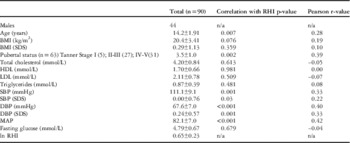
We performed univariate correlation analysis to study the relationship of patient demographics, blood pressure, lipid profile, and reactive hyperemia index within our study population (Table 1). We observed a positive correlation between reactive hyperemia index and age in the female patients (r=0.33, p<0.02), but this did not reach statistical significance in the male patients (r=0.24, p=0.11), whereas reactive hyperemia index correlated with pubertal status in both male (r=0.411, p=0.03) and female (r=0.36, p=0.03) patients. Reactive hyperemia index positively correlated with systolic and diastolic blood pressure raw values and z-scores (Table 1). Reactive hyperemia index did not significantly correlate with body mass index and lipid profile (Table 1). Notably, when adjusting for systolic and diastolic blood pressure or pubertal status, age and reactive hyperemia index no longer correlated.
Characteristics of study cohorts and relation to RHI.

BMI=body mass index; DBP=diastolic blood pressure; HDL=high-density lipoprotein; LDL=low-density lipoprotein; MAP=mean arterial pressure; RHI=reactive hyperemia index; SBP=systolic blood pressure; SDS=standard deviation score
Values are shown as mean±standard deviation
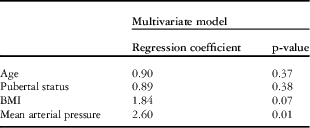
A multiple regression model was used to determine the impact of blood pressure, body mass index, age and pubertal status on reactive hyperemia index during adolescence (Table 2). Our analysis included mean arterial pressure, instead of systolic or diastolic blood pressure individually, as they are collinear variables. We found that the model accounted for approximately one-third of reactive hyperemia index variability (r2=0.33, p=0.005). When controlling for all other covariates, mean arterial pressure remained significantly associated with reactive hyperemia index (p=0.01).
Multivariate regression analysis of RHI as a dependent variable.
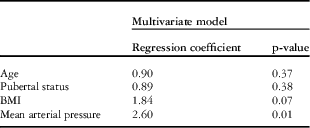
BMI=body mass index; RHI=reactive hyperemia index
Discussion
Peripheral arterial tonometry is a non-invasive test of peripheral endothelial function increasingly used in adults and high-risk paediatric cohorts. In this study, we demonstrated that significant changes in endothelial function occur with advancing age and pubertal maturity in a healthy adolescent cohort. In addition, we showed that reactive hyperemia index is positively associated with blood pressure and that blood pressure appears to be a significant contributor to reactive hyperemia index independent of age, body mass index, and/or pubertal status during adolescence. Importantly, even when we correct for the normal elevation in blood pressure that occurs during adolescence, by comparing blood pressure z-scores (adjusted for age, sex, and height) and reactive hyperemia index, we observed enhanced endothelial function with increasing blood pressure. As a test of peripheral microvascular function that is only partially mediated by nitric oxide release,Reference Nohria, Gerhard-Herman, Creager, Hurley, Mitra and Ganz 7 this suggests that the digital pulse amplitude response to hyperemia may relate to changes in skin blood flow and other local mediators. In adults, studies report lower prevalence of abnormal reactive hyperemia response associated with elevated systolic blood pressure,Reference Hamburg, Keyes and Larson 8 and newly diagnosed hypertensive adults appear to have reactive hyperemia index values within a normal range.Reference Yang, Park and Youn 9 These data suggest that in the context of reactive hyperemia index, elevations in blood pressure may act as a confounding factor resulting in improved microvascular compliance in the digits and that this testing modality may be better suited for assessment of other cardiovascular risk factors such as diabetes and hyperlipidemia.Reference Hamburg, Keyes and Larson 8 In paediatric cohorts, age-related changes in blood pressure could provide an explanation as to why children appear to have reactive hyperemia index values that are markedly different than adults.
A limitation to our study is the use of questionnaires to self-assess pubertal maturation. However, this methodology is non-invasive and has been previously validated.Reference Radtke, Khattab, Eser, Kriemler, Saner and Wilhelm 4 In addition, our cohort of healthy adolescents did not allow us to evaluate the impact of blood pressure on reactive hyperemia index in extreme phenotypes of cardiovascular disease such as in hypertension or obesity.
In conclusion, our study demonstrates that physiological changes in blood pressure significantly impact peripheral arterial tonometry testing during adolescence and emphasises the need for larger normative cohorts to better understand the clinical application and interpretation of peripheral endothelial function as a measure of vascular risk in paediatric cohorts.
Acknowledgement
The authors are grateful to Nadia Askeer for reviewing our manuscript and providing guidance with statistical analysis.
Financial Support
This research received no specific grant from any funding agency, commercial, or not-for-profit sectors.
Conflicts of Interest
None.
Ethical standards
The authors assert that all procedures contributing to this work comply with the ethical standards of the Canadian guidelines on human experimentation and with the Helsinki Declaration of 1975, as revised in 2008, and has been approved by the Research Ethics board at the Hospital for Sick Children and London Health Sciences (Ontario, Canada).