INTRODUCTION
Anguillicola crassus is a nematode that develops in the swimbladder of eels. This parasite originates from East Asia where it is a parasite of the Japanese eel (Anguilla japonica). Introduced to Europe about 25 years ago and a few years later to Northern America, A. crassus spread within stocks of the endemic European eel (Anguilla anguilla) and American eel (Anguilla rostrata), respectively. Whereas little is known about the epidemiology of A. crassus in Northern America, a number of studies documented the successful and fast spread of A. crassus over almost all of Europe, where it became one of the most prevalent parasites of A. anguilla (Sures et al. Reference Sures, Knopf, Würtz and Hirt1999; Sures and Streit, Reference Sures and Streit2001; Kirk, Reference Kirk2003).
So far, neither field studies nor experiments revealed evidence for a protective immunity against A. crassus in A. anguilla (Knopf, Reference Knopf2006). However, a recent experimental study on the infectivity of A. crassus in A. japonica and A. anguilla showed that the original host A. japonica is less susceptible and obviously possesses more effective defence mechanisms against this parasite compared to the newly acquired host A. anguilla (Knopf and Mahnke, Reference Knopf and Mahnke2004). A single infection with thirty 3rd-stage larvae (L3) of A. crassus resulted in an approximately 3 times higher recovery rate in A. anguilla compared to A. japonica, with a 10 times higher wet weight of parasites in A. anguilla. Only 27% of the recovered worms became adult in A. japonica, but 94% of the worms reached maturity in A. anguilla during a 98-day experiment. The fact that dead, encapsulated and necrotic larvae (almost 60% of the number of recovered parasites) were only found in A. japonica suggested the presence of protective immune effector mechanisms in the original host. However, such differences in susceptibility could theoretically also be related to factors other than immune responses, such as physiological differences or lack of certain stimuli that trigger the development of the parasites.
In an attempt to establish and compare protective immunity in both eel species, we used an approach taken earlier in animal models of filariasis. In these nematode infections a long-lasting and nearly complete immunity can be induced by vaccination with irradiation attenuated L3, and detailed protocols have been worked out for the rodent filaria Acanthocheilonema viteae (see Schrempf-Eppstein et al. Reference Schrempf-Eppstein, Kern, Textor and Lucius1997 for references). These reports stimulated us to compare the effect of an irradiated vaccine in A. japonica and A. anguilla, with the goal to find out whether possible differences in immune response exist that could play a role in the different susceptibility towards A. crassus of the two eel species.
MATERIALS AND METHODS
Assessment of an optimal irradiation dose
Attenuation of infective larvae (L3) by irradiation has been shown in a variety of filariae parasitizing in mammals (Lucius et al. Reference Lucius, Textor, Kern and Kirsten1991) but, to our knowledge, has not been reported for parasitic nematodes of fish. Therefore, an orienting experiment was performed to assess the effect of 135Cs irradiation on L3 of A. crassus. It was expected that a certain dose of irradiation would stop the development of the parasite without killing it.
L3 isolated from their intermediate host were irradiated by exposing to a 135Cs radiation source. Doses of 25 L3, irradiated with 0, 175, 350 and 525 Gy were applied to groups of 6 A. anguilla by oral administration, using a 1-ml syringe fitted with a 1·5 mm diameter plastic tubing.
The eels were maintained at a water temperature of 23°C, killed after 70 days and the swimbladder was examined for larvae and adults of A. crassus. Because L3 and 4th-stage larvae (L4) cannot be distinguished from each other perfectly by means of light microscopy (Blanc et al. Reference Blanc, Bonneau, Biagianti and Petter1992), larvae with a body length exceeding 1·5 mm were counted as L4, according to Knopf et al. (Reference Knopf, Würtz, Sures and Taraschewski1998).
Experimental design
Groups each of 16 A. japonica and A. anguilla were vaccinated with 1 dose of 40 irradiation (135Cs, 500 Gy) attenuated L3 of A. crassus, and after 5 weeks the eels were challenged with 40 L3. The L3 were counted in a round-bottomed 98-well plate and suspended in approximately 100 μl of RPMI-1640 medium, Hepes modification (Sigma-Aldrich, Taufkirchen, Germany). This suspension was introduced into the stomach of each eel as described above.
Challenge control groups each of 16 eels of both species were sham treated by peroral administration of medium and challenged with 40 normal L3. Medium control groups each of 16 eels of both species were sham infected twice with medium to monitor potential changes of the antibody response due to factors not related to the A. crassus infection. The irradiation control groups, also consisting of 16 eels of each species, were treated with 40 irradiated L3 without subsequent infection to test for a possible development of the L3 after the irradiation.
At dissection (12 weeks p.i.) living and dead/encapsulated larvae in the swimbladder wall and adults of A. crassus in the swimbladder lumen were counted. Male and female adult worms were individually weighed. Nematodes showing no reaction to mechanical stimulation were considered dead. The presence of A. crassus eggs/2nd-stage larvae (L2) in the swimbladder lumen was considered as evidence of reproduction of the nematodes.
The experiment was split into 2 consecutive parts (A and B), each performed with 8 eels per treatment group. Eels treated in part B of the experiment were bled by caudal vein puncture at -5, 0, 4, 8 and 12 weeks post-infection (p.i.).
Source and maintenance of eels
Anguilla anguilla were obtained from a commercial eel farm known to be free of A. crassus. The absence of A. crassus was confirmed by necroscopy of 15 eels. Anguilla japonica were imported as glass-eels from Japan and raised in a recirculation system free of A. crassus. For the experiment eels were kept individually in aerated 40-l compartments of 200 l tanks, equipped with a polypropylene tube serving as a hiding-place. Water temperature was maintained at 23°C. The eels were allowed to feed ad libitum on pellet food. Prior to the experiment fish were allowed to acclimatize for 2 weeks.
Parasites
L3 of A. crassus were obtained according to the method described by Knopf et al. (Reference Knopf, Würtz, Sures and Taraschewski1998). Briefly, 2nd-stage larvae (L2) collected from the swimbladder lumen of naturally infected eels were fed to planktonic copepods serving as intermediate hosts. After 14 days at 20°C, L3 were isolated from the intermediate hosts by the tissue potter method described by Haenen et al. (Reference Haenen, van Wijngaarden and Borgsteede1994) and stored in RPMI-1640 medium containing 100 U ml−1 penicillin and 100 μg ml−1 strepomycin at 4°C until use.
Enzyme-linked immunosorbent assay (ELISA)
Preliminary tests with monoclonal antibodies (mAbs) raised against A. anguilla immunoglobulin (Ig) heavy and light chain (WEI 1 and WEI2, van der Heijden et al. Reference van der Heijden, Rooijakkers, Booms, Rombout and Boon1995) revealed that A. japonica Ig are not recognized by WEI1, and WEI2 showed only a very weak reaction with A. japonica Ig. In contrast, polyclonal antibodies against A. anguilla Ig (Buchmann et al. Reference Buchmann, Østergaard and Glamann1992) also showed an appreciable reaction to A. japonica Ig. We used the most sensitive detection system for each species, namely the polyclonal antibodies to detect A. japonica Ig, and WEI1 for A. anguilla Ig. To allow a limited comparability of the results, the intensity of the antibody responses was expressed relative to the antibody content at the beginning of the experiment.
Crude antigen extracts from complete L3 and from the body wall of adult A. crassus were prepared by sonication on ice in a 10-fold amount of sarcosyl-TE-buffer (10 mm Tris, 1 mm EDTA, 2% N-lauroylsarcosine-sodium salt, pH 8·0) and centrifuged for 20 min at 16 000 g. The supernatant was stored at −70°C until use.
Polystyrene microtitre plates (Nunc, Kamstrup, Denmark) were coated with the crude antigen extracts in a concentration of 1·5 μg · ml−1 in carbonate buffer (10 mm Na2CO3, 35 mm NaHCO3, pH 9·6) overnight at 4°C. Wells were washed 3 times with PBS containing 0·05% (v/v) Tween 20 (PBS-T), blocked with 1% (w/v) non-fat dry milk (Bio-Rad Laboratories, USA) in PBS for 3 h at 20°C and washed 4 times with deionised water. After drying at 37°C the plates were sealed with plastic tape and stored at −70°C until use.
Eel sera were tested in triplicate at a dilution of 1:100 in PBS+1% dry milk and incubated for 1 h at 37°C. Antibodies of A. japonica were detected with polyclonal rabbit anti-eel Ig (Buchmann et al. Reference Buchmann, Østergaard and Glamann1992) in a concentration of 1:1000 in PBS+1% dry milk followed by incubation with horseradish peroxidase conjugated sheep anti-rabbit IgG (AP311, The Binding Site, England) in a concentration of 1:2000 in PBS+1% dry milk. Antibodies of A. anguilla were detected with a monoclonal mouse anti-eel Ig (WEI 1, van der Heijden et al. Reference van der Heijden, Rooijakkers, Booms, Rombout and Boon1995) diluted 1:500 in PBS+1% dry milk followed by incubation with sheep anti-mouse IgG conjugated with horseradish peroxidase (AP271, The Binding Site, England) diluted 1:1000 in PBS+1% dry milk.
Incubation with the secondary and tertiary antibodies was for 45 min at 37°C, and subsequently the wells were washed 3 times with PBS-T. The substrate reaction with TMB (3,3′,5,5′-Tetra-Methyl-Benzidine, Sigma) was stopped after 15 min with 2N H2SO4. The absorbance was read at 492 nm with a plate reader (Genios, Tecan, Männdedorf, Switzerland).
Statistical evaluation
Differences between groups were evaluated with the Mann-Whitney-U-Test. Statistical analysis of sequentially measured values within a group were analysed with the Friedman-Test and the Wilcoxon-Test. Fisher's exact test was used to check if the number of eels with eggs/L2 of A. crassus in the swimbladder lumen differed significantly between immunized eels with a challenge infection and the challenge control group and between the host species. Spearman's rank correlation coefficient was used to detect a link between the number of retrieved adult worms and the intensity of the antibody response. Significance was accepted when P<0·05. Statistical analyses were performed with SPSS 9.0 (SPSS Inc., Chicago, Illinois).
The resistance of immunized animals was calculated as follows, with the number of adult worms:

RESULTS
Assessment of optimal irradiation dose
Irradiation of L3 of A. crassus resulted in a dose-dependent inhibition of the larval development (Fig. 1). Whilst 78·0%±20·7% of the worms retrieved at day 70 p.i. became adult in the non-irradiated control group, irradiation with 175 Gy and 350 Gy reduced the percentage of adults to 42·5%±27·1% and 2·8%±6·8%, respectively. Irradiation with 525 Gy still allowed the development from L3 to L4, but development to the adult stage was completely stopped.
Effect of different doses of radiation (135Cs) on the larval development of Anguillicola crassus in Anguilla anguilla at a water temperature of 23°C. Shown are the percentage of L3, L4, and adult worms retrieved at 70 days p.i. (n=6).

The recovery rates (including L3, L4 and adults) were 23·3%±21·2%, 19·5%±13·8%, and 18·0%±10·4% for the worms irradiated with 175 Gy, 350 Gy, and 525 Gy, respectively, being not significantly different from the non-irradiated control with a recovery rate of 15·6%±16·8%. These data show that the irradiation attenuated the development without immediately killing the L3. Based on these results an irradiation dose of 500 Gy was chosen for further experiments.
Worm recovery in immunized eels and control eels
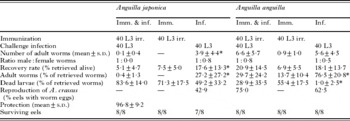
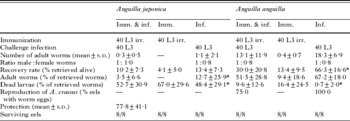
In part A (n=8) of the experiment, immunization of A. japonica with irradiated L3 induced 96·8%±9·2% protection, based on the number of adult worms developing from the challenge infection (P<0·05). In part B (n=8) of the experiment a similar trend, but no statistically significant difference, was observed (Table 1). Combining the results from both parts of the experiment (n=16) revealed a significant reduction of the number of adult worms in immunized A. japonica (P<0·05), implying a resistance of 87·3%±30·4%. In contrast, immunization of A. anguilla with irradiated L3 had no effect on the number of adult worms developing from the challenge infection (Table 1).
Effect of immunization of Anguilla anguilla and Anguilla japonica with 40 irradiated L3 of Anguillicola crassus
(The experiment was split into 2 independent parts A and B. Data presented are mean values±s.d.)
Trial A

Trial B

* Significant difference (U-test, P<0·05) between Imm. & inf. and Inf.
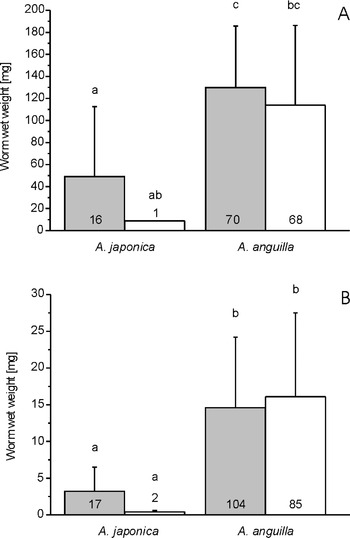
In A. japonica only immunized with irradiated L3 no adult worms were recovered, whereas in A. anguilla 1·7% of the irradiated L3 had developed to adult worms. These worms were very small (females weighing 3·9±4·1 mg, 1 male weighing 0·2 mg) compared to adult worms which had developed in A. anguilla within the same time from normal L3 (Fig. 2). The total burden of living worms (L3, L4, adults) in the immunization control group in A. anguilla was about one third to one forth compared to the challenge control group (Table 1).
Mean wet weight of (A) female and (B) male Anguillicola crassus from experimentally infected Anguilla japonica and Anguilla anguilla kept at a water temperature of 23°C and examined 12 weeks p.i. Error bars indicate s.d.; numbers within or on the columns indicate sample sizes. Columns with superscripts in common are not different from one another (P>0·05). Grey columns, normally infected eels (challenge control group); white columns, immunized and challenge-infected eels.

The wet weight of adult worms from immunized and challenge infected A. anguilla did not significantly differ from the wet weight of challenge control worms (Fig. 2). In contrast, the few adult A. crassus found in the immunized and challenge infected A. japonica tended to be smaller than the challenge control worms, but due to the low number of adult worms found in the immunized A. japonica this difference could not be shown to be statistically significant (Fig. 2).
The sex ratio of the adult worms was similar in both host species and in immunized versus non-immunized eels (Table 1). The number of eels with eggs/L2 of A. crassus in their swimbladder lumen was similar in A. anguilla immunized with a challenge infection and the challenge control group. In A. japonica 3 of 15 specimens of the challenge control group harboured eggs/L2 of A. crassus, while none of the immunized eels contained eggs/L2.
In the challenge control groups the percentage of adult A. crassus recovered was significantly lower in A. japonica compared to A. anguilla (19·5%±26·6% versus 71·5%±19·3%, respectively), and the wet weight of adult worms was significantly lower in A. japonica than in A. anguilla (Fig. 2). The proportion of dead/encapsulated larvae from all worms retrieved was significantly higher in A. japonica (48·8%±29·9%) than in A. anguilla (0·8%±2·2%), and the percentage of eels containing eggs/L2 of A. crassus in the swimbladder lumen was significantly lower in A. japonica compared to A. anguilla.
Antibody response of immunized eels and control eels
To study the course of the antibody response, sera obtained from eels in part B of the experiment were tested by ELISA with total soluble antigens of L3 and body wall soluble antigens of adult worms. The qualitative course of the antibody responses detected in both eel species was similar for both crude antigens. However, there were significant differences between host species (Fig. 3).
ELISA study of antibody responses of immunized and non-immunized Anguilla japonica (A, B) and Anguilla anguilla (C, D) against antigens of the adult worm body wall (A, C) and somatic L3 antigens (B, D) of Anguillicola crassus during the course of a challenge infection. Shown is the serum antibody content relative to the start of the experiment. Arrowheads indicate the date of immunization (imm.) and infection (inf.), error bars indicate s.d., and asterisks significantly increasd antibody contents. ■, immunized; ●, infected; ▲, immunized and infected; ▼, not immunized, not infected.

In immunized and challenge-infected A. japonica the first antibody responses were detected 1 month after the challenge infection, i.e. 2 months after the first antigen contact. The antibody response rose slightly until the end of the experiment. A. japonica of the challenge control group also reacted 2 months after the first antigen contact, i.e. 2 months after the challenge infection and had a slightly rising antibody response. In immunized A. japonica without challenge infection, antibody responses were also detectable 2 months after the immunization. Antibody responses against body wall antigens remained low, while antibodies against L3 antigens rose slightly. Sera from the A. japonica control group that was neither immunized nor challenge infected showed no reaction with the Anguillicola antigen preparations.
In immunized and challenge-infected A. anguilla first antibody responses (2 of 8 eels) were also detected 2 months after the first antigen contact (i.e. 1 month after the challenge infection). Much in contrast to A. japonica, the antibody response then increased drastically and reached a high level at the end of the experiment. A. anguilla of the challenge control group showed a relatively weak, but significant reaction 2 months after the challenge infection, but the antibody levels did not rise. No antibody response was detected in immunized A. anguilla without challenge infection, and in the control group that was neither immunized nor challenge infected.
The level of antibody responses in immunized A. japonica was not correlated with protection against challenge infection. However, in immunized A. anguilla a positive correlation was found between the level of antibody responses against the larval antigen preparation and the number of adult worms (week 8: r=0·802, P=0·017; week 12: r=0,786, P=0·021).
DISCUSSION
Our study shows that eels can be successfully vaccinated against A. crassus by application of irradiated L3, provided that the animals belong to a host species that is able to mount a protective immune response. Whereas A. japonica could be protected by vaccination with attenuated L3, the newly acquired host species A. anguilla could not restrict the worm burden deriving from challenge infection. These data suggest that the original host can restrict the burden of its parasite by immune responses, whereas A. anguilla cannot. Therefore, it is likely that the recent spread of A. crassus in Europe was facilitated by an immunologically determined susceptibility of A. anguilla.
Our data show that gamma irradiation (135Cs) is a useful method to obtain attenuated L3 of A. crassus. Compared with L3 of the filarial nematode Acanthocheilonema viteae, which is almost completely attenuated with a dose of 350 Gy (Lucius et al. Reference Lucius, Textor, Kern and Kirsten1991; Schrempf-Eppstein et al. Reference Schrempf-Eppstein, Kern, Textor and Lucius1997), attenuation of L3 of A. crassus requires a higher dose of radiation. Irradiation with 525 Gy still allowed the larval development from L3 to L4, but interfered with the further development to adults. This prompted us to reduce the level of irradiation to 500 Gy in the vaccination experiment, as we anticipated that a slightly better larval growth could induce a better immunity against the challenge infection. However, the vaccination experiment showed that a few 500 Gy-irradiated L3 of the irradiation control group reached maturity in the European eel, such that the original slightly higher irradiation dose of 525 Gy can be considered optimal for attenuation of A. crassus.
In A. japonica, the original host of A. crassus, immunization with irradiated L3 of A. crassus resulted in a significantly reduced number of adult worms developing from a subsequent challenge infection compared to the challenge control group only infected with normal L3, indicating that immunization induced partial resistance. In the new host A. anguilla, immunization with irradiated L3 had obviously no effect on the number of adult worms developing from the challenge infection, providing no evidence for an induced resistance. Although the basis of the immunity induced by irradiated nematode L3 has not been completely elucidated, work in rodent models suggests that adaptive immunity induced by irradiated filarial L3 requires IgE and eosinophils, and furthermore depends on activation of Toll-like receptor 4 (TLR4) (Abraham et al. Reference Abraham, Leon, Schnyder-Candrian, Wang, Galioto, Kerepesi, Lee and Lustigman2004; Kerepesi et al. Reference Kerepesi, Leon, Lustigman and Abraham2005). Therefore, the differences in reactivity between A. japonica and A. anguilla could be caused by a multitude of factors involved in such adaptive immune responses. Among others, variation in MHC genes or differences in cytokine regulation might determine the host qualities of eel species.
The lower susceptibility of A. japonica to A. crassus in comparison to A. anguilla, which has previously been demonstrated by experimental infection (Knopf and Mahnke, Reference Knopf and Mahnke2004), could be confirmed with the present experiment. Following a single infection, the percentage of adult worms found in A. japonica was lower as compared to A. anguilla, and the few adult worms were much smaller in A. japonica compared to A. anguilla. As published data prove that A. crassus has the potential to reach a similar size in both host species (Kuwahara et al. Reference Kuwahara, Niimi and Itagaki1974; Moravec and Taraschewski, Reference Moravec and Taraschewski1988) our data indicate that the worms' development is retarded in the original host, A. japonica, as compared to A. anguilla. This might indicate poorer living conditions for A. crassus in A. japonica as compared to A. anguilla. Such differences in growth conditions for A. crassus could be due to adaptive immune responses developing during the infection, but also to stronger innate immune responses of A. japonica as, for example, attacking neutrophils.
Comparison of the present experiment with a similar study on infection of various rodent species with the filarial nematode A. viteae reveals, as an interesting parallel, that in both cases the highest degree of protection was observed in the original host (Schrempf-Eppstein et al. Reference Schrempf-Eppstein, Kern, Textor and Lucius1997). A second interesting parallel pertains to the role of antibody responses in protection. It has been assumed that L3 of A. crassus can be killed by antibody-mediated mechanisms (Nielsen et al. Reference Nielsen1999; Knopf et al. Reference Knopf, Naser, van der Heijden and Taraschewski2000), but hitherto there is no proof for a role of antibody responses in immune protection neither in A. japonica nor in A. anguilla. In the present study, the level of antibody responses against the larval antigen preparation in vaccinated A. anguilla was positively correlated with the number of adult worms developing from the challenge infection, suggesting that the antibody response measured is more a marker for susceptibility than for resistance. This is intriguing, as antibody-mediated cellular cytotoxicity is also regarded as an important mechanism of protection in rodent infections with filarial nematodes (Abraham et al. Reference Abraham, Leon, Schnyder-Candrian, Wang, Galioto, Kerepesi, Lee and Lustigman2004). However, a recent vaccination study with recombinant tropomyosin of A. viteae revealed also an inverse correlation between protection and antibody responses and suggested T cell-mediated immune effector mechanisms (Hartmann et al. Reference Hartmann, Sereda, Sollwedel, Kalinna and Lucius2006). The same might hold true for the infection of A. japonica with A. crassus. It is, however, possible that the use of other antigen preparations, e.g. from L4, or other experimental conditions would reveal protective antibody-mediated immune mechanisms.
It is suggestive that comparative experiments with A. japonica and A. anguilla, that differ significantly in their susceptibility to A. crassus, might be a key for further insights into immune effector mechanisms of fish against a nematode parasite. Moreover, comparison between immune mechanisms of hosts as different as mammals and fish might help to determine common denominators of protection against nematode parasites.
We are most grateful to Professor Kazuo Ogawa, University of Tokyo, for organizing the shipment of the Japanese glass eels. We thank Dr Kurt Buchmann, University of Copenhagen, and Dr Jan Rombout, Wageningen University, for providing the antibodies against eel immunoglobulin. We also thank Dr Heidi Hecker-Kia, Deutsches Rheuma-Forschungszentrum Berlin, who enabled us to use the radiation source, and Eric Eckmann for technical support.