Introduction
Between 1750 and 1890, farmers in Galicia, on northwestern Spain’s cool, wet Atlantic coast, intensified their agricultural system and raised yields in the context of a growing human population. How did they manage to boost productivity on long-farmed soils prior to the advent of tractors, hybrid crops, synthetic fertilizers, and pesticides? How did communities reorganize agro-ecosystems to feed ever more people? The answer lies in soil fertility management. Employing a brushy, leguminous plant called gorse (Ulex Europaeus), villagers transferred soil nutrients from outlying bushland for deposition on their arable cropland. They also restructured their livestock management, with the aid of new crops imported from the Americas, to capture more manure. Those two strategies enabled increased fertilization of cropland, higher grain yields, and more food to feed more people. It was an ingenious adaptation to social and economic pressures and environmental possibilities, but it was unsustainable in the long run, as agro-ecosystems eventually depleted soil nutrients from outlying bushland. The analysis relies on the theory of social metabolism formulated by González de Molina and Toledo (Reference González de Molina and Toledo2011, Reference González de Molina and Toledo2014), which studies the coevolution of social and natural systems according to the material and energy exchanges that occur between them. The methodology of nutrient balances in historical agro-ecosystems developed by García-Ruiz et al. (Reference García-Ruiz, de Molina, Casado, Fernández and Infante-Amate2012) reveals how nutrient cycles worked and how sustainable they were, with special attention to land management techniques focused on replenishing soil fertility. To test the theoretical limits of the agricultural system, the article employs a “forced local funds sustainability assumption,” which considers the highest level of sustainability that might be reached within the constraints of an agro-ecosystem (Marco et al., Reference Marco, Roc and Claudio Cattaneo2018). The village of Fonsagrada serves as a case study, reconstructed for three time points (1752, 1852, 1887) from taxation and statistical sources and an imperial cadaster. Hardly an ignorant or unchanging peasantry, farmers in Fonsagrada responded to global events and social and demographic pressures, innovated their land management, raised productivity, and over a century and a half utterly remade their farm system. They accomplished those transformations by manipulating soil nutrients in ingenious ways across a varied landscape.
An Extensive Territory
The municipality of Fonsagrada lies in the interior province of Lugo, with an area of 439 square kilometers. Footnote 1 It is located in the eastern mountains of Galicia, in the northwestern corner of the Iberian Peninsula. Two river basins frame this municipality: the Eo valley on the West and the Navia valley on the East. Two minor rivers divide the area into northern and southern parts: the Rodil, which flows into the Eo River, and the Lamas-Villabol, which flows into the Navia River. The average elevation in the municipality is between 700 and 800 meters above the sea level (López Fernández, Reference López Fernández1986).
The eastern mountains of Lugo form a nexus with the Cantabric Mountains, creating a biogeographic frontier with the rest of the territory (Terra Chá, Sarria-Lemos) and blocking winds from the coast. An oceanic climate predominates, although with continental influence. Average annual precipitation ranges between 1750 and 2100 mm, and there is no dry season (Giménez de Azcárate, Reference Giménez de Azcárate Cornide1993). Winters are cold and snow is common, as are frosts through most of the year. Temperature and rainfall conditions favor certain weathering processes that do not modify soil chemistry very much (Martínez Cortizas et al., Reference Martínez Cortizas and Pérez Alberti1999). Average annual rainfall at the nearby meteorological station of Pedrafita reaches 1,900 mm, with an annual precipitation deficit of 122 mm during June through August. Mean annual temperature is 8.3 ºC. These average data inform the nutrient balance analysis in the following text Footnote 2 (Gil Sotres and Díaz-Fierros, Reference Gil Sotres and Viqueira1979).
By the Middle Ages, traditional land use in mountainous regions was characterized by an integration of crops, livestock grazing, and forestry, with micro-adaptations to the diverse ecological environments. Low-lying land in valley bottoms received deposits of dissolved nutrients washed down from uplands, as well as manure applications, and were intensely cropped. Human habitations concentrated on sunny slopes or at the bottom of the valleys. Vegetable gardens were spread among the houses and surrounding the village. Nearby were the soutos (chestnut groves) and labradío (cropland, mostly rye). Further away from the village there was monte, mostly composed of shrubland, especially gorse, and generally defined as uncultivated land. Villagers occasionally burned monte to regenerate shrub and pasture, and very occasionally cultivated it for a short period in a unique form of shifting agriculture referred to as estivadas. It was this monte that served as a crucial nutrient reserve for cropland. Hay meadows were located at the floor of the valleys and along water streams (Guitián, Reference Guitián Rivera1993).
Population in Fonsagrada
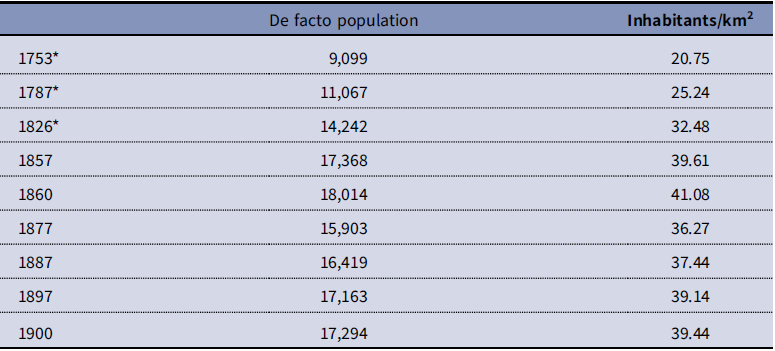
Demographic growth was likely the driving force behind agricultural intensification in Fonsagrada, where population doubled between the 1750s and 1860s. Such a rapid increase created a real challenge in the context of an isolated agrarian society with an unfavorable environment embedded in feudal relationships that extracted an important part of the agricultural produce from producers (Saavedra, Reference Saavedra Fernández1979). According to Saavedra, the increase in population was tightly connected with the introduction of potatoes, an American crop that arrived in Fonsagrada after 1788. The spread of this tuber was a partial solution to previous agrarian crises that had been responsible for population stagnation during the middle decades of the eighteenth century. With the introduction of potatoes, yields increased and rotations became more complex. Mortality rates fell due to more diverse and abundant nutrition (Saavedra, Reference Saavedra Fernández1979). After the 1860s, however, migration away from Galicia was responsible for a reduction in the rate of population growth (Table 1).
Fonsagrada. Population changes between 1753–1900

Source: Saavedra* (1979) and INEbase population censuses (http://www.ine.es/inebaseweb/libros.do?tntp=71807).
A key argument here is that the out-migration of the nineteenth century in Fonsagrada resulted from an agricultural intensification process that was very successful, but that had reached its biophysical limits under the specific historical and cultural practices of an organic metabolism. After a period of remarkable agricultural growth, there was no further opportunity for population to continue increasing on the same soil base. Between 1750 and 1890 Fonsagrada underwent changes that have been described elsewhere as the “First Agricultural Revolution.” Other terminology refers to these changes as the “First Wave of the Socio-Ecological Transition” (SET), recognizing that it was just the beginning of a long-term process that would not conclude until the twentieth century, with a massive incorporation of fossil fuels into agriculture. The process of SET in this case refers to the change from an organic or agrarian metabolism into an industrial one as it has been described by Fischer-Kowalski and Haberl (Reference Fischer-Kowalski and Helmut2007) or González de Molina and Toledo (Reference González de Molina and Toledo2014). The second wave, which mainly refers to the use of inorganic fertilizers, happened in Fonsagrada and across Galicia and all of Spain in the 1940s, following the Spanish Civil War (Fernández Prieto Reference Fernández Prieto1992; Soto, 2006). That second wave of the SET is well documented, but this article focuses on an important transformation that happened earlier, in the century and a half before the onset of the twentieth century. Prior to the better-known modernization of agriculture, changes related with the first wave were the result of an optimization of agrarian production and changes in cultural practices within an organic metabolism. Those changes were rooted in soil nutrient management, and they are the focus of this article.
Changes in Land Use, Rotations, and Yields
In the case of Fonsagrada, as in most interior regions of Lugo, changes related with the first wave of the SET appeared first as experiments in cortiñas, small enclosed plots with intensive management that Saavedra documented as early as the thirteenth century. Legumes were cultivated in cortiñas at the time, and by the sixteenth and seventeenth centuries every aldea had cortiñas, where turnips, flax, millet, and other crops grew. Farmers applied manure abundantly in these plots, which produced at least one harvest a year. With such intensive management, cortiñas were similar to vegetable gardens, which also used to be near the houses (Bouhier and Vila, Reference Bouhier and Benxamín Casal2001; López Fernández et al., Reference López Fernández1986; Saavedra, Reference Saavedra Fernández1979). However, it is difficult to track changes in cortiñas with detail, especially regarding their area. In Ensenada’s Cadaster of 1752, data are not very specific about this type of land use, and its accounted area reached only 20 hectares out of 2,105 hectares of total cropland. Beyond 1752, cortiñas cannot be tracked in available sources. Thus, they are not included in the soil nutrient balances presented in the following text. However, they do appear in general descriptions of the agro-ecosystem toward the middle of the eighteenth century due to their qualitative importance. This should not imply significant changes in the nutrient balances because cortiñas surface was not relevant in quantitative terms but only as experimental plots. However, we cannot provide further detail due to the lack of information in the sources.
A first goal is to present a general picture of the whole agro-ecosystems revealed by the sources, and then proceed to an analysis at crop scale. Some crops such as wheat, oats, or maize were very important in qualitative terms but occupied a very small area that was not representative of the agro-ecosystem, as in 1752, or not even recorded at all in the nineteenth century. These crops are excluded from the aggregated scale and the nutrient balances, although they appear in a more detailed description and general analysis due to their agronomic significance.
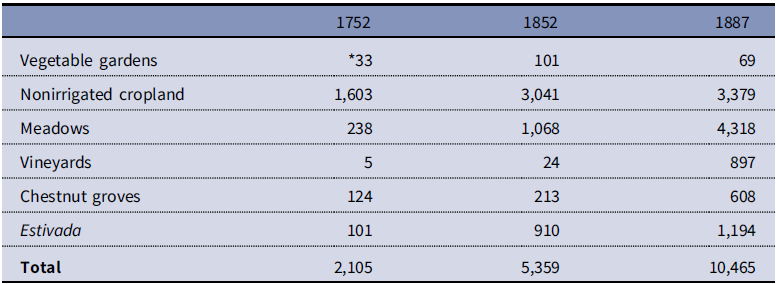
A structured description of the agro-ecosystem includes the following categories: vegetable gardens and cortiñas, cereal or nonirrigated crops, hay meadows (both irrigated and not), chestnut groves, vineyard, woodland, monte bushland, and estivada swidden. The most common and abundant crop throughout the period was rye: either in a biannual rye-fallow rotation or, progressively through the nineteenth century, associated with potatoes and turnips but without fallow. Table 2 shows changes in areas of each of these land use types.
Fonsagrada. Changes in cultivated area: 1752, 1852, and 1887 (ha)

Source: Respuestas Generales of Ensenada’s Cadastre (http://pares.mcu.es/Catastro/servlets/ServletController?ini=0&accion=0&mapas=0&tipo=0), and cartilla from 1852 and agricultural statistics from 1887, APHL, Facenda, C14491.
*Includes cortiñas.
Vegetable gardens decreased between 1852 and 1887, accompanying the reduction of population connected with active migration to America. Vineyard and chestnut groves must have been considerably underestimated in 1752, however their increase between 1852 and 1887 is very remarkable. Estivada area, which provided an extra cereal crop, also saw a large increase through the period, from 101 hectares in 1752 to 1,194 in 1887. Finally, the biggest increase was that of meadows, which grew from 238 hectares to 4,318 at the end of the period, when their area was larger than that of cropland (3,879 hectares) and had replaced monte surface as the agro-ecosystem’s main soil nutrient provider.
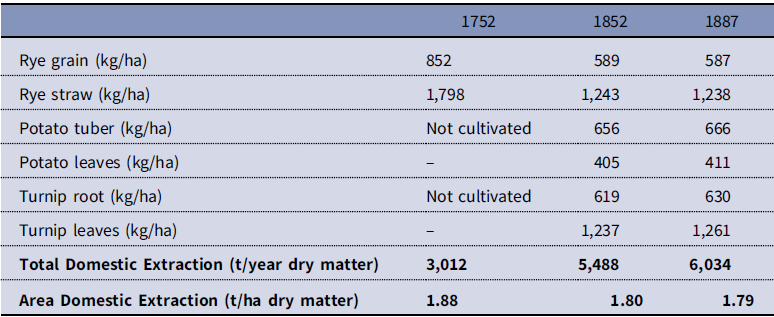
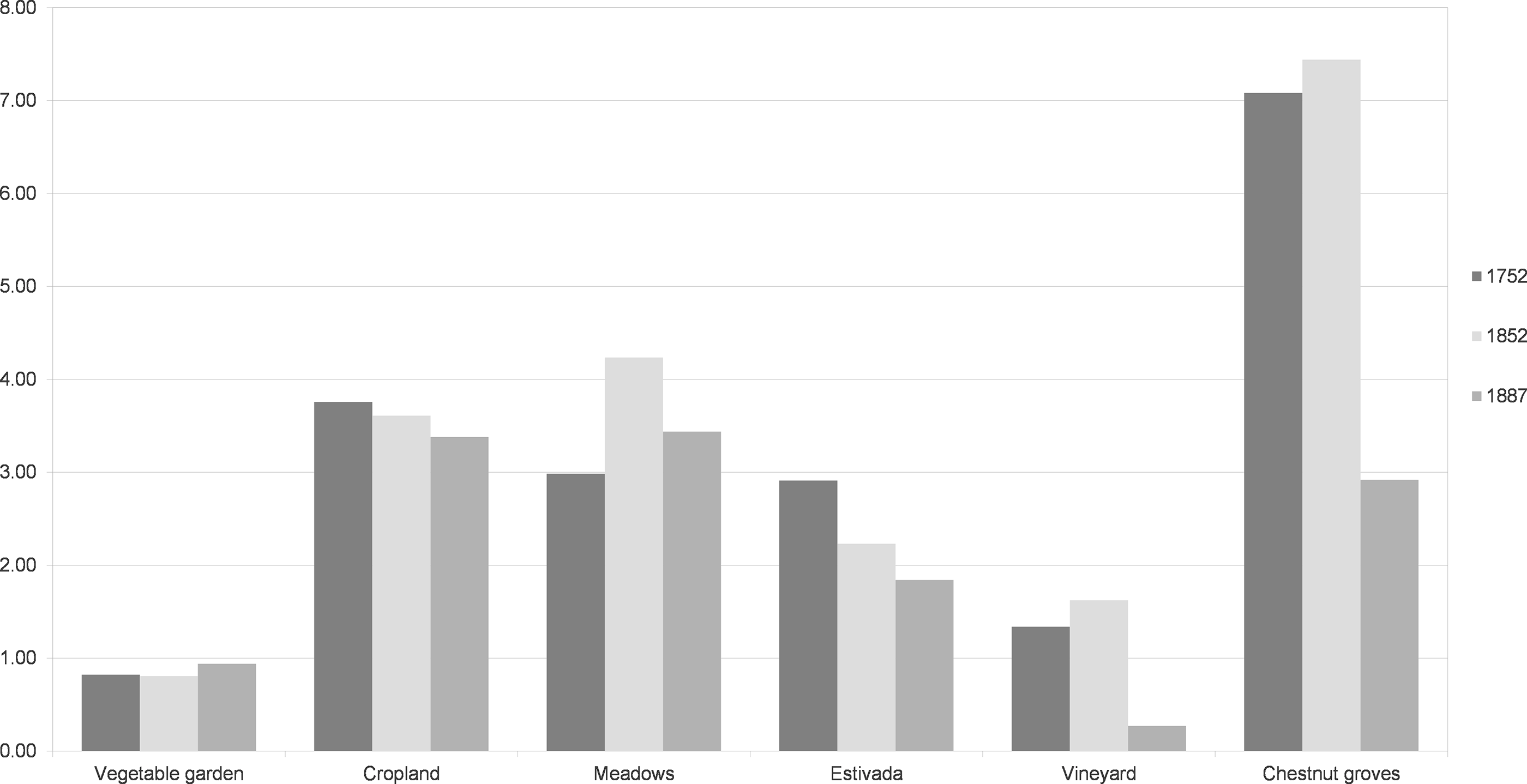
Average land productivity for these different types of land uses is showed in table 3 and figure 1, which indicate a decreasing trend and stagnation in most categories. Overall productivity in cropland remained more or less the same all through the period, although with a slight increase from 2.55 tons per hectare in 1752 to 2.57 in 1852, and 2.76 in 1887. However, note that the same yields have been applied to some crops in all three time points. Growth in productivity was mostly a result of changes in the quality of cultivated soils and especially the increase of cropped area. In the case of meadows, decreases can be explained by a larger proportion of nonirrigated meadows, which had lower yields. The same average yields were applied to vegetable gardens all through the period, and variations in production are only related with different distributions of soil qualities. The decrease in the productivity of soutos (chestnut groves) in 1887 was mainly due to the fact that first quality soils disappeared from the declarations of this year, and area increased considerably in the other two soil qualities. It is unclear whether this was a deliberate fraud in the taxation sources or if it represented real changes, which would seem too drastic. Chestnut yields are specific for 1752, but in the nineteenth century they come from the neighbor village of Rendar. Footnote 3 Productivity was generally so high in soutos because wood and firewood extractions are included, but chestnut yields varied between 596 kilograms per hectare in 1752, 880 in 1852, and 623 in 1887 (in dry matter equivalents). Changes in the productivity of vineyard were also related with a different soil quality distribution in the sources from the nineteenth century. An initial increase of productivity from 1.34 tons per hectare to 1.62 between 1752 and 1852, which was accompanied by a slight area expansion, grew to 1.66 tons per hectare in 1887, when the surface expanded immensely, especially in first quality soils.
Fonsagrada. Average productivity and annual domestic extraction in nonirrigated cropland (dry matter): 1752, 1852, and 1887

Sources: Respuestas Generales of Ensenada’s Cadastre, 1752, (http://pares.mcu.es/Catastro/servlets/ServletController?ini=0&accion=0&mapas=0&tipo=0); cartillas of Fonsagrada, 1852 and 1886, APHL, Facenda, C14491 and C14992, respectively, and agricultural statistics of 1887, APHL, Facenda, C14491.
Fonsagrada. Land productivity in 1752, 1852, and 1887 (t/ha, dry matter).Sources: Respuestas Generales of Ensenada’s Cadastre, 1752, (http://pares.mcu.es/Catastro/servlets/ServletController?ini=0&accion=0&mapas=0&tipo=0); cartillas of Fonsagrada from 1852 and 1886, APHL, Facenda, C14491 and C14992, respectively, and agricultural statistics from 1887, APHL, Facenda, C14491.

The nonirrigated cropland included only rye in 1752, mostly in a biannual rotation with fallow. Farmers grew rye, potatoes, and turnips in 1852 and 1887, but without fallow. The elimination of fallow and the addition of root crops was the most significant example of intensification in Fonsagrada. Net production in cropland doubled by the end of the period, in part because of a considerable expansion of its total area. But overall yields (production per area) decreased slightly, which was certainly connected with this process of more intensive cropping and a higher level of soil nutrient extractions. This strategy fed more people but drained nutrients from other parts of the landscape by means of livestock conversion, mainly from extensive monte at the beginning of the period, and then increasingly from hay meadows too. The most reliable indication of nutrient exhaustion resulting from this intensification pattern is the gradual decrease in productivity in both cropland and estivadas between 1752 and 1852. These were the main sources of food provision for the community, and the most intensively managed after vegetable gardens and cortiñas.
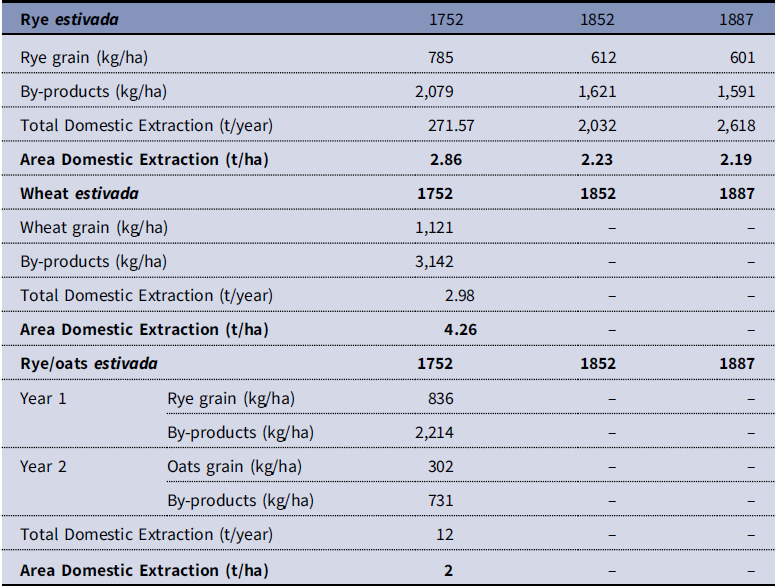
The nonirrigated cropland was one of the most important and widespread land uses in the region, with rye as the staple crop. Here one can best appreciate the intensification process: fallow disappeared progressively between 1752 and 1852, cropped area grew, new crops were introduced, and total production increased. In 1752, the 21 percent of labradío was cropped annually with rye. The remaining 79 percent could not produce without a year of fallow. By 1852, there was no fallow at all, and a biannual rotation had emerged, in which rye was cropped in the first year, and alternated with potatoes or turnips in the second. It is important to mention that in 1887, more surface was cultivated with potatoes and turnips than with rye. The introduction of potatoes from the New World was associated with the suppression of fallow but also with changes in techniques and tools. The cultivation of this tuber required deeper tillage and was more demanding in terms of nutrients than rye, thus increasing manure requirements. As shown in table 3, cropland produced in 1887 twice as much food as it did in 1752, but yields drifted downward from 1.88 tons per hectare 1752 to 1.80 in 1852, and to 1.79 in 1887. In the case of estivadas, as detailed in table 4, rye yields also declined, from 2.86 tons per hectare in 1752 to 2.19 at the end of the period.
Fonsagrada. Average yields and land productivity in estivada: 1752, 1852, and 1887 (dry matter)

Source: Respuestas Generales, Ensenada’s Cadastre, 1752, http://pares.mcu.es/Catastro/servlets/ServletController?ini=0&accion=0&mapas=0&tipo=0; cartillas of Fonsagrada, 1852 and 1886, APHL, Facenda, C14491 and C14992, respectively, and agricultural statistics from 1887, APHL, Facenda, C14491.
These changes in land uses, which implied an increasing prominence of meadows and estivada and an increase in cropped surface, were accompanied by adaptations in the management of livestock. Its numbers were dramatically reduced between 1752 and 1852 to secure a more intensive management that provided crops with manure, as we will see in this article. But again by 1897 livestock head had increased to satisfy higher manure demands.
However, agricultural intensification also kept in step with the demographic evolution. Population grew from 9,099 inhabitants in 1753 to 18,014 in 1860. By the time the next census was made in 1877 population had decreased to 15,903 inhabitants, thus indicating an exhaustion in the intensification pattern. However, it would recover slightly with 16,419 inhabitants in 1887 and 17,163 in 1897. Migration should be considered as a structural phenomenon in the region, with seasonal movements to other regions within the Iberian Peninsula until the middle of the nineteenth century, when it headed mostly toward America (Villares and Fernández, Reference Villares and Fernández1996).
Changes in Monte and Estivadas
Due to their specificities when compared with cultivated land, the uncultivated gorse shrublands, monte and estivadas, deserve special attention. In Fonsagrada, access to monte resources was determined by descent or lineage. These were called montes de varas, and were characteristic of the northern half of Galicia, whereas common lands, or montes en man común, where access was determined by locality, were predominant in the southern half. Co-owners in montes de varas could sell their plots and, apart from the common appropriation of pasture or firewood, most other uses were individual (Balboa, Reference Balboa López1990; Bouhier and Vila, Reference Bouhier and Benxamín Casal2001; Saavedra Fernández, Reference Saavedra Fernández1979).
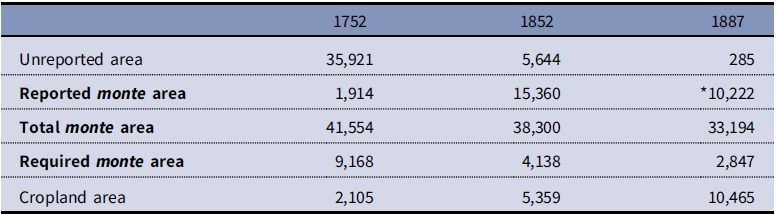
Monte satisfied three important needs in this organic metabolism: firewood, pasture, and bedding for stabled livestock. In doing so, they were also the primary soil nutrient supplier for cropland. Here “pasture” does not refer to cultivated grazing land, but rather to the multifunctional rough grazing in shrubland areas, where it was common for animals to range widely. This pasture was composed of both spontaneous plants and those shrubs that were planted in estivadas, namely gorse, which has been characterized both as the “support” (Bouhier and Vila, Reference Bouhier and Benxamín Casal2001) and as the “motor” (Soto, 2006) of the agrarian system. According to Bouhier, the diverse functions of monte remained the same during the intensification process, apart from a progressive decline of estivadas. According to Soto, however, changes in the appropriation of monte resources was the precondition of intensification. Nutrient balances reveal how this process occurred in Fonsagrada, where monte appropriation adapted to changes in the management of soil fertility. Table 5 reflects changes in the area of this essential resource and its proportion compared to cropland.
Fonsagrada. Monte area (ha): 1752, 1852, and 1887

Sources: Respuestas Generales, Ensenada’s Cadastre, 1752, http://pares.mcu.es/Catastro/servlets/ServletController?ini=0&accion=0&mapas=0&tipo=0; cartillas of Fonsagrada, 1852 and 1886, APHL, Facenda, C14491 and C14992, respectively, and agricultural statistics from 1887, APHL, Facenda, C14491.
*Estimated according to the increase in cropland in 1887 when compared with 1852 and its declared monte surface.
“Unreported area” has been estimated by deducting total reported area in the sources (7,929 ha in 1752; 38,206 ha in 1852; and 43,565 ha in 1887) from the current area of the Fonsagrada municipality (43,850 ha), as previous researchers have done in other case studies (Villares, Reference Villares1982). In 1887 unreported area was much lower, but that year includes estimated monte surface as reported. Estivadas are reported area too, both their yearly cropped area, and their corresponding fallow extent, obtained by multiplying total cropped estivada area by the number of years in which the soil is left fallow. The result is the maximum possible area requirements for estivada, although actual area must have been less. Reported surface was less than is indicated here because it includes fallow area requirements as well, which comes directly from the sources. Besides, the sources from 1752 included other areas: 105 hectares of oakwood and 86 hectares of urban and other unproductive areas such as paths or streams, which are also accounted for in 1852 and 1887.
The datum of “reported monte area” has been obtained from the accounts in the sources. In the 1880s monte area was not reported but annually cultivated estivada was. Therefore monte area for this year has been estimated according to the assumption that cropland expansion after 1852 occurred at the expense of monte. Thus, we deducted this increase in cropland area that occurred between 1852 and 1880s from the total monte area as declared in 1852 and obtained an estimated total of 10,222 ha of monte in this decade. Footnote 4
“Total monte area” represents the total current area of the municipality minus all reported area that is not monte. The result approximates the maximum possible monte area and is not included in the biophysical estimations because a considerable portion was unavailable due to steepness, rocks, rivers, and so forth. Fallow estivada area has been accounted for as monte as well because that is its actual use when not being cultivated by following a long-fallow strategy.
“Required monte area” has been estimated according to biophysical criteria by taking into account firewood, pasture, and stable bedding needs of the population and livestock present in the community in each year. Firewood needs were at least 2 kilograms per person per day, according to Infante-Amate et al. (2014). Firewood availability includes both woodland and chestnut groves. Estivadas area is not included because of its different treatment in nutrient balances. Although resource extraction took place on this land during fallow years, the management was completely different in the year of cultivation. Therefore, estivadas area did not follow such strict biophysical requirements and took place whenever peasants deemed it necessary in for shrub regeneration or food supply.
Finally, “cropland area” refers to the rest of the managed land: vegetable gardens, nonirrigated cropland, meadows, vineyard, chestnut groves, and yearly cropped estivada, all as reported in our sources. This combination of land uses has been described as “Used Agricultural Area” Footnote 5 by Soto (2006) or López Iglesias (Reference López Iglesias1995). The sum of cropland, total monte area, and urban land and oakwood as reported in 1752 represent the total of the municipality in all three time points.
The estimation of total required area allows comparison between sources and analysis of shrubland appropriation, but it does not correspond with actual surface, which was obviously much larger. This also means that the limits to intensification were not exclusively dependent on the amount of shrubland area available, which was more than enough in all three periods. The quality of monte, its distance, transport conditions, and labor availability were limitations on its appropriation and nutrient mobilization.
Limits to cropland intensification emerged mainly because the role of monte within the agro-system changed once villagers began to keep livestock in stables. Doing so meant that they mobilized soil nutrients in a different way. Livestock stabling suppressed an important form of direct fertilization, through fresh manure dropped on pastureland, both on monte and hay meadows. In Fonsagrada, the appropriation of monte surface to sustain livestock declined toward the end of the period specifically because of this change in livestock management.
Agricultural intensification was only possible by expanding cropland into former monte lands in a kind of frontier expansion. Thus soil nutrient stocks were mobilized from monte land that had never been intensively cultivated, and increasingly from hay meadows too. Cropland expansion into monte eventually exceeded sustainable limits due to nutrient scarcity and the increasing demand for fertilizer, which drained nutrients from meadows, but also from monte through estivadas. Estivada, the practice of shifting agriculture in the rough grazing lands, intensified as a result of a decreasing relative food availability in the community. This significant expansion of cultivated surface destroyed the previous land equilibrium. How could farmers sustain cropland fertility without extracting soil nutrients from extensive meadows and monte? This change was the origin of the “metabolic rift” between society and nature, and eventually created a land scarcity for the replenishment of soil fertility in a sustainable way.
Intensification of Estivadas
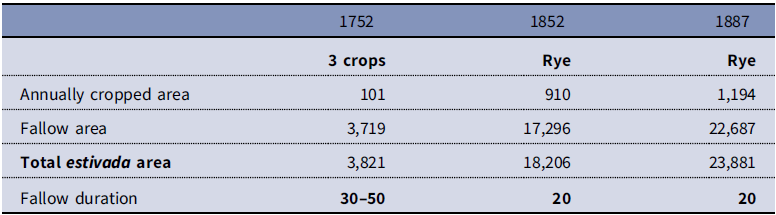
Estivada was a form of shifting agriculture that took place on monte bushland. It had a long fallow that allowed the soil to recover after the harvest. This could last between 30 and 50 years in 1752, depending on soil quality, and about 20 years in the second half of the nineteenth century. However, according to Saavedra, these numbers represent a maximum threshold, and the land could have been ploughed with greater or lesser frequency (Saavedra, Reference Gil Sotres and Viqueira1979). Table 6 shows the remarkable increase in estivada area, from 101 hectares in 1752 to 1,194 in 1887.
Fonsagrada. Estivadas: yearly cropped area (ha) and fallow duration (years) in 1752, 1852, and 1887

Source: Respuestas Generales, Ensenada’s Cadastre, 1752, http://pares.mcu.es/Catastro/servlets/ServletController?ini=0&accion=0&mapas=0&tipo=0; cartillas of Fonsagrada, 1852 and 1886, APHL, Facenda, C14491 and C14992, respectively, and agricultural statistics from 1887, APHL, Facenda, C14491.
Estivadas had several phases. In a first step, farmers cut shrubs and broke the land. Then they piled shrubs and clods together and burned them. Scattering the ashes over the whole surface returned some nutrients to the soil and slightly improved its acidity. Fire accelerates the process of mineralization in the soil, making nutrients more readily available to plants. Reducing soil acidity also increases the availability of some nutrients, such as nitrogen, phosphorus, potassium, sulfur, calcium, and magnesium. In a next phase, farmers plowed the land and prepared for cultivation with the first rains of the fall. At best, two crops were possible (Balboa, Reference Balboa López1990; Bouhier and Vila, Reference Bouhier and Benxamín Casal2001). However, in Fonsagrada most estivadas produced only one harvest. Only one case of a double harvest in estivada was described in 1752, which consisted of rye in the first year and oats in the second. The total cultivated area under this form of swidden reached 5.9 hectares annually in 1752, whereas 94.8 hectares were dedicated to rye under nonirrigated cropland, and 0.7 hectares to wheat. In the other two periods, estivadas were only composed of a single harvest of rye.
According to García Fernández, estivadas were already rising in the eighteenth century, as a result of increasing demographic pressure throughout the territory and the need for extra crops (García Fernández, Reference García Fernández1975). However, this author misses the purpose of estivadas, which have been described by Bouhier as a way of regenerating shrub growth, namely gorse, in support of an increasing demand for fertilizers (Bouhier and Vila, Reference Bouhier and Benxamín Casal2001). This explanation makes sense in agronomic terms because gorse grows better after fire (Sineiro, Reference Sineiro García1978). Cropland intensification was accompanied by a parallel monte intensification as well, which was usually only identified with the disappearance of estivadas in favor of more intensive gorse extractions. Farmers sold gorse seeds, and even selected for their improvement, and intensely cultivated the shrub. The span of time between gorse cuttings was more strictly observed in privatized lands, which also explains why they were more productive. Bouhier describes the general disappearance of estivadas in Galicia during the eighteenth and nineteenth centuries as a consequence of more intense uses over monte for gorse production. Pérez García, who describes this process for the southeastern coast of Galicia and Balboa, also confirm these main conclusions (Balboa, Reference Balboa López1990; Bouhier and Vila, Reference Bouhier and Benxamín Casal2001; Pérez García, Reference Pérez and José2000). However, in Fonsagrada there was also a parallel process of intensification of estivadas, a phenomenon that has not been studied so far. According to Bouhier, estivadas were intensified when required, but always attending to soil quality to sustain its fertility. In fact, according this author, they were progressively abandoned in Galicia. Fonsagrada is an exception, and perhaps there were other cases as well. Bouhier emphasizes the empirical knowledge of peasants in their management of land, affirming that gorse production was crucial. Besides, Bouhier contradicted modern prejudice against the supposed destructive and backward character of estivadas, a common misperception of swidden farming methods around the world. Farmers usually avoided establishing estivada on steep slopes, thus reducing soil erosion to the average for other cropland areas, and fire had a positive impact on soils by reducing acidity and favoring mineralization. Their main goal was to regenerate the growth of plants such as gorse and brooms, leguminous plants that increase nitrogen availability in the soil. By encouraging young gorse plants, symbiotic nitrogen fixation rates were also higher than with older plants (Bouhier, Reference Bouhier1984; Bouhier and Sila, Reference Bouhier and Benxamín Casal2001; Sineiro, Reference Sineiro García1982). Besides, the role of estivadas as extra food supplier with the cultivation of rye should not be discounted because in Fonsagrada they provided an important share of nutritional requirements in the most critical moments of the nineteenth century, when population struggled with relative food scarcity. Without the supply of cereal from estivadas, the nutritional security of the population in both 1852 and 1887 would have been much diminished, as shown in table 7. According to Cussó’s estimates on the minimum nutritional requirements of the Spanish population in 1860, an average diet should supply with at least 2,270 kilocalories per person per day (Cussó, Reference Cussó2005).
Fonsagrada. Estivadas contribution to human diets (kcal/pers/day) in 1752, 1852, and 1887

Source: Respuestas Generales, Ensenada’s Cadastre, 1752, http://pares.mcu.es/Catastro/servlets/ServletController?ini=0&accion=0&mapas=0&tipo=0; cartillas from Fonsagrada, 1852 and 1887, APHL, Facenda, C14491 and C14992, respectively, and agricultural statistics from 1887, APHL, Facenda, C14491.
In Fonsagrada, without the contribution of estivadas in 1852 and 1887, food availability would have been only 1,720.5 and 1,701.7 kilocalories per person per day instead of 1,998.6 and 2,078.7, respectively, that the entire agro-ecosystem delivered. Estivadas contributed between 250 and 400 kilocalories to the diet of the inhabitants of Fonsagrada in these critical moments of the second half of the nineteenth century, with a slight increase toward the 1880s that was related to a further expansion in cropland area and its intensification. The intensification of estivadas must have been driven by food scarcity, while also leading to fertility depletion and decreasing productivity in the long term.
The role of estivadas changed through time in direct relation with the intensification process and its eventual exhaustion. Thus, in 1752, when estivada mainly served to regenerate shrub production, monte mostly supported an extensively grazing livestock population. Farmers cultivated cereal on estivada because they had to carry out the labor either way to regenerate pasture. The grain harvest was a bonus, but clearly not the primary target of the estivada. Later on, this shrub regeneration was also necessary because monte had to supply ever more livestock bedding. Although these extractions were not higher than those of pasture, by the nineteenth century estivadas were mainly necessary to supply an extra crop to feed the community, despite the fact that it required a great deal of labor. These tasks did not require as much labor or land as did the process of increased manure production and the further expansion and intensification of cropland. Both depended on an increase in livestock numbers, daily gorse cuttings, frequent renewals of stable bedding, and manure distribution onto cropland. The intensification of estivadas can be interpreted as a result of reaching the physical limits of cropland appropriation.
However, the role of estivadas as food supplier in 1752 was irrelevant because estivada contributed only with 79 kilocalories per person per day at a time when the rest of agro-ecosystem provided 2,440, which was more than enough according to Cussó’s estimates.
As grazing pressure on monte pasture decreased during the nineteenth century, with livestock stabling and the expansion of hay meadows, there was a wider margin for intensification in estivadas, which increased their frequency to every 20 years by 1850. These monte crops were especially necessary toward the middle of the century with an increase in population and relative food scarcity. However, as a result of this increasing use of monte, nutrient imbalances worsened, with a parallel decrease in cropland yields. The nutrient balances confirm this trend also. Land availability had been overtaken by the requirements of soil fertility, and there were not enough resources to restore nutrients to cropland soils in a sustainable way. The expansion of cropland and more intensive land use alongside increasing demographic pressure created a metabolic rift. Besides, the reorientation in livestock management to produce manure in stables resulted in soil depletion in hay meadows and monte pastures, where nutrients were extracted but no longer replenished due to the relocation of animals to stables.
Similar conclusions regarding this metabolic rift have been obtained for case studies in Austria (Gingrich et al., Reference Gingrich, Gertrud, Fridolin and Roberto2015) and in the Mediterranean Spain (Galán et al., Reference Galán, Tello, Garrabou, Cussó and Olarieta2012; González de Molina et al., Reference González de Molina, García-Ruiz, Fernández, Casado, Herrera and Infante-Amate2012; Infante-Amate, Reference Infante-Amate2014), which generally confirm the connection between increasing demographic pressure and more intensive land uses as described by Boserup (Reference Boserup1967), as well as the relation between these processes and the institutional changes derived from liberal revolutions such as the reform of land property and the integration of markets.
Livestock: From Free-Range Animals to Stabled Cattle in Less Than a Century
Livestock fulfill functions that affect the entire agro-ecosystem, integrating its various elements and allowing matter and energy to flow within its boundaries. Domestic animals speed up the cycle of nutrients by means of their manure. They optimize farm production by consuming certain feed that is inedible to humans. And they provide transportation, labor, and ready cash when sold at the market (Martínez López, Reference Martínez López2000).
However, livestock are inefficient energy converters (Cussó et al., Reference Cussó i Segura, Garrabou, Olarieta and Tello2006). They represent a costly option within an agro-ecosystem, especially when—as in our case—it meant switching from an extensive form of animal husbandry to an intensive one that required keeping animals in stables, mowing hay crops, and cultivating feed such as turnips. This strategy required a great deal of human labor, but also much land. However, it was worth the effort due to livestock’s essential contributions in the form of manure and labor, allowing cropland intensification in turn. Livestock intensification led to stall feeding because the goal was to obtain more manure. Farmers had to collect gorse and bedding materials daily to refresh stables regularly, but also for feed. Gorse could be cut all year round, and especially in spring and summer. This operation, combined with transport, manure production, and manure application on the fields occupy as much as 19 percent of the time required for all agricultural tasks (Bouhier and Vila, Reference Bouhier and Benxamín Casal2001). Producing animal feed also competed with human food crops, which made it a costly land use option as well. It was the stabling of cattle that required both the expansion of meadows and the introduction of turnip and maize crops, which were used almost entirely for livestock feeding.
For the year 1752, the publication Censo ganadero de la Corona de Castilla, año de 1752 (INE, 1996) offers all livestock data available in Ensenada’s Cadastre for the entire Crown of Castile, including all the parishes that belonged to Fonsagrada at the time. For 1852 and 1887 data come from two documents: a livestock cartilla from 1855 and agricultural statistics from 1876, respectively. Footnote 6
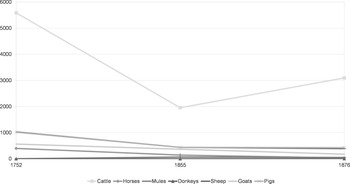
Livestock census data were converted into live weight measures with converters from Estudio de la ganadería en España, referred to the year 1917 (Ministerio de Fomento, 1920), and then total weight was transformed into standard Livestock Units of 500 kg each (LU-500 kg).Footnote 7 These data are represented in figure 2, which shows changes in livestock numbers through the study period. Livestock density was 20 animals per square kilometer in 1752, 8 in 1852, and 10 in 1887. This abrupt reduction by 1852 corresponds with the intensification of livestock management, when the whole system introduced adaptative changes in crops and land use. The small increase by 1876 was related to a further advance in the intensive management of livestock and was accompanied by an important increase in hay meadows as well.
Fonsagrada. Changes in livestock numbers: 1752, 1855, and 1876 (LU-500 kg).Source: Censo ganadero de la Corona de Castilla (INE, 1996), livestock cartilla, Fonsagrada, 1855, AHPL, Facenda, C14205; “Estadística Agrícola. Provincia de Lugo. Partido Judicial de Fonsagrada,” 1876, AHPL, Facenda, C14491; Estudio de la ganadería en España (Ministerio de Fomento, 1920)

The abundant livestock of 1752, namely cattle and swine, could not have been kept in stables; it would have been physically impossible. Livestock would have outnumbered people in the villages. To shelter livestock, it was necessary to reduce their numbers. This must have been a gradual process, and implied that livestock stopped spending most of their time grazing freely on monte and started to be stabled on the ground floor of peasant houses. The chronology of the process is still uncertain, but it occurred after the 1760s and it was completed by the 1850s. Footnote 8
The emphasis on cattle was directly related to their multifunctional character within the agro-ecosystem: cows provided milk, meat, labor, and calve production for the market. However, this specialization was not market driven. Cattle were not oriented solely to either labor, milk, or meat production, but supplied all of them at the same time, as was common in preindustrial agricultural metabolisms (Krausmann, Reference Krausmann2004).
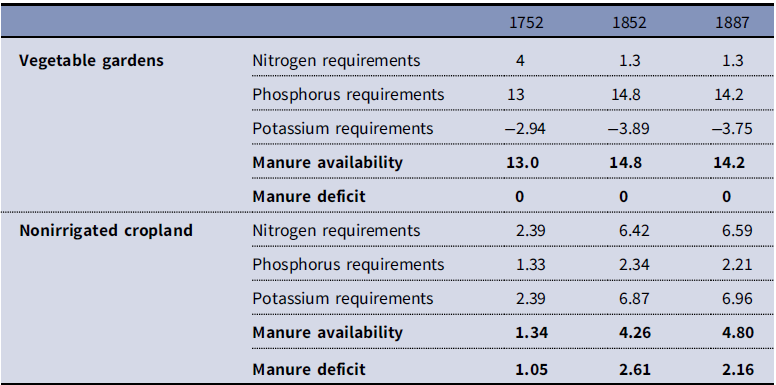
This change in livestock management aimed primarily at increasing manure availability for cropland, drawing on the livestock numbers reported in the previously mentioned sources. Specific converters for the corresponding amounts of manures deposited by different animals and nutrient contents of those manures come from ASAE (2003), and bedding amounts from Soroa (Reference Soroa1953). Total manure availability reached 2,332 tons in 1752, 14,465 in 1852, and 17,193 in 1887. Soil nutrient requirements for the two land uses that received manure, gardens, and nonirrigated cropland, appear in table 8.
Fonsagrada. Manure requirements in 1752, 1852, and 1887 (t/ha, fresh matter)

Source: Respuestas Generales of Ensenada’s Cadastre, 1752, (http://pares.mcu.es/Catastro/servlets/ServletController?ini=0&accion=0&mapas=0&tipo=0); Censo ganadero de la Corona de Castilla (INE, 1996), cartillas of Fonsagrada, 1852 and 1886, APHL, Facenda, C14491 and C14992, respectively; livestock cartilla, Fonsagrada, 1855, AHPL, Facenda, C14205; “Estadística Agrícola. Provincia de Lugo. Partido Judicial de Fonsagrada,” 1876, AHPL, Facenda, C14491; agricultural statistics from 1887, APHL, Facenda, C14491; and Estudio de la ganadería en España (Ministerio de Fomento, 1920).
Estimated availability refers to manure in stables, excluding manure dropped on pastureland. Availability in 1852 and 1876 has been estimated assuming that all cattle were permanently held in the stable to optimize manure collection. Such intensive stabling has been described by previous literature, but that assumption seems too extreme for Fonsagrada. Still, it is a conservative assumption to estimate the maximum manure and the most soil nutrients that could possibly have been collected. This would be an ideal situation or the upper limit of the agro-ecosystem for cropland nutrient availability. This might seem like a questionable decision but without any further information in the sources that allow us to estimate an accurate percentage of outdoors excreta we opted to approach the optimal situation. The aim of such decision is to show that even with that amount of manure the situation was still unsustainable in the long term.
Nitrogen must have never been a problem in vegetable gardens in Fonsagrada, but manure was not enough as to replenish it fully in the nonirrigated cropland already in 1752. This deficit increased significantly in 1852, when it was more than twice that of 1752, but it declined again by 1887 to about half a ton per hectare in comparison with the deficit of 1852. Peasant knowledge innovated further adaptations in the management of livestock and land uses to increase manure availability. Part of the solution was a larger number of livestock by 1887, which served to connect more hay meadow and cropland area.
Phosphorus was the most limiting nutrient in vegetable gardens, but there must have been enough manure to keep its soil balanced during the entire study period considering the logical hierarchy in the distribution of manure, which always favored the most intensive rotations. In the case of nonirrigated cropland, phosphorus was also balanced. Problems might have arisen with potassium, which was already scarce at the beginning of the period and in especially short supply toward the middle of the nineteenth century. However, potassium was not a problem at all in vegetable gardens because potential replenishment exceeded requirements (represented by negative values in table 8). Because vegetable gardens were very small compared to cropland, a transfer of all the manure from the former to the latter would not have solved the cropland deficits. This analysis assumes that logic would have aimed to guarantee a complete replenishment of nutrients in vegetable gardens instead of allowing imbalances in both vegetable and cereal land, especially considering the more intensive cropping of orchards.
Regarding total manure availability, amounts rose from 2,333 tons per year in 1752 to 14,465 in 1855 and 17,193 in 1887. This was equivalent to an average manure availability of 1.4, 4.6, and 5 tons per hectare, respectively, considering both types of fertilized land as a whole, disregarding their particular requirements. The general low availability for 1752 is explained by the fact that soil fertility relied not only on manure for nutrient replenishment but also on fallow. Nitrogen requirements in the nonirrigated cropland was replenished up to a 50 percent by fallow, while manure supplied 30 percent, and there was a deficit of 20 percent. At that time, potassium was the most limiting nutrient, with the following replenishment supplies: manure provided the 30 percent, fallow 47 percent, and there was still a 23 percent deficit. In the case of phosphorus, manure provided most of it, up to a 68 percent, and fallow replenished the remaining 32 percent. The management of soil fertility relied considerably on fallow for nutrient replenishment in the mid-eighteenth century. These results are similar to those that Krausmann found for preindustrial Austrian agriculture (Krausmann, Reference Krausmann2004).
Nutrient Balances in Fonsagrada and Agricultural Management of Soil Fertility
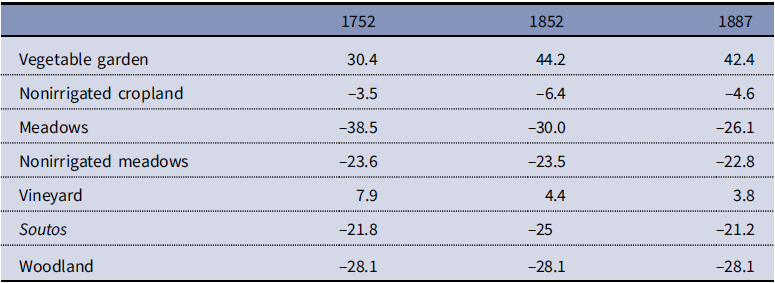
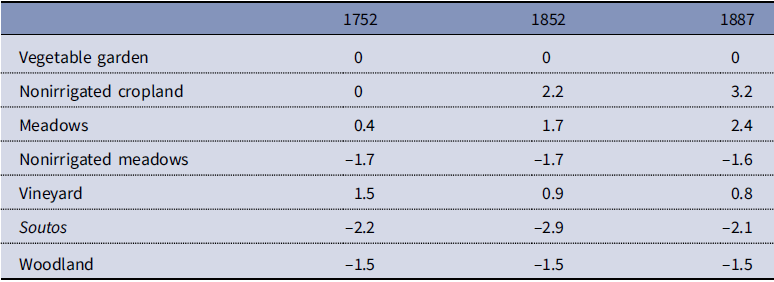
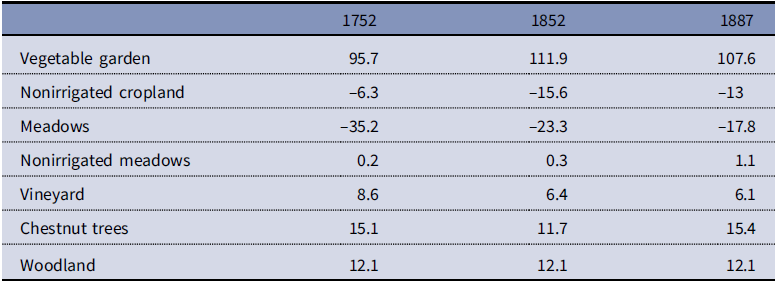
It is also useful to consider soil nutrient balances at land use scale to assess the functioning of the agro-ecosystem. These estimations have a margin of error considering the methodology, the sources, and the assumptions required to replace missing data. However, the magnitude of the results is coherent, both internally and when contrasted with the evolution of land productivity. In these balances, land uses are distributed to sustain the soil fertility in cropland, at the expense of other areas, namely monte and hay meadows (Tables 9–11).
Nitrogen balances in Fonsagrada: 1752, 1852, and 1887 (kg/ha)

Source: Respuestas Generales of Ensenada’s Cadastre, 1752, (http://pares.mcu.es/Catastro/servlets/ServletController?ini=0&accion=0&mapas=0&tipo=0); Censo ganadero de la Corona de Castilla (INE, 1996); Saavedra (1979) for population datum of 1752; INEbase population censuses from 1857 and 1887 (http://www.ine.es/inebaseweb/libros.do?tntp=71807#); cartillas from 1852 and 1886, Fonsagrada, APHL, Facenda, C14491 and C14992, respectively; livestock cartilla, Fonsagrada, 1855, AHPL, Facenda, C14205; “Estadística Agrícola. Provincia de Lugo. Partido Judicial de Fonsagrada,” 1876, AHPL, Facenda, C14491; agricultural statistics from 1887, APHL, Facenda, C14491; and Estudio de la ganadería en España (Ministerio de Fomento, 1920).
Phosphorus balances in Fonsagrada: 1752, 1852, and 1887 (kg/ha)

Source: Respuestas Generales of Ensenada’s Cadastre, 1752, (http://pares.mcu.es/Catastro/servlets/ServletController?ini=0&accion=0&mapas=0&tipo=0); Censo ganadero de la Corona de Castilla (INE, 1996); Saavedra (1979) for population datum of 1752; INEbase population censuses from 1857 and 1887 (http://www.ine.es/inebaseweb/libros.do?tntp=71807#); cartillas of Fonsagrada, 1852 and 1886, APHL, Facenda, C14491 and C14992, respectively; livestock cartilla, Fonsagrada, 1855, AHPL, Facenda, C14205; “Estadística Agrícola. Provincia de Lugo. Partido Judicial de Fonsagrada,” 1876, AHPL, Facenda, C14491; agricultural statistics from 1887, APHL, Facenda, C14491; and Estudio de la ganadería en España (Ministerio de Fomento, 1920).
Potassium balances in Fonsagrada: 1752, 1852, and 1887 (kg/ha)

Source: Respuestas Generales of Ensenada’s Cadastre, 1752, (http://pares.mcu.es/Catastro/servlets/ServletController?ini=0&accion=0&mapas=0&tipo=0); Censo ganadero de la Corona de Castilla (INE, 1996); Saavedra (1979) for population datum of 1752; INEbase population censuses from 1857 and 1887 (http://www.ine.es/inebaseweb/libros.do?tntp=71807#); cartillas of Fonsagrada, 1852 and 1886, APHL, Facenda, C14491 and C14992, respectively; livestock cartilla, Fonsagrada, 1855, AHPL, Facenda, C14205; “Estadística Agrícola. Provincia de Lugo. Partido Judicial de Fonsagrada,” 1876, AHPL, Facenda, C14491; agricultural statistics from 1887, APHL, Facenda, C14491; and Estudio de la ganadería en España (Ministerio de Fomento, 1920).
In the case of vegetable gardens, manure availability was enough to ensure the complete replenishment of these three main nutrients in all three periods. There was a conscious effort to optimize the management of soil fertility between the 1850s and the 1880s, which can be observed in the general improvement of balances. However, this pattern of intensification with a livestock specialization was not sustainable in the long term because nitrogen and potassium were clearly being depleted in some parts of the agro-ecosystem, especially in meadows and in cropland in the case of potassium, and in meadows and woodland (including soutos) in the case of nitrogen. This result was due to the expansion of an agriculture frontier over monte surfaces. The nutrient stocks of these soils were invested in the process of both intensification and extensification, thus widening the metabolic rift. By contrast, the combination of an unsustainable pattern and the lower suitability of such soils for crop production was evident in both the nutrient balances and in the trend toward yield stagnation. Despite the acknowledged margin of error in these results, a coherent picture emerges of this agro-ecosystem and its transformation through intensification.
Table 12 shows the nutrient balances in monte, which has been disaggregated from the rest because of its specific characteristics, including the long duration of the estivada fallow cycle, and the multifunctional role of this land use within the agro-ecosystem. Besides, the use of fire in estivadas made them distinctive.
Fonsagrada. Nutrient balances in monte in 1752, 1852, and 1887 (kg/ha)

Source: Respuestas Generales of Ensenada’s Cadastre, 1752, (http://pares.mcu.es/Catastro/servlets/ServletController?ini=0&accion=0&mapas=0&tipo=0); Censo ganadero de la Corona de Castilla (INE, 1996); Saavedra (1979) for population datum of 1752; INEbase population censuses from 1857 and 1887 (http://www.ine.es/inebaseweb/libros.do?tntp=71807#); cartillas of Fonsagrada, 1852 and 1886, APHL, Facenda, C14491 and C14992, respectively; livestock cartilla, Fonsagrada, 1855, AHPL, Facenda, C14205; “Estadística Agrícola. Provincia de Lugo. Partido Judicial de Fonsagrada,” 1876, AHPL, Facenda, C14491; agricultural statistics from 1887, APHL, Facenda, C14491; and Estudio de la ganadería en España (Ministerio de Fomento, 1920).
In 1752, an average of 40 years of fallow allowed for all nutrients to be fully replenished by nature. Over that time span, natural deposition in monte occurred at an average rate of 58 kilograms per hectare for nitrogen, 2 for phosphorus, and 31 for potassium. In 1852 and 1887, sources Footnote 9 confirm that all types of monte were cultivated under estivada every 20 years. For that time span, deposition rates decreased to 54, 1, and 27 kilograms per hectare, respectively, in 1852, a consequence of the intensification of this land use. Then problems with potassium began to become evident. In 1887, deposition rates recovered to similar values as in 1752 because of the reduction in grazing pressure on monte pastures after the stabling of livestock and the increasing reliance on hay meadows as nutrient suppliers for cropland. At that time, nitrogen and phosphorus were still fully replenished, but net losses of potassium became evident, indicating a nutrient mining process directly linked to the intensification of estivadas.
Conclusions
The agricultural innovations in Fonsagrada related to the first wave of the SET included the introduction of new crops such as maize, potatoes, and turnips, and a parallel intensification of cropland by eliminating fallow. Those changes meant a new approach to nutrient management, which performed adaptations in livestock management to provide cropland with more manure.
There was a clear connection between an increasing demographic pressure on the land and agricultural intensification between 1752 and 1852, when population doubled. But by the middle of the nineteenth century the distribution in land uses reached its limits, as it is evident in the decrease of food availability per person in 1852, and the beginning of significant migration to the Americas, which eventually contributed to relieve pressure on the territory and allowed to save nutrients and soil. Data allow us to hypothesize that there was still some margin for further intensification, at least until the 1880s. Livestock statistics from 1876 and land use distribution from 1888 show how both livestock numbers and cropland increased when compared with those of the 1850s, which resulted in a consequent growth in manure availability. More balanced soils in terms of nutrients at the end of the period confirm such a trend, which must have been partially enabled by migration as suggested by its chronology. However, other unknown driving factors must have been involved too, such as institutional changes or innovation, but sources do not provide any further information at this respect and we cannot be more conclusive.
However, balanced soils in cropland had an important downside. Sustaining the expansion of cropland and the increase of nutrient supplies could only be accomplished at the expense of nutrient reserves in monte areas and, especially, in meadows. There is evidence of a nutrient mining process of potassium in these parts of the landscape, which resulted from livestock stabling. Phosphorus stocks also decreased through the whole period. As Fernández Prieto (Reference Fernández Prieto2000) shows, the good response in yields to the application of industrial phosphate fertilizers throughout Galicia after 1900 indicates that phosphorus availability must have been problematic too. The comparison with current potassium levels in the soil would be misleading due to the general overfertilization with slurry and the abundant application of chemical fertilizers after the 1970s in regions with a livestock specialization (Fernández Marcos et al., Reference Fernández Marcos, Fuentes Colmeiro and López Mosquera1994; Guitián, Reference Guitián Rivera1993; Rubio and Gil Sotres, 1995). However, research indicates that potassium availability is usually low in Galician soils (Calvo et al., Reference Calvo, Macías and Riveiro1992; Fernández Marcos et al. Reference Fernández Marcos, Fuentes Colmeiro and López Mosquera1994) but the most determinant limitation is that of phosphorus (Gil-Sotres and Díaz-Fierros, Reference Gil Sotres and Viqueira1979).
In conclusion, more nutrient balances are required for the period after 1890 to assess whether the nutrient bottleneck was a driver of the second wave of the SET in the twentieth century. Even with continuing out-migration, the high productivity agricultural system established by the late nineteenth century in Fonsagrada could only have continued for a few decades more.
Appendix
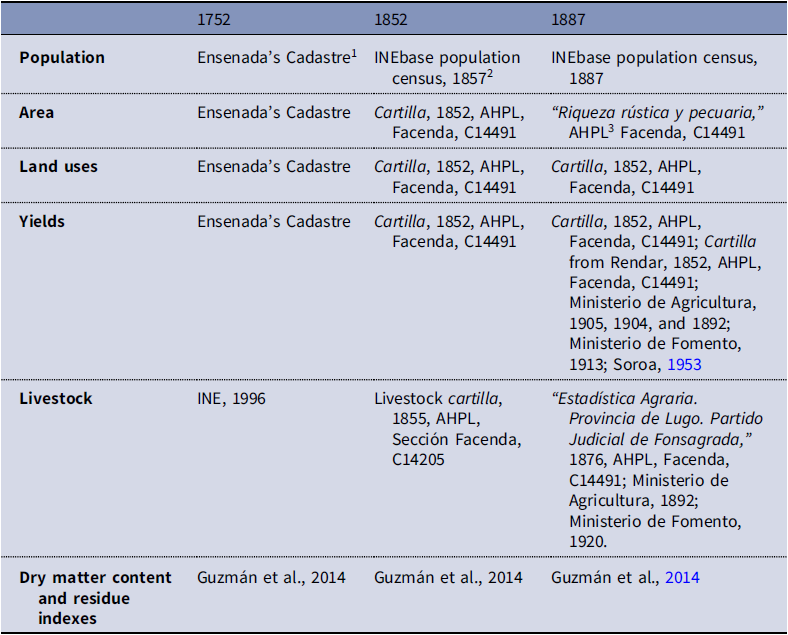
Data used in estimations