While all leaders desire to remain in office, the strategies used by leaders holding office under different regime types will inevitably be different (Bueno de Mesquita et al. Reference Bueno de Mesquita, Smith, Siverson and Morrow2005). The key question this paper addresses is how do leaders facing different incentives assemble a coalition to preserve their hold on power. Furthermore, how do different re-selection rules affect how leaders choose their strategy when building and maintaining a coalition, while also trying to maximize their own benefits? This paper uses an incentivized laboratory experiment to address these questions.
In the experiment, subjects are divided into groups that vary based on the size of their winning coalition and play an inter-group conflict game. After the inter-group game, the leaders distribute earnings within their group. This paper focuses on the distribution phase of the game and the results show that, consistent with the predictions of Selectorate Theory, leaders assigned to groups with large winning coalitions distributed points via a public good more frequently than small coalition leaders, while small coalition leaders distributed points to individual citizens via private goods more frequently.
Behaviorally, this paper proposes that small coalition leaders play a game similar to an apex game and may begin their time in office by seeking to form a large coalition, but later aim to increase their own payoff by excluding more demanding members of that initial coalition. In fact, the experiment shows that in small coalition groups, citizens that supported the leader in previous rounds benefited in the next round as leaders learned which citizens’ support is easily bought. Small coalition leaders directed private goods to citizens that supported them in past rounds of the experiment and away from citizens that did not. Moreover, consistent with shrinking their coalition, as small coalition leaders remained in power, they increased their own payoff. Meanwhile, focusing on individual citizens is too costly in a large coalition, so citizens that supported the leader in a large coalition received no benefit in future rounds for this support, nor did large coalition leaders increase their own payoff over their time in office. Overall, the experiment shows how the rules of small coalition systems allow leaders to form and maintain a coalition by targeting individuals in a way not possible in a large coalition system.
This paper precedes as follows: I begin by discussing Selectorate Theory and how I use that theory to induce regime type in the laboratory before I present the details of the game used in the experiment. The next sections derive the hypotheses and explain the experimental procedure. Finally, I present the results of the experiment before concluding.
Coalition Formation in Autocracies and Democracies
This section begins by addressing how I define regime types in the laboratory. To induce a political regime in the laboratory, I rely on the assumptions of Selectorate Theory. According to Selectorate Theory, the goal of all leaders is to retain office, but the strategy for doing so may differ by regime type (Bueno de Mesquita and Siverson Reference Bueno de Mesquita and Siverson1995; Bueno de Mesquita et al. Reference Bueno de Mesquita, Morrow, Siverson and Smith1999; Bueno de Mesquita et al. Reference Bueno de Mesquita, Morrow, Siverson and Smith2004; Bueno de Mesquita et al. Reference Bueno de Mesquita, Smith, Siverson and Morrow2005).
Selectorate Theory uses the ratio of two key components to determine regime type. The first component is the selectorate, S, which is the set of the population empowered to participate in choosing the leader. The second component is the winning coalition, W, which is the minimum subset of the selectorate that is of sufficient size to support a leader in power. Democracies tend to have a large selectorate, that is, nearly all of the population can participate in choosing the leader, and a large ratio of W to S, that is, a large proportion of the selectorate is required to maintain a leader in power. In contrast, autocracies have a small ratio of W to S, implying that dictators can lean on a few key supporters to keep themselves in power.Footnote 1
The ratio of W to S has implications for the strategy used by the leader to satisfy his winning coalition and retain office. In large coalition systems, too many votes are needed for a leader to attempt to buy off voters with private goods, so democratic leaders tend to invest resources in public goods. In contrast, in small coalition systems, the leader needs to satisfy fewer supporters, making the distribution of private goods a low-cost strategy for a leader that hopes to maximize her own payoff. Empirically, Morrow et al. (Reference Mintz, Redd and Vedlitz2008) show that democracies do, in fact, invest more in public goods than autocracies.
While autocratic leaders use resources differently than democratic leaders, a related question is whom do leaders target with goods. Specifically, does having supported a leader previously make an individual more likely to receive private goods in the future? In a large coalition system, this preposition seems unlikely, as individuals receive so few private goods anyway. While democratic leaders understand that high levels of public goods are necessary to continue in office, this strategy is undertaken without regard for the votes of individual citizens. By the nature of a public good, whether or not an individual voted for the leader does not affect her ability to share in the public good once it has been delivered. Therefore, compared with key supporters of an autocrat, citizens that helped place the leader of a large coalition in office should expect fewer special benefits in the future.
Meanwhile, in a small coalition system, previously supporting the leader indicates to the leader that an individual will be satisfied if she continues to benefit from the regime. The leader, with some indication of what level of goods is necessary to maintain that support, can target individuals with private goods at a level that satisfies them while excluding more demanding citizens. Therefore, previous support for a small coalition leader will likely result in that citizen benefiting from the continued leadership of that leader in the future in a way not possible in a large coalition system. Likewise, citizens that did not support an autocratic leader previously are likely to receive no share of private goods in the future. Thus, the lack of both formal and informal constraints on resource use by an autocratic leader enables the leader to target citizens in a way that ensures enough support to prevent challenges to her hold on power (Acemoglu, Verdier and Robinson Reference Acemoglu, Verdier and Robinson2004). Moreover, targeting individual citizens with private goods invests those citizens in the regime and promotes loyalty to the leader in the future because citizens worry they may be left out of future coalitions (Wintrobe Reference Thornhill1998).
Furthermore, because an autocrat’s coalition is initially unstable, dictators will often form a coalition consisting of more supporters than necessary and then eliminate redundant, demanding, or threatening supporters from the coalition over time (Bueno de Mesquita et al. Reference Bueno de Mesquita, Morrow, Siverson and Smith2004; Svolik Reference Przeworski2009). For example, Thornhill (Reference Svolik2004) argues that, while coming to power in Egypt, Gamal Abdel Nasser initially built a large oligarchy-style dictatorship. However, once he began to consolidate power, Nasser jettisoned unnecessary coalition members, such as communists and the Muslim Brotherhood, resulting in the elimination of all serious internal rivals and securing Nasser’s hold on power. Likewise, Saddam Hussein relied on purges to undermine the institutional power of Ba’ath Party, which helped bring him to power in Iraq. Instead, he ruled through relying on family ties and long-time associates (Karsh and Rautsi Reference Karsh and Rautsi1991, 176–82). In North Korea, Kim II Sung used a series of purges in the late 1950s to destroy factions within the Korean Workers’ Party to eliminate all political competition and obtain virtually unrestricted control over the party and the nation (Lankov Reference Karsh and Rautsi2002). Svolik (Reference Przeworski2009) argues this elimination of former supporters is strategic behavior on behalf of the leader to move his rule from a “contested dictatorship” to an “established dictatorship,” or a dictatorship that cannot be credibly challenged. Here I build on this logic to argue that small coalition leaders, because of the uncertainty of the process of power consolidation, may initially include more supporters than strictly necessary in their winning coalition, but then disregard excess supporters later.
I now address how I test these predictions using a laboratory experiment.
Experimental Setup
To test the effect of political structure on the formation of coalitions, I present a game in which a leader can distribute points within their group and then stand for re-selection. In the game, there are two groups, each consisting of n members attempting to capture a prize of value p. One member of each group is randomly selected as the leader and given a budget of points, b 1 and b 2, respectively. The two groups engage in negotiations that may lead to conflict over the division of p. I present the details of the international conflict phase of the game in the appendix and a full analysis in Reference BauschBausch (forthcoming). Here, I focus on the internal distribution phase.
In the distribution phase, the leader holds points from their budget plus their share of p. Leaders can keep points for themselves, give them directly to individual group members, or invest them in a public good, in which those points are multiplied by γ, where γ>1, and then distributed evenly to all members of the group. After the distribution, the group members vote on retaining the leader for the next round. If the leader receives w g votes, where g represents the group number and the number of votes needed can differ between groups, the leader is retained for the next round. If the leader does not receive the requisite number of votes, the leader’s payoff for the round is set to 0 and a new leader is randomly selected from the other members of the group at the beginning of the next round.Footnote 2 Before voting, citizens are informed of the total points controlled by the leader, the points they received as private goods, and the points distributed as public goods. Importantly, after voting, the vote of each citizen is revealed to the leader and all other citizens.
Thus, the round payoffs for the citizens consist of any points given directly to that group member by the leader plus γ/n times the amount invested in public goods by the leader. The round payoffs for the leaders are the points kept by the leader plus γ/n times the amount invested in public goods by the leader if that leader is retained and 0 otherwise. The payoffs here depart from standard Selectorate Theory payoffs, where leaders do not benefit from public good spending, which likely biases leaders toward using public goods in the experiment.
Given that analyzing the domestic phase separately from the international phase may result in the loss of experimental control, in this paper I only present results from rounds where no international war occurred. While the results do not change when war rounds are included, excluding rounds where war occurred gives me greater experimental control.Footnote 3 In addition, ~74 percent rounds resulted in no war, so a large portion of the data remains available. Moreover, the possibility of war seems unlikely to bias the results, as Reference BauschBausch (forthcoming) shows that once regime type and the leader’s usage of points on public and private goods are controlled for, the outcome of the war had no effect on whether or not the leader won re-selection (see in the further section and the appendix). Therefore, analyzing the domestic phase separately from the international phase in the manner done here is unlikely to bias the results.
Experimental Parameters
The specific values of the parameters of the game used in the experiment are as follows: the value of the prize, p, was 100 for all treatments. In each round the initial budgets are randomly set to either 150 for both groups or 100 for one group and 200 for the other, with the more powerful group also randomly determined in each round. Because I only analyze rounds with no war, this resulted in both leaders controlling 200 points or one leader controlling 267 and one controlling 133.
When the leader invests points in the public goods, those points are multiplied by 2.8 and then distributed evenly to all members of the group. After receiving their allocation of points, the citizens voted on whether to retain the leader from that round for the next round or not. The number of votes needed for re-selection of the leader was w=1 for small coalition systems and w=3 for large coalition systems.Footnote 4 Varying the number of votes needed to win re-selection changes W/S in accordance with Selectorate Theory’s assumptions about retaining office in a small versus large coalition system.
Deviations from Standard Selectorate Theory
Before turning to the hypotheses, it is important to note how the model tested here differs from the standard model of Selectorate Theory. Perhaps most notably, I did not include a challenger to the incumbent leader in the game. This omission was necessary to simplify an already complex game. However, this simplification seems unlikely to bias the results because the challenger in the standard model cannot credibly commit to provide goods to any defectors from the incumbent’s winning coalition. Essentially, the challenger can only engage in cheap talk and so, by itself, the simple up or down vote on the incumbent approximates this well.
However, the combination of lack of a challenger, small group size, and citizens replacing removed leaders, all departures from the standard model but necessary for practical reasons here, may result in different behavior than a test of the standard model. In fact, citizens who believe that the office of leader is valuable may vote against an otherwise suitable leader, simply because they anticipate random assignment into the leadership role in the next round. If citizens behave this way, citizens in small coalition systems will be more likely than otherwise to vote against the leader given that the role of leader is more valuable in a small coalition than in a large coalition. Accordingly, citizens may demand a higher share of goods to support the leader than would otherwise be expected in a small coalition system.
Another deviation from the standard model is that leaders receive a share of the public goods. Especially in small coalitions, this will likely predispose leaders toward spending more on public goods than in the standard model. The implications of this change to the leader’s payoff function is discussed in more depth in the hypotheses section as well as in the appendix.
Hypotheses
This section derives predictions about the experimental behavior in the game. The game begins with the leader in control of the group’s points after the negotiated settlement of the conflict phase of the game. The leader decides how to distribute the points within her group. The leader faces the dilemma of distributing points in such a way that she ensures re-selection, while also retaining as many points as possible for herself. Put more straightforwardly, if the leader gives all the points to citizens, she may win re-selection but receive a low round payoff for herself. Meanwhile, if she keeps too many points for herself, she will likely be removed from office (and have her round payoff set to 0).
Assuming that each citizen has a reservation price that represents the minimum number of points, she will accept for a payoff in a given round and still vote in favor of re-selection for the leader, the cheapest way for large coalition leaders to secure enough support for re-selection is through investing points in the public goods. Meanwhile, small coalition leaders can target one citizen through private goods.Footnote 5 Thus, I expect the experimental results to support Selectorate Theory’s prediction concerning the use of public goods and private goods by regime type, leading to the following two hypotheses:
Hypothesis 1a: Large coalition leaders will invest more resources in public goods than small coalition leaders.
Hypothesis 1b: Small coalition leaders will invest more resources in private goods than large coalition leaders.
While Hypotheses 1a and 1b address how coalitions are built, I now address how coalitions will persist over time. In large coalition groups, when a citizen casts a vote in favor of a leader in the previous round, that vote will likely have little effect on the actions of the leader in the next round. Large coalition leaders that deviate from the public good strategy and instead distribute private goods are unlikely to be re-selected. Therefore, the leader has no incentive to reward supporters from previous rounds in the current round. In fact, targeting previous supporters individually with private goods may draw so many resources away from the public goods that the leader loses support overall. Thus, I expect that support for a large coalition leader in one round will have little effect on a citizen’s payoff in the next.
However, previous support for the leader may affect the allocation of resources for a small coalition leader. For a small coalition leader, staying in office is similar to playing the role of the apex in an apex game. In an apex game, the apex player needs only to form a coalition with one non-apex, or base, player to receive a positive payoff, while the only coalition with positive payoffs that excludes the apex includes all base players. Therefore, the leader is similar to an apex player in that she needs only one supporter to stay in office. Meanwhile, to remove the leader from office, all citizens, who are similar to base players, must oppose the leader. Research on the apex game shows that both apex and base coalitions form regularly in laboratory experiments, as do grand coalitions including all base players and the apex player (Kahan and Rapoport Reference Kahan and Rapoport1984).
Returning to the current game, in her first round as leader, a small coalition leader may deviate from the optimal strategy of targeting one citizen with private goods and instead target multiple citizens with private goods or invest in public goods. Because she is unsure of the reservation prices of her citizens, a small coalition leader can target more than one citizen to increase her chances of finding at least one supporter. This strategy is akin, but not identical, to attempting to form a grand coalition in an apex game. Assuming at least one citizen’s reservation price is met, this deviation, while not maximizing points for the leader, allows the leader to retain power. However, coalitions that are larger than necessary are not likely to be stable in the long term (Acemoglu, Egorov and Sonin Reference Acemoglu, Egorov and Sonin2008).
For example, in the next round, a small coalition leader that targeted multiple citizens in the first round now has information about the reservation prices of at least some of her citizens. The small coalition leader can use this information to target the citizen with the lowest reservation price in subsequent rounds in order to increase her chances of both staying in office and maximizing her own payoff. Small coalition leaders in their second round in office will likely decrease payoffs to the citizens overall, increasing their own payoff while keeping the payoff of at least one citizen that previously supported her constant. This strategy effectively exploits the leader’s role as an apex-like player with the ability to form multiple coalitions by choosing the one that is most to her advantage (Beest, Dijk and Wilke Reference Beest, Dijk and Wilke2004). As a result, citizens that did not support the leader may all see their payoff decrease, while only some of the payoffs of citizens that did support the leader will decrease. Overall, then, a citizen that supported a small coalition leader in the previous round is likely to obtain a larger payoff in the current round than citizens that did not support the same leader in the previous round.Footnote 6 This payoff will induce the citizen to continue to support the leader, especially considering a future leader may not provide that citizen any positive payoff at all. Considering this behavioral implication, Selectorate Theory’s assumptions about coalition formation lead to the following two hypotheses:
Hypothesis 2a: In a large coalition, previous support for the leader will not affect a citizen’s payoff in the current round.
Hypothesis 2b: In a small coalition, a citizen that previously supported the leader will, on average, have a higher payoff in the current round than a citizen that did not support the leader in the previous round.
Experimental Design
I programmed the experiment in z-Tree and ran it at New York University’s Center for Experimental Social Science (CESS) (Fischbacher Reference Fischbacher2007). I recruited 120 subjects through CESS’s undergraduate recruitment pool to participate in five sessions of the experiment. All sessions included 24 subjects divided into four groups of six subjects.
After I obtained the subjects’ consent and read the instructions, the experiment began. Before the first round, subjects were randomly assigned to groups of six, randomly assigned a player number, and a leader was randomly selected from each group.Footnote 7 The groups and player numbers remained the same throughout the experiment. The experiment lasted 18 or 20 rounds depending on the session and the length was not revealed to the subjects.
At the beginning of each round, the four leaders in the session were randomly divided into pairs and played the conflict game, which is described in the appendix.Footnote 8 Over the course of the experiment, a given group was paired with three different groups for the inter-group game, but leaders were only told the type of group they were paired with and not the specific group. They also did not know the distribution of group types in the experiment. As noted above, in this paper, rounds where leaders selected into war are excluded from the analysis.
After receiving her share of the negotiated settlement, the leader distributed points to individual players or put them into a public good, described as a “multiplier fund” to the subjects. Citizens learned the result of the inter-group game as well as how many points the leader had available to distribute. After the leader distributed the points, all players were informed of their direct payoff from the leader (their private goods), the total public good investment of the leader, their share of the public goods, and their total payoff for the round. Citizens then voted on whether to retain the leader and the result of the vote was revealed to all group members, as well as how each individual member of the group voted. The leader retained her position for the next round if she earned one or three votes, depending on the group’s coalition size. If the leader lost the vote, her round payoff was set to 0 and one of the other five group members was randomly selected as leader at the beginning of the next round.Footnote 9
Subjects were paid a show-up fee of 10 dollars. Subjects received additional payment according to a random round payoff mechanism (Morton and Williams Reference Morrow, Bueno de Mesquita, Siverson and Smith2010, 382). Two rounds were randomly selected and used to calculate the subject’s payoff from the experiment. Points from these rounds were converted to US dollars at a rate of 10 points to 30 cents. The subjects earned an average of $3.80 during the experiment for a total of $13.80 (including the show-up fee). The experimental sessions lasted about an hour.
Results
Public and Private Goods
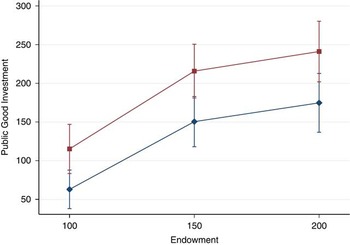
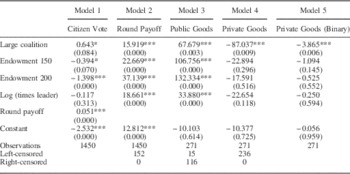
I begin by examining how leaders distribute their points. First, as Model 2 in Table 1 shows, citizens in large coalition groups received a higher payoff in each round on average than citizens in small coalition groups. The model predicts that the average citizen in a large coalition group received a payoff of 76.5 points/round, while the average citizen in a small coalition group received a payoff of 61.1 points/round, a statistically significant difference. Model 3 in Table 1 and the accompanying marginal effects plot in Figure 1 help to explain this difference. As predicted by Hypothesis 1a, for all three endowment levels, large coalition leaders place significantly more points in the public goods than small coalition leaders.Footnote 10 Although small coalition leaders did place a larger portion of their group’s points in the public goods than expected, large coalition leaders relied on the public goods even more heavily, which is unsurprising given the predictions of Selectorate Theory that large coalition leaders would need high public good expenditures to secure re-selection.Footnote 11
Predicted level of public good investment by regime type and initial endowment with 95 percent confidence intervalsNote: large coalitions are represented by squares and small coalitions by diamonds.

Random Effects Regressions with Standard Errors Clustered on Individual Subjects

Note: Model 1 is a logit regression estimating when an individual citizen votes in favor of re-selection of the leader. Model 2 is a Tobit regression estimating the round payoff of an individual citizen. Models 3 and 4 are Tobit regressions for the amount of public goods and private goods used by the leader in a given round, respectively. Model 5 is a logit regression for if a leader used any private goods. The unit of analysis is the individual citizen in Models 1 and 2 and the individual leader in Models 3, 4, and 5. Left-censored observations occur when a citizen receives a payoff of 0 in Model 2 or a leader either uses no points for public or private goods in Models 3 and 4, respectively. Right-censored observations occur when a leader uses all available points on the public goods or private goods in Models 3 and 4, respectively.
*p<0.10, **p<0.05, ***p<0.01.
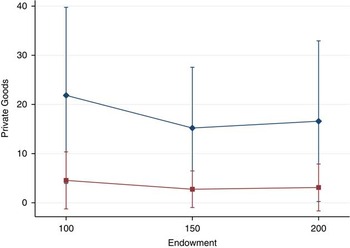
I now turn to the use of private goods. While private goods in the form of direct payments to citizens were used less frequently than public goods, Model 4 in Table 1 and the accompanying marginal effects plot in Figure 2 support Hypothesis 1b, which predicted small coalition leaders would give out significantly more private goods than large leaders.Footnote 12 Model 5 in Table 1 shows similar results when the dependent variable is binary and represents whether or not a leader distributed any private goods.
Predicted level of private goods dispersed by regime type and initial endowment with 95 percent confidence intervalsNote: large coalitions are represented by squares and small coalitions by diamonds.

Taken together, leaders’ distribution strategies explain why citizens in large coalition groups averaged higher payoffs than citizens in small coalition groups. Leaders of large coalitions invested more points in the public goods, raising all members’ payoffs, while leaders of small coalitions were more likely to target individual citizens with private goods.Footnote 13
Coalition Maintenance
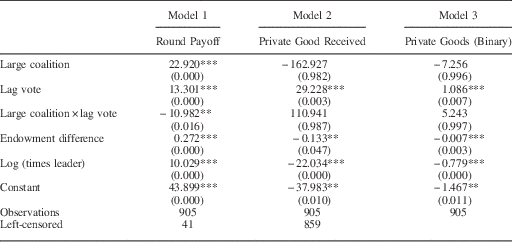
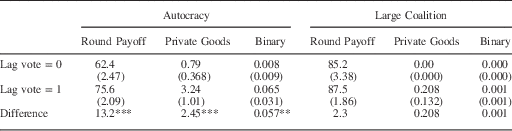
Turning to Hypotheses 2a and 2b, I examine how domestic coalitions are maintained over time. On one hand, it is clear from Model 1 in Table 1 that in the short term, a leader increasing a citizen’s payoff increases the probability that that citizen votes for the leader.Footnote 14 The results presented in Table 2 and the marginal effects in Table 3 address whether leaders, when returned to office, attempt to hold their winning coalition together through the use of private goods. Model 1 simply looks at the round payoff of citizens controlling for their votes in the previous round.Footnote 15 Model 2 addresses if differences in payoffs are due to the level of private goods, asking if a vote in favor of the leader in the previous round increased the amount of private goods a citizen receives in the next. However, the fact that in only about 5 percent of citizen-rounds did a given citizen receive private goods may make use of a Tobit model inappropriate. Therefore, I code a binary variable 1 if a citizen received any private goods in a round and 0 otherwise in order to determine if a vote in favor of the leader in the previous round increased the probability a citizen received private goods in the next. The key to all three models is the interaction between the lagged vote of the citizen and regime type, as Hypothesis 2b predicts supporters of small coalition leaders will be rewarded with private goods to hold the leader’s coalition together. Meanwhile, as Hypothesis 2a predicts, large coalition leaders rely heavily on public goods that cannot target a specific voter, so I expect the lagged vote of a citizen to have little effect on the goods that a citizen in a large coalition group receives in the next round.
Random Effects Regressions with Standard Errors Clustered on Individual Subjects

Note: Model 2 is a Tobit regression addressing the amount of private goods received by a citizen in a given round. Left-censored observations occur when a citizen received no private goods. Model 3 is a probit regression addressing the probability a citizen received private goods in a given round. The unit of analysis is the individual citizen.
*p<0.10, **p<0.05, ***p<0.01.
Predicted Round Payoff, Private Goods Received, and Private Goods as a Binary Variable with Standard Errors in Parentheses by Lag Vote and Regime Type

Note: *p<0.10, **p<0.05, ***p<0.01.
The results confirm that small coalition leaders reward their supporters while large coalition leaders do not. As predicted by Hypothesis 2b, a vote for a small coalition leader in the previous round results in that citizen having a payoff of 13.2 points higher in the current round than a citizen that voted against an autocrat. The comparable number in a large coalition group is 2.3 points, supporting Hypothesis 2a’s prediction. Furthermore, citizens that voted in favor of a small coalition leader in the previous round received over three times as many private goods as a citizen that voted against the leader. Similarly, a vote in favor of a small coalition leader makes it approximately eight times more likely a citizen received some private goods in the next round compared with a citizen voting against the leader. These results do not hold in large coalition groups. A vote for the leader in the previous round has no effect on receiving private goods in the next round in a large coalition group.
From Tables 2 and 3, different strategies for retaining office and maintaining a coalition clearly emerge between large and small coalition groups. Large coalition leaders rely on public goods in an attempt to satisfy enough voters to stay in office. In contrast, small coalition leaders are more likely to target specific citizens with private goods because they need fewer votes to retain office and can maximize their own payoff by excluding non-essential coalition members. Moreover, the targeted citizen is likely to be a citizen that previously supported the leader.Footnote 16 Because the leader knows the reservation price of that supporter, she can tune her distribution strategy to increase her own payoff. Citizens that received private goods and then voted against a small coalition leader represent those citizens that leader attempted to include in her coalition but then are subsequently excluded through the drop in payoff. The next section presents evidence that, once secure in office, small coalition leaders began attempting to maximize their own payoff in a way not possible in a large coalition, namely through decreasing the payoffs of those excluded from the coalition.
Leader Payoffs
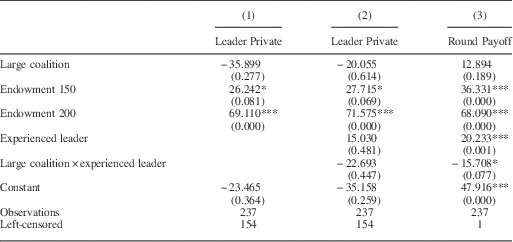
Table 4 presents results related to the leader’s strategy with respect to her own payoff. The data used here contain only rounds when the leader won re-selection in order to test the differences in successful leader strategies by regime type. Model 1 solely examines the effect of coalition size on the amount of private goods kept by the leader. Although not statistically significant, the large coefficient suggests that small coalition leaders keep more for themselves. Predictions from the marginal effects of the model suggest that, on average, small coalition leaders keep about 44.1 points in private goods, while large coalition leaders only keep about 27.8 points for themselves.
Random Effects Regressions with Standard Errors Clustered on Individual Subjects

Note: Only rounds in which the leader won re-selection are included. Models 1 and 2 are a Tobit regressions addressing the amount of private goods kept by the leader in a given round. Left-censored observations occur when a leader kept no private goods for herself. Model 3 is a Tobit regression addressing round payoff of leaders in a given round. The unit of analysis for all models is the individual leader.
*p<0.10, **p<0.05, ***p<0.01.
Models 2 and 3 in Table 4 add a variable to test for consistency with Hypotheses 2a and 2b. “Experienced Leader” is a binary variable indicating whether the leader is in her first round in office or not. This measure is meant to provide insight into how a leader’s strategy changes from the first round in office to later rounds in office.Footnote 17 Experienced Leader is interacted with large coalition to see if leaders are changing their strategies over time. The argument above anticipates that small coalition leaders can whittle down their coalition as they become more secure in power, leading to an increase in their own payoff. This whittling can occur either by excluding unnecessary supporters or decreasing payoffs to previous supporters. Meanwhile, large coalition leaders, because they rely on public goods, are not likely to increase their own payoff as they continue to hold power.
The predictions from the marginal effects from Model 2 suggest that small coalition leaders keep about 7.7 points more for themselves in later rounds than in their first round in office, while large coalition leaders actually kept about 3 points less. Though this difference is not statistically significant, the results are consistent with the prediction that small coalition leaders keep more points for themselves over time while large coalition leaders do not.
Meanwhile, Model 3 examines the overall round payoff for leaders that won re-selection. Here, the marginal effects show that small coalition leaders increase their payoff by over 20 points with experience, a statistically significant increase. However, large coalition leaders only increase their payoffs by about 4.5 points after their first round. Thus, once small coalition leaders secure their hold on power, they increase their payoff much more than large coalition leaders. Although only an indirect test, this increase is consistent with my conception of small coalition leaders as apex players in an apex game. Small coalition leaders may initially attempt to form an over-sized coalition giving payoffs to more citizens in their coalition than necessary before knowing the relative reservation prices of potential supporters. Citizens that do not support the leader reveal their relatively high reservation price. Once secure in office, small coalition leaders increase their own payoffs by exploiting their role as apex-like players, purging unnecessary or expensive coalition members, and targeting the citizen with the lowest reservation price in order to maximize their own payoff.
Conclusion
This paper has presented an experiment to test how leaders build support for themselves under different regime types. It began with the assumptions of Selectorate Theory, namely, that regime type is determined by the ratio of the number of supporters needed to stay in power to the number of potential supporters. When this ratio is high, leaders must act democratically and appease a large number of citizens to stay in power. When this ratio is low, the leader can target a narrow group of allies and still retain office. According to Selectorate Theory, large coalition systems will result in that leader investing more resources in public goods, while small coalition leaders can funnel private goods to the few supporters they need. The experimental results strongly supported the predictions of Selectorate Theory. Large coalition leaders invested more heavily in public goods than small coalition leaders. Meanwhile, small coalition leaders relied on private goods to purchase the votes of individual citizens more frequently than large coalition leaders. Overall, this had the effect of making citizens in large coalition systems better off than citizens of small coalition systems.
However, I must add a caveat to the discussion of public versus private goods in the experiment. The experiment did not make the distribution of club goods a possibility. The experiment also provided no possibility or incentives for special interest groups to develop. Given the ability of such groups to shape legislation to their benefit outside the laboratory, adding club goods to the experiment may decrease the advantage that large coalition systems’ have at providing public goods.
This paper also proposed that small coalition leaders, needing so few supporters to stay in power, are in a position similar to the apex player in an apex game. In the current game, small coalition leaders only needed the support of one citizen, or base player, while all citizens are necessary to remove the dictator from office. Working from a behavioral perspective, I predicted that small coalition leaders would initially attempt to form grand coalitions that included more than the lone requisite supporter. However, subsequently, small coalition leaders, now having some information about the reservation prices of their citizens, would only target the citizen who was cheapest to buy off. Results consistent with this prediction emerged, as small coalition leaders targeted previous supporters with private goods to hold their coalition together rather than trying to buy off new, and potentially more demanding, supporters. Thus, a citizen that supported the leader in the previous round in a small coalition received a higher payoff in the next round than a citizen that did not support the leader. In contrast, rewarding previous supporters would have proved too costly for large coalition leaders, and so previous support for the leader had little effect on citizens’ payoffs in future rounds.
The difference between how large and small coalition leaders use resources and build and maintain coalitions in the experiment has implications for how coalitions form under different regime types we see in the real world. Coalitions in large coalition systems will likely be relatively flexible or adaptable as the cost of leaving a leader’s coalition is low. Meanwhile, coalitions in small coalition systems are likely to decrease in size as the leader consolidates power. Once secure in power, coalitions in small coalition systems may become fixed, because leaders can target supporters with private goods and supporters, now invested in the leader’s system, have little incentive to leave the leader’s coalition.
Furthermore, while not directly tested in this paper, the converse of this finding is consistent with the theory presented here. As an autocrat’s grip on power loosens, that autocrat may need to expand the coalition, or return the coalition to its original size, through co-opting opposition groups. This broadening of dictatorship in response to threats has been noted by several scholars (Przeworski Reference Oliver1991; Lust-Okar Reference Lucas2005; Gandhi and Przeworski Reference Gandhi and Przeworski2006; Lucas Reference Lankov2012). The experiment presented here suggests that as a dictator’s hold on power tightens, that dictator will gradually cut supporters out of the coalition in an attempt to form an established dictatorship in which the leader has unchallenged power and control of resources.
Supplementary Material
To view supplementary material for this article, please visit http://dx.doi.org/10.1017/psrm.2015.63