Introduction
Severe trauma manifests itself heterogeneously in terms of cause, injury type, and severity. Reference Alberdi, García, Atutxa and Zabarte1,Reference Latuska, Graf, Zwislewski, Meyer and Nanassy2 Massive hemorrhage (MH) is one of the major consequences caused by lower and upper limb trauma, and this could be defined as a major life-threatening hemorrhage requiring massive transfusion; it is one of the leading causes of potentially preventable death following injury. Reference Bulger, Snyder and Schoelles3 Considering the wide-spread occurrence of this pathology in recent years, there have been multiple attempts to develop a framework and guidelines for action in this regard. Reference Llau, Acosta and Escolar4 In MH, tourniquets are the quickest and most effective type of intervention, Reference Rossaint, Bouillon and Cerny5,Reference Alonso-Algarabel, Esteban-Sebastià, Santillán-García and Vila-Candel6 for any segment of the population, whenever control via direct pressure is ineffective.
The tourniquet has a long tradition in military medicine, Reference Doyle and Taillac7 given the extreme conditions in which military prehospital care takes place (ie, unfavorable environmental conditions, long transfer times for victims, little time for on-site care, logistical austerity, and multiple victims in a context of limited capabilities Reference Champion, Bellamy, Roberts and Leppaniemi8).
The benefits of tourniquet use learned from tactical medicine have been generally used in the last decade for civilian medicine. Terrorist attacks which took place in recent years Reference Hirsch, Carli and Nizard9 (eg, Boston [USA] 2013, Paris [France] 2015, and Barcelona [Spain] 2017, among others) have highlighted the usefulness of tourniquets in civilian contexts. Therefore, out-of-hospital medical emergency teams must be trained in the use of tourniquets.
In this context, training campaigns have emerged such as the Hartford Consensus from the American College of Surgeons (ACS; Chicago, Illinois USA), which is endorsed by the European Resuscitation Council (Niel, Belgium). Reference Zideman, De Buck and Singletary10,Reference Jacobs11 The Hartford Consensus, in addition to its large-scale strategy in the United States, promotes itself using the following brief message: “See something, do something” (ie, if you see a hemorrhage, act). The teaching of mass-bleeding intervention aims to train all citizens in critical emergency assistance for blood loss, and the tourniquet is used in particular to achieve this aim. To this end, it establishes two levels of interveners: the immediate ones (citizens at the scene of the accident), and the professionals (prehospital care at the scene of the accident; ie, health teams, firefighters, first responders, and security forces). Depending on the target group, the educational techniques and contents vary substantially. 12
Multiple educational programs have been developed over time, such as the Tactical Combat Casualty Care Reference Butler, Holcomb, Giebner, McSwain and Bagian13 (TCCC) in the military context, or the Bleeding Control Course (BCon), and “Just-In-Time” Tourniquet Application Training, Reference Marcus, Pontasch and Duff14 all of which have different structures, methodologies, and timing.
The Hartford Consensus defines educational content for professional first responders 12 and points out that advanced courses should incorporate additional options for the control of life-threatening external bleeding. It also points out the possible formats of theoretical, practical, or mixed content and the use of various models Reference Jacobs11 (ie, mannequins or partners).
Despite the importance of this technique, and the need for health care professionals to master tourniquet use, the Liaison Committee on Resuscitation (ILCOR) established in 2018 that there is a knowledge gap around optimal education techniques for first aid providers, Reference Kleinman, Perkins and Bhanji15 and in 2020, it highlighted the need to determine the educational requirements for developing a mass tourniquet teaching strategy. The recognition of these training gaps, and the lack of recognition of their effectiveness, leads to the use of heterogeneous teaching methodologies and different technical means in teaching.
The aim of this study is to identify the training and evaluation strategies used in teaching the use of tourniquets in uncontrolled limb bleeding among professionals. The established Population/Problem/Patient, Intervention/Issue, Outcome (PIO) question has been the following: What are the training and evaluative methods used in the training of health personnel in the teaching of the tourniquet?
Methodology
A systematic review of the literature was carried out for the preparation of this work. The review was performed according to the Preferred Reporting Items for the Systematic Reviews and Meta-Analyses (PRISMA) statement. Reference Moher, Liberati, Tetzlaff and Altman16
Eligibility Criteria
The following criteria were taken into account for the selection of articles: population (health care personnel, including military personnel with health care training and students of health sciences); intervention (method of learning and evaluation of tourniquets for control of exsanguinating bleeding, surgical and union tourniquets will be excluded); and type of study (experimental studies published from 2010 through February 2020, in English, Spanish, or Portuguese).
Search Strategy
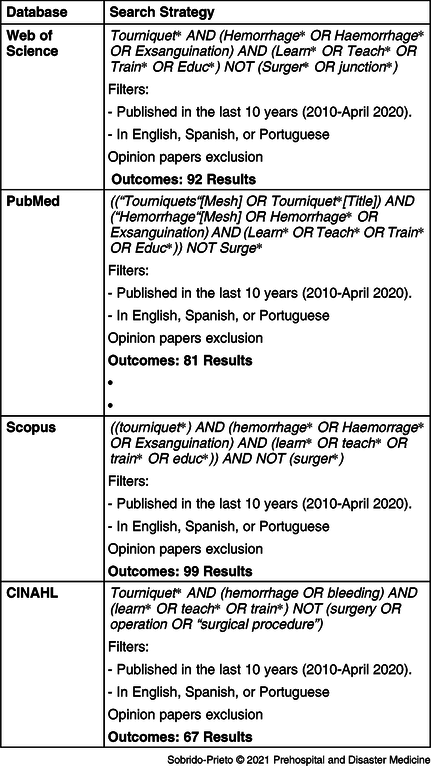
Table 1 shows the search strategy, carried out in May 2020. First of all, databases specialized in systematic reviews were consulted. None with the defined criteria were found. Subsequently, a search for original studies was carried out in health databases (Web of Science [Thomson Reuters; New York, New York USA]; Medline [US National Library of Medicine, National Institutes of Health; Bethesda, Maryland USA]; Scopus [Elsevier; Amsterdam, Netherlands]; and CINAHL [EBSCO Information Services; Ipswich, Massachusetts USA]; Table 2).
Search Strategy

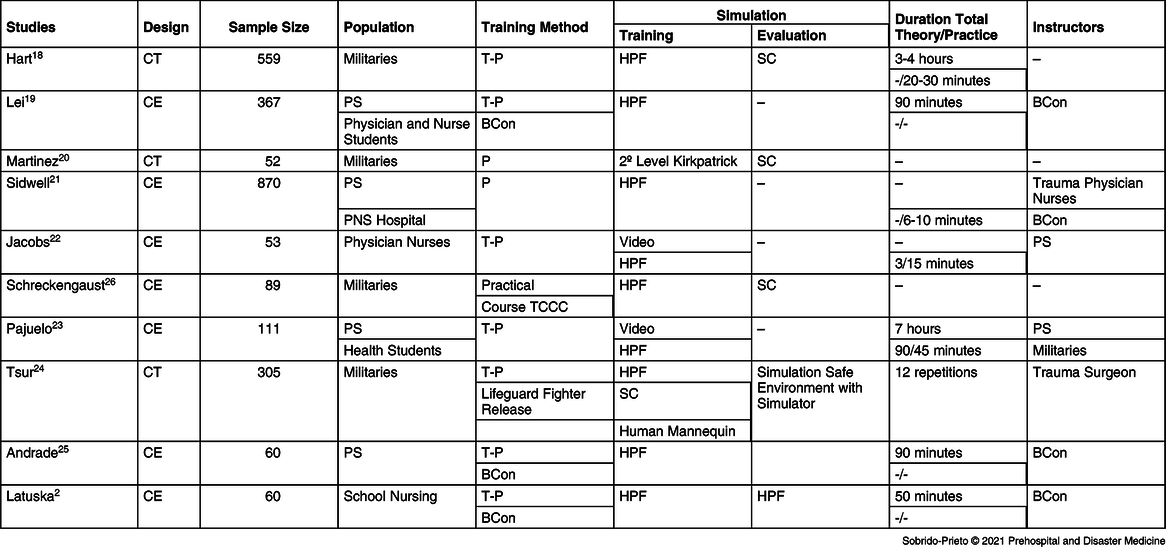
Characteristics of the Studies

Abbreviations: CT, clinical trial; CE, quasi-experimental; PS, health personnel; PNS, non-health personnel; T-P, theoretical and practical; BCon, Bleeding Control Course; TCCC, Tactical Combat Casualty Care; HPF, practical skills with feedback; SC: combat simulation.
This section was completed with a reverse search to verify whether there were other studies that had not been found in the initial search. Results were exported to Endnote x9 (Clarivate Analytics; Philadelphia, Pennsylvania USA) bibliographic reference manager to eliminate duplicates.
Selection of Studies
For the selection of studies, previously established selection criteria were used (patient and interventions, chronological coverage, and study design; see eligibility criteria). Two authors (SMI and MPL) independently selected the references according to the pre-defined criteria. The selection was carried out in three phases: reading by title, abstract, and/or full text. In the case of disagreement, they jointly analyzed the acceptance or rejection of the reference in question.
Evaluation of the Quality of the Studies
The Consolidated Standards of Reporting Trials Reference Cobos-Carbó and Augustovski17 (CONSORT) scale was used to evaluate the quality of the studies. Studies that did not meet at least 65% of the items included (24/37) were considered to contain substantial methodological flaws.
Data Collection and Analysis of Variables
For data extraction, a previously designed template was used with the following items: study (design and sample size), study population (type of test subject), intervention (type of teaching, number of sessions and duration, type of instructor, and tourniquet model), and effectiveness of the strategy (evaluation of knowledge, attitude, and practical skills).
Results
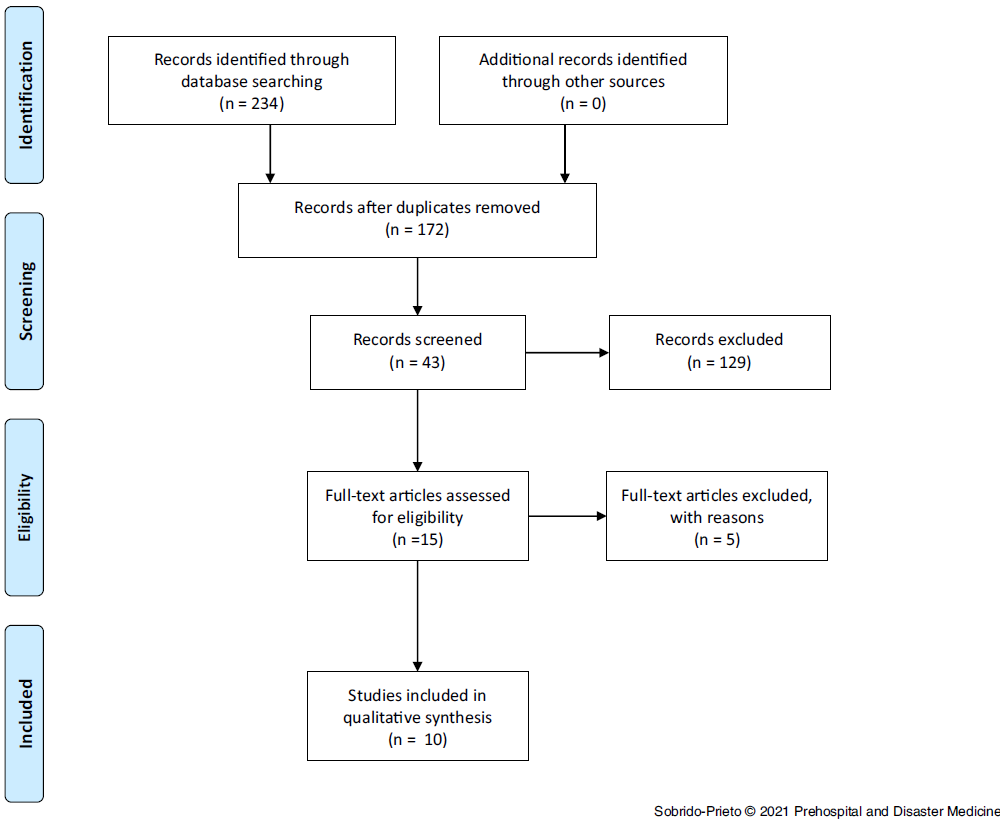
The search for original articles yielded a total of 172 results. After selection and critical reading, ten studies were included (Table 3) based on CONSORT Reference Cobos-Carbó and Augustovski17 criteria. The selection process was as shown in the flow diagram (Figure 1).
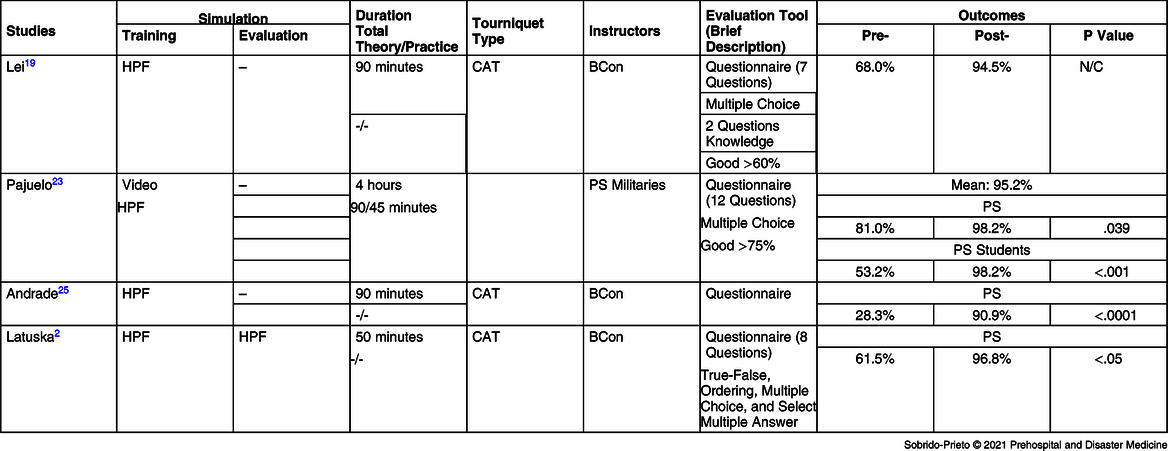
Training Methods and Knowledge Assessment

Abbreviations: HPF, practical skills with feedback; PS, health personnel; BCon, Bleeding Control Course; CAT, Combat Application Tourniquet.
PRISMA Flowchart.

Table 3 shows the studies Reference Latuska, Graf, Zwislewski, Meyer and Nanassy2,Reference Hart, Rush and Rule18–Reference Schreckengaust, Littlejohn and Zarow26 included. The average number of students was 252 students per study, presenting a variability from 5322 to 870. Reference Sidwell, Spilman, Huntsman and Pelaez21 Regarding the study designs, three were clinical trials Reference Hart, Rush and Rule18,Reference Martinez, Duron and Schaal20,Reference Tsur, Binyamin, Koren, Ohayon, Thompson and Glassberg24 and seven were quasi-experimental. Reference Latuska, Graf, Zwislewski, Meyer and Nanassy2,Reference Lei, Swartz and Harvin19,Reference Sidwell, Spilman, Huntsman and Pelaez21–Reference Pajuelo Castro, Meneses Pardo and Salinas Casado23,Reference Andrade, Hayes and Punch25,Reference Schreckengaust, Littlejohn and Zarow26 The study population focused on health care professionals and students, as well as military personnel with health care training. Two teaching methods were evaluated: exclusively practical (20%) Reference Martinez, Duron and Schaal20,Reference Schreckengaust, Littlejohn and Zarow26 or mixed method (80%; Reference Latuska, Graf, Zwislewski, Meyer and Nanassy2,Reference Hart, Rush and Rule18,Reference Lei, Swartz and Harvin19,Reference Sidwell, Spilman, Huntsman and Pelaez21,Reference Pajuelo Castro, Meneses Pardo and Salinas Casado23–Reference Andrade, Hayes and Punch25 Table 1).
In practical training, all of them used a simulation of practical skills with feedback from the instructor; theoretical training was supplemented in two studies Reference Jacobs and Burns22,Reference Pajuelo Castro, Meneses Pardo and Salinas Casado23 with video, and in four studies, Reference Latuska, Graf, Zwislewski, Meyer and Nanassy2,Reference Lei, Swartz and Harvin19,Reference Sidwell, Spilman, Huntsman and Pelaez21,Reference Andrade, Hayes and Punch25 materials from the stop bleeding training program (“The Bleeding Control for the Injured” [BCon]) were used. 12
Most of the studies (80%) reported a training duration between 15 and 90 minutes. Different times were observed for theoretical training with a three-minute video Reference Martinez, Duron and Schaal20 or a 45-minute lecture. Regarding the teaching of practical skills, it varied from six-to-ten minutes Reference Sidwell, Spilman, Huntsman and Pelaez21 to more than 30 minutes. Reference Pajuelo Castro, Meneses Pardo and Salinas Casado23
In 70% of the studies, they specified the type of instructor who delivered the training. It was BCon trainers in four studies, Reference Latuska, Graf, Zwislewski, Meyer and Nanassy2,Reference Lei, Swartz and Harvin19,Reference Sidwell, Spilman, Huntsman and Pelaez21,Reference Andrade, Hayes and Punch25 it was health care personnel Reference Sidwell, Spilman, Huntsman and Pelaez21,Reference Jacobs and Burns22 in two of them, and it was health care personnel from the armed forces in another two studies. Reference Hart, Rush and Rule18,Reference Martinez, Duron and Schaal20
There were three variables used to assess the suitability of the training strategies: knowledge, attitudes, and skills, which are described below.
Knowledge Reference Latuska, Graf, Zwislewski, Meyer and Nanassy2,Reference Lei, Swartz and Harvin19,Reference Sidwell, Spilman, Huntsman and Pelaez21,Reference Pajuelo Castro, Meneses Pardo and Salinas Casado23
Table 4 presents the aspects that were evaluated in terms of knowledge. It can be seen that all the studies analyzed obtained an increase in knowledge.
Attitude Assessment in Tourniquet Training Programs

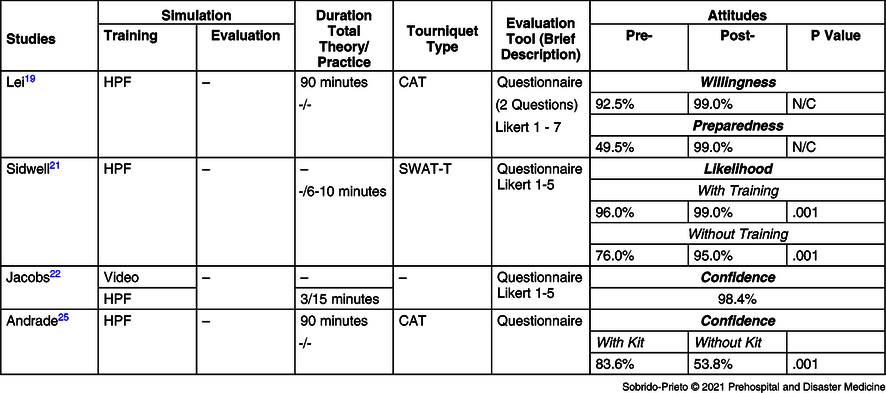
Abbreviations: HPF, practical skills with feedback; CAT, Combat Application Tourniquet; SWAT-T, Stretch Wrap and Tuck Tourniquet.
The assessment tools were heterogeneous in all the articles. Lei, et al Reference Lei, Swartz and Harvin19 and Pajuelo, et al Reference Pajuelo Castro, Meneses Pardo and Salinas Casado23 considered the percentage of success of 60% and 75% to be adequate.
Attitude Reference Latuska, Graf, Zwislewski, Meyer and Nanassy2,Reference Lei, Swartz and Harvin19,Reference Pajuelo Castro, Meneses Pardo and Salinas Casado23,Reference Andrade, Hayes and Punch25
The following items used were included under this heading, such as: willingness to prepare, willingness, and confidence (Table 4). There was an increase in confidence in every study, although there were substantial differences in the case of Andrade, et al. Reference Andrade, Hayes and Punch25
Variables were added in the evaluation process in two studies. Reference Sidwell, Spilman, Huntsman and Pelaez21,Reference Andrade, Hayes and Punch25 Andrade, et al Reference Andrade, Hayes and Punch25 assessed confidence as a function of the availability of a kit with material to stop a hemorrhage, while Sidwell, et al Reference Sidwell, Spilman, Huntsman and Pelaez21 assessed the willingness to control a hemorrhage, if the situation arose, as a function of the existence of previous training or not.
Practical Skills
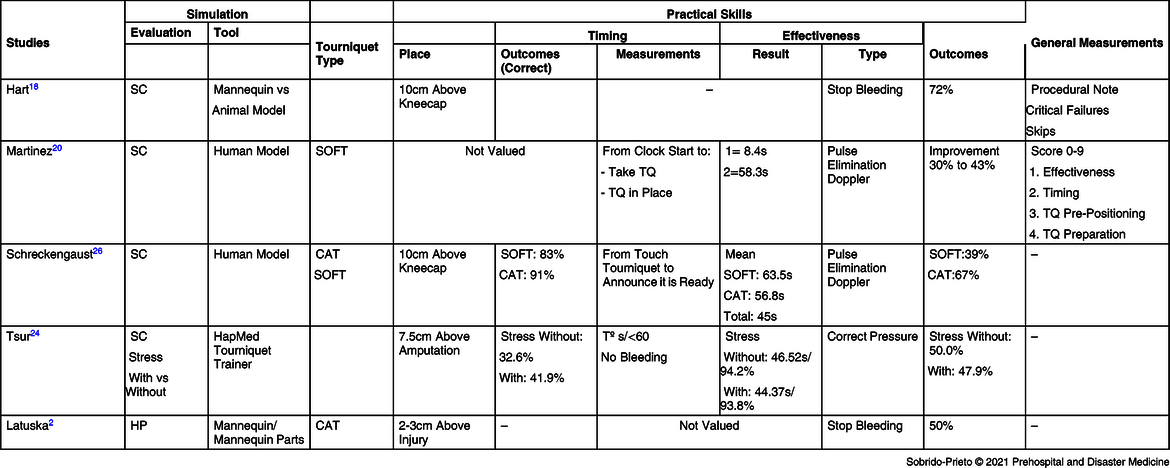
Table 5 summarizes the data pertaining to the practical skills. In all the studies, Reference Latuska, Graf, Zwislewski, Meyer and Nanassy2,Reference Hart, Rush and Rule18,Reference Martinez, Duron and Schaal20,Reference Tsur, Binyamin, Koren, Ohayon, Thompson and Glassberg24,Reference Schreckengaust, Littlejohn and Zarow26 a simulation of practical skills with feedback was used; in addition, Tsur, et al Reference Tsur, Binyamin, Koren, Ohayon, Thompson and Glassberg24 increased the level of complexity of the training, including a simulation in a combat and human model.
Simulation, Training, and Evaluation of Practical Skills

Abbreviations: SC, combat simulation; HP, practical skills; CAT, Combat Application Tourniquet; SOFT, Special Operation Forces Tactical Tourniquet; TQ, tourniquet.
In the evaluation (Table 5), an assessment of practical skills was performed with four studies Reference Hart, Rush and Rule18,Reference Martinez, Duron and Schaal20,Reference Tsur, Binyamin, Koren, Ohayon, Thompson and Glassberg24,Reference Schreckengaust, Littlejohn and Zarow26 in combat simulations.
The tools used for training in simulation of technical skills were the human model Reference Martinez, Duron and Schaal20,Reference Schreckengaust, Littlejohn and Zarow26 and partial or complete mannequin simulations. Reference Latuska, Graf, Zwislewski, Meyer and Nanassy2,Reference Tsur, Binyamin, Koren, Ohayon, Thompson and Glassberg24 Hart, et al Reference Hart, Rush and Rule18 compared the animal model versus simulation dummy, without obtaining differences after training, but did obtain differences in the evaluation according to the type of training. The simulation dummy seemed to obtain better results.
The variables included in the evaluation of practical skills were: placement time, placement site, and pulse elimination.
Placement time was measured in two different ways: (1) Martínez, et al Reference Martinez, Duron and Schaal20 divided it into two times. The first time starts at the beginning of the test until the subject picks up the tourniquet, and a second time is from the beginning of the test until the placement of the tourniquet is completed; (2) Schreckengaust, et al Reference Schreckengaust, Littlejohn and Zarow26 measured the time from the moment the subject touched the tourniquet until they verbally announced that it was ready.
Regarding the placement site, Reference Hart, Rush and Rule18,Reference Tsur, Binyamin, Koren, Ohayon, Thompson and Glassberg24,Reference Schreckengaust, Littlejohn and Zarow26 differences were found between the same anatomical reference site. Only Hart, et al Reference Hart, Rush and Rule18 and Schreckengaust, et al Reference Schreckengaust, Littlejohn and Zarow26 reported the same anatomical reference.
Tourniquet placement was measured with three different methods: pulse elimination by Doppler ECO, cessation of active bleeding, Reference Latuska, Graf, Zwislewski, Meyer and Nanassy2,Reference Hart, Rush and Rule18 or the correct pressure exerted. Dependent variables were introduced in two studies. On the one hand, Schreckengaust Reference Schreckengaust, Littlejohn and Zarow26 evaluated the type of tourniquet and observed that the Combat Application Tourniquet (CAT) type tourniquet was placed in the correct place, in less time, and with greater effectiveness than the Special Operation Forces Tactical Tourniquet (SOFT) one, while Tsur, et al Reference Tsur, Binyamin, Koren, Ohayon, Thompson and Glassberg24 determined the stress in the evaluation, obtaining better results in the evaluation with stress in the correct place of the tourniquet placement. Hart, et al Reference Hart, Rush and Rule18 and Martínez, et al Reference Martinez, Duron and Schaal20 employed ad hoc assessment tools to measure overall outcomes of practical skill acquisition.
Discussion
The aim of this study was to learn about the different training strategies and assessment methods used in tourniquet training amongst health care and military professionals. The number of studies found has been low considering the importance that this technique has acquired in recent years. Of these, only ten have exceeded the CONSORT Reference Cobos-Carbó and Augustovski17 criteria of 65%.
Regarding the training environment (civilian Reference Latuska, Graf, Zwislewski, Meyer and Nanassy2,Reference Lei, Swartz and Harvin19,Reference Sidwell, Spilman, Huntsman and Pelaez21–Reference Pajuelo Castro, Meneses Pardo and Salinas Casado23,Reference Andrade, Hayes and Punch25 versus military Reference Hart, Rush and Rule18,Reference Martinez, Duron and Schaal20,Reference Tsur, Binyamin, Koren, Ohayon, Thompson and Glassberg24,Reference Schreckengaust, Littlejohn and Zarow26 ), it does not seem to determine the effectiveness of learning either. Because of the circumstances in which the event takes place, both professional and military personnel are subjected to a high level of stress. However, only Tsur, et al Reference Hart, Rush and Rule18,Reference Martinez, Duron and Schaal20,Reference Tsur, Binyamin, Koren, Ohayon, Thompson and Glassberg24,Reference Schreckengaust, Littlejohn and Zarow26 compare the influence of stress on short-term learning and skill development with respect to a more controlled environment in military personnel. Although stress does not appear to be a determinant, in this review, it has not been possible to determine the role of stress given the variability of instruments and measures.
Training has been shown to be effective in previous studies. Reference Schroll, Smith and Martin27 The study by Jacobs Reference Jacobs and Burns22 is noteworthy for using less time and improving training efficiency by means of a video and a 15-minute practical training. In order to reach a wider range of the educated population, it will be essential to search for shorter, more effective, and efficient training methods.
In the post-training evaluation, it was found that professionals with prior knowledge were more confident. Reference Sidwell, Spilman, Huntsman and Pelaez21 This predisposition may have an influence on better performance and alerts to the importance of skills retraining.
In the analysis of knowledge, everyone used ad hoc theoretical questionnaires. As expected, even with the implementation of different strategies, any methodology increases knowledge (something is always better than nothing). One finding that requires further study must consider that with the current literature, neither who the trainer is nor the time devoted to training seems to be determinant, beyond the fact that 90 minutes seems a reasonable time for knowledge acquisition. More studies are needed in order to specify who and how much is necessary for optimal training.
Latasha, Reference Latuska, Graf, Zwislewski, Meyer and Nanassy2 who uses a more precise measurement tool and a shorter duration, showed a lower percentage of success than the other studies.
The attitude and/or confidence of the trainees are not influenced by the duration, number of sessions, and/or type of instructor. The different studies analyzed show how training increases the attitude towards hemorrhage. An aspect such as the availability of a kit with material to stop an active hemorrhage increases the confidence of the interveners. Reference Andrade, Hayes and Punch25 Although only one study has been found in this regard, it would support the Hartford Consensus in emergency vehicles (ie, fire departments, ambulances, and police) and also in places with public access. One possibility is the placement of these kits as complementary material to the automatic external defibrillator posts in areas of high population influx. Reference Jacobs, Burns, Langer and Kiewiet de Jonge28
Regarding the acquisition of practical skills, it seems clear that training increases the ability to perform these skills. All studies employ technical skills simulation with instructor feedback for training, and three of them Reference Hart, Rush and Rule18,Reference Martinez, Duron and Schaal20,Reference Schreckengaust, Littlejohn and Zarow26 developed a simulation in combat scenarios. In the study by Tsur, et al, Reference Tsur, Binyamin, Koren, Ohayon, Thompson and Glassberg24 both training and evaluation were carried out in a combat scenario.
In relation to the type of tourniquet, only five studies indicated the model used. The CAT tourniquet was used in four studies Reference Latuska, Graf, Zwislewski, Meyer and Nanassy2,Reference Lei, Swartz and Harvin19,Reference Andrade, Hayes and Punch25,Reference Schreckengaust, Littlejohn and Zarow26 (used in BCon training), the SOFT in two studies, Reference Martinez, Duron and Schaal20,Reference Schreckengaust, Littlejohn and Zarow26 the SWAT-T in one study, Reference Sidwell, Spilman, Huntsman and Pelaez21 while it is not recorded in three studies. Reference Hart, Rush and Rule18,Reference Pajuelo Castro, Meneses Pardo and Salinas Casado23,Reference Tsur, Binyamin, Koren, Ohayon, Thompson and Glassberg24 Schreckengaust Reference Schreckengaust, Littlejohn and Zarow26 compared two types of tourniquets and obtained better results with the CAT tourniquet than the SOFT one. The review by Alonso-Algarabel Reference Alonso-Algarabel, Esteban-Sebastià, Santillán-García and Vila-Candel6 points out the SWAT-T type tourniquet as being the most effective one in the prehospital setting for extremities. Given the importance that the type of tourniquet may have on the effectiveness in real situations and in training, it is necessary to increase research on training in the placement of the different types of tourniquets.
In the evaluation of practical skills, different tools were used, which makes it very difficult to determine which methodology or evaluation system is most appropriate. Heterogeneity was observed in the variable analyzed (ie, the place of the tourniquet placement, which can be 10cm above the patella, 7.5cm above the amputation, and 2-3cm above the lesion), and effectiveness was observed. The time in all the studies in which it is evaluated has a common beginning and end in the execution, although Martínez, et al Reference Martinez, Duron and Schaal20 includes an intermediate evaluation.
Another factor to highlight is the importance of the training material. Tsur, et al Reference Tsur, Binyamin, Koren, Ohayon, Thompson and Glassberg24 compared training with a simulation manikin versus an animal model, and the results showed that those who trained with a simulation manikin in the combat evaluation obtained a more successful result whether they were evaluated on a simulation manikin or on the animal model. However, to date, the availability of highly reliable dummies is scarce due to high costs. In this sense, it would be interesting to consider other effective and efficient options, such as the one contemplated by Silverplats, et al Reference Silverplats, Jonsson and Lundberg29 in which they evaluated an easily reproducible, simple, and inexpensive hybrid model for training personnel.
Limitations of the Study
In order to locate as much information as possible, the main international databases were searched in English, Spanish, and Portuguese. Although the selected coverage is important, it should be taken into account that articles not included in these databases, or not published in these languages, have not been included.
As for the methodological quality of the studies, although the selected designs could provide reliability (quasi-experimental and clinical trials), several elements required taking the results with some caution. Firstly, the instruments and units of measurement were not always uniform, which made it very difficult to read and interpret the data. Other limitations were the heterogeneity of the teaching and evaluation method, which made it difficult to compare results, and the absence of relevant data in some projects, such as the type of tourniquet or the context in which the work was carried out.
Taking into account the limitations expressed, the review shows that the strategies studied are effective both in increasing knowledge and attitudes and, above all, in training practical skills.
Conclusion
This systematic review found different models for tourniquet training. However, with the available evidence, it is not possible to determine which the best method is. The training strategies studied are effective in improving knowledge, attitudes, and practical skills. The evaluative methods are heterogeneous and make comparability difficult; it is necessary to standardize evaluative criteria to be able to assess short-term results.
It is necessary to further investigate factors that influence the performance of the technique, such as stress or the type of training tool used, in order to provide more solid evidence on the subject under study.
Conflicts of interest/funding
none