INTRODUCTION
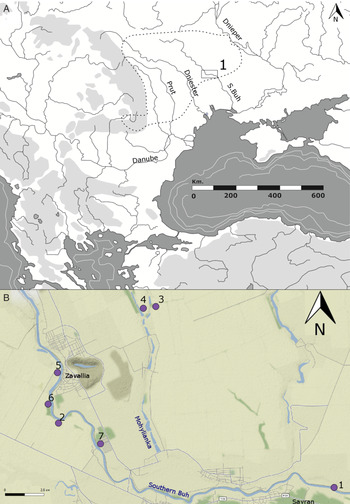
In central Ukraine, the Mesolithic and Neolithic cultural sequence had been determined by the early 1980s (Danilenko Reference Danilenko1969; Telegin Reference Telegin1982). The agricultural colonization of the region started either en milieu of the local Buh-Dniester (Bug-Dniester) culture (Danilenko Reference Danilenko1969; Kotova Reference Kotova2003; Kotova Reference Kotova, Kosko and Smyt2004; Kotova Reference Kotova2015) or with the expansion of the Linear Pottery culture (LPC; Motuzaite-Matuzeviciute and Telizhenko Reference Motuzaite-Matuzeviciute and Telizhenko2016; Kiosak Reference Kiosak2017). The Trypillian groups were the next agriculturalists (after LPC) to enter the southern Buh valley. Later, their development resulted in the formation of mega-sites, generally situated north of the region under study (Chapman et al. Reference Chapman, Videiko, Hale, Gaydarska, Burdo, Rassmann, Mischka, Müller, Korvin-Piotrovskiy and Kruts2014; Videiko et al. Reference Videiko, Chapman, Burdo, Gaydarska, Terna, Rud and Kiosak2015; Müller et al. Reference Müller, Rassmann and Videiko2016). Hunter-gatherers inhabited and exploited the hilly landscape between the Southern Buh and the Middle Dnieper and the adjacent steppe lowland (Figure 1) in various ways and for a long period in coexistence with early farmers further to west and northwest (Zvelebil and Lillie Reference Zvelebil, Lillie and Price2000; Wechler Reference Wechler2001; Larina Reference Larina and Dergaciov2010; Kiosak Reference Kiosak2014; Kotova Reference Kotova2015). The absolute chronology for these cultural aspects was reconstructed on the first numerically sufficient series of radiocarbon dates in the 1990s (Jacobs Reference Jacobs1993; Anthony Reference Anthony1994; Potekhina and Telegin Reference Potekhina and Telegin1995; Telegin et al. Reference Telegin, Kovaliukh, Potekhina and Lillie2000, Reference Telegin, Lillie, Potekhina and Kovaliukh2003). Significant work was carried out on the Dnieper Rapids cemeteries, making this micro-region the best-dated in the whole Ukraine (Lillie Reference Lillie1998, Lillie et al. Reference Lillie, Budd, Potekhina and Hedges2009; Budd et al. Reference Budd, Potekhina and Lillie2020). Other regions of central Ukraine received notably less attention. At the moment, the archaeological radiocarbon dataset is not sufficient to draw definite conclusions on the nature and intensity of human settlement in central Ukraine.
A: Map of the area in central Ukraine showing the region of study (1) and an area of Cucuteni-Trypillia culture (dotted line); B: middle southern Buh region and the dated sites. 1 – Melnychna Krucha, 2 – Hnyla Skelia, 3 – Mohylna III, 4 – Mohylna V, 5 – Kamyane-Zavallia 1, 6 – Shamrai, 7 – Berezivska HES.

Important uncertainties are derived from chronologies that differ more than 400 years for major cultures (for an overview see Gaskevych Reference Gaskevych and Gierlach2007, Reference Gaskevych2014). The series of 1998–1999 Kyiv dates formed a basis for a “new chronology” (Burdo Reference Burdo2003; Kotova Reference Kotova2003; Kotova and Videiko Reference Videiko2004). Later, some archaeologists pointed out discrepancies of the Kyiv radiocarbon dates of 1998–2008 series compared to the traditional typo-chronology and radiocarbon dates obtained from other laboratories (Gaskevych Reference Gaskevych and Gierlach2007; Gaskevych Reference Gaskevych2013; Tovkailo Reference Tovkailo2004, Reference Tovkailo2014). Thus, the regional Neolithic and Eneolithic periods were dated according to two chronological scales (as defined by D.L. Haskevych [Gaskevych Reference Gaskevych and Gierlach2007]). The “old” chronology is based on dates from laboratories in Berlin, Leningrad, and Oxford. The “new” chronology has arisen from Kyiv laboratory dates obtained in several series between 1998 and 2008 (Gaskevych Reference Gaskevych2013, Reference Gaskevych2014). Recently, the “old” chronology received additional support from new series of “direct” dates on characteristic potsherds (Haskevych et al. Reference Haskevych, Endo, Kunikita and Yanevich2019). There are almost no dates from “secure contexts,” since most derive from general cultural layers rather than single intra-site structures.
Given existing controversies, here we aim to build a reliable chronology for the VIII–V mill. BC sites of a single micro-region in central Ukraine. The micro-region (middle southern Buh region) is a stretch of the southern Buh river valley between towns of Zavallia and Savran, where the river flows roughly from west to east (Figure 1B). It is situated on the natural margin between the hilly landscapes of the Podillia upland and the Ukrainian Shield on the one hand, and much flatter terrain of the steppic Black Sea lowland on the other hand. The micro-region is a natural contact zone between populations of these two different environmental zones. The middle southern Buh region could provide a reference point for further work on the chronology of VIII–V mill. BC in central Ukraine. This effort is supported by a coherent novel series of accelerator mass spectrometry (AMS) dates with small standard deviation. These dates can complement the two existing chronological schemes that are based almost exclusively on conventional 14C dates (Kotova and Videiko Reference Videiko2004; Tovkailo Reference Tovkailo2004, Reference Tovkailo2014; Gaskevych Reference Gaskevych2013).
METHODS
We aimed for a small series of 14C dates covering a group of sites from the Southern Buh valley. The preceding works in the region were “shovel and spade” excavations without locating every find and with many inconsistencies in the field documentation (Gaskevych Reference Gaskevych2013, Reference Gaskevych2014; Haskevych et al. Reference Haskevych, Endo, Kunikita and Yanevich2019). So, new archaeological works were executed as microstratigraphic excavations (“trowel and brush”) by micro-horizons of 10–15 cm. They were accompanied by 3-D mapping of the finds. In addition, every visible burrowing animal hole (krotovina) was mapped in the course of the excavations and materials coming from krotovinas were excluded from consideration. When systematically employed, these strategies resulted in an agreement between the dates and the archaeological synchronization. The bones for radiocarbon dating were mostly shaft fragments of long bones of large ungulates (either cattle or red deer). They were selected from stratigraphic units of the reference site of Melnychna Krucha site and from pits or dwellings remains of the other six sites (see Supplementary Tables 6–7).
The samples were dated in the Laboratory for the Analysis of Radiocarbon with AMS (LARA) at the University of Bern employing the MICADAS equipment (Szidat et al. Reference Szidat, Salazar, Vogel, Battaglia, Wacker, Synal and Türler2014). Collagen extraction was performed according to Szidat et al. (Reference Szidat, Vogel, Gubler and Lösch2017), which was extended by an additional ultrafiltration step. The results were calibrated with the OxCal software (Bronk Ramsey and Lee Reference Ramsey and Lee2013; Bronk Ramsey Reference Ramsey1995, Reference Ramsey1998) version 4.3.2 based on the IntCal13 calibration curve (Reimer et al. Reference Reimer, Bard, Bayliss, Beck, Blackwell, Bronk Ramsey, Grootes, Guilderson, Haflidason, Hajdas, Hatté, Heaton, Hoffmann, Hogg, Hughen, Kaiser, Kromer, Manning, Niu, Reimer, Richards, Scott, Southon, Staff, Turney and van der Plicht2013). Here and thereafter, we differentiate clearly between calibrated 14C dates (cited “calBC”) and estimates interpolated from 14C dates, typological seriation and stratigraphies (cited “y. BC”).
ARCHAEOLOGICAL SITES AND NEW AMS DATES
The seven dated sites are situated between the towns Zavallia and Savran, which are distributed along 35 km of the river Buh and river Mohylianka (Figure 1B). The dates cover the period 7500–4100 calBC, namely the timespan from the Mesolithic period up to the establishment of developed Trypillian settlements with polychromous painted pottery (B1–B2 stage).
Melnychna Krucha is a stratified site, which yielded finds spanning the period from the Mesolithic (7500 calBC) until the Iron Age (III–V century AD). We dated several stratigraphic units from the site: SU4 (Middle Mesolithic), SU3 (Late Mesolithic), SU2 and SU-R4 (ceramic-bearing “Buh-Dniester” groups). SU-R4 is not in the stratigraphic succession with other units and is located 150 m apart from the main excavation pit. The early farmers’ expansions were dated by samples from the sites of Hnyla Skelia (Linear Pottery culture), Mohylna III and V (Early Trypillia), Berezivs’ka HES, Kamyane-Zavallia I and Shamrai (Trypillia B1).
RESULTS AND DISCUSSION
There are two Mesolithic horizons at Melnychna Krucha (Figure 1: 1; 48°8'49"N; 30°13'1"E; Supplementary Table 6).
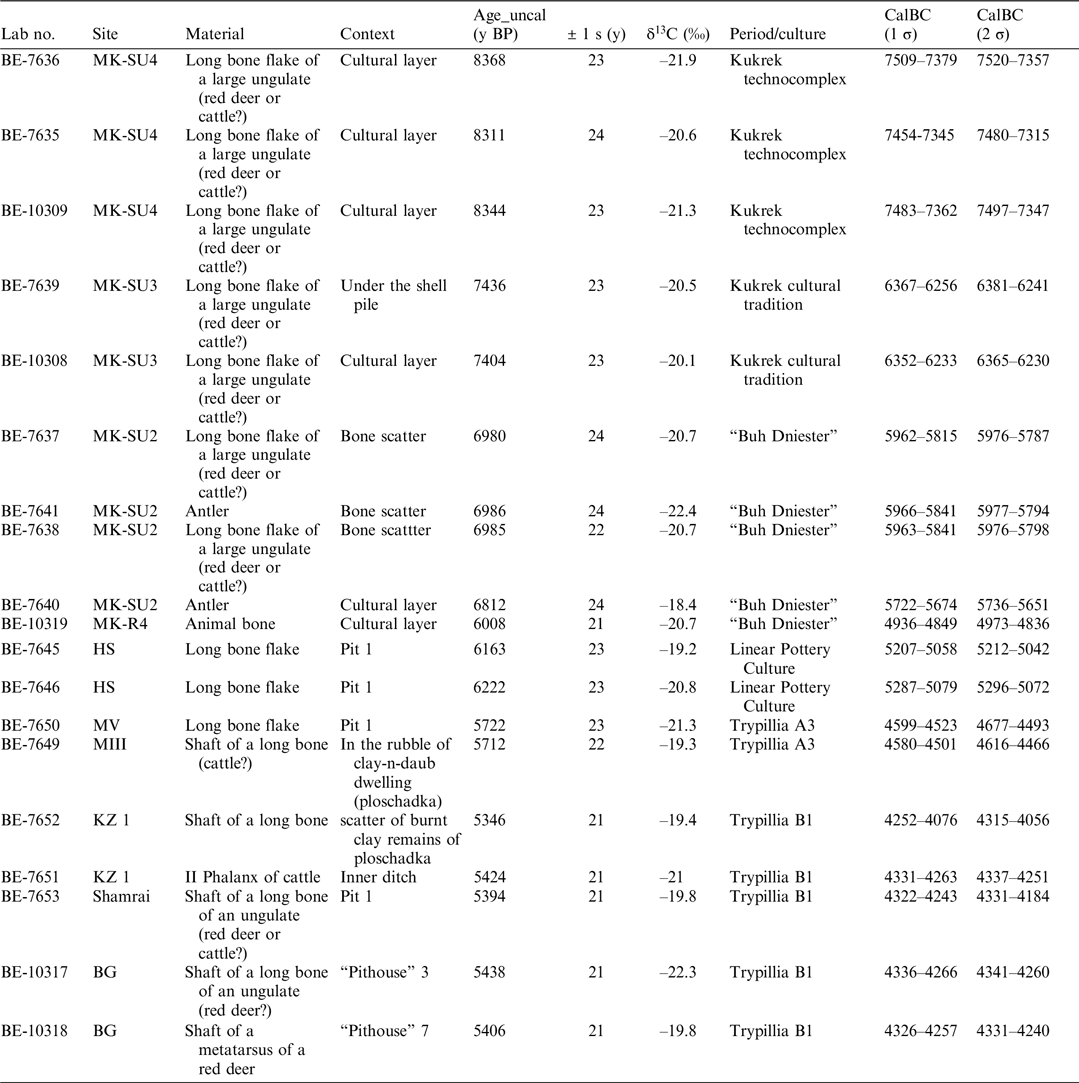
The thin (5–15 cm thick) level contains sparse finds of auroch bones and lithic implements (Melnychna Krucha, SU4, Supplementary Table 6). It includes conical cores for fine bladelets and microblades, multiple burins on blades, blade fragments with ventral trimming and retouch (so called Kukrek inserts) and points with partial abrupt retouch forming a distal acute tip and a notch on the opposite end by a bulb. There are close parallels to the sites of the Kukrek technocomplex (Kozłowski and Kozłowski Reference Kozłowski and Kozłowski1979; Yanevich Reference Yanevich1987; Zaliznyak Reference Zaliznyak2005) in particular according to Kukrek’s classic definition by (Telegin Reference Telegin1982). Three bones were sampled from this unit for radiocarbon dating (BE-7636, 8368 ± 23 BP; BE-7635, 8311 ± 24 BP; BE-10309, 8344 ± 23 BP). They yielded a calibrated age: 7520–7315 calBC (2 σ) (Table 1), when combined: 7485–7356 calBC (2 σ) (here and in the following discussion we used R_Combine function of OxCal).
Details of the novel dates obtained in Bern LARA laboratory (see Figure 2 for abbreviations).

Novel dates obtained in Bern LARA laboratory: MK – Melnychna Krucha, SU – stratigraphical unit, HS – Hnyla Skelia, MV – Mohylna V, MIII – Mohylna III, KZ1 – Kamyane-Zavallia 1, Sh – Shamrai, BG – Berezivs’ka HES

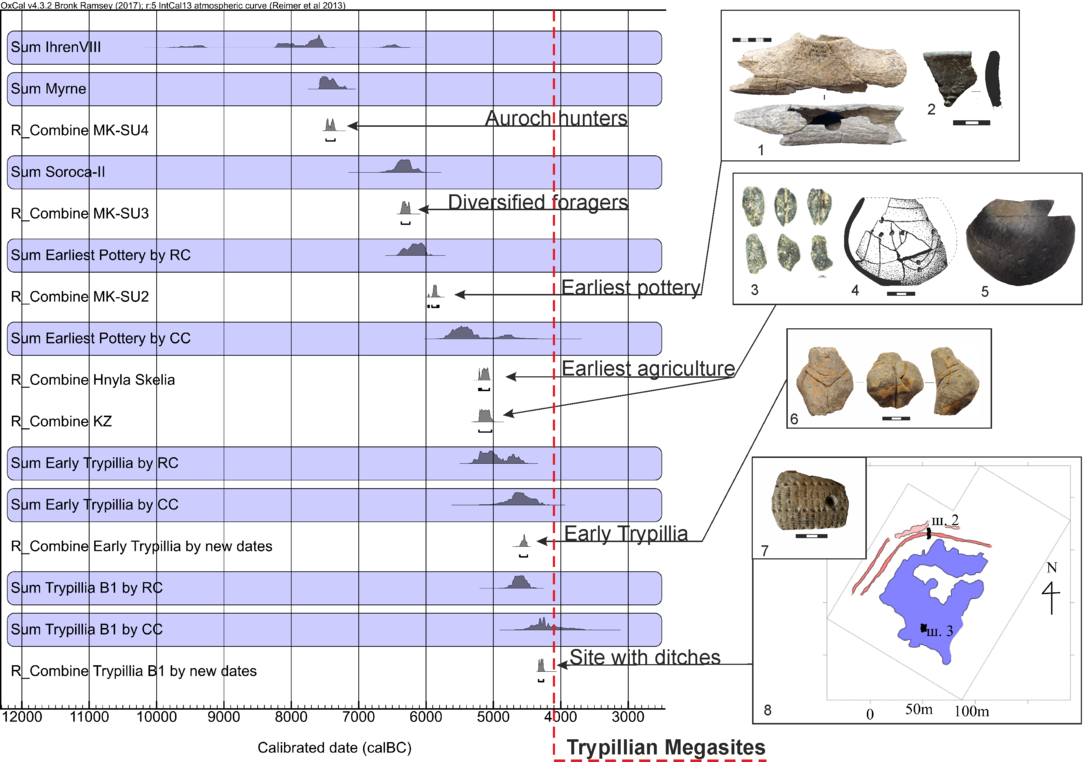
Similar dates were obtained from cemeteries in the region of the Dnieper Rapids. Their ages can be distorted by reservoir effects (Lillie Reference Lillie1998; Lillie et al. Reference Lillie, Budd, Potekhina and Hedges2009; Kotova Reference Kotova2018). There are several dates from the mid-VIII mill. BC among numerous and contradictory radiocarbon dates of the site of Ihren VIII from the Dnieper Rapids region (Telegin Reference Telegin2002; Biagi and Kiosak Reference Biagi and Kiosak2010). The site of Myrne (Mirnoe, 300 km south of Melnychna Krucha) yielded a microlithic assemblage with many trapezes (of Hrebenyky (Grebeniki) type) alongside with a Kukrek-like inventory (Stanko Reference Stanko1982). It yielded four 14C dates that cover roughly the same timespan (7590–7180 calBC 2 σ; Supplementary Table 1; Figure 3; Biagi and Kiosak Reference Biagi and Kiosak2010) as the dates from the lowermost layer of Melnychna Krucha. The latter is distinctive regarding its lithic typology. SU4 lithic collection resembles the assemblage of Ihren VIII by presence of conical cores, multiple burins, Kukrek inserts.
Based on the available dates, we infer that the Middle Southern Buh region was inhabited by a population bearing the Kukrek lithic inventory already in the 7500–7300 years BC.
On the Melnychna Krucha site, the late Mesolithic remains were embedded in a layer of lithic artefacts and fragmented bones (SU3, Supplementary Table 6). The stratigraphic unit contained freshwater turtle shell plates, avian bones, fish vertebra and bones of small mammals. The lithic inventory is microlithic with some micro-cores, end-scrapers on flakes, backed bladelets and one isosceles trapeze. It is similar to the sites of the “Kukrek cultural tradition,” which postdates the above-mentioned Kukrek complex, as defined by (Gaskevych Reference Gaskevych2005). Recently, a growing amount of evidence supports attribution of “Kukrek cultural tradition” to the Late Mesolithic (Gaskevych Reference Gaskevych2014). There were no potsherds and no evidence of cultivated plants or domestic animals in SU3. The novel dates (BE-10308, 7436 ± 23 BP; BE-7639, 7404 ± 23 BP) obtained for SU3 of Melnychna Krucha fall between 6380 and 6230 calBC (Table 1). There are two dates from this stratigraphic context obtained in 2014 (Kiosak and Salavert Reference Kiosak and Salavert2018) that fit well in the same timespan of 6366–6240 cal BC (2 σ, when combined; Supplementary Table 2).
These dates correspond more closely to the radiocarbon chronology of pre-pottery sites from valleys of southern Buh and Dniester than to the earliest dates for pottery-bearing sites of the “Buh-Dniester culture” (Supplementary Table 2). The latter were dated by a series of conventional Kyiv dates on bones and potsherds (Gaskevych Reference Gaskevych2014; Tovkailo Reference Tovkailo2014). The timespans covered by these dates are large enough to be synchronous with the SU3 of Melnychna Krucha, however, most pottery-bearing sites postdate the late Mesolithic sites. For example, we can compare a calibrate age of 6494–6244 calBC for the pre-pottery site of Ziankivtsi II (Kotova Reference Kotova2003) and 6212–6055 calBC for the site of Baz’kiv Ostriv, (combined; Supplementary Table 2; Kotova Reference Kotova2003, see also Figure 3). Thus, according to the new radiocarbon evidence, late Mesolithic bearers of the microlithic inventory of the “Kukrek cultural tradition” settled the Southern Buh valley approx. at 6400–6200 years BC.
The earliest pottery-bearing layer (Melnychna Krucha, SU2, Supplementary Table 6) was composed of a dense scatter of bones and debris of decortification of several concretions of yellow-wax flint. Despite the paucity of pottery in the excavation trench, this horizon likely correlates with local pottery-bearing groups acquainted with products of agriculture, but with a subsistence strategy reliant on fishing, hunting and gathering, namely para-Neolithic (the term is used in sense of the work of Nowak [Reference Nowak2007]), so-called “Buh-Dniester culture.” The reasons for such correlation are (1) the stratigraphic unit yielded eight potsherds (incl. a single identifiable rim fragment with comb impressions and incised lines); (2) in excavations of 1949 on Melnychna Krucha, V. Danilenko reported nine characteristic “Buh-Dniester” potsherds in similar sedimentological conditions; (3) the T-shaped antler axes have been found in SU2 and are well-known from Buh-Dniester contexts (Danilenko Reference Danilenko1969: Figures 55, 63, 73, 129–130); (4) lithic collection yielded isosceles trapezes, which are described as a typical tool from many “Buh-Dniester” assemblages (Gaskevych Reference Gaskevych2005); (5) there are prismatic cores, side-scrapers and end-scrapers on blades, which are rather typical for Neo-Eneolithic collections in Ukraine (Telegin Reference Telegin1976). The animal bones mostly belonged to wild species (Cervus elaphus and Sus scrofa) in the SU2 and we selected two bone samples as well as two small antler chips of T-shaped axes to radiocarbon date SU2. The samples yielded dates of 5977–5651 calBC (2 σ) (Table 1). This layer contains pottery, if rarely, and three dates (BE-7638, 6985 ± 22 BP; BE-7641, 6986 ± 24 BP; BE-7637, 6980 ± BP) from this layer are quite consistent and can be combined in the timeslot 5834–5727 calBC (2 σ). The fourth date (BE-7640, 6812 ± 24 BP) is somewhat younger—5736–5651 calBC (2 σ).
The origin of the earliest pottery in central Ukraine is attributed to the influence of the Criş culture on its III and IV stage (Gaskevych Reference Gaskevych and Gierlach2007; Zaliznyak and Panchenko Reference Zaliznyak and Panchenko2007; Zaliznyak et al. Reference Zaliznyak, Tovkailo, Man’ko and Sorokun2013; Haskevych et al. Reference Haskevych, Endo, Kunikita and Yanevich2019). The supporters of this hypothesis usually advocate the “old” chronology for “Buh-Dniester” para-Neolithic (Supplementary Table 3; Zaliznyak and Panchenko Reference Zaliznyak and Panchenko2007; Gaskevych Reference Gaskevych2014; Tovkailo Reference Tovkailo2014). The sites of Criş III–IV are known from the Prut and Reut valleys (Moldova) 150 km westwards from the middle southern Buh region. Generally, they are dated to 5650–5500 y. BC (Larina Reference Larina and Dergaciov2010). For example, the Sacarovca I site has a date (Bln-2425, 6650 ± 100 BP) calibrated to the time frame 5580–5440 calBC (Dergaciov and Larina Reference Dergaciov and Larina2015: 342) and is later than the well-defined chronological position of the SU2 at Melnychna Krucha (even taking into account only the latest date of SU2), which is instead partially contemporaneous with the I–II stages of the Criş culture (Biagi et al. Reference Biagi, Shennan, Spataro, Nikolova and Higgins2005). The IIIrd stage of Criş culture started in Romania only after 5800–5700 calBC (Biagi et al. Reference Biagi, Shennan, Spataro, Nikolova and Higgins2005: 43). Thus, either sites of the Early First Temperate Neolithic are yet to be found in Moldova, or we may hypothesize much more distant relationships between these two cultural phenomena—at distances over 600 km. Kotova (Reference Kotova2015) suggested that the early pottery in the sites of fishers, hunters, and gatherers of the southern Buh valley would be linked with earlier stages of First Temperate Neolithic development. Her hypothesis is partially supported by the results from Melnychna Krucha SU2.
At the Hnyla Skelia site (Linear Pottery Culture; Figure 1: 2; 48°10'51"N; 30°0'25"E; Supplementary Table 7) a pit (pit N1) contained many fragmented animal bones, potsherds, and some lithic implements. Some potsherds bore Notenkopf (“music note”) decoration. We sampled two bones from pit 1 for radiocarbon dating yielding ages of 5296–5042 calBC (2 σ) when calibrated (BE-7645, 6163 ± 23 BP; BE-7646, 6222 ± 23 BP; Table 1). They are contemporaneous and were combined to the timespan of 5218–5062 calBC (2 σ).
There are 21 radiocarbon dates for LPC in Ukraine and two—in Romania, which were made in different laboratories (Supplementary Table 4; Mantu Reference Mantu2000; Kotova Reference Kotova2003; Kovaliukh et al. Reference Kovaliukh, Kotova and Okhrimenko2007; Motuzaite-Matuzeviciute and Telizhenko Reference Motuzaite-Matuzeviciute and Telizhenko2016). Due to poor development of direct pottery dating in the Kyiv laboratory at that time, some dates made on potsherds are questionable (series of dates for Golyshiv and a single determination from Gnidava [Kovaliukh et al. Reference Kovaliukh, Kotova and Okhrimenko2007]).
In 2014, two dates were obtained from a “long pit” of LPC site Kamyane-Zavallia (Supplementary Table 4; Kiosak and Salavert Reference Kiosak and Salavert2018) situated 1.7 km to the north of Hnyla Skelia. They cover the period of 5295–4960 calBC and are in reasonable correspondence to the chronology of the Notenkopf phase (Oross and Banffy Reference Oross and Banffy2009). Hnyla Skelia and Kamyane-Zavallia are roughly contemporaneous forming a typical group of settlements of LPC, Siedlungskammer. This is the easternmost LPC group of settlements, so far studied in Europe. Both sites are earlier than the latest LPC sites in Ukraine (Gnidava and Girka Polonka), bearing elements of Şarka and Želiesovce ceramic styles—5050–4850 calBC (Kovaliukh et al. Reference Kovaliukh, Kotova and Okhrimenko2007). The “long pit” of Kamyane-Zavallia yielded charred rests of wheat and barley (Kiosak and Salavert Reference Kiosak and Salavert2018; Salavert et al. Reference Salavert, Gouriveau, Messager, Lebreton and Kiosak2020). Thus, LPC bearers were farming on the banks of the Southern Buh and settled the region at least for two centuries in the late VIth millennium y. BC well before the Trypillian expansion in the region.
The decline of LPC is poorly studied in the region to the east of the Carpathians. Several sites (listed below) were dated to 4950–4750 y. BC. The site of Tătărăuca Nouă XV (Larina Reference Larina2006) yielded a ceramic complex made in the syncretic tradition of LPC and local para-Neolithic groups. Another scatter of finds of Melnychna Krucha (SU-R4, Supplementary Table 6) was studied some 150 m upstream from SU2. The former contained para-Neolithic pottery, chipped stone artefacts and animal bones. A single date (BE-10319; 6008 ± 21 BP; Table 1) was obtained on an animal bone from SU-R4. It encompasses a time interval of 4973–4836 (2 σ) calBC. AMS dates encompassing 5211-4491 calBC (Supplementary Table 3) were obtained from potsherds of Samchyntsi- and Savran-style local para-Neolithic pottery (Haskevych et al. Reference Haskevych, Endo, Kunikita and Yanevich2019) similar to those found from the SU-R4 of Melnychna Krucha. Thus, after the end of the LPC in the southern Buh valley there was a revival of groups with para-Neolithic ceramic vessels.
The earliest Trypillia (Precucuteni II in Romanian terminology) settlers occupied the valleys of Dniester, Prut and Reut further to the west. There is no evidence of their penetration into central Ukraine up to the Precucuteni III phase (Zbenovich Reference Zbenovich1996). Like a development of the “Buh-Dniester” culture, the Early Trypillia has two chronologies—“old” and “new” (Supplementary Table 5; Rassamakin Reference Rassamakin, Menotti and Korvin-Piotrovsky2012; Gaskevych Reference Gaskevych2014). The “new” chronology in central Ukraine is supported by seven Kyiv radiocarbon dates for the sites Hrebeniukiv Yar, Sabatynivka II and Hrenivka (Supplementary Table 5; Burdo Reference Burdo2003; Figure 3). They encompass 5318–4538 calBC (2 σ). Non-Kyiv dates from the sites of the Southern Buh valley were lacking prior to this study. The alternative (“old”) version of dating is based on the Berlin and Groningen dates for the sites of Tymkove, Poduri-Dealul-Ghindaru and Târpesti I (Supplementary Table 5; Rassamakin Reference Rassamakin, Menotti and Korvin-Piotrovsky2012; Figure 3). They cover the period 4934–4406 calBC (2 σ). The date for Mohylna V (48°14'13"N; 30°4'20"E, Figure 1: 4; Trypillia A3, BE-7650, 5722 ± 23 BP, Figure 3, Table 1; Supplementary Table 7) is calibrated to 4677–4493 calBC (2 σ). It falls into the range provided by the Berlin and Groningen dates, but it is later than the median dates according to both chronologies, Kyiv and non-Kyiv. It corresponds to the timing of the first entities with painted pottery in Romanian Moldova (Cucuteni A1-2) (Mantu Reference Mantu2000). Another site, Mohylna III (48°14'32"N; 30°4'45"E; Figure 1: 3) is dated to 4616–4466 calBC (2 σ) (BE-7649; 5712 ± 22 BP; Figure 3, Table 1).
Chronology of human settlement in the valley of southern Buh river in context. Abbreviations: see Figure 2. MK-SU2: 1 – antler T-shaped ax, 2 – a potsherd; Kamyane-Zavallia: 3 – charred grains of domestic cereals (photo of A. Salavert, Salavert et al. Reference Salavert, Gouriveau, Messager, Lebreton and Kiosak2020); 5 – a vessel ornamented with “music notes” decoration; Hnyla Skelia: 4 – a vessel ornamented with “music notes” decoration; Mohylna V: 6 – an anthropomorphic figurine (fragment); Shamrai: 7 – a comb-ornamented potsherd analogous to Seredny Stog (Sredny Stog) culture finds (Kotova Reference Kotova, Kosko and Smyt2004); Kamyane-Zavallia 1: an interpretation of geomagnetic survey showing two ditches (after Kiosak Reference Kiosak2019). RC – “new” chronology; CC – “old” chronology. For cited dates see Supplementary Tables 1–5.

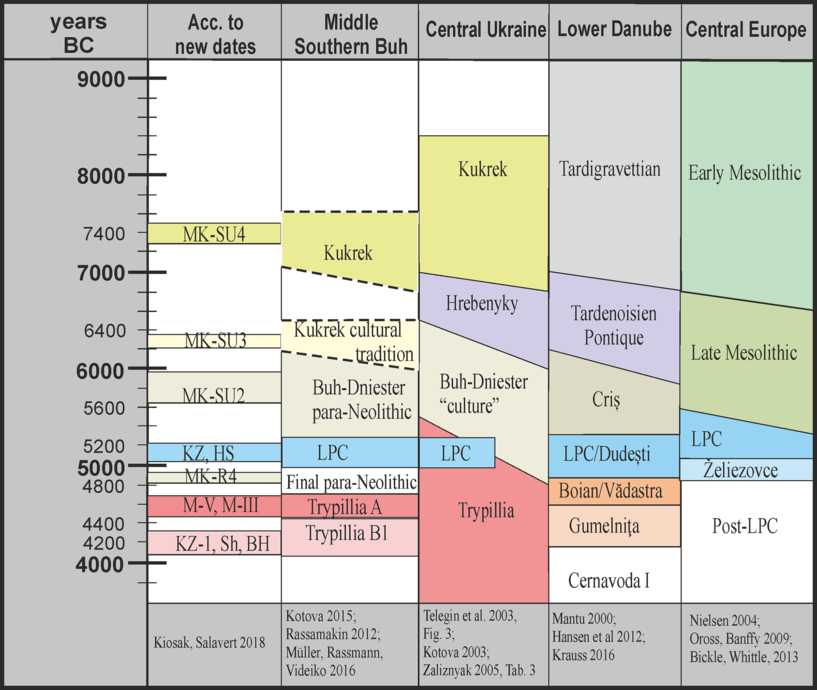
Human settlement in central Ukraine compared to other regions of Europe. Abbreviations: see Figure 2. The column 1 represents the results of 14C dating carried out in this work. The column 2 represents their interpretation for the middle southern Buh region in relation to the previously published datasets (see references below). Columns 3–5 are intended for comparison only. They are compiled according to the references underneath.

The sites of Mohylna are situated nearby (1-km distance) and form a part of the concentration of five sites with very similar material culture. Dates suggest their contemporaneity and provide additional arguments in treating such concentrations as micro-regions, similar to Siedlungskammern of LPC. Our data indicate the long persistence of bearers of the Early Trypillian traditions in the region. The late date obtained for Mohylna III is important as it is also the latest Early Trypillian site according to typo-chronology (Videiko Reference Videiko2004) and has the largest area recorded for an Early Trypillian site so far (7–25 hectars by different estimates). Our field work rather confirms the upper figures for the area of Mohylna III (judging from spatial distribution of surface finds). However, it is important that the large Early Trypillian site was accompanied by several smaller settlements situated within 1–2 km from each other in a single valley (Mohylna I–II, V, Siedlungskammer model) while mega-sites seems to be formed by merging the population into a single large site (Agglomeration model; Chapman et al. Reference Chapman, Videiko, Hale, Gaydarska, Burdo, Rassmann, Mischka, Müller, Korvin-Piotrovskiy and Kruts2014).
The Trypillia B1 chronology still has some incongruence. The sites from Southern Buh valley that were excavated in the 20th century (Sabatynivka I and Berezivs’ka HES) obtained Kyiv dates spanning 4800–4401 calBC (2 σ; Supplementary Table 5; Burdo Reference Burdo2003). Five dates from the LARA laboratory in Bern (Table 1) were obtained from animal bones from sites of Berezivs’ka HES (48°10'7"N; 30°2'16"E), Kamyane-Zavallia I (48°12'12"N; 30°0'12"E) and Shamrai (48°11'21"N; 29°59'48"E), (Figure 1: 5–7; Supplementary Table 7). They are significantly younger (4341–4056 calBC; 2 σ; Table 1). Four dates can be combined (4332–4256 calBC, 2 σ) and a single date (BE-7652, 5346 ± 21 BP) is slightly younger. The dates could be contemporaneous in the narrow time slot of 4328–4241 calBC (2 σ). However, they likely reflect a prolonged existence of dated sites due to the following observations. The Bern dates are slightly younger than Heidelberg dates for Scânteia (Cucuteni A3) and two earlier dates for the site of Putineşti III (Cucuteni A4) and could be synchronous with the site of Drăguşeni-Ostrov (Cucuteni A4). The painted pottery found on the sites of Sabatynivka I and Berezivs’ka HES is similar to the painted ware of Hâbaşeşti (Cucuteni A3) and Jura-Bereşti (Cucuteni A4) (Palaguta Reference Palaguta2007: 47). Analogous potsherds were revealed in Shamrai and in Kamyane-Zavallia 1. They form a part of a single cultural aspect (Sabatynivka group) with the site of Sabatynivka I and Berezivs’ka HES (Burdo Reference Burdo2015). Thus, we can expect a prolonged existence of Trypillia B1 sites in the Middle Southern Buh valley during both intervals: Cucuteni A3 and A4.
Thus, the typological analogies dated earlier in the context of both “new” and “old” datasets are not necessarily a contradiction. Instead, they may indicate a long persistence of Trypillia B1 traditions in the Southern Buh valley. The small standard deviations and coherent ranges of the Bern new dates may suggest that they reflect rather a single and a well-defined event in the prolonged Trypillia B1 development in the southern Buh valley.
Kamyane-Zavallia I was surrounded by a double ditch (Saile et al. Reference Saile, Posselt, Dębiec, Kiosak and Tkachuk2016) and yielded a notable (32 items) collection of bifacial flint arrowheads (Kiosak Reference Kiosak2019). The Shamrai site brought other evidence (typical pottery tempered with crushed shells) for intercultural contacts with mobile herder groups of Seredny Stog culture settling the Pontic steppe to the south and the east. So, by 4250 y. BC some Trypillian groups were included in the exchange networks with bearers of painted pottery of Cucuteni A3-4 types and were involved in some type of interaction with the mobile population of the Steppe. The Shamrai and Berezivs’ka HES collections also yielded some imports of Gumelniţa culture (recently dated to 4600–4250 years BC; Hansen et al. Reference Hansen, Toderas, Reingruber, Wunderlich, Benecke, Gatsov, Marinova, Muller, Nachev, Nedelcheva, Nowacki, Ropke, Wahl and Zauner2012; Reingruber Reference Reingruber, Hansen, Raczky, Anders and Reingruber2012). These vivid connections made the southern Buh valley an intersection point for different influences and cultural and social impulses around 4250 y. BC. Probably, this period was an apex of Sabatynivka group development, and this fact found its reflection in new 14C dates.
CONCLUSIONS
Recently obtained radiocarbon dates have allowed us to reconstruct the chronology of human settlement in the southern Buh valley. Together with previously obtained data on settlement sites, this micro-region is among the best-dated for the first half of the Holocene in central Ukraine and as such should be a reference point for future discussions of cultural and social development in the region. The Dnieper Rapids region is another micro-region with a well-established chronology (Lillie Reference Lillie1998; Lillie et al. Reference Lillie, Budd, Potekhina and Hedges2009; Budd et al. Reference Budd, Potekhina and Lillie2020). However, its chronology is mostly based on dating cemeteries. It hampers a direct comparison with regions that are not so rich in burial sites of VIII–V mill. BC.
A Mesolithic population settled the Middle Southern Buh micro-region during the Early Holocene (as early as 7500–7300 calBC). They produced their lithic implements in Kukrek style characterized by the absence of geometric microliths, the utilization of backed points, burins on blades and particular tools for working hard wood (Kukrek inserts). Their subsistence included hunting of aurochs and wild horses. This cultural aspect finds no direct parallels in the Central European archaeological record (Kozłowski and Kozłowski Reference Kozłowski and Kozłowski1979; Zaliznyak Reference Zaliznyak2005).
The period 6400–6200 years BC, at the end of the Early Holocene, was marked by the appearance of a distinctive regional cultural unit (attested in SU3 of Melnychna Krucha), with its microlithic flint inventory similar to the complexes of the third stage of the Kukrek culture (according to O. Yanevich Reference Yanevich1987). Implements in the “Kukrek cultural tradition” are different enough from contemporaneous assemblages with geometric microliths and other knapping technologies exemplified by the Soroca-II site in the Dniester valley. Their mostly non-geometric outlook is in contrast with predominance of trapezes in contemporaneous complexes in Steppe (Hrebenyky culture) and also in central and southern Europe (Kozłowski and Kozłowski Reference Kozłowski and Kozłowski1979). At that time, the late Mesolithic settlers of Melnychna Krucha were dependent on a variety of resources including fish, birds, turtles, river mollusks and small mammals.
In VIth millennium BC, the pottery-bearing para-Neolithic groups settled Melnychna Krucha twice—5900–5800 calBC (most probably) and after 5750 calBC. Whether these visits correspond to two stages of the “Buh-Dniester” culture is not clear, however, we can state that their economy was completely extractive. According to archaeozoological data there are no domestic animals’ bones in SU2 of Melnychna Krucha.
The late VIth millennium BC was marked by the LPC expansion. These early farmers were the first to bring agriculture to the region. Maybe their disappearance was followed by a short episode of presence of comb-ornamented pottery bearers at the Melnychna Krucha (SU-R4). However, this intriguing “renaissance” of the local ceramic-bearing population needs further clarification.
Finally, the Early Trypillians inhabited the region in the Precucuteni III stage and their settlements persisted when the painted pottery makers of Cucuteni style already settled nearby. Mohylna III, the largest so far dated Precucuteni site (4616–4466 calBC), has a large area and could indicate a demographic agglomeration following external pressure.
The Trypillia B1 settlement also persisted longer, at least up to the last quarter of Vth mill. BC. These communities flourished being included in the networks connecting the Carpathians, the Lower Danube basin and mobile herders of the steppe and could indicate the successful coping with environmental pressure.
We conclude that the new dates have the potential to reconcile the apparent contradiction between “old” and “new” datasets, being chronologically located in an intermediate position or suggesting long persistence of cultures that were so far considered to be chronologically narrow, at least in the presented case study of the middle southern Buh region. More AMS-radiocarbon dates from secure complexes carefully considering stratigraphic, taxonomic and cultural contexts are urgently needed to further explore the contradiction between the existing “old” and “new” radiocarbon chronologies for the whole central Ukraine.
ACKNOWLEDGMENTS
We are grateful to Olena Sekerskaya (South Ukrainian K.D. Ushinsky Pedagogical University for providing us with samples from Berezivs’ka HES and for archaeozoological analysis of Melnychna Krucha collections), Zhanna Matviishyna (Institute of Geography, National Academy of Sciences of Ukraine) for soil profiles description, C.Q. Gover (University of Colorado, Boulder) for editing the text and Maria Lobanova for her help with laboratory analysis and sample treatment, to students of “I.I. Mechnikov” Odessa National University for their help with excavations. We acknowledge the SNF SCOPES grant, Project IZ73Z0_152732 for funding the project.
SUPPLEMENTARY MATERIAL
To view supplementary material for this article, please visit https://doi.org/10.1017/RDC.2020.120