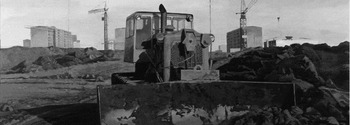
It is a big yellow bulldozer. There are heaps of soil on flattened ground. No humans in sight, but in the background high, towering buildings dominate the horizon. This oil painting by Gerhard Nordström (1925–) is a nice representation both of Swedish welfare and housing programmes during the 1960s and 1970s and of Swedish archaeology (figure 1). The large triptych was commissioned in the 1970s by the director of archaeology at the Malmö city museum. It hung directly above the entrance to the new prehistoric exhibition. It was a thoughtful and ambiguous illustration: the true field of archaeology. After some years it was taken down for reasons unknown; maybe it became too ambiguous.
Triptyk, 300 × 190 cm. Oil painting by Gerhard Nordström. Published by courtesy of Malmö Muséer. Photo Andreas Nilsson.

When my colleagues heard the round table's central question, they exchanged questioning glances since they know all too well my ambivalent position towards traditional archaeology. ‘Please tell me you will argue “pro excavation”’ was a common reaction. Well, the question demands a different answer than a simple for or against.
Why excavate? My rhetorical point of departure would be that we do so because we cannot stop excavating: archaeologists have become part of an unstoppable excavation machine, at least in Sweden. Now, the metaphor of the machine conjures up both positive and negative associations. What I want to stress is not that archaeology finds itself in a mechanistic condition, but that it must be seen as a vast and never-ending field of activity. Archaeology is not only a scientific discipline, but also a cultural expression. The culture of archaeology is rather physical and connects past and present through tangible historical remains. Excavation is essential in connecting the present to the past. I will argue that archaeology is an unstoppable excavating machine – and that archaeologists are not really in charge.
Let me point out eight distinguishing features of excavation that explain why archaeology can be compared to an unstoppable machine. Nothing new, nothing complicated, but important enough when trying to understand why archaeologists excavate, especially in a modern north European country such as Sweden.
Excavation is a brand
As shown by Cornelius Holtorf (2005; 2007) excavation has become a brand. The image of the archaeologist, in both popular and professional media, centres around excavation. The excavation process is most often treated as the main source of archaeological knowledge and we ourselves tend to reinforce this methodological simplification, especially through popular media. On the edge of the excavation pit, with moving backhoes behind, we hear the archaeologist explaining the archaeological process: after meticulous preparation and excavation, careful post-excavation will succeed. In the three-step method of the archaeological knowledge process – pre-excavation, excavation, post-excavation processing – excavation as the hallmark of the discipline is centre stage and dominates the image and perception of what archaeology is all about.
Excavation is a common metaphor
Equally strong is the more abstract image or metaphor of the archaeological excavation as used by scholars like Freud and Foucault to explain their methods of research. There are plenty of other philosophical, poetical and artistic ‘archaeologists’ doing their own cultural excavations. The excavation as a metaphor for unveiling and uncovering hidden truths is not to be explored here in more detail, but one may assume that ‘real’ archaeology gains from this figurative use of the archaeological excavation, maybe more than we might expect. Consequently, these other ‘archaeologies’ tend to flatter, provoke or even influence the more theoretical archaeologist (cf. Holtorf 2005, 16 ff.).
Excavation is a cultural heritage
Archaeological excavation is not just a method of exploration regarding various forms of cultural heritage; it has become a form of cultural heritage in itself. As part of the modern, the Western, the scientific and the colonial, archaeological excavation, and its people, rules and goals, can be seen as a cultural praxis. That archaeological excavation can be seen as a cultural tradition is yet another part of the unstoppable excavating machine. To put it rhetorically and ironically: every civilized country must conduct archaeological excavations. In Sweden, where I work, cultural-heritage laws are strict, and archaeology-friendly. We still spend much money on excavation, although there is a growing body of people who want to reduce the budget for archaeology in general and particularly for archaeological fieldwork.
Excavation is a groundbreaking ritual
The rapidly expanding city of Malmö, in southern Sweden, has been paying millions of euros for excavation every year. The mayor is a proud man. In a groundbreaking ceremony for Hyllie, a new residential suburb of Malmö, he made clear that the first diggers to appear on the spot were archaeologists. As the example illustrates, ideologically, archaeological excavation has become part of the construction of modernity, while more practically, field archaeologist are seen as part of the construction business who come to clear the ground. After completion of the excavation, road or house building can start to take place. Excavation in a sense is thus more of a ritual than a scientific or a rescue operation (Nilsson and Rudebeck 2010, 61). In this sense excavation is beyond the control of archaeology itself.
Excavation produces excavations
Excavation not only produces material and knowledge, it also produces future work and costs. Once the field project has been concluded, excavations continue to generate costs through processing finds and, more generally, the production of a past. But archaeological excavation also produces additional archaeological work in the future. On the one hand, in areas where large-scale exploitation has revealed significant amounts of archaeological materials and ‘new’ knowledge, archaeology tends to entrench and reinforce its power. Sites or areas of previous archaeological inquiry – spared from exploitation – continuously attract new excavations. This is indeed true for famous sites such as Pompeii or Çatal Höyük, but it is also evident on a more regional or national scale. Repeated excavations can be spread out over decades, and do not necessarily relate closely to each other from a scientific point of view. Areas of archaeological research are unevenly spread geographically. Sites or areas with a high density of archaeological activity are often of marked importance for the construction of archaeological biographies, of both individuals and institutions.
Excavation produces archaeologists
People and research institutes are connected to special places, and excavations perform an important role in archaeological categorization and ranking. You are what you excavate – or, more often, what you have been excavating. In that sense, excavation is powerful, since it binds people together, living and dead. Prestigious archaeologists excavate prestigious places, and you can inherit, or earn, part of that prestige if you put the shovel in the same soil yourself. Excavations are great producers of archaeology, not only in a material or epistemological sense. They also produce archaeologists.
Excavation produces archaeology
Excavations produce cultural history, but the excavation process itself is also taken as a guarantee for ‘real’ archaeological research. It is difficult to think of a rescue archaeological project without ‘real’ digging, even though one easily can imagine that other methods in some cases could be more effective. If you need research funding, excavation is a good thing. Hence excavation is a prime motor in archaeology, not only as a mode of gathering prehistoric data, but to ensure and secure the field of archaeological thinking.
Excavation is far more than archaeology
From the above one could conclude that archaeology needs the excavating machine. The machine gives us an image, a reputation, a task, people, and money. These are some of the explanations for why we excavate, and also for why a questioning of the raison d'être of excavation might frighten some of us. What would archaeology be without excavation? Let me put it this way: excavation is not exclusively archaeological. The excavation machine existed long before the professional discipline of archaeology came into being and will continue to exist longer than our discipline. This recognition is central for the metaphor of the unstoppable machine: to excavate and search for past material is not an exclusively professional enterprise. In order to answer properly the why-question, one has to include other excavation practices: scientific and unscientific, justified and illegal. That is the composition of the excavating machine, and that is why it has become, or has always been, unstoppable, from the archaeologist's point of view.
From a Swedish perspective I dare to claim that the question ‘why excavate?’ is redundant. Of course, things do change: the future of archaeology is hard to tell. In a longer-term perspective, more thrilling questions might be raised, such as ‘how long can archaeology live with excavation?’, and indeed, ‘how long can excavation live with archaeology?’