Introduction
Around 80 per cent of babies with congenital hypothyroidism will have an underlying dysgenesis wherein the gland has failed to develop and/or descend normally. Thyroid dysgenesis is sporadic, with a female predominance.Reference Devos, Rodd, Gagné, Laframboise and Van Vliet1 A lingual thyroid is one particular subgroup of dysgenesis and occurs in approximately 1 out of 100 000 children. In such cases, the thyroid gland has failed to descend to the usual pretracheal region.Reference Noussios, Anagnostis, Goulis, Lappas and Natsis2
Babies with a lingual thyroid may be asymptomatic, or they may present with oropharyngeal obstruction including stridor, dysphonia, dysphagia and dyspnoea with faltering growth. Thyroid ectopia can be confirmed by ultrasound and/or thyroid isotope scan.Reference Perry, Maroo, Maclennan, Jones and Donaldson3 Up to 70 per cent of patients with a lingual thyroid are hypothyroid.Reference Kansal, Sakati, Rifai and Woodhouse4 An ectopic thyroid gland may therefore be suspected in a baby with respiratory compromise who also has positive screening test results for congenital hypothyroidism. Management options for babies in severe respiratory distress include surgical resection of the ectopic thyroid gland.
Case report
A female infant presented on several occasions to the accident and emergency department and the postnatal ward in the first 10 days of life because of stridulous breathing, which was worse when supine and during feeding. She was born at 36 weeks gestation via normal vaginal delivery and was the first child of healthy parents. Her birth weight was 2.43 kg (25th centile). She was thought to have laryngomalacia and was sent home on each occasion until day 11 when she was admitted and reviewed by the tertiary respiratory team. By this stage, she weighed 2.25 kg and had noisy breathing, with significant associated respiratory effort.
The baby was seen by the ENT team and underwent nasendoscopy. This revealed a mass on the tongue that was approximately 2 × 2 cm in size and covered in mucosa. The baby had undergone neonatal screening for conditions that included congenital hypothyroidism on day 5 of postnatal life. However, the blood spot sample had insufficient blood to conduct the necessary triplicate analysis of thyroid-stimulating hormone. Analysis of a single blood spot had revealed an elevated thyroid-stimulating hormone level of 24.3 mU/l (20 mU/l or over is classified as a positive result). However, rather than reporting an ‘abnormal’ result, a repeat sample was requested; hence, the clinical team were not aware of this background.
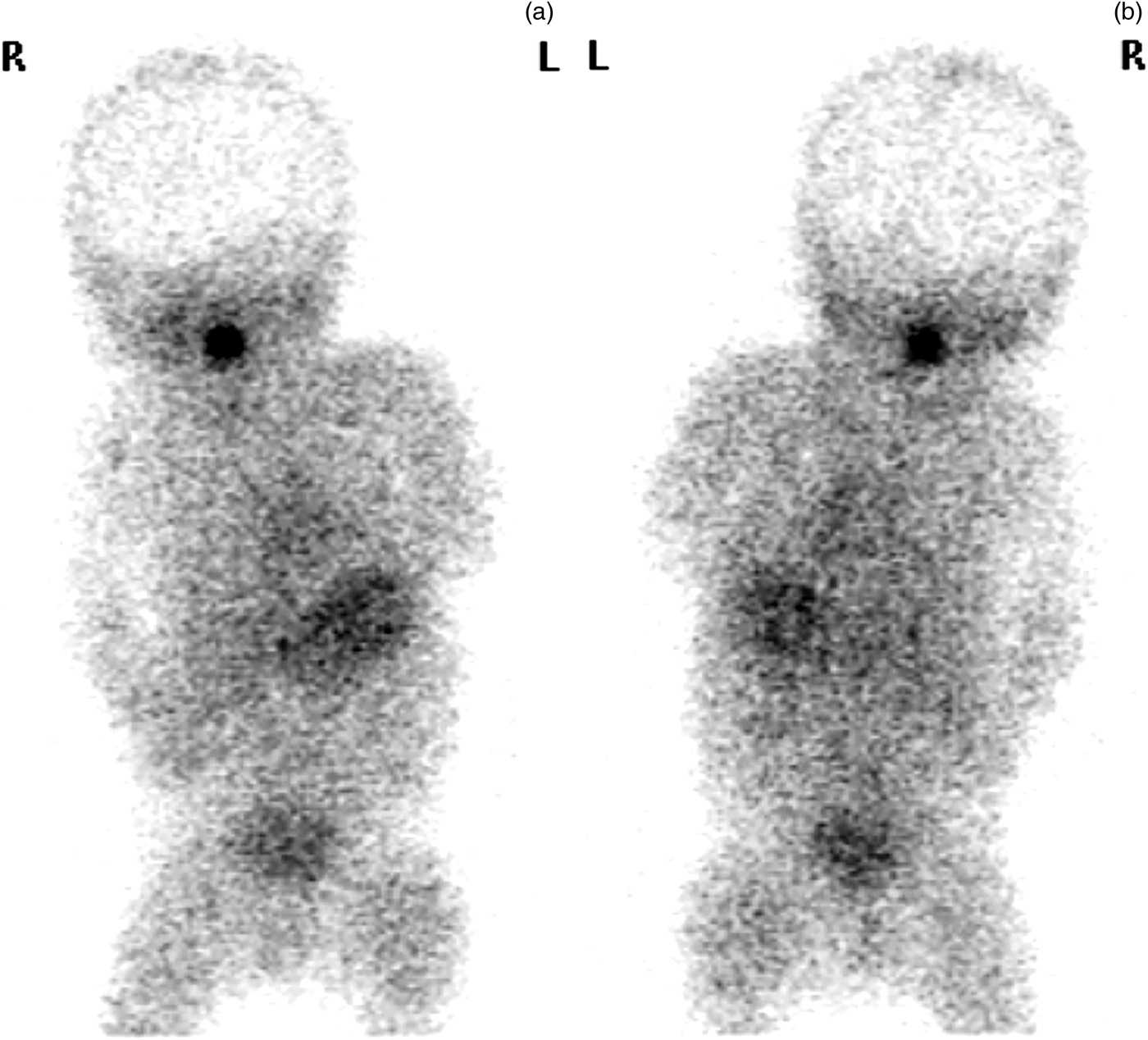
In the interim, the baby had undergone magnetic resonance imaging (MRI) of her neck, following the ENT assessment. The MRI confirmed a mass within her tongue (Figure 1), in keeping with an ectopic lingual thyroid gland. This diagnosis was confirmed by technetium isotope scanning (Figure 2).
Sagittal magnetic resonance imaging scan demonstrating a mass (11 × 8 × 8 mm) at the base of the tongue (arrow).

Technetium isotope anterior (a) and posterior (b) scans highlighting ectopic thyroid tissue. R = right; L = left
Formal thyroid function tests on serum conducted on day 21 of life (before the repeat blood spot sample had been collected) indicated congenital hypothyroidism. The thyroid-stimulating hormone level was elevated, at 53.4 mU/l, with a free thyroxine level of 16.2 pmol/l, which is at the lower end of the newborn reference range.Reference Williams, Simpson, Delahunty, Ogston, Bongers-Schokking and Murphy5
The baby was commenced on oral thyroxine 25 µg daily (10 µg/kg). The aim was to administer a substantial dose, despite there being good evidence of endogenous thyroid gland production. The objective was to reduce thyroid-stimulating hormone levels to less than 1 mU/l.
The stridor and the baby's bottle and breastfeeding improved in the subsequent days, and the baby was discharged with scheduled out-patient follow-up appointments. On review three months after starting thyroxine, the patient remained asymptomatic and continued to grow well with no feeding problems. Her thyroid-stimulating hormone level 13 days post-intervention with thyroxine was 0.3 mU/l.
Discussion
A lingual thyroid is a well-recognised cause of respiratory distress. Our case highlights the importance of medical intervention in this scenario. Patient age and symptoms are key considerations when deciding on an optimal therapeutic strategy.Reference Noussios, Anagnostis, Goulis, Lappas and Natsis2 Management may require surgical removal of the lingual thyroid; this can be performed via direct excision or radioisotope ablation,Reference Noussios, Anagnostis, Goulis, Lappas and Natsis2 although neither method is ideal in the neonate. Surgical resection does have high success rates, but there are significant risks associated with anaesthesia, in addition to concerns about inflammation, scarring and incomplete resection. The use of radioactive isotopes in children may be a less invasive option, but the risks associated with radiation exposure need to be considered carefully.Reference Iglesias, Olmos-Garcia, Riva and Diez6
Dutta et al. reported three cases of older children with dysphagia and odynophagia.Reference Dutta, Kumar, Thukral, Biswas, Jain and Ghosh7 All three children were diagnosed by ultrasound and technetium scanning. They responded well to treatment with levothyroxine alone. This treatment resolved the associated compressive symptoms by reducing the size of the ectopic thyroid tissue. Thyroid-stimulating hormone will promote the growth of thyroid tissue, and removing this stimulus with a thyroxine replacement will result in a reduction in gland size.Reference Toso, Colombani, Averono, Aluffi and Pia8 Our experience suggests that the response can be relatively rapid, occurring over a matter of days rather than weeks. A general increase in airway circumference may be another key factor that contributes to the improvement. There are very few case reports where medical treatment was the only therapy for a lingual thyroid associated with compressive symptoms.Reference Dutta, Kumar, Thukral, Biswas, Jain and Ghosh7, Reference Chanin and Greenberg9
The most important diagnostic tool has been suggested to be thyroid technetium scanning, which enables detection of ectopic thyroid tissue.Reference Noussios, Anagnostis, Goulis, Lappas and Natsis2, Reference Perry, Maroo, Maclennan, Jones and Donaldson3 Ultrasonography, computed tomography and MRI are helpful in defining the extent and location of the ectopic thyroid gland. Nasendoscopy, as used in the case described, may be performed with or without general anaesthesia, and provides views of the nasal fossae, choanae, pharynx and larynx, even in the neonate. In this case, nasendoscopy was carried out successfully without the use of general anaesthesia.
• A lingual thyroid is a rare embryological anomaly, wherein the thyroid gland has failed to descend to the usual pretracheal region
• Ectopic lingual thyroid should be considered in infants with evidence of oropharyngeal obstruction and poor feeding
• Nasendoscopy can provide valuable information about an ectopic thyroid gland
• Thyroid replacement therapy may suppress ectopic thyroid gland size and prevent unnecessary surgery
• Surgery should only be considered if adequate thyroid replacement therapy fails to resolve obstructive symptoms
There will always be occasions when repeat samples are requested as part of a screening programme. It was unfortunate that the blood sample for the baby described, who happened to have an ectopic thyroid gland, was insufficient for triplicate thyroid-stimulating hormone blood testing. It is important for laboratories to adhere to a predetermined set of standards, appreciating that there will be a tension between the desire to provide rapid feedback and the desire to provide reliable information. Closer links between the laboratory and the clinical team may have resulted in a repeat sample being obtained at an earlier stage. These oversights are an inevitable part of clinical practice. The newborn screening programme should be recognised for what it is – a screening, not a diagnostic programme. Therefore, clinicians should maintain a clinical awareness of congenital hypothyroidism and not assume that the screening programme will have detected all cases.
In summary, nasendoscopy can provide valuable information in neonatal cases where there is little external evidence of thyroid ectopia. Prompt intervention with thyroxine in babies with thyroid ectopia and associated respiratory compromise can result in a rapid response and minimise the need for surgical intervention. We recommend a substantial dose of thyroxine so that thyroid-stimulating hormone suppression occurs relatively quickly, removing the stimulus for further gland growth.