1. INTRODUCTION
Route selection directly influences the profits of shipping companies, especially in transoceanic sailing. The World Geodetic System (WGS) 84 reference ellipsoid is commonly used as the model of the Earth in modern navigation. The track connecting two points on the reference ellipsoid is either a Great Ellipse (GE) or a Rhumb Line (RL). A GE is the shortest track on the surface of a spheroid and is also called the Great Circle (GC) or the orthodrome when it is on the surface of a sphere. Besides the equator and the meridians (the special cases of the GE), steering along a GE requires changing course continually because it crosses every meridian at a different angle. A RL, also called a loxodrome, spirals toward the pole. However, steering along a RL enables a vessel to steer a constant course because it intersects all meridians at the same angle. How do navigators face the trade-off between the shorter distance and the simpler sailing procedure?
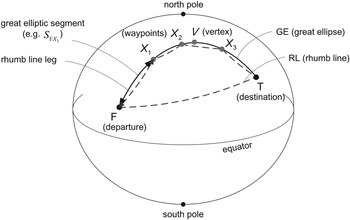
To evaluate and execute the Great Elliptic Sailing (GES) are both important issues. It is well known that the GE can provide a shorter distance. However, the difference in distance between GE and RL is not always significant. For example, the great elliptic distance from Sydney, Australia (33°50·0′S, 151°20·0′E) to Valparaiso, Chile (33°S, 71°37·0′W) is 6131·7 nautical miles (nm), which is 751·3 nm shorter than the RL distance. However, the great elliptic distance from Sydney, Australia (33°50·0′S, 151°20·0′E) to San Francisco, California (37°56·0′N, 123°04·0′W) is 6415·8 nm, which is only 18 nm shorter than the RL distance. Hence, whether the GE is worth adopting depends on whether the distance saved is significant, otherwise, the RL is easier to navigate. Although the difference in distance can be accurately calculated, do we have a concise criterion to evaluate it? In addition, even when a GE is worth adopting, a ship will not follow it exactly because its true direction changes continuously. Instead, a number of waypoints (also called intermediate points) are determined along the GE, and the navigator will steer a series of RL legs between each successive pair of waypoints, as shown in Figure 1. Thus, the problem is how to approximate the GE. The commonly practised methods all determine the waypoints at fixed intervals. Is the number of waypoints suitable? Do we have an effective method that can use the appropriate number of waypoints to approximate the GE?
Illustration of the GE and the RL.

GES and Great Circle Sailing (GCS) have both been discussed for decades. To begin with, the Earth is regarded as a sphere. Navigators usually adopt Napier's rule or spherical triangle formulae to solve the GCS problems (Bowditch, Reference Bowditch2002; Cutler, Reference Cutler2004; Royal Navy, Reference Royal2008). To reduce the number of solution steps and to apply to more different conditions, the studies of GCS have mainly focused on formula derivation with different approaches, such as vector algebra methods (Chen et al., Reference Chen, Liu and Gong2014; Chen, Reference Chen2016), linear combination methods (Miller et al., Reference Miller, Moskowitz and Simmen1991; Nastro and Tancredi, Reference Nastro and Tancredi2010; Tseng and Chang, Reference Tseng and Chang2014) and the rotation transformation method (Chen et al., Reference Chen, Hsieh and Hsu2015). In order to improve the accuracy and to comply with the WGS 84 geodetic datum, the Earth is regarded as a spheroid. Several studies have started to derive the formulae to deal with GES problems, for example: Williams (Reference Williams1996) presented the integral formulae of the inverse solution. Pallikaris and Latsas (Reference Pallikaris and Latsas2009) introduced series expansion formulae of the direct solution. Earle (Reference Earle2011) provided harmonic series formulae of the direct solution and the GE equation of the inverse solution. Sjöberg (Reference Sjöberg2012) used the Clairaut constant to establish the iterative process of the direct solution and the closed formulae of the inverse solution. The direct solutions can obtain the great elliptic distance and the waypoint position at a given distance. The inverse solutions can acquire the latitude of the waypoint at a given longitude. Although these studies make great contributions to the GES or the GCS, they did not pay attention to the evaluation and execution of the shortest track.
In brief, this study seeks not only to create a criterion to evaluate the GE, but also to propose a method for approximating the GE. Apart from the current section, Section 2 lists reference formulae that we use in the following sections. Section 3 creates a criterion to evaluate a GE. Section 4 provides a new method to approximate the CE. Then, several numerical examples are demonstrated in Section 5. Finally, the work is summarised and concluded in Section 6.
2. REFERENCE FORMULAE
In this work, the formulae Earle (Reference Earle2011) derived are used in the following sections to compute the GE problems. These required formulae are listed in Sections 2.1 to 2.4.
2.1. Auxiliary Variables
Geocentric latitudes of the departure and destination (θF and θT) are:
 $$\eqalign{\tan\theta_{\rm F}&=(1-e^2)\tan\phi_{\rm F}}$$
 $$\eqalign{\tan\theta_{\rm T}&=(1-e^2)\tan\phi_{\rm T}}$$
where e is the eccentricity of the WGS 84 reference ellipsoid (e = 0·081819190842622) and ϕF and ϕT are the geodetic latitudes of the departure and destination.
Geocentric Cartesian coordinates of the departure and destination:
 $$\eqalign{\vec{\hbox{F}}=[x_{\rm F},y_{\rm F},z_{\rm F}]=[r_{\rm F}\cos\theta_{\rm F}\cos\lambda_{\rm F},\ r_{\rm F}\cos\theta_{\rm F}\sin\lambda_{\rm F},\ r_{\rm F}\sin\theta_{\rm F}]}$$
 $${\vec{\hbox{T}}=[x_{\rm T},y_{\rm T},z_{\rm T}]=[r_{\rm T}\cos\theta_{\rm T}\cos\lambda_{\rm T},\ r_{\rm T}\cos\theta_{\rm T}\sin\lambda_{\rm T},\ r_{\rm T}\sin\theta_{\rm T}]}$$
where r F and r T are the radiuses from the centre to the departure and destination, and they can be obtained by the following equations.
 $$\eqalign{r_{\rm F}=\sqrt{\displaystyle{{1-e^2}\over{1-e^2\cos^2\theta_{\rm F}}}}}$$
 $$\eqalign{r_{\rm T}=\sqrt{\displaystyle{{1-e^2}\over{1-e^2\cos^2\theta_{\rm T}}}}}$$
Parameters which define the GE equation (λ and μ):
 $${\lambda = \displaystyle{{y_{\rm F}z_{\rm T}-z_{\rm F}y_{\rm T}}\over{x_{\rm F}y_{\rm T}-y_{\rm F}x_{\rm T}}}}$$
 $$\eqalign{\mu = \displaystyle{{-x_{\rm F}z_{\rm T}+z_{\rm F}x_{\rm T}}\over{x_{\rm F}y_{\rm T}-y_{\rm F}x_{\rm T}}}}$$
Latitude and longitude of the vertex (θ V , ϕ V and λ V ):
 $$\eqalign{\tan \theta_V&=\pm\sqrt{\lambda^2+\mu^2}}$$
 $$\eqalign{\tan \phi_V&=\displaystyle{{\tan \theta_V}\over{1-e^2}}}$$
 $$\eqalign{\tan \lambda_V&=\left(\displaystyle{{\mu}\over{\lambda}}\right)\pm\pi}$$
where the vertex is the point of highest latitude on a GE.
Longitude of the equator crossing point (λ E ):
 $$\tan \lambda_E=\left(\displaystyle{{-\lambda}\over{\mu}}\right)\pm \pi$$
Eccentricity of the GE (e′):
 $$e'=\displaystyle{{e\sin \theta_V}\over{\sqrt{1-e^2\cos^2\theta_V}}}$$
Geocentric great elliptic angles of the departure and destination (
 $\theta'_{\rm F}$
and
 $\theta'_{\rm T}$
):
 $$\eqalign{\cos\theta'_{\rm F}&=\cos\theta_{\rm F}\cos(\lambda_{\rm F}-\lambda_E) }$$
 $$\eqalign{\cos\theta'_{\rm T}&=\cos\theta_{\rm T}\cos(\lambda_{\rm T}-\lambda_E) }$$
Geodetic great elliptic angles of the departure and destination (ϕ′F and ϕ′T):
 $$\eqalign{\tan\phi'_{\rm F}&=\displaystyle{{\tan\theta'_{\rm F}}\over{1-e^{\prime2}}}}$$
 $$\eqalign{\tan\phi'_{\rm T}&=\displaystyle{{\tan\theta'_{\rm T}}\over{1-e^{\prime2}}}}$$
2.2. Great Elliptic Distance
Great elliptic distance from the departure to the destination (D FT):
 $$\eqalign{D_{\rm FT}=& a[a'_0(\phi'_{\rm T}-\phi'_{\rm F})+2a'_1\cos(\phi'_{\rm T}+\phi'_{\rm F})\sin(\phi'_{\rm T}+\phi'_{\rm F}) \cr & +2a'_2\cos(2(\phi'_{\rm T}-\phi'_{\rm F}))\sin(2(\phi'_{\rm T}-\phi'_{\rm F})) +2a'_3\cos(3(\phi'_{\rm T}-\phi'_{\rm F}))\sin(3(\phi'_{\rm T}-\phi'_{\rm F}))] }$$
where the parameters are
 $a'_{0}=1-\displaystyle{{1}\over{4}}e^{\prime2}-\displaystyle{{3}\over{64}}e^{\prime4}-\displaystyle{{5}\over{256}}e^{\prime6}$
,
 $a'_{1}=-\left(\displaystyle{{3}\over{8}}e^{\prime2}+\displaystyle{{3}\over{32}}e^{\prime4}+\displaystyle{{45}\over{1024}}e^{\prime6}\right)$
,
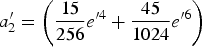 $a'_{2}=\left(\displaystyle{{15}\over{256}}e^{\prime4}+\displaystyle{{45}\over{1024}}e^{\prime6}\right)$
, and
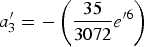 $a'_{3}=-\left(\displaystyle{{35}\over{3072}}e^{\prime6}\right)$
.
2.3. Waypoint at a Given Distance
Normalised given distance (D N ):
 $$D_N=\displaystyle{{\pi}\over{2}}\left(\displaystyle{{D_{E{\rm F}}+D_{{\rm F}X}}\over{D_{EV}}}\right),$$
where D EF is the great elliptic distance from the equator crossing point to the destination, D FX is the given distance from the destination to the waypoint, and D EV is the great elliptic distance from the equator crossing point to the vertex. D EF and D EV can be obtained by using Equation (18).
Geodetic great elliptic angle of the waypoint (ϕ′ X ):
 $$\phi'_X=b'_0D_N+b'_1\sin(2D_N)+b'_2\sin(4D_N)+b'_3\sin(6D_N)+b'_4\sin(8D_N)$$
where parameters are b′0 = 1,
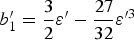 $b'_{1}=\displaystyle{{3}\over{2}}\varepsilon'-\displaystyle{{27}\over{32}}\varepsilon^{\prime3}$
,
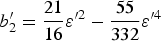 $b'_{2}=\displaystyle{{21}\over{16}}\varepsilon^{\prime2}-\displaystyle{{55}\over{332}}\varepsilon^{\prime4}$
,
 $b'_{3}=\displaystyle{{151}\over{96}}\varepsilon^{\prime3}$
, and
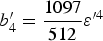 $b'_{4}=\displaystyle{{1097}\over{512}}\varepsilon^{\prime4}$
.
 $\varepsilon'$
can be obtained by the following equations.
 $$\eqalign{\varepsilon'&=\displaystyle{{1-\sqrt{\alpha'}}\over{1+\sqrt{\alpha'}}} }$$
 $$\eqalign{\alpha'&=1-e' }$$
Geocentric great elliptic angle of the waypoint (θ′ X ):
 $$\tan\theta'_X=\alpha'\tan \phi'_X$$
Geocentric latitude of the waypoint (θ X ):
 $$\sin\theta_X=\sin\theta'_X\sin\theta_V$$
Geodetic latitude and longitude of the waypoint (ϕ X and λ X ):
 $$\eqalign{\tan\theta_X=\displaystyle{{\tan\theta_X}\over{1-e^2}}}$$
 $$\eqalign{\cos(\lambda_V-\lambda_X)=\displaystyle{{\tan\phi_X}\over{\tan\phi_V}}}$$
2.4. Waypoint at a Given Longitude
Geodetic latitude of the waypoint (ϕ X )
 $$\tan\phi_X=\displaystyle{{-\lambda\cos\lambda_X+\mu\sin\lambda_X}\over{1-e^2}}$$
2.5. Rhumb Line Course and Distance
When the sequence of waypoints are determined, the rhumb line courses and distance can be computed by using the formulae given by Bennett (Reference Bennett1996) as follows:
Meridional parts of waypoint
 $i \lpar M_{X_{i}}\rpar $
:
 $$M_{X_i}=\displaystyle{{10800}\over{\pi}}\left[\ln\tan\left(45^\circ+\displaystyle{{\phi_{X_i}}\over{2}}\right) -\displaystyle{{1}\over{2}}e\ln\left(\displaystyle{{1+e\sin\phi_{X_i}}\over{1-e\sin\phi_{X_i}}}\right)\right]$$
where
 $\phi_{X_{i}}$
is in degrees.
Rhumb line course from the waypoint i to the waypoint
 $i+1 \lpar c_{X_{i}X_{i+1}}\rpar $
:
 $$\tan c_{X_iX_{i+1}}=\displaystyle{{60'(\lambda_{X_{i+1}}-\lambda_{X_i})}\over{M_{X_{i+1}}-M_{X_i}}}$$
where
 $M_{X_{i+1}}$
is the meridional parts of waypoint i + 1, and it can be obtained by using Equation (28).
Meridional arc length of waypoint
 $i \lpar m_{X_{i}}\rpar $
:
 $$\eqalign{m_{X_i} =& a\left[ {\left( {1 - \displaystyle{{e^2} \over 4} - \displaystyle{{3e^4} \over {64}} - \displaystyle{{5e^6} \over {256}}} \right)\phi _{X_i} - \displaystyle{3 \over 8}\left( {e^2 + \displaystyle{{e^4} \over 4} + \displaystyle{{15e^6} \over {128}}} \right)\sin 2\phi _{X_i}} \right. \cr & \left. + {\displaystyle{{15} \over {256}}\left( {e^4 + \displaystyle{{3e^6} \over 4}} \right)\sin 4\phi _{X_i} - \displaystyle{{35e^6} \over {3072}}\sin 6\phi _{X_i}} \right],} $$
where a is the semi-major axis of the WGS 84 reference ellipsoid (
 $a=3443{\cdot}918467$
nm) and
 $\phi_{X_{i}}$
is in radians.
Rhumb line distance from the waypoint i to the waypoint
 $i+1 \lpar d_{X_{i}X_{i+1}}\rpar $
:
 $$d_{X_iX_{i+1}} = \left\{\matrix{(m_{X_{i+1}}-m_{X_{i}})\sec c_{X_iX_{i+1}}, & c_{X_iX_{i+1}} {=}\!\!\!{/}\ 90^\circ \cr \displaystyle{{a\pi(\lambda_{X_{i+1}}-\lambda_{X_i})\cos[(\phi_{X_{i+1}}-\phi_{X_i})/2]}\over{180\sin c_{X_iX_{i+1}}\{1-e^2\sin^2[(\phi_{X_{i+1}}-\phi_{X_i})/2]\}^{1/2}}}, & c_{X_iX_{i+1}} \simeq 90^{\circ}\cr}\right.$$
where
 $m_{X_{i+1}}$
is the meridional arc length of waypoint i + 1, and it can be obtained by using Equation (30).
 $\phi_{X_{i+1}}$
and
 $\phi_{X_{i}}$
are in degrees, and
 $d_{X_{i}X_{i+1}}$
is in nautical miles.
2.6. Indices Used for Comparing the Great Ellipse and the Rhumb Line
Difference in distance between the GE and RL (DD):
 $$DD=\mid D_{\rm FT}-d_{\rm FT} \mid$$
where D FT and d FT can be obtained by using Equations (18) and (31), respectively.
Normalised Difference in Distance (NDD):
 $$NDD=\displaystyle{{\mid D_{\rm FT}-d_{\rm FT} \mid }\over{D_{\rm FT}}}$$
Saving in Distance (SD):
 $$SD= \mid td-d_{\rm FT} \mid = \mid (d_{{\rm F}X_1}+d_{X_1X_2}+\ldots+d_{X_n{\rm T}})-d_{\rm FT} \mid $$
This indicates how much the sum of each RL leg distance has already reduced, which compares to the RL from the departure to the destination.
Remaining Benefit (RB):
 $$RB= \mid D_{\rm FT}-td \mid = \mid D_{\rm FT}-(d_{{\rm F}X_1}+d_{X_1X_2}+\ldots+d_{X_n{\rm T}})\mid $$
This indicates how much the sum of each RL leg distance has achieved, which compares to the GE. It can be calculated by using Equation (35).
3. EVALUATION OF GREAT ELLIPTIC SAILING
To choose between the GE or the RL, there are several criteria found in the navigation textbooks as follows: a GE is not worth considering if the two places are at lower latitudes, because the RL near the equator is almost equivalent to the GE (Cutler, Reference Cutler2004). A GE is worth considering when the latitudes of the two places are high, the difference of latitude is small, and the difference of longitude is large (Bowditch, Reference Bowditch2002). A GE is worth considering if the two places are in the same hemisphere, especially when the difference of latitude is small and the difference of longitude is large (Royal Navy, Reference Royal2008). However, all of the above-mentioned criteria provide only the geographical relationship between the departure and the destination to evaluate a GE. Unlike these criteria, we want to propose a criterion that can accurately indicate the key point which influences the difference in distance between the GE and the RL.
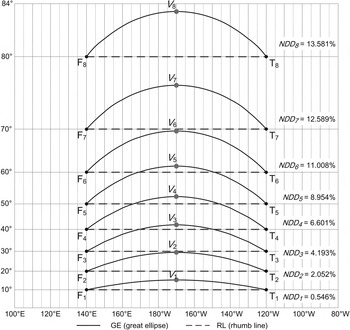
In order to find a new criterion, this study uses the example of Hiraiwa (Reference Hiraiwa1987). In this example, the eight cases are given as shown in Figure 2. The given latitudes of the departure and destination (ϕF and ϕT) are both varied from 10°N to 80°N. This excludes two special cases: when the given latitudes are 0° both places are on the equator, and when the given latitudes are 90° both places are on a meridian. The GE will be treated as the RL in these two special cases. In addition, the given longitudes of the departure (
 $\lambda_{\rm F}$
) in all cases are at 140°E, and the given longitudes of the destination (
 $\lambda_{\rm T}$
) are all at 120°W. Hence, the two places in all cases are in the northern hemisphere, the differences in latitude (
 $\phi_{\rm F}-\phi_{\rm T}$
) are all 0°, and the differences in longitude (
 $\lambda_{\rm F}-\lambda_{\rm T}$
) are all 100°. The eight cases are represented graphically on a Mercator map, as is typically used for navigation. In Figure 2, the GEs are depicted as curved lines, and the RLs are depicted as straight lines. This example corresponds with all of the above-mentioned criteria. Moreover, we found that the vertex can be considered as the key point because it has the maximum curvature on the GE. When the vertex is at higher latitude, the difference between the GE and RL will become more apparent. For instance, in the eighth case, its vertex is at the highest latitude, and its Normalised Differecnce in Distance (NDD
8) is the most significant among all the cases. Although the vertex is the highest point on a GE, a GE track from departure to destination is not always through the vertex. This depends on whether the longitude of the vertex (λ
V
) is between the longitudes of the departure (
 $\lambda_{\rm F}$
) and destination (
 $\lambda_{\rm T}$
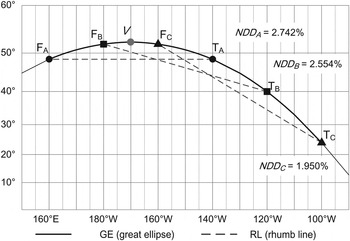
). If the GE track is through the vertex, the difference in distance between the GE and the RL will become more significant. When the latitudes and longitudes of the departure and destination are given, the longitude of the vertex can be calculated by using Equation (11). As shown in Figure 3, the GE track from FA to TA is through the vertex (V) because the longitude of V (170°W) is between the longitude of FA (160°E) and the longitude of TA (140°W). The GE track from FB to TB is through the vertex because the longitude of V (170°W) is between the longitude of FB (180°W) and the longitude of TB (120°W). Nevertheless, The GE track from FC to TC is not through the vertex because the longitude of V (170°W) is not between the longitude of FC (160°W) and the longitude of TC (100°W). Besides, the NDD of pair A and pair B (NDD
A
and NDD
B
) are both larger than pair C (NDD
C
). Hence, we propose the criterion that the GE track is worth adopting when the vertex lies between the departure and destination.
Hiraiwa's example represented on a Mercator map.

Illustration of the vertex criterion to evaluate the GE.

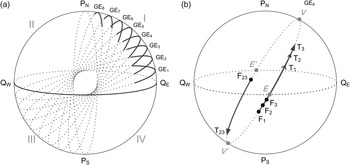
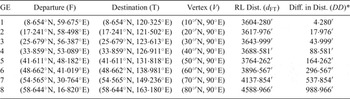
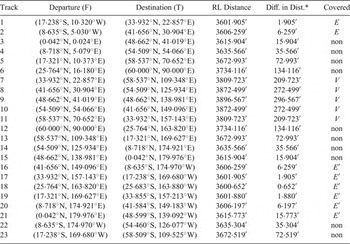
In order to verify that the proposed criterion is effective in most cases, a quantitative analysis is carried out as follows. First, the angle between the inclined GE plane and the equator plane will influence the difference in distance between the GE and the RL (DD), as shown in Figure 4(a). In Figure 4(a) first quadrant, we design eight situations to compare their DD values. The given distances of the GE in all situations are 3,600 nm, and all given vertices are located at the middle of the GE. Through Table 1, we show that if the angle between the inclined GE plane and the equator plane is smaller, the vertex will be at lower latitude, and the difference in distance is smaller; if the angle between the inclined GE plane and the equator plane is larger, the vertex will be at a higher latitude, and the difference in distance will become larger. Because the latitude of the vertex on the GE plane in the first quadrant and in third quadrant are symmetrical, and changing the longitude of the vertex will not influence the angle between the inclined GE plane and the equator plane, the above results can be applied to the other quadrants. Second, adopting different tracks on the same GE plane will influence the difference in distance between the GE and the RL (DD), as shown in Figure 4(b). In Figure 4(b), taking the plane of GE6 as an example, we take twenty-three tracks to compare their DD values. The given distances of the GE in all tracks are 3,600 nm. Through Table 2, we show that if the track crosses the equator (E or E′), the difference in distance will be smaller, such as Track 1 to Track 2 and Track 16 to Track 21; if the track passes through the vertex (V), the difference in distance will be larger, such as Track 7 to Track 11. In particular, if the vertex is at the middle of the GE, it will have the greatest DD value, such as Track 9. The above results can be applied to the other GE planes. Hence we can verify that a GE track is worth adopting when the vertex lies between the departure and destination. In particular, when the vertex is at a higher latitude, the difference in distance between the GE and RL will become more apparent.
Quantitative analysis to verify the proposed criterion.

Different inclinations of the GE plane to compare the GE with the RL.

* The given distance of the GE (D FT) in eight situations are 3600 nm.
Taking different tracks on the plane of GE6 to compare the with the RL.

* The given distance of the GE in all tracks is 3,600 nm.
4. EXECUTION OF GREAT ELLIPTIC SAILING
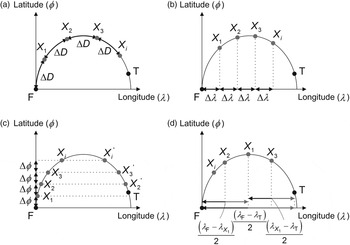
When a GE is used, how do we follow its path? Since a GE looks like a sine curve on a Mercator map, the ship has to continually change course. In common practice, a number of waypoints are determined at fixed intervals on the GE, and the navigator then steers along a series of rhumb line legs between each successive pair of waypoints to approximate the GE. The three common methods are as follows. As shown in Figure 5(a), Method 1 establishes the waypoints at fixed distance intervals (generally use the one-day sailing distance), and the course is usually changed at noon. As shown in Figure 5(b), Method 2 establishes the waypoints at fixed longitude intervals, and the course is usually changed at whole-degree meridians (generally use 5° or 10° intervals of longitude), which is in accordance with the scale of the chart. As shown in Figure 5(c), Method 3 sets the waypoints at fixed latitude intervals, which is seldom used because one latitude may correspond to two longitudes, requiring the additional pre-judgment step. However, the above-mentioned methods, which use fixed intervals to establish the waypoints, do not consider whether the number of waypoints is appropriate or not.
Four methods to approximate the GE.

Using varying intervals, the Longitude Bisection Method (LBM) is proposed to approximate the GE as shown in Figure 5(d). There are two rules. First, the selected GE should have a significant DD value. When the GE is divided into two or more great ellipse segments, the segment in which the DD value is greatest should be selected preferentially. Second, the waypoint is determined by bisecting the difference of longitude between the two ends of the selected segment because the calculation of the longitude is easier than the calculation of the distance. Thus, the steps of the algorithm can be constructed as follows.
Step 1: Calculate the DD values of segments. Initially, there is only one segment from the departure to the destination. When waypoint 1 is established, the GE is divided into two segments, which are from the departure to waypoint 1 (
 $S_{{\rm F}X_{1}}$
) and from waypoint 1 to the destination (
 $S_{X_{1}{\rm T}}$
). Thus if the number of waypoints is n, the GE will be divided into n + 1 segments. Next, the DD values of segments (e.g.,
 $\vert D_{{\rm F}X_{1}}-d_{{\rm F}X_{1}}\vert $
) can be calculated. The great elliptic distance can be obtained by using Equation (18), and the RL distance can be obtained by using Equation (31).
Step 2: Evaluate the total DD values. If the sum of DD values, which is equal to the remaining benefit of the GE, is significant, we can add a waypoint and go to the next step; otherwise, the process ends. Adopting the Royal Navy's (Royal Navy Reference Royal2008) suggestion that any GE which saves more than one hour of travel time is worth adopting, we assume the average speed is 15 knots and define the significant total DD values should be more than 15 nm. Navigators can define the significant value by themselves. Then, the segment in which the DD value is the greatest should be selected as the priority segment. If more than one segment has the greatest value, we can choose any one of them.
Step 3: Determine the waypoints. The longitude of the waypoint can be determined by bisecting the difference of longitude between the two ends of the priority segment. For example, if the priority segment is
 $S_{{\rm F}X_{1}}$
, the longitude of the waypoint can be determined from
 $\lpar \lambda_{\rm F}-\lambda_{X_{1}}\rpar /2$
, as shown in Figure 5(d). When the longitude of the waypoint is obtained, its latitude can be calculated by using Equation (27).
When the waypoint is determined, the priority segment will be divided into new segments, and the number of segments increases by one. To repeat steps 1 to 3 until the total DD values of segments is insignificant in step 2. It is important to note that the sequence of waypoints should, in practice, be reorganised according to the geographical order.
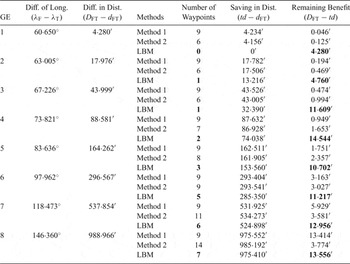
When the number of waypoints is insufficient, the effectiveness of approximating the GE may not achieve a satisfactory standard; when the number of waypoints is excessive, the efficiency may decrease. The appropriate number of waypoints is to use neither a higher or lower number of waypoints to achieve the goal of approximating the GE. In order to compare the performance between Method 1, Method 2 and the LBM (ignoring Method 3, which is seldom used in practice), we take the eight GE tracks of Table 1 for example. These tracks are more worth approximating than others because their vertices are all at their middles, and they all have the greatest DD value on their GE planes. The results are shown in Table 3. The Saving in Distance (SD) can be calculated by using Equation (34), and the Remaining Benefit (RB) can be calculated by using Equation (35). First of all, Method 1 determines the waypoints on the GE at each 360 nm interval. Because the distances of the GE in eight tracks are all 3,600 nm, the numbers of waypoints in all tracks are nine. In addition, Method 2 determines the waypoints on the GE at each 10° intervals of longitude. Because the differences of longitude between departure and destination (
 $\lambda_{\rm F}-\lambda_{\rm T}$
) in eight tracks are 60
 ${\cdot}650^{\circ}$
to 146
 ${\cdot}360^{\circ}$
, the numbers of waypoints in all tracks are six to 14. Only depending on the assumed intervals, Method 1 and Method 2 may use too many waypoints to approximate the GE. For example, the difference in distance of GE2 is 17·976 nm. The LBM only determines one waypoint, and can save 13·216 nm. In Method 1 and Method 2, they are inefficient because they have to use nine and six waypoints. There are, perhaps, two ways to reduce the number of waypoints. One way is to increase the fixed interval, the other way is to take partial waypoints. If we double the given interval, the number of waypoints will halve. However, how do we determine the appropriate fixed interval to obtain the appropriate number of waypoints? Method 1 and Method 2 may use the trial-and-error method to determine the appropriate fixed interval. However, the trial-and-error method itself is essentially inefficient. Likewise, if we want to pick n waypoints from a given set of waypoints, how many waypoints should be picked? Which ones should be taken? If these problems have yet to be solved, the number of waypoints of Method 1 still depends on the given distance interval, and the number of waypoints of Method 2 still depends on the given longitude interval. In fact, when the fixed interval is determined, the waypoints and the number of waypoints are also determined at the same time. Because the number of waypoints has no immediate connection with the DD value, Method 1 and Method 2 cannot provide the appropriate number of waypoints to approximate the GE. In contrast, the LBM would calculate the DD value. If the DD value is more than 15 nm, the LBM will determine the first waypoint. Furthermore, the next waypoint is not added unless the total DD values of segments is still more than 15 nm. As shown in Table 3, no waypoint can be determined on GE1 because the DD value of GE1 is 4·280 nm. The LBM, which has to evaluate the DD value to add a waypoint, can ensure the remaining benefit (D
FT − td) will not be more than 15 nm (see Table 3). Hence, the LBM can establish the appropriate number of waypoints to approximate the GE.
Compare three methods to approximate the GE.

5. DEMONSTRATED EXAMPLES
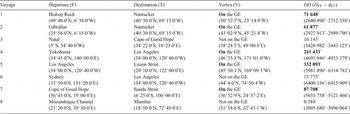
To demonstrate the proposed criterion and the LBM, this study proposes eight practical transoceanic voyages to be used as examples: Voyage 1 transits from Bishop Rock (near the English Channel) to Nantucket (on the east coast of the United States); Voyage 2 leaves Gibraltar (at the entrance to the Mediterranean) for Nantucket; Voyage 3 proceeds from Natal (in north-eastern Brazil) to the Cape of Good Hope (in South Africa); Voyage 4 sails from Yokohama (in Japan) to Los Angeles (on the west coast of the United States); Voyage 5 leaves Los Angeles for Luzon Strait (in south-east Asia); Voyage 6 transits from Sydney to Los Angeles; Voyage 7 proceeds from the coastal waters south of the Cape of Good Hope to the Sunda Strait (in Indonesia); Voyage 8 sails from the Mozambique Channel (in the south-east of Africa) to Mumbai (in India). The latitudes and longitudes of all departures and destinations can be obtained using the Pilot Chart (NGA, 2001); see Table 4. Voyages 1, 2 and 3 are trans-Atlantic transits; Voyages 4, 5 and 6 are trans-Pacific transits; Voyages 7 and 8 are trans-Indian Ocean transits.
Eight transoceanic voyages to validate the proposed criterion.

At first, we use the proposed criterion to evaluate the GEs in eight voyages. The vertices of the eight voyages can be calculated by using Equations (10) and (11), respectively. As shown in Table 4, the vertices of Voyages 1, 2, 4, 5 and 7 are on their GE. According to the proposed criterion, the GE is worth using on these voyages. To validate the result, we calculate the DD value, which can be determined accurately by using Equation (32). The DD values of these five voyages are more significant, as expected. Consequently, the proposed criterion can help us to simply judge the difference in distance between the GE and the RL.
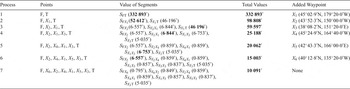
Next, use the LBM to execute the GE in Voyages 1, 2, 4, 5 and 7. Voyage 5 is a good example to list the solution process because its DD value is the greatest among the five voyages. As shown in Table 5, first, there is only one segment (S
FT). The DD value of S
FT is 332·893 nm. Add a waypoint on the S
FT because its DD value is significant (more than 15 nm). Waypoint 1 (
 $45^{\circ}02{\cdot}9'$
N,
 $179^{\circ}20{\cdot}0'$
W) is determined from
 $\lpar \lambda_{\rm F}-\lambda_{\rm T}\rpar /2$
. Second, the GE is divided into two segments (
 $S_{{\rm F}X_{1}}\comma \; S_{X_{1}{\rm T}}$
). Add a waypoint on the
 $S_{{\rm F}X_{1}}$
because its DD value is greater, and the total DD values of segments is still significant. Waypoint 2 (43°52·3′N, 150°00·0′W) is determined from
 $\lpar \lambda_{\rm F}-\lambda_{X_{1}}\rpar /2$
. Third, the GE is divided into three segments (
 $S_{{\rm F}X_{2}}$
,
 $S_{X_{2}X_{1}}$
,
 $S_{X_{1}{\rm T}}$
). Add a waypoint on the
 $S_{X_{1}{\rm T}}$
because its DD value is greater, and the total DD values of segments is still significant. Waypoint 3 (
 $38^{\circ}08{\cdot}2'$
N,
 $151^{\circ}20{\cdot}0'$
E) is determined from
 $\lpar \lambda_{X_{1}}-\lambda_{\rm T}\rpar /2$
. Fourth, the GE is divided into four segments (
 $S_{{\rm F}X_{2}}$
,
 $S_{X_{2}X_{1}}$
,
 $S_{X_{1}X_{3}}$
,
 $S_{X_{3}{\rm T}}$
). Add a waypoint on the
 $S_{X_{2}X_{1}}$
because its DD value is greater, and the total DD values of segments is still significant. Waypoint 4 (
 $45^{\circ}24{\cdot}9'$
N,
 $164^{\circ}40{\cdot}0'$
W) is determined from
 $\lpar \lambda_{X_{2}}-\lambda_{X_{1}}\rpar /2$
. Fifth, the GE is divided into five segments (
 $S_{{\rm F}X_{2}}$
,
 $S_{X_{2}X_{4}}$
,
 $S_{X_{4}X_{1}}$
,
 $S_{X_{1}X_{3}}$
,
 $S_{X_{3}{\rm T}}$
). Add a waypoint on the
 $S_{X_{1}X_{3}}$
because its DD value is greater, and the total DD values of segments is still significant. Waypoint 5 (
 $42^{\circ}43{\cdot}3'$
N,
 $166^{\circ}00{\cdot}0'$
E) is determined from
 $\lpar \lambda_{X_{1}}-\lambda_{X_{3}}\rpar /2$
. Sixth, the GE is divided into six segments (
 $S_{{\rm F}X_{2}}$
,
 $S_{X_{2}X_{4}}$
,
 $S_{X_{4}X_{1}}$
,
 $S_{X_{1}X_{5}}$
,
 $S_{X_{5}X_{3}}$
,
 $S_{X_{3}{\rm T}}$
). Add a waypoint on the
 $S_{{\rm F}X_{2}}$
because its DD value is greater, and the total DD values of segments is still significant. Waypoint 6 (
 $40^{\circ}12{\cdot}8'$
N,
 $135^{\circ}20{\cdot}0'$
W) is determined from
 $\lpar \lambda_{\rm F}-\lambda_{X_{2}}\rpar /2$
. Seventh, the GE is divided into seven segments (
 $S_{{\rm F}X_{6}}$
,
 $S_{X_{6}X_{2}}$
,
 $S_{X_{2}X_{4}}$
,
 $S_{X_{4}X_{1}}$
,
 $S_{X_{1}X_{5}}$
,
 $S_{X_{5}X_{3}}$
,
 $S_{X_{3}{\rm T}}$
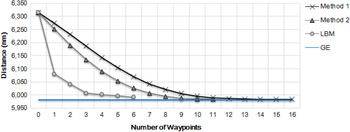
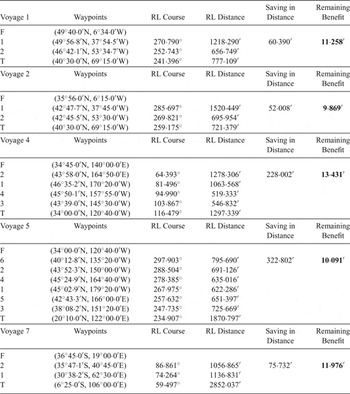
). However, the total DD values of segments is insignificant. Hence, the process ends. According to the above process, the waypoints of these five voyages are established as shown in Table 6. After determining the appropriate waypoints, the remaining benefit of these five voyages are not more than 15 nm. As shown in Figure 6, in Voyage 5, the LBM uses six waypoints to approximate the GE. Method 1 determines eleven waypoints at 360 nm intervals on the GE, and Method 2 determines sixteen waypoints at every 10° of longitude on the GE. Comparing the LBM with Method 1 and Method 2, the trend line of the LBM is steeper than other methods, and the end of trend lines in Method 1 and Method 2 are almost ineffective. Consequently, the proposed LBM can help us to approximate a GE by using the proper number of waypoints.
Comparing three methods to approximate the GE on Voyage 5.

Using LBM to approximate the GE in Voyage 5.

LBM to approximate the GE in Voyages 1, 2, 4, 5 and 7.

6. CONCLUSIONS
In this study, we create a criterion to evaluate the difference in distance between the GE and the RL, and propose the method to approximate the GE. In order to establish the criterion, we use the Hiraiwa's (Reference Hiraiwa1987) example to compare the GE (a shorter track) and the RL (easier to steer) on a Mercator map. The key point which causes the difference of the saved distance is found to be at the vertex. In order to verify the influence of the vertex, a quantitative analysis is carried out. This shows that when the vertex is at a higher latitude, the difference in distance between the GE and RL will become more apparent. Accordingly, the simple criterion we proposed is that if the vertex lies between the departure and destination, the GE will be worth using. In addition, we develop the LBM, which uses varying intervals, to approximate the GE. The first waypoint will be established when the difference in distance between the GE and RL (DD) is significant, and the next waypoint will not be added unless the total DD values of segments is still significant. The waypoint is determined by bisecting the difference of longitude between the two ends of the priority segment which has the greatest difference in distance. We define that a significant DD value should be more than 15 nm. Navigators can define the significant value to suit their needs. As a result, the LBM can use the appropriate number of waypoints to approximate the GE. We hope the criterion and the LBM can benefit navigators.