




No CrossRef data available.
Article contents
Using decision modeling to determine pricing of new pharmaceuticals: The case of neurokinin-1 receptor antagonist antiemetics for cancer chemotherapy
Published online by Cambridge University Press: 01 August 2004
Abstract
Objectives: Decision analysis is commonly used to perform economic evaluations of new pharmaceuticals. The outcomes of such studies are often reported as an incremental cost per quality-adjusted life year (QALY) gained with the new agent. Decision analysis can also be used in the context of estimating drug cost before market entry. The current study used neurokinin-1 (NK-1) receptor antagonists, a new class of antiemetics for cancer patients, as an example to illustrate the process using an incremental cost of $Can20,000 per QALY gained as the target threshold.
Methods: A decision model was developed to simulate the control of acute and delayed emesis after cisplatin-based chemotherapy. The model compared standard therapy with granisetron and dexamethasone to the same protocol with the addition of an NK-1 before chemotherapy and continued twice daily for five days. The rates of complete emesis control were abstracted from a double-blind randomized trial. Costs of standard antiemetics and therapy for breakthrough vomiting were obtained from hospital sources. Utility estimates characterized as quality-adjusted emesis-free days were determined by interviewing twenty-five oncology nurses and pharmacists by using the Time Trade-Off technique. These data were then used to estimate the unit cost of the new antiemetic using a target threshold of $Can20,000 per QALY gained.
Results: A cost of $Can6.60 per NK-1 dose would generate an incremental cost of $Can20,000 per QALY. The sensitivity analysis on the unit cost identified a range from $Can4.80 to $Can10.00 per dose. For the recommended five days of therapy, the total cost should be $Can66.00 ($Can48.00–$Can100.00) for optimal economic efficiency relative to Canada's publicly funded health-care system.
Conclusions: The use of decision modeling for estimating drug cost before product launch is a powerful technique to ensure value for money. Such information can be of value to both drug manufacturers and formulary committees, because it would facilitate negotiations for optimal pricing in a given jurisdiction.
Information
- Type
- GENERAL ESSAYS
- Information
- International Journal of Technology Assessment in Health Care , Volume 20 , Issue 3 , August 2004 , pp. 289 - 295
- Copyright
- © 2004 Cambridge University Press
The rapid growth of health-care expenditures in industrialized countries has led to increased interest in economic evaluations of health-care programs (1;6). This is particularly true for pharmaceuticals, which constitute a substantial portion of the health-care budget (1). The basic premise of pharmacoeconomic evaluations is to compare the costs and consequences of alternative pharmaceutical interventions and determine which treatment offers the best value for money (1;6). There are several methods available to evaluate economic efficiency (7). All of the approaches measure costs in monetary terms, but differ in the way that consequences are evaluated (1). Decision analysis modeling is one of the most commonly used methods for conducting cost-effectiveness analyses and the outcomes are typically presented as the incremental cost per quality-adjusted life year (QALY) gained. In the Canadian health-care setting, it has been suggested that a new agent represents “good value for money” if the incremental cost is less than $20,000 per QALY gained (21).
New pharmaceuticals are often approved for clinical use before an economic evaluation is conducted. However, pharmacoeconomic analyses can also be very informative when performed before product launch and during clinical development. To illustrate one application of pharmacoeconomic analyses at this stage of drug development, decision analyses modeling was used to estimate the cost of a new drug before approval for clinical use. The therapeutic area selected as the case study was a new antiemetic agent for the prevention of chemotherapy-induced emesis.
The severity and pattern of chemotherapy-induced emesis depends on the chosen drug regimen, dose, route, and schedule of administration (23;29;32). Cisplatin, a commonly used cytotoxic drug, can induce severe nausea and vomiting in virtually all patients, unless antiemetic agents are administered (29;32). For this reason, cisplatin-induced emesis has become the human model by which antiemetic regimens are evaluated (7). Cisplatin, at doses ≥50 mg/m2 of body-surface area, can induce a biphasic pattern of emesis (26). Acute emesis usually begins 2 to 4 hours after cisplatin administration and peaks at 6 hours (23;26). Delayed emesis can persist up to five days after cisplatin administration, peaking in intensity at 48 to 72 hours. Approximately 50 percent of patients are reported to experience delayed emesis, despite the use of modern antiemetic protocols containing serotonin receptor antagonists (5-HT3; 26;32). Because these two phases are distinct in their onset and intensity, their biochemical mechanisms are thought to be unique in nature (22;26).
Research efforts to prevent delayed emesis have been directed at blocking neurotransmitter receptors in the brainstem's vomiting center. The role of serotonin blockade in the pathophysiology of chemotherapy-induced emesis is well-established clinically through the serotonin receptor antagonists, which include ondansetron, granisetron, dolasetron, and tropisetron (14;28). When combined with dexamethasone, these agents can prevent acute emesis in approximately 70 percent of patients receiving a cisplatin-based chemotherapy regimen (28–30). In contrast, the impact of 5-HT3s in the prevention of delayed emesis has been marginal at best (16;18;27). Therefore, there is a need to identify new agents that will improve the control of delayed emesis.
Substance P, a neurotransmitter found to produce vomiting when injected into ferrets, is considered to have an important role in delayed emesis (10). Substance P exerts its effect by binding to the neurokinin-1 (NK-1) receptor, and blockade of this interaction inhibits the emetic potential of a wide range of stimuli. Neurokinin-1 (NK-1) receptor antagonists are a novel class of antiemetics and are currently under investigation for the control of acute and delayed emesis after cisplatin chemotherapy (2;15). There have been several randomized studies demonstrating that an NK-1 alone or in combination with granisetron and dexamethasone significantly improves the control of both acute and delayed emesis (2;3;15;23). If these preliminary results are confirmed by larger trials, these agents will become an important advance in cancer supportive care. In this study, the NK-1 receptor antagonists were used to illustrate how decision analysis modelling can be used for estimating a product's pricing before clinical approval.
METHODS
Economic Model
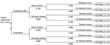
A decision model for the treatment of cisplatin-induced emesis was developed with DATA version 4.0 (Treeage Software, Inc.; Fig. 1). The analytic time frame was five days, and a Canadian health-care system perspective was taken. The primary clinical outcome for measuring successful antiemetic therapy was complete emesis control defined as no emetic episodes during day 1 (i.e., acute phase) and from days 2 to 5 (i.e., delayed phase) after cisplatin chemotherapy (32). Patients would receive the NK-1 or placebo before cisplatin chemotherapy and twice daily to day 5. Two clinical oncologists who had experience in antiemetic treatment protocols evaluated the face and content validity of the model.

Decision analysis model for emesis control with associated payoffs in terms of quality-adjusted days
The model began at the decision node (square) where the treatment choice for cisplatin-naïve patients would be either an NK-1 receptor antagonist or placebo combined with both intravenous granisetron and dexamethasone pre-cisplatin administration. Patients in either group would be assessed for complete emesis control during the first 24 hours after cisplatin administration (i.e., acute phase). Previous studies have established that patients who have complete control of acute emesis are less likely to experience delayed emesis (26). All patients would then be followed for complete emesis control until day 5.
Clinical Data
A comprehensive literature search was conducted to identify well-designed randomized controlled trials that evaluated NK-1 antagonists in the setting of cisplatin-induced emesis. The clinical data required for this study were the number of treatment days; complete response rates for day 1, days 2 through 5, and days 1 through 5; the use of secondary or rescue antiemetic therapy; and the associated success rate. Three randomized trials were identified for potential inclusion into the decision model (2;15;23). Among these trials, relevant and complete clinical data required for the decision analysis could only be extracted from one of the studies. This was a randomized double-blind placebo-controlled phase II study (15). A total of 58 patients were randomized into one of two groups: (i) NK-1 100 mg orally, granisetron 1 mg intravenously (IV), and dexamethasone 20 mg IV thirty minutes before cisplatin followed by NK-1 orally every twelve hours for five days; or (ii) oral placebo, with granisetron 1 mg IV and dexamethasone 20 mg IV thirty minutes before cisplatin, followed by placebo for five days. The primary end point was the proportion of patients with complete control (i.e., no emesis episodes) during days 2 to 5 after cisplatin. Secondary end points were complete emesis control during the acute period (i.e., day 1) and complete control throughout the study (i.e., days 1 to 5). Approximately 68 percent of patients receiving NK-1 treatment had no emesis during days 2 to 5, compared with 37 percent of those receiving NK-1 placebo (p=.042). Approximately 86 percent of patients receiving NK-1 plus granisetron and dexamethasone had no acute emesis compared with 66.7 percent in the NK-1 placebo group (p=.09). During days 1 to 5, control of emesis was observed in 64.3 percent of those receiving NK-1 compared with 30 percent of those receiving placebo (p=.009). These rates of complete emesis control were subsequently incorporated into the decision-analysis model.
Estimation of Treatment Costs
Costs for standard antiemetic therapy, including pharmacy preparation and nursing administration costs, consisting of granisetron and dexamethasone were obtained from The Princess Margaret Hospital Pharmacy, Toronto, Canada. The cost of secondary therapy (i.e., rescue therapy) for patients who had breakthrough emesis was obtained from a published Canadian study (4). Data on the average number of emetic episodes and the use of rescue therapy were not reported in the randomized trial (15). Therefore, costs related to breakthrough emesis were not entered in the baseline analysis. The unknown variable in the analysis was the unit cost of the NK-1 agent. All costs in the current analysis were reported in Canadian dollars ($1Can=0.73$US or 0.65EUR as of September 2003).
Patient Preferences for Alternative Health States
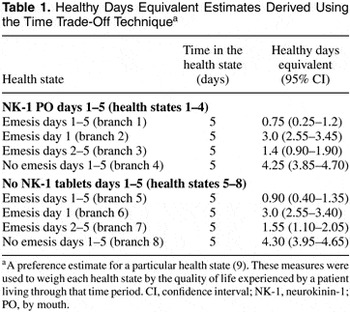
The health-related quality-of-life values measured in the current analysis were individual preferences for alternative health outcomes, as illustrated in the decision-analytic model. In the current study (i.e., quality-adjusted emesis-free time intervals) were measured as “healthy days equivalent” for the time spent in each outcome of the decision model (Fig. 1). These parameters were determined using the Time Trade-Off technique as described by Torrance (31). There is evidence in the oncology cost utility literature that health-care professionals are suitable patient surrogates for utility measurements (25). Hence, the quality of life impact of the NK-1 agent was estimated from a cohort of twenty-five oncology nurses and pharmacists. With a sample of twenty-five subjects, health state preferences were measured with a precision that extended to 1.0 day, with a 95 percent probability. Healthy days equivalence was then converted into quality-adjusted life years (QALY) (9).
After informed consent was obtained, one of the principal investigators (PL) interviewed each respondent for fifteen to twenty minutes. Participants were presented with a standard description of the route of administration of each agent and potential side effects as reported in the trial (15). Subjects were then asked how many days of “optimal health” they considered being equivalent to the time spent in each of the less than optimal health states described in the model. For example, respondents may consider 1 day of optimal health to be equivalent to five days of uncontrolled vomiting as depicted in branch 1 and 5 of the model. These measures were then used to weigh each branch of the model by the quality of life experienced by a patient living through that event. An identical process was administered for each of the eight outcomes in the decision model (Fig. 1).
Participants provided responses for each health outcome. The “healthy days equivalent” estimates for each branch of the model were based on scores obtained from the interviews. Once the model was “rolled back,” the difference in the mean number of “healthy days equivalent” between the comparators (NK-1 versus placebo) was then divided by 365 days to estimate the associated number of QALYs gained (9). The process for estimating QALY is valid and has been used successfully by our group in other published cost utility studies of oncology products (25).
Cost Utility Analysis
The clinical, economic, and respondent preference data were then combined into a cost-utility analysis comparing an NK-1 to placebo for the prevention of cisplatin-induced emesis. The primary objective of this case study was to estimate a unit cost of an NK-1 for a targeted incremental cost of $Can20,000 per QALY gained. A threshold of $Can20,000 per QALY gained was used because it has been suggested that medical interventions at or below this level represent good value for money for the publicly funded Canadian health-care system (21). However, it is important to note that the choice of optimal economic value should be country- or health-care system-specific.
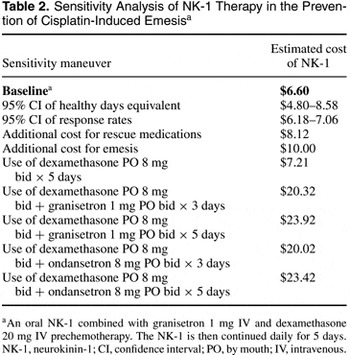
Indirect costs were not included in the current analysis, because there were no data available on the association between NK-1 usage and indirect cost avoidance. In addition, future costs and benefits were not discounted because of the short time periods involved. However, the stability of the baseline results was evaluated by a comprehensive sensitivity analysis. This analysis consisted of substituting the 95 percent confidence intervals (CI) for the complete emesis control rate and the health-state utilities, as well as including additional costs related to secondary emesis therapy. To measure the economic impact of breakthrough emesis, a value of $Can14.00 was used per episode and it was assumed that these patients experienced two breakthrough events in the first 24 hours and from days 2–5 (4).
Additional analyses consisted of extending the use of granisetron and dexamethasone up to five days after chemotherapy. Emesis control rates for this and other scenarios were also obtained from published randomized trials (11–13; 17–20). For scenarios with more than 1 available published report, meta-analytic techniques using a random effects model were used to determine a pooled weighted-response rate (8). The sensitivity analysis provided estimates of the upper and lower extremes of the unit cost of an NK-1 in the difference clinical scenarios.
RESULTS
Estimation of Healthy Days Equivalent
The preference values from oncology nurses and pharmacists are presented in Table 1. The model probabilities and the associated payoffs presented as quality-adjusted days are illustrated in Fig. 1. The results suggested that patient preferences were influenced by the number of days of vomiting rather than the severity of vomiting. As an example comparing health states 2 and 3 of the model, respondents considered four days of delayed emesis worse (i.e., lower utility score) than one day of acute emesis. Respondents also rated the scenario without vomiting (health states 4 and 8 of Fig. 1) as being the most preferable with the highest “healthy days equivalent” scores. The least desirable health states were in branches 1 and 5 of the model, where there was uncontrolled emesis for the entire 5-day period after chemotherapy (Table 1). It was also observed that taking one tablet twice daily of the NK-1 with its mild side effect profile did not impact the utility score of health states 4 to 8.

Cost Utility Analysis
The emesis control rate from the clinical trial, the estimated costs associated with each treatment, and the health state “healthy days equivalent” estimates were combined into the cost-utility analysis. The unit cost for an NK-1 was then varied until the incremental cost-effectiveness ratio reached the threshold of $Can20,000 per QALY gained. By using this approach, the cost of the NK-1 was estimated to be $Can6.60. At this cost, the addition of an NK-1 to a Canadian hospital or provincial formulary would be considered to be economically attractive in the context of Canada's publicly funded health-care system.
Sensitivity Analysis
A series of one-way sensitivity analyses were then conducted using the 95 percent CI for the “healthy days equivalent” and the antiemetic control rates reported from the trial. Other sensitivity maneuvers consisted of adding the cost of emesis and secondary therapy for breakthrough vomiting to the model. Using the lower and upper 95 percent CI for “healthy days equivalent” and complete control rates resulted in a lower and upper unit cost of $Can4.80 and $Can8.58 (Table 2). When the cost of emesis and rescue therapy was included, the unit cost increased to a maximum of $Can10.00. An additional maneuver consisted of adding dexamethasone and 5-HT3 antiemetics for up to five days. The results suggested that the use of oral dexamethasone for five days after chemotherapy is an inexpensive treatment that would only marginally impact the unit cost of the NK-1. However, if 5-HT3 antiemetics are routinely used for up to five days, then the cost of an NK-1 could increase to almost $Can24.00 per tablet and still remain less than the $Can20,000 per QALY threshold (Table 2). Even at a cost of $Can24.00 per tablet, an NK-1 would remain a better economic alternative to a 5-HT3 for the prevention of delayed emesis. The final analysis assumed that the unit cost of the NK-1 was $Can20.00, the same as a 5-HT3 in Canada. If NK-1s had the same unit cost as a 5-HT3, the incremental cost per QALY would be approximately $Can54,000.

In summary, the results of the sensitivity analyses suggested that the cost of an NK-1 is highly dependent on how the 5-HT3s are used in a given cancer center. If 5-HT3s are not routinely used for the prevention of delayed emesis, it would be difficult to justify an NK-1 unit cost over $Can10.00.
DISCUSSION
Decision analysis modeling is a powerful simulation technique widely used to perform cost-effectiveness evaluations of new drugs. In such studies, the health services researcher develops a decision model comparing the new therapy to the current standard, incorporates into the analysis the costs and consequences of the two alternatives, and then estimates the incremental cost per QALY gained with the new intervention. If the cost per QALY is below a predetermined threshold, the conclusion is that the new treatment is cost-effective and should be added to a hospital or national formulary.
Decision analysis is a useful tool that can be used to estimate any unknown in the analysis. The unknown in most published studies has been the incremental cost per QALY gained. However, decision analysis can also be applied in the context of pricing a new drug before it is introduced to market. In this study, this process was used to estimate a unit cost for an NK-1 receptor antagonist, a new class of antiemetics for cancer supportive care that is currently under development.
The baseline analysis suggested that a unit cost of approximately $Can6.60 per tablet (range of $Can4.80 to $Can10.00) would be economically attractive within the context of the publicly funded Canadian health-care system. At this cost, Canadian formulary committees should reimburse the drug in cancer patients receiving cisplatin-based chemotherapy. The guidelines for cost-effective therapy under this scenario would be to add an NK-1 to an existing 5-HT3-dexamethasone “cocktail” prechemotherapy and then continue the NK-1 for five days.
The findings of the current study became more complicated when the 5-HT3 antiemetics for delayed emesis were considered in the analysis. An expert committee of Cancer Care Ontario conducted a meta-analysis of randomized trials evaluating the benefits of a 5-HT3 for the prevention of delayed emesis (27). The results of the analysis suggested that the use of 5-HT3 antiemetics beyond the first 24 hours after chemotherapy reduces the absolute risk of delayed emesis by only 5 percent (p<.05). To take this benefit into perspective, twenty patients who would have to be treated with a 5-HT3 agent for five days to prevent one patient from vomiting. Given the high cost of these agents, it would not be cost-effective to adopt this practice. Despite their limited benefit, 5-HT3 antiemetics continue to be used for the prevention of delayed emesis (5).
The results of the current analysis suggested that an NK-1 would be a cost-effective alternative to a 5-HT3 antiemetic even if the former agent were priced at $Can24.00 per dose. The main drivers behind this conclusion were the modest efficacy of the 5-HT3s in preventing delayed emesis and their substantial daily cost. Therefore, Canadian institutions that have difficulties with the use of 5-HT3 antiemetics beyond the first 24 hours should welcome the addition of an NK-1 into their formularies as a better alternative, provided that the cost of NK-1 is below $Can24.00 per tablet.
The NK-1 antiemetic example presented in the current study demonstrates how the application of decision analysis can be a powerful technique to estimate the cost of a new drug before launch in any national jurisdiction. One practical advantage of the method demonstrated in this study is that it can readily be applied to health-care systems that are privately or publicly funded. The only requirement is that target thresholds in terms of cost per QALY gained have to be set before initiating the study. In the current study, $Can 20,000 per QALY gained was set as the target to illustrate the process. However, this target could have been $Can50,000 or higher, depending on the setting in which the analysis was conducted. Target selection should be determined by reviewing the published national literature or through the use of focus groups involving the key stakeholders.
There are several limitations in the application of this technique that have to be discussed. The decision analysis model relied on high-quality randomized trial data to predict estimates that were reasonably accurate. However, randomized trial data may not be available with all investigational products, and marketing approval may be granted based on nonrandomized phase II data. This is a common occurrence, especially in oncology. Another limitation is in the use of the $Can20,000 per QALY threshold that was used within the context of Canada's publicly funded health-care system. Even though some leading clinicians and economists have advocated this estimate as being an acceptable threshold for adopting cost-effective therapies in Canada, others have extensively criticized it as not being consistent with economic theory (24). To address this drawback, health services researchers should establish their own thresholds for accepting new drugs into clinical practice through review of their national literature or through the use of focus groups involving the key stakeholders. Indirect costs such as time off work secondary to poor emesis control are relevant in this setting but were not considered in the current analysis because there are no data on the impact of NK-1 antiemetics on this parameter. The final limitation relates to the analysis of the NK-1 antiemetic. The data relied on a small randomized trial that did not report the number of emetic episodes in patients who had emesis nor the type of rescue therapy administered. Hence, estimates for these variables had to be taken from the 5-HT3 antiemetic literature, which may not be generalizable to the NK-1s.
Policy Implications
The current study presents a systematic process to estimate drug cost based on predetermined thresholds for societal value. The advantages of this technique are that it is relatively straightforward to perform and transparent, and the decision model can be easily applied to other jurisdictions using local cost data. Such information can be of value to both drug manufacturers and formulary committees, because it would facilitate negotiations for optimal pricing within a given jurisdiction.
This study was not supported by an external sponsor but was part of an ongoing outcomes research program.
References
Blumenschein K,
Johannesson M.
1996
Economic evaluation in healthcare: A brief history and future directions.
Pharmacoeconomics.
2:
114–
122.Google Scholar
Campos D,
Pereira JR,
Reinhardt RR, et al.
2001
Prevention of cisplatin-induced emesis by the oral neurokinin-1 antagonist, MK-869, in combination with granisetron and dexamethasone or with dexamethasone alone.
J Clin Oncol.
19:
1759–
1767.Google Scholar
Cocquyt V,
Van Belle S,
Reinhardt RR.
2001
Comparison of L-758,298, a prodrug for the selective neurokinin-1 antagonist, L-754,030, with ondansetron for the prevention of cisplatin-induced emesis.
Eur J Cancer.
37:
835–
842.Google Scholar
Dranitsaris G,
De Angelis C,
Warr D,
Narine L.
1995
Pharmacoeconomic analysis of prophylactic treatments for emesis secondary to breast cancer chemotherapy.
Can J Hosp Pharm.
48:
266–
275.Google Scholar
Dranitsaris G,
Leung P,
Warr D.
2001
Implementing evidence based guidelines in the oncology setting: Results of a four-month prospective intervention study.
Support Care Cancer.
9:
611–
618.Google Scholar
Drummond M,
Brandt A,
Luce B, et al.
1993
Standardizing methodologies for economic evaluation in health care: Practice problems and potential.
Int J Technol Assess Health Care.
9:
26–
36.Google Scholar
Drummond MF,
Stoddard GL,
Torrance GW.
1987
Methods for the economic evaluation of health care programs.
Oxford:
Oxford Medical Publications;
Einarson TR.
1997
Pharmacoeconomic applications of meta-analysis for single groups using antifungal onychomycosis lacquers as an example.
Clin Ther.
19:
559–
568.Google Scholar
Gafni A.
1997
Alternatives to the QALY measure for economic evaluations.
Support Care Cancer.
5:
105–
111.Google Scholar
Gardner CJ,
Twissell DJ,
Dale JD, et al.
1995
The broad-spectrum anti-emetic activity of the novel non-peptide tachykinin NK1 receptor antagonist GR203040.
Br J Pharmacol.
116:
3158–
3163.Google Scholar
Goedhals L,
Heron JF,
Kleisbauer JP, et al.
1998
Control of delayed nausea and vomiting with granisetron plus dexamethasone or dexamethasone alone in patients receiving highly emetogenic chemotherapy: A double-blind, placebo-controlled, comparative study.
Ann Oncol.
9:
661–
666.Google Scholar
Gralla RJ,
Tittenberg C,
Peralta M, et al.
1996
Capsulation and emesis: Aspects of treatment and a new trial for delayed emesis using oral dexamethasone plus ondansetron beginning at 16 hours after cisplatin.
Oncology.
53
(Suppl 1):
86–
91.Google Scholar
Heron JF,
Goedhals L,
Jordaan JP, et al.
1994
Oral granisetron alone and in combination with dexamethasone: A double blind randomized comparison against high-dose metoclopramide plus dexamethasone in prevention of cisplatin-induced emesis.
Ann Oncol.
5:
579–
584.Google Scholar
Hesketh P.
1994
Treatment of chemotherapy-induced emesis in the 1990s: Impact of the 5-HT3 receptor antagonists.
Support Care Cancer.
2:
286–
292.Google Scholar
Hesketh PJ,
Gralla RT,
Webb RT, et al.
1999
Randomized phase II study of the neurokinin 1 receptor antagonist CJ-11,974 in the control of cisplatin-induced emesis.
J Clin Oncol.
17:
338–
343.Google Scholar
Hesketh PJ,
Harvey WH,
Harker WG, et al.
1994
A randomized, double-blind comparison of intravenous ondansetron alone and in combination with intravenous dexamethasone in the prevention of high-dose cisplatin-induced emesis.
J Clin Oncol.
12:
596–
600.Google Scholar
Italian Group for Antiemetic Research.
1995
Ondansetron versus granisetron, both combined with dexamethasone, in the prevention of cisplatin-induced emesis.
Ann Oncol.
6:
805–
810.
Joss AL,
Hill AS,
Soukop M, et al.
1994
Ondansetron plus dexamethasone is superior to ondansetron alone in the prevention of emesis in chemotherapy-naïve and previously treated patients.
Ann Oncol.
5:
253–
258.Google Scholar
Kris MG,
Gralla RJ,
Clark RA, et al.
1985
Incidence, course, and severity of delayed nausea and vomiting following the administration of high-dose cisplatin.
J Clin Oncol.
3:
1379–
1384.Google Scholar
Latreille J,
Pater J,
Johnston D, et al.
1998
Use of dexamethasone and granisetron in the control of delayed emesis for patients who receive highly emetogenic chemotherapy.
J Clin Oncol.
16:
1174–
1178.Google Scholar
Laupacis A,
Feeny D,
Detsky AS,
Tugwell PX.
1992
How attractive does a new technology have to be to warrant adoption and utilization? Tentative guidelines for using clinical and economic evaluations.
Can Med Assoc J.
146:
473–
481.Google Scholar
Martin M.
1996
The severity and pattern of emesis following different cytotoxic agents.
Oncology.
53
(Suppl 1):
26–
31.Google Scholar
Navari RM,
Reinhart RR,
Gralla RJ.
1999
Reduction of cisplatin-induced emesis by a selective neurokinin-1-receptor antagonist.
N Engl J Med.
340:
190–
195.Google Scholar
Naylor DC,
Williams I,
Basinski A, et al.
1993
Technology assessment and cost-effectiveness analysis: Misguided guidelines?
Can Med Assoc J.
148:
921–
924.Google Scholar
Ortega A,
Dranitsaris G,
Sturgeon J, et al.
1997
Cost-utility analysis of paclitaxel in combination with cisplatin for patients with advanced ovarian cancer.
Gynecol Oncol.
66:
454–
463.Google Scholar
Ossi M,
Anderson E,
Freeman A.
1996
5-HT3 receptor antagonists in the control of cisplatin-induced delayed emesis.
Oncology.
53
(Suppl 1):
78–
85.Google Scholar
Provincial Systemic Treatment Disease Site Group.
1999
Cancer Care Ontario Practice Guidelines Initiative.
Use of 5-HT3 receptor antagonists in patients receiving moderately or highly emetogenic chemotherapy.
Toronto;
Roila F,
Ballatori E,
Tonato M,
Del Favero A.
1997
5-HT3 receptor antagonists: Differences and similarities.
Eur J Cancer.
33:
1364–
1370.Google Scholar
Roila F,
Tonato M,
Ballatori E,
Del Favero A.
1996
Comparative studies of various antiemetic regimens.
Support Care Cancer.
4:
270–
280.Google Scholar
Tonato M,
Roila F,
Del Favero A.
1994
Are there differences among the serotonin antagonists?
Support Care Cancer.
2:
293–
296.Google Scholar
Torrance GW.
1987
Utility approach to measuring health-related quality of life.
J Chron Dis.
40:
593–
600.Google Scholar
Verweij J,
de Wit R,
de Mulder P.
1996
Optimal control of acute cisplatin-induced emesis.
Oncology.
53
(Suppl 1):
56–
64.Google Scholar
Decision analysis model for emesis control with associated payoffs in terms of quality-adjusted days
Healthy Days Equivalent Estimates Derived Using the Time Trade-Off Techniquea
Sensitivity Analysis of NK-1 Therapy in the Prevention of Cisplatin-Induced Emesisa
 You have
Access
- 9
- Cited by