

INTRODUCTION
The growing demand for food products and an increasing awareness of the impact of unsustainable production methods are of increasing concern to society. Global food requirements are expected to be 70% higher in 2050 than in 2009 (FAO 2009), placing unprecedented demand on agricultural land and supply chains. Pressures such as soil erosion, reduced numbers of pollinating insects and water stress are of particular concern because they can generate negative feedbacks that may compromise future food production. The contribution of agriculture to global warming through the release of greenhouse gases (GHGs) is another such feedback. Agriculture contributes up to 0·32 of anthropogenic GHGs when land use change is included (Bellarby et al. Reference Bellarby, Foereid, Hastings and Smith2008). Projected consequences for agriculture in the 21st century include increased crop productivity at mid to high latitudes, decreased crop productivity at lower latitudes, decreased water resources in semi-arid areas and changes in precipitation patterns (IPCC Reference Pachauri and Reisinger2007).
Up to 0·18 of global GHG emissions are attributed to livestock production when land use change is included (Steinfeld et al. Reference Steinfeld, Gerber, Wassenaar, Castel, Rosales and De Haan2006). Of particular concern are the potent GHGs methane (CH4) and nitrous oxide (N2O), which have warming potentials of 25 and 298 times that of CO2 per kg over a 100 year period (Forster et al. Reference Forster, Ramaswamy, Artaxo, Bernsten, Betts, Fahey, Haywood, Lean, Lowe, Myhre, Nganga, Prinn, Raga, Schulz, Van Dorland, Solomon, Qin, Manning, Chen, Marquis, Averyt, Tignor and Miller2007). The production of CH4 as a by-product of feed fermentation in the rumen means that red meat has far greater emission intensity than an equivalent quantity of white meat produced from monogastric animals (Bellarby et al. Reference Bellarby, Foereid, Hastings and Smith2008; Gill et al. Reference Gill, Smith and Wilkinson2010; Stott et al. Reference Stott, Macleod and Moran2010). Red meat produced from pasture-based systems can be a significant source of N2O emissions, particularly direct emissions from soil as a result of fertilizer applications (Schils et al. Reference Schils, Verhagen, Aarts and Šebek2005; Edwards-Jones et al. Reference Edwards-Jones, Plassmann and Harris2009). This recognition of agriculture's contribution to climate change is manifest in intra and international GHG policy and emission reduction targets for agriculture and the red meat sector. For example, the UK Climate Change Act requires that all emissions be reduced by 34% (from 1990 levels) by 2020 and 80% by 2050. This has shaped sector-specific targets under the low carbon transition plan, including a 10% reduction for the agriculture industry by 2020 (DECC 2009). A GHG action plan subsequently identified nutrient and livestock management as categories for action, resulting in a red meat GHG reduction strategy (EBLEX 2012). Literature on mitigating GHG emissions from red meat production at a farm-scale level typically focuses on cattle to the exclusion of sheep. The current paper presents an overview of the most prominent mitigation options suited to sheep farm systems, and focuses primarily on options aimed at reducing enteric CH4 and soil N2O emissions, as the dominant forms of sheep farm emissions.
SHEEP FARM EMISSIONS
On-farm emissions dominate the sheep supply chain carbon footprint up to the point of sale (EBLEX 2012) and even after-export and consumer-stage emissions such as cooking are accounted for (Ledgard et al. Reference Ledgard, Lieffering, Mcdevitt, Boyes and Kemp2010). Enteric fermentation CH4 emissions constitute the largest component of on-farm emissions from sheep production (e.g. 0·57–0·58), followed by N2O arising directly from soils in response to nitrogen application as fertilizer or animal waste (e.g. 0·15) (Ledgard et al. Reference Ledgard, Lieffering, Mcdevitt, Boyes and Kemp2010; Taylor et al. Reference Taylor, Jones and Edwards-Jones2010).
Emissions associated with sheep meat production are linked strongly to farm type. In the UK, for example, sheep produced in lowland systems typically have lower emissions than their upland and hill counterparts (Wiltshire et al. Reference Wiltshire, Wynn, Clarke, Chambers, Cottrill, Drakes, Gittins, Nicholson, Phillips, Thorman, Tiffin, Walker, Tucker, Thorn, Green, Fendler, Williams, Bellamy, Audsley, Chatterton, Chadwick and Foster2009; EBLEX 2012). Better pasture and subsequent silage quality and a milder climate favour faster growth rates and quicker sales in lowland environments. Recent data place the average carbon footprint of lowland lamb produced in England at 10·98 kg CO2e/kg live-weight (LW) and at 14·42 kg CO2e/kg LW for hill production (EBLEX 2012). Substantially lower emissions have been reported elsewhere, e.g. 7·2–8·3 kg CO2e/kg of hot carcase produced in Western Australia (Peters et al. Reference Peters, Rowley, Wiedemann, Tucker, Short and Schulz2010). However, differences in calculation and reporting methods make comparisons problematic (Schils et al. Reference Schils, Olesen, Del Prado and Soussana2007; Edwards-Jones et al. Reference Edwards-Jones, Plassmann and Harris2009). Carbon footprinting practitioners advocate that carbon footprints should be used as a starting point to steer the process of emission reduction and not to identify poor performers. Some production systems will inevitably have a higher footprint than others, for example, those with a significant area of organic soil may have high N2O emissions as highlighted by Edwards-Jones et al. (Reference Edwards-Jones, Plassmann and Harris2009). Mitigation options tailored to the requirements of specific systems are therefore required.
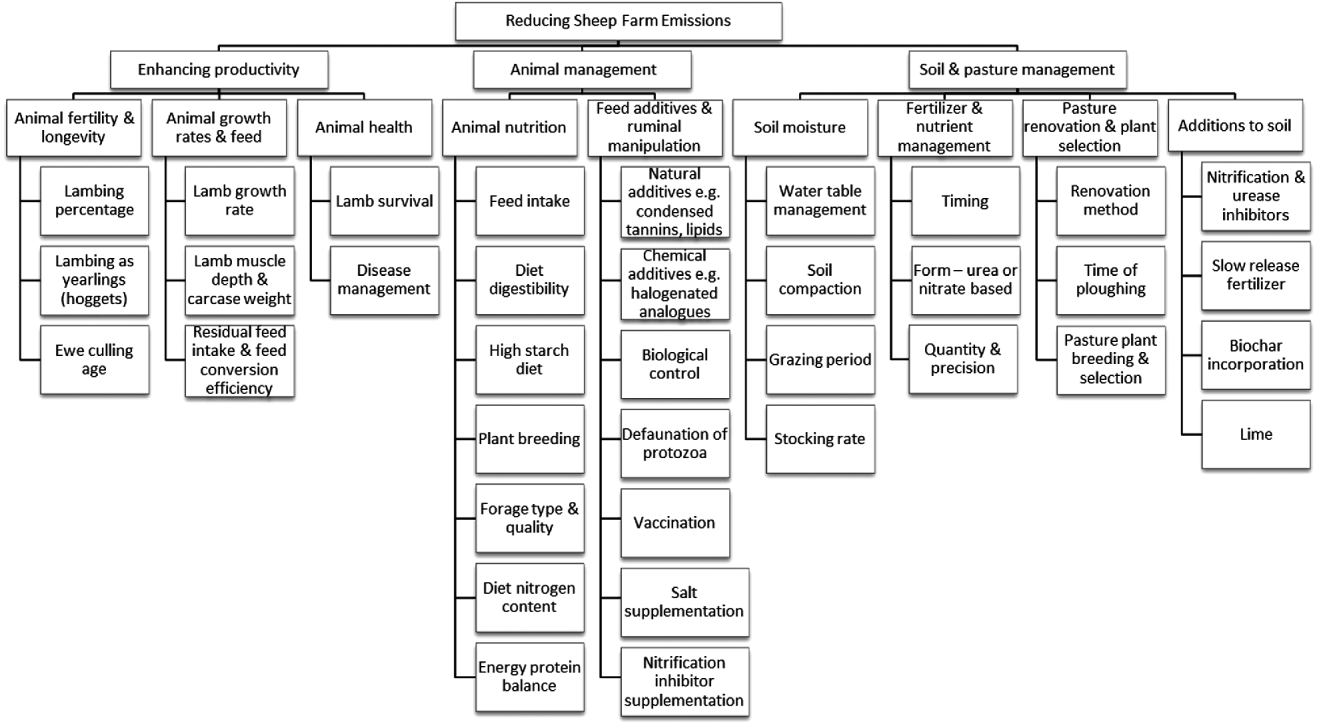
Much of the scope for reducing GHG emissions from sheep farms lies in improved productivity and system efficiencies. Enhancing productivity maximizes output per unit of input, reducing emissions per kg of product. Tackling system inefficiencies reduces waste such as feed energy lost as CH4 and fertilizer nitrogen lost directly or indirectly as N2O. Other mitigation options target emissions that cannot be avoided directly through system optimization, for example, vaccination against methanogens and addition of nitrification inhibitors (NIs) to pastures. There have been a number of reviews of livestock-related mitigation options (EC Agri DG 2002; Weiske Reference Weiske2005; Johnson et al. Reference Johnson, Franzluebbers, Weyers and Reicosky2007; Moorby et al. Reference Moorby, Chadwick, Scholefield, Chambers and Williams2007; Smith et al. Reference Smith, Martino, Cai, Gwary, Janzen, Kumar, Mccarl, Ogle, O'mara, Rice, Scholes, Sirotenko, Howden, Mcallister, Pan, Romanenkov, Schneider, Towprayoon, Wattenbach and Smith2008; Eckard et al. Reference Eckard, Grainger and de Klein2010; Gill et al. Reference Gill, Smith and Wilkinson2010; Shibata & Terada Reference Shibata and Terada2010). The sheep farm-relevant mitigation options reviewed in the current paper are outlined in Fig. 1 under the headings of enhancing productivity, animal management, and soil and pasture management.
Schematic representation of the opportunities for reducing CH4 and/or N2O emissions on sheep farms. The headings ‘enhancing productivity’, ‘animal management’ and ‘soil & pasture management’ corresponded to subsections within the text.

For a number of the mitigation options, research on mitigation potential originated in cattle only studies. If there were no equivalent sheep system studies available it was necessary to supplement the sheep system-related literature with examples from cattle-based systems, with the understanding that the mitigation options are generic across ruminant systems. It should also be noted that a proportion of the studies were published as industry or project reports, and therefore not all the literature cited has been subject to rigorous peer-review.
ENHANCING PRODUCTIVITY
Despite conflicting results in the scientific literature regarding the efficacy of many mitigation options, there is a general consensus amongst scientists and in the industry that increased productivity is a priority mitigation option (EBLEX 2010; Gill et al. Reference Gill, Smith and Wilkinson2010; Shibata & Terada Reference Shibata and Terada2010). The underpinning notion is that maximized lamb production from the flock's maintenance feed provision will lead to a reduction in emissions per kg of produce (Smith et al. Reference Smith, Martino, Cai, Gwary, Janzen, Kumar, Mccarl, Ogle, O'mara, Rice, Scholes, Sirotenko, Howden, Mcallister, Pan, Romanenkov, Schneider, Towprayoon, Wattenbach and Smith2008; Buddle et al. Reference Buddle, Denis, Attwood, Altermann, Janssen, Ronimus, Pinares-Patiño, Muetzel and Wedlock2011). The productivity of sheep systems can be boosted through a range of strategies targeting growth, fertility, longevity and feed efficiency of the animals (Gill et al. Reference Gill, Smith and Wilkinson2010; Hegarty et al. Reference Hegarty, Alcock, Robinson, Goopy and Vercoe2010). Relevant strategies include increases in lamb growth rate to reduce time on farm; increases in lamb muscle depth and carcase weight to increase saleable product; increases in lamb births and survivals to increase product output; lambing as yearlings to maximize the ewe's lifetime production capability which in turn decreases the proportion of unproductive time on farm; increases in ewe culling age to increase lifetime lamb output and reduce the need for replacements; reductions in incidences of disease and reducing residual feed intake (RFI) or improving feed conversion efficiency (Genesis Faraday 2008; Hegarty Reference Hegarty2009; Hegarty & McEwan Reference Hegarty and Mcewan2010; Hegarty et al. Reference Hegarty, Alcock, Robinson, Goopy and Vercoe2010; Alcock & Hegarty Reference Alcock and Hegarty2011; P. Amer et al. unpublished).
These strategies can be delivered through genetic improvement, i.e. livestock selection and breeding, and improved animal husbandry, i.e. animal feeding and health management (Gill et al. Reference Gill, Smith and Wilkinson2010; Hegarty et al. Reference Hegarty, Alcock, Robinson, Goopy and Vercoe2010). Desirable productivity traits can also be attained through changing breeds stocked (Allard Reference Allard2009; IBERS et al. 2011a). Some sectors of the UK livestock industry have achieved significant GHG reductions as a by-product of genetic selection for productivity, for example, emissions per kg of product from the pig and dairy industries decreased by 0·8% per annum in the 20 years prior to 2008 (Genesis Faraday 2008). Breeding improvements in the UK sheep industry lag behind those made for other livestock (Moorby et al. Reference Moorby, Chadwick, Scholefield, Chambers and Williams2007; Gill et al. Reference Gill, Smith and Wilkinson2010), and as a result emissions per kg of product have decreased by just 0·5% in total over the same 20-year period. Studies in other countries suggest that breeding for improved productivity in the sheep industry may further reduce emissions. For example, P. Amer et al. (unpublished) estimated that a 10% increase in ewe-litter size in New Zealand between 1994 and 2006 resulted in a 6% reduction in emissions per kg of lamb carcase produced. The Institute of Biological, Environmental and Rural Studies (IBERS) et al. (2011a) suggested that genetic improvement for productivity based on existing breeding indices could decrease annual CH4 emissions by 0·03% per tonne of carcase produced in Wales.
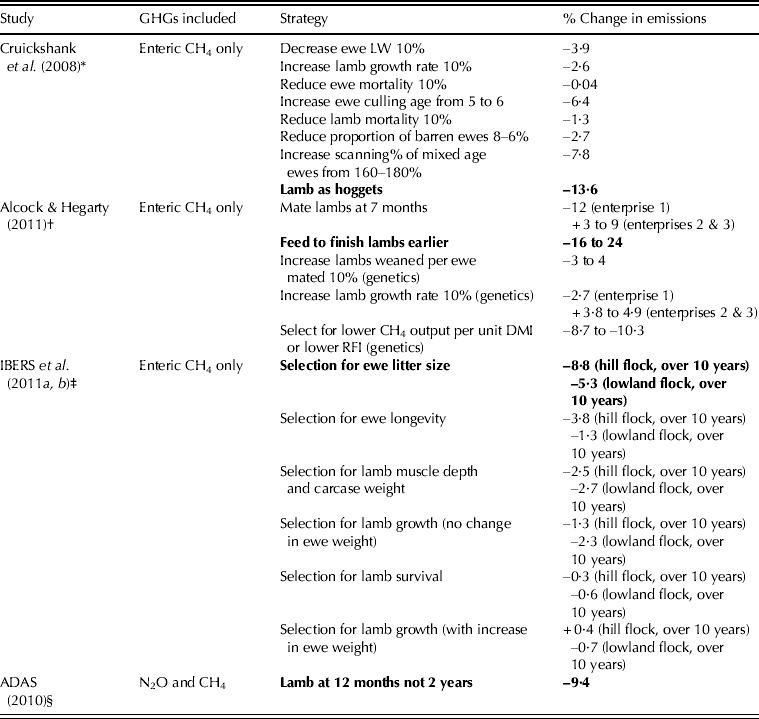
There is a growing body of research using emissions modelling to estimate the mitigation potential of productivity improvements in defined flocks. The results of a number of recent studies are summarized in Table 1 and are discussed in the sections that follow.
Summary of GHG reductions achieved through improvements in productivity. Data were taken from studies modelling GHG mitigation potential in defined flocks. The greatest reductions modelled in each study are highlighted in bold text
* New Zealand-based study that modelled the emission reductions possible through individual management strategies against a baseline flock of 1000 ewes. Baseline emissions were 15·99 kg CH4 per lamb sold. Percentage reductions are a percentage change from the base flock in terms of CH4 emissions per net lamb sold.
† An Australian study which modelled management options to reduce CH4 output on a range of simulated sheep enterprises. Three common Australian production systems were characterized: (1) merino ewe flock – all replacements from progeny and surplus sold as weaners or hoggets; (2) dual purpose merinos – merino ewes mated to Poll Dorset and all progeny sold as stores or to slaughter; (3) prime lamb enterprise where Border Leicester × Merino ewes are mated with Poll Dorset rams and all progeny sold as stores or slaughter. Percentage reductions are in emissions intensity reported as kg CO2e/kg LW sold.
‡ A Welsh study that modelled the enteric CH4 emission reductions possible through selection for single genetic traits to improve productivity in hill, upland and lowland flocks. Reductions are a percentage change in CH4 emissions over 10 years and per tonne of carcase produced.
§ An English study that calculated the GHG emissions reductions possible per kg of carcase meat produced from a lowland spring lambing flock that breeds its own replacements or buys in ewe lambs.
Animal fertility and longevity
In a self-replacing New Zealand flock of 1000 ewes, Cruickshank et al. (Reference Cruickshank, Thomson and Muir2008) found that lambing replacements as yearlings (hoggets) instead of waiting to lamb them later (as two-tooth ewes) had the greatest potential for reducing enteric CH4 emissions (Table 1). This strategy maximized lamb output from the maintenance costs of the existing ewes. Similar findings in the direction and magnitude of change were modelled in a study by ADAS (Reference Rees and Philips2010), suggesting that lambing at 12 months rather than 2 years could reduce CH4 and N2O emissions by 9·4 kg CO2e/kg of carcase meat. In the self-replacing Australian flocks modelled by Alcock & Hegarty (Reference Alcock and Hegarty2011), mating replacements at 7 months was estimated to reduce enteric CH4 emissions by 12% per kg of LW lamb produced. However, in their second and third sheep enterprise types, replacements were not home-reared but brought in 2 weeks before mating. Consequently, mating at 7 months increased enteric CH4 emissions between 3 and 9% per kg LW lamb produced. In these scenarios there was no unproductive young stock on farm and mating at an earlier age only served to reduce lambing percentages and growth rates.
The Institute of Biological, Environmental and Rural Studies et al. (2011b) found selection for ewe-litter size to be the genetic trait with the greatest stand-alone potential for emission reduction in Welsh flocks over a 10-year period. Similar strategies of increasing scanning percentage and the number of lambs weaned per ewe resulted in substantial enteric CH4 savings of 3–4 and 7·8%, respectively (Cruickshank et al. Reference Cruickshank, Thomson and Muir2008; Alcock & Hegarty Reference Alcock and Hegarty2011). Increasing ewe longevity and decreasing lamb mortality also have potential to reduce lamb production emissions.
Animal growth rates and feed
In each of their three modelled enterprise types (Table 1) Alcock & Hegarty (Reference Alcock and Hegarty2011) found that production and creep feeding to finish lambs earlier had the greatest potential to reduce enteric CH4 per kg of LW lamb produced; however, their study only considered enteric CH4 emissions and did not consider the emissions burden of grain production. The effect on emissions of genetic selection for faster growth rate in lambs is dependent on whether or not this also results in a correlated increase in ewe mature weight. The Institute of Biological, Environmental and Rural Studies et al. (2011b) estimated that selection for lamb growth over 10 years in Welsh hill flocks would decrease enteric CH4 emissions by 1·3% with no change in ewe weight, and increase them by 0·4% if ewe weight increased in synchrony. It is reported that improvements in lamb growth rates were behind most of the genetic-related reduction in GHG emissions in the UK sheep industry in the last 20 years (Genesis Faraday 2008). However, the net benefit was constrained by the increased emissions associated with the higher mature weights of the ewes. Net N2O emissions demonstrated a marginal increase over time as a result of faster lamb growth rates, underlining the importance of incorporating all GHGs in any emissions calculation.
While the efficiency of feed use is widely used for selective breeding in other livestock species, limited use has been made of traits such as RFI in the ruminant industry (Genesis Faraday 2008; Wall et al. Reference Wall, Simm and Moran2010). Studies have demonstrated that cattle with lower RFI have reduced dry matter intake (DMI) and may also have lower daily rates of CH4 production (Nkrumah et al. Reference Nkrumah, Okine, Mathison, Schmid, Li, Basarab, Price, Wang and Moore2006; Hegarty et al. Reference Hegarty, Goopy, Herd and Mccorkell2007). The modelled sheep flock scenarios of Alcock & Hegarty (Reference Alcock and Hegarty2011) found selection of sheep for lower RFI to be the most promising genetic improvement option for reducing enteric CH4 emissions. If achieved, low RFI animals will provide a mitigation option suited to both intensive and extensive systems (Waghorn & Hegarty Reference Waghorn and Hegarty2011).
There is increasing interest in breeding directly for CH4-reducing traits and feed nitrogen conversion efficiency (Wall et al. Reference Wall, Bell, Simm, Rowlinson, Steele and Nefzaoui2008; Keogh & Cottle Reference Keogh and Cottle2009; Hegarty & McEwan Reference Hegarty and Mcewan2010). Inter-sheep variation was estimated to be responsible for 70–80% of the differences in CH4 emissions per unit of feed intake recorded from livestock fed the same diet in large-scale experiments (O'Hara et al. Reference O'hara, Freney and Ulyatt2003). Persistent variation in CH4 emissions between sheep has been recorded under grazing conditions (Pinares-Patino et al. Reference Pinares-Patino, Ulyatt, Lassey, Barry and Holmes2003). Making use of this variation in breeding schemes is contingent upon the heritability of CH4 traits, and the repeatability of this variation for different age classes and diets (Hegarty & McEwan Reference Hegarty and Mcewan2010).
Animal health
Improvements to animal health present opportunities to improve productivity and fertility by reducing culling rates and the subsequent number of replacements needed to maintain maternal flock size (Wall et al. Reference Wall, Simm and Moran2010). Stott et al. (Reference Stott, Macleod and Moran2010) estimated that prophylactic disease treatment in a hypothetical extensive sheep farm would reduce overall CH4 emissions by 28%.
ANIMAL MANAGEMENT
Mitigation measures that target direct emissions from livestock and their excreta dominate the ruminant GHG mitigation debate. These measures fall into two principal categories: nutritional management and dietary and ruminal manipulation. Unlike cattle, there is little scope for reducing sheep farm emissions through manure management because the majority is excreted in the field (Smith et al. Reference Smith, Martino, Cai, Gwary, Janzen, Kumar, Mccarl, Ogle, O'mara, Rice, Scholes, Sirotenko, Howden, Mcallister, Pan, Romanenkov, Schneider, Towprayoon, Wattenbach and Smith2008).
Animal nutrition
Nutritional strategies for reducing emissions from sheep target the inefficient use of dietary nitrogen and the loss of feed energy as CH4. Between 0·75 and 0·95 of ingested nitrogen is excreted (Eckard et al. Reference Eckard, Grainger and de Klein2010), and gross feed energy intake lost as CH4 ranges from 0·02 to 0·15 (Weiske Reference Weiske2005; Lassey Reference Lassey2007; Hopkins & Lobley Reference Hopkins and Lobley2009; Eckard et al. Reference Eckard, Grainger and de Klein2010).
Enteric methanogenesis
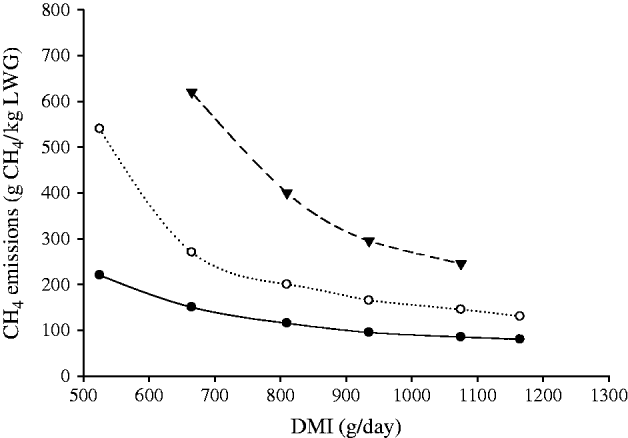
The volume of CH4 produced during digestion depends on intake levels, diet composition and the rate and extent of digestion by microflora (Weiske Reference Weiske2005; PGgRc 2007). Typically, forages of high fibre or low digestibility that have a long residence time in the rumen will tend to produce high levels of CH4 (PGgRc 2007). Models suggest that as sheep DMI increases LW gain (LWG) and daily CH4 also increase, the overall result of which is a decrease in CH4 production per kg LWG (Fig. 2) (Hegarty et al. Reference Hegarty, Alcock, Robinson, Goopy and Vercoe2010). As diet digestibility increases, CH4/kg LWG decreases because of an underlying increase in LWG (Fig. 2) (Hegarty et al. Reference Hegarty, Alcock, Robinson, Goopy and Vercoe2010).
The modelled relationship between DMI and CH4 production per kg of LWG at three different levels of diet digestibility (▼65%, ○75%, ●85%) for a 30 kg Border Leicester × Merino wether offered ad libitum access to roughage (adapted from Hegarty et al. Reference Hegarty, Alcock, Robinson, Goopy and Vercoe2010).
Increasing feed intake and digestibility can be achieved through replacing structural carbohydrates (cellulose and hemicelluloses) in the diet with non-structural carbohydrates (starch and sugars) (O'Mara et al. Reference O'mara, Beauchemin, Kreuzer, Mcallister, Rowlinson, Steele and Nefzaoui2008), or through altering forage type. Feeding higher starch, such as grain-based diets, not only increases diet digestibility and feed intake but also favours propionate production in the rumen providing an alternative pathway to methanogenesis for hydrogen use (Eckard et al. Reference Eckard, Grainger and de Klein2010; Martin et al. Reference Martin, Morgavi and Doreau2010). Benchaar et al. (Reference Benchaar, Pomar and Chiquette2001) estimated that increasing the proportion of concentrates in the diet from 0 to 0·20 would reduce CH4 production in ruminants as a proportion of gross energy intake (GEI) by 3%. However, in a meta-analysis of 87 studies, Sauvant & Giger-Reverdin (Reference Sauvant, Giger-Reverdin, Ortigues-Marty, Miraux and Brand-Williams2007) found CH4 losses as a proportion of GEI to be relatively constant for diets containing 0·30–0·40 concentrate, suggesting higher proportions of concentrates are needed to gain any mitigation benefit. Dragosits et al. (Reference Dragosits, Chadwick, Del Prado, Scholefield, Mills, Crompton, Newbold, Crighton and Audsley2008) suggested that feeding a high starch diet nationally to sheep flocks would only reduce CH4 emissions by 1%. Production emissions associated with the grain and the baseline productivity and emissions of the farming system will determine the net GHG impacts of increasing the quantity of grain fed. The applicability of feeding high-concentrates diets is restricted to more intensive production systems.
In other research areas, the breeding of grasses and legumes with high water-soluble carbohydrate (WSC) content may potentially reduce direct CH4 emissions from both intensive and extensive farming systems. For instance, IBERS (2010) found that lambs reared on a mix of three high WSC grasses produced up to 25% less CH4/kg LWG compared with the control diet of conventional (normal WSC) grass. This was possibly due to increased ruminal bacterial numbers in lambs on the high WSC diet, leading to greater capture of metabolic hydrogen and reducing availability for methanogenic archaea. Other forage-based options include grazing animals on less mature herbages (Deighton et al. Reference Deighton, Wims, O'loughlin, Lewis and O'donovan2010) and feeding ensiled forages (Lima et al. Reference Lima, Díaz, Castro and Fievez2011). Results from studies investigating the emission reduction benefits of feeding or grazing leguminous forages and pastures have been inconclusive. It is thought that legumes have a faster rate of ruminal breakdown than grasses and consequently a higher voluntary intake, lowering CH4 yields/kg of DMI (Rochon et al. Reference Rochon, Doyle, Greef, Hopkins, Molle, Sitzia, Scholefield and Smith2004; Hammond et al. Reference Hammond, Hoskin, Burke, Waghorn, Koolaard and Muetzel2011). Waghorn et al. (Reference Waghorn, Tavendale and Woodfield2002) found significant promise for mitigating emissions through changing forage type with a doubling of CH4 emissions/kg DMI over a range of fresh forage diets, ranging from 11·5 g CH4/kg on a ryegrass and white clover pasture to 25·7 g CH4/kg on a diet of lotus forage. Knight et al. (Reference Knight, Molano, Nichols and Clark2007) also found significant differences in CH4 yield/kg DMI through varying legume species and proportion in the diet. In contrast, two separate feeding trials concluded that CH4 yield is not influenced by forage species or maturity and that ‘there are no simple relationships between chemical components of fresh forages and CH4 yield’ (Hammond et al. Reference Hammond, Hoskin, Burke, Waghorn, Koolaard and Muetzel2011; Sun et al. Reference Sun, Hoskin, Zhang, Molano, Muetzel, Pinares-Patiño, Clark and Pacheco2012).
Nitrogen conversion efficiency
Low efficiency of dietary nitrogen use in ruminants and subsequent high urea nitrogen losses are primarily attributed to imbalances in dietary protein and energy (non-structural carbohydrates), and feeding regimes that contain nitrogen in excess of dietary requirements (O'Hara et al. Reference O'hara, Freney and Ulyatt2003; Moorby et al. Reference Moorby, Chadwick, Scholefield, Chambers and Williams2007; Prosser et al. Reference Prosser, Bowes, Thomas, Stebbings, Skates, Leroux, Williams, Bevan and Davies2008). Decreasing the quantity of nitrogen excreted would be expected to reduce N2O losses, both directly from soils and indirectly when leached nitrate is converted to N2O in water bodies or when volatilized ammonia is deposited on the land.
Increasing the efficiency of nutrient use entails correctly formulating animal diets, matching feed provision more closely to animal nutrient requirement, which requires characterization of feed composition and nutritional advice (Moorby et al. Reference Moorby, Chadwick, Scholefield, Chambers and Williams2007; Prosser et al. Reference Prosser, Bowes, Thomas, Stebbings, Skates, Leroux, Williams, Bevan and Davies2008). This can be achieved by avoiding excess nitrogen diets and by increasing the proportion of dietary nitrogen utilized through feeding a diet balanced in energy and protein. Pastures and fresh forages typically contain high levels of protein, in excess of available energy, resulting in the excretion of ammonia (Abberton et al. Reference Abberton, Marshall, Humphreys, Macduff, Rowlinson, Steele and Nefzaoui2008; Eckard et al. Reference Eckard, Grainger and de Klein2010; Luo et al. Reference Luo, de Klein, Ledgard and Saggar2010). Lowering the crude protein content of the diet is known to reduce dietary nitrogen losses (Schils et al. Reference Schils, Eriksen, Ledgard, Vellinga, Kuikman, Luo, Petersen and Velthof2011), although careful management is required to ensure maintenance of yield (Nielsen et al. Reference Nielsen, Kristensen, Nørgaard and Hansen2003). For example, Seip et al. (Reference Seip, Breves, Isselstein and Abel2011) showed that supplementing grass and legume silage of adult sheep with barley reduced urinary nitrogen excretion in an unfertilized grassland system. Numerous examples exist of the efficacy of this strategy in dairy systems (Luo et al. Reference Luo, de Klein, Ledgard and Saggar2010; Schils et al. Reference Schils, Eriksen, Ledgard, Vellinga, Kuikman, Luo, Petersen and Velthof2011). Increasing the carbohydrate content of the diet is the alternative option for balancing energy and protein, e.g. balancing high protein forages with high energy supplements (O'Hara et al. Reference O'hara, Freney and Ulyatt2003; Eckard et al. Reference Eckard, Grainger and de Klein2010) or through feeding high WSC grasses (Merry et al. Reference Merry, Lee, Davies, Dewhurst, Moorby, Scollan and Theodorou2006). Feeding trials have shown that high WSC grasses can reduce nitrogen excretion by up to 24% whilst also increasing DMI and improving LWG (IGER 2005).
Feed additives and ruminal manipulation
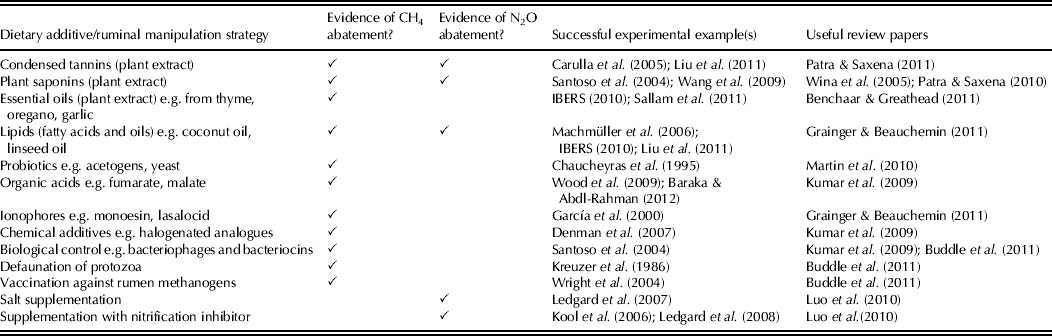
Many studies have tested the effects of a range of dietary additives and alternative methods of rumen manipulation on enteric CH4 and dietary nitrogen losses (Table 2). The rumen-based CH4 mitigation strategies listed in Table 2 have several different modes of action. Feed additives such as condensed tannins and bacteriocins directly inhibit methanogenesis (Kreuzer et al. Reference Kreuzer, Kirchgessner and Müller1986; O'Mara et al. Reference O'mara, Beauchemin, Kreuzer, Mcallister, Rowlinson, Steele and Nefzaoui2008). Others, such as organic acids and probiotics, provide an alternative sink or pathway for H2 use in the rumen, displacing CH4 production (O'Mara et al. Reference O'mara, Beauchemin, Kreuzer, Mcallister, Rowlinson, Steele and Nefzaoui2008; Martin et al. Reference Martin, Morgavi and Doreau2010); while plant saponins and ionophores eliminate rumen protozoa that are thought to have a symbiotic relationship with some methanogenic archaea (Kreuzer et al. Reference Kreuzer, Kirchgessner and Müller1986; Kumar et al. Reference Kumar, Puniya, Puniya, Dagar, Sirohi, Singh and Griffith2009; Eckard et al. Reference Eckard, Grainger and de Klein2010). A number of the strategies act to reduce emissions in multiple ways. For example, ionophores are known to improve feed conversion efficiency (Grainger & Beauchemin Reference Grainger and Beauchemin2011). Fat supplementation may reduce nitrogen losses and CH4 emissions concomitantly (Machmüller et al. Reference Machmüller, Ossowski and Kreuzer2006). Oil supplementation may improve digestibility and energy use efficiency (Klevenhusen et al. Reference Klevenhusen, Zeitz, Duval, Kreuzer and Soliva2011).
Dietary and ruminal manipulation strategies for emissions mitigation
Research interest appears to be focusing on the use of natural feed additives such as tannins, essential oils and lipids and on the novel approaches of vaccination and defaunation. Supplementation with lipids is one strategy at the forefront of dietary mitigation research. Martin et al. (Reference Martin, Morgavi and Doreau2010) recently reviewed the results of 67 dietary supplementation experiments from the literature, concluding that overall, for sheep and cattle combined, with every 1% addition of fat, mean CH4 emissions decreased by 3·8%. Martin et al. (Reference Martin, Morgavi and Doreau2010) also found that medium chain fatty acids (most frequently coconut oil) showed the greatest mitigation potential. In a similar study, a meta-analysis of studies limiting supplementation within the practical range of feeding, Grainger & Beauchemin (Reference Grainger and Beauchemin2011) found a slightly greater decrease in cattle CH4 emissions/g of fat added to the diet. In contrast to Martin et al. (Reference Martin, Morgavi and Doreau2010), Grainger & Beauchemin (Reference Grainger and Beauchemin2011) found that fatty acid type had no effect on CH4 yield. Nor did the form of fat added (oil v. oilseed) or fat source (e.g. coconut v. sunflower). Grainger & Beauchemin (Reference Grainger and Beauchemin2011) suggested that their results were more robust than those of Martin et al. (Reference Martin, Morgavi and Doreau2010) because they were based on a covariance analysis of CH4 yield data as opposed to average data, and also because the dataset used by Grainger & Beauchemin (Reference Grainger and Beauchemin2011) was restricted to practical dietary fat levels. Grainger & Beauchemin (Reference Grainger and Beauchemin2011) also highlighted a significant difference in the relationship between dietary fat and CH4 yield among beef, dairy and sheep, finding that more data are needed to give an accurate assessment of the effect of fat supplementation in sheep. In a recent study in Wales, IBERS (2010) measured CH4 production and nitrogen retention in store lambs fed diets supplemented with linseed oil or a novel high fat naked oat. Linseed oil supplementation reduced CH4 emissions by 22% and the naked oats by 33% compared with the control diet. Neither supplements affected nitrogen retention significantly.
Lipid supplementation research highlights the uncertainties that persist in the application of many dietary mitigation strategies, e.g. optimal lipid source, dosage level, dependence on diet type, transfer to animal products and possible human health impacts and limited sheep specific data (Hook et al. Reference Hook, Wright and Mcbride2010; Martin et al. Reference Martin, Morgavi and Doreau2010). Despite these uncertainties, implementation is beginning to be considered including using drinking water to administer supplements in extensive grazing systems and the identification of high fatty acid content grasses (Grainger & Beauchemin Reference Grainger and Beauchemin2011).
SOIL AND PASTURE MANAGEMENT
Soil and pasture-based mitigation options aim to limit direct and indirect N2O emissions. Nitrogen enters the soil through animal excretion in the field, manure and fertilizer application, crop residues, fixation by leguminous crops and atmospheric deposition (Schils et al. Reference Schils, Eriksen, Ledgard, Vellinga, Kuikman, Luo, Petersen and Velthof2011). Losses from the system can occur directly as gas (dinitrogen (N2) or N2O) or indirectly through leaching (nitrate (NO3−); dissolved organic N), runoff (NO3− and ammonium (NH4+)) or volatilization (ammonia (NH3)). Skiba et al. (Reference Skiba, Sheppard, Macdonald and Fowler1998) estimated that 0·017 of the nitrogen input from mineral fertilizer and animal excreta applied to a sheep-grazed pasture in Scotland, was emitted as N2O.
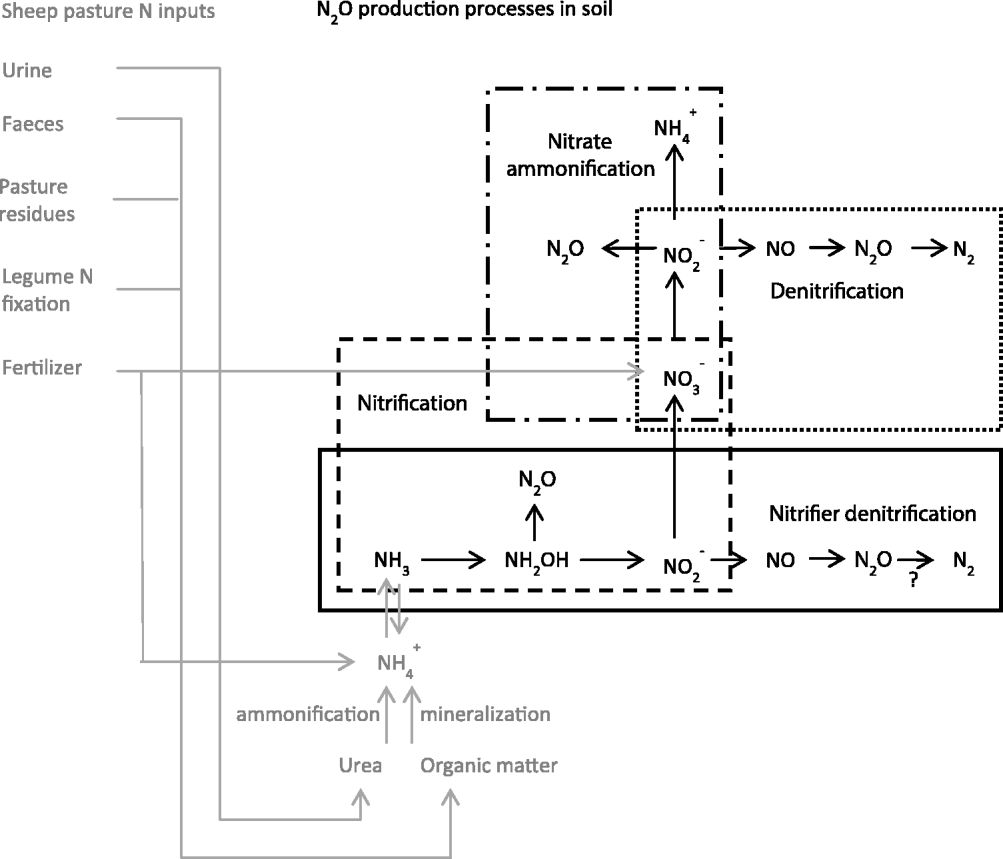
There are multiple pathways through which N2O is produced in soils (Fig. 3), not all of which have been fully characterized. Denitrification (the anaerobic reduction of NO3− or nitrite (NO2−) to N2) is thought to be the primary source of N2O in soils. However, nitrification (the oxidation of ammonia (NH3) →NO2−) is now known to be a significant source of N2O in some situations (Baggs & Philippot Reference Baggs, Philippot and Smith2010). The importance of other N2O production pathways such as nitrifier denitrification and aerobic denitrification are also now being recognized (Wrage et al. Reference Wrage, Velthof, Van Beusichem and Oenema2001; Baggs & Philippot Reference Baggs, Philippot and Smith2010). Soil conditions regulate the activity and relative importance of microbial pathways. Understanding the conditions favoured by each is crucial when targeting mitigation strategies to ensure net N2O reductions (Richardson et al. Reference Richardson, Felgate, Watmough, Thomson and Baggs2009; Baggs & Philippot Reference Baggs, Philippot and Smith2010).
Soil microbial pathways of N2O production within sheep pasture systems (adapted from Baggs Reference Baggs2008).
Soil moisture
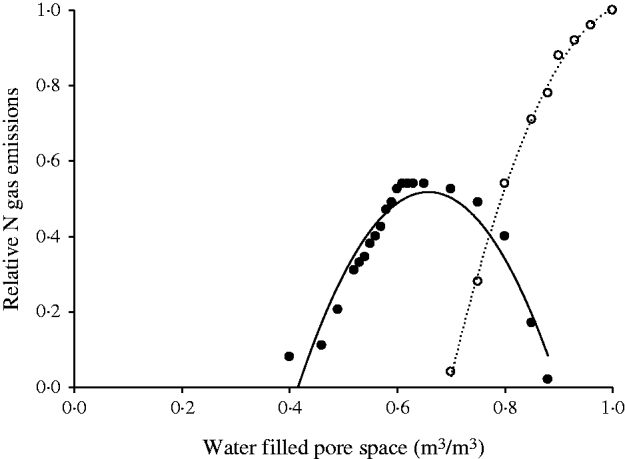
Several studies have demonstrated that N2O emissions and overall nitrogen losses are accentuated in high moisture conditions. For example, Chambers et al. (Reference Chambers, Smith and Pain2000) showed that NO3− leaching from the application of organic manure to grassland sites was greatest when applied in the autumn and winter. Cardenas et al. (Reference Cardenas, Thorman, Ashlee, Butler, Chadwick, Chambers, Cuttle, Donovan, Kingston, Lane, Dhanoa and Scholefield2010) reported far higher N2O emissions from fertilized grazed grasslands in the West of the UK compared with the East, which they attributed to the wetter conditions in the West. Frequently, N2O emissions positively correlate with soil water-filled pore space (WFPS), with maximum emissions occurring at 0·60–80 m3 water/m3 pore space (Fig. 4) (Clayton et al. Reference Clayton, Mctaggart, Parker, Swan and Smith1997; Jones et al. Reference Jones, Rees, Skiba and Ball2007; Rafique et al. Reference Rafique, Hennessy and Kiely2011). In poorly aerated soils (WFPS >0·60 m3/m3) denitrification becomes dominant, and >0·80 m3/m3 N2 becomes the dominant product of denitrification (Dalal et al. Reference Dalal, Wang, Robertson and Parton2003). Flechard et al. (Reference Flechard, Ambus, Skiba, Rees, Hensen, Van Amstel, van den Pol-van Dasselaar, Soussana, Jones, Clifton-Brown, Raschi, Horvath, Neftel, Jocher, Ammann, Leifeld, Fuhrer, Calanca, Thalman, Pilegaard, Di Marco, Campbell, Nemitz, Hargreaves, Levy, Ball, Jones, Van De Bulk, Groot, Blom, Domingues, Kasper, Allard, Ceschia, Cellier, Laville, Henault, Bizouard, Abdalla, Williams, Baronti, Berretti and Grosz2007) found that N2O emission factors from European grassland sites were highest for soils where WFPS mostly remained in what they called the ‘optimum range for N2O emissions of 60–90%’.
Relationship between WFPS in soil and the relative fluxes of N2O (●) and N2 (○) from both nitrification and denitrification within sheep pasture systems (adapted from Dalal et al. Reference Dalal, Wang, Robertson and Parton2003).
Water table management
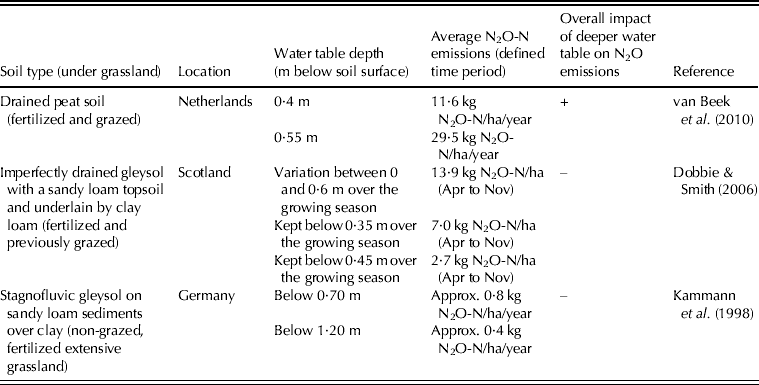
In many northern European countries, water table manipulation through soil drainage presents a practical option for controlling WFPS in sheep-grazed grasslands (Dobbie & Smith Reference Dobbie and Smith2006). A small number of studies have investigated the relationship between water table level and N2O emissions in the field (Table 3). Dobbie & Smith (Reference Dobbie and Smith2006) and Kammann et al. (Reference Kammann, Grünhage, Müller, Jacobi and Jäger1998) demonstrated a significant decrease in N2O emissions as water table depth below the soil surface increased. As the water table falls, WFPS and soil moisture decrease, leading to an increase in aeration in the upper soil, which in turn reduces the presence of anaerobic zones for denitrification and enhances root growth leading to better fertilizer N use efficiency. Dobbie & Smith (Reference Dobbie and Smith2006) concluded that draining grasslands to keep the water table more than 0.35 m below the surface when nitrogen is available for denitrification could cut N2O emissions by 50% during the growing season. However, mitigation through water table management is complex (Fig. 4). If for example, soil is drained below saturation but WFPS remains above 0·40 m3/m3, N2O emissions could potentially increase (Eckard et al. Reference Eckard, Grainger and de Klein2010). The WFPS values at which nitrification and denitrification dominate N2O production are site- and soil-specific (Müller & Sherlock Reference Müller and Sherlock2004). Although drainage can effectively reduce CH4 and N2O emissions from mineral soils, the case for GHG is more complicated for organic (peat) soils. Draining peat soils may reduce CH4 and N2O; however, this can be negatively offset by increased CO2 emissions as the increased oxygenation stimulates aerobic mineralization of soil organic matter (e.g. van Beek et al. Reference Van Beek, Pleijter, Jacobs, Velthof, Van Groenigen and Kuikman2010; Table 3). The overall GHG balance of improved drainage is also uncertain due to the increased potential for nitrate leaching (and increased indirect N2O emissions) (Smith et al. Reference Smith, Martino, Cai, Gwary, Janzen, Kumar, Mccarl, Ogle, O'mara, Rice, Scholes, Sirotenko, Howden, Mcallister, Pan, Romanenkov, Schneider, Towprayoon, Wattenbach and Smith2008; Eckard et al. Reference Eckard, Grainger and de Klein2010).
The influence of water table depth on N2O emissions from grassland soils in Western Europe
Soil compaction
The deposition of excreta on waterlogged soils increases nitrogen supply for denitrification and subsequent emissions may be exacerbated by soil compaction through animal trafficking. The likelihood and severity of compaction increases at elevated soil moisture content creating anaerobic sites in the soil (Rafique et al. Reference Rafique, Hennessy and Kiely2011). In separate field experiments, Sitaula et al. (Reference Sitaula, Hansen, Sitaula and Bakken2000), Van Groenigen et al. (Reference Van Groenigen, Velthof, Van Der Bolt, Vos and Kuikman2005) and Bhandral et al. (Reference Bhandral, Saggar, Bolan and Hedley2007) demonstrated that soil compaction increased average N2O emissions from agricultural soils receiving urine and/or fertilizer by a factor of 1·7, 2·2 and 7, respectively, compared with no compaction. On an intra-farm scale, Matthews et al. (Reference Matthews, Chadwick, Retter, Blackwell and Yamulki2010) showed that poached land surrounding water troughs on beef and sheep farms can have significantly higher N2O emissions rates than surrounding managed pasture. Information on the impact of sheep grazing on soil compaction and subsequent N2O emissions is scarce (Saggar et al. Reference Saggar, Hedley, Giltrap and Lambie2007). While the hoof pressures of sheep are lower than those of cows (83 kPa compared with 192 kPa), there is evidence that infiltration in soil decreases with increased sheep-stocking rate (Willatt & Pullar Reference Willatt and Pullar1984). Decreased infiltration indicates that soil is compacted. Betteridge et al. (Reference Betteridge, Mackay, Shepherd, Barker, Budding, Devantier and Costall1999) found that the effect of a severe short-term treading event on wet hill soils was greater for cattle than sheep stocked at the same metabolic LW/ha, but they also indicated that at soil water contents above the critical water content for compaction the ratio of soil compaction to deformation may be greater for sheep than for cattle. Many opportunities to reduce soil compaction on pastures are already well established as best practice for limiting poaching, water pollution and safeguarding animal welfare when out-wintering stock. These include sale of barren ewes to reduce stocking rates in winter, and the use of electric fences to control access to forage crops and boggy areas.
There has been little follow-through research on the impact of these measures on N2O emissions. Restricted grazing on wet pastures (e.g. through housing animals) may reduce N2O emissions provided that collected excreta is spread uniformly (Hopkins & Lobley Reference Hopkins and Lobley2009). The extent to which this mitigation measure is relevant to sheep farms will depend on the stocking rate and current winter housing and grazing practice. Schils et al. (Reference Schils, Verhagen, Aarts and Šebek2005) modeled the GHG budget of reducing grazing time on a case study dairy farm. Reduced N2O emissions from excreta were offset by an increase in CH4 emissions from manure storage, suggesting that restricted grazing may not offer mitigation potential at a whole farm level. Luo et al. (Reference Luo, de Klein, Ledgard and Saggar2010) suggested that for grazed winter forage crops, the method of tillage used to establish the crop will impact on the subsequent soil compaction by grazing animals and therefore N2O emission. Direct drilling to establish forage crops was suggested as a means of emissions reduction.
Reducing stocking rates also holds potential for emissions reduction. Howden et al. (Reference Howden, White and Bowman1996) found that CO2e emissions/ha grassland increased linearly with stocking rate at low to moderate stocking rates (from 2 to 8 or 9 ewes/ha), but remained constant at higher stocking rates from 10 to 14 ewes/ha, although the causality of this relationship was not explored. Rafique et al. (Reference Rafique, Hennessy and Kiely2011) found that intensively grazed grasslands produced N2O fluxes up to three times higher per hour than their extensive counterparts, which they attributed to greater urine and dung excretion and soil compaction on intensive sites.
Fertilizer and nutrient management
Soil moisture should also be taken into account when planning fertilizer applications. High WFPS, low oxygen conditions promote denitrification when carbon and NO3− supplies are non-limiting, indicating that fertilizer applications should be avoided in late autumn and winter and early spring. In conditions where denitrification predominates, such as during cool, wet months, N2O emissions may be lower from the application of a urea-based fertilizer than a NO3− -based fertilizer. Conversely, emissions may be expected to be higher from ammonium rather than NO3− -based fertilizers in drier soil conditions favouring nitrification (Eckard et al. Reference Eckard, Johnson and Chapman2006).
Other fertilizer management opportunities for emissions reduction limit the supply of nitrogen feedstock for N2O producing soil microbes. When fertilizer applications exceed pasture or forage requirements the nitrogen surplus can be immobilized, becoming part of the organic nitrogen pool or lost through the pathways previously defined. As nitrogen supply exceeds the requirements of the pasture the efficiency of use for growth declines (Eckard et al. Reference Eckard, Johnson and Chapman2006). Pasture derived emissions of N2O are positively correlated with nitrogen input (Jones et al. Reference Jones, Rees, Skiba and Ball2007; Cardenas et al. Reference Cardenas, Thorman, Ashlee, Butler, Chadwick, Chambers, Cuttle, Donovan, Kingston, Lane, Dhanoa and Scholefield2010; Rafique et al. Reference Rafique, Hennessy and Kiely2011). Adoption of a fertilizer recommendation system, which includes a soil and plant nutrient analysis, would ensure the optimization of nutrient supply (O'Hara et al. Reference O'hara, Freney and Ulyatt2003; Moorby et al. Reference Moorby, Chadwick, Scholefield, Chambers and Williams2007). This would also account for the nitrogen content of the soil and any applied manure (as many farmers fail to account for the nutrient content of organic manures when applying fertilizers; Jones et al. Reference Jones, Rees, Skiba and Ball2007). Proper maintenance and calibration of spreader equipment will improve targeting of nutrients to crop needs. Precision in fertilizer timing can also reduce nitrogen losses. These are simple approaches including ensuring application coincides with periods of rapid crop growth; minimizing delays between application and crop uptake and splitting applications into several smaller applications to improve efficiency of nitrogen uptake (Eckard et al. Reference Eckard, Johnson and Chapman2006; Jones et al. Reference Jones, Rees, Skiba and Ball2007).
Pasture renovation and plant selection
Temporary pastures on sheep farms are periodically ploughed and either reseeded to grass to improve sward productivity or planted with a forage crop. Pasture renovation has been associated with temporary, but significant, increases in soil N2O emissions (Davies et al. Reference Davies, Smith and Vinten2001; Estavillo et al. Reference Estavillo, Merino, Pinto, Yamulki, Gebauer, Sapek and Corré2002; Vellinga et al. Reference Vellinga, Van Den Pol-Van Dasselaar and Kuikman2004). Velthof et al. (Reference Velthof, Hoving, Dolfing, Smit, Kuikman and Oenema2010) found that renovation of intensively managed fertilized grasslands increased N2O emissions by an average of 1·8–3 times compared with non-reseeded control grasslands. Possible explanations include increased mineral nitrogen content of soil through the incorporation of crop residues, mineralization of N from soil organic matter and limited uptake of nitrogen by crops post-ploughing. Careful management of pasture ploughing (i.e. method and timing) may reduce emissions, although the number of studies supporting this is limited. Contrary to what might be expected, MacDonald et al. (Reference Macdonald, Rochette, Chantigny, Angers, Royer and Gasser2011) showed that full inversion tillage (FIT) reduced N2O emissions relative to soil NO3− levels by two or three times compared with a no-till/glyphosate (chemical fallow) regime on poorly drained grassland soils. They suggested that FIT may reduce N2O emissions in a wet year by placing the most nutrient-rich soil surface at depth where lower oxygen levels lead to the complete reduction of NO3− to N2. In the case of chemical fallow, carbon and nitrogen remain available close to the surface, where higher oxygen concentrations may hinder the full conversion of N2O to N2. Similarly Velthof et al. (Reference Velthof, Hoving, Dolfing, Smit, Kuikman and Oenema2010) reported lower N2O emissions from ploughed grassland than grassland renovated through chemical destruction of the sward, perhaps due to increased aeration of soils through ploughing. Grassland renovation in spring as opposed to autumn may reduce total nitrogen losses from soil because the new sward has a higher capacity to take up nitrogen during the growing season (Vellinga et al. Reference Vellinga, Van Den Pol-Van Dasselaar and Kuikman2004; Velthof et al. Reference Velthof, Hoving, Dolfing, Smit, Kuikman and Oenema2010). Davies et al. (Reference Davies, Smith and Vinten2001) have also suggested that avoiding grazing and fertilizer application on pastures prior to ploughing can reduce emissions, however, further work is needed to quantify the overall benefits of this.
Pasture renovation provides an opportunity to select plant varieties that may reduce nitrogen losses over the long term. Mixed pastures of legumes and grass typically fix between 100 and 250 kg/N/ha/year, reducing the need for mineral fertilizer use (Rochon et al. Reference Rochon, Doyle, Greef, Hopkins, Molle, Sitzia, Scholefield and Smith2004). In a life-cycle analysis model of lowland and upland sheep production systems in England, lamb production emissions from fertilized grasslands have been estimated to be 14·6 kg CO2e/kg of meat compared with 13·1 kg CO2e/kg produced from an unfertilized grass-clover sward (EBLEX 2009). However, some uncertainty relating to the mitigation potential of clover arises from the possibility that NO3− and dissolved organic nitrogen leaching may increase with the legume content of the sward and the level of nitrogen fixation (Rochon et al. Reference Rochon, Doyle, Greef, Hopkins, Molle, Sitzia, Scholefield and Smith2004). Possible explanations include low soil nitrogen immobilization and high mineralization due to the low carbon-to-nitrogen ratio of clover litter; and enhanced soil structure (Loiseau et al. Reference Loiseau, Carrère, Lafarge, Delpy and Dublanchet2001; Rochon et al. Reference Rochon, Doyle, Greef, Hopkins, Molle, Sitzia, Scholefield and Smith2004). Forage legumes also represent a small source of N2O, directly from the process of biological fixation, but primarily as a result of the release of root exudates in the growing season and the decomposition of crop residues post-harvest (Rochon et al. Reference Rochon, Doyle, Greef, Hopkins, Molle, Sitzia, Scholefield and Smith2004). Few studies have compared the overall nitrogen balance of grazed unfertilized grass–clover pastures with grazed fertilized pure grass pastures. In a review of available data, Ledgard et al. (Reference Ledgard, Schils, Eriksen and Luo2009) found total nitrogen leaching losses and N2O emissions from nitrogen cycling of excreta to be similar in both pasture types with comparable total nitrogen inputs. However, due to fertilizer-specific CO2 and N2O emissions (such as increased denitrification losses) whole system GHG emissions were typically lower per unit of produce in grass–clover systems. Research on the comparative nitrogen balance of pure legume pastures is more limited. There is some evidence that nitrogen leaching from pure white clover pasture may be considerably higher than grass–white clover pasture, possibly as a result of high nitrogen concentrations in the clover leading to greater nitrogen excretion, which the pasture is unable to take up (Loiseau et al. Reference Loiseau, Carrère, Lafarge, Delpy and Dublanchet2001).
Plant breeding to improve the efficiency of nitrogen use holds promise for future mitigation through pasture plant and forage crop selection. One area of current research interest is ryegrass breeding for improved fertilizer recovery (Abberton et al. Reference Abberton, Marshall, Humphreys, Macduff, Rowlinson, Steele and Nefzaoui2008). Some species hold interest for future breeding strategies because of features such as improved rooting depths that enable nitrogen uptake from deep in the soil profile; the production of natural NIs in the roots; and greater nitrogen immobilization in soil associated with the quality of the crop residues (Luo et al. Reference Luo, de Klein, Ledgard and Saggar2010; Schils et al. Reference Schils, Eriksen, Ledgard, Vellinga, Kuikman, Luo, Petersen and Velthof2011). Richardson et al. (Reference Richardson, Felgate, Watmough, Thomson and Baggs2009) suggested that plant breeding to control exudates to the soil could be a means of manipulating denitrification to increase the ratio of N2 to N2O production. Although these rhizosphere strategies involving manipulation of the soil microbial community hold strong promise it is likely that this technology will not be readily transferable between soil types making its widespread adoption difficult.
Additions to soil
Nitrification inhibitors, urease inhibitors (UIs) and slow-release fertilizers influence the rate at which fertilizer or urine nitrogen is supplied to plants (Shaviv & Mikkelsen Reference Shaviv and Mikkelsen1993). They provide a steadier supply of nutrients to pasture and forage crops and minimize losses of excess nutrients. Slow release fertilizers such as those coated to reduce solubility have been shown to reduce losses of applied nitrogen, avoiding large fluxes of N2O after rainfall (following a fertilizer application), whilst maintaining yields (Ball et al. Reference Ball, Mctaggart and Scott2004). Despite confidence in their mitigation potential the cost of slow release fertilizers in terms of substitution for a conventional fertilizer and in terms of the cost per tonne of carbon abated is currently prohibitive (Ball et al. Reference Ball, Mctaggart and Scott2004; Moran et al. Reference Moran, Macleod, Wall, Eory, Pajot, Matthews, Mcvittie, Barnes, Rees, Moxey, Williams and Smith2008). Although outreach programmes are increasing farmer awareness of GHG issues, overcoming the barriers to technology adoption will remain difficult without farm subsidies.
Nitrification inhibitors and/or UIs can be applied directly to the crop (e.g. as a spray), incorporated into fertilizers or even infused into the gastrointestinal tract of livestock for excretion onto pasture (Ledgard et al. Reference Ledgard, Menneer, Dexter, Kear, Lindsey, Peters and Pacheco2008). Nitrification inhibitors reduce the rate of conversion of NH4 to NO3− in the soil (Di et al. Reference Di, Cameron and Sherlock2007), releasing NO3− at a rate which better matches crop uptake. Urease inhibitors slow the conversion of urea to NH4+, reducing the potential for NH3 volatilization (Watson & Akhonzada Reference Watson and Akhonzada2005). Numerous studies have demonstrated the efficacy of NIs (Di et al. Reference Di, Cameron and Sherlock2007; Hoogendoorn et al. Reference Hoogendoorn, de Klein, Rutherford, Letica and Devantier2008; Ledgard et al. Reference Ledgard, Menneer, Dexter, Kear, Lindsey, Peters and Pacheco2008) and UIs (Watson & Akhonzada Reference Watson and Akhonzada2005; Dawar et al. Reference Dawar, Zaman, Rowarth, Blennerhassett and Turnbull2011) in reducing nitrogen losses from pastures and forage crops receiving urine and/or urea. A recent review of studies on the NI dicyandiamide (DCD) found that, when applied above the recommended minimum rate of 10 kg/ha, it reduced N2O emissions from urine by an average 57% (compared with controls receiving no DCD) (de Klein et al. Reference de Klein, Cameron, Di, Rys, Monaghan and Sherlock2011). However, emission reduction potential varies depending on site-specific factors such as soil type, soil moisture, urine nitrogen application rate and whether or not urea fertilizer is also applied (Luo et al. Reference Luo, de Klein, Ledgard and Saggar2010; de Klein et al. Reference de Klein, Cameron, Di, Rys, Monaghan and Sherlock2011).
Critical knowledge gaps remain for NIs, including their efficacy over the long-term and under non-ideal conditions (Suter et al. Reference Suter, Eckard and Edis2007). The validity of extrapolating data from small-scale experiments to whole farm potentials is also problematic (Suter et al. Reference Suter, Eckard and Edis2007). Most studies to date have been based in New Zealand; therefore efficacy under other climatic conditions is less certain. The UK, for example, has predominantly heavy texture soils and short growing seasons in comparison with the free draining soils and longer growing seasons in New Zealand (Moorby et al. Reference Moorby, Chadwick, Scholefield, Chambers and Williams2007). In contrast, one UI (n-butyl thiophosphoric triamide (NBTPT)) is already available commercially in the UK. When applied with urea to four contrasting soil types (two arable, two grasslands) it inhibited NH3 loss on average across all soils, temperatures and formulations by 61·2–79·8% (Watson & Akhonzada Reference Watson and Akhonzada2005).
The effect of biochar incorporation on soil nitrogen cycling is an emerging area of research. In addition to the primary objective of sequestering carbon, biochar incorporation in soil may also increase biological nitrogen fixation, reduce N2O emissions and NO3− leaching and increase nitrogen retention as NH3 and NH4+ (Clough & Condron Reference Clough and Condron2010). In the only field-based study to date on the effect of biochar incorporation on emissions from ruminant urine patches on pasture, Taghizadeh-Toosi et al. (Reference Taghizadeh-Toosi, Clough, Condron, Sherlock, Anderson and Craigie2011) incorporated biochar into a renovated perennial ryegrass pasture. The grass was fertilized with urea after emergence, cut to simulate grazing and received an application of urine. Biochar addition at a rate of 30 t/ha was found to reduce cumulative N2O emissions over a 65-day period by c. 50% compared with a urine-only treatment. This biochar treatment also had the lowest soil NO3− concentrations and the highest soil NH4+ concentrations. Taghizadeh-Toosi et al. (Reference Taghizadeh-Toosi, Clough, Condron, Sherlock, Anderson and Craigie2011) proposed that the biochar functioned as a sink for urinary NH3, reducing the inorganic nitrogen pool available to nitrifiers, therefore reducing N2O emissions and the subsequent formation of NO3−. Work on forage crops and grassland destined for silage has also indicated increased N use efficiency in the presence of biochar; however, the effects were not consistent over a 3-year period, suggesting that it does not offer a reliable strategy for GHG emission reduction (Jones et al. Reference Jones, Rousk, Edwards-Jones, Deluca and Murphy2012). In addition, the high production and transport cost of biochar, competition from other sectors for biochar feedstock (e.g. biomass energy), risks to humans and the environment from pollutants contained within the biochar (e.g. dioxins, PAHs), negative interactions with pesticides and current legislative barriers all limit its use in sheep-based agricultural systems (Jones et al. Reference Jones, Edwards-Jones and Murphy2011). Further work is certainly needed to understand the mechanisms through which biochar affects soil nitrogen cycling, the soil conditions, which favour these mechanisms and cost-effective strategies for implementation.
The addition of lime to soil has been suggested as a mitigation option with small potential for reducing N2O losses (Clark et al. 2001). The rates of both nitrification and denitrification are sensitive to soil pH (Dalal et al. Reference Dalal, Wang, Robertson and Parton2003; Kemmitt et al. Reference Kemmitt, Wright, Goulding and Jones2006). Bouwman et al. (Reference Bouwman, Boumans and Batjes2002) modelled the relationship between N2O emissions and controlling environmental and management factors such as climate, soil type and fertilizer type based on 846 published N2O emission measurements. Soil pH was a significant determinant of N2O emissions, which were lowest in alkaline conditions. Recent studies by Zaman & Nguyen (Reference Zaman and Nguyen2010) and Galbally et al. (Reference Galbally, Meyer, Wang, Smith and Weeks2010) found that liming pasture soils with and without the addition of urine or nitrate fertilizer has no significant effect on N2O emissions, demonstrating that understanding of the impacts of liming under different field conditions restricts its viability as an on-farm mitigation option at present. It must also be remembered that lime itself has a high intrinsic GHG cost associated with production, transport and its subsequent decarbonation in soil (Brock et al. Reference Brock, Madden, Schwenke and Herridge2012). As with any GHG intervention, it is therefore important that a full life-cycle assessment (LCA) is performed to evaluate the net GHG balance of the mitigation strategy in a truly holistic sense before blanket policy recommendations are made.
CURRENT AND FUTURE MITIGATION OPTIONS
The present review has highlighted the current research and development status of mitigation options applicable to sheep farms. A number of interventions have emerged, which are available for current application, which have broad agreement on their mitigation potential and are likely to be widely applicable across sheep farms. These are: increasing lambing percentages, lamb survival and ewe longevity; increasing diet digestibility and formulating diets to minimize nitrogen excretion; avoiding exceeding pasture and forage crop nitrogen requirements particular in wet conditions. Other more novel interventions are also becoming commercially available such as high WSC grasses, a UI and lipid supplemented feed (currently only available for dairy cows).
Many more interventions require significant research and development before deployment or need technological enhancement or farm payment subsidies to become cost-effective. Long-term field trials under a range of conditions are clearly needed for interventions such as dietary additives and NIs. An assessment of net impact on all GHGs is required for interventions such as the inclusion of legumes in pasture and faster growth rates in lambs. Furthering understanding of underlying biological processes will enable exploitation of the mitigation potential of interventions such as pasture drainage and vaccination against rumen methanogenesis. Research into the efficacy of interventions such as the incorporation of biochar and breeding for lower RFI is at an early stage and longer term trials are required urgently.
DEVELOPING A MITIGATION STRATEGY
Distilling the long list of mitigation options to produce a farm-specific shortlist is challenging. Mitigation strategies must be developed based on a whole farm approach to GHG accounting, i.e. ensuring all CO2, N2O and CH4 fluxes and the effect of mitigation measures on interactions between fluxes are accounted for (Schils et al. Reference Schils, Verhagen, Aarts and Šebek2005, Reference Schils, Olesen, Del Prado and Soussana2007; Smith et al. Reference Smith, Martino, Cai, Gwary, Janzen, Kumar, Mccarl, Ogle, O'mara, Rice, Scholes, Sirotenko, Howden, Mcallister, Pan, Romanenkov, Schneider, Towprayoon, Wattenbach and Smith2008; Stewart et al. Reference Stewart, Little, Ominski, Wittenberg and Janzen2009; Eckard et al. Reference Eckard, Grainger and de Klein2010). Often only the most evident of interactions are accounted for (Schils et al. Reference Schils, Verhagen, Aarts and Šebek2005) and in reality the full effect of numerous mitigation practices on the GHG budget are still to be explored. The GHG balance of buying in additional concentrates to creep-feed lambs for faster growth is one example of this.
Another crucial consideration is that mitigation strategies must be constructed using additive measures that act upon different elements of the production system. Putting together complimentary sets of interventions is challenging given that the effectiveness of an abatement measure may be diminished depending on the measures applied before or after it. A very limited number of studies touch upon interactions between interventions.
In any farm system, abatement potential is contingent on current baseline emissions and the extent to which good practice, such as optimal fertilizer management, have already been adopted. Lambing replacements at a younger age has been shown to be an effective mitigation option in self-replacing flocks. However, in flocks where replacements are purchased, lambing earlier can decrease lambing percentages and growth rates and subsequently increase emissions. This example affirms that the effect of any intervention is highly dependent on the baseline flock management scenario. Many interventions such as pasture drainage and selection of fertilizer form cannot be recommended at a regional or national scale because their mitigation potential is inextricably linked to soil and weather conditions in the locality of use.
Other considerations when designing a mitigation strategy include ease of adoption, financial commitment and the permanence of the effect of the interventions (Smith et al. Reference Smith, Martino, Cai, Gwary, Janzen, Kumar, Mccarl, Ogle, O'mara, Rice, Scholes, Sirotenko, Howden, Mcallister, Pan, Romanenkov, Schneider, Towprayoon, Wattenbach and Smith2008), for example, the long-term efficacy of NIs is unknown. It has also been argued that the uncertainty surrounding the calculated abatement potential figure of a mitigation measure should itself be used as a selection criterion in mitigation strategies (Schils et al. Reference Schils, Verhagen, Aarts and Šebek2005).
A number of tools are now available which help with bringing together some of these selection criteria:
1. Whole-farm GHG models quantifying all direct, indirect, upstream and on-farm GHG emissions are a crucial tool for developing emissions baselines and exploring the abatement potential of farm-level mitigation options. As a result of increased model sensitivity at a farm level (e.g. estimation of enteric CH4 emissions based on diet composition), the GHG reduction potential of mitigation measures is continuously being refined.
2. Some emissions mitigation studies have refined their strategies by farm type and locality. For example MacLeod et al. (Reference Macleod, Moran, Mcvittie, Rees, Jones, Harris, Antony, Wall, Eory, Barnes, Topp, Ball, Hoad and Eory2010) assessed the applicability of a shortlist of mitigation measures to specific farm types, sizes and locations using a qualitative scoring system and found that, across all regions, mitigation measures were typically most applicable to larger farms. Sintori & Tsiboukas (Reference Sintori and Tsiboukas2010) grouped dairy farms through cluster analysis based on size, intensity and production orientation. This identified four farm types for which they were able to estimate the effects of varying levels of emissions reductions on the gross margin under optimal management. Applying this type of analysis to sheep farms will identify the mitigation options most suited to different production systems in different countries, for example, lowland, upland and hill farms in the UK.
3. Final selection and implementation of mitigation measures relies upon the incorporation of a financial component into whole farm models (Schils et al. Reference Schils, Verhagen, Aarts and Šebek2005, Reference Schils, Olesen, Del Prado and Soussana2007; Weiske Reference Weiske2005). Gibbons et al. (Reference Gibbons, Ramsden and Blake2006) used a whole-farm model that maximized farm net margin by optimizing the crop, animal and labour mix over a year, and linked this with emissions data to determine the most cost-effective measures for reducing farm emissions. Marginal abatement cost curves plot the relationship between the costs per tonne of carbon abated against the abatement potential for individual mitigation measures. They provide a decision-making tool for selecting cost and emissions saving measures, or for selecting options that reduce emissions below a selected cost threshold.
Applying these tools that have primarily been developed and adopted in relation to beef and dairy systems to sheep farms is a critical next step in sheep farm-specific GHG mitigation research.
CONCLUSIONS
Incorporation of the most promising mitigation options into sensitive and holistic farm models is needed to develop robust sheep farm GHG mitigation strategies. Refining the full set of mitigation options is a function of each individual measure's estimated abatement potential, whole system effects and interactions, deployment stage, ease of adoption and cost to the farm business. One significant hurdle to overcome is accounting for the effect of interactions between interventions on the overall carbon footprint. This will enable complimentary sets of interventions to be developed. Modelling mitigation potential against baseline emissions specific to farm typology will ensure that interventions with the maximum mitigation benefit in those conditions can be selected. Costed mitigation strategies tailored to sheep farm typology will be a critical stage in the translation of research-based advice to farm-level action, and in the realization of agricultural emissions targets.
This work was funded through a grant provided by EBLEX and Hybu Cig Cymru.