Introduction
Research on Alzheimer disease (AD) and other dementias usually requires each patient to have a study partner because of the progressive decline in cognition and function intrinsic to the disease (Lingler et al., Reference Lingler, Parker, KeKosky and Schulz2006). Typically, a study partner is a family member or close friend – often the research patient's primary informal caregiver – who is knowledgeable about and usually accompanies the patient to study visits. The role of study partner can vary based on the type of protocol (e.g. natural history study vs. drug study) and characteristics of the research participant (e.g. disease severity). While study partners are critical to conducting dementia research with cognitively impaired participants, we know little about their role, responsibilities, and experiences (Karlawish et al., Reference Karlawish, Cary, Rubright and Tenhave2008; Grill et al., Reference Grill, Monsell and Karlawish2012; Grill et al., Reference Grill, Raman, Ernstrom, Aisen and Karlawish2013).
Prior research has shown that study partners usually participate in the research enrollment decision (Karlawish et al., Reference Karlawish, Casarett, Klocinski and Sankar2001; Black et al., Reference Black, Wechler and Fogarty2013b; Dunn et al., Reference Dunn2013) and often respond to questionnaires for various outcome measures after enrollment (Schneider et al., Reference Schneider2006; Seeheer et al., Reference Seeheer2014; Grill et al., Reference Grill, Zhou, Karlawish and Elashoff2014), but little else is known empirically about how study partners are involved in the research process. In addition, there are no guidelines on what characteristics or qualities are desirable in study partners that enable them to fulfill their research responsibilities effectively, and empirical evidence is lacking on whether there are any challenges or burdens that caregivers face as study partners in dementia research. For example, are research demands on study partners adding to any existing caregiver burdens, which are known to be high generally in family caregivers of persons with dementia (Etters et al., Reference Etters, Goodall and Harrison2008)? A fuller understanding of how study partners contribute to dementia research could enable stakeholders (e.g. investigators, institutional review boards) to ensure that the interests of caregivers who serve in this role are addressed.
As a first step in a larger research agenda on the role of study partners, we conducted interviews with principal investigators (PIs), study coordinators, and research nurses who conduct dementia research to address this research question – How do researchers perceive the role, responsibilities, and experiences of study partners? Obtaining their views on these issues is important since investigators specify in their protocols the criteria for and responsibilities of study partners and coordinators or research nurses regularly interact with and may obtain data from study partners over the course of the participant's involvement in a study. The findings of this activity described below were used to shape and inform current data collection activities with study partners themselves.
Methods
Our approach to data collection and analyses is most closely aligned with focused ethnography, which is a distinctive type of sociological ethnography that focuses on small elements of one's own society and requires prior familiarity with the setting (Knoblauch, Reference Knoblauch2005). Qualitative data collection and analytic methods were used to explore and examine the views, attitudes, and opinions of researchers engaged in dementia research that requires the involvement of a study partner. Our goal is to present the research environment in which study partners are expected to serve. Our first step was to conduct in-depth interviews with researchers (i.e. PIs, study coordinators, research nurses) to orient ourselves to the research effort in which they are engaged. That is, we wanted to understand the more general view from the researchers’ perspective to frame the specific views of study partners – the next step of our research agenda. Interviews were conducted in two academic research settings. The Institutional Review Boards (IRBs) of the Johns Hopkins Medical Institutions and the University of Pennsylvania approved this research. Each participant provided written informed consent.
Eligible participants were identified by first seeking a convenience sample (Corbin and Strauss, Reference Corbin and Strauss2008) of actively enrolling dementia studies in which study partners are involved at each site. Studies in which any investigator on our project was involved were excluded. A total of 16 studies were identified. This sample reflected a range of studies that pose minimal to more than minimal risk to participants. Recruitment letters and consent forms for this study were sent first to the PI of each eligible study. One PI of the seven approached declined to participate. If the PI agreed to participate and have the study included in this project, he or she was asked for permission to recruit the study's coordinator(s) and research nurse(s). Three PIs agreed to have more than one of their studies included in this project for a total of 15 studies. No coordinator or research nurse declined to participate.
An in-person, semi-structured interview was conducted with each consenting researcher by one of two investigators (BB, HT). Interviews focused on the following topics from the researchers’ perspectives: (1) the role and responsibilities of study partners, (2) ideal characteristics or qualities of study partners, (3) challenges or burdens faced by study partners, (4) study partners’ motivations for participating in research, and (5) potential benefits that study partners may derive from research involvement. Each interview was audio recorded and took about 1 h. Participants completed a brief questionnaire on their demographic characteristics (e.g. gender, education) and research experience.
Data analyses
The recorded interviews were transcribed verbatim; transcripts were verified against the recordings, and corrections were made as needed. Each transcript was summarized to provide a brief (2–3 pages) outline of the salient points of the interview. Transcripts were then open coded and content analyzed (Patton, Reference Patton2002) by first segmenting and coding the text to facilitate further analysis. Coding was organized around key themes and sub-themes revealed in the data based on both domains that were introduced to respondents by the interview guide and those that were raised by participants. Codes were defined and applied to relevant text segments. Two study team members independently coded each transcript; coded text segments were compared for reliability; and discrepancies were discussed and resolved by consensus. Two investigators independently analyzed the coded text. Matrices displaying key findings by participant were used to identify patterns in the data and compare findings within and across participant categories (e.g. PIs vs. coordinators; Miles and Huberman, Reference Miles and Huberman1994). For example, data were examined to identify whether coded narrative output varied in content or tone by respondent. The investigators met to review their analyses, verify patterns in the data, and discuss implications of the findings. Member checks with participating researchers were used to confirm the credibility of our findings (Flick, Reference Flick2006). Data analysis was aided by Nvivo 9 (QSR International, Australia) qualitative computer software.
Results
Seventeen researchers participated in this study, including six PIs, seven study coordinators, and four research nurses. Two PIs and all coordinators and nurses were females. The PIs included four individuals with MD and two with PhD degrees. They had a median of 29.0 (range 10–53) years of research experience and had served as PIs on a median of 17.5 (range 8–25) research studies. Six of the seven study coordinators had college degrees, including four with bachelor degrees and two with master degrees. Among the four research nurses with other academic degrees, one had an associate degree and two had master degrees. The 11 coordinators and nurses had a median of 6.0 (range 2–30) years of research experience and had worked on a median of 5.5 (range 1–100) research studies. These researchers were working on 15 different dementia studies that were approved as sources for participants in this study. They included 12 clinical trials (nine testing drugs), two natural history studies, and one imaging study.
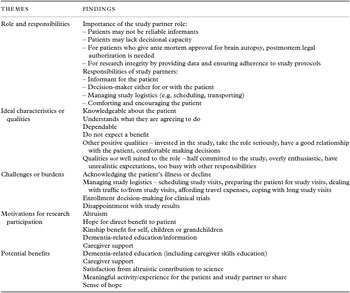
The following narrative covers key themes: (1) the role and responsibilities of study partners, (2) ideal characteristics or qualities of study partners, (3) challenges or burdens faced by study partners, (4) study partners’ motivations for research participation, and (5) potential benefits that study partners may derive from research involvement. Table 1 outlines these key themes and study findings.
Principal themes and findings from researchers’ perspectives on study partners
Role and responsibilities of study partners
Several participants (n = 8, mostly PIs) noted reasons why the role of study partner is important in dementia research. First, dementia research usually includes cognitively impaired individuals who may lack insight into their deficits and be unable to accurately report their illness history or observe clinical indicators, such as symptoms or changes in function or behavior, that are of interest to researchers. Second, because of their cognitive disorder, these individuals may lack or could lose decisional capacity during study participation. For that reason, researchers are legally required to have a surrogate decision maker available, usually the study partner, to provide proxy informed consent if needed. In addition, some dementia research (e.g. natural history studies) seeks the participant's antemortem approval for brain autopsy, which also requires postmortem legal authorization and cooperation of family members, again usually the study partner. Finally, for research integrity, study partners provide data on the patient and ensure the patient's adherence to study procedures. One PI emphasized, “We have no data without them;” and a research nurse described study partners as, “. . .the memory keepers.”
The role of study partner can include a range of responsibilities – some common to all studies, some unique to certain types of studies (e.g. clinical trials). All the researchers described the role of study partner as an informant for the patient. The information provided may include the patient's family and medical history (e.g. co-morbidities, medication use, presence of metal implants), responses to questionnaires and measures that help with diagnosing and quantifying disease severity, and validation of the participant's subjective reports.
A second key study partner responsibility identified by researchers (n = 11, mentioned most often by PIs) is that of a decision maker, either as a surrogate for subjects who lack decisional capacity or a participant in joint decision-making with those who are less cognitively impaired. After enrollment, a study partner may either make or help make decisions about whether the patient should participate in specific procedures (e.g. imaging studies, lumbar punctures), whether to switch from in-person to telephone visits for longitudinal studies, and whether to continue or withdraw from study participation.
A third major responsibility (n = 13, noted mostly by coordinators and nurses) is managing the logistics of study participation. They described a range of activities, including scheduling study visits to fit with a study's protocol and avoid conflicts with participants’ other commitments, transporting, and accompanying the patient to study visits, and ensuring compliance with study requirements. Complying with study protocols could involve ensuring that the patient fasts before a blood draw or takes study pills as prescribed. In clinical trials, study partners also monitor for and document any side effects or adverse events and any medical care delivered for those events.
A fourth responsibility (n = 5, mentioned mostly by PIs) is to comfort and encourage the patient during participation. Comfort may come in the form of simply being with the patient during enrollment and study visits, helping them to understand what they are doing and why, or encouraging the patient to remain involved in the study. For example, a PI noted, “. . .the study partner facilitates the patient's participation in the study by bringing the patient, guiding the patient, sitting with the patient, you know, comforting the patient if the procedure is not the most pleasant, encouraging, exhorting or making the patient do something that the patient may not want to do if the patient doesn't really understand as much anymore, so that's where sort of the proxy decision-making comes up.” In contrast, as one PI reported, a study partner could have a change of heart and begin discouraging the patient to the point of withdrawal from the study.
Several researchers (n = 5) stated that in their experience subject withdrawals are relatively uncommon. Of the withdrawals they could recall, researchers reported health-related issues and inconvenience as reasons patients/subject partners may withdraw. Health-related reasons for withdrawal reported by researchers included the patient experiencing adverse events, side effects of the study drug or medical instability (n = 5) or the patient's decline due to the progression of their dementia (n = 5). Researchers also reported inconvenience-related reasons for withdrawal such as adhering to the study protocol is too difficult or “too much of a hassle” for either the patient or study partner (n = 5). Captured in the following quote, a number of PIs (n = 3) mentioned that they believe failure to see positive results in the patient as an underlying motivation for the decision to withdraw.
“When you’re putting all that effort in and you’re not seeing anything beneficial, I think it's hard for some families. Those are probably the main ones, sort of fatigue over the study altogether if there's not this feeling of doing well, and usually I feel it's when people are actively declining. Now of course you never know if they would’ve been declining even more if they weren't taking the drug or if they’re [in the] placebo arm, but I think when you’re not getting any kind of positive feedback it's pretty hard to want to stay in a study. . ..”
Ideal characteristics and qualities of study partners
According to the respondents (n = 7), given the primary responsibility as informant, study partners must be knowledgeable about the patient in order to provide reliable information on the person's history and current status. Second, some researchers (n = 4) noted they would like study partners to understand what they are agreeing to when making the commitment to research involvement. A third important quality mentioned by respondents (n = 4) is being dependable – being available for study visits and adherent to a study's protocol. Fourth, some researchers (n = 3) noted that they prefer study partners who do not expect a benefit from the study and recognize its primary purpose is for advancement of knowledge. Other positive characteristics identified by fewer respondents included: that they be invested in the study and take their role seriously, have a good relationship with the patient, and are comfortable making decisions on the patient's behalf.
Some researchers (n = 3) also described characteristics of individuals who may not be well suited to the role of study partner. For example, investigators do not want “half committed” people to join a study and then drop out, and they are cautious regarding individuals who are “overly enthusiastic” about enrolling or have “unrealistic expectations” about a study's potential benefits. One PI expressed a concern about the attitude of some potential study partners by referring to a caregiver's comment:
“‘I’d like to do that study, but I don't want to be on the placebo.’ When people say things like that, it's a red flag that their goals are in some sense honorable that they want to take care of their spouse, but that they’re not necessarily in keeping with someone who we think would have likely good compliance with the study, and we have had people who say these kinds of things and they feel like their spouse is not really on the treatment and drop out of a study or get upset because why isn't this working. . ..”
In addition, respondents noted that some people are too busy or too committed to other responsibilities (e.g. work, family, their own health issues) to serve effectively as a study partner.
Challenges and burdens for study partners
According to our respondents (n = 6), acknowledging the patient's illness or decline as the illness progresses is the most common research-related challenge for study partners. This is particularly relevant to natural history studies that evaluate and follow subjects for years and clinical trials of longer duration that periodically assess the patient's status. It can occur simply by asking the study partner to describe their loved one's abilities or changes in memory. A related challenge noted by some coordinators and nurses (n = 3) is for the study partner to learn what is “not normal” for the patient and how to report this during study visits, as one nurse described:
“. . .with caregivers, they sometimes come to us, and they almost have to go through a learning process of how to respond to our questions, what we’re really asking them. And, the kind of things – they’ll come back after the second and third visit and say, ‘I never noticed that she did that before, but you told me, and so now I know.’ So, you’re really changing the way they observe things.”
Other challenges mentioned by researchers (n = 9) relevant to managing the logistics of study participation include scheduling study visits to fit the protocol, persuading and getting the patient ready for visits, dealing with traffic to and from study visits, affording travel expenses for people who live long distances from the study site, or coping with long and tiring study visits. A few researchers (n = 3) also noted that it is burdensome for some study partners to make the decision to enroll in a clinical trial or to experience disappointment if interventions do not work as hoped.
Finally, while aspects of research involvement can be challenging, coordinators, and nurses (n = 5) suggested that the burden of being a caregiver to a cognitively impaired loved one exceeds those experienced in the role of study partner. This is reflected by one nurse's comment:
“. . .the challenges with the study itself may be pretty straightforward, but it's the challenges of sort of daily living that are the ones that are really more present for them because it's something they’re experiencing every day.”
Study partners’ motivations for research involvement
Altruism – the desire to contribute to the advancement of science and as such to help people with dementia in the future – was reported by a majority of researchers (n = 11) as the primary reasons why they think study partners agree to participate in research. According to our respondents (n = 5), other study partners seem driven by hope that a study will directly benefit the patient, sometimes because, “They want a cure.” As one nurse described, some study partners seem motivated by both hope and altruism:
“. . .in most cases it's people who don't want to just sit and try what's there and are willing to and want to take that chance to look at something else with the hope of maybe it will help, maybe it won’t, maybe it will help somebody else. That's really the biggest thing.”
A related less common theme, mentioned by three researchers, is the study partners’ desire for a kinship benefit – hope that the study might someday benefit the study partner, their children or grandchildren who may be at risk for dementia.
Researchers (n = 4, mostly coordinators and nurses) believe that some study partners join research to obtain dementia-related education or information. For example, respondents report that some people want to know what is wrong with their loved one, if the person has not been diagnosed, and seek answers through studies that include evaluation procedures. Others, according to our respondents, seem to join research to obtain caregiver support from study team members or referral to relevant resources.
Potential benefits for study partners
In response to what, if anything, study partners derive from research involvement, the most common response from participants (n = 9) was dementia education – education in the form of general knowledge about dementia or specifically about the patient's cognitive disorder. A sub-theme of this was caregiver skills education, which some nurses and coordinators (n = 3) discussed and one research nurse described:
“. . .after they start the medication, you do the telephone call to find out how they’re doing, any side effects. She gave me all the information, but that's not the telephone call she wanted; she needed help. ‘How do I get him to bathe?’ And that's what I spent most of my time talking about was, you know, suggestions about taking a bath.”
Another related benefit to study partners mentioned by PIs, coordinators, and nurses (n = 7) is social or emotional support for the individual as a caregiver. This can occur by listening to their concerns, being available for caregiver questions by phone, referring them to other resources, or expressing concern about the study partner's own well-being by simply asking, “How are you doing?”
Several researchers (n = 8) suggested that study partners benefit by deriving satisfaction from their altruistic contribution to science. Other potential benefits that some individuals mentioned include providing a meaningful activity or experience for the patient and study partner to share and giving them a sense of hope.
Discussion
Researchers interviewed for this project believe that study partners facilitate research participation of their loved one by either making or helping to make research enrollment and post enrollment decisions, being a knowledgeable informant for the patient, managing the logistics required to enable the patient to comply with a study's protocol, and providing comfort and encouragement for the cognitively impaired person to remain in the study. While the tasks of decision-making, accompanying patients to study visits, and serving as their informants are known from prior research (Karlawish et al., Reference Karlawish, Casarett, Klocinski and Sankar2001; Black et al., Reference Black, Johnston, Rabins, Morrison, Lyketsos and Samus2013a; Grill et al., Reference Grill, Zhou, Karlawish and Elashoff2014), the researchers’ perspectives in this study shed new light on the logistical and supportive demands that dementia research may place on study partners.
This study also suggests that study partners may face practical challenges as they learn to be effective informants for data collection or emotional burdens as they help document or learn of assessment results showing the progression of their loved one's illness. However, researchers also believe that study partners may derive some benefits from serving in this role, including dementia education, social support, and satisfaction from their altruistic contribution to science. Our findings have implications for at least three stakeholder groups – investigators conducting dementia research, caregivers as potential study partners, and IRBs reviewing dementia research protocols.
Implications for investigators
Researchers’ views on ideal qualities of study partners go beyond the typical eligibility criteria listed in a study's protocol. In addition to being a reliable informant who understands and is dependable in carrying out study tasks, other attributes (e.g. being comfortable making decisions), attitudes (e.g. feeling invested in the study, not expecting a benefit, not overly enthusiastic), and intrinsic characteristics (e.g. having a good relationship with the patient) are also considered by researchers to be beneficial in the role of study partner. Taken together, these qualities could help investigators successfully carry out their research mission, enable the study partner to comfort and support the patient, and may help avoid some disappointment from unrealistic expectations about the benefits of research.
According to researchers, the challenges and burdens for study partners are both practical (e.g. managing study logistics, learning to be a good informant) and emotional (e.g. acknowledging the subject's decline, experiencing clinical trial disappointment), and in rare instances, coping with the consequences when a study patient experiences a physical set back (e.g. side effects of a study drug or adverse events). Researchers speculate that some of these challenges in combination may result in a study partner's decision to withdraw the patient from a study. However, as noted above, some qualities in study partners (e.g. not expecting a benefit, dedication to making a contribution to science) may enable them to avoid disappointment that could lead to study withdrawal. Our respondents suggest that research-related challenges faced by study partners may add to but are less burdensome than the responsibilities that these individuals may have as caregivers. Given that dementia-related caregiver needs – especially for resource referrals and education – often go unmet (Black et al., Reference Black, Johnston, Rabins, Morrison, Lyketsos and Samus2013a), study partners may need or expect relevant education and social support to enable their participation. Recognition of this by study team members should be a factor in leading them to provide some measure of dementia education and caregiver support during study participation if it is not included in a protocol. If there are reasons why caregiver education and support should not be provided, they should be justified in the protocol.
Furthermore, since the researchers interviewed for this study believe that the desire for dementia education and caregiver support are factors that both motivate participation and serve as potential benefits for study partners, investigators should consider whether their study team is adequately trained and prepared to provide this education and support. It is equally important to consider what role access to education and support play in the motivation of study partners to enroll with their loved one. It would be unfortunate to find that study partners feel enrollment is their only option to receive such services or they discount the risk of enrollment to the patient compared to the value they place on access to education and support.
Implications for study partners
Study partners have an array of responsibilities, ranging from tasks required for one annual visit in longitudinal studies to handling many details (e.g. scheduling appointments, transporting the patient, supervising pill-taking, monitoring for side effects) for a clinical trial involving regular study visits over many months. These findings on role responsibilities may begin to explain why the majority of study partners in clinical trials are spouses/partners (who are often retired), while the majority of caregivers are adult children of persons with dementia (Grill et al., Reference Grill, Monsell and Karlawish2012). Adult children, with perhaps employment and/or child care responsibilities, may be less able to manage the added load of clinical trial responsibilities. The role of study partner requires the commitment of time and energy and calls for organizational skills, the ability to cope with potentially stressful situations (e.g. traffic when commuting to study sites), and costs for travel to study visits. This type of information – tailored specifically to a study's protocol – can be used to orient individuals to what they can expect when serving as a study partner. This information should be included in the informed consent process to enable them to make an informed enrollment decision.
According to our respondents, study partners comfort and encourage the patient during a study. This is likely an emotion-laden task that may vary based on the patient's disease severity and presence of behavioral symptoms (e.g. anxiety, agitation), and how the patient reacts to experiencing potentially distressing procedures (e.g. cognitive testing, magnetic resonance imaging, lumbar punctures) or lengthy study visits. How well study partners are able to reassure, console, and help the patient understand what is happening and why may be critical to the patient's and study partner's willingness to complete a study. This too is important for study partners to know.
Implications for IRBs
IRBs reviewing research that involves cognitively impaired patients ought to assure that investigators have included the availability and engagement of a capable study partner as a component of the eligibility criteria. Given study partners’ key role and responsibilities, assuring they are available is essential to study success. In addition, IRBs ought to review whether investigators have considered how dementia research may require attention to details relevant to study partners, details that may not be routinely considered in clinical research. These include encouraging investigators to consider the education and support they can provide to caregivers who are serving as study partners. As Lingler and colleagues (Reference Lingler, Parker, KeKosky and Schulz2006) note, the complexity of AD clinical trials and the demands they place on study partners warrant explicit ethical consideration regardless of whether they are considered to be research participants. A related issue for IRBs to consider when reviewing a protocol is, whether and, if so, to what extent study partners should receive financial compensation given their responsibilities in the conduct of dementia research. IRBs should also assure that recruitment and consent materials detail study partners’ roles and responsibilities, including the logistical requirements as well as potential emotional burdens that participation may involve for study partners.
Limitations of this study include its small sample of researchers at only two academic research sites in the USA. Determining whether our findings are transferable to non-academic research sites and dementia research settings outside the USA requires further research. Given the impact of dementia worldwide, including low, middle, and high income countries (Prince et al., Reference Prince, Prina and Guerchet2013), we speculate that our results are relevant to the conduct of dementia research elsewhere. This study's qualitative approach is appropriate for a relatively unexamined topic that seeks to understand the subjective views of individuals and how they engage in complex processes. Each participant drew on years of experience engaged in dementia research involving study partners. However, researchers’ perspectives on issues such as the motivations, expectations, and challenges or burdens of study partners may not reflect the opinions of individuals who serve in that role. For example, do study partners expect to receive dementia education or caregiver support through their involvement in research as our respondents and others (Connell, et al., Reference Connell, Shaw, Holmes and Foster2001) suggest? Seeking the views of study partners involved in a range of dementia studies is needed to understand their perspectives, and we are presently gathering and analyzing data from them.
Researchers’ perspectives on the role of study partners may be limited in this study by a selection bias related to the characteristics of individuals who participate in dementia research. For example, minority ethnic groups and non-spousal caregivers are underrepresented in dementia drug trials (Cooper et al., Reference Cooper, Tandy, Balamurali and Livingston2010; Grill et al., Reference Grill, Raman, Ernstrom, Aisen and Karlawish2013). The inclusion of more diverse samples in dementia research could impact researchers’ views on their experiences with study partners. Identifying and addressing the interests of prospective study partners from diverse populations could be one approach to broadening recruitment and retention in dementia research.
The importance of a reliable, knowledgeable study partner for an adult is not unique to dementia research. For example, informants are relied on in research involving persons with schizophrenia and other severe mental illnesses (Bellack et al. Reference Bellack2007). Whether the role of study partner/informant in research on disorders such as schizophrenia differs from that of study partners for persons with dementia is a question for future research.
Conclusions
The role of study partner, critical to the dementia research process, can be complex, laden with hope and expectations, and can add to the study partner's responsibilities as a caregiver. Further research that examines the perceptions and experiences of study partners is required to determine whether their views are consistent with those of dementia researchers. Documenting their experiences will help determine whether other issues of concern to study partners should be addressed by investigators or IRBs.
Conflict of interest
This study was funded by a National Institute on Aging grant (AG038440).
Description of authors’ roles
Betty Black and Holly Taylor designed the study, participated in data collection and analysis, and wrote the paper. Peter Rabins and Jason Karlawish designed the study, assisted in identifying eligible dementia studies, and participated in writing the paper.
Acknowledgments
The authors wish to acknowledge and thank the researchers who volunteered to participate in this study and shared their views on the role of dementia research study partners.