Introduction
Paediatric patients with CHD are at an increased risk of thromboses for a multitude of reasons. Many patients with CHD have abnormal heart function or physical abnormalities leading to irregular blood flow. These patients also frequently require invasive procedures, including corrective surgeries, catheterization, or extracorporeal membrane oxygenation. Additionally, there are numerous pharmacokinetic and pharmacodynamic differences in paediatric patients compared to adults, including increased volume of distribution, and hemostasis differences put these patients at especially high risk for thrombotic events. Reference Silvey and Brandão1–Reference Yee, O’Brien and Young3 Differences in hemostasis are attributed to decreased levels of coagulation and anticoagulation factors, most notably anti-thrombin III, which does not reach adult levels until 6–12 months of age. Reference Yee, O’Brien and Young3,Reference Monagle, Chan and Goldenberg4
Enoxaparin, a low-molecular weight heparin, is a commonly utilized anticoagulant for the prophylaxis and treatment of thromboses, particularly in children. Reference Silvey and Brandão1,Reference Monagle and Newall5–Reference van and Luijnenburg7 Paediatric dosing of enoxaparin was initially extrapolated based on adult studies. The current American College of Chest Physicians (CHEST) guideline recommends initial enoxaparin dosing of 1.5 mg/kg/dose every 12 hours for infants <2 months of age, and 1 mg/kg/dose every 12 hours for children >2 months. Reference Giglia, Massicotte and Tweddell8 However, many recent studies highlight the need to initiate enoxaparin at higher doses, especially for neonates with CHD, due to differences in pharmacokinetics and pharmacodynamics. Reference Sanchez de Toledo, Gunawardena and Munoz9–Reference Schloemer, Abu-Sultaneh and Hanson18 Recent literature has shown that in addition to neonates, older infants may also require higher initial dosing of enoxaparin. Reference Monagle, Chan and Goldenberg4,Reference Giglia, Massicotte and Tweddell8–Reference Schloemer, Abu-Sultaneh and Hanson18 A 2021 retrospective review by Ankola and colleagues studied cardiac patients differentiated into the age groups of 0–3 months, 3–12 months, and >12 months. Reference Ankola, Ghbeis and Bailey10 They found an enoxaparin dose requirement of 2.1 mg/kg, 1.5 mg/kg, and 1.2 mg/kg (p < 0.02), respectively. Their study reinforces the idea that investigating additional age groups could be important for identifying the most appropriate starting doses for these populations. Optimized initial dosing could prevent a delay in obtaining therapeutic anticoagulation. The aim of this study is to determine the therapeutic dose requirements of enoxaparin necessary to reach therapeutic levels in patients ≤2 months, >2 to ≤6 months, >6 to ≤12 months, and >12 months old, and to determine whether an increased empiric dose in these age groups could be justifiable.
Materials and methods
This is a single-centre, retrospective review of enoxaparin dose requirements at Nemours Children’s Hospital, Delaware. The aim of this study is to describe the dose of enoxaparin required for therapeutic anticoagulation in children with congenital or acquired heart disease at our institution. This analysis included paediatric patients admitted to the cardiac ICU or cardiac stepdown unit between July 1st 2019 through June 30th 2024. Included patients received subcutaneous enoxaparin twice daily with a goal peak anti-Xa level of 0.5–1 IU/mL. Patients were excluded if they were born at less than 36 weeks’ gestational age, were 18 years of age or older, received renal replacement therapy, or used a ventricular assist device. Patients who did not achieve a therapeutic anti-Xa level were also excluded. We defined a therapeutic dose as two consecutive anti-Xa levels between 0.5 and 1 units/mL drawn within 3.5–6 hours after the last dose of enoxaparin was administered. Finally, serum creatinine was collected during enoxaparin treatment. To avoid confounding by patients with renal dysfunction or acute kidney injury, patients were excluded if their maximum serum creatinine exceeded two times their baseline creatinine at enoxaparin initiation.
Data collected for each enoxaparin treatment course included patient age, sex, weight, initial enoxaparin dose, indication for anticoagulation, and each patient’s therapeutic enoxaparin dose. Anti-Xa levels were collected until the patient was therapeutic for two consecutive checks. Appropriately collected anti-Xa levels were defined as being collected 3.5–6 hours after enoxaparin administration. This time frame was chosen to reflect national and institutional guidelines recommending peak anti-Xa level collection at 4–6 hours post-dose, while acknowledging that peak anti-Xa effect has been described as 3–5 hours after administration. Reference Lexi-Drugs19 Therefore, levels collected slightly earlier than recommended are still expected to have clinical value. Levels collected outside of this window were omitted from data analysis and not considered for determining attainment of therapeutic levels.
The primary outcome of this study was the weight-based dose of enoxaparin required to achieve therapeutic anti-Xa level in each defined age group: ≤2 months, >2 to ≤6 months, >6 to ≤12 months, and >12 months old. Secondary outcomes included the difference between initial and therapeutic dose, number of days to achieve a therapeutic dose, and the number of dose titrations. Continuous variables were assessed for normality with the Shapiro–Wilk test and are reported as mean (SD) or median (IQR) as appropriate, while categorical variables are presented as frequencies and proportions. Differences in continuous outcomes across the four age strata were evaluated by the Kruskal–Wallis rank sum test, with significant global findings followed by pairwise Mann–Whitney U tests against the >12 months reference for therapeutic dose (mg/kg), therapeutic dose minus the initial dose (mg/kg), and days to therapeutic dose. Relationships between measures were visualized via scatter plots (enoxaparin dose vs. anti-Xa level, separated by age group) and bar plots of medians, quantified by Spearman’s rank correlation coefficient with corresponding p-value to test statistical significance. All analyses were conducted using the latest version of R. p-values less than 0.05 were considered significant.
Results
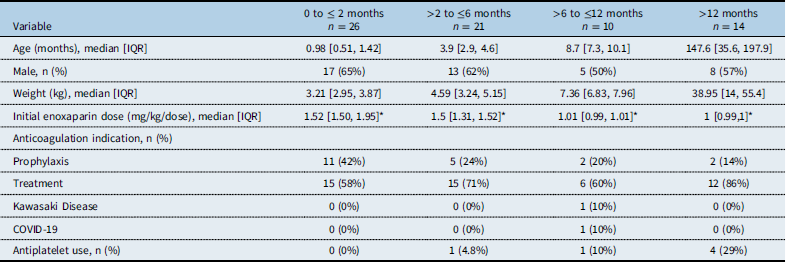
In total, 136 patients received enoxaparin during the 5-year study period; 71 met inclusion criteria. Patients were excluded for having an anti-Xa goal other than 0.5–1 IU/mL (n = 38), never achieving a therapeutic dose (n = 13), initiation of therapy prior to study period (n = 10), and an enoxaparin dosing interval of every 24 hours (n = 4). Of the 71 included patients, 26 (37%) were 0–2 months old, 21 (30%) were 2–6 months old, 10 (14%) were 6–12 months old, and 14 (20%) were >12 months old. The population had a slight male predominance of 61%. The median initial starting doses (mg/kg) for patients <6 months old were significantly higher than patients >12 months old (0 to 2 months: 1.52 [1.50, 1.95]; >2 to ≤6 months: 1.5 [1.31, 1.52]; >6 to ≤12 months: 1.01 [0.99, 1.01]; >12 months: 1 [0.99,1]; p < 0.001). Most patients were being treated for an active thrombus (68%), with a limited number of patients being anticoagulated for other indications, as seen in Table 1.
Patient demographics and baseline characteristics

Table 1. Long description
The table presents patient demographics and baseline characteristics for 71 patients who received enoxaparin, divided into four age groups: 0 to 2 months, 2 to 6 months, 6 to 12 months, and over 12 months. The table has 12 rows and 5 columns. Column headers are: Variable, 0 to 2 months n = 26, >2 to 6 months n = 21, >6 to 12 months n = 10, >12 months n = 14. Row labels include Age (months), median [IQR], Male, n (%), Weight (kg), median [IQR], Initial enoxaparin dose (mg/kg/dose), median [IQR], Anticoagulation indication, n (%), Prophylaxis, Treatment, Kawasaki Disease, COVID-19, Antiplatelet use, n (%). Each row provides specific data for each age group. For example, the median age in months for the 0 to 2 months group is 0.98 [0.51, 1.42], and the median initial enoxaparin dose for this group is 1.52 [1.50, 1.95]. The table also includes percentages for male patients, prophylaxis, treatment, and other indications.
* p < 0.001.
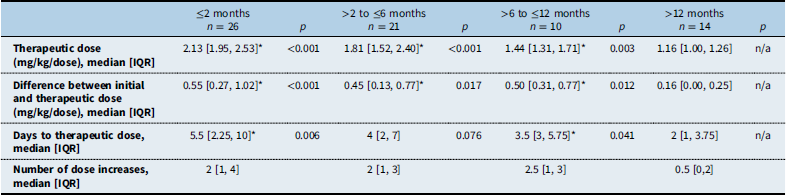
The age groups of 0 to ≤2 months, >2 to ≤6 months, >6 to ≤12 months, and >12 months had median enoxaparin dose requirements of 2.13 mg/kg/dose [1.95, 2.53], 1.81 mg/kg/dose [1.52, 2.40], 1.44 mg/kg/dose [1.31, 1.71], and 1.16 mg/kg/dose [1.00, 1.26], respectively, to achieve a therapeutic anti-Xa level of 0.5–1 IU/mL (Table 2). All age groups, when compared to those greater than 12 months of age, required significantly higher enoxaparin doses to achieve therapeutic levels (p < 0.001) (Figure 1). The difference in the initial and therapeutic dose of enoxaparin for patients >12 months of age was 0.16 mg/kg/dose. This was significantly less as compared to patients >6 to ≤12 months old (0.5 mg/kg/dose, p = 0.012), >2 to ≤6 months old (0.45 mg/kg/dose, p = 0.017), and ≤2 months old (0.55 mg/kg/dose, p < 0.001). It took patients ≤2 months old a median of 5.5 days [2.25, 10] to reach therapeutic levels, with the number of days required declining with increasing age (Table 2).
Enoxaparin course characteristics

Table 2. Long description
A table comparing enoxaparin dose requirements across different age groups. The table has four rows and five columns. The columns are labeled as follows: <=2 months, >2 to <=6 months, >6 to <=12 months, and >12 months. The rows are labeled as follows: Therapeutic dose (mg/kg/dose), median [IQR]; Difference between initial and therapeutic dose (mg/kg/dose), median [IQR]; Days to therapeutic dose, median [IQR]; Number of dose increases, median [IQR]. Row 1: Therapeutic dose (mg/kg/dose), median [IQR]; <=2 months, 2.13 [1.95, 2.53]; >2 to <=6 months, 1.81 [1.52, 2.40]; >6 to <=12 months, 1.44 [1.31, 1.71]; >12 months, 1.16 [1.00, 1.26]. Row 2: Difference between initial and therapeutic dose (mg/kg/dose), median [IQR]; <=2 months, 0.55 [0.27, 1.02]; >2 to <=6 months, 0.45 [0.13, 0.77]; >6 to <=12 months, 0.50 [0.31, 0.77]; >12 months, 0.16 [0.00, 0.25]. Row 3: Days to therapeutic dose, median [IQR]; <=2 months, 5.5 [2.25, 10]; >2 to <=6 months, 4 [2, 7]; >6 to <=12 months, 3.5 [3, 5.75]; >12 months, 2 [1, 3.75]. Row 4: Number of dose increases, median [IQR]; <=2 months, 2 [1, 4]; >2 to <=6 months, 2 [1, 3]; >6 to <=12 months, 2.5 [1, 3]; >12 months, 0.5 [0, 2].
*Indicates statistically significant outcome in comparison to >12 months group.
There was a moderately positive relationship between enoxaparin dose and anti-Xa level in patients ≤2 months old (r = 0.38, p < 0.05), negligible relationship in patients >2 to ≤6 months old (r = 0.03, p < 0.76), strong positive relationship in patients >6 to ≤12 months old (r = 0.60, p < 0.05), and weak positive relationship in patients >12 months old (r = 0.25, p < 0.1) (Figure 2). Only 7 of 342 (2%) documented anti-Xa levels were supratherapeutic for our included patients.
Discussion
This study demonstrates that, consistent with an increasing body of literature, infants require a higher dose of enoxaparin to achieve anti-Xa levels within the desired therapeutic range. Reference Sanchez de Toledo, Gunawardena and Munoz9–Reference Schloemer, Abu-Sultaneh and Hanson18 In 2009, a study by Bauman and colleagues reviewed paediatric cardiology patients being treated for a thrombus and found dose requirements of 1.83 mg/kg/dose for patients 0–3 months old, 1.48 mg/kg/dose for 3–12 months old, 1.23 mg/kg/dose for 1–5 years old, and 1.13 mg/kg/dose for 6–18 years old. Reference Bauman, Belletrutti and Bajzar11 A recent study by Saini and colleagues sought to determine a difference between neonates and patients >28 days old being treated for central vascular catheter-related arterial or venous thrombosis. These authors noted a therapeutic requirement of 1.8 mg/kg/dose for neonates, and 1.6 mg/kg/dose for patients >28 days old. Reference Saini, Cavalcante and Crisanto12 A similar study by Sanchez de Toledo and colleagues noted a similar finding in neonates and children >2 months old. Reference Sanchez de Toledo, Gunawardena and Munoz9 These studies had a primary focus on the youngest subset of patients, which demonstrates the largest dose difference compared to adult dosing.
Most available literature has demonstrated an increased requirement in patients <3 months of age or younger when compared to older children. No studies have specifically investigated the requirement of enoxaparin in the age groups of 2 to 6 months or 6 to 12 months. Given that many clotting factors take until 6–12 months of age to reach adult concentrations, Reference Yee, O’Brien and Young3,Reference Monagle, Chan and Goldenberg4 we felt this represented a gap in the currently available literature, as historically chosen age cohorts may miss significant variability in dosing requirements due to developmental changes in coagulation as well as pharmacokinetic parameters. In our study, patients in this group required a median of 1.44 mg/kg/dose compared to patients >12 months old requiring 1.16 mg/kg/dose (p = 0.003). The differentiation of this age group is significant as it allows for greater customization of pharmacotherapy among older infants; their elevated dose requirement is of a lower magnitude than infants <6 months of age. Therefore, empiric doses for this group may be escalated without imparting undue risk of bleeding due to observed higher dosing requirements in their younger peers.
In the previously mentioned study conducted by Ankola et al., they reported a dose requirement for patients <3 months of age to be 2.1 mg/kg/dose. The results of that study report a higher dose requirement than our population. This may in part be because their population included a subgroup of patients that were preterm neonates (21%), while our study did not. Reference Ankola, Ghbeis and Bailey10
Enoxaparin dose requirements are also significantly impacted by renal function. In our study, renal dysfunction was accounted for using a number of surrogate markers: patients receiving RRT or once-daily regimens of enoxaparin were excluded. Patients were also excluded if their maximum creatinine exceeded two times their baseline serum creatinine. Ultimately, no patients were excluded due to these criteria.
Anecdotally, it has been observed in practice at our institution that younger patients experience greater delays in achieving therapeutic anti-Xa levels. This trend was confirmed in our findings, as the youngest group required a median of 5.5 days, while patients >12 months old only required 2 days, an unacceptable delay in achieving the therapeutic benefit of anticoagulation. Unexpectedly, this result did not appear to align with the number of dose increases between groups. All patients <12 months old required a similar number of dose increases; however, the youngest infants experienced a greater number of days prior to therapeutic. This may be due to many different factors, including difficulty obtaining labs or conscientious blood conservation efforts in neonates, as well as the unpredictable pharmacokinetics observed in younger infants due to variability in renal function, volume of distribution, and absorption of subcutaneously administered medications.
At our institution, enoxaparin is used for primary prophylaxis of line-associated thrombosis in patients with central venous access and structural cardiac defects conveying risk for paradoxical embolization. The majority of patients receiving enoxaparin for this indication in the cardiac ICU will target a therapeutic range of 0.5–1 IU/mL. This practice evolved following an observed increase in stroke and myocardial infarction events in patients with these risk factors while receiving prophylactic anticoagulation with a lower anti-Xa goal. The prophylactic indication may have impacted perceived urgency of achieving targeted anti-Xa levels, impacting the time to therapeutic.
It is common at our institution to start most patients <6 months old at a median enoxaparin dose of 1.5 mg/kg/dose. This is higher than the American Heart Association and CHEST guidelines current recommendations, which, based on the currently available literature and the results of this study, are likely outdated. Reference Monagle, Chan and Goldenberg4,Reference Giglia, Massicotte and Tweddell8 Despite this practice, it still took significantly longer to achieve therapeutic anti-Xa levels in the youngest age groups, and even in the oldest age groups a final dose of >1 mg/kg/dose was required to achieve therapeutic anti-Xa levels. Additionally, our results showed that the majority of patients <12 months of age required a cumulative dose increase of 0.5 mg/kg/dose to obtain a therapeutic anti-Xa level, in relation to their starting dose. This is a considerable difference, especially in patients <6 months of age, as our providers tended to already start them at an increased empiric dose of 1.5 mg/kg/dose.
Ideally, it would be possible to determine the most appropriate starting dose for each patient encountered in clinical practice. However, enoxaparin has demonstrated substantial inter-patient pharmacodynamic variability, as demonstrated by our findings (Figure 2), and there are likely many additional factors that need to be considered. With this variability in dose response, it is of the utmost importance to have a dosing protocol that focuses on the safety of the patient while still rapidly achieving the desired level of anticoagulation. Based on the available literature, the findings of our study, and the relatively low incidence of supratherapeutic anti-Xa levels, it would be reasonable to recommend starting doses of 2, 1.8, 1.5 and 1.0 mg/kg/dose for those age groups ≤2 months, >2 to ≤6 months, >6 to ≤12 months, and >12 months old, respectively. Reliable recommendations for preterm infants remain elusive.
Median weight-based enoxaparin dose required to achieve therapeutic peak anti-Xa level of 0.5–1 U/mL. Doses required in the ≤ 2, >2 to ≤6, and >6 to ≤12 month age groups were significantly higher than those in the >12 month age.

Notably, there has been increased use of direct oral anticoagulants in paediatric patients in recent years. This comes with the availability of more quality data in this population, and even specifically in the cardiac population. Indeed, rivaroxaban, apixaban and dabigatran have received approval from the Food and Drug Administration for use in paediatric patients in the United States, and the most recent American Society of Hematology/International Society on Thrombosis and Haemostasis Guidelines for Treatment of Venous Thromboembolism in paediatric patients suggest treatment with direct oral anticoagulants over older anticoagulants. Reference Monagle, Azzam and Bercovitz20 The UNIVERSE trial highlighted equivocal safety with the use of rivaroxaban over aspirin for thromboprophylaxis following Fontan procedure. Reference McCrindle, Michelson and van Bergen21 Additionally, the SAXOPHONE trial assessed apixaban use in paediatric patients with any congenital or acquired heart disease, also demonstrating similar safety and efficacy compared to standard of care; these data have been further supported by reports on real-world use in the CHD population. Reference Payne, Burns and Glatz22,Reference VanderPluym, Esteso and Ankola23 These agents offer a less invasive, painless administration route, without requiring routine therapeutic monitoring. Still, enoxaparin remains an attractive option for paediatric anticoagulation, particularly in the inpatient setting. In addition to provider familiarity, the relatively short half-life, availability of a partial reversal agent in protamine, and ability to monitor for safe and therapeutic levels often argue in favour of enoxaparin use. Additionally, enoxaparin has limited drug-drug interactions relative to oral anticoagulant options, and offers more robust data in the neonatal population. This degree of clinical flexibility grants enoxaparin an important niche in patient care.
Recommendations made based on this study’s results should be carefully considered due to aspects of this study’s design, including that it represents the practices of a single institution and excludes preterm infants, potentially limiting its generalizability. Our study did not evaluate incidence of bleeding and thrombotic events, and instead used anti-Xa levels as a surrogate marker for these risks. Given its retrospective nature, the indication for, choice of, initial dosing and titration of enoxaparin were not protocolized and were subject to individual practice variability, thus limiting the clinical importance of observed time to therapeutic Xa range and number of dosing alterations. The lack of standardized intervals between sampling (i.e. 1 day, 2 days, 1 week, etc.) may also impact pharmacodynamic results. Pharmacodynamic findings may also have been strengthened if all patients with observed anti-Xa within the range of 0.5–1 IU/mL were included in this study, regardless of intended therapeutic target. While patients with more severe degrees of renal dysfunction (as evidenced by RRT or doubling of baseline creatinine) were excluded, those with lesser degrees of renal dysfunction were not, which may further limit the generalization of pharmacodynamic results.
In conclusion, this study’s findings support the recent literature and clinical experience that there is an inverse relationship between age and enoxaparin dosing requirements. In particular, those infants in the youngest age groups (≤ 6 months) are likely being considerably underdosed based on the most up-to-date guidelines for enoxaparin dosing in infants and children. Additionally, prospective studies should be completed utilizing similar age groups as this study at higher initial starting doses of enoxaparin to better differentiate pharmacokinetic and pharmacodynamic differences. These studies should ideally include preterm infants, whose dosing requirements of enoxaparin are likely different and more variable than their term counterparts. This study contributes to the current body of evidence that certain populations require an initial higher enoxaparin dose to achieve therapeutic anticoagulation.
Enoxaparin dose-response relationship in studied age groups.

Acknowledgements
Enoxaparin Dose Assessment in Pediatric Cardiology Patients: None
Financial support
Work supported by an Institutional Development Award from the National Institute of General Medical Sciences of the National Institutes of Health under grant number U54-GM104941 (PI:Hicks) and the State of Delaware.
Competing interests
No authors have any conflicts of interest to report.