INTRODUCTION
The earliest evidence of Roman activity in the area comes from milestones of the third and fourth centuries ad in Tintagel’s hinterland.Footnote 1 This period corresponds with an intensification of local tin streaming,Footnote 2 probably underlain by an imperial demand for tin;Footnote 3 tin ingots of late Roman date have been found in Cornwall, such as those from the excavations at Trethurgy, near St Austell.Footnote 4 No structures of this date have yet been identified at Tintagel and evidence for a possible Romano-British presence on the headland consists of modest numbers of potsherds,Footnote 5 a group of coins of the second half of the fourth centuryFootnote 6 and the primary text inscribed on the slate known as the Artognou stone,Footnote 7 with its apparent reference to the Emperor Honorius Augustus (ad 393–423). This piece of probable signage was taken by the late Charles Thomas (1928–2016), the acknowledged expert on Tintagel during his lifetime, as an indicator that a putative Roman settlement on Tintagel had included a building with an official imperial status dating to c ad 400.Footnote 8 The requirement for such an outpost there could lie in tin, as the trade in metals was an imperial monopoly.Footnote 9
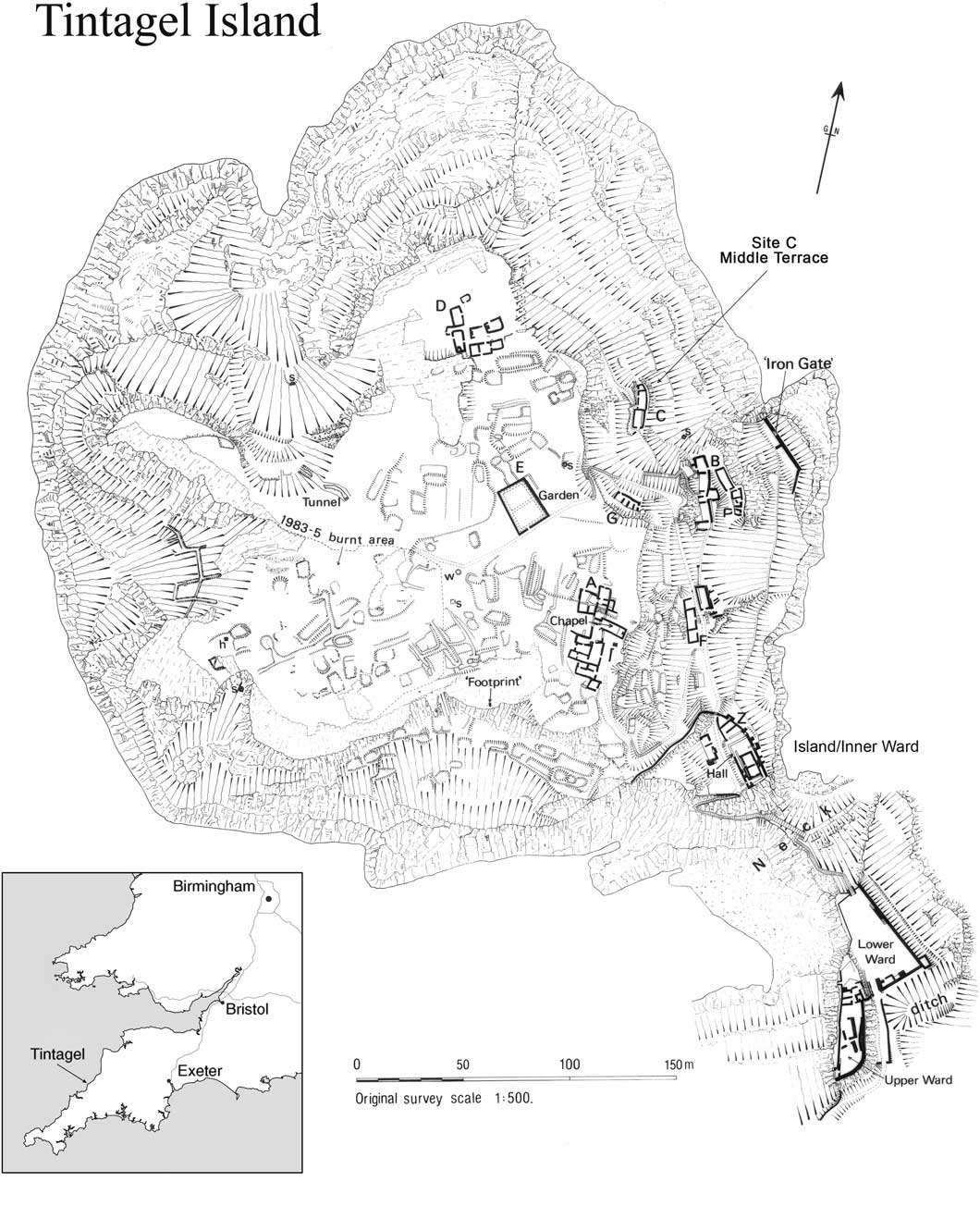
Subsequently, the Tintagel headland was occupied intensively from the later fifth into the seventh century ad, as evidenced by the large volume of excavation finds from the site, mainly comprising imported post-Roman pottery (amphorae and finewares) and high-status glass drinking vessels. There is also visible evidence of more than 100 simple rectilinear structures on the headland, the majority of which are likely to be post-Roman in date (fig 1).Footnote 10 Debate has been on-going over an extended period as to the nature of the post-Roman settlement there; Barrowman et al Reference Barrowman, Batey and Morris2007 provides a useful summary.Footnote 11
Plan of Tintagel Island. © Historic England Archive

Tintagel has been seen as a place with urban attributesFootnote 12 from which imported commodities were traded on to satellite settlements. Charles Thomas, however, wrote that the site’s marginal location argued against thatFootnote 13 and, on the evidence of the wine amphorae, fineware dishes and drinking vessels,Footnote 14 saw it instead as a place where the rulers of the Dumnonii, a tribe whose post-Roman territory comprised Cornwall and Devon (extending into Somerset), met with their followers during the summer, received tribute and engaged in ceremonies and feasting. Ewan Campbell’s analysis of the characteristics of post-Roman import sites of Atlantic BritainFootnote 15 supports this interpretation and puts Tintagel in the top rank of such sites: a royal centre of the local rulers.Footnote 16
Later written sources connected the site with the Dark Age leader (real or legendary) known as King Arthur, and in the medieval period Richard, earl of Cornwall, had a castle with a well-defended wharf built on the site in the 1230s–40s, possibly wishing to associate himself with Arthur.Footnote 17 Its connection with the Arthurian legends has made Tintagel a visitor attraction from the Tudor period onwards.
The site, which belongs to the Duchy of Cornwall, was placed in guardianship in 1929 and is now managed by the English Heritage Trust (EH). Excavations were undertaken by C A Ralegh Radford on behalf of the Ministry of Works, principally between 1933 and 1939, and his identification of the majority of the ceramics found at the site as post-Roman imports from the Mediterranean brought the archaeology of the site to international attention.Footnote 18 Radford’s interventions were followed by thirty years in which numerous watching briefs were undertaken by the Cornwall Archaeological Unit (CAU). The 1990s was a period of intensive excavation after a grass fire on the headland exposed the remains of many previously unseen structures,Footnote 19 after which EH commissioned a series of research excavations undertaken by Chris Morris and Glasgow University. A newly exposed building on the lower terrace of Site C was excavated in the early 1990s,Footnote 20 after which Radford’s trenches on the middle terrace of Site C – never published in any detail – were re-excavated in conjunction with the excavation of new trenches in adjacent areas.Footnote 21 More recently, a proposed re-display of the visitors’ centre at Tintagel Castle by EH provided the opportunity in 2014 for a fresh consideration of elements of the collections for the site, seven years after the publication of the excavations by the University of Glasgow.
IMPORTED POST-ROMAN CERAMICS
Imported ceramics of the fifth–seventh centuries ad have also been identified at a number of mainly coastal sites in south-west England, as well as sites (in smaller numbers) in southern and western Scotland, south and coastal Wales extending north to include a number of high-status sites in Ireland.Footnote 22 The sites of south-west England are at the end of a sea route starting from ports in the Mediterranean and extending up the west coasts of Spain and France. Tintagel is well known for having the largest assemblage of imported post-Roman ceramics in Britain. Bantham, in Devon,Footnote 23 with the second-largest assemblage, offers a useful comparison: more than 750 sherds were recovered there, while Thomas and Thorpe estimated in 2007 that the numbers of imported sherds from Tintagel were probably in excess of 5,000.Footnote 24 Cadbury Congresbury, a site with probable aristocratic or minor royal status,Footnote 25 comes third, with 544 sherds, and the quantities from other sites then drop off rapidly.Footnote 26
These ceramics, which originated in production sites in the eastern Mediterranean and North Africa,Footnote 27 consist mainly of amphorae used for the distribution and long-term storage of wine, olive oil and occasionally other commodities such as fish products. In the past, it has been assumed that the shape of an amphora was a clear indication of its original contents. Recent studies have called that assumption into question;Footnote 28 however, wine and (to a lesser extent) olive oil would certainly have been the principal commodities being transported in the vessels.
The classes of amphorae occurring at Tintagel Castle are: Late Roman Amphora 1 (Bii), Late Roman Amphora 2 (Bi), Late Roman Amphora 3 (Biv/Peacock and Williams Form 45), and Thomas 1981 (Bv), similar to Tunisian Africana Grande/Peacock and Williams Form 34.Footnote 29 LRA1 amphorae contained wine, LRA2 were used for both wine and oil. In addition to the amphorae, fineware bowls (African Red Slip Ware and Phocaean Red Slip Ware) for the serving of food are the other imported form-type occurring in relatively large numbers at Tintagel.Footnote 30
From the excavation of c 5 per cent of the site to date, a recent estimate of the number of individual amphorae found is c 200Footnote 31 and fineware bowl numbers were estimated at c eighty in 2007.Footnote 32 Non-ceramic imports that also relate to drinking comprise the small number of fragments of imported glass vessels (flagons/bottles, beakers, cups and bowls). Glass fragments of this date are not frequent finds as, once a vessel was broken, the fragments would have been collected up as a valuable resource to be recycled. Most of the glass from Tintagel is late fifth/early sixth century in date and the likely sources are mainly in the western Mediterranean.Footnote 33
While the forms of the amphorae discussed here are long lived, the finewares are more closely datable. Campbell provides a useful account of the dating and chronology for the various forms obtained from excavations at key sites in the Mediterranean.Footnote 34 The period during which Tintagel was receiving post-Roman imports from the Mediterranean has been shown to be narrow and specific, datable to c ad 475–550.Footnote 35 This period comprises an early package that originated in the north-eastern Mediterranean (PRS, LRA 1, 2 and 3) and which was supplemented or replaced by wares from North Africa (ARS and North African amphorae) during the period ad 525–550.Footnote 36 These wares occur as elements in a standard package seen throughout the Mediterranean in large-scale trading systems, and this, in conjunction with the continuity of supply through a period in which the production sources changed, implies that the trade was instigated and organised at the Byzantine end.Footnote 37
A qualification to be made regarding this exchange of goods is that while the total number of post-Roman amphorae sherds from Tintagel exceeds all other sites of the period in Britain, a projected number of individual amphorae for the entire site, when considered against the period of time during which imports occurred, is not substantial. While Charles Thomas suggested that either deliveries of wine were not very frequent and/or that individual consignments of amphorae formed a small element within a mixed cargo,Footnote 38 recent study has suggested that the extent of trade was more substantial and involved a number of intermediate ports between the production sites in the eastern Mediterranean and Britain.Footnote 39 It is possible that wine was also being imported in wooden casks as well as in amphorae, though there is no archaeological evidence for this in Britain during this period.
The total assemblage of ceramics that occurs at Tintagel breaks down into c 90 per cent imported vessels (the amphorae and finewares), with small numbers of possible coarseware sherds.Footnote 40 Locally made ceramics account for only c 10 per cent of the ceramics, of which the only form occurring at Tintagel is the Native Ware flanged bowl, which remained in use for a considerable period. This Cornish vessel type appears in the late Roman period and remained in use in post-Roman Tintagel.Footnote 41 Overall, the post-Roman ceramics from Tintagel mainly relate to either the storage or the serving of prestige foodstuffs.
Campbell identified variations in the distribution of these wares across the site indicative of zoning, with a concentration of the finewares on Radford’s Site A (the cluster of buildings on the flat summit), the terraces on the north side of the island, and below the Lower and Inner/Island Wards of the medieval castleFootnote 42 (see fig 1) where the medieval Great Hall is known to sit on a substantial depth of post-Roman stratigraphy.Footnote 43 The amphorae predominantly came from the Inner Ward, the terraces around sites B and C, and the Iron Gate. The focus of occupation in the post-Roman period is taken to be the sheltered area of the Island Ward and on the southern and eastern terraces.Footnote 44
EARLY STONE DISCS
The bulk of the collections for Tintagel Castle are held at the Royal Institution of Cornwall (the Royal Cornwall Museum at Truro), which, as well as the imported ceramics and glass, contains at least eighty-one slate discs, most with diameters between c 30mm (the approximate size of a gaming counter) and c 100mm. Numbers of stone or slate discs occurring on other post-Roman sites are not large, and this is an unanticipated quantity for what is a relatively small collection compared with those for sites of other periods.
This paper has arisen out of a small display project and the research underpinning it consisted of only two days of access to the collections at Truro, where the Radford material was accessible but the bulk of the University of Glasgow excavation finds and their associated paper archive was not. The interpretations offered here are based on the various published excavation reports, principally the excavation of the lower terrace of Site C,Footnote 45 the 2007 Barrowman et al monograph on the University of Glasgow excavations and Thomas and Thorpe’s catalogue of the Radford material from the 1980s.Footnote 46 It has not been possible to provide here the finer detail of the individual objects, and the questions addressed below are relatively general ones: how were the discs used and why are there so many of them at Tintagel Castle?
The earliest certain appearances of plain stone discs in the archaeological record in Britain date to the Bronze Age: Tregulland Burrow, in Cornwall, produced five small, unperforated slate discs, and comparators from other sites of the period in Britain and on the Continent (mainly burial sites) were cited in the report.Footnote 47
In the case of stone discs occurring in Iron Age and earlier Roman contexts, their specific use is indicated by the ceramics with which they occur, and they are usually interpreted in the literature as pot lids (for example, Cadbury Congresbury).Footnote 48 Where they have central perforations, these have been seen as a probable socket for a wooden handle, or simply to facilitate the lid’s removal.Footnote 49 At both ends of the size spectrum there is a grey area between those discs likely to have been used as pot lids and other find-types: the very smallest unperforated discs are likely to have been gaming counters, though it has also been suggested that some could have functioned as buttons.Footnote 50 Occasional very large discs have been seen as bakestones.Footnote 51 The suggestion has been made for the Iron Age hill fort at Danebury, in Hampshire, that of the (chalk) discs occurring there, those with a central perforation and a diameter of more than 100mm were unlikely to be spindle whorls and probably had a different function. The author speculated that they could have been used as small fly wheels or drill weights.Footnote 52
A pot lid would usually sit unfixed over the mouth of a vessel, to retain the heat within if being used for cooking. Roman pot lids have been found with smoke blackening around their circumference, showing clear evidence of use as the lid of a cooking pot.Footnote 53 Excavations at the Romano-British courtyard house settlement at Porthmeor, in Cornwall, which dates to the second to fourth centuries ad, produced a pot with its slate lid sitting inside.Footnote 54 A stopper, however, would sit within the neck of a vessel – a vessel of a different form from an open-mouthed cooking pot. An individual disc above a certain size could be used in either way, and Quinnell has suggested that lids could have been used for storage rather than cooking if used in conjunction with a cloth or wooden cap tied over it to fix the lid down.Footnote 55 A stopper was more likely to have been deployed where long-term storage was intended, and particularly where a liquid was being stored, in which case a sealant would be required if storage for any period of time was desired. The use of a sealant over the entire surface of a disc would also allow the perforated examples to function as stoppers.
A number of sites in Cornwall of Iron Age and Romano-British date have produced discs, the courtyard house settlement at Chysauster, in west Cornwall, being a notable example. There are large numbers of stone discs from this pre-Roman Iron Age/Romano-British settlement site in the unpublished Croft Andrew material held by EH, reflecting an extensive range of vessel types and numbers of individual ceramic vessels occurring there with which the discs could have been used.Footnote 56
Recent excavations at Calstock produced perforated and unperforated discs of early Roman date.Footnote 57 Further Cornish evidence comes from The Rumps,Footnote 58 and Trethurgy Round.Footnote 59 Trevelgue Head produced discs,Footnote 60 though they are not closely datable. Discs were also excavated at Castle Dore, where the site, thought by Radford to be post-Roman in date after his excavations in the 1950s,Footnote 61 has been re-evaluated by Quinnell as probably dating to the Late Iron Age.Footnote 62
A useful picture of the general distribution of Roman stone discs in Britain can be seen in The Rural Settlement of Roman Britain: an online resource.Footnote 63 Their main focus is around the upper reaches of the Bristol Channel (Gloucestershire, Somerset and into west Wiltshire, and south Wales), with another concentration in the far South West (Cornwall). They occur in smaller numbers in the north and infrequently in the south and east, where they mainly appear alongside major roads or at coastal sites. That stone discs occur rarely in the east and south-east of England must relate in part to poor local sources of stone; the alternative material available in these areas was wood. The EH collections database confirms and complements this distribution pattern: within the database, the Roman town of Wroxeter, in Shropshire, with a vast collection very many times the size of that for Tintagel Castle, is notable as having the largest number of stone discs from a single site encountered to date – over 100.Footnote 64
POST-ROMAN STONE DISCS
Excavated post-Roman sites in Cornwall and south-west Britain, as elsewhere, are few. On Cornish sites of the period other than Tintagel, stone discs do appear but not frequently. One of the discs from Trevelgue Head is possibly fifth century in date.Footnote 65 The well-known, high-status sites of Somerset have produced more: two discs from Cadbury CastleFootnote 66 and four from Cadbury Congresbury, 50–78mm in diameter,Footnote 67 in addition to a disc from earlier excavations at the site and identified as Pennant stone, often used for Roman roof tiles, the reuse of which is strongly associated with post-Roman sites in the area.Footnote 68 In Gloucestershire, the important site at Great Witcombe, close to the Dobunnic tribal capital at Corinium and which carried on in use into the fifth century ad, produced nine stone discs made from reused Pennant or Old Red Sandstone. The diameters are in the general range of 30–55mm, with some larger examples in the 70–90mm range.Footnote 69
Stone discs also appear in small numbers in Wales on post-Roman sites that are coastal and/or high-status in nature. Capel Maelog, in Powys,Footnote 70 yielded one example. Excavations at Dinas Emrys, with a similar assemblage of imported ceramics to Tintagel’s, produced a small number of discs in association with late- and post-Roman deposits, which the excavator believed too small in diameter (the largest was just over 2 inches/51mm) to be used as pot lids. The author also cited the royal site Dunnadd, in Scotland, as having produced stone discs.Footnote 71 Stone discs have been recorded on a number of Irish sites of this period: the royal sites of LagoreFootnote 72 and Garranes; the latter produced sherds of LR1 amphorae and two stone discs with diameters between 35mm and 90mm (nos 408 and 481).Footnote 73 The authors wrote of the Irish stone discs: ‘this type of stone disc occurs in various contexts of different dates. It is usually regarded as a pot cover but occurs on sites where no pottery has been found.’Footnote 74
THE SLATE DISCS AT TINTAGEL CASTLE
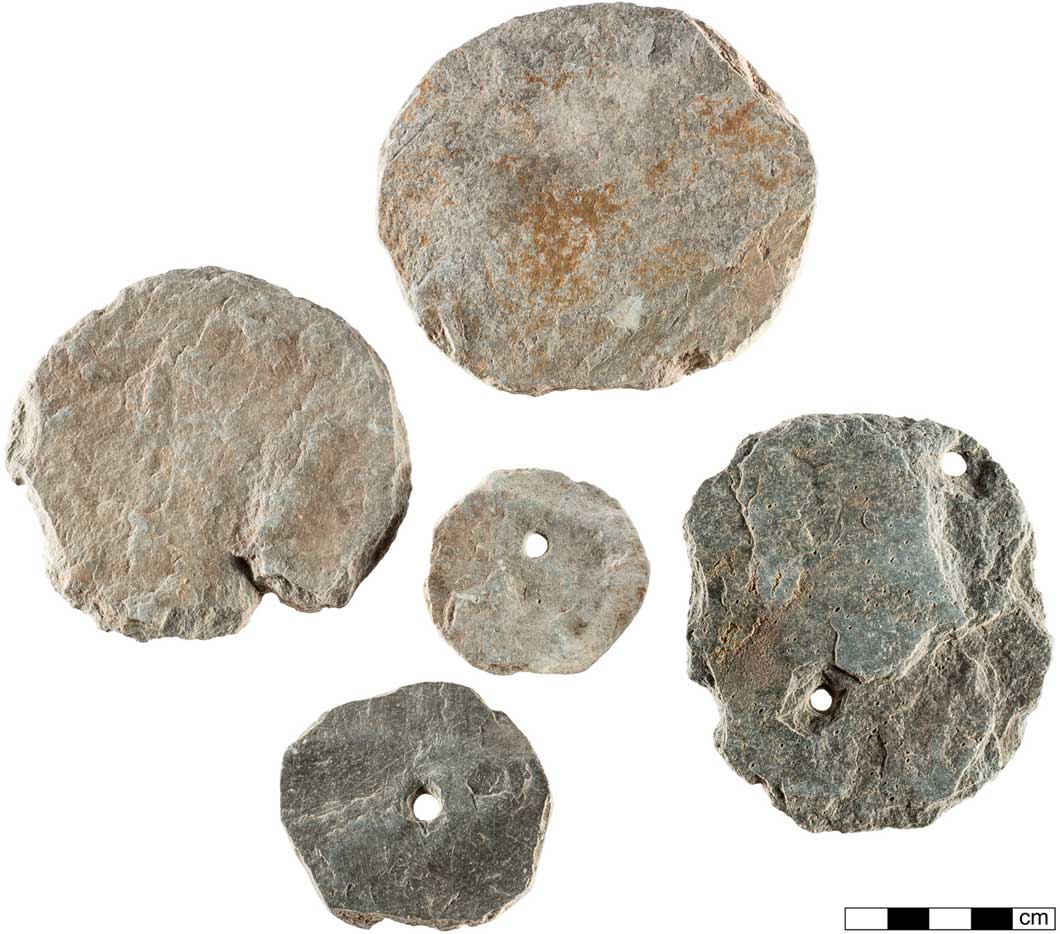
Of Tintagel’s eighty-one discs, a minimum of eight are from Radford’s excavations, where the weeding out of what were perceived to be less interesting objects would probably have been common.Footnote 75 The discs are made of slate in all but one case where gritstone was used.Footnote 76 There is a marked concentration of the discs in the wider zone of the Site C middle terrace, an area c 50m² centring on the building there (see fig 1). Fifty-four discs came from here, thirty of which were from the immediate area of the building, and a further twelve from the previous excavations on the lower terrace at Site C.Footnote 77 A further seven discs were from Site T, the post-Roman ditch below the Lower Ward on the mainland, and of Radford’s discs three are probably from Site A and one from Site F (fig 2). In summary, sixty-six of the site’s c eighty-one discs came from excavations on the terraces of Site C – 81 per cent of the total (though one factor in this marked concentration must be the extensive modern excavations that have taken place at Site C in contrast to the rest of the site).
A group of slate discs from Tintagel Castle, principally from Radford’s excavations. From left (using reference numbers from the Thomas and Thorpe Reference Thomas and Thorpe1988 catalogue, where these exist): 1. S25 ?Site A, u/s; 2. TRURI:1983:40.23 u/s; 3. S28 u/s; 4. S24 ?Site A u/s; 5. central disc: S27 ?Site A u/s. Photograph: © Historic England Archive/Steven Baker

The post-Roman slate discs from Tintagel Castle have been interpreted as probable amphora stoppersFootnote 78 made as replacements for the ceramic originals (for example, RF 3566 and 3805),Footnote 79 which are 30–50mm in diameter.Footnote 80 The secondary stone stoppers are generally 60–80mm in diameter.Footnote 81 In general, stone discs of the pot lid/stopper variety are fairly crudely worked. Discs with a diameter of 30–35mm were taken by Colleen Batey to be probable gaming counters.Footnote 82 Many of the Tintagel slate discs have diameters in the 60–80mm range, though there may also be a group with diameters of 30–50mm, as seen in the Site C upper terrace trench,Footnote 83 as well as occasional outliers above 100mm (for example, RF 1374 diam 175mm).Footnote 84 The small number of measurements obtainable from the published sources for Tintagel indicates that the internal diameter at the narrowest point of the neck of LRA1 is in the region of c 97mm; for LRA2 it is c 75mm and fig 130 in Barrowman et al shows a Tintagel Bv group amphora with an internal neck diameter of 156mm. The discs ranging 60–80mm are compatible with the Late Roman amphorae 1 and 2. It cannot, however, be demonstrated that the few larger discs served the same purpose for the Tintagel Bv group amphorae: disc RF 1374 cited here is larger than the neck of the amphora shown in fig 130.
Tintagel’s discs are sometimes, but not always, perforated and, in examples with a central perforation, it is their lack of finish as well as their average larger size and shallower depth that distinguish them from spindle whorls and loom weights. It has not been possible to provide the ratio of perforated to unperforated discs here: in Radford’s small collection of retained discs almost all are perforated, but this seems not to be the case for the finds from the later excavations and may reflect retention of the more unusual examples in the 1930s. Within the group of perforated discs from Tintagel seen by the author, there is a large degree of variability in the details of their perforation: single or multiple; central or offset. Some discs have two perforations, which might suggest the use of cord threaded through the perforations, again to facilitate the removal of the stopper. Even so, the discs with a single perforation could also have been used in the same way, but with knotted cord. Some discs have pecked depressions, and Colleen Batey suggested that notches seen on the edges of some slate discs, as well as partial central perforations, ‘may have been associated with the “picking” open of the sealed pot lid to release the contents’.Footnote 85
The slate used for manufacturing the Tintagel discs was obtained from the headland itself, where much of the upper geological levels are slate. The slate was also used for a wider range of equipment at the site: notched stones were probably used as ‘strike-a-lights’; larger pieces of slate with drilled socket holes are interpreted as having supported smaller upright structural timbers (for example, used in partitions) and roofing slates.Footnote 86 Less utilitarian uses for the slate from the site can be seen in the collection of inscribed slates of various dates recovered from Tintagel.Footnote 87
Tintagel’s slate discs can be seen within the wider context of a recurring set of small stone tool or implement types that are fabricated either from locally occurring stone or from reused materials to hand: tools made from utilised stone can include hones and whetstones, rubbing/polishing and hammer stones, spindle whorls and, occasionally, weights. Beyond Cornwall, stone discs were often made from roof slates salvaged from Roman buildings. At Wroxeter, for example, roofing slates were reused extensively in building works and for the manufacture of smaller objects.Footnote 88 There is, however, a more regionally distinctive group of specialised stone objects specific to the far South West (Cornwall): bowls, mortars and weights, made of stone from quarries within the region.Footnote 89 This regional specialisation may provide a background to the further development of stone discs in the post-Roman period.
THE BUILDING ON THE MIDDLE TERRACE, SITE C
Site C comprises three levels of terracing at the northern end of the sheltered east-facing side of Tintagel Island. Excavation of the lower terrace produced a sequence of ephemeral post-Roman buildings and associated hearths interpreted as evidence of intermittent occupation of the site early on in the period of post-Roman occupation.Footnote 90 The middle terrace of Site C (see fig 1, indicated by the arrow) is the location of a more substantial structure dating to the fifth–seventh century ad. This building had been the focus of one of Ralegh Radford’s larger clearance excavations in the 1930s, and re-excavation between 1991 and 1998 revealed surviving deposits below and beyond the backfill of Radford’s trenches.Footnote 91 The lowest courses of the building’s dry-stone walling survive unaltered below twentieth-century consolidation and re-building.
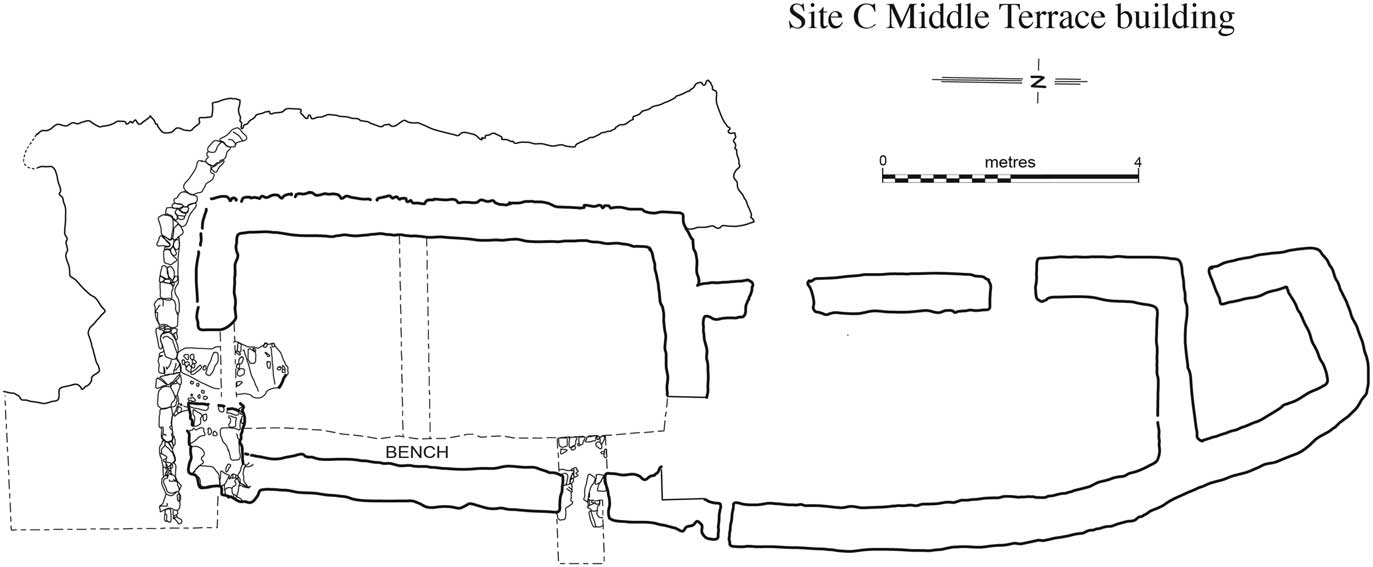
The building is tripartite with the earliest component being the southern room (c 6.6m by 5m internally), which has a door in its south wall. The terrace it sits on is defined to the west by a vertical quarried face, and a natural spring runs down from the top of the island and emits from a hole in the bedrock there. As part of the initial post-Roman development of the terrace, the run-off from the spring was contained within a covered drain running north–south. The primary room of the structure was built to the northeast of the drain, which was then modified and extended to run around the south wall of the structure. Little of the building’s interior survived Radford’s clearances, but it contained, running along the east wall of its southern room, an integral bench-like feature built of slate, which the evidence of the surviving original courses showed to be primary to the structure (fig 3). This feature has only been identified at Tintagel. Dark wrote that these bench features have also been seen on sites B and F (the terraces east and west of Site C), and some had slots for wooden upright members. Dark suggested that these were used for the storage of the imported material.Footnote 92
Plan of the building on the middle terrace of Site C Tintagel Castle. Modified from fig 72 in Barrowman et al Reference Barrowman, Batey and Morris2007. © Society of Antiquaries/L McEwan

In contrast to the plateau, the assemblage of post-Roman ceramics found in and around the building comprised mainly amphorae with few finewares. In the re-excavated Radford trench, 77 per cent of the sherds were from LR1 and LR2 amphorae,Footnote 93 while in the new trenches, those wares accounted for approximately 63 per cent of sherds. Thirty slate discs were recovered from within and around the previously excavated building, with another twenty-four from trenches adjacent and from the terrace above. Twenty discs from the middle terrace building were found in backfill and disturbed/recent deposits from the Radford excavations, and ten were from stratified contexts associated with the building.Footnote 94 Similar evidence came from the less substantial building remains on the lower terrace of Site C, where twelve slate discs were found in association with a predominantly imported ceramic assemblage, of which most was, again, amphorae.
Barrowman et al described the site C complex as probably ‘peripheral to the core activity further south’Footnote 95 (that is, the probable main area of post-Roman activity beneath the medieval Great Hall in the Inner Ward). A primary function for the middle terrace building relating to the storage and reuse of amphorae is indicated by the high occurrence of secondary disc/stoppers and amphorae sherds there. Storage of the imported amphorae was considered a probable use for the buildings on both the lower and middle terraces of Site C at Tintagel;Footnote 96 at Longbury Bank, in Dyfed, Structure A, a building also on the periphery of its site and which contained amphorae sherds broken in situ, has also been interpreted as a store for amphorae.Footnote 97 At Dyfed, however, no stone discs have been found.
The storage of amphorae alone is unlikely to explain the large numbers of secondary stoppers occurring at Tintagel. That the stoppers were manufactured specifically for use with the amphorae is clear: in the fifth–seventh centuries ad, the range of ceramic vessel forms occurring here, imported or local, is limited and their individual (vessel) numbers are small. With the shallow fineware bowls being suitable for serving and eating rather than storage, the vessels requiring the stoppers must have been the more numerous amphorae.
THE REUSE OF AMPHORAE
The primary use of an amphora was packaging for the distribution and subsequent long-term storage of, mainly, wine or oil.Footnote 98 Once a wine amphora had been opened, usual practice was to decant the contents into other, smaller containers, usually leather wineskins, sometimes wooden casks.Footnote 99 Reducing the headroom and thereby the ambient oxygen in a container prevents the oxidisation process that results in the souring of the wine.
The wider subject of amphorae reuse has been considered in great depth recently,Footnote 100 though mainly in the context of sites in the Mediterranean and Near East, where the numbers of emptied amphorae available for reuse were huge, to the extent that they were frequently used as materials in the construction of buildings. There is substantial evidence from the wider Roman world for the reuse of amphorae for the storage of a wide range of both foodstuffs and non-foodstuffs.Footnote 101 Within a domestic context, those amphorae suitable for reuse were most often reused for storing different foodstuffs from their original contents. Amphorae that had formerly contained olive oil were limited in the scope of their possible reuse as the residue from the oil could taint the secondary contents.Footnote 102 At Tintagel, the collection and distribution across the site of fresh water is likely to have been a frequent use for redundant amphorae, followed by the storage of dry goods (for example, grain or dried legumes),Footnote 103 though there is no tangible evidence for this at the site.
In the areas of amphora production (that is, in the eastern Mediterranean), the primary stoppers were mainly fabricated from broken or unusable amphorae, and were usually shaped by hand chipping,Footnote 104 probably with a metal tool. Numbers of these primary stoppers occurring at Tintagel are very small in comparison to estimated numbers of amphorae, and indicates that they were generally broken when opening an amphora, and most of the resultant sherds may be indistinguishable from the smaller sherds of amphorae: the ceramics from Tintagel are characterised by the preponderance of smaller, heavily abraded sherds due to the harsh conditions of the site. At the production sites for wine, etc, in the Mediterranean, plaster and pitch are known to have been the principal sealants used with the stoppers.Footnote 105 These ceramic discs occur in small numbers at Tintagel and other sites where post-Roman imported amphorae have been recorded,Footnote 106 and Campbell observed a ceramic stopper in the collection for Tintagel with surviving traces of pitch or resin.Footnote 107 One activity that could have contributed to the need for replacement stoppers at Tintagel (if, indeed, it was practised in such a remote location) was the opening of some amphorae to test the quality of the shipment on arrival, an entitlement of the purchaser under contract law in the Empire’s homeland.Footnote 108 The primary ceramic stoppers would often have been broken in the opening of the vessel, though in some cases the opening of an amphora was achieved instead by the drilling or cutting of an aperture into the vessel’s neck or shoulder.Footnote 109 Using this technique, the wine could have been ladled off its dregs. However, the amphora could not then be reused as a sealable container. Campbell, having handled most of the British material, observed no evidence of punched holes,Footnote 110 which, in the case of amphorae, could be taken as an intention to reuse.
There may, then, have been some immediate re-sealing of inspected amphorae as well as decanting of others. Numbers of discs generated for the activities suggested above may not have been substantial. The requirement for the large numbers of new amphorae stoppers seen at Tintagel, and the focus of their distribution in and around the Site C middle terrace building, indicate that a production process involving the re-filling and sealing of the imported amphorae may have been taking place there.
ASPECTS OF THE DOMESTIC ECONOMY OF TINTAGEL CASTLE IN THE FIFTH–SEVENTH CENTURIES AD
Tintagel Castle is a premier site in terms of its political importance within its hinterland. Tribute in the form of food renders,Footnote 111 needed for the provisioning of the royal household when seasonally based at Tintagel, is likely to have comprised mainly commodities requiring minimal preparation prior to cooking/consumption, though for convenience livestock would have been herded there or nearby, as necessary, with the killing and butchery taking place at, or very near to, the site. While little animal bone has come from the excavations at Tintagel to date, principally because of the acidity of the soil, the presence of cattle, carpines and pigs has been suggested.Footnote 112 There is some evidence for the presence of cereals: barley and oats (though, whether the latter was wild or a cultivated crop could not be determined).Footnote 113
The evidence for food systems in Anglo-Saxon England has been considered in a recent work by Alan Frantzen,Footnote 114 and is potentially of use here. Such evidence demonstrates an organised hinterland in which animals were being raised, fattened and ‘delivered live to a central point and kept there until slaughtered. Food renders had to be staggered to keep the estate’s central stores from being overloaded’.Footnote 115 Frantzen rejects earlier, pyramid-based models used to describe food-chain relationships, and instead proposes the concept of a network in which every settlement is connected to a greater or lesser extent by ‘links and exchanges’.Footnote 116 There is an absence of evidence from Tintagel for exotic imported foodstuffs and little evidence for the collection of local wild fruit, nuts or local heathland plants,Footnote 117 another indication that to a large extent the sources of what was eaten at Tintagel in the post-Roman period may not have been immediately to hand. The delivery to the site of the required quantities of foodstuffs of acceptable quality points to an organised background formed of a great many links and exchanges: that is, the luxury goods brought to the site from a distance (wine, olive oil, salt, honey, etc) combined with the meat and basic agricultural produce from the hinterland.
To date, evidence for cooking on any scale at Tintagel is confined to a small trench outside the north-west (island-facing) wall of the Lower Ward on the mainland side of the site.Footnote 118 Here, evidence for a series of superimposed slate-lined hearths and an oven with a number of stake-post windbreak shelters, or wattle structures, was found on a terrace in 1986. Areas for food cooking and preparation were found here, as was animal bone, some with evidence of butchery and of having been cooked. Imported pottery and an archaeomagnetic date of ad 450–500Footnote 119 indicated that the area had been utilised at the end of the fifth century and into the first half of the sixth century. In general, there is limited evidence of food processing from Tintagel in this period: two unstratified rotary quern stones from Radford’s excavations and a deposit of weed seeds from the lower terrace building Site C that might relate to final-stage grain processing, the initial coarse cleaning having been done offsite.Footnote 120 Whetstones, a common find on most domestic sites and a find-type that points to on-going chores of the kind requiring bladed tools taking place in the background (for example, agriculture, carpentry, butchery), occur infrequently at Tintagel.
Hampering analysis of the domestic economy of the site is the fact that many of its potential components are missing, mainly due to the acidic soil conditions. In particular, this applies to metals, in the form of containers for the preparation, cooking and serving of food and as tools, as well as organics such as leather, basketry and wood. Bone/horn, as objects or cooking residues, is scant. The very small amount of Native WareFootnote 121 found could suggest the presence of more substantial metal cooking vessels, evidence of which would be unlikely to survive. However, much of what was cooked there may have been meat roasted in a closed oven, as seen in the Lower Ward trench.
Roman Cornwall had a strong native tradition and throughout the Romano-British period had a clear autonomous identity that served to foster the continuity of a British Iron Age culture. The response to Roman influence and trends was pragmatic and selective. As it had been in the Iron Age and Romano-British periods, the economy of post-Roman Dumnonia was entirely non-monetary, and trade – internal or external – was based solely on the exchange of goods or labour. A passage attributed to Solinus in the third century ad refers to the Dumnonii as insisting on barter and refusing coinage.Footnote 122 In addition to food renders, other high-value commodities would also have been incoming as tribute to the ruling family in the post-Roman period, and these could then have been used for trading with external parties. Barrowman et al suggest that the commodities for which the imported wine, etc, would have been exchanged are likely to have been tin, slaves and animal products/organics, which would have included furs, leather goods and honey.Footnote 123
HONEY, MEAD AND BEESWAX
The combined evidence of the large numbers of slate disc stoppers recovered from Site C at Tintagel, their association with the building on the middle terrace and its specific details, and the concentration of amphorae sherds dating mainly to the fifth and sixth centuries ad in the immediate vicinity, has no parallels – so often the case for the archaeology of Tintagel. The stockpiling of drinking water is unlikely: there are springs on the headland and there is no evidence for warfare or siege at the site. Building on one significant activity already indicated to have been taking place on the basis of the imported material – the consumption of alcohol – it is suggested here that the building was used during the fifth to sixth centuries ad for the production of a fermented alcoholic drink.
The alcoholic drinks known to have been made in western Europe in prehistory were beer, grog and mead. From the Neolithic, beer was almost universal in all places where grain could be grown, and has come to be seen by some as potentially a major driver in the spread of agriculture.Footnote 124 ‘Grog’ (a modern application of the word) was a drink that was brewed from various ingredients and could include grains, fruit and honey.Footnote 125 As for mead,Footnote 126 Hilary Cool has written of Roman Britain that while honey was the principal sweetener of antiquity, there is next to no archaeological evidence for it and while it might also be expected that mead would have been consumed, the evidence for this is rarer than the evidence for honey.Footnote 127
The main constituents of honey – sugars and water – decompose rapidly leaving no chemical markers. The two components of honey that do survive and can be detected are the pollen it contains and the chemicals occurring within beeswax. A 2015 pan-European research project, described in Nature, analysed residues extracted from Neolithic potsherds across Europe, looking for the consistent chemical fingerprint of beeswax from the honeybee (A. mellifera).Footnote 128 The results show beeswax occurring in ceramic vessels throughout temperate Europe, with a number of epicentres such as Anatolia, and demonstrate a clear association between early farmers and honeybees. The beeswax observed in this study could derive from any of the following: cooking with honey, the processing of honey or beeswax, or the repair of cracked vessels using beeswax, as suggested by Cato.Footnote 129 The properties and the many applications of beeswax were well known in antiquity:Footnote 130 it is impermeable and, among a wide range of applications, was used for waterproofing textiles, basketry and pottery and as a sealant to fix vessel lids into place.Footnote 131 The traditional use of beeswax in the preservation of foodstuffs is not well documented. However, the waxed linen cerecloth (variants scere- or sear-), known now principally as a material that was used for making shrouds, formerly had a wide range of uses in the domestic sphere.Footnote 132
Where the presence of mead has been suggested in an archaeological deposit, it has usually been on the basis of a tidemark in a container, indicating that the vessel formerly contained a liquid in conjunction with bee-derived pollen. The rare occurrences of this in Britain are in Bronze Age burials, and the special nature of the context allows the suggestion that the liquid included there was also special: a fermented alcoholic drink,Footnote 133 though whether it was mead or honey beer or mixed grog containing honey cannot be determined and the greater potency of mead may lie behind assumptions here. A recent study of human coprolites from Iron Age and Viking period deposits in Sweden and Austria has pointed to the likely consumption of mead in those populations on the basis of large amounts of pollen from meadowsweet occurring (Filipendula ulmaria), a plant not useful for bee foraging, but traditionally used for flavouring mead.Footnote 134
Honey has always been a high-value commodity, particularly so in the colder temperate zones where there are no other sources of sugar in nature. The demand for both honey and beeswax has always been high, in all periods.Footnote 135 Sherratt described honey in prehistory as a prestige commodity with a limited supply in temperate Europe that would not have allowed for the mass production of mead.Footnote 136 Though the environment of the Cornish coast does not support bees particularly well – the best habitats for which are woodland and rich pasture – it should be presumed that the Dumnonian elite, during their periods of residence at Tintagel, had access to honey as an incoming tribute item from an extensive hinterland.
Other than the evidence of poetry surviving as later transcriptions, written sources do not survive for the Celtic West in the post-Roman/early medieval period. At a later date, however, there is documentary evidence in which honey repeatedly appears as a foodstuff in lists of food renders to the king, a system that is said to have been ‘common to the Celtic and Germanic parts of the British Isles in the centuries after the departure of the Roman army and Roman mints’.Footnote 137 The practice is also seen in Old Irish Law.Footnote 138 From the Saxon territories there is an early written reference to food renders to the king in a legal document of c 694, where the law codes of the West Saxon kingdom of Ine describe what is expected as the contribution from ten hides of land, and that list includes ten vats of honey.Footnote 139 It has been suggested elsewhere that beekeepers were a select class under Ine, and that there may have been controls imposed on any trade in honey at that date.Footnote 140
The early Welsh laws of 904–49, during the reign of Hywel Dda, latterly ruler of all of Wales, also record what was due to the king as food render. This includes a large vat of mead but no honey.Footnote 141 In the Domesday Book, honey appears occasionally as a render item; the earliest reference to beekeeping in the south-west peninsula (on Dartmoor) also appears there.Footnote 142 While the usefulness of these early Welsh laws, which survive only in a manuscript of the thirteenth century, in the interpretation of the details of pre-Conquest sites has been questioned,Footnote 143 the intention here is only to suggest that this tradition might have earlier origins.
Greek and then Roman writers recorded their prejudices against alcoholic drinks other than wine. References to mead appear in texts of the period and include recipes for making it,Footnote 144 but more usually we find disparaging mentions of (principally) beer: the ubiquitous drink of the lower classes. Mead and honey beer also appear as the other preferred drinks of uncivilised barbarians, these being less downmarket than beer but still decidedly inferior to wine. An exhaustive account of beer in antiquity, from 2005, quotes a wide range of classical authors, such as Plato and Plutarch, who rated wine as the only pure drink, dismissing beer as being effeminate and cold in contrast to the manly and heating properties of wine, and condemning the drinking habits of barbarians as generally immoderate.Footnote 145 From the Iron Age, large-scale importation of wine from the Mediterranean resulted in that more exotic commodity becoming the drink of choice in north-west Europe, at least for the elite.Footnote 146 This would often have been sweetened with honey prior to consumption. Before wine began to be imported from the Mediterranean, mead had been the most prestigious drink available in Britain, as the most potent in the absence of distilled spirits.Footnote 147
As access to imported wine was radically reduced during the post-Roman period, and in many places ceased altogether, mead, though always a minority drink in comparison to beer due to the cost and scarcity of honey, re-acquired its importance, which it retained until importation of wine from the Continent resumed in the medieval period. Mead can be seen in the later medieval period as another aspect of domestic production in any household keeping bees. Monasteries kept bees to supply the ecclesiastical requirement for pure beeswax candles,Footnote 148 and there is early structural evidence for beekeeping on monastic sites.Footnote 149 However, mead would always have been a minor element due to the limited availability of honey.
MEAD MAKING AT TINTAGEL CASTLE
A possible interpretation of the way in which the building on the middle terrace of Site C functioned is offered here: to the southwest of the building the spring emitting from the rock face provided fresh water and a washing area, with waste water being taken away in the drain constructed there. The southern room with its enigmatic bench feature is a possible location for the primary fermentation stage, with containers located on the bench, facilitating the transfer of liquids at the end of the fermentation process into another container situated below. The two rooms added north of this primary structure may have functioned as storage for amphorae. As to what specific fermented drink might have been made here, of the few possibilities only mead, with its high alcohol content, could be stored for future use – a defining characteristic of a commodity. Beer and grog had to be consumed as soon as fermentation had finished as they rapidly spoiled.
The making of mead is extremely simple, considerably more so than beer, which requires the malting of the grain used. To make mead, only honey, hot water, a suitable wide-mouthed container for the initial fermentation stage and a sealable container in which to store the finished mead (if not intended for immediate consumption) are needed. Honey has the highest concentration of simple sugars in any food source (up to 80 per cent), and will ferment from its own naturally occurring yeasts. Basic ‘short’ mead can be fermented in approximately six to eight weeks, while mead laid down and stored will improve with age, three years being the minimum period recommended. Mead can have an alcohol by volume (ABV) of between 8 and 20 per cent; the maximum strength of wine is 14 per cent ABV.
Traditionally, mead is made with the water that has been used for washing the honeycomb clean after the honey has been extracted.Footnote 150 The extracting of honey from the comb would result in two valuable commodities: the prime honey and beeswax. Mead is an equally valuable secondary product derived from the process. The reuse of the amphorae with stoppers at Tintagel, regardless of the contents, does imply access to beeswax.
Residue analysis using gas chromatography was undertaken on six amphorae body sherds from the University of Glasgow excavations at Tintagel Castle: three LRA2, two North African and one unidentified.Footnote 151 At the time of testing, evidence was being sought specifically to establish a wine or olive oil content for the amphorae, though the author pointed out that there was no way of knowing if the results might indicate the original or a secondary content.Footnote 152 Although the amount of residue obtained from all of the sherds was very small and degraded in quality by the harsh environment, two sherds (RF 2290/LRA2 and RF 3426/ North African) differed from the rest, producing evidence for probable long-chain hydrocarbons and alcohols, which are found in, for example, waxes. These two compounds were not identical.Footnote 153 The sherds selected for analysis were suitably sized body sherds,Footnote 154 making it less likely that the wax-like residues were the result of contamination than would be the case for a neck or rim sherd, where there is the potential for direct contact with beeswax if used as the sealant for a stopper. No identification of the specific waxes occurring was made, but future residue-testing of amphorae from Tintagel may be able to address more closely the question of whether beeswax occurs.
Would honey have come to Tintagel in a cleaned state with beeswax as a separate tribute item, or was the processing of comb honey carried out there? Cleaning honeycomb requires it to be boiled in water twice, which might argue against that taking place on any scale at Tintagel. However, excavation of the earliest drain associated with the Site C building recovered ecofactual evidence that may potentially relate to the processing of honey and/or comb on Site C. The primary fill of the drain contained a waterlogged organic deposit within which survived a range of plant macro-fossils indicative of a number of differing habitats: ‘open habitats, damp or freshwater marsh habitats and sea costal habitats’.Footnote 155 While it was considered possible that all these disparate plant types could have been found at Tintagel, the mechanism for these plant remains coming together in the fill of the covered drain was unclear to the excavators. There was the potential for it being in part the result of contamination, as water was still moving through the drain during its excavation and, as a response to this, the sampling strategy involved samples being taken only from the bottom of the deposit.Footnote 156
The presence of these plant remains and the mix of habitats represented in the drain-fill could be explained otherwise: this material might be the residue from the processing of honeycomb, derived either from the grasses, etc, used to make skeps (traditional bell-shaped containers made of straw or wickerwork for housing bees), or from organic materials used as packaging for honeycombs that were possibly brought to Tintagel as tribute items from a variety of locales within the south-west peninsula.
The transportation of honey could have been undertaken in a variety of containers. Crane, in her classic work on the archaeology of beekeeping, describes a skep cap,Footnote 157 an extension to the top of a skep that can be detached when filled to form a stand-alone container of the best quality honey. The small access hole from the main body of the skep into the cap prevented the queen bee from entering it to lay brood, maximising the honey content and minimising the subsequent processing required.
With regard to the amphorae, in their regions of production these containers are a cheap commodity, the value lying in their contents. In the context of Cornwall in the fifth and sixth centuries ad, the value of these durable large-capacity vessels must have been very different. Clearly, a supply of amphorae is not essential to the making of mead. The Anglo-Saxon parts of the country functioned perfectly well without, using equipment mainly made from organics (wood). However, the supply of amphorae in the west of Britain in this period, routinely renewed – the estimated life of an amphorae is five years – would have made the process very much easier.
DISCUSSION
Mead is particularly associated with the Celtic West in the early medieval period and is mentioned frequently in poems of the pre-Conquest period – for example, those of Taliesin such as The Song of Mead (sixth century), Beowulf (set in the sixth century) and Y Gododdin (sixth/seventh century),Footnote 158 as well as in myths of north-west European cultures. In these sources, it is depicted as a drink with high cultural significance, given by a lord to his inner circle to bind them together, and drunk ceremonially in the lord’s mead-hall. In early Welsh and Irish literature, there is a clear connection between a king’s right to rule and his ability to host a feast at which alcohol was (generously) served. This use of alcohol in societies with formal centralised leadership roles symbolically institutionalises a patron–client relationshipFootnote 159 and partaking of the king’s feast implied the willingness to lay down one’s life in his service.Footnote 160 An understanding of the deeper system underpinning this relationship is essential here – that participation in the feast and reciprocating subsequently in the required form was, in fact, obligatory, as refusal to participate was effectively a declaration of hostility.Footnote 161 These are social structures that have their origins here in Iron Age societies and probably earlier.
The suggestion that mead was being made at Tintagel in the second half of the fifth into the sixth century ad enhances understanding of the social hierarchy in operation there. Wine would not have been drunk by the full range of people occupying post-Roman Tintagel. Recent work on Late Iron Age/Roman era sites in Scotland, which have produced imported glassware presumed to be for the drinking of wine,Footnote 162 provides some insight into the detail of social stratification within the drinking ceremonies of the elite, and both culturally and politically there is much common ground between Scotland at this date and post-Roman Cornwall a century later. Drinking in the Roman style – imported wine drunk from imported glassware – was for the few, while mead drunk from horns, wooden cups or communal vessels was for the more numerous but less important guests.Footnote 163
At the smaller post-Roman sites in the west of England where stone discs have been found, their presence does not necessarily indicate that mead was being produced on site. If those discs are stoppers for amphorae and/or other containers that may relate to mead, then their presence may be a demonstration of that site being linked directly or indirectly to the regional power structure, allowing the occupiers to receive as largesse some of the mead being produced in a central place and then stored and transported in reused Roman amphorae. It is not being suggested here that any non-local slate disc occurring on a post-Roman site in the west of Britain came from Tintagel, though there is the potential for bringing petrological analysis to bear on the question and a reappraisal of post-Roman stone discs on sites other than Tintagel would be useful.
In this period, the feast is the mechanism by which the ruling classes consolidate and maintain their power and influence, using, at Tintagel, both imported wine acquired with the regional surplus (agricultural, mineral or other) available to them as tribute, and mead, a locally made secondary product of the same surplus. The feast transforms this material surplus into social indebtedness. Alcohol is a special type of material culture in that it is consumed and cannot, therefore, be subsequently reused as a gift. Recipients of the king’s patronage and hospitality could only accrue debt by participating in the feast.
To what purpose might that debt have been deployed at Tintagel? The Lower Ward cooking area must have been ancillary to a kitchen located on the headland to serve the Great Hall, presumed to lie beneath the medieval Great Hall where a great depth of post-Roman deposits has been observed. The proximity of the Lower Ward kitchen to the Great Ditch, confirmed as a post-Roman feature,Footnote 164 suggests a phase of investment of labour in improving the defences of the site with working parties set to digging the Great Ditch. A parallel for this can be seen in a reference in early Irish law to the working party feast.Footnote 165 This is likely to have been during Campbell’s earlier phase of imports c ad 475–525, where the correlation between the reused amphorae and the slate discs on the grounds of their sizes is strong. Excavations undertaken by CAU during the summer of 2016 on the southern slope of the headland produced significant numbers of post-Roman glass vessel sherds, and it may be that more than one kind of feast took place at Tintagel in the post-Roman period.
A developed version of this royal right to the services of a labour force can be seen later in the ‘common burdens’ (trimoda/trinoda necessitas), a system in place from c 800 until the Norman Conquest, whereby all freeholders were obliged to give armed service when demanded by the king, and to provide men for military defence works – specifically, the building and repairing of fortifications and bridges. Stenton wrote that during Offa’s reign these particular obligations regarding the building of fortifications stood apart from others: that ‘they were normally reserved when exemption was granted from all of the public burdens and they are undoubtedly of primitive origin’.Footnote 166
The mead halls of early medieval literature belonged to the king, prince or tribal leader, and, because of this connection, mead latterly came to be referred to as ‘the drink of kings’. This close association may indicate that such leaders could exert, if not complete control over mead production and consumption, then at least the authority to restrict access to it by ensuring that the first claim to the raw material needed for its production – honey – was the king’s by right.
Acknowledgements
Thanks to the staff of the Royal Cornwall Museum, particularly Jane Marley, the former curator of Archaeology and World Cultures, and Sara Chambers, former Collections and Exhibitions Manager; to Angela Broome, librarian at the Royal Institution of Cornwall’s Courtney Library; and to the Duchy of Cornwall for allowing access to their collections.
Thanks to reader Elsa Perruchini and her colleagues at Glasgow Archaeology, and to Lavinia Porter, editor of the Antiquaries Journal, for time generously given.
Thanks to colleagues at EH, Pam Braddock, Ian Leins, Mary Luckhurst, Frances McIntosh, Bob Smith, Graeme Stobbs, Martin Allfrey and Sharon Strong, and staff of the Cornwall Archaeological Unit, Carl Thorpe and, especially, Jacky Nowakowski, for introducing me to the works of Dr Eva Crane and for making the time to read this paper in draft. Thanks to John Gould for stimulating conversation on early kingships, to old friends and beekeepers Andy Pearce and Hazel Tarragon and thanks to my eternal reader, Nigel Baker.
ABBREVIATIONS AND BIBLIOGRAPHY
Abbreviations
- CAU
-
Cornwall Archaeological Unit
- EH
-
English Heritage Trust
- LRA
-
late Roman amphora
- RF
-
recorded find