The use of natriuretic peptides as important biomarkers in response to pressure and volume overload has now gained popularity in adults for assessing multiple clinical settings, such as acute dyspnoea, ventricular dysfunction, and valvar diseases.Reference Daniels and Maisel1–Reference Nessmith, Fukuta, Brucks and Little7 In adults with cardiac failure, levels of the B-type natriuretic peptide are known to be elevated in the setting of systolic and diastolic left ventricular dysfunction, correlating with the standing of the patient in the categorization of the New York Heart Association, and also with the prognosis.Reference Maisel, Krishnaswamy and Nowak3, Reference Richards, Nicholls and Yandle9 The levels of the peptide may also reflect the severity of diastolic dysfunction.Reference Lubien, DeMaria and Krishnaswamy4, Reference Scardovi, Coletta and Aspromonte5
There is a paucity of data, however, examining the relation between levels of the peptide with ventricular dysfunction, and especially the severity of diastolic dysfunction, in children with heart diseases.Reference Nir and Nasser10–Reference Nasser, Bar-Oz and Nir12 Thus, we evaluated the correlation of levels of the peptide in the plasma with echocardiographic measures of ventricular performance, such as myocardial performance index and grading of diastolic dysfunction, in a group of children with signs and symptoms of cardiac disease. In addition, we correlated the measured values with the score in the New York University Pediatric Heart Failure Index,Reference Connolly, Rutkowski, Auslender and Artman13 arguing that comparison of these scores with neurohormonal indexes of cardiac failure as reflected in levels of B-type natriuretic peptide would, from the physiologic standpoint, further validate this newly developed index.
Method
In a prospective study, we studied a sample of 99 patients aged less than 17 years referred for diagnostic or follow-up echocardiography to our institute. We enrolled patients who had been referred for assessment using diagnostic echocardiography of cardiovascular signs and symptoms, such as respiratory distress, presence of a cardiac murmur, chest pain, or palpitation. We also enrolled those patients referred for follow-up echocardiography with known cardiomyopathy or congenitally malformed hearts. After enrollment, we recorded the clinical characteristics of each subject, including demographics, symptoms, signs, use of medications, and the results of electrocardiographic, chest roentgenographic, and standard blood tests. We scored all those enrolled within the New York University Pediatric Heart Failure Index.Reference Connolly, Rutkowski, Auslender and Artman13 Patients were excluded from analysis if they had renal failure, profound obesity with a body mass index greater than the 95th centile, sepsis, or insufficient information. Most of the infants and younger patients were sedated with chloral hydrate for performing echocardiography. M-mode, cross-sectional, spectral, and color flow Doppler recordings were obtained with VingMed 750 echocardiography machine, operating at 3.5 to 5 megahertz. All data were recorded in VHS videotape for subsequent analysis and measurement. Left ventricular ejection fraction was measured by M-mode or Simpson’s rule algorithm. Doppler spectral recordings were obtained in the apical 4-chamber view from a sample volume positioned at the tips of the mitral valvar leaflets and in the right upper pulmonary vein. The transmitral pulsed Doppler velocity recordings from 3 consecutive cardiac cycles were used to derive the velocities of the peak E wave, for early diastole, the A wave representing atrial contraction, the deceleration time of the E wave, the time of isovolumic, time and the duration of the A wave. In addition, the velocities of pulmonary venous systolic and diastolic flows, and the velocity of reversal of the pulmonary venous atrial flow, along with their duration, were related to the respective phase of the electrocardiogram. Systolic dysfunction was defined by an ejection fraction of less than half. Diastolic function was categorized as on the basis of normal, impaired relaxation, pseudonormal, and restrictive patterns.Reference Oh, Appleton, Hatle, Nishimura, Seward and Tajik14, Reference O’Leary15 We classified 3 categories of diastolic dysfunction on the basis of a combination of echocardiographically derived parameters.Reference O’Leary15 Abnormal relaxation was defined on the basis of a ratio of E to A of less than 2 standard deviations below the mean, prolongation of isovolumic relaxation time and the deceleration time of the E wave more than 2 standard deviations above the mean, dominant systolic pulmonary venous flow, with the ratio of systolic to diastolic flows greater than 1, and with variable reversal times of pulmonary venous atrial flow usually within the normal limits. We considered pseudonormalization to exist in presence of a normal pattern of mitral valvar filling, pulmonary venous atrial reversal velocity more than 2 standard deviations of the mean, and the duration of pulmonary venous atrial reversal more than 20 milliseconds longer than the duration of the A wave. In older and cooperative patients, a Valsalva maneuver was performed to unmask abnormal relaxation by showing the decrease in velocity of the E wave, the increase of the A wave velocity, and a lengthening deceleration time. Restrictive patterns were defined when the ratio of E to A was more than 2 standard deviations above the mean, the deceleration time was less than 2 standard deviations below the mean, there was diastolic dominance of pulmonary venous flow, with a ratio of systolic to diastolic flows of less than 1, and longer pulmonary venous atrial reversal duration more than 30 milliseconds compared to the duration of the mitral valvar A wave. Instead of using specific values, we made our interpretations on the basis of the overall patterns of flow, and normal values for age or heart rate specific for the individual patient.Reference O’Leary15, Reference O’Leary, Durongpisitkul and Cordes16 The left myocardial performance index was calculated according to the equation previously described by Tei and colleaguses.Reference Tei, Ling and Hodge17 The interval between closure and opening of the mitral valve was defined as a and the duration of left ventricular ejection was defined as b. The Tei index was then calculated using the equation a minus b divided by b. Instead of grading our patients in the categorization of the New York Heart Association, we scored them with the New York University Pediatric Heart Failure Index developed by Connolly and colleagues.Reference Connolly, Rutkowski, Auslender and Artman13 This index carries a range of possible scores from zero, in the absence of cardiac failure, to 30 representing severe failure. The severity is determined from signs and symptoms, the medical regimen, and ventricular physiology. A total score is derived by adding scores attributed to each individual criterion. Blood samples for N-terminal pro-B-type natriuretic peptide were collected on the same day as the echocardiogram was performed. Samples were analyzed using the sandwich immunoassay system (Elecsys N-terminal pro-B-type natriuretic peptide, made by Roche Diagnostics Inc, 2010 Immunoassay System). The echocardiographic examination was done by 3 experienced paediatric cardiologists in a uniform manner. All were blinded to the values of N-terminal pro-B-type natriuretic peptide measured in the plasma prior to the study. The research protocol was approved by the Institutional Ethics Review Committee of our center.
Statistical analysis
Results are expressed as the mean with the standard deviation for continuous variables. Group comparisons were made, when possible, by use of independent sample t test and ANOVA with post hoc Tukey tests. Non-normally distributed raw values were transformed to normally-distributed Neperian logarithmic values. In all cases, comparison tests were computed with the raw values, and repeated with log-transformed values. The Chi-square test was performed to compare qualitative data. Receiver operating characteristic curves were constructed to determine the diagnostic ability for measured values of the peptide to provide cut points. The diagnostic utility of this natriuretic peptide alone was compared with the echocardiographic probability of ventricular dysfunction. Results are expressed in terms of area under the curve and 95% confidence intervals for this area. Linear regression analysis was used to determine the correlation between continuous variables and the log-transformed values. Multivariate logistic regression was used to evaluate the ability of values of the peptide to identify ventricular dysfunction over and above the information provided by other indicators such as age and gender. A value of p < 0.05 was considered statistically significant. SPSS inc. for windows standard version 13 was used for statistical analysis.
Results
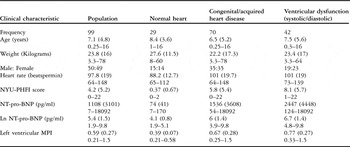
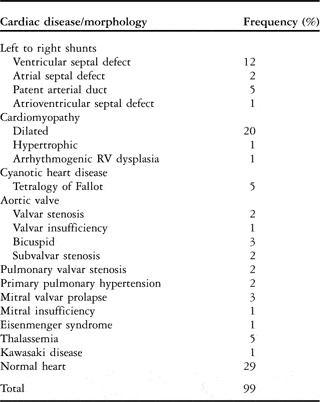
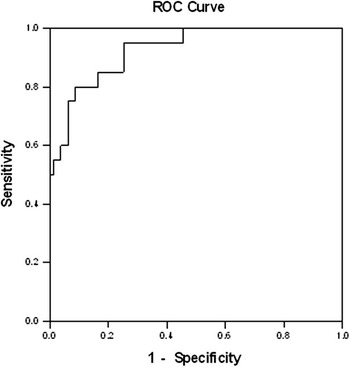
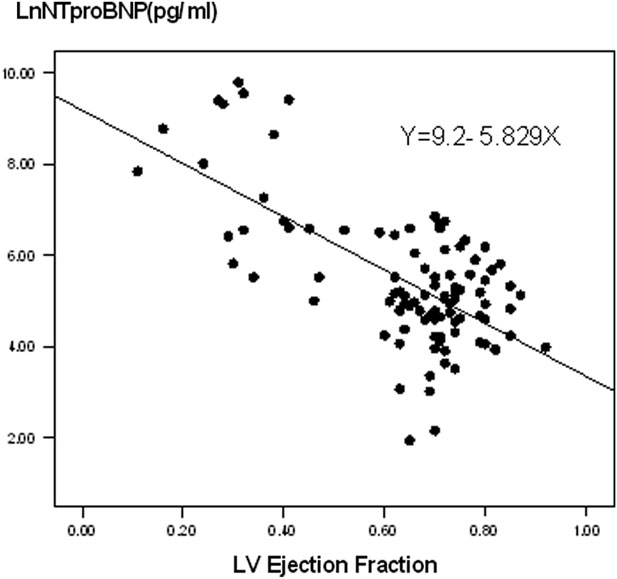
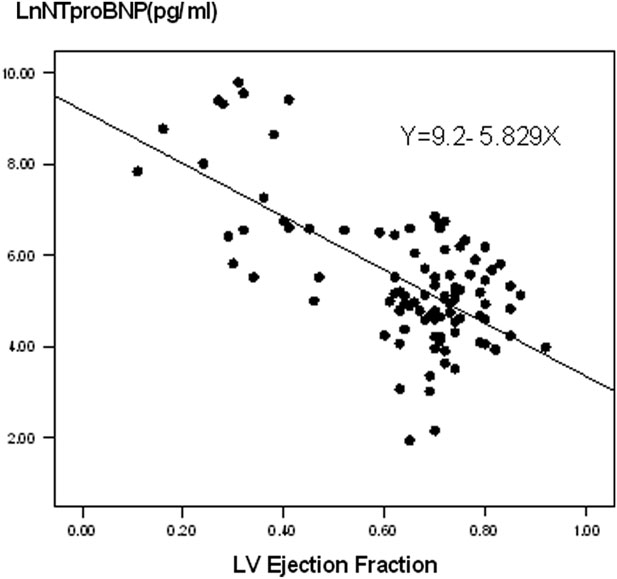
We enrolled 99 eligible subjects with signs and symptoms of cardiac disease aged from 3 months to 16 years. Their baseline characteristics are shown in Table 1. In 70 patients, presence of congenital or acquired heart disease was confirmed by echocardiography, the various lesions being listed in Table 2. Of the patients, 20 had left ventricular systolic dysfunction on the basis of their ejection fraction being less than 50%. The mean level of of N-terminal pro-B-type natriuretic peptide in the patients with systolic dysfunction was 4645 plus or minus 5737 pg/ml, with the log-transformed levels being 7.5 plus or minus 1.5 pg/ml. The area under the receiver operating characteristic curve for detection of systolic dysfunction is shown in Figure 1. The area under the curve for detection of any significant systolic dysfunction was 0.93, with 95% confidence intervals from 0.87 to 0.98 (p < 0.0001), the optimal partition value being 336.5 pg/ml, which gives a sensitivity of 85% and specificity of 83%. There was a significant negative correlation between the log-transformed values and left ventricular ejection fraction (r = −0.7, p < 0.0001 – Fig. 2). Although the level of log-transformed values in the group with normal systolic function proved to be related to both age (p < 0.0001) and gender (p = 0.017), it was similar in the 20 patients with systolic dysfunction regardless of their age (p = 0.74) or gender (p = 0.42) Table 3. The highest levels of the peptide were found in patients with cardiomyopathy.
Demographic and clinical characteristics of studied population and its subgroups.

Values are mean with standard deviation and ranges.
NYU PHFI = New York University Pediatric Heart Failure Index; NT-pro-BNP = N-terminal pro-B-type natriuretic peptide; Ln NT-pro-BNP = log-transformed of N-terminal pro-B-type natriuretic peptide (Neperian); MPI = Myocardial performance index.
Echocardiographic findings of enrolled sample.

Receiver operating curve (ROC) for sensitivity and specificity of N-terminal pro-B-type natriuretic peptide in the diagnosis of systolic dysfunction. A value of 336.5 pg/ml has a sensitivity of 85% and specificity of 83% for detection of any significant systolic dysfunction. The area under the curve (AUC) is equal to 0.93 (95% confidence interval, 0.87 to 0.98; p < 0.0001).

Left ventricular (LV) ejection fraction and logarithmic value of N-terminal pro-B-type natriuretic peptide (Ln NT-pro-BNP), r of regression = 0.7, p < 0.0001.
Mean values, and standard deviations, of the log-transformed N-terminal pro-B-type natriuretic peptide according to the age and gender in the enrolled sample with and without ventricular dysfunction.

Values are mean and (standard deviation).
Ln NT-pro-BNP = log-transformed of N-terminal pro-B-type natriuretic peptide (Neperian).
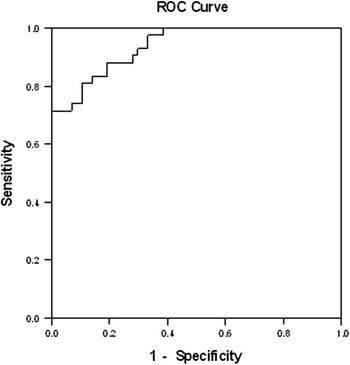
We show the result of receiver operating characteristic analysis for detection of diastolic dysfunction in the 42 patients in whom this feature was confirmed by echocardiographic findings in Figure 3. The area under the curve used to detect any abnormal diastolic function was 0.94, with 95% confidence intervals from 0.89 to 0.98 (p < 0.0001). The value of 178 pg/ml had a sensitivity of 88% and specificity of 81% for detecting abnormal diastolic function.
Receiver operating curve (ROC) for sensitivity and specificity of N-terminal pro-B-type natriuretic peptide in diagnosis of diastolic dysfunction. A value of 178 pg/ml has a sensitivity of 88% and specificity of 81% for detection of any significant diastolic dysfunction. The area under the curve (AUC) is equal to 0.94 (95% confidence interval, 0.89 to 0.98; p < 0.0001).

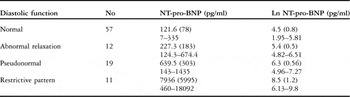
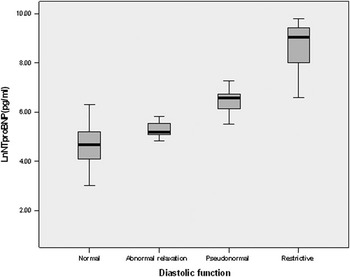
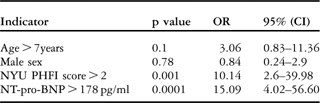
The mean log-transformed levels of the peptide increased according to the severity of diastolic dysfunction, and ranged from 5.5 plus or minus 0.6 pg/ml in those with impaired relaxation, to 6.3 plus or minus 0.6 pg/ml in those with pseudonormal findings, and to 8.5 plus or minus 1.2 pg/ml in those with restrictive filling patterns. The values were significantly different between all groups as assessed using the post hoc Tukey test, with p values equal to 0.003, 0.022, and 0.0001, respectively (Table 4 and Fig. 4). The difference between groups was not significant in raw forms. Patients diagnosed with abnormal diastolic function had a mean value of 2447 plus or minus pg/ml of the peptide, which converts to 6.6 plus or minus 1.4 pg/ml when log-transformed, whereas the 57 subjects with normal diastolic function had a mean value of 121.6 plus or minus pg/ml, giving a log-transformed value of 4.5 plus or minus 0.8 pg/ml (p < 0.0001). In subjects with normal diastolic function, the log-transformed values were higher in children younger than 7 years old (p < 0.0001), and in females (p = 0.012). Like patients with systolic dysfunction, nonetheless, the log-transformed value was related neither to age (p = 0.2) nor gender (p = 0.5) in those with abnormal diastolic function (Table 3). Logistic regression in a multivariate approach for evaluating the ability of levels of the peptide to identify diastolic dysfunction over and above the information provided by usual indicators is shown in Table 5.
Mean values, standard deviations, and ranges of raw and logarithmic values of N-terminal pro-B-type natriuretic peptide according to the severity of diastolic dysfunction.

NT-pro-BNP = N-terminal pro-B-type natriuretic peptide; Ln NT-pro-BNP = log-transformed of N-terminal pro-B-type natriuretic peptide (Neperian).
Box plots showing median levels of log-transformed N-terminal pro-B-type natriuretic peptide (Ln NT-pro-BNP) for normal diastolic function versus impaired relaxation, pseudonormal and restrictive like filling patterns. Each abnormal group was different from normal group and others as shown by post hoc Tukey tests (p < 0.05).

Logistic regression in a multivariate approach for evaluating the ability of N-terminal pro-B-type natriuretic peptide to identify diastolic dysfunction. To produce Odds ratios (OR), cut points were used for age (>7 years) and N-terminal pro-B-type natriuretic peptide (>178 pg/ml) to reduce them to nominal variables.
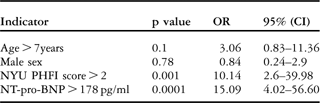
CI = Confidence interval; NYU PHFI = New York University Pediatric Heart Failure Index; NT-pro-BNP = N-terminal pro-B-type natriuretic peptide; OR = Odds ratio.
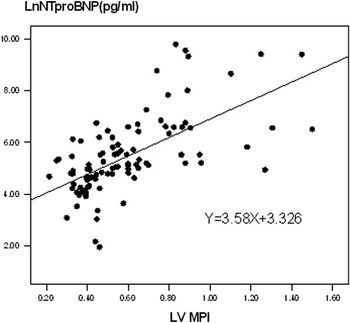
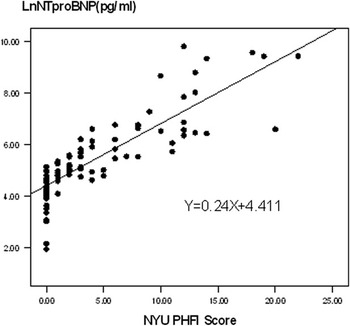
The log-transformed value was also significantly correlated in positive fashion with the left ventricular myocardial performance index, the r value of linear regression being 0.63 (p < 0.0001 – Fig. 5). The values of the means and standard deviations for the myocardial performance index in patients with and without cardiac diseases are shown in Table 1. In similar fashion, the levels of the B-type natriuretic peptide levels increased significantly according to score achieved within the New York University Pediatric Heart Failure Index, ranging from 7 to 266 pg/ml in 54 healthy or asymptomatic subjects scoring less than 2, to 102 to 18092 pg/ml in 45 patients with scores more than 2. Means and standard deviations of the log-transformed values were 4.5 plus or minus pg/ml, and 6.54 plus or minus 1.4) pg/ml, for these two groups, respectively. The log-transformed value also had a linear correlation with this index, showing a robust value of r of regression of 0.89 (p < 0.0001 – Fig. 6).
Scatter plots of log-transformed N-terminal pro-B-type natriuretic peptide (Ln NT-pro-BNP) concentration versus left myocardial performance index (LV MPI), (r = 0.63, p < 0.0001).

Scatter plots of log-transformed N-terminal pro-B-type natriuretic peptide (Ln NT-pro-BNP) concentration versus New York University Pediatric Heart Failure Index score (NYU PHFI score), (r = 0.89, p < 0.0001).

Discussion
The source of the B-type natriuretic peptides in plasma is mainly the ventricles, which in itself suggests that measures of the level of the peptide may be a more sensitive and specific indicator of ventricular dysfunction when compared to other natriuretic peptides, such as the atrial natriuretic peptide.Reference Yoshimura, Yasue and Okumura18 In the setting of volume expansion or pressure overload due to either acquired or congenital heart diseases, the resulting ventricular mural stress leads to the release of a biologically active B-type natriuretic peptide, along with the inactive amino-terminal fragment, this being the N-terminal pro-B-type natriuretic peptide. There are several clinical situations that can cause levels of these peptides to rise, including acute coronary syndromes, arrhythmias, pulmonary embolism, pulmonary diseases, renal dysfunction, and high output states such as sepsis, cirrhosis, and hyperthyroidism.Reference Daniels and Maisel1
We decided to use the N-terminal pro-B-type natriuretic peptide instead of B-type natriuretic peptide itself as a predictor of ventricular dysfunction in our children because it has a longer half life, of approximately 1 to 2 hours, and thus leads to higher circulating levels and slower fluctuations compared with the B-type natriuretic peptide.Reference Daniels and Maisel1, Reference Shimizu, Masuta and Aono19 The accuracy of the diagnosis of heart failure by clinical means and testing is often inadequate, and echocardiographic imaging may not be accessible in emergent situation to delineate cardiac causes of acute dyspnoea. Hence, the rapid measurement of the level of the N-terminal pro-B-type natriuretic peptide in blood will improve the ability of paediatricians to differentiate children with dyspnoea due to congestive cardiac failure from those with dyspnoea due to other causes in acute care settings.
Despite the use worldwide of the N-terminal pro-B-type natriuretic peptide in testing, prospective studies that have examine its role in the diagnosis and assessment of ventricular dysfunction in children, particularly the diastolic component, have been limited. Another aim of our study, therefore, was to investigate the relationship of this biomarker with the severity of diastolic dysfunction as assessed by Doppler echocardiography. Diastolic dysfunction plays a primary role in determining individual prognosis.Reference Vasan, Benjamin and Levy20 Invasive measurement of pressure-volume relationships using catheterization is the gold standard for the assessment of diastolic function.Reference Kass21 This approach is not only invasive, but also more time consuming than is feasible in most clinically laboratories.
A noninvasive method, if proven to be robust, will be of greater value for routine clinical screening and assessment of diastolic function. Doppler echocardiography is currently the noninvasive method of choice for diagnosis of ventricular dysfunction, but its implementation in clinical routine is suboptimal due to its operator dependency and limited availability in primary health care.Reference Grodecki and Klein22 Moreover, Doppler assessment of diastolic dysfunction is more complex in children than adults, and hence not routinely performed. The pattern of velocity of transmitral filling is related to age during childhood, as well as being heart-rate dependent.Reference O’Leary15, Reference O’Leary, Durongpisitkul and Cordes16 A simple rapid blood screening test that reflects ventricular dysfunction, therefore, would be of significant clinical benefit. If proven to be reliable, the use of measuring the N-terminal pro-B-type natriuretic peptide in a high risk subgroup of children could dramatically reduce the use of echocardiograms. In our study, we assessed the diagnostic performance of measuring the peptide as a marker of ventricular dysfunction in a less pre-selected population, their broader spectrum of disease better reflecting the real situation. The novel finding of our study is that, in this heterogenous group of children who came to our clinic because of various cardiovascular signs and symptoms, the N-terminal pro-B-type natriuretic peptide proved a suitable marker with which to rule out ventricular dysfunction.
Our findings validate and extend to children the observations in adults using levels of natriuretic peptides to aid in the diagnosis of systolic and diastolic cardiac failure.Reference Mueller, Scholer and Laule-Kilian2–Reference Scardovi, Coletta and Aspromonte5 Because levels of the peptide are higher in females, and also age-related according to some, although this latter finding remains controversial among subjects without cardiovascular disease,Reference Nir, Bar-Oz, Perles, Brooks, Korach and Rein23–Reference Redfield, Rodeheffer, Jacobsen, Mahoney, Bailey and Burnett26 we also sought to determine if age and gender influenced the discriminatory value of this peptide. We found the peptide to be age and gender dependent in healthy children. The cutoff point we judged to be optimal for making the diagnosis of systolic heart failure was 336.5 pg/ml, with 178 pg/ml being the value for diastolic failure. These values are age and gender independent as cut points. We also showed that the impact of age and gender on the levels of the peptide observed in normal subjects is not apparent when the test is applied to subjects with cardiovascular disease. Thus, age and gender adjusted discriminatory values are not necessary if levels of the N-terminal pro-B-type natriuretic peptide are used to screen for ventricular dysfunction,. This provides an advantage for the N-terminal pro-B-type natriuretic peptide over and above the B-type natriuretic peptide, since age and gender specific discriminatory values are needed for screening when using the peptide itself rather than the terminal fragment.Reference Lubien, DeMaria and Krishnaswamy4, Reference Redfield, Rodeheffer, Jacobsen, Mahoney, Bailey and Burnett27
Our study, therefore, as with adult studies, has demonstrated the relation of levels of the N-terminal pro-B-type natriuretic peptide with the severity of diastolic heart failure in children, underscoring the potential prognostic importance of use of this peptide in assessment of children with congenital or acquired cardiac disease.Reference Lubien, DeMaria and Krishnaswamy4, Reference Scardovi, Coletta and Aspromonte5 We found that children with abnormal systolic function along with a restrictive diastolic pattern had the highest levels of the peptide. This group of patients essentially had advanced systolic dysfunction, and showed the worst prognosis of all echocardiographic classifications of left ventricular dysfunction. Since most of the patients with advanced diastolic dysfunction, showing pseudonormal and restrictive patterns, had coexisting systolic dysfunction, it is not possible to provide accurate cut-off points for moderate and severe diastolic dysfunction is not possible. This means that the levels of N-terminal pro-B-type natriuretic peptide measured in our patients with pseudonormal and restrictive patterns could not be attributed solely to the severity of diastolic dysfunction. Although the measured levels alone cannot differentiate between systolic and severe diastolic dysfunction, a low level of this peptide in the serum may be able to rule out clinically significant ventricular dysfunction seen on echocardiography.
The myocardial performance index is also frequently used as an echocardiographic measure of ventricular function in various cardiac diseases. This index is very useful in the assessment of patients with complex congenitally malformed hearts, since it is independent of their geometric shape.Reference Williams, Ritter, Tani, Pagoto and Minich28–Reference Perlowski, Aboulhosn, Castellon, Miner and Child30 Our findings also emphasize the positive correlation, and unique ability, of both the N-terminal pro-B-type natriuretic peptide and the myocardial performance index to assess global ventricular function. In other words, measuring the levels of the N-terminal pro-B-type natriuretic peptide is sufficient to act as a non-selective index of cardiac performance, reflecting the combined effects of left ventricular systolic and diastolic function.
In adults with heart failure, there is good correlation between levels of natriuretic peptide and standing in the New York Heart Failure Association classification.Reference Maisel, Krishnaswamy and Nowak3, Reference Dao, Krishnaswamy and Kazanegra8, Reference Richards, Nicholls and Yandle9 We found that levels of the peptide were elevated in patients with symptomatic ventricular dysfunction and significantly correlated to their score in the New York University Pediatric Heart Failure Index. Comparison of these scores with levels of the peptide taken as a neurohormonal index of heart failure has further validated the index as a measure of the severity of the heart failure from a physiologic standpoint. The New York University Pediatric Heart Failure Index, therefore, appears to be a reliable and convenient instrument for measuring the severity of cardiac failure in children.
There are some limitations to our study. It was limited by the size of our cohort, particularly for the subgroups of those with congenitally malformed hearts, cyanosis, and isolated diastolic dysfunction. Hence, we excluded statistical results that were not adequately powered to permit us to draw reliable conclusion.
In conclusion, despite these limitations, our findings have suggested that, when used in conjunction with other clinical information and echocardiographic parameters, measurement of the levels of N-terminal pro-B-type natriuretic peptide may be useful in either establishing or ruling out the diagnosis of systolic and diastolic heart failure in children. The combination of neurohormonal and echocardiographic parameters could well represent a rational approach for the initial diagnostic workup, and might assist with stratification of risk and timing for therapeutic intervention. A low level may preclude the need for echocardiography in patients who have no symptoms of heart failure and a normal score in the New York University Pediatric Heart Failure Index. On the other hand, elevated levels may indicate the presence of ventricular dysfunction, thus warranting further cardiac evaluation. Despite the great value of the peptide as a screening test, it should not supplant clinical acumen and other standard diagnostic modalities. Instead, it should be used in combination with standard diagnostic modalities. A more comprehensive study, using a larger sample of children with isolated diastolic dysfunction, should now be designed to assess the validity of this biomarker as a screening tool for isolated diastolic dysfunction in paediatrics.
Acknowledgments
We thank the authorities of the Day Hospital Laboratory Department for their kind cooperation. Our special thanks are due to Dr Elaheh Malakan Rad, Dr Mohammad Rafie Khorgami, Mrs Arezoo F. Hamidi and Mrs Giti H. Moghaddam for their help and cooperation.