1 Introduction
Within the field of second language acquisition, synchronous computer-mediated communication (SCMC) has drawn an increasing amount of attention from teachers and researchers alike. In particular, text-based SCMC has gained popularity as a pedagogical tool due to its capacity for instant interaction and text-based communication. A substantial number of studies have explored learners’ interactions in text-based SCMC to determine how SCMC can enhance second- or foreign-language learning (e.g., Lai & Zhao, Reference Lai and Zhao2006; Pellettieri, Reference Pellettieri2000; Smith, Reference Smith2003). While these studies provide a glimpse into possible pedagogical uses for particular text-based SCMC tasks, it seems premature to establish the claim to show how text-based SCMC affects learner language production. Considering that studies on text-based SCMC employed various tasks in diverse conditions, it is difficult to know if the findings are comparable across studies. In particular, few studies have investigated the interaction between the mode of communication and task type, although the mode of communication and task type have been explored separately as influential factors. The discussion comparing the efficacy of text-based SCMC with face-to-face (F2F) oral communication should carefully consider the different interactional contexts that can influence second language (L2) learner performance.
Variability in learners’ language production has long been an interest within second-language research. When learners learn a target language, they construct their own linguistic system that differs from both the target language and the learners’ native language (Selinker, Reference Selinker1972), passing through several developmental sequences before reaching a final stage of development. This transitional language is often called interlanguage (Selinker, Reference Selinker1972). While learners’ interlanguage has its own systematic internal rules, variations in interactional context may result in alternate patterns of language use. The learners’ language production may vary in performance quality, depending on several complex factors, including “the communicative function of a feature, the linguistic environment of that feature, and social/situational factors such as formality of situation and ability to attend to form” (Tarone, Reference Tarone1988: 37). This variability of interlanguage within an interactional context at a single point raises questions about how teachers and researchers should assess learner language. If variables can affect learner language, these variables should be noted and considered when discussing the data. In this sense, comparing learner language in text-based SCMC with the language used in oral interaction may help to identify the strategies used by language learners in the two different modes of communication and may provide pedagogical implications. The findings can help teachers to choose an appropriate mode of communication for designing materials and selecting effective teaching techniques, dependent on the specific educational purpose.
Because text-based SCMC involves unique interactional features, such as keyboard use, the visual presentation of the discourse, the time lag between the initiation of the message and its receipt, and the absence of paralinguistic cues, text-based SCMC may affect learners’ production of utterances in a second language differently than the way context of speech produced within oral interactions does. Mode of communication may impact learners’ cognitive load, output processes, and language learning (Baralt, Reference Baralt2010; Grabowski, Reference Grabowski2007; Granfeldt, Reference Granfeldt2008). Therefore, the modality effect may be present on L2 learners’ interlanguage, even before the occurrence of language-related episodes, such as feedback and negotiation. For example, learners may be able to produce certain linguistic forms in one mode more accurately than they can in others. Salaberry (Reference Salaberry2000) found the signs of change more frequently in developmental stages of past-tense verbal morphology in computer-based interaction tasks than he did in the F2F oral tasks. Salaberry suggested that text-based SCMC could be a more pedagogically sound environment for increasing meta-linguistic awareness in the L2. Understanding the potential strengths and limitations of each interactional modality will help educators make better use of SCMC for teaching and assessing pedagogical procedures.
Similarly, task types may affect learner performance in the text-based SCMC context. In oral and written contexts, research evidence supports the idea that a task can influence the level of complexity, accuracy, or fluency depending on its type, cognitive complexity, nature, and the conditions under which the task is performed (Granfeldt, Reference Granfeldt2008; Kuiken & Vedder, Reference Kuiken and Vedder2011; Robinson, Reference Robinson2001; Skehan, Reference Skehan2009; Tavakoli & Skehan, Reference Tavakoli and Skehan2005). The effect of task type on learner interaction has been also reported in the SCMC context (Smith, Reference Smith2003; Yilmaz & Garñena, 2010). However, these SCMC studies on the impact of tasks often focused only on learner performance in text-based SCMC without comparing it with F2F oral task performance. Given the widespread use of tasks in L2 classes or in SCMC research, further investigation into the impact of tasks on L2 performance in each mode of communication will grow in importance.
In order to assess the accuracy and fluency of a learner in an L2, an understanding of the influence of both mode of communication and task type on learners’ L2 performance is essential. What are the effects of modality on L2 performance? Does one mode of communication better promote L2 performance than the other? Do learners pay more attention to linguistic forms while producing output in either mode of communication, thereby more accurately producing the L2? Which types of task are likely to elicit specific oral and text-based SCMC L2 performance? To address these questions, this study explores intermediate-level English-as-a-second-language (ESL) learners’ interlanguage variation in F2F interaction and text-based SCMC, as seen while the learner is completing various tasks.
2 Task effect
The task effect on L2 learner performance in the F2F context has been examined by many studies (e.g., Ellis, Reference Ellis2003; Robinson, Reference Robinson1995, Reference Robinson2007; Skehan, Reference Skehan1998). The effect of a task is theoretically and pedagogically important because the conditions under which learners perform may affect their cognitive processes and L2 performance. Therefore, in choosing and designing tasks, teachers must understand the effects of their designs on students in the classroom, in order to maximize learning along stated pedagogical goals. The pervasive use of technology has found its way into language learning tasks. Accordingly, we will need to understand the task effect on the language choices made by learners in order to complete each task, as well as how the mode of communication might mediate the language used (Gonzalez-Lloret, Reference Gonzalez-Lloret2014).
Despite the importance of task effects, only a small number of studies have explored the effect of task type on learner language in text-based SCMC contexts, and those studies have reported mixed findings. For example, Blake (Reference Blake2000) used a series of online tasks, including jigsaw, information-gap, and decision-making tasks, in order to demonstrate the common presence of negotiation of meaning in text-based SCMC; he found that jigsaw tasks promote more negotiation among learners than other tasks, including information-gap, decision-making, and opinion tasks. In contrast, Smith (Reference Smith2003) found that, although jigsaw tasks might elicit more incidental negotiation on the non-target forms, decision-making tasks would elicit more negotiation sequences and the noticing of forms, than would jigsaw tasks, when the target lexical items have been infused into the task. Similar results were obtained by Pellettieri (Reference Pellettieri2000) in a study with 20 undergraduate learners of Spanish as a foreign language. In that study, Pellettieri investigated the nature of negotiation routines and also the linguistic modifications made by participants during language negotiations. Students participated in five communicational tasks, which ranged from open conversation to a more closed task (e.g., jigsaw). Pellettieri claimed that goal-oriented tasks with a task difficulty that involved vocabulary, concepts, or items beyond the repertoire of the learners could increase the quantity of negotiation.
Recently, in two similar studies, Yilmaz and Grañena (Reference Yilmaz and Grañena2010) and Yilmaz (Reference Yilmaz2011) investigated the task effect on the number and characteristics of focus-on-form instances by exploring language-related episodes (LREs) or any part of learner dialogue where learners question the accuracy or meaning of a linguistic item or correct errors. Yilmaz (Reference Yilmaz2011) found that dictogloss tasks elicited a higher number of LREs than jigsaw tasks. The primary focus of learners during the tasks, Yilmaz speculated, may affect the number of LREs. In contrast to dictogloss, exchanging information was a primary concern for learners in the jigsaw task. For that reason, the learners could not afford to divert their attention from message-content to message-form in the jigsaw task. While these studies draw attention to the task effect on learner interaction in text-based SCMC context, no studies have compared the task effect in F2F versus text-based SCMC. All these studies explored task effect only in text-based SCMC and did not investigate the effect of task across mode of communication (i.e., F2F and text-based SCMC) or their interactions. Considering their assumed role as one of the important factors influencing L2 performance, it is surprising that the relationship between task effect and the mode (F2F vs. text-based SCMC) has not been systematically investigated. The research done in this area is both scarce and inconclusive, so more study is called for in this area.
3 Modality effect
Differences between text-based SCMC and the process of F2F oral interaction raise an important concern in the study of L2 performance in SCMC. Modalities, such as writing and speaking, involve varied levels of cognitive resources. Written language production is cognitively more costly than the resources involved in speaking (Grabowski, Reference Grabowski2010). Text-based SCMC is a communication medium that is different from traditional oral or written communication. Text-based SCMC shares some discursive features with both oral and written communication; it is similar to traditional writing because it employs a visual textual message, which is recorded permanently. Consequently, learners can access previous utterances. In addition, the turn exchange often takes longer in text-based SCMC, so learner use of cognitive resources can take longer per interaction than for F2F speaking. In its lack of paralinguistic cues, including intonation, pitch, and tone, text-based SCMC resembles traditional writing, but in its capacity for instant interaction, text-based SCMC resembles F2F oral conversation. Thus unique features of text-based SCMC may influence L2 learner performance, and may further provide users with affordances for unique communicational practices and the emergence of new communication genres (Tagg & Seargeant, Reference Tagg and Seargeant2014).
The SCMC literature reports text-based SCMC features that differ from those reported in use by oral communication (Kim, Reference Kim2014; Yuksel & Inan, Reference Yuksel and Inan2014). Text-based SCMC generated more talk by participants (Beauvois, Reference Beauvois1998; Kern, Reference Kern1995) and more balanced participation by learners in SCMC than in F2F (Chun, Reference Chun1994; Warschauer, Reference Warschauer1996). Text-based SCMC is believed to promote more participation from diverse students by providing less stressful and more motivating interactional contexts to students. A less stressful interactional context and the extra time between turns appear to contribute to the quality of interlanguage in text-based SCMC. For example, text-based SCMC appeared to facilitate accuracy for L2 learners (Salaberry, Reference Salaberry2000). Positing a hypothesis that SCMC could leave more time for students to succeed in using more difficult levels of word order in SCMC than F2F, Böhlke (Reference Böhlke2003) compared SCMC and F2F group discussions of 27 learners of German. By comparing their syntactic levels, Böhlke found that students made fewer mistakes in the SCMC than in F2F. This finding suggests that SCMC might better draw learner’s attention to forms than F2F, although the findings might not be applied to dyadic interactions, where learners have to participate in interactions without much choice. Similarly, Sauro (Reference Sauro2012) investigated L2 learner output in both text-chat and spoken discourse using narrative tasks and claimed that learners made use of the additional online planning time afforded by text-chat for monitoring.
While there is evidence that learner language in text-based SCMC can be more accurate, findings on the quality of the interlanguage produced in text-based SCMC have been inconclusive. For example, some studies have reported finding the syntax in text-based SCMC to be more complex than that found in F2F group discussions (Böhlke, Reference Böhlke2003; Kern, Reference Kern1995; Warschauer, Reference Warschauer1996). Other studies have reported that learner output in SCMC is simpler than in F2F dyadic discussions (Pyun, Reference Pyun2003). These mixed findings may stem from the scarcity of studies and the type of method used to evaluate the complexity of learner language such as the t-unit and c-unit. In addition, most studies comparing learner interaction in text-based SCMC and F2F explored group discussions (e.g., Böhlke, Reference Böhlke2003; Sauro, Reference Sauro2012; Warschauer, Reference Warschauer1996), therefore it is not clear whether previous findings can be carried over into dyadic interactions.
Moreover, most studies employed open-ended discussion questions to explore modality effect. No studies explored modality effect using more closed-type tasks, such as, tasks where students have to pay attention to the interactor’s responses in aiming to reach the goals. Other types of processing might be required for more interactive tasks and there may be other interactional consequences of text-based SCMC. Questions that arise are: How does reduction of the number of dynamic cues for social context in text-based SCMC affect the way that learners attend to forms and produce output? How do task types affect learners’ L2 production in text-based SCMC and F2F? These questions have not been addressed in discussions of the effect of SCMC on learner language. Thus this study investigates how the two different modalities of text-based SCMC and F2F oral interaction influence learners’ ability to produce grammatical forms accurately in a second language. In addition, this study also investigates how task type affects learner interlanguage within different modes of communication. The present study addresses the following research questions:
-
1. To what extent does ESL learners’ production of articles and question forms differ in F2F and text-based SCMC settings?
-
2. To what extent does task type influence learner production of articles and question forms in F2F and text-based SCMC settings?
4 Methodology
4.1 Participants
Participants were 20 intermediate-level ESL students (9 females, 11 males) from three ESL classrooms at a large public midwestern university. The participants belonged to four different first-language backgrounds – Arabic (2), Chinese (7), Korean (8), and Vietnamese (3). They ranged in age from 22 to 35 years. Participants completed a background questionnaire which asked them about a comparable previous experience with computers. Most participants reported that they regularly used computers for sending email, word processing, Web surfing, and chatting. They had experiences with online chatting in their native languages, rather than in English; however, all were comfortable typing in English. Participants, on average, spent about five hours per day using computers.
4.2 Task types
Three different task types were used: spot-the-difference, decision-making, and story-sequencing. These three task types were chosen because they were believed to facilitate negotiated interaction (e.g., Pica, Kanagy & Falodun, Reference Pica, Kanagy and Falodun1993; Pica, Kang & Sauro, Reference Pica, Kang and Sauro2006) and to lead to the production of a sufficient number of target forms, question forms, and articles by the participants. In addition, considering the popularity of the task as a tool to elicit interaction in interactional research and in many ESL classes, the use of these tasks seemed to offer more implications for research and pedagogy. Care was taken to control the kinds of content and the complexity of pictures used in each task type. To prevent the contents of tasks from influencing learners’ production of language, picture sets were created that included concrete, recognizable items, shown in familiar contexts (e.g., bed in a bedroom, desk in a classroom). In addition, the cognitive complexity of the pictures in one type of task matched the comparative level of complexity of the other pictures used in the same type of task across all versions (e.g., Robinson, Reference Robinson2001). For example, the similarities between pictures used for the same task type were evaluated and controlled by number of characters, contextual support (i.e., here and now), and reasoning demands (i.e., a simple sequence of behaviors, not requiring the background information of characters’ motivation).
For the spot-the-difference task, pairs of pictures were given to a dyad. Each pair of pictures was identical, except for a small number of changes for the participants to find. The participants were told the total number of dissimilarities and they worked together to find the variations. Participants could not see the pictures held by their partner; in order to complete the tasks, both interlocutors needed to request and supply information to each other. For decision-making tasks, participants were asked to imagine that they were on a sinking boat. Each participant received pictures of twelve items and needed to select five of the twelve items to take to an imaginary desert island and to discuss the choices with their partners. Therefore, multiple outcomes were possible for decision-making tasks. Story-sequencing tasks were a type of information-gap tasks, where the necessary information to complete the task was given to only one participant. For story-sequencing tasks, sets of pictures that illustrate the events of each episode’s story were presented to participants. All stories involved three characters: one character, who lost or misplaced an object (e.g., bag, bottle) either on a street or at a market, and two other characters, who helped to find the object back at the end of stories. One learner held a set of pictures showing a complete story, while the other learner held a jumbled set of individual scenes, including dummy pictures that were unrelated to that story. The learner who held the storyline was required to explain the story to help the other learner select the correct individual scenes and put them in order.
4.3 Data collection and analysis
The dyads completed the study in a computer lab. Participants began with practice tasks resembling the tasks used in the study. Each participant practiced each task for five minutes using both F2F conversation and SCMC via an online-chat tool, Microsoft Windows Messenger. During the practice session, the tasks were explained to the participants in detail. After completing the practice session, all 20 participants performed the three tasks in each mode (text-based SCMC and F2F conversation), generating 60 cases. To prevent the ordering effect, the dyads completed the tasks in random order. In addition, half of the students completed the tasks in F2F first, while the others started SCMC first. The participants were allowed 15 minutes to finish each task, using both text-based SCMC and F2F conversations. A total of 90 minutes was allotted to each pair of learners to complete the six tasks. All participants finished the tasks in the specified time. The time that participants spent to complete three tasks was similar in SCMC (34 minutes 49 seconds) and F2F (34 minutes 2 seconds). The F2F conversations were audiotaped, and the online chats were recorded.
Audiotapes of the interactions between learners during the tasks were transcribed. Selected for study was the presence or absence of two targeted forms: articles and question forms. These grammatical forms were chosen because they are often hard to master, even by advanced learners, and also, because these forms were likely to occur in sufficiently large numbers to allow an analysis in terms of variability. In addition, the developmental stages of question formation were relatively easy to identify, because each stage was characterized by distinct structures and components, with the more complex structures in the higher stages. Focusing on these two target forms enables a comparison of learners’ language performances based on modalities and task types.
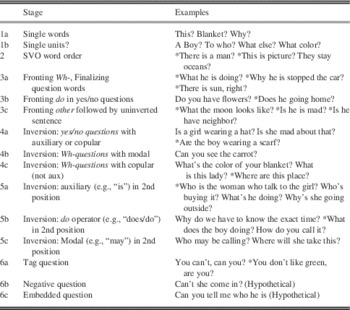
For articles, all obligatory contexts were identified in the transcripts by task and the presence or absence of the required articles in these obligatory contexts was noted; accuracy rate was then calculated across task types and modalities. All questions produced by participants were coded for stages based on the developmental sequences for ESL question formation adopted from Pienemann (Reference Pienemann1998) and Pienemann and Johnston (Reference Pienemann and Johnston1987). For example, L2 learners in Stage I typically ask questions by adding rising intonation to a single word (e.g., “Snowman?”). Questions in Stage II are characterized as subject-verb-object clauses with a rising intonation (“You have a Snowman?”). A complete description of the stages is provided in Table 1. An additional rater was presented with six randomly selected transcripts that constituted 60% of the data, in order to calculate the accuracy rate of article use and to code the question forms for measuring the developmental stages used. At points of disagreement or where questions have occurred, the points were reviewed and discussed by the two original reviewers and also a third reviewer, until reaching a consensus. The level of agreement between the raters was 92% (k=.84).
Stages of question formation in English

5 Findings
Descriptive statistics were reported to show the range, mean, and standard deviation for each of the rates and performance variables across tasks. Then, various analyses were carried out to investigate observed differences further. In the following section, only results that are pertinent to the research focus are reported.
5.1 Interlanguage variation in question forms
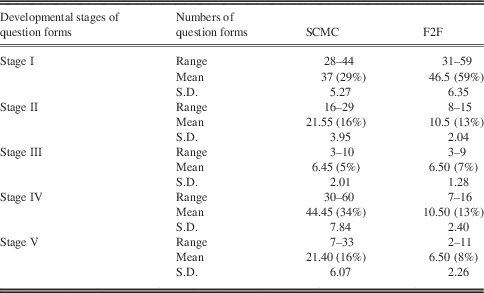
Participants manifested wide variations in the production of question forms in both text-based SCMC and F2F interactions. While the developmental sequences of questions adopted from Pienemann and Johnston (Reference Pienemann and Johnston1987) include six stages, none of the participants in this study produced question forms of the highest stage (Stage VI). Table 2 displays the descriptive statistics for the frequency and rate of questions produced in each stage by the participants. The means presented in each row represent the average number of questions at each stage produced by all participants across tasks.
Descriptive statistics for distribution of question forms in developmental stages

Although all learners demonstrated that they could produce high-stage question forms in the developmental sequences, as Table 2 illustrates, the learners often produced relatively rudimentary question forms. Participants produced a higher number of lower-stage question forms (Stage I and II) in F2F interactions than they produced in SCMC. About 50% of the question forms used in SCMC were categorized as Stage IV or Stage V in developmental sequences, while only 21% of question forms used in F2F interaction were categorized in these highest two stages. In contrast, the majority (72%) of question forms that participants used in F2F fell in either Stage I or Stage II, whereas only 45% of question forms used in SCMC fell in these stages. Shapiro-Wilk’s test revealed that numbers of questions at each stage were normally distributed (p>.05).
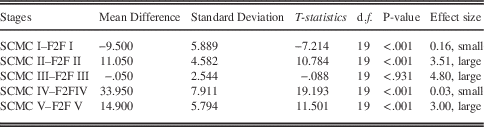
t-test results for question forms in each developmental stage and two modalities (SCMC vs. F2F)

The paired samples t-test procedure (Table 3) reveals that the difference between text-based SCMC and F2F was statistically significant (p<.001) across all developmental stages, except for Stage III. Results indicate no significant differences (p=.931) between SCMC and F2F in the number of Stage III questions produced, t(19)=−.088, p=.931, d=−0.03. Text-based SCMC led to a production of the Stage II, IV, and V questions that was significantly more frequent (p<.001) than in F2F. In contrast, F2F conversation led to more Stage I questions than text-based SCMC. In other words, most participants used single words or sentences with subject-verb-object word order to form questions more often during F2F conversations than during SCMC, as in the following examplesFootnote 1 .
Example 1: Text-based SCMC
-
1 Choi: We might need it [flashlight].
-
2 Lee: What do you want to look at at night?
Example 2: F2F
-
1 Lee: Sun is smiling? No?
-
2 Choi: No. There is no sun.
-
3 Lee: OK. And… There is one boy? Right?
As the example illustrated, in text-based SCMC, learners produced questions of a more advanced stage in complete sentences, whereas during F2F conversations, learners produced questions using only one word or unit of words. In the following example (Example 3), Lily starts a new topic (i.e., Snowman) in Line 2, after talking about a house with Cheon in Line 1; however, she does not use a complete sentence, such as, “Do you have a snowman?” but rather, the unit “A snow man?” with raising intonation to indicate a question. Her interlocutor, Cheon, does not have a problem understanding her question and answers her accordingly. In the next turn (Line 4), Lily again forms a question with an incomplete sentence.
Example 3: F2F during a spot-the-difference task
-
1 Cheon: I also saw fence around the house.
-
2 Lily: Yeah… … Hmm. A snow man?
-
3 Cheon: Yes. I have. The snow man has big nose.
-
4 Lily: Made from cabbage?
-
5 Cheon: I don’t know but it looks like cat, carrot.
As this exchange illustrates, learners do not ask questions in full sentences or in higher-stage question forms in F2F. It appears that F2F conversational contexts allow a learner to identify topics and follow another’s idea more easily than in text-based SCMC without forming full sentences. Because time delays or overlapping turns are absent during F2F, interlocutors responded to each other by acknowledging or asking questions before moving on to new topics. Therefore, a speaker can ask questions with simple units, such as “A snow man?” only to attract the other’s attention to the topic. Once the speaker succeeds in attracting the other’s attention to the topic, they can talk about the topic in more detail. In Example 4, on Line 1, Cheon does not specify the location of a hat in the first question although the task requires learners to share specific information on the location of items to complete tasks. Later in Line 3, he indicates the hat’s location. This conversation is possible because both interlocutors are on the same topic and when Cheon adds “On the snow man?” in the second question, it makes sense, as “[Is there a hat] on the snowman?”
Example 4: F2F during spot-the-difference task
-
1 Cheon: Is there hat?
-
2 Lily: Hat?
-
3 Cheon: On the snow man?
In contrast, asking questions using a single word or an incomplete sentence may cause confusion in text-based SCMC because overlapping turns and split interactions are pervasive in text-based SCMC. Learners, therefore, seem to try to produce complete question forms with all necessary information to make the statement clear.
Example 5: Text-based SCMC during spot-the-difference task
-
1 Cheon: Do you have frame on the furniture?
-
2 Lily: How many drawers are there under the vase?
-
3 Cheon: Just two drawers.
-
4 Lily: What kind of furniture is it?
-
5 Cheon: On the left side of picture, there is a furniture with three drawers.
-
6 Lily: I have one with four drawers without frame.
In Line 1 of this excerpt, Cheon specifies the location of a frame by including “on the furniture,” rather than asking “Do you have a frame?” as he does in F2F. Because of the time delay between turns, Lily does not answer Cheon’s first question immediately. However, after one exchange regarding drawers in Lines 2 and 3, Lily asks him again in Line 4 about the furniture that Cheon mentioned in the first question in Line 1. Imagine learners trying to identify a topic by using a word or unit and then having an interlocutor ask questions about it three turns later. Such a process would take too many turns to complete, and the split turns would exacerbate the miscommunication. In these text-based SCMC interactions, learners tried to broach topics by including all the necessary information during their initial turns in order to better their chances of achieving their goal, using complete sentences that are less ambiguous to avoid miscommunication.
While the mode of communication affected some levels of question forms that learners produced, it appeared that task types did not interact with the mode of communication in affecting question formation. A one-way multivariate analysis of variance revealed that there is no statistically significant interaction effect between task types and question levels on the combined dependent variables, F(4, 222)=1.019, p=.422; Wilks λ=.930. This suggests that the effect of task types is consistent across mode of communication.
5.2 Interlanguage variation in the use of articles
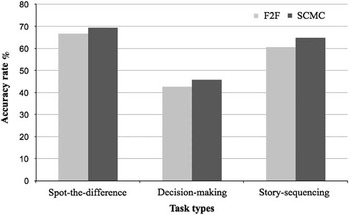
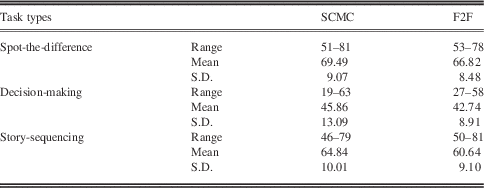
Table 4 displays the range, means, and standard deviations of the rate measures for the three different tasks and the two modalities (text-based SCMC and F2F). In general, the accuracy rates for articles were higher in text-based SCMC than in F2F conversation. Although text-based SCMC produced higher rates of accuracy than F2F in all task types, both text-based SCMC and F2F showed similar patterns of accuracy depending on the task types (Figure 1). The descriptive statistic demonstrated that accuracy rates in both text-based SCMC and F2F were higher in the spot-the-difference tasks, followed by, in order, the story-sequencing and decision-making tasks. Thus, while the mode of communication appears to be related to the accuracy rate of articles and stages of question forms, the data indicate that task types may affect the accuracy in both text-based SCMC and F2F interactions in a similar way. The Levene’s tests for all independent samples were checked and their p-values were higher than .05, meaning that SCMC and F2F had equal variances. Shapiro-Wilk’s test revealed that all dependent variables were normally distributed (p>.05).
Average accuracy rates of articles in three task types

Accuracy rates of articles

Note: The scores are presented in percentages: the number of correct articles used divided by the total number of obligatory contexts.
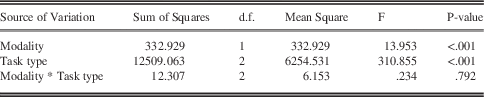
A repeated measures analysis (ANOVA) design was used to compare the accuracy rate of article use by participants in text-based SCMC and F2F across three different language tasks. Thus, there were two within-subject factors – Modality with two levels: SCMC and F2F and Task Type with three levels: Spot-the-difference, Decision-making, and Story-sequencing. The results (Table 5) show significant main effects for Modality, F(1, 19)=13.953, p<.001, and Task Type, F(2, 38)=310.855, p<.001. However, there are no significant interactions between Modality and Task. The main effect for Modality confirms that the participants use articles more accurately in text-based SCMC than F2F. In addition, the main effect for Task Type shows that accuracy rate for articles are different depending on task types.
ANOVA summary table for the accuracy rate of article uses

6 Discussion
In answering the first research question, participants varied widely in accuracy levels and in producing question forms in both text-based SCMC and F2F interactions. First, all participants produced lower-stage question forms in F2F interactions more frequently than in text-based SCMC. The differing patterns of question forms in the two modes of interaction indicate that the mode of communication affects the nature of the interaction. Because in text-based SCMC paralinguistic cues were absent and split turns were abundantly present, learners seemed to try to convey meaning without causing misunderstanding by producing complete and more advanced question forms. In contrast, during F2F interaction, learners conveyed meaning without forming a complete question, aided by paralinguistic cues, such as intonation. Moreover, due to the use of paralinguistic cues during F2F conversation, there was little worry over split or overlapping turns that made it hard for learners to follow their stream of thought. Accordingly, learners appeared to produce a lower level of question forms in F2F than in text-based SCMC.
Similarly, the higher accuracy rate for articles in text-based SCMC supports previous research suggesting higher accuracy in SCMC. Learners in this study might take advantage of text-based messaging and the extra time between turns in producing articles. Learners might also pay closer attention to articles in text-based SCMC than in F2F interaction, in part, because the physical absence of an interlocutor makes speakers concentrate more on article use, which is crucial for maintaining clear reference. During oral interaction, learners could sense whether or not interlocutors understood their utterances even before their interlocutors responded, because interlocutors often signaled their understanding by using paralinguistic cues. However, during SCMC, speakers were unable to see whether their interlocutors understood them, unless the interlocutors made an effort to type in their responses. Therefore, speakers used language more carefully in order to assist their listeners behind the computer screen. In addition to affecting features of interactional modes, the learning practices associated with writing appeared to affect the level of attention to forms in learners. Although text-based SCMC is a kind of instant interaction, learners might feel that it was closely related to traditional writing. Learners often have been trained to pay attention to forms while writing. Consequently, learners (perhaps, unconsciously) might pay more attention to forms in SCMC and therefore, might produce more correct forms in SCMC than in F2F interaction.
Participants’ interlanguage variability in SCMC indicates that these learners have extensive knowledge of question forms and are able to produce them; however, the learners may not always apply this knowledge in their spoken production. Not all Stage I and II question forms are ungrammatical; in fact, ungrammatical forms appear even in the speech of native speakers. From a pedagogical perspective, however, regular production of lower-stage question forms is problematic, because learners may not have a chance to practice higher-stage questions and so, may fail to expand their interlanguage. This finding suggests that teachers need to pay attention to the effects of conversational modality on learners’ interlanguage production and also raises questions regarding the way that teachers assess learners’ abilities. Given the popularity of text-based SCMC as a new method of communication, testing may need to be extended to include this new discourse context.
In answering the second research question, the task types were also found to be influential in article production. In both modalities, spot-the-difference tasks elicited a higher accuracy rate, while decision-making tasks elicited the lowest. This finding corroborates studies (Pellettieri, Reference Pellettieri2000; Yilmaz and Grañena, Reference Yilmaz and Grañena2010; Yilmaz, Reference Yilmaz2011) indicating that in the more closed-type tasks with convergent goals and only one possible outcome, the expectation is to generate the largest degree of negotiation. Although the focus of this study is not on the negotiation episode, the closed-task type may also have affected learner attention similarly to its effect on the accuracy of the article produced. In addition to being a closed-task type with one outcome possible, spot-the-difference tasks require a relatively high level of precision in their expression, a condition that likely could affect the accuracy rate of the articles produced.
Articles are important in maintaining cohesiveness in discourse and in tracking referents. In both spot-the-differences and story-sequencing tasks, references to objects and people are more important than in the decision-making task because participants must distinguish among various objects and people in order to make the storyline clear and cohesive. The use of articles is crucial in maintaining clear reference. The learners seemed to understand the need for articles to complete goals in the spot-the-differences and story-sequencing tasks, and so, they used articles more correctly. In contrast, in the decision-making task, learners did not need to maintain clear reference because there was little possibility of misinterpretation by listeners. Consequently, learners appeared to focus more on the content of discourse than on its forms. The difference in accuracy of article usage might occur because all three distinct tasks elicited disparate types of noun phrases, each suited for articles’ various functions. Although an analysis of noun phrases is beyond the scope of this study, such analysis might explain the variations in accuracy rate across tasks (Tarone & Parrish, Reference Tarone and Parrish1988).
In terms of accuracy, the results are in line with previous findings (Foster & Skehan, Reference Foster and Skehan1996; Skehan & Foster, Reference Skehan and Foster1997), which reported that decision-making tasks lead to higher accuracy levels than narrative tasks. In discussing their findings, Foster and Skehan argued that different kinds of tasks posed different types of cognitive demands affecting the complexity and fluency of learner language. In this sense, the spot-the-difference tasks used in this current study appear to have made the least amount of cognitive demand because the context is embedded in the task information and no reasoning is required. The decision-making task, on the other hand, may have made more cognitive demand because the context is more remote and because reasoning is required in presenting opinions. Although the reasons for the variations in accuracy rates are not apparent, interestingly, the same patterns have been found in both text-based SCMC and F2F interactions. In both modalities, spot-the-differences tasks elicited a higher accuracy rate and the decision-making task elicited the lowest. Findings suggest that in both text-based SCMC and F2F interaction, factors that influence variation in interlanguage work in similar ways.
7 Conclusion
Much research on F2F interaction has reported that the nature of the task that learners perform affects the accuracy of the grammatical forms they produce (e.g., Tarone, Reference Tarone1988). The current study also demonstrated that task type affects learner interlanguage in text-based SCMC in a way that resembles that of F2F interaction. The different ranges of variability of interlanguage in SCMC indicate that SCMC provides learners with varying environments for conversation. Although both text-based SCMC and F2F interactions are more spontaneous and less deliberate than traditional writing, SCMC could help learners pay more attention to forms (both consciously and unconsciously) and produce linguistic forms more correctly and at a higher stage, at least in terms of articles and questions. The findings indicate that text-based SCMC as a new language-learning environment differs from F2F interaction and leads to a different level of learner attention to forms.
These findings suggest that text-based SCMC needs to be used selectively based on pedagogical purpose. Text-based SCMC may be a better way to encourage learners to practice articles and higher levels of question formation. These results may not, however, be generalized to other populations, given the small number of participants in this study. In addition, because participants in this study are highly educated and have learned English in less-communicative classrooms, their experience of writing may influence their production in SCMC. Learners who lack strong experience with writing may experience SCMC differently. Further study should be done to compare variability among the three modalities of F2F speaking, oral SCMC, and text-based SCMC. In addition, investigation into the links in SCMC between L2 learners’ language production and acquisition promises productive research. Future studies need to further explore the internal features of tasks and the demand they make in order to understand task-induced interlanguage variation.
Acknowledgements
This research was supported by the Postdoctoral Research Program of Sungkyunkwan University, Korea (2016). I would like to thank the anonymous reviewers for their insightful comments on an earlier version of the paper.
Appendix A. Sample spot-the-difference task

Appendix B. Sample decision-making task

Appendix C. Sample story-sequencing task