Introduction
Léon Provancher (1820–1892), a French Canadian naturalist and priest, contributed greatly to the knowledge of insects in the Nearctic region. He was among the first entomologists in Canada, describing thousands of species known from Québec, Ontario, and elsewhere in North America (Cody et al. Reference Cody, Savile and Sarazin1986; Perron Reference Perron2011, Reference Perron2012). Of particular interest to Provancher was the Hymenoptera, and he made foundational contributions to knowledge of Symphyta (Sarazin Reference Sarazin1986), Chalcidoidea (Burks Reference Burks1963), Ichneumonidae (Gahan and Rohwer Reference Gahan and Rohwer1917, Reference Gahan and Rohwer1918; Townes Reference Townes1939; Heinrich Reference Heinrich1959; Barron Reference Barron1975), Formicidae (Francoeur and Béique Reference Francoeur and Béique1966), Proctotrupoidea (Masner Reference Masner1969), and Bethylidae (Azevedo Reference Azevedo2007). Provancher described almost 1000 species of Hymenoptera (Azevedo Reference Azevedo2007); 963 species were tallied by Desmeules (Reference Desmeules2006) from the catalog of Hurd (Reference Hurd1979). Most of Provancher's species were described in the journal Naturaliste canadien (Provancher Reference Provancher1882, Reference Provancher1883a, Reference Provancher1895, Reference Provancher1896) and in Additions et corrections au Volume II de la Faune Entomologique du Canada (Provancher Reference Provancher1888). The 1882 and 1883 volumes of Naturaliste canadien were repeated in Provancher's (1883b) Petite faune entomologique du Canada et particulièrement de la province de Québec. The last two of Provancher's works covering bees (Apoidea: Apiformes) (Provancher Reference Provancher1895, Reference Provancher1896; which included 15 newly described species) were published posthumously. Provancher's notebook shows that he was still actively working on bees and many other insects at the time of his death, with several proposed names that were never published.
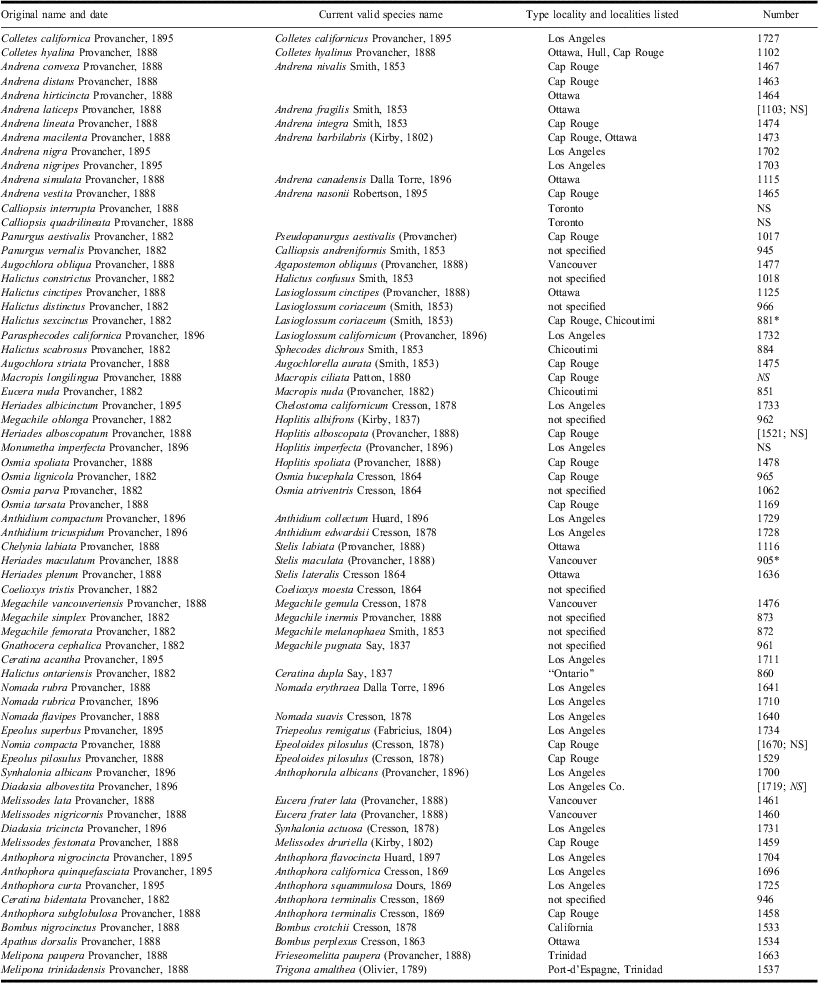
No single treatment has focused on the bees described by Provancher, though many species were covered within the catalogues of Dalla Torre (Reference Dalla Torre1896), Michener (Reference Michener1951), Hurd (Reference Hurd1979), and Moure and Hurd (Reference Moure and Hurd1987), and in many revisions of North American bees. Mitchell (Reference Mitchell1960, Reference Mitchell1962) examined most of Provancher's species from eastern Canada (as indicated by correspondence archived at the Université Laval, Ste Foy, Québec, Canada); however, only in a few published instances did Mitchell specificially state that type material was examined. Additionally, Titus (Reference Titus1906) published on the type material of most of Provancher's Megachilidae, though several errors were made in recording information from specimens. Despite this coverage, the taxonomy of several of Provancher's species remains unclear as taxonomists (e.g., Fowler Reference Fowler1899b; Rozen Reference Rozen1958; Timberlake Reference Timberlake1969; McGinley Reference McGinley1986) have not been able to study some of the material because specimens are lost, their repositories are unknown, or lectotypes were not designated properly (Table 1).
Bee (Hymenoptera: Apoidea) species described by Provancher (Reference Provancher1882–Reference Provancher1895), including their status as valid species or junior synonyms, type locality (if known), and Provancher's notebook entry number of the type specimen (corresponding to yellow label, unless indicated by * for blue label).

The data are presented taxonomically according to the higher classification of Michener (Reference Michener2007), and alphabetically within genus.
NS = no specimen.
“Lectotypes” for most of Provancher's bee species were selected and labelled by Comeau, the former curator of the Provancher collection, mostly in 1941; in 1971, Barron (also a former curator of the Provancher collection) also labelled these same specimens as lectotypes. However, these designations were never published, as pointed out by Ordway (Reference Ordway1966) and Rightmyer (Reference Rightmyer2008), and are thus not valid. Fortunately, most of the specimens selected by Comeau, and later by Barron, were from the “dernière Provancher Collection” (also called the “Second” collection by Gahan and Rohwer (Reference Gahan and Rohwer1917) and Townes (Reference Townes1939)), as indicated by the labels with double red lines. Incidentally, these labels on a specimen do not necessarily indicate that it is a Provancher type specimen, but often just the first specimen of a series within the collection (Burks Reference Burks1963). As indicated by Schwarz (Reference Schwarz1948), “the dernière collection was retained and used by Provancher” until his death, and maintained separate from the “First” collection which was sold to and maintained by the Québec Provincial Museum. It was from this dernière collection that Gahan and Rohwer (Reference Gahan and Rohwer1917, Reference Gahan and Rohwer1918) selected lectotypes for Provancher's Ichneumonidae (Schwarz Reference Schwarz1948; Burks Reference Burks1963). Perron (Reference Perron2011, Reference Perron2012) provides a detailed account of the history of the Provancher collection and the specimens it contains.
Gahan and Rohwer (Reference Gahan and Rohwer1917) wrote that “[t]hat Provancher had no concrete idea of the value of types is shown by the fact that in no case (with possibly a few exceptions in later years) were his types labelled as such. Furthermore, it is apparent that when he discovered one of his species to be a synonym he often removed the name label from the type and pinned the specimen among others of the species to which he thought it belonged. In other instances, upon deciding that one of his species was synonymous with another not already represented in his collection he removed the original name label and replaced it with what he considered to be the correct one”. Desmeules (Reference Desmeules2010) provides a thorough review of Provancher's concepts of species and type material. Also problematic was that Provancher did not indicate in published form how many specimens were examined (i.e., which comprised the type series), though in many cases both sexes were described and/or several localities were listed (see examples below). This indicates that for some of his bee species, a series of specimens were used, or could exist within the collections. Even in cases where a single sex and/or location were described for a species, it is not clear how many specimens were in the type series, as pointed out by Schwarz (Reference Schwarz1948) [and revealed in Provancher's notebook]. These issues are also true for the species that were named and described after Provancher's death, and for the material that was dispersed to several collections in Québec during and after Provancher's life time (Gahan and Rohwer Reference Gahan and Rohwer1917; Townes Reference Townes1939; Burks Reference Burks1963).
The main objective of this work is to clarify the taxonomic status of Provancher's bees, designate lectotypes where required (and possible), and provide a complete catalogue of bee species described by Provancher, including their current status, storage locations, and type localities. We deemed it necessary to designate lectotypes for specimens which may or may not be the sole representatives of Provancher's species, following Recommendation 73F of the International Commission on Zoological Nomenclature (ICZN) (i.e., avoidance of assumption of holotype). These mostly correspond to the unpublished designations of former curator Comeau, and later by Barron. A second objective is to summarise the published bee works of Provancher to establish a pre-1900 baseline list of bee species for the eastern Canadian fauna, in particular the provinces of Québec and adjacent Ontario. To meet this objective, specimens identified by Provancher, with published accounts (Provancher Reference Provancher1882–Reference Provancher1895), were examined, and the taxonomy clarified.
Methods and materials
The Provancher Collection (ULQC: Université Laval, Ste Foy, Québec, Canada) contains two collections of Provancher material (Gahan and Rohwer Reference Gahan and Rohwer1917) that were examined. Additionally, a collection of Provancher material was maintained, until recently, in the “Collection Léon-Provancher du Collège de Lévis”; this is now also at ULQC. Few of Provancher's species have had lectotypes properly designated, so material from all of Provancher-related collections (much of which was presumably identified by Provancher) were also examined. Much of this material was misidentified.
Institutions holding examined specimens are indicated as follows: ULQC Université Laval, Ste Foy, Québec, Canada (includes Provancher material previously held at Collège de Lévis, Lévis, Québec, Canada); NCSU: North Carolina State University, Entomology, Raleigh, North Carolina, United States of America; PCYU: Packer Collection at York University, Toronto, Ontario, Canada; NMNH: Smithsonian, National Museum of Natural History, Department of Entomology, Washington, DC, United States of America.
The labels accompanying the specimens are referred to from the top to the bottom of the pin, each separated by a double forward slash (//). It was assumed that handwritten labels with a double red-bordered label (Fig. 1) or labels with similar handwriting were Provancher's original designations, as the penmanship matches that found in Provancher's notebook. In addition, Provancher's notebook was used to associate type material to names; most of his specimens were originally labelled with a number that corresponds to information in the notebook (Townes Reference Townes1939; Burks Reference Burks1963; Perron Reference Perron2011, Reference Perron2012).
An example of Provancher's handwriting on a label of a species he described.
Results and discussion
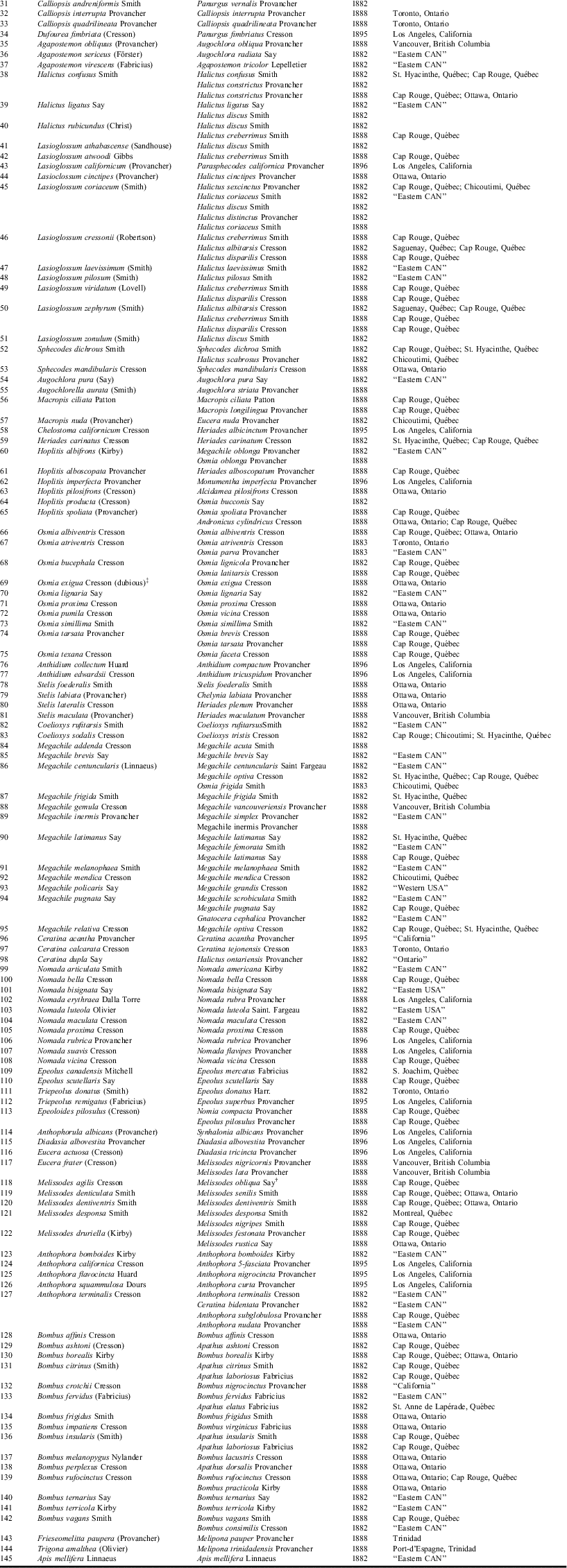
In his published works on bees (Provancher Reference Provancher1882, Reference Provancher1883a, Reference Provancher1883b, Reference Provancher1888, Reference Provancher1895, Reference Provancher1896), Provancher recorded and/or applied 179 names to bees in North America (and two from Trinidad), including the 67 species he described as new (Table 1), representing 145 currently valid species (Appendix 1). Among these, 21 of the 67 bees described by Provancher are here considered valid species; an additional five of Provancher's names were preoccupied. Lectotypes for 60 of Provancher's species are here designated. An additional six specimens were previously designated, and are now labelled to reflect this. Type material for eight species has not been located (nor designated), though one of these specimens was apparently examined by Titus (Reference Titus1906). Five species are here considered nomena oblita.
Many of the specimens identified by Provancher were done so incorrectly, though primarily due to the fact that many of these species were not yet described (see Part B below). As such, some of these specimens represent the oldest records of these species in Canada, dating to at least 1882–1892, and thus provide a historic baseline for this region. At the present time, Québec and Ontario have 255 and 399 species recorded, respectively (Sheffield et al. Reference Sheffield, Dumesh and Cheryomina2011b), so during his work, Provancher examined and published accounts of between 35–55% of the regions known bee fauna.
PART A – Annotated catalogue of bee species described by Provancher
COLLETIDAE
1. Colletes californicus Provancher
Colletes californica Provancher, Reference Provancher1895: 189 [♀, ♂]. Lectotype hereby designated.
Viereck (Reference Viereck1902) provided a complete description of what he thought was the male of Provancher's species. Cockerell (Reference Cockerell1905c) also provided a description for the male of C. californica, and indicated that the specimen Viereck referred to as “californica” was not Provancher's species, but an undescribed species that he (Cockerell) named Colletes gandialis (name later emended to C. gaudialis Cockerell (Cockerell Reference Cockerell1905d); now considered a subspecies of C. hyalinus Provancher). However, it is apparent than neither Viereck nor Cockerell examined the type material of Provancher's species; the male specimen at ULQC, labelled: 1727–2 [white label] // Allotype 284 Colletes californica Provancher Comeau 1944 [purple label] // Paralectotype 1727 Colletes californica Provancher Barron '71 [yellow label], is not a Colletes Latreille, but a Melissodes Latreille. However, this was probably not the specimen that Provancher was referring too (based on his description). Stephen (Reference Stephen1954), who revised the genus Colletes for North America, indicated the location of the type material, but also did not examine it. Although Provancher (Reference Provancher1895) indicated the type material was at the Musée du Parlement, Québec, he did not specifically assign a specimen to be the holotype. In lieu of this, we hereby designate the lectotype for Provancher's species.
Type Material: The lectotype female of Colletes californica is in the ULQC. The specimen is in excellent condition, and is labelled: 1727 [yellow label] // Colletes californica Prov. [handwritten on double red bordered label] // Lectotype Colletes californica Prov. Comeau 1944 [red label] // Lectotype 1727 Colletes californica Provancher Barron '71 [red label] // Lectotype Colletes californica Provancher Sheffield & Perron, 2013 [our red label]. Type locality: Los Angeles, Cal[ifornia].
2. Colletes hyalinus hyalinus Provancher
Colletes hyalina Provancher, Reference Provancher1888: 303 [♀, ♂]. Lectotype hereby designated.
Colletes spurcus Viereck, Reference Viereck1903: 59 [♀, ♂].
Colletes fraserae Swenk, Reference Swenk1908: 41 [♂].
Colletes cauponarius Cockerell, Reference Cockerell1929: 297 [♀].
Colletes nitidicaudus Cockerell, Reference Cockerell1929: 299 [♂].
Colletes hyalinus hyalinus Provancher is one of three subspecies listed by Stephen (Reference Stephen1954), the other two (C. h. oregonensis Timberlake; C. h. gaudialis Cockerell) are restricted to coastal areas west of the Rockies. Although Stephen (Reference Stephen1954) expressed some doubt of the synonymies of C. spurcus Viereck and C. fraserae Swenk under C. hyalinus s. str. at the subspecies level, primarily due to their montane distribution, he did believe the association was correct at the species level. There is no indication that Stephen (Reference Stephen1954) examined Provancher's type material, though he indicates the location in the “Quebec Public Museum”. Correspondence to N. Comeau (former curator at ULQC) from July 1947 indicates that T.B. Mitchell examined Provancher specimen, but he (Mitchell) never indicated this in published form (i.e., Mitchell Reference Mitchell1960). In lieu of this, we hereby designate a lectotype for Provancher's species.
Type Material: The lectotype female of Colletes hyalina is in the ULQC. The specimen is in good condition, and is labelled: 1102 [yellow label] // Colletes hyalina Prov. [handwritten on double red bordered label] // Lectotype Colletes hyalina Prov. Comeau 1944 [red label] // Lectotype 1102 Colletes hyalina Provancher Barron '71 [red label] // Lectotype Colletes hyalina Provancher Sheffield & Perron, 2013 [our red label]. Type locality not given on specimen label: Ottawa (Ontario, Canada), Hull (Québec, Canada), and Cap Rouge (Québec, Canada) are listed in the original description by Provancher (Reference Provancher1888), but not on the specimen.
ANDRENIDAE
3. Andrena (Leucandrena) barbilabris (Kirby)
Apis sericea Christ, Reference Christ1791: 190 (primary junior homonym of Apis sericea Forster, 1771) [♀].
Hylaeus similis Fabricius, Reference Fabricius1793: 306 (secondary junior homonym of Andrena similis Smith, 1849) (nomen oblitum).
Melitta barbilabris Kirby, Reference Kirby1802: 151 [♂].
Melitta albicrus Kirby, Reference Kirby1802: 156–157 [♀].
Andrena albocincta Zetterstedt, Reference Zetterstedt1838: 460 [♀].
Andrena barbatula Zetterstedt, Reference Zetterstedt1838: 461 [♂].
Andrena parumpunctata Schenck, Reference Schenck1853: 236.
Andrena placida Smith, Reference Smith1853: 112 [♀].
Andrena angustipes Schenck, Reference Schenck1866: 326 [♀, ♂].
Andrena ciliata Schenck, Reference Schenck1869: 375 (secondary junior homonym of Apis ciliata Gmelin, 1790) [♂].
Andrena macilenta Provancher, Reference Provancher1888: 313 [♀, ♂]. Lectotype hereby designated.
Andrena macgillivrayi Cockerell, Reference Cockerell1897a: 308 [♀].
Andrena salicacea Robertson, Reference Robertson1900: 48 [♀].
Andrena sapellonis Cockerell, Reference Cockerell1900b: 19 [♀, ♂].
Andrena pauperata Pérez, Reference Pérez1902: 177.
Andrena ciliatula Viereck, Reference Viereck1916a: 127 (nomen novum for Andrena ciliata Schenck).
Andrena sericea malaisei Alfken, Reference Alfken1929: 5 [♀].
Andrena (Euandrena) taisetsusana Tadauchi and Hirashima, Reference Tadauchi and Hirachima1987: 133 [♀, ♂].
Andrena (Andrena) dolharubang Tadauchi and Xu, 1997 in Tadauchi et al. Reference Tadauchi, Xu and Paik1997: 189 [♀].
The synonymy of Andrena macilenta Provancher under A. placida Smith was made by Viereck (Reference Viereck1907), though there is no mention of the Provancher type material being examined. LaBerge (Reference LaBerge1986b) synonymised Provancher's species under A. barbilabris but also did not examine the type material, citing that T.B. Mitchell had, and that he (Mitchell) supported the synonymy. Mitchell (Reference Mitchell1960) does not make a specific statement about examining Provancher's type material, but correspondence between Mitchell and N. Comeau (ULQC) (dated July 1947) indicates that he did. In lieu of a published account, we hereby designate a lectotype for Provancher's species.
Type Material: The lectotype male of Andrena macilenta is in the ULQC. The specimen is in good condition, and is labelled: 1473 [yellow label] // Andrena macilenta Prov. [handwritten on double red bordered label] // Lectotype Andrena macilenta Prov. Comeau 1941 [red label] // Lectotype 1473 Andrena macilenta Provancher Barron '71 [red label] // Lectotype Andrena macilenta Provancher Sheffield & Perron, 2013 [our red label]. Type locality not specified on specimen: Cap Rouge (Québec, Canada) and Ottawa (Ontario, Canada) are listed in the original description by Provancher (Reference Provancher1888).
4. Andrena (Cnemidandrena) canadensis Dalla Torre
Andrena simulata Provancher, Reference Provancher1888: 313 (primary junior homonym of Andrena simulata Smith, Reference Smith1879) [♀, ♂]. Lectotype hereby designated.
Andrena canadensis Dalla Torre, Reference Dalla Torre1896: 107 (nomen novum for Andrena simulata Provancher).
Andrena (Pterandrena) persimilis Graenicher, Reference Graenicher1904: 66 [♀].
Andrena canadensis oslarella Viereck and Cockerell, Reference Viereck and Cockerell1914: 28 [♂].
Although Donovan (Reference Donovan1977) presumably (i.e., he acknowledged a loan of material from Laval University, and states specimen number 1115) examined the “holotype female”, the assumption that Andrena simulata Provancher was based upon a single type specimen (as per ICZN Code Article 74.6) is not met, as Provancher's (1888) work indicates at least two syntypes. Thus according to Code Article 74.5, the work of Donovan (Reference Donovan1977) does not constitute a valid lectotype designation and following Code Recommendation 73F (“avoidance of assumption of holotype”), we hereby designate a lectotype of Provancher's species.
Type Material: The lectotype female of Andrena simulata is in the ULQC. The specimen is in good condition, and is labelled: 1115 [yellow label] // Andrena simulata Prov. [handwritten on double red bordered label] // Lectotype Andrena simulata Prov. Comeau 1941 [red label] // Lectotype 1115 Andrena simulata Provancher Barron '71 [red label] // Lectotype Andrena simulata Provancher Sheffield & Perron, 2013 [our red label]. Type locality: Ottawa (Ontario, Canada).
5. Andrena (Ptilandrena) distans Provancher
Andrena distans Provancher, Reference Provancher1888: 307 [♀, ♂]. Lectotype hereby designated.
Andrena g[erani]. maculati Robertson, Reference Robertson1897: 333 [♀, ♂].
LaBerge (Reference LaBerge1986b) indicates that T.B. Mitchell examined the Provancher type material, which is supported by correspondence between Mitchell and N. Comeau (ULQC) (dated July 1947). Mitchell (Reference Mitchell1960) synonymised Robertson's species under Provancher's, but does not specifically mention that the type material for A. distans was examined. In lieu of a published account, we hereby designate a lectotype for Provancher's species.
Type Material: The lectotype female of Andrena distans is in the ULQC. The specimen is in good condition, and is labelled: 1463 [yellow label] // Andrena distans Prov. [handwritten on double red bordered label] // Lectotype Andrena distans Prov. Comeau 1941 [red label] // Lectotype 1463 Andrena distans Provancher Barron '71 [red label] // Lectotype Andrena distans Provancher Sheffield & Perron, 2013 [our red label]. Type locality: Cap Rouge (Québec, Canada).
The “paralectotype” male specimen at ULQC is labelled: 1463A [white label] // Andrena distans Prov. ♂ Type [red label with single black border] // Allotype 45 Andrena distans Provancher Comeau '41 [purple label] // Paralectotype 1463 Andrena distans Provancher Barron '71 [yellow label] is not A. distans, but Andrena frigida Smith.
6. Andrena (Gonandrena) fragilis Smith
Andrena fragilis Smith, Reference Smith1853: 115 [♂].
Andrena laticeps Provancher, Reference Provancher1888: 307 (primary junior homonym of Andrena laticeps Morawitz, 1877) [♂].
Andrena provancheri Dalla Torre, Reference Dalla Torre1896: 147 (nomen novum for Andrena laticeps Provancher).
Provancher's species from Ottawa (Ontario, Canada) was placed into synonymy under A. fragilis by Viereck (Reference Viereck1907, Reference Viereck1916c), though there was no mention that the type material was examined. LaBerge and Ribble (Reference LaBerge and Ribble1972) indicated that the type specimen was in the “Québec Provincial Museum in Québec” but also did not examine this material in their revision. To our knowledge, no lectotype was ever designated for A. laticeps, and the specimen (labelled 1103 in Provancher's notebook) has apparently been lost. According to correspondence between T.B. Mitchell and N. Comeau (ULQC) (dated July 1947), this specimen has been lost since at least 1947. Interestingly, Provancher (Reference Provancher1888) provided a description of the male of Smith's (1853) species (A. fragilis) in the same work (p. 309), and several of these specimens are in the ULQC collection. Unfortunately, all of these were misidentified.
7. Andrena (Cnemidandrena) hirticincta Provancher
Andrena fimbriata Smith, Reference Smith1853: 116 (primary junior homonym of Andrena fimbriata Brullé, 1832) [♀, ♂].
Andrena hirticincta Provancher, Reference Provancher1888: 308 [♀, ♂]. Lectotype hereby designated.
Anthrena americana Dalla Torre, Reference Dalla Torre1896: 102 (nomen novum for Andrena fimbriata Smith).
Although Donovan (Reference Donovan1977) revised the subgenus Cnemidandrena Hedicke in North America, he does not specifically state that he examined type material for A. hirticincta, nor was a lectotype designated. Correspondence between T.B. Mitchell and N. Comeau (ULQC) (dated July 1947) indicates that he (Mitchell) did examine the type material for A. hirticincta, but he did not mention this in published form (i.e., Mitchell Reference Mitchell1960). Thus, we hereby designate the lectotype for Provancher's species.
Type Material: The lectotype male of Andrena hirticincta is in the ULQC. The specimen is in excellent condition, and is labelled: 1464 [yellow label] // Andrena hirticincta Prov. [handwritten on double red bordered label] // Lectotype Andrena hirticincta Prov. Comeau 1941 [red label] // Lectotype 1464 Andrena hirticincta Provancher Barron '71 [red label] // Lectotype Andrena hirticincta Provancher Sheffield & Perron, 2013 [our red label]. Type locality: Ottawa (Ontario, Canada).
8. Andrena (Gonandrena) integra Smith
Andrena integra Smith, Reference Smith1853: 114 [♀].
Andrena lineata Provancher, Reference Provancher1888: 309 [♀]. Lectotype hereby designated.
Andrena lucifera Cockerell, Reference Cockerell1932a: 155 [♀].
Although Mitchell (Reference Mitchell1960) provides a published account that he examined the Provancher type specimen, we follow ICZN Code Recommendation 73F (“avoidance of assumption of holotype”), and hereby designate a lectotype for Andrena lineata Provancher.
Type Material: The lectotype female of Andrena lineata is in the ULQC. The specimen is in good condition, and is labelled: 1474 [yellow label] // Andrena lineata Prov. [handwritten on double red bordered label] // Lectotype Andrena lineata Prov. Comeau 1941 [red label] // Lectotype 1474 Andrena lineata Provancher Barron '71 [red label] // Lectotype Andrena lineata Provancher Sheffield & Perron, 2013 [our red label]. Type locality Cap Rouge (Québec, Canada).
9. Andrena (Simandrena) nasonii Robertson
Andrena vestita Provancher, Reference Provancher1888: 310 (primary junior homonym of Andrena vestita Fabricius, Reference Fabricius1793) [♂]. Lectotype hereby designated.
Andrena nasonii Robertson, Reference Robertson1895: 120 [♀].
Andrena hartfordensis Cockerell, Reference Cockerell1902a: 103 [♀].
Andrena (Andrena) nasonii fulvodorsata Viereck, Reference Viereck1917: 385 [♀].
LaBerge (Reference LaBerge1989) did not examine Provancher's type material, but indicates that T.B. Mitchell did (who apparently confirmed the synonymy); this is supported by correspondence between Mitchell and N. Comeau (ULQC) (dated July 1947). However, Mitchell (Reference Mitchell1960) does not specifically mention that type material for A. vestita was examined. In lieu of a published account, we hereby designate a lectotype for Provancher's species.
Type Material: The lectotype male of Andrena vestita is in the ULQC. The specimen is in good condition, and is labelled: 1465 [yellow label] // Andrena vestita Prov. [handwritten on double red bordered label] // Lectotype Andrena vestita Prov. Comeau 1941 [red label] // Lectotype 1465 Andrena vestita Provancher Gahan & Rohwer ‘15, Barron '71 [red label] // Lectotype Andrena vestita Provancher Sheffield & Perron, 2013 [our red label]. Type locality Cap Rouge (Québec, Canada).
10. Andrena (Scrapteropsis) nigra Provancher
Andrena nigra Provancher, Reference Provancher1895: 173 [♀]. Lectotype hereby designated.
Andrena griseonigra Cockerell, Reference Cockerell1905a: 371 [♂].
Andrena subtristis Cockerell, Reference Cockerell1905a: 372 [♀].
Although Linsley (Reference Linsley1938) provides a published account that he examined the Provancher type specimen, we follow ICZN Code Recommendation 73F (“avoidance of assumption of holotype”), and hereby designate a lectotype for Andrena nigra Provancher. LaBerge and Bouseman (Reference LaBerge and Bouseman1977) placed Provancher's species in the subgenus Scrapteropsis Viereck.
Type Material: The lectotype female of Andrena nigra is in the ULQC. The specimen is in excellent condition, and is labelled: 1702 [yellow label] // Andrena nigra Prov. [handwritten on double red bordered label] // Lectotype Andrena nigra Prov. Comeau 1941 [red label] // Lectotype 1702 Andrena nigra Provancher Barron '71 [red label] // Lectotype Andrena nigra Provancher Sheffield & Perron, 2013 [our red label]. Type Locality: Los Angeles (California, United States of America).
11. Andrena (Oligandrena) nigripes Provancher
Andrena nigripes Provancher, Reference Provancher1895: 173 [♀]. Lectotype hereby designated.
Andrena macrocephala Cockerell, Reference Cockerell1916a: 278 [♂]. New synonymy.
Andrena peratra Cockerell, Reference Cockerell1916b: 46 [♀]. New synonymy.
Andrena macrocephala tetleyi Linsley, Reference Linsley1938: 282 [♀]. New synonymy.
Andrena nigripes (Fig. 2) was placed in the subgenus Melandrena Pérez by Hurd (Reference Hurd1979). Bouseman and LaBerge (Reference Bouseman and LaBerge1979) considered this to perhaps be the case but did not recognise it in their revision of Melandrena (Bouseman and LaBerge Reference Bouseman and LaBerge1979). Bouseman and LaBerge (Reference Bouseman and LaBerge1979) did not examine the type material of A. nigripes, but suggested that Provancher's species could be synonymous with either A. (Melandrena) perimelas Cockerell or A. (Melandrena) carliniformis Cockerell. Upon examining the Provancher material, it was determined that it was an Oligandrena Lanham, not a Melandrena, as recognised by the broad facial quadrangle (Fig. 2B), the poorly formed propodeal corbicula that lacks internal setae and an anterior border, with the dorsal setae short (Fig. 2C), and the incomplete trochanter flocculus, which is comprised of short, mostly simple setae (LaBerge Reference LaBerge1986a; Michener Reference Michener2007). Andrena macrocephala, here placed into synonymy with A. nigripes, serves as the type species for the subgenus Oligandrena, as designated by Lanham (Reference Lanham1949). Following ICZN Code Recommendation 73F (“avoidance of assumption of holotype”), we hereby designate a lectotype for Andrena nigripes Provancher.
(A) Lateral, (B) face, and (C) incomplete propodeal corbicula with absence of internal setae of the lectotype female of Andrena nigripes Provancher.
Type Material: The lectotype female of Andrena nigripes is in the ULQC. The specimen is in excellent condition, and is labelled: 1703 [yellow label] // Andrena nigripes Prov. [handwritten on double red bordered label] // Lectotype 52 Andrena nigripes Prov. Comeau 1941 [red label] // Lectotype 1703 Andrena nigripes Provancher Barron '71 [red label] // Lectotype Andrena nigripes Provancher Sheffield & Perron, 2013 [our red label]. Type Locality: Los Angeles (California, United States of America).
12. Andrena (Melandrena) nivalis Smith
Andrena nivalis Smith, Reference Smith1853: 118 [♀].
Andrena errans Smith, Reference Smith1879: 55 [♀, ♂].
Andrena convexa Provancher, Reference Provancher1888: 311 (primary junior homonym of Andrena convexa Schrank, 1781) [♀, ♂]. Lectotype hereby designated.
Andrena semirufa Cockerell, Reference Cockerell1900a: 407 [♀].
Andrena pluvialis Cockerell, 1901 in Morice and Cockerell Reference Morice and Cockerell1901: 154 [♀].
Andrena solidula Viereck, Reference Viereck1904: 191, 194 (keys), 222 [♀, ♂].
Andrena compactiscopa Viereck, Reference Viereck1904: 191 (key), 222 [♀].
Andrena junonia Viereck, Reference Viereck1904: 191 (key), 222 [♀].
Andrena argentiniae var trichomelaena Cockerell, Reference Cockerell1913: 376 [♂, ♀].
Andrena idahorum Viereck, Reference Viereck1916b: 732 [♀].
Andrena spaldingi Cockerell, Reference Cockerell1934: 3 [♀].
The synonymy of A. convexa Provancher under A. nivalis was first hinted at by Cockerell (1901; in Morice and Cockerell Reference Morice and Cockerell1901), and later supported by Viereck (Reference Viereck1907), though there was no mention of Provancher's type material being examined. Mitchell (Reference Mitchell1960) examined a male (syntype) specimen of A. convexa, and also supported this synonymy. Bouseman and LaBerge (Reference Bouseman and LaBerge1979) supported Mitchell (Reference Mitchell1960), though they also did not examine Provancher's material, but instead examined the male specimen Mitchell compared to the type material (i.e., a homotype). Although Mitchell (Reference Mitchell1960) examined Provancher's type material, the assumption that Andrena convexa Provancher was based upon a single type specimen (as per ICZN Code Article 74.6) is not met, as Provancher's (Reference Provancher1888) work indicates at least two syntypes. Thus according to Code Article 74.5, the work of Mitchell (Reference Mitchell1960) does not constitute a valid lectotype designation, so we do so here.
Type Material: The lectotype male of Andrena convexa is in the ULQC. The specimen is in good condition, and is labelled: 1467 [yellow label] // Andrena convexa Prov. [handwritten on double red bordered label] // Lectotype Andrena convexa Prov. Comeau 1944 [red label] // Lectotype 1467 Andrena convexa Provancher Barron '71 [red label] // Lectotype Andrena convexa Provancher Sheffield & Perron, 2013 [our red label]. Type Locality: Cap Rouge (Québec, Canada).
13. Pseudopanurgus aestivalis (Provancher)
Panurgus aestivalis Provancher, Reference Provancher1882: 205 [♀, ♂]. Subsequently placed in the genus Calliopsis Smith by Provancher (Reference Provancher1888). Lectotype hereby designated.
Panurginus nebrascensis Crawford, Reference Crawford1903: 335 [♂, ♀]. New synonymy(holotype examined).
Pseudopanurgus (Heterosarus) nebrascensis timberlakei Michener, Reference Michener1947a: 446 [♂, ♀]. Junior homonym. New synonymy.
Pseudopanurgus (Heterosarus) nebrascensis muesbecki Michener, Reference Michener1951: 1100 (nomen novum for P. nebrascensis timberlakei Michener). New synonymy.
Although Mitchell (Reference Mitchell1960) examined Provancher's type material, the assumption that Panurgus aestivalis Provancher was based upon a single type specimen (as per ICZN Code Article 74.6) is not met, as Provancher's (1882) work indicates at least two syntypes (see below). Thus according to Code Article 74.5, the work of Mitchell (Reference Mitchell1960) does not constitute a valid lectotype designation, so we do so here.
Mitchell (Reference Mitchell1960) provided a brief description, concluding Provancher's species was a member of the genus Pseudopanurgus Cockerell, probably the subgenus Heterosarus Robertson. He noted that no additional material other than the female holotype of Panurgus aestivalis, and a male specimen in the NMNH (labelled as C.[alliopsis] aestivalis) were available for examination (Mitchell Reference Mitchell1960), and concluded that the male was Pseudopanurgus nebrascensis muesbecki Michener. Provancher's specimen (Fig. 3) matches the female holotype of Pseudopanurgus nebrascensis (Crawford) from Nebraska, both species sharing the shiny, sparsely punctate mesoscutum (Fig. 3C) and the shiny, sparsely punctate basal tergum. Although Michener (Reference Michener1947a) was the first to recognise eastern and western forms of P. nebrascensis, this was based primarily on subtle variations in maculation patterns of the male, a common phenomenon among many panurgine bee species. DNA barcode sequences of individuals from Nova Scotia, Canada (i.e., P. muesbecki) do not vary from those from Manitoba, Canada (i.e., P. nebrascensis), thus both forms are here placed into synonymy with Provancher's species.
(A) Lateral, (B) face, and (C) dorsal images of the lectotype female of Panurgus aestivalis Provancher (current valid name Pseudopanurgus aestivalis (Provancher)).
Type Material: The lectotype female of Panurgus aestivalis is in the ULQC. The specimen is in good condition, pointed into a cork base, to which the metasoma is poorly glued. It is missing the left hind leg, and the last five flagellomeres of the left antenna. It is labelled: ♀ // 1017 [yellow label] // Calliopsis aestivalis Prov. [handwritten on double red bordered label] // Lectotype 1017 Panurgus aestivalis Provancher Barron '71 [red label] // Lectotype Panurgus aestivalis Provancher Sheffield & Perron, 2013 [our red label]. Type Locality: Cap Rouge (Québec, Canada).
The two type specimens of of Panurginus nebrascensis Crawford in the USNM were examined (the male and female are pinned together). The specimens are in excellent condition, and are labelled: Lincoln Nebr // Aug 27 02 // On Solidago missouriensis // J C Crawford collector // Crawford no. 1361 // Types No. 8235 U.S.N.M [red label, with combined male/female symbol] // Panurginus nebrascensis Crawford Types [red bordered label, with combined male/female symbol] // USNM ENT 00533809 [yellow label with barcode]. It is not clear from Crawford's original description (Crawford Reference Crawford1903) which of the two specimens was designated the holotype (though the male is described first) (nor is it clear in the NMNH type specimen database), but Crawford later indicated that the male specimen is the holotype (Crawford Reference Crawford1912).
14. Calliopsis (Calliopsis) andreniformis Smith
Calliopsis andreniformis Smith, Reference Smith1853: 128 [♀].
Calliopsis flavipes Smith, Reference Smith1853: 129 [♂].
Calliopsis lepidus Cresson, Reference Cresson1878a: 68 [♀].
Panurgus vernalis Provancher, Reference Provancher1882: 204 [♀, ♂]. Provancher Reference Provancher1888 (synonymy). Lectotype hereby designated.
Provancher (Reference Provancher1888) placed his species into synonymy with Calliopsis andrenoides Smith (lapsus of Calliopsis andreniformis Smith, based on citation by Provancher (Reference Provancher1888)). As indicated by Gahan and Rohwer (Reference Gahan and Rohwer1917), it is very likely that Provancher removed “type” labels when he placed his species into synonymy, and in this case relabelled his species as “Calliopsis andrenoides”.
Type Material: The lectotype female of Panurgus vernalis is in the ULQC. The specimen is in good condition, and is labelled: 945 // Calliopsis andrenoides Prov. [handwritten on double red bordered label] // Lectotype Panurgus vernalis Provancher Barron '71 [red label] // Lectotype Panurgus vernalis Provancher Sheffield & Perron, 2013 [our red label]. Type locality not specified.
15. Calliopsis interrupta Provancher, nomen oblitum
Calliopsis interrupta Provancher, Reference Provancher1888: 320 [♀].
16. Calliopsis quadrilineata Provancher, nomen oblitum
Calliopsis 4-lineata Provancher, Reference Provancher1888: 319 [♀]. Dalla Torre Reference Dalla Torre1896: 174 (Calliopsis quadrilineata; emendation of Calliopsis 4-lineata Provancher).
The type locality indicated for both C. interrupta and C. quadrilineata is Toronto (Ontario), Canada (Provancher Reference Provancher1888). Rozen (Reference Rozen1958) and Hurd (Reference Hurd1979) were unable to place these two species to subgenus within the genus Nomadopsis Ashmead, now considered a subgenus of Calliopsis Smith (Michener Reference Michener2007). Nomadopsis, which occurs primarily in western North America, was revised by Rozen (Reference Rozen1958), who could not examine the Provancher types as they were never designated and could not be located, but suggested that if the Provancher specimens are indeed from Ontario, then they may be members of the genus Perdita Smith. Five species of Perdita are known from eastern Canada (Packer et al. Reference Packer, Genaro and Sheffield2007), but Provancher apparently recognised Perdita; in the same publication in which these two Calliopsis were described (Provancher Reference Provancher1888: 321), Perdita octomaculata Say was described as being primarily green in colour, a characteristic shared by all the eastern Canadian species of Perdita (Mitchell Reference Mitchell1960; Packer et al. Reference Packer, Genaro and Sheffield2007). Provancher's descriptions for these two Calliopsis species indicate black integument and the abdomen with “cinq lignes blanches” [five white lines], therefore not matching any panurgine bee in eastern North America. A single female specimen of Calliopsis subgenus Nomadopsis was found in the Provancher collection of ULQC labelled: 239 // PROVANCHER coll. 239 UN. LAVAL Barron 1977, tentatively identified here as Calliopsis (Nomadopsis) mellipes (Timberlake), a species found in southern California (Rozen Reference Rozen1958). The specimen matches the brief description for Calliopsis quadrilineata, but no information in Provancher's notebook links that species to this specimen.
After an exhaustive search in collections known to contain Provancher material, no other specimens matching his brief descriptions were discovered, though two specimens of Panurginae (a female of Perdita octomaculata and male Calliopsis andreniformis) apparently identified by Provancher for William Brodie were discovered in the Royal Ontario Museum's Wm. Brodie Collection. However, the collection date (21-6-[18]95) on the specimen of Calliopsis post-dates the description dates of Provancher's species (and the year of his death).
As mentioned above, many of the species described by Provancher were from Los Angeles County, California (collected by Coquillett; see Table 1). Therefore, it seems probable that the type locality of C. interrupta and C. quadrilineata were recorded incorrectly, and that the specimens are lost and are hereby considered nomina oblita.
HALICTIDAE
17. Agapostemon (Agapostemon) obliquus (Provancher)
Augochlora obliqua Provancher, Reference Provancher1888: 318 [♀]. Lectotype hereby designated.
Agapostemon cockerelli Crawford, Reference Crawford1901: 161 [♀].
Janjic and Packer (Reference Janjic and Packer2003) examined Provancher's type material, making the synonymy listed above, but did not designate the specimen they examined as the lectotype. In lieu of Provancher not ruling out syntypes in the original work (Provancher Reference Provancher1888), and following ICZN Code Recommendation 73F (“avoidance of assumption of holotype”), we hereby designate the lectotype of Augochlora obliqua Provancher.
Type Material: The lectotype female of Augochlora obliqua is in the ULQC. The specimen is in good condition, and is labelled: 1477 [yellow label] // Augochlora obliqua Prov. [handwritten on double red bordered label] // Lectotype Augochlora obliqua Prov. Comeau 1941 [red label] // Lectotype 1477 Augochlora obliqua Provancher Barron '71 [red label] // Lectotype Augochlora obliqua Provancher Sheffield & Perron, 2013 [our red label]. Type Locality: Vancouver (British Columbia, Canada).
18. Halictus (Pachyceble) confusus Smith
Halictus confusus Smith, Reference Smith1853: 70 [♀, ♂].
Halictus constrictus Provancher, Reference Provancher1882: 202 (primary junior homonym of Halictus constrictus Smith, Reference Smith1853) [♂ not ♀; the ♀ was described by Provancher (Reference Provancher1888)]. Lectotype hereby designated.
Halictus provancheri Dalla Torre, Reference Dalla Torre1896: 77 (nomen novum for Halictus constrictus Provancher).
Halictus nearcticus Vachal, Reference Vachal1904: 470 [♀, ♂].
Halictus alpinus Alfken, Reference Alfken1907: 205 [♀, ♂].
Halictus perkinsi Blüthgen, Reference Blüthgen1926: 417 (nomen novum for Halictus flavipes of other authors [but not Halictus flavipes Fabricius]; see Perkins Reference Perkins1922).
Halictus arapahonum Cockerell, Reference Cockerell1906a: 316 [♀].
Halictus (Chloralictus) olivarius Sandhouse, Reference Sandhouse1924: 10 [♀].
Halictus (Seladonia) confusus glacialis Ebmer, Reference Ebmer1979: 121 [♂, ♀].
Halictus (Seladonia) confusus pelagius Ebmer, Reference Ebmer1996: 269 [♂, ♀].
Although considered to be a Holarctic species, H. confusus may actually be a species complex (Rosenmeier and Packer Reference Rosenmeier and Packer1993; Packer and Taylor Reference Packer and Taylor1997; Pesenko et al. Reference Pesenko, Banaszak, Radchenko and Cierzniak2000), possibly with separate Holarctic and Nearctic distributions. Preliminary DNA barcoding analysis also supports that this species may be a complex in North America. As such, H. provancheri Dalla Torre would be the oldest valid name for at least one of the North American species. According to Lovell (Reference Lovell1908), Robertson (Reference Robertson1895) incorrectly used Halictus fasciatus Nylander for this species (as Halictus provancheri Dalla Torre) in North America. Clearly, more morphological and molecular work needs to be undertaken to further resolve the taxonomy of this species complex.
Type Material: The lectotype male of Halictus constrictus is in the ULQC. The specimen is in good condition, labelled: 1018 [yellow label] // Halictus constrictus Prov. [handwritten on double red bordered label] // Lectotype Halictus constrictus Provancher Comeau 1944 [red label] // Lectotype 1018 Halictus constrictus Provancher Barron '71 [red label] // Lectotype Halictus constrictus Provancher Sheffield & Perron, 2013 [our red label]. Type locality not specified.
19. Lasioglossum (Lasioglossum) californicum (Provancher)
Parasphecodes californica Provancher, Reference Provancher1896: 8 [♀]. Subsequently placed in the genus Halictus Latreille by Cockerell (Reference Cockerell1898b). Lectotype hereby designated.
Lasioglossum timberlakei McGinley, Reference McGinley1986: 228–234 [♀, ♂]. New synonymy(holotype examined).
Following ICZN Code Recommendation 73F (“avoidance of assumption of holotype”), we hereby designate the lectotype of Parasphecodes californica Provancher. Parasphecodes californica (Fig. 4) is easily recognised as belonging to the subgenus Lasioglossum (Lasioglossum), the type material obviously from California, United States of America. McGinley (Reference McGinley1986) revised the New World Lasioglossum (Lasioglossum), and the type material of Parasphecodes californica keys to his species L. timberlakei; the most notable features being the rather sparsely and shallowly punctured mesoscutum (Fig. 4C) and pubescence (see McGinley Reference McGinley1986), and matches the published description. McGinley (Reference McGinley1986) recognised two forms of L. timberlakei, a “dark” form (from southern California, which includes the type specimen) and a “light” form. In addition to differences in pubescence, McGinley (Reference McGinley1986) recognised differences in the sculpturing of the propodeum, with more regularly and evenly spaced striae in the type form. Not mentioned, but illustrated (see McGinley Reference McGinley1986, Figs. 623–624) is the difference in the shape of the metanotum, being widest medially in the type form (see McGinley Reference McGinley1986, Fig. 623), and parallel throughout in the “pale form” (see McGinley Reference McGinley1986, Fig. 624). The Provancher material matches the type form of L. timberlakei, which is here placed into synonymy.
(A) Lateral, (B) face, and (C) dorsal images of the lectotype female of Parasphecodes californica Provancher (current valid name Lasioglossum californicum (Provancher)).
Much confusion has arisen from Provancher's use of Parasphecodes Smith, a group found in Tasmania, Australia, and New Guinea (Michener Reference Michener1965), for North American bees (McGinley Reference McGinley2003). Michener (Reference Michener1965) correctly recognised Parasphecodes as a subgenus of Lasioglossum Curtis and placed many Australian bees previous placed in the genus Halictus Latreille into this subgenus (Danforth Reference Danforth1999). The relationships among subgenera of Lasioglossum, including Parasphecodes, were clarified by Danforth and Ji (Reference Danforth and Ji2001).
Type Material: The lectotype female of Parasphecodes californica is in the ULQC. The specimen is in excellent condition, labelled: ♀ // 1732 [yellow label] // Parasphecodes californica Prov. Cal[ifornia]. [handwritten on double red bordered label] // Lectotype 1732 Parasphecodes californica Provancher Barron '71 [red label] // Lectotype Parasphecodes californica Provancher Sheffield & Perron, 2013 [our red label]. Type Locality: Los Angeles (California, United States of America).
The holotype female of Lasioglossum timberlakei McGinley in the USNM was examined. The specimen is in excellent condition, and is labelled: Los Angeles Co., Cal[ifornia]. // Holotype Lasioglossum timberlakei R.J. McGinley // USNM#105473 [red bordered label] // USNM 00535219 [yellow barcode label].
20. Lasioglossum (Evylaeus) cinctipes (Provancher)
Halictus cinctipes Provancher, Reference Provancher1888: 316 [♂]. Lectotype hereby designated.
Halictus arcuatus Robertson, Reference Robertson1893: 145 [♀].
Halictus crassus Vachal, Reference Vachal1904: 477 [♀].
Halictus adelipus Vachal, Reference Vachal1904: 479 [♂].
Halictus arcuatus parisus Lovell, Reference Lovell1908: 36 [♂].
Halictus arcuatus gulosus Cockerell, Reference Cockerell1911b: 661 [♀].
Halictus gulosus punctiferus Cockerell, Reference Cockerell1916a: 287 [♀].
Although the taxonomy of Provancher's species was covered by Mitchell (Reference Mitchell1960) and Knerer and Atwood (Reference Knerer and Atwood1964), to our knowledge there is no published account of the type material being examined before 2000 (thus meeting the conditions of ICZN Code Articles 74.5 or 74.6) is available, though correspondence between Mitchell and N. Comeau (ULQC) (dated July 1947) indicates that he (Mitchell) did. In 2011, J. Gibbs did examine Provancher's type material, a single male specimen that was considered in that study to be the holotype (see Gibbs et al. Reference Gibbs, Packer, Dumesh and Danforth2013). However, in lieu the fact that Provancher (Reference Provancher1888) did not rule out the existence of syntypes in his description, and following ICZN Code Recommendation 73F (“avoidance of assumption of holotype”), we hereby designate the lectotype of Halictus cinctipes Provancher. Halictus arcuatus serves as the type species of the subgenus Evylaeus Robertson, as originally designated by Robertson (Reference Robertson1902).
Type Material: The lectotype male of Halictus cinctipes is in the ULQC. The specimen is in good condition, labelled: 1125 [yellow label] // Halictus cinctipes Prov. [handwritten on double red bordered label] // Lectotype Halictus cinctipes Provancher Comeau 1944 [red label] // Lectotype 1125 Halictus cinctipes Provancher Barron '71 [red label] // Lectotype Halictus cinctipes Provancher Sheffield & Perron, 2013 [our red label]. Type locality: Ottawa (Ontario, Canada).
21. Lasioglossum (Lasioglossum) coriaceum (Smith)
Halictus coriaceus Smith, Reference Smith1853: 70 [♀].
Halictus subquadratus Smith, Reference Smith1853: 72 [♂].
Halictus 6-cinctus Provancher, Reference Provancher1882: 200 [♂]. Dalla Torre, Reference Dalla Torre1896: 59 [Halictus sexcinctus; emendation of Halictus 6-cinctus Provancher]. Lectotype hereby designated.
Halictus distinctus Provancher, Reference Provancher1882: 200 (junior homonym of Halictus distinctus Schenck, 1868 [♂]. Lectotype hereby designated, New synonymy.
Halictus distinguendus Dalla Torre, Reference Dalla Torre1896: 60 (nomen novum for Halictus distinctus Provancher). New synonymy.
To our knowledge, the lectotype of Halictus sexcinctus Provancher was never designated, and a specimen labelled as such could not be found. Provancher (Reference Provancher1888) placed his species into synonymy with Smith's H. coriaceus and probably removed his original type label and replaced it (see Gahan and Rohwer Reference Gahan and Rohwer1917). Such a specimen was found (with two additional specimens), one of which is hereby designated the lectotype.
The male of Halictus distinctus Provancher was described from material collected in Québec, Canada (Moure and Hurd Reference Moure and Hurd1987). Even in the most recent catalogues of North American Hymenoptera (Hurd Reference Hurd1979) and western Hemisphere halictid bees (Moure and Hurd Reference Moure and Hurd1987) this specimen has gone unplaced within the Halictini. It is unfortunate that this material was not examined by Mitchell (Reference Mitchell1960; though correspondence to Comeau (ULQC) suggested he did), McGinley (Reference McGinley1986) or Moure and Hurd (Reference Moure and Hurd1987); it is easily recognised as a male Lasioglossum (Lasioglossum). The extremely elongate mandibles (Fig. 5A), and the broad, moderately angulate gena (Fig. 5B) would have distinguished it from all other male Lasioglossum (Lasioglossum) in eastern North America except L. coriaceum (Smith) and L. acuminatum McGinley; males of L. acuminatum have yellow tarsi and a raised anterior mesoscutal edge (McGinley Reference McGinley1986), both of which are absent in L. coriaceum and the Provancher type. Following ICZN Code Recommendation 73F (“avoidance of assumption of holotype”), we hereby designate the lectotype of Halictus distinctus Provancher.
(A) Face, showing elongate mandibles and (B) gena of the lectotype male of Halictus distinctus Provancher (current valid name Lasioglossum coriaceum (Smith)).
Type Material: The lectotype male of Halictus sexcinctus is in the ULQC. The specimen is in excellent condition, and is labelled: 881 [blue label] // Halictus coriaceus Smith [handwritten on double red bordered label] // Halictus coriaceus Levis 881 // Lectotype Halictus sexcinctus Provancher Sheffield & Perron, 2013 [our red label]. Type locality not specified on specimen: Cap Rouge and Chicoutimi (Québec, Canada) are listed in the original description by Provancher (Reference Provancher1882). The two paralectotype males are each labelled Halictus coriaceus Levis 881 // Paralectotype Halictus sexcinctus Provancher Sheffield & Perron, 2013 [our yellow label].
The lectotype male of Halictus distinctus is in the ULQC. The specimen is missing the entire metasoma, the left forewing, and flagellomeres 2–11 of the right antenna, and is labelled: ♂ // 966 // Halictus Distinctus Prov. [handwritten on double red bordered label] // Lectotype 544 Halictus distinctus Provancher Comeau 1944 [red label] // Lectotype 966 Halictus distinctus Provancher Barron '71 [red label] // Lectotype Halictus distinctus Provancher Sheffield & Perron, 2013 [our red label]. Type locality not specified.
22. Sphecodes dichrous Smith
Sphecodes dichroa Smith, Reference Smith1853: 38 [♀, ♂].
Sphecodes arvensis Patton, Reference Patton1880b: 230 [♀, ♂].
Halictus scabrosus Provancher, Reference Provancher1882: 200 [♂]. Lectotype hereby designated; New synonymy.
Sphecodes lautus Lovell and Cockerell, Reference Lovell and Cockerell1907b: 103 [♀].
Sphecodes (Sphecodes) macfarlandi Viereck, Reference Viereck1909: 292 [♀].
The synonymy of Sphecodes scabrosus (Provancher) (Fig. 6) under S. dichrous Smith was indicated by Lovell and Cockerell (Reference Lovell and Cockerell1907b) and Meyer (Reference Meyer1917), but was subsequently listed as uncertain (“?”) by Mitchell (Reference Mitchell1960) and in the catalogues of Hurd (Reference Hurd1979) and Moure and Hurd (Reference Moure and Hurd1987), the latter volume indicating that the type was not found. This proposed synonymy was probably based on Provancher's description of a single male specimen in which he described the antenna as “fortement festonnées en dessous” [heavily scalloped below] (Fig. 6B). A specimen labelled “Halictus scabrosus Prov” was found in the Provancher general collection at ULQC, and matches his description, and matches the description (including genitalia, Fig. 6C) of S. dichrous in Mitchell (Reference Mitchell1960), thus supporting the synonymy previously suggested.
(A) Lateral, (B) antenna, showing ventral facets, and (C) dorsal view of genitalia of the lectotype male of Halictus scabrosus Provancher (current valid name Sphecodes dichrous Smith).
Three additional male specimens identified and labelled “Halictus scabrosus Prov. [handwritten] PROVANCHER 2ième coll. 1032 UN. LAVAL Barron 1977” were also found at ULQC; only one specimen was a Sphecodes Latreille, the other two specimens were males of Lasioglossum (Lasioglossum) zonulum (Smith) and L. (Evylaeus) rufitarse (Zetterstedt). This Sphecodes specimen is not S. dichrous; it is smaller and lacks the densely pilose basal semicircular facets on the flagellomeres. Instead, it is Sphecodes coronus Mitchell (described in 1960; paratypes in NCSU examined), a species known only from the male, though Sheffield et al. (Reference Sheffield, Hebert, Kevan and Packer2009) associated it with females identified as S. carolinus Mitchell (known only from the female) in Nova Scotia, Canada. Paratypes of S. carolinus also matched the barcoded females from Nova Scotia.
Type Material: The lectotype male of Halictus scabrosus is in the ULQC. It is in excellent condition, and is labelled: 884 // Halictus scabrosus Prov. [handwritten on double red bordered label] // Halictus scabrosus Provancher Sheffield & Perron, 2013 [our red label]. Type locality: Chicoutimi (Québec, Canada).
23. Augochlorella aurata (Smith)
Augochlora aurata Smith, Reference Smith1853: 82 [♀].
Augochlora striata Provancher, Reference Provancher1888: 317 [♀, ♂].
Augochlora matilda Robertson, Reference Robertson1893: 147 [♀].
Augochlora austrina Robertson, Reference Robertson1893: 147 [♀].
Augochlora confusa Robertson, Reference Robertson1897: 324 [♀, ♂].
Augochlora coloradensis Titus, Reference Titus1901: 133 [♀, ♂].
Augochlora confusa coloradensis Cockerell, Reference Cockerell1903c: 442.
Halictus levinasis Vachal, Reference Vachal1911: 107.
Augochlora pseudopurella Strand, Reference Strand1914: 163.
Ordway (Reference Ordway1966) designated the lectotype female and lectoallotype male for Provancher's species. Although Coelho (Reference Coelho2004) placed A. striata, into synonymy with A. aurata, much morphological variation has been noted in Provancher's species (Ordway Reference Ordway1966). Ordway (Reference Ordway1966) recognised four distinct forms of A. striata with most forms occurring throughout its range (central and eastern United States, adjacent southern Canada), and considered A. aurata to be a species of the southeastern United States of America. DNA barcoding suggests that enough variation within “A. aurata” exists to warrant further study. As such, Provancher's species ultimately may be resurrected.
Type Material: The lectotype female of Augochlora striata is in the ULQC. The specimen is in good condition, labelled: 1475 [yellow label] // Augochlora striata Prov. [handwritten on double red bordered label] // Lectotype Augochlora striata Provancher Comeau 1941 [red label] // Lectotype 1475 Augochlora striata Provancher Barron '71 [red label] // Lectotype Augochlora striata Provancher Ordway, Reference Ordway1966 [red label, added here]. Type locality: Cap Rouge (Québec, Canada).
The paralectotype male of Augochlora striata is labelled: 1475 A // Allotype Augochlora striata Provancher Comeau 1944 [purple label] // Paralectotype 1475 Augochlora striata Provancher Barron '71 [yellow label] // Paralectotype Augochlora striata Provancher Ordway, Reference Ordway1966 [yellow label, added here].
MELITTIDAE
24. Macropis (Macropis) ciliata Patton
Macropis ciliata Patton, Reference Patton1880a: 31 [♀].
Macropis longilingua Provancher, Reference Provancher1888: 424 [♀].
The type specimen of Macropis longilingua Provancher from Cap Rouge (Québec, Canada) is apparently lost.
25. Macropis (Macropis) nuda (Provancher)
Eucera nuda Provancher, Reference Provancher1882: 174 [♀]. Lectotype hereby designated.
Macropis morsei Robertson, Reference Robertson1897: 338 [♂, ♀].
Macropis clypeata Swenk, Reference Swenk1907: 293 [♂].
Although Mitchell (Reference Mitchell1960) provides a published account that he examined the Provancher type material, we follow ICZN Code Recommendation 73F (“avoidance of assumption of holotype”), and hereby designate a lectotype for Eucera nuda Provancher. As discussed by Mitchell (Reference Mitchell1960), Provancher (Reference Provancher1888) synonymised his Eucera nuda with Macropis ciliata Patten in error.
Type Material: The lectotype female of Eucera nuda is in the ULQC. The specimen is in excellent condition, and is labelled: 851 [yellow label] // Eucera nuda Prov. [handwritten on double red bordered label] // Lectotype Eucera nuda Provancher Comeau 1944 [red label] // Lectotype 851 Eucera nuda Provancher Barron '71 [red label] // Lectotype Eucera nuda Provancher Sheffield & Perron, 2013 [our red label]. Type Locality: Chicoutimi (Québec, Canada).
An additional specimen in the Provancher general collection labelled “♂ // 899 // Macropis ciliata Cresson [handwritten on double red bordered label]” is a male Macropis nuda. It is unlikely that this is Provancher's Macropis longilingua, as the description of that species (and Eucera nuda) are clearly of females.
MEGACHILIDAE
26. Chelostoma (Foveosmia) californicum Cresson
Chelostoma californicum Cresson, Reference Cresson1878a: 108 [♂].
Heriades albicinctum Provancher, Reference Provancher1895: 190 [♀, ♂]. Lectotype hereby designated.
Heriades odontura Cockerell, Reference Cockerell1902b: 139 [♂].
Robertsonella dolichosoma Cockerell, Reference Cockerell1922: 546 [♀].
Provancher (Reference Provancher1895) indicated the type was at the Musée du Parlement, Québec, but did not specifically assign a specimen to be the holotype. Although Titus (Reference Titus1906) examined Provancher's type material, the assumption that Heriades albicinctum Provancher was based upon a single type specimen (as per ICZN Code Article 74.6) is not met, as Provancher's (Reference Provancher1895) work indicates at least two syntypes. Thus according to Code Article 74.5, the work of Titus (Reference Titus1906) does not constitute a valid lectotype designation, so we do so here.
Type Material: The lectotype male of Heriades albicinctum is in the ULQC. The specimen is in good condition, and is labelled: 1733 [yellow label] // Heriades albicinctum Prov. [handwritten on double red bordered label] // Lectotype Heriades albicinctum Provancher Comeau 1944 [red label] // Lectotype 1733 Heriades albicinctum Provancher Barron '71 [red label] // Lectotype Heriades albicinctum Provancher Sheffield & Perron, 2013 [our red label]. Type Locality: Los Angeles (California, United States of America).
27. Hoplitis (Monumentha) albifrons (Kirby)
Chelostoma albifrons Kirby, Reference Kirby1837: 270 [♂].
Monumetha argentifrons Cresson, Reference Cresson1864a: 387 [♂].
Monumetha borealis Cresson, Reference Cresson1864a: 388 [♀].
Monumetha obsoleta Cresson, Reference Cresson1864a: 388 [♂].
Megachile oblonga Provancher, Reference Provancher1882: 230 (primary junior homonym of Megachile oblonga Smith, Reference Smith1879) [♀]. Subsequently, Provancher (Reference Provancher1888) placed this species in the genus Osmia Panzer. Lectotype hereby designated.
Osmia maura Cresson, Reference Cresson1878a: 104 [♀].
Andronicus hesperius Cockerell, Reference Cockerell1903a: 35 [♂]. Also presented as Andronicus hesperius sp. nov. [♂] by Cockerell (Reference Cockerell1903b: 76)].
Although Titus (Reference Titus1906) provides a published account that he examined the Provancher type material, we follow ICZN Code Recommendation 73F (“avoidance of assumption of holotype”), and hereby designate a lectotype for Megachile oblonga Provancher.
Type Material: The lectotype female of Megachile oblonga is in the ULQC. The specimen is in excellent condition, and is labelled: 962 [yellow label] // Osmia oblonga Prov. [handwritten on double red bordered label] // Lectotype Megachile oblonga Provancher Comeau 1946 [red label] // Lectotype 962 Megachile oblonga Provancher Barron '71, Titus Reference Titus1906 [red label] // Lectotype Megachile oblonga Provancher Sheffield & Perron, 2013 [our red label]. Type locality not specified by Provancher (Reference Provancher1882) (Cap Rouge, Québec, Canada listed in Provancher's notebook).
28. Hoplitis alboscopata (Provancher), nomen oblitum
Heriades alboscopatum Provancher, Reference Provancher1888: 425 [♀].
Titus (Reference Titus1906) studied the type material of this species (yellow label 1521; Cap Rouge (Québec, Canada), and placed it in the genus Alcidamea Cresson, now considered a subgenus of Hoplitis Klug (Michener Reference Michener1947b). In his North American revision of Hoplitis, Michener (Reference Michener1947b) pointed out that the description of Titus (Reference Titus1906) more closely matched western subspecies of H. producta (Cresson) (H. p. gracilis (Michener) and H. p. subgracilis Michener). As the type locality recorded for Provancher's species is in eastern Canada, it seems likely that either the type locality was recorded incorrectly, or that the specimen in question is an eastern form of Alcidamea (i.e., H. pilosifrons (Cresson); H. producta). The type material examined by Titus (Reference Titus1906) could not be found and is presumed lost, but a second specimen remains in the Provancher collection labelled “908 // Heriades alboscopatum Prov. [handwritten on double red bordered label]” but unfortunately, the specimen is badly damaged and an accurate identification is not possible (though it is clearly not a Stelis). Interestingly, Provancher (Reference Provancher1882) misidentified specimens of Hoplitis producta (as Osmia bucconis Say; see below), and in 1888 records H. pilosifrons from Ottawa (Ontario, Canada) (in the same publication as he describes Heriades alboscopatum and Heriades plenum, the latter being the cleptoparasite Stelis lateralis Cresson (see below)). Therefore, unless the type material examined by Titus (Reference Titus1906) is located, the true identity of this species remains uncertain.
29. Hoplitis imperfecta (Provancher), nomen oblitum
Monumetha imperfecta Provancher, Reference Provancher1896: 9 [♀].
In a revision of the North American Hoplitis, Michener (Reference Michener1947b) indicated that this species and H. alboscopatum (mentioned above) were the only species of uncertain position in North America, and was not even certain that M. imperfecta was actually a Hoplitis. Based on Provancher's description, he believed that the specimen may more likely belong to the genus Megachile Latreille (Michener Reference Michener1947b), and was not a synonym of H. albifrons as suggested by Titus (Reference Titus1906), though neither author examined the type specimen. Unfortunately, no specimen could be found within the Provancher collection at ULQC. The work (Provancher Reference Provancher1896) was published posthumously and indicates that the type material (from Los Angeles (California, United States of America)) was not kept at ULQC, so it is presumed lost.
30. Hoplitis (Monumentha) spoliata (Provancher)
Andronicus cylindricus Cresson, Reference Cresson1864a: 384 (secondary homonym of Osmia cylindrica Giraud, 1857) [♂].
Osmia spoliata Provancher, Reference Provancher1888: 327 [♀]. Lectotype hereby designated.
Hoplitis monardae Cockerell, Reference Cockerell1914: 363 [♀].
Hoplitis hicksi Cockerell, Reference Cockerell1932b: 203 [♀].
Although Titus (Reference Titus1906) provides a published account that he examined the Provancher type material, we follow ICZN Code Recommendation 73F (“avoidance of assumption of holotype”), and hereby designate a lectotype for Osmia spoliata Provancher.
Type Material: The lectotype female of Osmia spoliata is in the ULQC. The specimen is in good condition, and is labelled: 1478 [yellow label] // Osmia spoliata Prov. [handwritten on double red bordered label] // Lectotype 1478 Osmia spoliata Provancher Barron '71, Titus Reference Titus1906 [red label] // Lectotype Osmia spoliata Provancher Sheffield & Perron, 2013 [our red label]. Type Locality: Cap Rouge (Québec, Canada).
31. Osmia (Melanosmia) atriventris Cresson
Osmia atriventris Cresson, Reference Cresson1864b: 29 [♀].
Osmia parva Provancher, 1883: 37 (secondary junior homonym of Pseudosmia parva Radoszkowski, 1874) [♂]. Lectotype hereby designated. New synonymy.
Osmia parvula Dalla Torre, Reference Dalla Torre1896: 405 (primary junior homonym of Osmia parvula Dufour and Perris, 1840) (nomen novum for Osmia parva Provancher). New synonymy.
Osmia nigritula Friese, Reference Friese1902: 109 (nomen novum for Osmia parvula Dalla Torre). New synonymy.
Although Titus (Reference Titus1906) provides a published account that he examined the Provancher type material, we follow ICZN Code Recommendation 73F (“avoidance of assumption of holotype”), and hereby designate a lectotype for Osmia parva Provancher. The type locality of Osmia parva Provancher was never specified, though Dalla Torre (Reference Dalla Torre1896) indicates “Canada”. The specimen (Fig. 7) matches closely with O. atriventris Cresson, a common eastern species with a range extending across North America. The type specimen of O. atriventris is a female, so the Provancher type was compared to males of O. atriventris that were reared from trap-nests with associated females, and were DNA barcoded (Sheffield et al. Reference Sheffield, Hebert, Kevan and Packer2009).
(A) Lateral image of the lectotype male of Osmia parva Provancher (current valid name Osmia atriventris Cresson).
Type Material: The lectotype male of Osmia parva is in the ULQC. It is in good condition, and is labelled: 1062 [yellow label] // Osmia parva Prov. [handwritten on double red bordered label] // Lectotype 1062 Osmia parva Provancher Barron '71 [red label] // Lectotype Osmia parva Provancher Sheffield & Perron, 2013 [our red label]. Type locality not specified.
32. Osmia (Melanosmia) bucephala Cresson
Osmia bucephala Cresson, Reference Cresson1864b: 17 [♀].
Osmia megacephala Cresson, Reference Cresson1864b: 18 [♀].
Osmia latitarsis Cresson, Reference Cresson1864b: 20 [♂].
Osmia lignivora Packard, Reference Packard1867: 376 [♀].
Osmia lignicola Provancher, Reference Provancher1882: 208 [♀]. Lectotype hereby designated.
Osmia subornata Cockerell, Reference Cockerell1897b: 342 [♀].
Although Titus (Reference Titus1906) provides a published account that he examined the Provancher type material, we follow ICZN Code Recommendation 73F (“avoidance of assumption of holotype”), and hereby designate a lectotype for Osmia lignicola Provancher.
Type Material: The lectotype female of Osmia lignicola is in the ULQC. The specimen is in excellent condition, and is labelled: 965 [yellow label] // Osmia lignicola Prov. [handwritten on double red bordered label] // Lectotype 965 Osmia lignicola Provancher Barron '71, Titus Reference Titus1906 [red label] // Lectotype Osmia lignicola Provancher Sheffield & Perron, 2013 [our red label]. Type Locality: Cap Rouge (Québec, Canada).
33. Osmia (Acanthosmioides) tarsata Provancher
Osmia tarsata Provancher, Reference Provancher1888: 328 [♂]. Lectotype hereby designated.
Osmia kenoyeri Cockerell, Reference Cockerell1915: 483 [♂, ♀].
New synonymy.
Although Titus (Reference Titus1906) provides a published account that he examined the Provancher type material, we follow ICZN Code Recommendation 73F (“avoidance of assumption of holotype”), and hereby designate a lectotype for Osmia tarsata Provancher. Osmia tarsata (Fig. 8) was previously placed in synonymy under O. bucephala by Sandhouse (Reference Sandhouse1939) and Sinha and Michener (Reference Sinha and Michener1958), although Titus (Reference Titus1906) noted distinct differences. Mitchell (Reference Mitchell1962) examined the type material of O. tarsata and also concluded it was distinct from O. bucephala; the male of O. bucephala lacks a median emargination on tergum 6 (Fig. 9F), which is slight but present on O. tarsata (Fig. 9B). In addition, Titus (Reference Titus1906) and Mitchell (Reference Mitchell1962) correctly noted that the basal mesotarus is robust and expanded apically in O. tarsata (Fig. 9A), as is also the case with O. kenoyeri (Fig. 9C; also see Sandhouse (Reference Sandhouse1939) Plate 2, number 88), but structurally quite different from O. bucephala (Fig. 9E).
(A) Lateral image of the lectotype male of Osmia tarsata Provancher.
Mesotarsi (A, C, E) and tergum 6 (B, D, F) of the lectotype male of Osmia tarsata Provancher (A, B), the holotype male of O. kenoyeri Cockerell (C, D), and male O. buceplala Cresson (E, F).
At the time of Titus's examination of Provancher's material (Titus Reference Titus1906) O. kenoyeri Cockerell was not described, and Mitchell (Reference Mitchell1962) had not recorded it from eastern North America so the holotype male (from Nebraska Hill, Colorado) was probably not examined. Rust and Osgood (Reference Rust and Osgood1993) indicated that the range of O. kenoyeri extends into eastern North America, and it is a pollinator of lowbush blueberry (Vaccinium angustifolium Aiton; Ericaceae) in Maine, United States of America. More recently, this species has been collected associated with lowbush blueberry in northern Québec, Canada (specimens in PCYU). Rust and Osgood (Reference Rust and Osgood1993) clarified the taxonomy of O. kenoyeri, distinguishing it from O. integra Cresson females as described by White (Reference White1952) and Mitchell (Reference Mitchell1962), and males of O. felti Cockerell in Mitchell (Reference Mitchell1962). As such, O. kenoyeri is much more widespread, and its range includes the type locality of O. tarsata. Interestingly, Provancher (Reference Provancher1888) examined a female of O. tarsata, though identified it (as did Titus Reference Titus1906) as Osmia brevis Cresson, a western species (see below).
The lectotype of O. tarsata was compared with the holotype of O. kenoyeri, and matches very closely. It also matches the published descriptions of Sandhouse (Reference Sandhouse1939) and Rust and Osgood (Reference Rust and Osgood1993), and is therefore placed into synonymy.
Type Material: The lectotype male of Osmia tarsata is in the ULQC. It is missing the entire left hind leg and all but the coxa of the right hind leg, and the entire flagellum of the right antenna. Much of the pubescence is matted, and a film (possibly glue or nectar) covers much of the surface, somewhat obscuring the integument. It is labelled: ♂ // 1169 [yellow label] // Centosmia tarsata Prov. ♂ [handwritten on single black bordered label] // Osmia tarsata Prov. [handwritten on double red bordered label] // Lectotype 1169 Osmia tarsata Provancher Barron '71, Titus Reference Titus1906 [red label] // Lectotype Osmia tarsata Provancher Sheffield & Perron, 2013 [our red label]. Type locality: Cap Rouge (Québec, Canada).
The male holotype of O. kenoyeri is in the University of Colorado, Museum of Natural History, Boulder, Colorado, United States of America. It is in good condition, missing only the apical right mesotarsomere. It is labelled: Nebraska Hill Colo. above T.L. July ‘15 on Trifolium L.A. Kenoyer [handwritten] // Osmia kenoyeri Ckll. [handwritten] // Osmia kenoyeri Ckll. TYPE ♂ [handwritten, pink borders] // FROM COLLS UNIV OF COLO MUSEUM [blue label] // UCMC 0000125 [collection barcode label].
34. Anthidium (Anthidium) collectum Huard
Anthidium compactum Provancher, Reference Provancher1896: 9 (primary junior homonym of Anthidium compactum Smith, Reference Smith1879) [♂]. Lectotype hereby designated.
Anthidium collectum Huard, Reference Huard1896: 124 (nomen novum for Anthidium compactum Provancher).
Anthidium angelarum Titus, Reference Titus1906: 164 [♀].
Anthidium transversum Swenk, Reference Swenk1914: 19 [♀].
Anthidium puncticaudum Cockerell, Reference Cockerell1925c: 360 [♂].
Anthidium collectum bilderbacki Cockerell, Reference Cockerell1938: 38 [♂].
Anthidium catalinense Cockerell, Reference Cockerell1939a: 433 [♂, ♀].
Anthidium clementinum Cockerell, Reference Cockerell1939b: 138 [♀].
Although Titus (Reference Titus1906) provides a published account that he examined the Provancher type material, we follow ICZN Code Recommendation 73F (“avoidance of assumption of holotype”), and hereby designate a lectotype for Anthidium compactum Provancher. Gonzalez and Griswold (Reference Gonzalez and Griswold2013) revised the genus for the Western Hemisphere, but did not examine Provancher's type material for this, or the following Provancher species (Anthidium tricuspidum).
Type Material: The lectotype male of Anthidium compactum is in the ULQC. It is in excellent condition, and is labelled: 1729 [yellow label] // Anthidium compactum Prov. [handwritten on double red bordered label] // Lectotype Anthidium compactum Prov. Comeau 1941 // Lectotype 1729 Anthidium compactum Provancher Barron '71, Titus Reference Titus1906 [red label] // Lectotype Anthidium compactum Provancher Sheffield & Perron, 2013 [our red label]. Type locality: Los Angeles (California, United States of America).
35. Anthidium (Anthidium) edwardsii Cresson
Anthidium edwardsii Cresson, Reference Cresson1878a: 112 [♂].
Anthidium 3-cuspidum Provancher, Reference Provancher1896: 10 [♂]. Cockerell, Reference Cockerell1904a: 59 [Anthidium tricuspidum; emendation of Anthidium 3-cuspidum Provancher]. Lectotype hereby designated.
Anthidium hesperium Swenk, Reference Swenk1914: 18–19 [♀].
Anthidium depressum Schwarz, Reference Schwarz1927: 4 [♂].
Although Titus (Reference Titus1906) provides a published account that he examined the Provancher type material, we follow ICZN Code Recommendation 73F (“avoidance of assumption of holotype”), and hereby designate a lectotype for Anthidium tricuspidum Provancher.
Type Material: The lectotype male of Anthidium tricuspidum is in the ULQC. It is in excellent condition, and is labelled: 1728 [yellow label] // Anthidium tricuspidum Prov. [handwritten on double red bordered label] // Lectotype Anthidium tricuspidum Prov. Comeau 1941 [red label] // Lectotype 1728 Anthidium tricuspidum Provancher Barron '71, Titus Reference Titus1906 [red label] // Lectotype Anthidium tricuspidum Provancher Sheffield & Perron, 2013 [our red label]. Type locality: Los Angeles (California, United States of America).
36. Stelis (Stelis) labiata (Provancher)
Chelynia labiata Provancher, Reference Provancher1888: 322 [♀, ♂]. Lectotype hereby designated.
Stelis (Microstelis) birkmanni Cockerell, Reference Cockerell1909: 29 [♂].
Although Titus (Reference Titus1906) examined Provancher's type material, the assumption that Chelynia labiata Provancher was based upon a single type specimen (as per ICZN Code Article 74.6) is not met, as Provancher's (1888) work indicates at least two syntypes. Thus according to Code Article 74.5, the work of Titus (Reference Titus1906) does not constitute a valid lectotype designation, so we do so here. Titus (Reference Titus1906) examined what he considered the male of Chelynia labiata Provancher (which is actually a female), and indicated the specimen was conspecific with S. nitida Cresson. Mitchell (Reference Mitchell1962) treated S. labiata as a valid species, and although he did not indicate that Provancher's specimen(s) was examined, correspondence between Mitchell and N. Comeau (ULQC) (dated July 1957) indicates that it was.
Type Material: The lectotype female of Chelynia labiata is in the ULQC. It is in excellent condition, and is labelled: 1116 [yellow label] // Chelynia labiata Prov. [handwritten on double red bordered label] // Lectotype Chelynia labiata Prov. Comeau 1944 [red label] // Lectotype Chelynia labiata Sheffield & Perron, 2013 [our red label]. Type locality: Ottawa (Ontario, Canada).
37. Stelis (Stelis) lateralis Cresson
Stelis lateralis Cresson, Reference Cresson1864a: 410 [♀].
Heriades plenum Provancher, Reference Provancher1888: 425 [♂]. Lectotype hereby designated. New synonymy.
Although Titus (Reference Titus1906) provides a published account that he examined the Provancher type material, we follow ICZN Code Recommendation 73F (“avoidance of assumption of holotype”), and hereby designate a lectotype for Heriades plenum Provancher. Mitchell (Reference Mitchell1962) also examined Provancher's material, and although it had been previously synonymised with S. lateralis (Titus Reference Titus1906; Michener Reference Michener1951), he felt it was not that species. He suggested that it may be a variant form of one of the eastern species, or that it was western species in which the type locality was incorrectly recorded (Mitchell Reference Mitchell1962). Mitchell (Reference Mitchell1962) gave a brief description, indicating that the head and thorax were entirely black, but with ferruginous legs and tegula. However, examination of the Provancher type at the present time suggests that the red colouration observed by Mitchell (Reference Mitchell1962) may be due to natural fading of the specimen with age; most of the integument of this black specimen (Fig. 10) and others (e.g., see P. aestivalis; Fig. 3) have become ferruginous with age. When one considers integument fading Provancher's specimen keys to S. lateralis and matches closely with his description, including the complete fascia on sternum 3. Thus, we feel Provancher's specimen is a faded, unusually small form of S. lateralis and place it into synonymy.
(A) Lateral image, and (B) dorsal image of metasoma of the lectotype male of Heriades plenum Provancher (current valid name Stelis lateralis Cresson).
Type Material: The lectotype male of H. plenum is in the ULQC. It is in excellent condition, pinned with a minuten pin into a cork base, and is labelled: 1636 [yellow label] // 48 // Heriades plenum Prov. [handwritten on double red bordered label] // Microstelis lateralis, xxxx (determin. xxxx xxxxxxxxx) [x = illegible handwritten text characters] // Lectotype 589 Heriades plenum Provancher Comeau 1944 [red label] // Lectotype 1636 Heriades plenum Provancher Barron '71 [red label] // Lectotype Heriades plenum Provancher Sheffield & Perron, 2013 [our red label]. Type locality: Ottawa (Ontario, Canada).
38. Stelis (Stelis) maculata (Provancher)
Heriades maculatum Provancher, Reference Provancher1888: 323 [♀, ♂]. Lectotype hereby designated.
The female specimen of Heriades maculatum (1105 [yellow label] from Vancouver, British Columbia, Canada) examined by Titus (Reference Titus1906) was not found in the collection at ULQC, and is assumed lost. A second specimen, presumable the male (syntype) described by Provancher (Reference Provancher1888), was found at ULQC and also matches Provancher's brief description. It is thus designated the lectotype.
Type Material: The lectotype male of Heriades maculatum is in the ULQC. It is in good condition, and is labelled: 905 [blue label] // Heriades maculatum Prov. [double red border] // Lectotype Heriades maculatum Provancher Sheffield & Perron, 2013 [our red label]. Type locality: Vancouver (British Columbia, Canada).
39. Coelioxys (Coelioxys) sodalis Cresson
Coelioxys sodalis Cresson, Reference Cresson1878a: 99 [♂].
Coelioxys tristis Provancher, Reference Provancher1882: 241 [♀]. Lectotype hereby designated. New synonymy.
Coelioxys ribis Cockerell, Reference Cockerell1900c: 301 [♀].
Coelioxys ribis kincaidii Cockerell, Reference Cockerell1904c: 33 [♀].
Provancher (Reference Provancher1882) clearly thought that this specimen(s) was the female of C. moesta Cresson, based on the brief description he provided of the sixth abdominal segment: “…finement ponctué, sa partie supérieure carénée au milieu, l'inférieure plus longue, avec une légère échancrure en avant du sommet” [finely punctured with upper surface [tergum 6] keeled in the middle, the lower longer [sternum 6], with a slight indentation basal to the tip]; the slight notches or “indentations’ on the lateral edges of sternum 6 being one of the main distinguishing characters of C. moesta. Strangely, Provancher provides a key to the two species of Coelioxys Latreille he felt were in the Québec region at this time, C. rufitarsis Smith (as C. rufitarsus) and C. moesta, but then describes C. rufitarsis Smith, and C. tristis (attributed to Cresson; the lapsus indicated by Baker Reference Baker1975). In his examination of Provancher's megachilid bees, Titus (Reference Titus1906) indicates that he did not examine any of Provancher's Coelioxys specimens.
Since the time of these works, other authors (Baker Reference Baker1975; Hurd Reference Hurd1979) have placed C. tristis Provancher into synonymy with C. moesta, seemingly based on Provancher's brief description only, with no indication of type material or other Provancher specimens being examined. Mitchell (Reference Mitchell1962, Reference Mitchell1973) apparently did examine a specimen from the Provancher collection at ULQC, and felt that Provancher's C. tristis was actually C. sodalis, a species that does not have the lateral notches on sternum 6 in the female, thus not matching the description of C. moesta nor C. tristis, but matching the specimen at ULQC (Fig. 11). Strangely, the specimen at ULQC is labelled as a paratype of C. tristis Provancher; but Provancher (Reference Provancher1882) did not indicate that multiple specimens were examined in his study, so it seems this designation was done in error. Although Mitchell (Reference Mitchell1962) provides a published account that he examined the Provancher type material, we follow ICZN Code Recommendation 73F (“avoidance of assumption of holotype”), and hereby designate a lectotype for Coelioxys tristis Provancher (Reference Provancher1882).
(A) Lateral image, and (B) dorsal image of tergum 6 and sternum 6 of Coelioxys tristis Provancher (current valid name Coelioxys sodalis Cresson), showing the absence of lateral notches.
Type Material: The lectotype female of Coelioxys tristis is at ULQC. It is missing flagellomeres 2–10 of the left antenna, and 3–10 of the right, the left protibia and protarsus, and the right metatarsomeres. It is labelled: ♀ // Paratype Colyoxy's [spelling as on label] tristis Provancher Comeau 57 [yellow label] // Lectotype Coelioxys tristis Provancher Sheffield & Perron, 2013 [our red label]. Type locality not specified by Provancher (Reference Provancher1882) (Cap Rouge and Chicoutimi, Québec, Canada listed in Provancher's notebook).
40. Megachile (Xanthosarus) gemula Cresson
Megachile gemula Cresson, Reference Cresson1878a: 118 [♂ only, nec ♀].
Megachile avara Cresson, Reference Cresson1878a: 123 [♂].
Megachile carbonaria Cresson, Reference Cresson1879: 208 (primary junior homonym of Megachile carbonaria Smith, Reference Smith1853) [♀].
Megachile vancouveriensis Provancher, Reference Provancher1888: 424 [♂]. Lectotype hereby designated.
Megachile cressonii Dalla Torre, Reference Dalla Torre1896: 427 (nomen novum for Megachile carbonaria Cresson, Reference Cresson1879).
Megachile albula Lovell and Cockerell, Reference Lovell and Cockerell1907a: 18 [♂].
Megachile vandykei Cockerell, Reference Cockerell1925b: 205 [♀].
Megachile (Delomegachile) gemula fulvogemula Mitchell, Reference Mitchell1935: 185 [♀].
Although Titus (Reference Titus1906) provides a published account that he examined the Provancher type material (though he indicated it was numbered 1417), we follow ICZN Code Recommendation 73F (“avoidance of assumption of holotype”), and hereby designate a lectotype for Megachile vancouveriensis Provancher. Mitchell (Reference Mitchell1935) synonymised the species with M. gemula Cresson.
Type Material: The lectotype male of Megachile vancouveriensis is in the ULQC. It is in good condition, and is labelled: 1476 [yellow label] // Megachile vancouveriensis Prov. [handwritten on double red bordered label] // Lectotype Megachile vancouveriensis Provancher Comeau 1946 [red label] // Lectotype 1476 Megachile vancouveriensis Provancher Barron '71, Titus Reference Titus1906 [red label] // Lectotype Megachile vancouveriensis Provancher Sheffield & Perron, 2013 [our red label]. Type locality: Vancouver (British Columbia, Canada).
41. Megachile (Megachile) inermis Provancher
Megachile simplex Provancher, Reference Provancher1882: 229 (primary junior homonym of Megachile simplex Smith, Reference Smith1853) [♂]. Lectotype hereby designated.
Megachile inermis Provancher, Reference Provancher1888: 323 (Provancher's replacement name for Megachile simplex).
Megachile simplicissima Dalla Torre, Reference Dalla Torre1896: 449 (nomen novum for Megachile simplex Provancher, Reference Provancher1882).
Megachile sapellonis Cockerell, Reference Cockerell1900b: 7 [♀].
Megachile temporalis Friese, Reference Friese1903: 247 [♂ nec ♀; ♀ is specimen of Megachile pugnata Say].
Megachile decipiens Lovell and Cockerell, Reference Lovell and Cockerell1907a: 19 [♂].
Although Titus (Reference Titus1906) provides a published account that he examined the Provancher type material, we follow ICZN Code Recommendation 73F (“avoidance of assumption of holotype”), and hereby designate a lectotype for Megachile simplex Provancher.
Type Material: The lectotype male of Megachile simplex is in the ULQC. The specimen is in excellent condition, and is labelled: 873 [yellow label] // Megachile simplex Prov. [handwritten on double red bordered label] // Lectotype Megachile simplex Provancher Comeau 1946 [red label] // Lectotype 873 Megachile simplex Provancher Barron '71, Titus Reference Titus1906 [red label] // Lectotype Megachile simplex Provancher Sheffield & Perron, 2013 [our red label]. Type locality not specified.
42. Megachile (Xanthosarus) melanophaea Smith
Megachile melanophaea Smith, Reference Smith1853: 191 [♀, ♂].
Megachile femorata Provancher, Reference Provancher1882: 228 (primary junior homonym of Megachile femorata Smith, Reference Smith1879) [♂]. Lectotype hereby designated.
Megachile wootoni Cockerell, Reference Cockerell1898c: 125 [♂].
Megachile calogaster Cockerell, Reference Cockerell1898a: 55 [♂].
Megachile canadensis Friese, Reference Friese1903: 248 (nomen novum for Megachile femorata Provancher, Reference Provancher1882).
Megachile wootoni rohweri Cockerell, Reference Cockerell1906c: 453 [♀].
Megachile pseudolatimanus Strand, Reference Strand1917: 65 [♂].
Megachile tuala Strand, Reference Strand1917: 66 [♀].
Megachile (Delomegachile) melanophaea submelanophaea Mitchell, Reference Mitchell1935: 197 [♀].
Although Titus (Reference Titus1906) provides a published account that he examined the Provancher type material, we follow ICZN Code Recommendation 73F (“avoidance of assumption of holotype”), and hereby designate a lectotype for Megachile femorata Provancher.
Type Material: The lectotype male of Megachile femorata is in the ULQC. The specimen is in excellent condition, and is labelled: ♂ // 872 [yellow label] // Megachile femorata Smith [handwritten on double red bordered label; underside of label “M. melanophaea det Titus”] // Lectotype Megachile femorata Provancher Sheffield & Perron, 2013 [our red label]. Type locality not specified.
43. Megachile (Sayapis) pugnata pugnata Say
Megachile pugnatus Say, Reference Say1837: 408 [♂, ♀].
Megachile scrobiculata Smith, Reference Smith1853: 191 [♂].
Megachile bucephala Smith, Reference Smith1853: 193 [♀].
Megachile disparilis Cresson, Reference Cresson1872: 264 [♂].
Megachile lucrosa Cresson, Reference Cresson1872: 267 [♀].
Gnathocera cephalica Provancher, Reference Provancher1882: 233 [♀]. Lectotype hereby designated.
Megachile temporalis Friese, Reference Friese1903: 247 [♀ nec ♂; ♂ is specimen of Megachile inermis Provancher].
Although Titus (Reference Titus1906) provides a published account that he examined the Provancher type material, we follow ICZN Code Recommendation 73F (“avoidance of assumption of holotype”), and hereby designate a lectotype for Gnathocera cephalica Provancher.
Type Material: The lectotype female of Gnathocera cephalica is in the ULQC. The specimen is in excellent condition, and is labelled: 961 [yellow label] // Gnathocera cephalica Prov. [handwritten on double red bordered label] // Lectotype Gnathocera cephalica Provancher Comeau 1944 [red label] // Lectotype Gnathocera cephalica Provancher Sheffield & Perron, 2013 [our red label]. Type locality not indicated by Provancher (Reference Provancher1882) (Cap Rouge, Québec, Canada indicated in Provancher's notebook).
APIDAE
44. Ceratina (Zadontomerus) acantha Provancher
Ceratina acantha Provancher, Reference Provancher1895: 190 [♀].
Ceratina submaritima Cockerell, Reference Cockerell1897b: 352 [♂, ♀].
Ceratina submaritima ehrhorni Cockerell, Reference Cockerell1903c: 453 [♂].
Daly (Reference Daly1973) designated the lectotype for Ceratina acantha Provancher.
Type Material: The lectotype female of Ceratina acantha is in the ULQC. The specimen is in good condition, and is labelled: 1711 [yellow label] // Ceratina acantha Prov. [handwritten on double red bordered label] // Lectotype Ceratina acantha Prov. Comeau 1944 [red label] // Lectotype Ceratina acantha Provancher Daly 1971 [red label]. Type Locality: Los Angeles (California, United States of America).
45. Ceratina (Zadontomerus) dupla Say
Ceratina dupla Say, Reference Say1837: 397 [♀, ♂].
Halictus ontariensis Provancher, Reference Provancher1882: 203 [♂].
Ceratina dupla halophila Cockerell, Reference Cockerell1911a: 390 [♀].
Daly (Reference Daly1973) designated the lectotype for Halictus ontariensis Provancher. This specimen serves as the neotype for Ceratina dupla, as designated by Daly (Reference Daly1973).
Type Material: The lectotype male of Halictus ontariensis is in the ULQC. The specimen is in good condition, though glued to a card, and is labelled: 860 [yellow label] // Halictus ontariensis Prov. [handwritten on double red bordered label] // Lectotype Halictus ontariensis Prov. Comeau 1944 [red label] // Lectotype Halictus ontariensis Provancher Daly 1971 [red label]. Type Locality: Ontario (Canada).
46. Nomada erythraea Dalla Torre
Nomada rubra Provancher, Reference Provancher1888: 427 (primary junior homonym of Nomada rubra Smith, 1849) [♀]. Lectotype hereby designated.
Nomada erythraea Dalla Torre, Reference Dalla Torre1896: 343 (nomen novum for Nomada rubra Provancher).
To our knowledge, the lectotype of Nomada rubra Provancher has not been designated, and we follow ICZN Code Recommendation 73F (“avoidance of assumption of holotype”), and hereby designate a lectotype.
Type Material: The lectotype female of Nomada rubra is in the ULQC. The specimen is in excellent condition, labelled: 1641 [yellow label] // Nomada rubra Prov. [handwritten on double red bordered label] // Lectotype Nomada rubra Prov. Comeau 1945 [red label] // Lectotype 1641 Nomada rubra Provancher Barron '71 [red label] // Lectotype Nomada rubra Provancher Sheffield & Perron, 2013 [our red label]. Type Locality: Los Angeles (California, United States of America).
47. Nomada rubrica Provancher
Nomada rubrica Provancher, Reference Provancher1896: 8 [♀]. Lectotype hereby designated.
To our knowledge, the lectotype of Nomada rubrica Provancher has not been designated, and we follow ICZN Code Recommendation 73F (“avoidance of assumption of holotype”), and hereby designate a lectotype.
Type Material: The lectotype female of Nomada rubrica is in the ULQC. The specimen is in excellent condition, labelled: 1710 [yellow label] // Nomada rubrica Prov. [handwritten on double red bordered label] // Lectotype Nomada rubrica Prov. Comeau 1945 [red label] // Lectotype 1710 Nomada rubrica Provancher Barron '71 [red label] // Lectotype Nomada rubrica Provancher Sheffield & Perron, 2013 [our red label]. Type Locality: Los Angeles (California, United States of America).
48. Nomada suavis Cresson
Nomada suavis Cresson, Reference Cresson1878a: 74 [♀, ♂].
Nomada flavipes Provancher, Reference Provancher1888: 426 [♀]. Lectotype hereby designated.
To our knowledge, a primary type specimen of Nomada flavipes was not selected by Provancher, and two specimens were mentioned in the original work (Provancher Reference Provancher1888). We hereby designate a lectotype for Provancher's species.
Type Material: The lectotype female of Nomada flavipes is in the ULQC. The specimen is in excellent condition, labelled: 1640 [yellow label] // Nomada flavipes Prov. [handwritten on double red bordered label] // Lectotype Nomada flavipes Prov. Comeau 1945 [red label] // Lectotype 1640 Nomada flavipes Provancher Barron '71 [red label] // Lectotype Nomada flavipes Provancher Sheffield & Perron, 2013 [our red label]. Type Locality: Los Angeles (California, United States of America). A male specimen was also found in the collection previously kept at the Collection Léon-Provancher du Collège de Lévis. This is most likely the variable form also mentioned by Provancher (Reference Provancher1888; though indicated as a female).
49. Triepeolus remigatus (Fabricius)
Melecta remigata Fabricius, Reference Fabricius1804: 387.
Epeolus superbus Provancher, Reference Provancher1895: 190 [♀].
Triepeolus texanus nigripes Cockerell, Reference Cockerell1898d: 61 [♂].
Rightmyer (Reference Rightmyer2008) examined the type material for Provancher's species and indicated that the lectotype designations of Comeau in 1944 and Barron 1971 (as indicated by red lectotype labels on the specimens) were never published. Provancher's species was placed into synonymy with T. remigatus in that work (Rightmyer Reference Rightmyer2008), and the examined specimen was considered to be the holotype. However, in lieu the fact that Provancher (Reference Provancher1895) did not rule out the existence of syntypes in his description (and considering that he had been deceased for three years), and following ICZN Code Recommendation 73F (“avoidance of assumption of holotype”), we hereby designate the lectotype of Epeolus superbus Provancher.
Type Material: The lectotype female of Epeolus superbus is in the ULQC. The specimen is in good condition, labelled: 1734 [yellow label] // Epeolus superbus Prov. [handwritten on double red bordered label] // Lectotype Epeolus superbus Prov. Comeau 1944 [red label] // Lectotype 1734 Epeolus superbus Provancher Barron '71 [red label] // Lectotype Epeolus superbus Provancher Sheffield & Perron, 2013 [our red label]. Type Locality: Los Angeles (California, United States of America).
50. Epeoloides pilosulus (Cresson)
Nomada pilosula Cresson, Reference Cresson1878a: 77 [♂].
Nomia compacta Provancher, Reference Provancher1888: 337 [♂].
Epeolus pilosulus Provancher, Reference Provancher1888: 426 [♀]. Lectotype hereby designated.
Viereckella obscura Swenk, Reference Swenk1907: 299 [♀].
Viereckella ceanothina Cockerell, 1907 in Swenk (Reference Swenk1907: 300) [♀].
Epeoloides nearcticus Ducke, Reference Ducke1909: 39 [♀].
To our knowledge, lectotypes for Nomia compacta and Epeolus pilosulus were never designated properly. Mitchell (Reference Mitchell1962) synonymised both of Provancher's species with Epeoloides pilosulus, but made no direct indication that the type material was examined; indicating this is the fact that the lectotype specimen of Epeolus pilosus is a male, not female, as was originally described by Provancher (Reference Provancher1888). The type material for Nomia compacta (1670 [yellow label] from Cap Rouge (Québec, Canada)) could not be located, and is thus assumed lost.
Type Material: The lectotype male of Epeolus pilosulus is in the ULQC. The specimen is in good condition, labelled: 1529 [yellow label] // Epeolus pilosulus Prov. [handwritten on double red bordered label] // Lectotype Epeolus pilosulus Prov. Comeau 1944 [red label] // Lectotype 1529 Epeolus pilosulus Provancher Barron '71 [red label] // Lectotype Epeolus pilosulus Provancher Sheffield & Perron, 2013 [our red label]. Type Locality: Cap Rouge (Québec, Canada).
51. Anthophorula (Anthophorula) albicans (Provancher)
Synhalonia albicans Provancher, Reference Provancher1896: 27 [♂]. Lectotype here designated.
Diadasiella coquilletti Ashmead, Reference Ashmead1899: 64 [♂].
Exomalopsis (Anthophorula) albicans Timberlake, Reference Timberlake1947: 92 [♀, ♂; key only].
To our knowledge, no lectotype has ever been designated for Provancher's species, though Michener apparently examined the single specimen in the Provancher collection (as cited in Timberlake Reference Timberlake1947). The male specimen is hereby designated as the lectotype of S. albicans. Although Timberlake (Reference Timberlake1947) included both the female and male of this species in a key to species, the female of A. albicans was not described until much later (Timberlake Reference Timberlake1980).
Type Material: The lectotype male of Synhalonia albicans is in the ULQC. The specimen is in excellent condition though missing all but the scape of the right antenna, and is labelled: 1700 [yellow label] // Synhalonia albicans Prov. Mal[e]. [handwritten on double red bordered label] // Lectotype Synhalonia albicans Provancher Sheffield & Perron, 2013 [our red label]. Type Locality: Los Angeles (California, United States of America).
52. Diadasia albovestita Provancher, nomen oblitum
Diadasia albovestita Provancher, Reference Provancher1896: 27 [♀].
This species is known only from the type material, and was not examined for the only treatment of the genus for North America (Adlakha Reference Adlakha1969), a PhD dissertation that remains unpublished. Fowler (Reference Fowler1899b) reported that this species (as D. alboresta Provancher) seemed distinct from two other species in southern California, United States of America (Berkeley area), but never examined the type material. The specimen from Los Angeles (California, United States of America), recorded as # 1719 in Provancher's catalogue, has apparently been missing since at least the 1950s (as noted in Comeau's annotations in Provancher's notebook), and is presumed lost. Unlike other species described in Provancher's 1896 work (published posthumously), there is no indication that the type material was even kept at the Musée du Parlement in Québec. Therefore, the placement of this species remains unresolved, and is here considered nomen oblitum.
53. Eucera (Synhalonia) actuosa (Cresson)
Melissodes actuosa Cresson, Reference Cresson1878b: 208 [♀].
Diadasia 3-cincta Provancher, Reference Provancher1896: 28 [♀]. Fowler, Reference Fowler1899b: 286 [Didasia tricincta; emendation of Diadasia 3-cincta Provancher; as above, note the lapsus calami of Diadasia]. Lectotype hereby designated. New synonymy.
Synhalonia californica Fowler, Reference Fowler1899a: 137 (secondary junior homonym of Melissodes californica Cresson, 1878) [♀].
Synhalonia fowleri Cockerell, Reference Cockerell1905c: 28 [♀].
Synhalonia territella Cockerell, Reference Cockerell1905b: 146 [♂].
In his revision of North American Synhalonia Patton (now considered a subgenus of Eucera Scopoli), Timberlake (Reference Timberlake1969) placed Diadasia tricincta into synonymy with S. actuosa (Cresson) with “almost” certainty, but no indication was made as to whether the Provancher type material was examined. In that same year, Adlakha (Reference Adlakha1969) placed Provancher's species (Fig. 12) into synonymy with Diadasia enavata (Cresson), following Fowler (Reference Fowler1899a); the location of Provancher's type material was indicated in that work, though no indication as to whether it was examined was provided. Later, Provancher's species was recorded as a questionable synonymy of D. enavata by Hurd (Reference Hurd1979). It is clear that the Provancher specimen is not a Diadasia Patton (Emphorini); the relatively flattened head and elongate second abscissa of M+Cu (about twice the length of cu-v) of the hind wing are characteristic of eucerine bees (Eucerini) (Michener Reference Michener2007). Upon examining the type material of Diadasia tricincta, we confirm Timberlake's (1969) synonymy, and hereby designate the lectotype.
Lateral image of the lectotype female of Diadasia tricincta Provancher (current valid name Eucera actuosa (Cresson)).
Type Material: The lectotype female of Diadasia tricincta is in the ULQC. The specimen is in excellent condition, and is labelled: 236 // 1731 [yellow label] // Diadasia 3-cincta Prov. [handwritten on double red bordered label] // Lectotype 404 Diadasia tri-cincta Provancher Comeau 1944 [red label] // Lectotype 1731 Diadasia tricincta Provancher Barron '71 [red label] // Lectotype Diadasia tricincta Provancher Sheffield & Perron, 2013 [our red label]. Type Locality: Los Angeles (California, United States of America).
54. Eucera (Synhalonia) frater lata (Provancher)
Melissodes lata Provancher, Reference Provancher1888: 302 [♀]. Lectotype hereby designated.
Melissodes nigricornis Provancher, Reference Provancher1888: 302 [♂]. Lectotype hereby designated.
Synhalonia edwardsii latior Cockerell, Reference Cockerell1897b: 347 [♂].
In his revision of the genus Synhalonia, now considered a subgenus of Eucera, Timberlake (Reference Timberlake1969) considered the two Provancher species (i.e., E. nigricornis synonymised under E. lata) as a subspecies of E. frater (Cresson). In that work, Timberlake (Reference Timberlake1969) separated the female of E. lata from the nominate form chiefly by the colour of the metasomal bands (being white on the 3rd and 4th terga on E. lata), and scopal colour. However, these characters seem to vary considerably across the subspecies, and males show even less variation (Timberlake Reference Timberlake1969). Although there does seem to be some geographic separation of subspecies based on data in Timberlake (Reference Timberlake1969), clearly more morphological and molecular study of this species is warranted; here we follow the taxonomy of Provancher's subspecies, as proposed by Timberlake (Reference Timberlake1969).
No mention of examining Provancher's type material was indicated by Timberlake (Reference Timberlake1969), and following Code Recommendation 73F (“avoidance of assumption of holotype”), lectotypes are hereby designated. In examining the Provancher type material, inconsistencies were found on the labelled specimens. Though the lectotype labels by Barron (dated from 1971) match the current catalogue numbers at ULQC, it seems apparent that he recorded the incorrect names with each specimen (see specimen labelling below), though these designations were never published.
Type Material: The lectotype female of Melissodes lata is in the ULQC. The specimen is in excellent condition, labelled: 8 // ♀ // 1461 [yellow label] // Melissodes lata Prov. [handwritten on double red bordered label] // Lectotype 812 Melissodes lata Provancher Comeau 1946 [red label] // Lectotype 1461 Melissodes nigricornis Provancher Barron '71 [red label] // Lectotype Melissodes lata Provancher Sheffield & Perron, 2013 [our red label]. Type locality: Vancouver (British Columbia, Canada).
The lectotype male of Melissodes nigricornis is in the ULQC. It is in excellent condition, though lacks the right antenna which is glued to a card with the specimen. It is labelled: 6 // ♂ // 1460 [yellow label] // Melissodes nigricornis Prov. [handwritten on double red bordered label] // Lectotype 813 Melissodes nigricornis Provancher Comeau 1946 [red label] // Lectotype 1460 Melissodes lata Provancher Barron '71 [red label] // Lectotype Melissodes nigricornis Provancher Sheffield & Perron, 2013 [our red label]. Type locality: Vancouver (British Columbia, Canada).
55. Melissodes (Eumelissodes) druriella (Kirby)
Apis druriella Kirby, Reference Kirby1802: 285 [♂].
Macrocera rustica Say, Reference Say1837: 406 [♂, ♀].
Melissodes assimilis Smith, Reference Smith1879: 114 [♀, ♂].
Melissodes ambigua Smith, Reference Smith1879: 116 [♀].
Melissodes festonata Provancher, Reference Provancher1888: 300 [♀, ♂]. Lectotype hereby designated.
Melissodes simillima Robertson, Reference Robertson1897: 355 [♀, ♂].
Melissodes asteris Robertson, Reference Robertson1914: 373 [♀].
Although LaBerge (Reference LaBerge1961) examined Provancher's type material, the assumption that Melissodes festonata Provancher (as M. festinata in that study) was based upon a single type specimen (as per ICZN Code Article 74.6) is not met, as Provancher's (1888) work indicates at least two syntypes. Thus according to Code Article 74.5, the work of LaBerge (Reference LaBerge1961) does not constitute a valid lectotype designation and following Code Recommendation 73F (“avoidance of assumption of holotype”), we here designate a lectotype for Provancher's species.
Type Material: The lectotype female of Melissodes festonata is in the ULQC. The specimen is in excellent condition, labelled: 1459 [yellow label] // Melissodes festonata Prov. [handwritten on double red bordered label] // Lectotype Melissodes festonata Prov. Comeau 1946 [red label] // Lectotype 1459 Melissodes festonata Provancher Barron '71 [red label] // Lectotype Melissodes festonata Provancher Sheffield & Perron, 2013 [our red label]. Type Locality: Cap Rouge (Québec, Canada).
A paralectotype male is also in the ULQC; it is in excellent condition, also labelled 1459 [white label] // Allotype Melissodes festonata Prov. Comeau 1946 [purple label] // paralectotype 1459 Melissodes festonata Provancher, Barron '71 [yellow label] // Paralectotype Melissodes festonata Provancher Sheffield & Perron, 2013 [our yellow label].
56. Anthophora (Anthophoroides) californica Cresson
Anthophora californica Cresson, Reference Cresson1869: 290 [♂].
Anthophora tarsata Sichel, 1869 in Dours (Reference Dours1869: 147) [♀, ♂].
Anthophora 5-fasciata Provancher, Reference Provancher1895: 172 [♂]. Lectotype hereby designated.
Anthophora tarsata subtarsata Cockerell, Reference Cockerell1904b: 88 [♀, ♂].
Anthophora texana Cresson, Reference Cresson1872: 282 [♀].
Podalirius doursii Dalla Torre, Reference Dalla Torre1896: 265 (unnecessary nomen novum for Anthophora tarsata Sichel).
Anthophora erysimi Cockerell, Reference Cockerell1937b: 150 [♀].
Anthophora californica albomarginata Timberlake, Reference Timberlake1937: 13 [♀, ♂].
As correctly pointed out by Moure et al. (Reference Moure, Urban and Melo2007), the nomen novum of Dalla Torre (Reference Dalla Torre1896) was unnecessary. Dalla Torre (Reference Dalla Torre1896) placed Tetralonia tarsata Spinola (1838) (=Habropoda tarsata (Spinola)) and Sichel's (1869) species into the genus Podalirius Latreille, now considered a synonym of Anthophora (Anthophora) Latreille (Michener Reference Michener2007). The name Anthophora 5-fasciata Provancher is here emended to Anthophora quinquefasciata in compliance with ICZN Article 32.5.2.6. To our knowledge, the lectotype of Provancher's species has not been designated properly, and following Code Recommendation 73F (“avoidance of assumption of holotype”), we hereby designate the lectotype.
Type Material: The lectotype male of Anthophora quinquefasciata is in the ULQC. The specimen is in excellent condition, and is labelled: 1696 [yellow label] // Anthophora 5-fasciata Prov. [handwritten on double red bordered label] // Lectotype Anthophora 5-fasciata Prov. Comeau 1941 [red label] // Lectotype 1696 Anthophora 5-fasciata Provancher Barron '71 [red label] // Lectotype Anthophora 5-fasciata Provancher Sheffield & Perron, 2013 [our red label]. Type Locality: Los Angeles (California, United States of America).
57. Anthophora (Heliophila) flavocincta Huard
Anthophora nigrocincta Provancher, Reference Provancher1895: 172 (primary junior homonym of Anthophora nigrocincta LePeletier, Reference LePeletier de Saint-Fargeau1841) [♂]. Lectotype hereby designated.
Anthophora flavocincta Huard, Reference Huard1897: 25 (nomen novum for Anthophora nigrocincta Provancher).
Anthophora anstrutheri Cockerell, Reference Cockerell1906b: 71 [♀].
To our knowledge, the lectotype of Anthophora nigrocincta Provancher has not previously been designated properly, and following Code Recommendation 73F (“avoidance of assumption of holotype”), we hereby do so here.
Type Material: The lectotype male of Anthophora nigrocincta is in the ULQC. The specimen is in excellent condition, labelled:♂// 1704 [yellow label] // Anthophora nigrocincta Prov. Cal. [handwritten on double red bordered label] // Lectotype 82 Anthophora nigrocincta Provancher ♂ Comeau '41 [red label] // Lectotype 1704 Anthophora nigrocincta Provancher Barron '71 [red label] // Lectotype Anthophora nigrocincta Provancher Sheffield & Perron, 2013 [our red label]. Type Locality: Los Angeles (California, United States of America).
58. Anthophora (Heliophila) squammulosa Dours
Anthophora squammulosa Dours, Reference Dours1869: 78 [♀, ♂].
Anthophora curta Provancher, Reference Provancher1895: 173 [♀]. Lectotype hereby designated.
Anthophora curta melanops Cockerell, Reference Cockerell1926: 84 [♂].
Anthophora curta ensenadensis Cockerell, Reference Cockerell1941: 349 [♂].
To our knowledge, the lectotype of Anthophora curta Provancher has not previously been designated properly. Brooks (Reference Brooks1988) synonymised Provancher's species under A. squammulosa, though there was no mention in that work of the Provancher type material being examined. Therefore, following Code Recommendation 73F (“avoidance of assumption of holotype”), we hereby designate the lectotype for Provancher's species.
Type Material: The lectotype female of Anthophora curta is in the ULQC. The specimen is in excellent condition, labelled: 1725 [yellow label] // Anthophora curta Prov. Cal. [handwritten on double red bordered label] // Lectotype 81 Anthophora curta Provancher ♀ Comeau '41 [red label] // Lectotype 1725 Anthophora curta Provancher Barron '71 [red label] // Lectotype Anthophora curta Provancher Sheffield & Perron, 2013 [our red label]. Type Locality: Los Angeles, California, United States of America.
59. Anthophora (Clisodon) terminalis Cresson
Anthophora terminalis Cresson, Reference Cresson1869: 292 [♀, ♂].
Anthophora pernigra Cresson, Reference Cresson1879: 210 [♀].
Ceratina bidentata Provancher, Reference Provancher1882: 234 [♂]. Lectotype hereby designated.
Anthophora nudata Provancher, Reference Provancher1888: 336 (nomen novum for Ceratina bidentata Provancher).
Anthophora subglobulosa Provancher, Reference Provancher1888: 297 [♂]. Lectotype hereby designated.
Podalirius syringae Cockerell, Reference Cockerell1898a: 54 [♂].
Anthophora nubiterrae Viereck, Reference Viereck1903: 46 [♂].
Clisodon neofurcata Sladen, Reference Sladen1919: 125 [♂, ♀].
Clisodon terminalis sperryi Cockerell, Reference Cockerell1937a: 107 [♂].
Provancher (Reference Provancher1888) proposed Anthophora nudata as a replacement name for his previously described Ceratina bidentata (Provancher Reference Provancher1882), though in the same publication, he also described it as A. subglobulosa (Provancher Reference Provancher1888). Although Mitchell (Reference Mitchell1962) provides a published account that he examined type material of Ceratina bidentata Provancher and Anthophora subglobulosa Provancher, and also synonymised these species under A. terminalis, we follow ICZN Code Recommendation 73F (“avoidance of assumption of holotype”), and hereby designate lectotypes for both of Provancher's species.
Type Material: The lectotype male of Ceratina bidentata is in the ULQC. The specimen is in excellent condition, and is labelled: 946 [yellow label] // Ceratina bidentata Prov. [handwritten on double red bordered label] // Lectotype Ceratina bidentata Prov. Comeau 1941 [red label] // Lectotype 946 Ceratina bidentata Provancher Barron '71 [red label] // Lectotype Ceratina bidentata Provancher Sheffield & Perron, 2013 [our red label]. Type locality not indicated.
The lectotype male of Anthophora subglobulosa is in the ULQC. The specimen is in excellent condition, and is labelled: 1458 [yellow label] // Anthophora subglobulosa Prov. [handwritten on double red bordered label] // Lectotype Anthophora subglobulosa Prov. Comeau 1941 [red label] // Lectotype 1458 Anthophora subglobulosa Provancher Barron '71 [red label] // Lectotype Anthophora subglobulosa Provancher Sheffield & Perron, 2013 [our red label]. Type locality: Cap Rouge (Québec, Canada).
60. Bombus (Cullumanobombus) crotchii Cresson
Bombus crotchii Cresson, Reference Cresson1878b: 184 [♀].
Bombus nigrocinctus Provancher, Reference Provancher1888: 342 [♀].
Bombus crotchii nigricaudus Frison, Reference Frison1927: 375 [♀].
Franklin (Reference Franklin1912) provides a published account that he examined Provancher's type material, a specimen in the USNM (labelled as a syntype), but a second specimen of Bombus nigrocinctus is at ULQC. In lieu of these syntypes, we hereby designate a lectotype for Bombus nigrocinctus Provancher. Due to the poor condition of the ULQC specimen, we designate the specimen at the USNM.
Type Material: The lectotype female is in the USNM. It is in excellent condition, and labelled: Los Angeles, Co., CAL. // Collection Coquillett // Type No. 1982 U.S.N.M [red label] // Bombus nirgocinctus Prov. [handwritten text] // USNM ENT 00534377 [yellow label with barcode] // Lectotype Bombus nigrocinctus Provancher Sheffield & Perron, 2013 [our red label].
The second specimen, another female, is at ULQC. It is missing the entire metasoma, and is labelled: 1533 [yellow label] // Bombus nigrocinctus Prov. [handwritten on double red bordered label] // Lectotype 180 Bombus nigrocinctus Provancher Comeau 1944 // Lectotype 1533 Bombus nigrocinctus Provancher Barron '71 // Paralectotype Bombus nigrocinctus Provancher Sheffield & Perron, 2013 [our yellow label].
61. Bombus (Pyrobombus) perplexus Cresson
Bombus perplexus Cresson, Reference Cresson1863: 91 [♂].
Bombus hudsonicus Cresson, Reference Cresson1863: 92 [♂].
Apathus dorsalis Provancher, Reference Provancher1888: 343 [♀ = ♂]. Lectotype hereby designated.
Although Mitchell (Reference Mitchell1962) provides a published account that he examined the Provancher type material, we follow ICZN Code Recommendation 73F (“avoidance of assumption of holotype”), and hereby designate a lectotype for Apathus dorsalis Provancher. Mitchell (Reference Mitchell1962) synonymised Provancher's species under B. perplexus; he also indicated the type specimen of Provancher's species is a male, not a female.
Type Material: The lectotype male of Apathus dorsalis is in the ULQC. The specimen is in good condition, and is labelled: 1534 [yellow label] // Apathus dorsalis Prov. [handwritten on double red bordered label] // Lectotype Apathus dorsalis Prov. Comeau 1941 [red label] // Lectotype 1534 Apathus dorsalis Provancher Barron '71 [red label] // Lectotype Apathus dorsalis Provancher Sheffield & Perron, 2013 [our red label]. Type locality: Ottawa (Ontario, Canada).
62. Frieseomelitta paupera (Provancher)
Melipona paupera Provancher, Reference Provancher1888: 427 [♀].
Trigona parastigma Cockerell, Reference Cockerell1918: 165 [♂].
Although this species has been considered a subspecies of Melipona nigra Cresson (e.g., Schwarz Reference Schwarz1948; Torres et al. Reference Torres, Hoffmann and Lamprecht2009), it is considered a valid species of Frieseomelitta von Ihering in most recent taxonomic accounts (Moure et al. Reference Moure, Urban and Melo2007; Oliveira et al. Reference Oliveira, Urban and Engel2011). The lectotype for Provancher's species was designated by Oliveira, who examined the specimen in 2001 [and later published on the status of the species, see Oliveira et al. Reference Oliveira, Urban and Engel2011].
Type Material: The lectotype female of Melipona paupera is in the ULQC. The specimen is in excellent condition, and is labelled: 1663 [yellow label] // Melipona paupera Prov. [handwritten on double red bordered label] // Lectotype Frieseomelitta paupera Provancher F.F. de Oliveira, 2001 [red label] // Lectotype Melipona paupera Provancher F.F. de Oliveira, 2001 [red label, added here]. Type locality: Trinidad (Trinidad and Tobago).
63. Trigona amalthea (Olivier)
Apis amalthea Olivier, Reference Olivier1789: 78 [♀].
Melipona trinidadensis Provancher, Reference Provancher1888: 344 [♀].
Trigona silvestriana rohwerae Cockerell, Reference Cockerell1925a: 626 [♀].
As per ICZN Code Article 74.5, Schwarz (Reference Schwarz1948) is the first author (before the year 2000) to have examined, and used the term “lectotype” in reference to type material of Melipona trinidadensis Provancher, and specifically indicated the specimen numbered 1537. He is thus considered the designator of the lectotype. Though Schwarz (Reference Schwarz1948) considered Trigona trinidadensis (Provancher) as a valid species, he presents much discussion of the problematic taxonomy of this species (i.e., T. amalthea (Olivier) as considered here), which still are not fully resolved (Moure et al. Reference Moure, Urban and Melo2007).
Type Material: The lectotype female of Melipona trinidadensis is in the ULQC. The specimen is in excellent condition, and is labelled: 1537 [yellow label] // Melipona trinidadensis Prov. [handwritten on double red bordered label] // Lectotype Melipona trinidadensis Prov. Comeau 1946 [red label] // Lectotype 1537 Melipona trinidadensis Provancher Barron '71 [red label] // Lectotype Melipona trinidadensis Provancher Schwarz, Reference Schwarz1948 [red label, added here]. Type locality: Port-d'Espagne, Trinidad (Trinidad and Tobago).
PART B – Comments on other specimens identified by Provancher (in chronological order of publication)
“Andrena bicolor Fab.” (Provancher Reference Provancher1882: 194)
Eight specimens labelled as Andrena bicolor in the Provancher collection were examined. The first of series “853” is a female of Andrena (Andrena) clarkella Kirby, and is labelled “853 // Andrena bicolor Fabr. [handwritten on double red bordered label]”, with two additional specimens labelled: “Lévis 853 [orange label]”. An additional female A. clarkella is labelled “♀ // 854 // Andrena bicolor Fabr. [handwritten on double red bordered label]”. A third series, “592” is also identified as Andrena bicolor Say (not Fabricius). The first is labelled “592 // Andrena bicolor Say [handwritten label]”, with three additional specimens in the series labelled “Andrena bicolor Say [handwritten] PROVANCHER 1ère coll. 592 UN. LAVAL Barron 1977”. Two of these are female Andrena (Andrena) frigida Smith, one is a female Andrena (Leucandrena) erythronii Robertson, and the fourth, a male of Andrena (Melandrena) vicina Smith. Sladen (Reference Sladen1919) also examined eight of Provancher's specimens labelled as “A. bicolor” and also concluded that these were A. clarkella. Although Provancher (Reference Provancher1882) does not provide locality information for his specimen(s), Andrena bicolor Fabricius is from the Palaearctic region and would be an obvious misidentification for North America; Andrena clarkella is a Holarctic species (though A. bicolor LePeletier is a synonym of A. clarkella).
“Halictus discus Smith” (Provancher Reference Provancher1882: 200)
Provancher (Reference Provancher1882) identified female and male specimens as Halictus discus. Pérez (cited by Robertson Reference Robertson1893) examined material from Canada (i.e., identified as H. discus) and Europe and felt (as did Robertson) that Halictus discus was H. zonulus (=Lasioglossum zonulum Smith). Later, Cockerell (Reference Cockerell1905e) examined the type in the British Museum from “North America” (Smith Reference Smith1853) and indicated that it was close to L. zonulum (and L. fuscipenne Smith), though with a much shinier, sparsely punctate mesoscutum. Mitchell (Reference Mitchell1960) also studied the type specimen and thought it distinct from L. zonulum, but because of the similar propodeum structure to L. zonulum and L. leucozonium (Schrank) (i.e., being narrower than the scutellum, and with coarse striations), placed it early in his key to eastern North American species of Lasioglossum (Lasioglossum), separating it from these two species by the shiny, sparsely punctate mesoscutum. Lasioglossum discum is most similar to L. zonulum, as both possess a shiny, sparsely punctate basal tergum, as described by Smith (Reference Smith1853), Cockerell (Reference Cockerell1905e), and Mitchell (Reference Mitchell1960).
Mitchell (Reference Mitchell1960) noted that no specimens were found in the Provancher collection at Laval. However, further examination of Provancher material at Laval yielded 19 specimens labelled as H. discus and among these there are several valid species represented. Of these, the majority (12 specimens) are female L. zonulum Smith; the first in series “861” is labelled “♀ // 861 // Halictus discus Smith [handwritten on double red bordered label]”; ten additional specimens are labelled “861 // Halictus discus Smith [handwritten] PROVANCHER 1ière coll. 861 UN. LAVAL Barron 1977”; one labelled “861 // Halictus discus Smith [handwritten] PROVANCHER 2ième coll. 583 UN. LAVAL Barron 1977”. A female and male of Halictus rubicundus (Christ), and a female Lasioglossum (Lasioglossum) coriaceum (Smith) are also represented in this material (Provancher identified the male of L. coriaceum as Halictus distinctus in 1882; see above). In series “583”, the first specimen is labelled “583 // Halictus discus Smith [handwritten by Provancher]”, and is a female of Lasioglossum (Lasioglossum) athabascense Sandhouse (described in 1933). Three additional specimens in this series are labelled “Halictus discus Smith [handwritten] PROVANCHER 1ère coll. 583 UN. LAVAL Barron 1977”; one of these is a female Halictus ligatus Say, one is a female H. rubicundus, and the third is L. zonulum.
Though the female of Halictus discus Smith was described from “North America” this is believed to be an error; Mitchell (Reference Mitchell1960) indicated that it “is a doubtful species with respect to its inclusion in the fauna of Eastern North America”, a position later supported by Ebmer (Reference Ebmer1976) who considered it a Palaearctic species distinct from L. zonulum. This position was later supported by molecular evidence (Danforth Reference Danforth1999). Interestingly, the Holarctic distribution of L. zonulum has recently come into question; Giles and Ascher (Reference Giles and Ascher2006) proposed that because of its molecular phylogenetic position in the Old World L. leucozonium species group (with L. discum) (Danforth and Ji Reference Danforth and Ji2001), and its biogeography in North America, L. zonulum, like L. leucozonium, is introduced; the morphology-based phylogeny of Packer (Reference Packer1998) also supports this placement. As this is likely the case, Provancher's specimens (Provancher Reference Provancher1882) of L. zonulum would place its time of arrival in North America at least pre-1880s (Sheffield et al. Reference Sheffield, Dumesh and Cheryomina2011b).
“Halictus albitarsis Cress.” (Provancher Reference Provancher1882: 201)
The three specimens in series “889” identified by Provancher and labelled “889 // Halictus albitarsis Cresson [handwritten by Provancher]” are Lasioglossum (Dialictus) cressonii (Robertson) (described in Robertson Reference Robertson1890). An additional four specimens are labelled “1033 // Halictus albitarsis Cresson [handwritten by Provancher]”; three of these are L. cressonii, one is L. (Dialictus) zephyrum (Smith). This species is now considered a synonym of L. disparile (Gibbs Reference Gibbs2010a) and its presence in Canada is questionable, though it has been reported from Ontario (Michener Reference Michener1951, as L. albitarse; possibly including Provancher's records from Québec, Canada) and southern Alberta, Canada (Cockerell Reference Cockerell1937c, as H. disparilis). The Canadian records cannot be confirmed and no credible records north of Kansas or North Carolina, United States of America have been found (Gibbs Reference Gibbs2010a).
“Agapostemon tricolor Lepell.” (Provancher Reference Provancher1882: 203)
It seems apparent that Provancher (Reference Provancher1882) recognised LePeletier's (Reference LePeletier de Saint-Fargeau1841) species Halictus tricolor as an Agapostemon; Robertson (Reference Robertson1893) described it as Agapostemon bicolor. The species in question is Agapostemon virescens (Fabricius).
“Augochlora radiata Say” (Provancher Reference Provancher1882: 205)
Provancher (Reference Provancher1882) incorrectly assigned the genus name Augochlora as this species was originally described as Halictus radiatus by Say (in 1837) and Agapostemon pulchra Smith (in 1853) before Provancher's work. Interestingly, Provancher (Reference Provancher1882) clearly recognised and distinguished Agapostemon and Augochlora, as valid species of both genera are mentioned in this same work.
“Osmia bucconis Say” (Provancher Reference Provancher1882: 208)
Provancher (Reference Provancher1882) did not indicate the locality of the specimens he examined, but this species (Ashmeadiella bucconis), found mainly in the western United States of America and Canada is an unlikely record for eastern Canada. The three specimens found in the Provancher general collection labelled “♀ // 869 // Osmia bucconis Say [handwritten on double red bordered label] // Alcidamea simplex Cr. [handwritten on single black bordered label]”, “♀ // 923 // Osmia bucconis Say [handwritten on double red bordered label]”, “Lévis 923 [orange label]” are Hoplitis (Alcidamea) producta (Cresson).
“Megachile optiva Cress.” (Provancher Reference Provancher1882: 232)
As indicated by Titus (Reference Titus1906), the two specimens incorrectly identified as M. optiva by Provancher (Reference Provancher1882) are actually M. relativa Cresson and M. centuncularis (Linnaeus) (the latter of which Titus described as a new species Megachile leoni; type material at ULQC). Both species are common members of the Canadian bee fauna (Sheffield et al. Reference Sheffield, Ratti, Packer and Griswold2011a). Megachile optiva is a synonym of M. albitarsis Cresson, and has not been recorded from Canada.
“Epeolus mercatus Fab.” (Provancher Reference Provancher1882: 235)
Mitchell (Reference Mitchell1962) and Rightmyer (Reference Rightmyer2008) suggest that Epeolus mercatus cannot be confidently assigned to either Epeolus or Triepeolus, and none of Fabricius's specimens were examined. Cresson (1878) applied this name to North American specimens, and provided a description that was probably used on specimens in the United States National Museum (Mitchell Reference Mitchell1962), and probably by Provancher (Reference Provancher1882). The specimen in the Provancher general collection is labelled “951 // Epeolus mercatus Fabr. [handwritten on double red bordered label]” keys out to and matches the description of Epeolus canadensis Mitchell (described in 1962), and falls within the geographic range of this species.
“Nomada punctata Fabr.” (Provancher Reference Provancher1882: 240)
This species is not a bee, but the vespid wasp Oxybelus uniglumis (Linnaeus). Unfortunately, no specimen from the Provancher collection at Laval was examined as only the pin and labels of this specimen remain.
“Apathus laboriosus Fabr.” (Provancher Reference Provancher1882: 268)
The genus Apathus Newman is a synonymy of Psithyrus LePeletier, now considered a subgenus of Bombus. As indicated by Thorp et al. (Reference Thorp, Horning and Dunning1983), Apathus laboriosus (originally described in the genus Bombus) is not a Psithyrus but a species of Emphoropsis (=Habropoda); Habropoda laboriosa (Fabricius) is a common species found in the eastern United States, though not recorded from Canada. The specimens identified by Provancher (Reference Provancher1882) are Bombus (Psithryus) insularis; one female labelled “889 // Apathus laboriosus Fabr. [handwritten on double red bordered label]”; and four male B. (Psithyrus) citrinus, one male labelled “966 // Apathus laboriosus Fabr. [handwritten on double red bordered label”], and three additional males labelled “Lévis 966 [orange label]”.
“Osmia frigida Smith” (Provancher Reference Provancher1883a: 37)
As previously indicated by Titus (Reference Titus1906, as Anthemois infragilis Cresson) and later by Mitchell (Reference Mitchell1935), the male specimen that Provancher (Reference Provancher1882) called Osmia frigida labelled “1061 // Osmia frigida Smith [handwritten on double red bordered label]” is M. centuncularis. Osmia frigida is a synonym of Osmia nigriventris (Zetterstedt), a Holarctic species. Interestingly, the female of M. centuncularis was known by Provancher (Reference Provancher1882, p. 230), though he attributes the species to “St. Farg[eau]” (=LePeletier) and not Linnaeus.
“Ceratina tejonensis Cress.” (Provancher 1883: 38)
The male specimen that Provancher identified from Toronto, Ontario, Canada is Ceratina calcarata Robertson, a species not described until 1900. In eastern North America, the male of this species (and Provancher's specimen) is most similar to C. strenua Smith, which was only described 1879 and may not have been known to Provancher; males of both species share the wide, triangular ventral projection of the metafemur. As indicated by Provancher (1883), C. tejonensis is a western species known only from California, United States of America at that time. Rehan and Sheffield (Reference Rehan and Sheffield2011) reviewed the species of Ceratina occurring in eastern North America.
“Melissodes obliqua Smith” (Provancher Reference Provancher1888: 299)
The male specimen that Provancher identified from Cap Rouge, Québec, Canada labelled “1042 // ♂ // Melissodes obliqua Smith [handwritten on double red bordered label]” is Melissodes agilis Cresson, a common eastern North American species. Svastra obliqua (Say) is a much larger species, and though it occurs in Canada, it has not been recorded as far east as Québec. A second specimen in the Provancher general collection at Laval labelled “1042 // Melissodes obliqua Smith [handwritten] PROVANCHER 2ième coll. 1042 UN. LAVAL Barron 1977” is a female Andrena frigida Smith. Thus LaBerge's (Reference LaBerge1956) account of S. obliqua (as Melissodes obliqua) from Québec is not confirmed, though he also reported it from Chatam, Ontario.
“Andrena aliena Smith” (Provancher Reference Provancher1888: 310)
According to Michener (Reference Michener1964) “this species was not included in Cockerell's (1934) review of the group (Andrena) since it had been misplaced as an American andrenid, although it is really an Australian colletid”. However, previously Morice and Cockerell (Reference Morice and Cockerell1901) indicated that this species is from Florida, United States of America and provided a brief description, and placed it close to A. (Trachandrena) forbesii Robertson. Mitchell (Reference Mitchell1960) also commented on this bee (from Florida) and was unable to place it with any certainty, even to genus, and indicated it may be a melittid. From the Provancher collection at Laval, 14 speciemens labelled as Andrena aliena Smith were examined from two series. The first series, labelled “1466” contains 12 specimens, the first of which is labelled “1466 // Andrena aliena Smith [handwritten on double red bordered label]”. This specimen, and five others in the series labelled “1466 // Andrena aliena Smith [handwritten] PROVANCHER 2ième coll. 1466 UN. LAVAL Barron 1977”, are females of Andrena (Larandrena) miserabilis Cresson; five others are females of A. (Micrandrena) melanochroa Cockerell, and a male A. (Melandrena) dunningi Cockerell. The second series contains a female A. melanochroa labelled “866 // Andrena aliena Smith [handwritten on double red bordered label], and a male A. dunningi labelled “Lévis 866 [orange label]”. It is interesting to note that Provancher (Reference Provancher1888) lists A. miserabilis from Québec, Canada, and gives a brief description for the male and female; A. melanochroa and A. dunningi were both described by Cockerell in 1898.
“Andrena fulvipennis Smith” (Provancher Reference Provancher1888: 313)
Two specimens in the Provancher general collection match those described in 1888 (Provancher Reference Provancher1888). The specimen labelled “874 // Andrena fulvipennis Smith [handwritten on double red bordered label]” is a female Andrena (Trachandrena) hippotes Robertson (described in 1895). The second specimen, labelled “1471 // Andrena fulvipennis Smith [handwritten on double red bordered label]” is a female Andrena (Gonandrena) persimulata Viereck (described in 1917), which matches Provancher's (1888), albeit brief, description of the male.
“Halictus creberrimus Smith” (Provancher Reference Provancher1888: 317)
Lasioglossum creberrimum (Smith) has not been recorded from Canada (Gibbs Reference Gibbs2010b) or the adjacent United States of America (Gibbs Reference Gibbs2011). The two specimens identified as H. creberrimus in the Provancher collection in series “886” are Lasioglossum cressonii and L. viridatum (Lovell) (described in Lovell Reference Lovell1905); the specimens in series “864) are Lasioglossum zephyrum (Smith) (two specimens) and Halictus rubicundus (Christ); specimen “589” is Lasioglossum atwoodi Gibbs (described in 2010).
“Halictus disparilis Cress.” (Provancher Reference Provancher1888: 317)
Two series of specimens were found in the Provancher collection. The first specimen of series 1123 is labelled “1123 // Halictus disparilis Cress. [handwritten on double red bordered label]” and is a female Lasioglossum (Dialictus) zephyrum (Smith); the second is a Lasioglossum (Dialictus), but the identification could not be determined due to the quality of the specimen. The second series, 892, contains four specimens; the first is labelled “892 // Halictus disparilis Cress. [handwritten on double red bordered label]”, and is L. zephyrum. The remaining specimens are males L. (Dialictus) cressonii (Robertson), L. (Dialictus) viridatum (Lovell), and a L. (Dialictus), but the species could not be identified due to specimen quality.
“Osmia brevis Cress.” (Provancher Reference Provancher1888: 326)
Provancher (Reference Provancher1888) recorded this species from Cap Rouge, Québec, Canada; the specimen labelled “♀ // 868 // Osmia brevis Cress. [handwritten on double red bordered label] // brevis Cr. [handwritten on black bordered label]”, a determination confirmed by Titus (Reference Titus1906). The specimen is actually the female of Provancher's Osma tarsata (=Osmia kenoyeri Cockerell; see above). Osmia brevis is a western species.
“Osmia faceta Cress.” (Provancher Reference Provancher1888: 326)
Provancher's (1888) specimen labelled “1160 // Osmia faceta Cress. [handwritten on double red bordered label]” represents the oldest record of Osmia texana Cresson in Canada (Cap Rouge, Québec, Canada), and the first record in the east. This species was only recently found in southern Ontario, Canada (Lambdon County).
“Osmia exigua Cress.” (Provancher Reference Provancher1888: 330)
Provancher (Reference Provancher1888) records this species from Ottawa, Canada, which seems unlikely as this species is known from western North America. This is most likely a misidentification (as thought Titus Reference Titus1906), but no voucher specimen was found.
“Bombus virginicus Fabr.” (Provancher Reference Provancher1888: 338)
The specimen identified by Provancher (Reference Provancher1888) labelled “♀ // 1096 // Bombus virginicus Oliv. [handwritten on double red bordered label]” is a queen of Bombus impatiens Cresson. Lutz and Cockerell (Reference Lutz and Cockerell1920) list many cases of the use of B. virginicus for B. impatiens.
“Bombus lacustris Cress.” (Provancher Reference Provancher1888: 340)
Bombus lacustris is a synonym of B. melanopygus Nylander, and the two female specimens labelled “954 // Bombus lacustrus Cresson [handwritten on double red bordered label]” and”3 // 1531 // Bombus lacustrus Cresson [handwritten on double red bordered label]” key out to this species. Provancher (Reference Provancher1888) records these specimens (as ♀ and ♂) from Ottawa, Ontario, Canada but this is much further south than previously reported for this species (Laverty and Harder Reference Laverty and Harder1988; Owen et al. Reference Owen, Whidden and Plowright2010), though it certainly is known from southern latitudes in the west.
“Bombus praticola Kirby” (Provancher Reference Provancher1888: 341)
Bombus praticola, a species described from northern North American by Kirby in 1837, is most likely the same species as B. (Pyrobombus) mixtus Cresson, though the true identity remains uncertain (Williams Reference Williams1998). The two specimens from Ottawa, Ontario, Canada examined by Provancher (Reference Provancher1888) are Bombus (Cullumanobombus) rufocinctus Cresson: one is a male labelled “23 // 1095 // Bombus praticola Kirb. [handwritten on double red bordered label]”, the second a female labelled “23 // 1095 // Bombus praticola Kirb. PROVANCHER 2ième coll. 1095 UN. LAVAL Barron 1977”.
“Megachile acuta Smith” (Provancher Reference Provancher1888: 462)
In Provancher's 1888 work, Megachile acuta is indicated as a synonym of M. latimanus Say. Titus (Reference Titus1906) examined Provancher's specimen and found that it was Megachile addenda Cresson, another species found within this geographic range of Provancher's work.
Acknowledgements
We thank Laurence Packer and Sheila Dumesh, York University, Toronto, Ontario and Jason Gibbs, Cornell University, Ithaca, New York, for comments on earlier drafts of this work, and for support throughout; and to Valérie Fournier, Université Laval, Québec, for encouragement throughout the project. Thanks also to Molly Rightmyer and Terry Griswold, United States Department of Agriculture – Agricultural Research Service Bee Biology and Systematics Laboratory, Utah State University, Logan, Utah for advice on specimens; John Ascher, American Museum of Natural History, New York, New York for advice on specimens and discussions on bees; and Gisèle Wagner, Collections de l'Université Laval, Québec City, Québec for handling of specimens. Additional loans of material from Antonia Guidotti, Royal Ontario Museum, Toronto, Ontario; Virginia Scott, University of Colorado Museum of Natural History, Boulder, Colorado; Bob Blinn, North Carolina State University Insect Museum, Raleigh, North Carolina; and Seán Brady, Smithsonian, National Museum of Natural History, Washington, DC are greatly appreciated. Sincere thanks to Christophe Praz, University of Neuchatel, Neuchatel, Switzerland; Doug Yanega, University of California, Riverside, California for helpful suggestions; and Andrew Smith, Canadian Museum of Nature, Ottawa, Ontario for thoroughly reviewing the manuscript and offering many helpful suggestions. This paper is contribution #53 from the Canadian Pollination Initiative.
Provancher's published accounts of bees, arranged following higher classification of Michener (Reference Michener2007), and alphabetically within genus, with year of publication and location.