Introduction
Parasitic organisms have been shown to be good indicators of their hosts’ biology and environment: parasites can be biological tags of host population structure (Catalano et al., Reference Catalano, Whittington, Donnellan and Gillanders2013), phylogeography (Nieberding et al., Reference Nieberding, Morand, Libois and Michaux2004), diet, trophic interactions (Marcogliese, Reference Marcogliese2004) and environmental impact (Sures, Reference Sures2004). This is due to the intimate nature of the host–parasite relationship. Indeed, several processes might influence parasite colonization and persistence in host populations, and most of the evidence highlights the importance of host attributes. In this sense, the habitat, diet and morphology of the hosts are determinants of parasite species occurrence (Poulin, Reference Poulin1997, Reference Poulin2007; Bush et al., Reference Bush, Fernández, Esch and Seed2001; Poulin & Morand, Reference Poulin and Morand2004).
Studies on amphibian parasites, in particular, are potentially good models for investigating variations in parasite species occurrence (Aho, Reference Aho, Esch, Bush and Aho1990). Moreover, studies of this nature are relevant to amphibian conservation, to our understanding of wildlife disease ecology and environmental change (Koprivnikar et al., Reference Koprivnikar, Marcogliese, Rohr, Orlofske, Raffel and Johnson2012). Here, we investigate variations in the helminth communities of anuran species from two contrasting habitats. Five anuran species of different life-habits and two different families were surveyed: Hypsiboas raniceps, Phyllomeduza azurea and Pseudis paradoxa, which belong to the Hylidae, and Leptodactylus podicipinus and Leptodactylus fuscus, which belong to the Leptodactylidae.
The hylids P. azurea and H. raniceps are arboreal and nocturnal species, which occur in open areas (Caramaschi & Cruz, Reference Caramaschi and Cruz2002). The mean body size of P. azurea individuals is slightly smaller (37 mm) than that of H. raniceps (57 mm). They both reproduce in the rainy season, but individuals of H. raniceps visit water bodies to lay their eggs, while P. azurea individuals lay their eggs on the leaves of herbaceous vegetation (Uetanabaro et al., Reference Uetanabaro, Prado, Rodrigues, Gordo and Campos2008). Pseudis paradoxa is also a hylid but, unlike the other two, it has an aquatic habit. Anurans of this species are on average 35 mm long. They feed on small insects and reproduce throughout the year by laying their eggs on the underwater vegetation. Their most outstanding characteristic is the development of a giant tadpole, which is larger than the adult, a paradox that influenced the naming of the species (Uetanabaro et al., Reference Uetanabaro, Prado, Rodrigues, Gordo and Campos2008).
The two leptodactilids are medium-sized anurans with an average size of 30 mm, nocturnal and diet generalists (Rodrigues et al., Reference Rodrigues, Uetanabaro and Prado2004; Sugai et al., Reference Sugai, Terra and Ferreira2012). They both occur in open areas, but individuals of L. fuscus tend to be more terrrestrial than L. podicipinus, which are usually found closer to bodies of water (De-Carvalho et al., Reference De-Carvalho, Freitas, Faria, Batista, Batista, Coelho and Bocchiglieri2008; Uetanabaro et al., Reference Uetanabaro, Prado, Rodrigues, Gordo and Campos2008). Leptodactylus fuscus reproduces in the rainy season, when the male individuals build underground nests to mate and breed (Lucas et al., Reference Lucas, Brasileiro, Oyamaguchia and Martinsa2008). Leptodactylus podicipinus reproduces throughout the year; these anurans lay eggs in the water bodies and the females care for the eggs and tadpoles (Prado et al., Reference Prado, Uetanabaro and Lopes2000; Martins, Reference Martins2001).
All these anuran species are very abundant in the Pantanal wetland (Brazil), occurring both in forested and cattle-grazing areas. Considering the current interest in understanding how biodiversity is affected by anthropogenic activity, and the potential of parasite species as indicators (Vidal-Martínez et al., Reference Vidal-Martínez, Pech, Sures, Purucker and Poulin2010), we surveyed anurans collected from ponds within a protected nature reserve and from a pasture area. Specifically, the parasite communities of these anurans are described, and helminth infracommunities, prevalence and abundance are tested for variations according to host collection site.
Materials and methods
Study sites
This study was carried out in the farmland Fazenda Alegria (18°59′S, 56°39′W), in south-eastern Pantanal, Brazil. The Pantanal is one of the world's largest continuous flood plains, surrounded by tropical forests, such as the Amazon Forest and the Atlantic Forest, and by lowland and savanna areas, such as Chaco and Cerrado (Brazilian savanna). The Pantanal wetland is notable for an extraordinary concentration and abundance of wildlife, and has been recognized as a wetland of international importance, designated as a Biosphere Reserve by the United Nations Educational, Scientific, and Cultural Organization (UNESCO). Part of it is also a World Heritage Site, allowing for an unique opportunity for biodiversity conservation in conjunction with sustainable development (Harris et al., Reference Harris, Tomas, Mourão, Da Silva, Guimarães, Sonoda and Fachim2005). Agriculture represents one of the major threats to this ecosystem, with the Pantanal area accounting for 15% of the cattle farming in Brazil. The farmland Fazenda Alegria is very representative of the Pantanal region, with areas of extensive livestock farming in natural fields, and a forested protected area consisting of a legal nature reserve (600 ha) that has no cattle or cattle farming. We thus selected one pond in the pasture area (19°03.397′S, 56°47.011′W), and one pond in the nature reserve (19°03.885′S, 56°45.000′W). The ponds are around 4 km apart from each other; the water is accumulated through rainfall. During the rainy season, the ponds in the fields and pastures usually flood, but the reserve area does not, due to its slightly higher altitude. The study sites are contrasting habitats. The pond in the reserve area is surrounded by caronal and shrubs, while the cattle clear the vegetation around the pond in the pasture area. This lack of surrounding vegetation gives the pasture pond higher exposure to solar radiation. Additionally, livestock farming often contributes to eutrophication of local ponds due to excessive organic matter deposition from the accumulation of cattle excreta. Therefore, water samples were sent to an environment quality laboratory to quantify total phosphorus and nitrogen in the two ponds. Water samples were collected in the rainy season, on 3 February 2011, at least 2 m from the ponds’ margins.
Collection and examination of anurans
Field trips to collect the host species were conducted in the rainy seasons, in January and February of 2011, and in December of 2013. Leptodactylus podicipinus and P. paradoxa were collected in 2011, L. fuscus and P. azurea in 2013, and H. raniceps in both years (16 in 2011 and 10 in 2013). Anurans were hand-captured, transported alive to the laboratory, and then euthanatized with an overdose of sodium thiopental solution (0.01 ml/g injected into the body cavity). The body cavity, digestive tract, kidneys, liver, urinary bladder, lungs and musculature of anurans were examined for helminth parasites. Nematodes were fixed in hot alcohol–formaldehyde–acetic acid (AFA) solution; cestodes and trematodes were fixed under cover-slip pressure, also using cold AFA; acanthocephalans were maintained in cold water until their probosces were extruded, and then fixed in cold AFA. All helminths were preserved in 70% ethyl alcohol. For identification, acanthocephalans, cestodes and trematodes were stained with carmine and cleared with eugenol, while nematodes were cleared with Amman's lactophenol. Vouchers of helminth specimens are deposited in the zoology collection Coleção Zoológica de Referência (ZUFMS) of Universidade Federal de Mato Grosso do Sul, Campo Grande, Brazil. Voucher accession numbers are given in supplementary table S1.
Data analysis
Helminth infracommunity species richness, prevalence and abundance follow Bush et al. (Reference Bush, Lafferty, Lotz and Shostak1997), and these parameters were tested for variations in parasite communities from pasture and reserve sites. For these analyses, we used generalized mixed-effect models (GLMM), which allow us to test for general study-site influences, and observe the variations among host and parasite species. First, the effect of study site (fixed effect variable) on helminth infracommunity richness (response variable) was modelled using Poisson distribution. This effect may vary among host species; thus, host species were considered a random variable. The second model tested for differences in helminth species prevalence across sites using binomial distribution. Here, in addition to variation among host species, variations among parasite species and among host individuals (random variables) were considered. This last random variable was included because a single host individual might be infected by more than one parasite species, being repeated as a response variable. The third model was similar to the second, considering the same sources of variation, but the influence of the study site on helminth species abundance was calculated using negative binomial distribution. Only helminths identified to species or morphotype were included in these analyses. All analyses were performed in R (R Development Core Team, 2013), and the ‘lme4’ package was used for the mixed models analyses (Bates et al., Reference Bates, Maechler, Bolker and Walker2014).
Results and discussion
Chemical analysis of water samples from the nature reserve showed total phosphorus as 0.11 mg/l and nitrogen as 3.5 mg/l, compared with 0.27 mg/l of phosphorus and 9.5 mg/l of nitrogen in the pasture area.
A total of 120 anuran individuals were examined, comprising 26 H. raniceps, 21 P. azurea, 27 P. paradoxa, 21 L. fuscus and 25 L. podicipinus, of which respectively 7, 12, 17, 11 and 13 were collected in the nature reserve site. Up to 22 helminth species and an acanthocephalan cystacanth were recovered and these included three trematode species: Catadiscus sp., Diplostomulum sp., Glypthelmins palmipens; and 19 nematodes: Aplectana sp., Brevimulticaecum sp., Cosmocerca parva, Cosmocerca podicipinus, Cosmocercella cf. phyllomedusae, Oswaldocruzia sp., Oxyascaris oxyascaris, Oxyascaris sp., Physaloptera sp., Physalopteroides venancioi, Physocephalus sp. 1, Physocephalus sp. 2, Physocephalus sp. 3, Porrocaecum sp., Raillietnema minor, Raillietnema sp., Rhabdias sp., Schrankiana formosula and Schrankiana fuscus (supplementary table S1).
The trematode Catadiscus sp. was among the most frequent helminth taxa. It was found in all host species, reaching the highest prevalence in leptodactylid hosts from the nature reserve site. Larval nematodes were also frequently occurring parasites. They occurred in low prevalence, but were associated with most host species. For instance, Brevimulticaecum sp. larvae were found in all studied hosts. Similarly, larvae of Physocephalus sp. and Porrocaecum sp. were associated with three of the five sampled host species. Among adult nematodes, C. podicipinus was found in four host species, but reached the highest prevalence in L. podicipinus. Physalopteroides venancioi was the second most frequent adult nematode, associated with three host species (supplementary table S1).
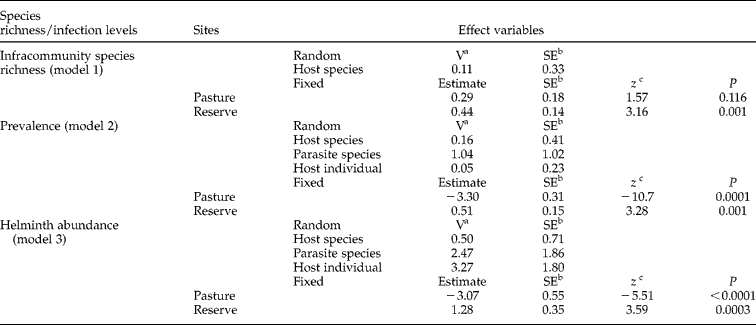
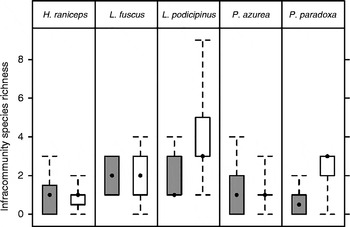
A total of nine helminth species were found in P. paradoxa and H. raniceps, 10 helminth species in P. azurea, and 12 helminth species in the leptodactylid hosts. However, each parasitized anuran harboured an average of two or three helminth species, and this did not vary much among the different host species. Infracommunity species richness was influenced by the collection site of the hosts (table 1), being generally higher in anuran individuals of P. paradoxa and L. podicipinus from the reserve site (fig. 1).
Mixed-effect models of helminth infracommunity species richness, prevalence and abundance of infection in five anuran species, Hypsiboas raniceps, Leptodactylus fuscus, L. podicipinus, Phyllomedusa azurea and Pseudis paradoxa, relative to reserve and pasture sites.

aVariance; bStandard error; c z standard score.
Boxplot of infracommunity species richness in five anuran species from a nature reserve (white bars) and a pasture area (grey bars) in Pantanal, Brazil.

Helminth prevalence varied according to host collection site. The first random variable considered in model 2, host individuals, had the lowest variance. On the other hand, variance among host species was high, indicating that in terms of parasite prevalence hosts are similar within, but different across, each anuran species. The greatest variation observed in the random predictors was within parasite species (table 1). This is because most helminth species had higher prevalence in hosts from the reserve; but a few taxa showed high prevalence in hosts from the pasture site. Additionally, a few helminth species varied across hosts and across collection sites. However, it is interesting to observe that all such cases, when the prevalence of parasite species in each study site varied across hosts, only occurred in helminths with low prevalence (supplementary table S1). Nonetheless, most parasite species had higher prevalence in anurans collected in the reserve area.
The third model showed a similar pattern, indicating differences in helminth parasite abundance between sites (table 1). Unlike model 2 though, the random predictor that accounted for host individuals was highly variable for helminth abundance, which shows the aggregated pattern of parasite distribution among host individuals. There was also a lot of variation in the abundance across parasite species within a host, and within a parasite species across hosts. However, except for rare parasite species, most helminths had higher mean abundance in anurans collected in the reserve site (supplementary table S1).
The water bodies of the reserve and pasture are, respectively, mesotrophic and eutrophic (Von Sperling, Reference Von Sperling1996), and the GLMMs showed significant differences in parasite communities between them. Hosts from the reserve site had, on average, higher helminth species richness, prevalence and abundance. Although these data do not support an assertion, we believe helminths might be responding to changes in land use. Other factors could cause differences in helminth communities, but land use is the most outstanding difference between study sites. Moreover, several studies have examined amphibians from preserved versus impacted areas and found that human land-use activities somehow affected parasites (Hamann et al., Reference Hamann, Kehr and González2006; Koprivnikar et al., Reference Koprivnikar, Forbes and Baker2006; King et al., Reference King, Mclaughlin, Gendron, Pauli, Giroux, Rondeau, Boily, Juneau and Marcogliese2007, Reference King, Mclaughlin, Boily and Marcogliese2010; McKenzie, Reference McKenzie2007; Schotthoefer et al., Reference Schotthoefer, Rohr, Cole, Koehler, Johnson, Johnson and Beasley2011).
In general, parasite species richness and abundance seem to be negatively affected by environmental alterations (Hamann et al., Reference Hamann, Kehr and González2006; Koprivnikar et al., Reference Koprivnikar, Forbes and Baker2006; McKenzie, Reference McKenzie2007; Hartson et al., Reference Hartson, Orlofske, Melin, Dillon and Johnson2011). However, land-use alteration may enhance the intensity of infection when it facilitates parasite transmission by increasing intermediate host abundance or suppressing the host immune system (Johnson & Chase, Reference Johnson and Chase2004; Rohr et al., Reference Rohr, Schotthoefer, Raffel, Carrick, Halstead, Hoverman, Johnson, Johnson, Lieske, Piwoni, Schoff and Beasley2008; Schotthoefer et al., Reference Schotthoefer, Rohr, Cole, Koehler, Johnson, Johnson and Beasley2011).
Parasite species with different life strategies are expected to vary in their response to habitat change (Marcogliese, Reference Marcogliese2005; Vidal-Martínez et al., Reference Vidal-Martínez, Pech, Sures, Purucker and Poulin2010), which could explain the variance found in parasite prevalence across ponds in the impacted and protected areas within different hosts. Despite the variance, helminth prevalence was usually lower in hosts collected in the impacted area. This is especially evident among the trematodes Catadiscus sp. and G. palmipens, and the nematodes P. venancioi, R. minor and Rhabdias sp.
Differences in helminth species richness, prevalence and abundance across the two sites were more evident in the parasite communities of P. paradoxa and L. podicipinus. Pseudis paradoxa individuals are most often found within the water bodies. Indeed, aquatic anurans may be particularly prone to experience changes in their parasite communities due to changes in the environment (McKenzie, Reference McKenzie2007). Leptodactylus podicipinus are semi-terrestrial anurans, frequently found close to the water bodies. They live in the interface between aquatic and terrestrial habitats, which allows the infection with parasites from both habitats. On the other hand, L. fuscus tends to be more terrestrial, and most parasites found in these anurans are transmitted trophically. Parasite communities of L. fuscus from the different habitats were similar in terms of prevalence and abundance, with few larval nematodes presenting higher abundances in the pasture. It is interesting to observe how parasite communities of L. podicipinus and L. fuscus responded differently, despite these hosts being congeneric. Such differences highlight the asymmetry in parasite response observed in this study, which may be jointly influenced by features of the parasite, e.g. life-cycle strategy, and host species, e.g. ecology and phylogeny.
Considering all parasites in the tree frogs H. raniceps and P. azurea, the number of helminth species found in these hosts was slightly higher in the pasture site. We believe this is due to the lack of herbaceous cover in the pasture, which causes these frogs to stay on the ground more often. In the reserve site, these tree frogs were always found perched in aquatic and semi-aquatic herbs. However, in the pasture site, aquatic herbs are scarce and tree frogs were found foraging on the ground. This contact with soil may enhance the chances of acquiring direct-life-cycle nematodes, such as the species of Cosmocerca, Cosmocercella, Oswaldocruzia and Oxyascaris that were only found in tree frogs from the pasture site.
Mixed-effect models showed a similar pattern on parasite abundance and prevalence. Thus, the same mechanisms underlying lower parasite prevalence may lead to the decreased parasite abundance in hosts from the pasture site. The mechanisms underlying our findings are not clear, but some studies have shown that residual anthelmintics present in cattle faeces can decrease the diversity and abundance of insects in pastures (Spratt, Reference Spratt1997; Jensen et al., Reference Jensen, Diao and Hansen2009; Lumaret et al., Reference Lumaret, Errouissi, Floate, Römbke and Wardhaugh2012). This could, potentially, reduce parasite transmission success because several helminth groups require insect species as intermediate hosts to complete their life cycle (Anderson, Reference Anderson2000). Anthelmintic residues could also reduce the survival of helminth free-living infective stages. Therefore, future studies could shed light on the effect of anthelmintic residues in cattle faeces as a potential cause of lower parasite diversity in wildlife.
Overall, the helminth communities of five anuran species differed according to the collection site. Descriptors of parasite infection varied among different parasites in a host, and within the same parasite in different host species. Nevertheless, helminth species richness, prevalence and abundance were generally higher in hosts collected in the reserve area. These results agree with those from other studies on amphibian macroparasites (Hamann et al., Reference Hamann, Kehr and González2006; Koprivnikar et al., Reference Koprivnikar, Forbes and Baker2006; McKenzie, Reference McKenzie2007; Hartson et al., Reference Hartson, Orlofske, Melin, Dillon and Johnson2011). However, more studies, especially in the long term and on large scales, are needed to elucidate the influence of human land use in wetland areas. Nevertheless, this study helps to fill the gap in the knowledge of parasite biodiversity in a changing area, and in a sensitive group of vertebrate hosts.
Supplementary material
To view supplementary material for this article, please visit http://dx.doi.org/10.1017/S0022149X16000109
Acknowledgements
We are grateful to Heitor Herrera for allowing the fieldwork at Alegria farmland, and all the employees of the farm for their kind help during the work. We thank an anonymous reviewer and the area editor for valuable comments on an earlier version of the manuscript, and Maria Pil and Jeffrey Himmelstein for reviewing the English.
Financial support
K.M.C. and L.E.R.T. received fellowship grants from Coordenação de Aperfeiçoamento de Pessoal de Nível Superior (CAPES, Brazil) and Conselho Nacional de Desenvolvimento Científico e Tecnológico (CNPQ, Brazil), respectively.
Conflict of interest
None.