




No CrossRef data available.
Assibilation of /-r/ and migration among Mexicans
Published online by Cambridge University Press: 01 March 2004
Abstract
This article examines the assibilation of the vibrant /-r/ in word final position in Mexican Spanish in an urban and a rural community in Moroleón (Guanajuato, Mexico) and Kennett Square (Pennsylvania, United States). The data was collected according to traditional sociolinguistic methodology during 1995 and 1996. The analysis of the data uses linguistic factors combined with socioeconomic factors that include movement seen as social mobility and/or migratory tendencies in the population. Through the intertwining of these factors interesting tendencies can be observed: female preference for the innovative and prestigious variant as a way to acquire power in a society where women do not have a voice to claim or seek social mobility and power; the influence of the linguistic market in the community, and the effects of accommodation.My thanks go to the anonymous reader who reviewed this paper. I am responsible for any shortcomings found here.
Information
- Type
- Research Article
- Information
- Copyright
- © 2004 Cambridge University Press
The Spanish from Mexico City allows a variant of the simple vibrant /-r/ in word final position: an assibilated [ř]. This article attempts to explain where the assibilation came from and how it moved from the capital to a small population in the state of Guanajuato. Assibilation of /-r/ appears to be a relatively new phenomenon found in Mexican Spanish; its study can be traced back to Matluck (1951), who documented sporadic cases of assibilation in the groups [tr] and [dr]. Alvar (1967), Boyd-Bowman (1960), Cárdenas (1967), and Gavaldón (1970) mentioned the occurrence of assibilation among the population in their descriptions of the dialects of various regions without specifying the sociolinguistic distribution of the variant. Boyd-Bowman (1960) considered that assibilation characterizes only semieducated and educated females in his study in Guanajuato. Moreno de Alba (1972), Perissinotto (1972), and Rissel (1989) studied the occurrence of assibilated /-r/ before pause. They analyzed its occurrence considering its distribution in the population allocating the variant among females from lower, middle, and upper social classes.
Here, I use “mobility” in reference to migration and social mobility to explain sociolinguistic patterns associated with the assibilation of /-r/. Chambers (1999:54) refers to migration as a form of mobility, indicating that, “The consequences of mobility have attracted little or no attention in sociolinguistic studies.” I do assume that social mobility and migration play important roles in the spread of assibilation. This article is an attempt to depart from the prevailing criteria, which simply link linguistic variables with extralinguistic variables.1
See Labov (1972) and Milroy (1987) for the interplay of social factors with network membership, Sankoff and Laberge (1979) for the relation between symbolic capital and the linguistic market, and Labov (1972) for the local identity to present findings.
I contend that the cyclic pattern in Mexican migration has promoted the diffusion of linguistic forms in the migrants' language inside Mexico, and the abandonment of urban prestigious forms outside Mexico, prompting the disappearance of regional as well as generational differences seen in the population in Mexico. On one hand, people who migrate to big cities within Mexico have access to urban prestige variables that emanate from urban communities, especially from Mexico City. On the other hand, migrating to the United States inverts the prestigious patterns according to the working environment; people who traditionally speak using prestige forms abandon them to adopt the prevailing speech forms in the workplace in the United States, where they interact. This can be seen as an inverse effect of accommodation among the population.
I develop my contention in the following paragraphs, with a brief description of the sites of the research and the informants, a delimitation of the linguistic environment of the assibilated /-r/ in word final position, and the relevant sociolinguistic factors affecting the variable starting with migration patterns. My argument uses findings from Moroleón, Mexico and contrasts them with those from Kennett Square, Pennsylvania.
THE SITES OF RESEARCH AND INFORMANTS
Fieldwork was conducted in Kennett Square during the Spring of 1995 and 1996, and in Moroleón during the Summer of 1995 and December 1996. From a total of 100 interviews in Moroleón and in Kennett Square, I eliminated 17 because they did not fulfill the profile established for the interviewees. Even though at the beginning of the interview individuals identified themselves as being from Moroleón, during the actual conversation they confessed that they were not from the town, but that they were happy to talk to me, “Look, to tell you the truth, I am not from Moroleón, but I will gladly talk to you about my hometown.” ‘Pues mire, la verdad, yo no soy de Moroleón, pero yo le platico de mi pueblo con mucho gusto’. For this reason, this study is based on 83 interviews, in total. Each interview lasted a minimum of 30 minutes to a maximum of an hour, depending on the informant's willingness to talk to me in front of a microphone. On the mushroom farms, most of the people enjoyed talking to me about their hometown. When I thanked them for talking to me, some speakers replied, “Thank you, you made me remember my hometown.” ‘Gracias a usted, que me hizo recordar mi pueblo’.
People from states on the Mexican plateau, including Guanajuato, have migrated to Kennett Square to work on the mushroom farms (García & González, 1995). Kennett Square is a rural community that is considered the main mushroom shipping center in the United States (Bastalick, 1982; García & González, 1995); its workers are mainly from Mexico (Castillo, 1994; González Martínez, 1995). Although the U.S. Census of Population and Housing does not report a great number of Mexicans living in the county, unofficial numbers exceed the percentages referred to in the census. “Today, Mexicans make up the majority of the labor force in the mushroom industry” (García & González, 1995:7; Smith, 1992).2
In general, researchers face the problem of having a direct account of undocumented Mexican migrants. Alternative ways of counting the actual number of undocumented migrants have been used. Some investigators employ the number of apprehensions of Mexicans trying to cross the border illegally as an “indicator of the gross inflow” (Massey, Arango, Graeme, Kouaouci, Pellegrino, & Taylor, 1994:705).
Moroleón is an industrial city in the state of Guanajuato, Mexico. It is known all over Mexico and in some Southern states of the United States for its prevailing activity, tailoring. Small hamlets called rancherías surround Moroleón like any other small city on the Mexican plateau. The 16 hamlets economically rely on the city of Moroleón (Ortiz, 1993). They are extremely poor, sometimes without running water. People who live in the hamlets cultivate the land. They are self-sufficient farmers who raise small quantities of cattle to trade or to feed themselves. When people from the hamlets improve their situation economically, they immediately move to the city of Moroleón to exhibit their change of socioeconomic status. Like the return-migrants from abroad, these migrants “purchase land, often for its prestige value” (Massey, Arango, Graeme, Kouaouci, Pellegrino, & Taylor, 1993:452).3
Researchers agree, “some households … have maintained or improved their class position through migration” (Grassmuck & Pessar, 1991:121).
At the community level, migration represents the necessary path from childhood to adulthood. “Migration becomes a rite of passage …” (Massey et al., 1993:453). People who do not follow this behavior are considered lazy, without ambition, and to some extent undesirable.
THE LINGUISTIC ENVIRONMENT OF THE VARIABLE
The linguistic variable /-r/ in word final position is analyzed, here, considering two variants: the standard voiced alveolar flap variant [r] (Barrutia & Schwegler, 1994:129; Dalbor, 1997) and the voiceless assibilated fricative variant [ř] (Dalbor, 1997). The analysis includes ten factors; five linguistic and five sociolinguistic. The linguistic factors include the influence of the preceding phonological segment, distinguishing between high and nonhigh vowels; and following phonological segment, differentiating among pause, consonant, and vowel. A morphological factor contrasts two categories; verb and “other”. The category “other” includes prepositions, nouns, and adjectives. The remaining linguistic factors are the length of the informants' answers, which are divided between short answer and extended discourse, and the position of the variable within the interview: at the beginning or at the end of the conversation.
The last two factors, the length of the informants' answers and the position of the dependent variable in the interview, are used to analyze stylistic variation or intraspeaker variation. The criteria used here may be considered an extension of criteria in Labov (1972), in that I am assuming that the interviewees monitored, that is, paid more attention to their speech, at the beginning of the conversation than at the end of it. The speaker seems more involved in what he is saying, rather than how he is saying it, by the end of the interview. Attention is also implied in that speakers are more careful with their speech in short answers than in narrations, where the topic may prompt them to monitor the content more than the form. I also borrow some ideas from Finegan and Biber (1994). They use oral registers (conversation, interview, public speech) and written registers (personal letters, general fiction, press reportage, and academic prose) to analyze the stylistic or intraspeaker variation. From them I borrowed the idea of oral registers, specifically the interview, where the speaker has “the opportunity for careful production” (Finegan & Biber, 1994:321) especially early in the utterance or in short utterances. The sociolinguistic factors, to be seen later in this analysis, include gender, generation, education level, origin, and migratory patterns. The term “migration patterns” refers to the migratory movements that the informants follow, that is, cyclical or permanent (Castillo, 1994:270).
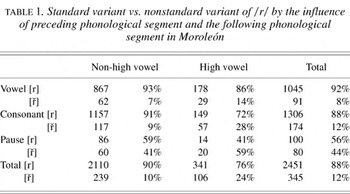
Although the percentages of occurrence are different in Moroleón than Kennett Square, the phonological environments affecting the two variants of /-r/ are the same in both communities. Here, I refer to the percentages of occurrence in Moroleón to indicate the phonological effects. Nonhigh vowel /a, e, o/ in the preceding phonological segment and vowel in the following phonological segment form the phonological environment of the standard variant in expressions like “po[r] ejemplo” ‘for example’ or “volve[r] a” ‘to return to’ with a total percentage of occurrence of 93%. High vowels in the preceding phonological segment and a following pause form the environment of the assibilated variant [ř] with 44% of occurrence in words like: “vivi[ř]” ‘to live’, “vesti[ř]” ‘to dress’, or “reuni[ř]” ‘to get together’. When the environments are observed independently, the tendency indicates that assibilation occurs after high vowel 24% of the time and before pause 44% of the time. Table 1 shows these results for the sample from Moroleón. The fact that the occurrence of assibilation increases before a pause, in an audible position, may indicate the prestige value of the variant. In spite of the fact that several Spanish dialects weaken the allophones in absolute final position (Dalbor, 1997; Navarro, 1948), Mexican Spanish from Mexico City offers voiceless and voiced assibilated variants, as Lope Blanch (1990) indicated in the Atlas lingüístico de México. It is the voiceless assibilated variant that has been disseminated in the communities in Moroleón, Guanajuato, and in Kennett Square, according to the findings presented here.
Standard variant vs. nonstandard variant of /r/ by the influence of preceding phonological segment and the following phonological segment in Moroleón

The morphological factor is only relevant in Moroleón. The morphological analysis, here, distinguishes between verb and the category “other” including preposition, noun, and adjective. The category “other” favors the occurrence of the standard vibrant [r] with a percentage of 92% in words like: “mayo[r]” ‘older’, “prime[r]” ‘first’, “superviso[r]” ‘supervisor’, “po[r]” ‘by’, or “familia[r]” ‘familiar’, whereas, the category verb favors the assibilated variant [ř] with a percentage of 14% in words like “urdi[ř]” ‘to spin’ or “llora[ř]” ‘to cry’. When combined with a high vowel in the preceding segment, the assibilation in verbs increases up to 24%. However, if the verb category coincides with a following pause, the percentage of occurrence reaches 48%. Thus, before a pause is the most productive position for the assibilation of the final /-r/.
There seems to be some stylistic difference in the sample from Kennett Square. The results obtained by the binominal variable rule analysis suggest its significance; the last factor added in the stepup run of the program is one of the indicators of style (the length of the informants' answers). The stepdown run of the program also does not discard length of the answer. In addition, in terms of percentage of occurrence, an increment of significance is detected when combined with the gender factor in the cross-tabulation of gender and length of the answer. The percentage of occurrence for women is 8% and for men it is 3% for the assibilated variant. These are undoubtedly low percentages; they suggest, however, a certain level of significance of assibilation in the population.
SOCIOLINGUISTIC ANALYSIS
This section exhibits the results obtained for gender, generation, education level, origin, and the migration patterns of the informants. As I stated in the introduction, I claim that the patterns of Mexican migration cause the dissemination of certain linguistic forms and the abandonment of others. I start, here, by introducing Mexican migration. Once I establish the findings according to the migration patterns, the linking thread throughout the rest of the article will be the gender factor.
Migration has been the common practice in Mexico for years. Lower-class uneducated Mexicans often consider migration the only way to improve their standard of living.5
This migratory culture is supported and promoted by “return migrants' stories and through concrete ties of assistance” (Hondagneu-Sotelo, 1994:84). People who have relatives working in El Norte exhibit their wealth by acquiring material goods that they could not afford before their relatives migrated.
Castillo (1994) found poverty to be the origin of migration in Mexico, Central America, Northern South America, and the Caribbean. However, he stresses that, although poverty is an important factor in promoting migration, this might combine with other factors, such as political situations in each country.
People usually start migration with one trip in mind to solve a specific need. Nevertheless, once they “acquire a stronger concept of social mobility and a taste for consumer goods and styles of life that are difficult to attain through local labor” (Massey et al., 1993:452), they continue migrating, and migration constitutes their style of life. Every time someone crosses the border successfully, his chances of continuing the same pattern increase; they will migrate to the United States until retirement or until they die in their attempt.
Migrants can be observed to exhibit dual personalities on the opposing sides of the border. This is reflected in their attire and their speech. While visiting their families in Mexico, they may flaunt their economic success by wearing the outfit that shows their change of fortune: cowboy hat and boots, Levis jeans and shirt.8
“Migrants display a widely admired lifestyle that others are drawn to emulate” (Massey et al, 1994:737). Successful migrants possess the ability to consume goods and purchase property that people who work in the local economy cannot afford.
The fact that migrant workers receive higher wages than those they used to earn in local employment, and the material goods they can afford with new wages create “new standards of material well-being, and first-hand experience in an affluent society raise expectations and create new ambitions for upward social mobility” (Massey, Goldring, & Durand, 1994:1498).

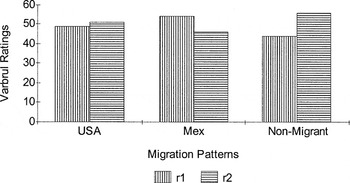
Standard variant versus nonstandard variant of /r/ by migration patterns in Moroleón (r1: [r]; r2: [ř]).
Moreno de Alba (1972:370) affirmed that assibilation of the simple vibrant /-r/ radiates from Mexico City. However, Perissinotto (1972:76) stated “la clase media y alta asibilan más que la bajas; aunque los miembros de las clase baja conocen la asibilación.” Thus, assibilating by the migrant workers not only associates them with urban speech and society, but also exhibits their change of economic status; they have experienced upward social mobility. Assibilation may be considered as an emblem of change of status; those who adapt more completely to the urban environment assibilate more than those who have not done so. “Hay algunos individuos cuyo deseo de identificarse con grupos élites o grupos superiores en términos sociales, económicos o políticos los lleva a tratar de imitar a adoptar la forma lingüística de más prestigio … ,” according to Fernández (1990:51). The results of assibilation according to migration patterns yield meaningful information in terms of social membership. The highest usage of assibilation belongs to the people who reside permanently in the city, but, somewhat surprisingly, next are those who have raised their status and returned to the city of Moroleón after migrating to the United States.
In contrast, while in the United States, it appears that neither place of origin nor migration history are relevant; migrants change the cowboy outfit to second-hand clothes and an old baseball cap. It may be that the migrant workers not only change their attire, but also the linguistic forms spoken in their workplace. Being in the United States acts as an equalizer among the migrant workers. They share the same working and living conditions on the American side of the border. They live in segregated housing, which deters them from mixing with the local population. Their everyday life consists of working, eating, and sleeping. Their cyclic routine may prompt them to give up the use of prestigious linguistic forms in their speech to adopt often nonstandard forms used by the majority of the migrants. “The transmission of linguistic traits demands first of all the importance of a high frequency of contact …” (Labov, 1986:289). Working in the same place entails constant contact. While living in the United States, women as well as men from the city assibilate less than their counterparts in Mexico, reversing the trend of rising assibilation rates, especially in the city in Mexico.
The reference to women in the previous paragraph brings us to the gender factor, which exhibits patterns that may be explained by the interaction of gender with other factor groups, and the prevailing attitudes at the research sites. The differences between female and male linguistic preferences have been explored extensively in the literature. There are some linguists who attribute gender preferences to relations of power (Coates & Cameron, 1988; Gardner, 1980; Uchida, 1992; West & Zimmerman, 1983). Others analyze “social forces that attach to women by virtue of their place in the economy” (Eckert, 1989:255), seen also in Holmes (1997a, 1997b) and Holmquist (1985). Milroy (1987) referred to the concept of networks, and Chambers (1992) and Labov (1990) explained how sociolinguistic factors intertwine with linguistic factors. There is no uniform indication of the factors that influence gender differences. Nevertheless, I have found several factors that the literature has pointed out before to be useful: the linguistic market; “language as a form of symbolic capital” (Holmes, 1997b:132) in a patriarchal society where women do not possess power (Uchida, 1992) or “control of their own salary” (Grassmuck & Pessar, 1991:147); and migration patterns followed by the farm workers along with their desire to identify with “grupos superiores en términos sociales, económicos” (Fernández, 1990:51).
Women's desire to accommodate to the largely male community in Kennett Square may account for the decrease in occurrence of assibilation in their speech in comparison to women in Moroleón: 24% for Moroleón and 6% for Kennett Square. Nevertheless, the results from Kennett Square still indicate that women assibilate more than men. It should be noted that females have been found to favor assibilation throughout the different studies of the phenomenon (Boyd-Bowman, 1960; Moreno de Alba, 1972; Perissinotto, 1972; Rissel, 1989). This notwithstanding, the motivations of the women in Kennett Square may be different from those of women in Moroleón.
In Moroleón, women seem to make a subconscious effort to speak uttering the assibilation. All the female informants volunteered to talk to me when they heard I came from Mexico City and that I was living in Pennsylvania. They expressed their admiration for women coming from big urban areas, especially from Mexico City. Almost every woman pointed out during the conversation that they had visited the capital of the country at least once, and how impressed they were with its beauty and size. Thus, assibilation may make those women feel closer to the cosmopolitan women, who also assibilate, in Mexico City.
Women in Kennett Square face a different reality.10
It should be noted that some studies portray a different image of women. They are far from being abnegating, docile, and subservient to men (Farr, 2000:72).
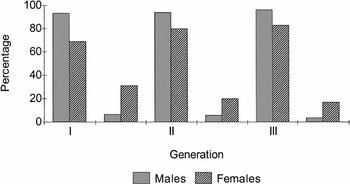
Continuing with gender, let us now examine the correlation between gender and the generational factors in the city of Moroleón. Initially, the generational factor stratifies the population from older to younger generations. The percentage favorable to assibilation increases as the informants' age decreases. The youngest generation favors the innovative assibilated variant [ř] with 20% of its occurrence, and the second and third generations have results of 10% and 7%, respectively. In contrast, the increment in age corresponds to the use of the standard variant [r], where the older generation favors the standard variant most. These findings confirm the establishment of the assibilation among the young generation. In earlier studies (Moreno de Alba, 1972; Perissinotto, 1972), assibilation was not as clearly stratified as it is in the present study; its predominance vacillated between the first and the second generations. Here, the second generation, whose members are characterized by having reached emotional and financial stability, favor the prestigious variant only half as much as the youngest generation. The fact that the third, or oldest, generation uses the assibilation for 7% of its occurrence suggests the stability of the variable in the society; generally, members of the third generation embrace values that the younger generation rejects, and they tenaciously resist any change. “Los informantes … se consideran miembros de una sociedad que ya no existe y portadores de valores que muchos rechazan; sus hábitos están ya formados desde hace mucho y se resisten tenazmente a cualquier cambio” (Perissinotto, 1972:72).
Looking at the results in Figure 2 from the cross-tabulation between gender and generation in Moroleón, we find that women favor the assibilated variant [ř] throughout the generational spectrum. (The shorter columns in each generational group represent the assibilated variant.) Interestingly, males from the second generation assibilate more than either the first or the third generation: 7% for the second generation, 6% and 4% for first and third generation, respectively. The informants' productive activity may account for the tendencies observed among the second generation; they are fully integrated into the labor market. Therefore, their preference for the assibilated variant may reflect this integration.

Standard variant versus nonstandard variant of /r/ by gender and generation in Moroleón.
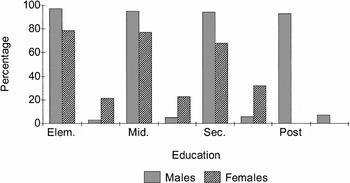
It is now necessary to consider the relation between gender and education to seek further proof of the role of the informants' productive activity in the selection of either variant, that is, to confirm that “Occupation and workplace network are crucial to language use …” (Lippi-Green, 1989:216). Surprisingly, the education factor indicates that the secondary level of education uses more assibilation (21%) than any other level, including the post-secondary (7%). One would assume that the highest level of instruction would favor the prestige variant, the assibilated [ř], more than the lower levels of instruction. The correlation between gender and educational level may explain these results (see Figure 3). As may be seen, the post-secondary level does not include women who hold that level of education (I had difficulty encountering female members of this group in Moroleón). An increment in the percentage of assibilation can be observed in both genders according to the increment in the level of instruction. Women favor the assibilated variant [ř] with higher percentages than men. The difference between elementary and middle school instruction is very small, 2% among females and males. However, the difference between these two levels and the secondary school reaches 9% for the female section of the sample.

Standard variant versus nonstandard variants of /r/ by gender and education in Moroleón.
The percentages obtained for the gender and education factors reaffirm the influence of the informants' jobs on their choice of either the standard variant [r] or the assibilated variant [ř]. Most of the women from all levels of education have worked or currently work in places where they have contact with people from different parts of Mexico; grocery stores, clothing stores, or the Municipal Presidency. Their occupations allow them to be aware of the most prestigious way of speaking in the country, especially in Mexico City.11
Rissels (1989:272) stated that the assibilation “according to the information available (Boyd-Bowman, 1960; Moreno de Alba, 1972; Perissinotto, 1972), began among women of the middle and upper classes and therefore has local prestige.”
Lastly, considering the origin factor, it can be noticed that, although the overall percentages are somewhat small, the influence of origin reaffirms assibilation as an urban variant and illustrates the increment in its occurrence in the transition from the small hamlets to the city of Moroleón. In Moroleón, the lowest percentage of assibilation belongs to people from the small hamlets that continue living in the hamlets with 3% of occurrence, followed by the group who moved from the small hamlet to the city with 5% of occurrence, and finally the group from the city with 14% of occurrence. Although the percentages are low, the influence of the city can be observed among persons from the small hamlets who move to the city of Moroleón. The percentage of occurrence for the assibilated variant almost doubles from 3% in the small hamlet to 5% when they live in the city of Moroleón. The difference almost quintuples from 3% to 14% of occurrence, when contrasting those living in the hamlets with the speakers from the city.
In Kennett Square, however, regional differences disappear; only gender and educational differences are maintained, with extremely low percentages of assibilation compared to the results from Moroleón. It has been explained before that the female preference for assibilation may be a reaction to the power of decision in the masculine society in which they live and work. However, although women in Kennett Square assibilate more than men, they do not assibilate as much as women who live in the city of Moroleón. Thus, to some extent, they too have given up forms that were part of their speech while living in the city of Moroleón. The results yielded by the education factor in Kennett Square indicate that people with middle school education assibilate more than those with elementary school education. The fact that no other factors (origin, migration, generation) are relevant in Kennett Square suggests an equalizing situation that the mushroom pickers undergo. They all share the isolation and segregation of their working environment.
CONCLUSION
To sum up, high vowels in the preceding phonological segment and pause in the succeeding phonological segment form the phonological environment of the assibilated variant. This is an urban prestige variant that has been established in Mexican society among the younger generations and females. The migration patterns followed by the population have contributed to the spread of the use of this urban variant in small cities like Moroleón. However, migration may also have prevented the diffusion of the assibilation in the community in Kennett Square, where regional and generational differences have collapsed; in Kennett Square, the mushroom pickers are a segregated Mexican society with little if any influence coming from the big cities in Mexico. Urban women living in Kennett Square have decreased the use of the assibilated variant to adapt to the working environment. To some extent, the mushroom pickers' migration patterns have promoted effects of inverse accommodation in the population.
References
REFERENCES
Alvar, Manuel.
(1967).
El español de Oaxaca.
México:
Universidad Nacional Autónoma de México.
Barrutia, Richard, &
Schwegler, Armin.
(1994).
Fonética y fonología españolas: Teoría
y práctica.
New York:
Wiley.
Bastalick, Henrietta G.
(1982).
Kennett Square; Yesterday and today: A history of the borough of
Kennett Square in the County of Chester in the Commonwealth of
Pennsylvania.
Kennett Square:
KNA Press.
Boyd-Bowman, Peter.
(1960).
El español de Guanajuato.
México:
Universidad Nacional Autónoma de México.
Cárdenas, Daniel N.
(1967).
El español de Jalisco. Contribución a la
geografía lingüística hispanoamericana.
Madrid:
Consejo Superior de Investigaciones Científicas.
Castillo, Manuel Angel.
(1994).
A preliminary analysis of emigration determiners in Mexico, Central
America, Northern South America and the Caribbean.
International Migration Quarterly Review
32(2):269–306.Google Scholar
Coates, J., &
Cameron, D. (eds.).
(1988).
Women and their speech communities.
New York:
Longman.
Dalbor, John B.
(1997).
Spanish pronunciation, theory and practice.
Orlando, FL:
Harcourt Brace.
Chambers, J. K.
(1992).
Linguistic correlates of gender and sex.
English World Wide
13(2):173–218.Google Scholar
Chambers, J. K.
(1999).
Sociolinguistic theory, linguistic variation and its social
significance.
Malden, MA:
Blackwell.
Eckert, Penelope.
(1989).
The whole women: Sex and gender differences in variation.
Language Variation and Change
1:245–267.Google Scholar
Farr, Marcia.
(2000).
A mí no me manda nadie! Individualism and identity in
Mexican speech.
Pragmatics
10:61–85.Google Scholar
Fernández, Rosa.
(1990).
Actitudes hacia los cambios de códigos en Nuevo Mexico:
Reacciones de un sujeto a ejemplos de su habla. In
J. Bergen (ed.),
Spanish in the United States: Sociolinguistic issues.
Washington, DC:
Georgetown University Press.
49–58.
Finegan, Edward, &
Biber, Douglas (eds.).
(1994).
Register and social dialect variation: An integrated approach.
Sociolinguistic perspectives on register.
New York:
Oxford University Press.
315–347.
García, Víctor, &
González, Laura.
(1995).
Finding and enumerating migrants in Mexican enclaves of the U.S.
Northeast: The case of southern Chester County, Pennsylvania.
Washington, DC:
United States Census Bureau.
Gardner, C.B.
(1980).
Passing by: Street remarks, address rights, and the urban female.
Sociological Inquiry
50:328–356.Google Scholar
Gavaldón, Lourdes.
(1970).
El habla de Múzquiz, Coahuila. Aspectos fonéticos y
léxico ganadero.
Tesis,
Universidad Nacional Autónoma de México.
Grassmuck, Sherri, &
Pessar, Patricia R.
(1991).
Between two islands, Dominican international migration.
Los Angeles:
University of California Press.
Holmes, Janet.
(1997a).
Setting new standards: Sound changes and gender in New Zealand
English.
English World Wide
18(1):107–142.Google Scholar
Holmes, Janet.
(1997b).
Women, language and identity.
Journal of Sociolinguistics
1(2):195–223.Google Scholar
Holmquist, Jonathan. C.
(1985).
Social correlates of a linguistic variable: A study in a Spanish
village.
Language in Society
14:191–203.Google Scholar
Hondagneu-Sotelo, Pierrette.
(1994).
Gender Transitions, Mexican Experiences of Immigration.
Berkeley, CA:
University of California Press.
Labov, William.
(1972).
Sociolinguistic patterns.
Philadelphia:
University of Pennsylvania Press.
Labov, William.
(1986).
Language structure and social structure. In
S. Lindeberg,
J. Coleman, and
S. Nowak (eds.),
Approaches to social theory.
New York:
Russell Sage.
265–290.
Labov, William.
(1990).
The intersection of sex and social class in the course of
linguistic change.
Language Variation and Change
2:205–254.Google Scholar
Lippi-Green, Rosina L.
(1989).
Social network integration and language change in progress in a
rural alpine village.
Language in Society
18:213–234.Google Scholar
Lope Blanch, Juan M. (Dir.).
(1990).
Atlas lingüístico de México. Tomo I
Fonética, vol. 1.
México, D.F.:
El Colegio de México y Fondo de Cultura Económica.
Massey, Douglas S.,
Arango, Joaquín,
Graeme, Hugo,
Kouaouci, Ali,
Pellegrino, Adela, &
Taylor, Edward.
(1993).
Theories of international migration: A review and appraisal.
Population and Development
19(3):431–466.Google Scholar
Massey, Douglas S.,
Arango, Joaquín,
Graeme, Hugo,
Kouaouci, Ali,
Pellegrino, Adela, &
Taylor, Edward.
(1994).
Evaluation of international migration theory: The North American
case.
Population and Development
20(4):699–751.Google Scholar
Massey, Douglas S.,
Goldring, Luin, &
Durand, Jorge.
(1994).
Continuities in transnational migration: An analysis of nineteen
Mexican communities.
American Journal of Sociology
99(6):1492–1533.Google Scholar
Matluck, Joseph.
(1951).
La pronunciación en el español en el Valle de
México.
Mexico:
Universidad Nacional Autónoma de México.
Milroy, Lesley.
(1987).
Language and social networks.
London:
Backwell.
Milroy, James.
(1992).
Social network and prestige arguments in sociolinguistics. In
K. Bolton &
H. Kwok (eds.).
Sociolinguistics today, international perspectives.
New York:
Routledge.
146–162.
Moreno de Alba, José.
(1972).
Frecuencias de la asibilación de /R/ y /RR/
en México.
Nueva Revista de Filología Hispánica
21:363–370.Google Scholar
Murray, O. Stephen.
(1993).
Network determination of linguistic variables.
American Speech: A Quarterly of Linguistic Usage
68:161–177.Google Scholar
Navarro, Tomás.
(1948).
El español de Puerto Rico.
Río Piedras:
Universidad de Puerto Rico.
Ortiz, Ortiz Alfonso.
(1993).
Disertaciones moroleonenses.
Guanajuato:
Impsego.
Perez-Itriago, A., &
Guendelman, A.
(1989).
Role models and parallel lives: Mexican migrant women return. In
R. Appleyard (ed.),
The impact of international migration on developing countries.
Paris:
L'Incidende des migrations Internationales sur les pays en
developpement.
269–286.
Perissinotto, Giorgio.
(1972).
Distribución demográfica de la asibilación de
vibrantes en el habla de la Ciudad de México.
Nueva Revista de Filología Hispanoamericana
1:72–79.Google Scholar
Rissel, Dorothy A.
(1989).
Sex, attitudes, and the assibilation of /r/ among young
people in San Luis Potosi, Mexico.
Language Variation and Change
1:269–283.Google Scholar
Sankoff, Guillian, &
Laberge, Suzanne.
(1979).
The linguistic market and the statistical explanation of
variability. In
D. Sankoff (ed.),
Linguistic variation: Models and methods.
New York:
Academic Press.
239–250.
Singer, Audrey, &
Massey, Douglas S.
(1998).
The social process of undocumented border crossing among Mexican
migrants.
International Migration Review
32(3):561–592.Google Scholar
Smith, Robert.
(1992).
Case study 1: The mushroom industry in Chester County,
Pennsylvania. In
Monica L. Heppel &
Sandra L. Amendola (eds.),
Immigration reform and perishable crop agriculture: Compliance or
circumvention?
Lanham, MD:
University Press of America, and
Washington, DC: Center for Immigration Studies.
Uchida, Aki.
(1992).
When “difference” is “dominance”: A
critique of the “anti-power-based” cultural approach to sex
differences.
Language in Society
21:547–568.Google Scholar
West, C., &
Zimmerman, D. H.
(1983).
Small insults: A study of interruptions in cross-sex conversations
between unacquainted persons. In
B. Thorne,
C. Kramarae, &
N. Henley (eds.),
Language gender and society.
Rowley, MA:
Newbury House.
103–117.
Standard variant vs. nonstandard variant of /r/ by the influence of preceding phonological segment and the following phonological segment in Moroleón
Standard variant versus nonstandard variant of /r/ by migration patterns in Moroleón (r1: [r]; r2: [ř]).
Standard variant versus nonstandard variant of /r/ by gender and generation in Moroleón.
Standard variant versus nonstandard variants of /r/ by gender and education in Moroleón.
 You have
Access
- 10
- Cited by