Introduction
Institutional reforms of employment policies are sweeping across all OECD countries. Reorganising implementation of employment services is related to new public management of the public sector in general, but the intention is also to change the content of employment policies. It is, however, often difficult to determine whether the intention of decision makers is to create more effective bureaucratic or administrative solutions, or to make substantial policy changes.
In this article we want to focus on one of these institutional reforms: the contracting-out of Public Employments Services (PES). The arguments behind this institutional reform are linked to expectations that a quasi-market will deliver more efficient, effective and de-bureaucratised employment services. By comparing evidence from three different countries and welfare regimes (constrasting Denmark to the Netherlands and Australia), we will, on the one hand, try to find out whether these mainly ‘technical’ arguments hold water (do the reforms in fact deliver on their own promises), and, on the other, investigate whether there are substantial differences in the motivations for and designs of the contracting-out models in the three welfare regimes, in relation to the question of more efficient bureaucracy versus policy changes. This should enable us to conclude with an evaluation of whether a quasi-market model in effect creates a new type of employment policy, clouded in the ‘technical’ language of improving efficiency and effectiveness, and, if so, what this implies for the governance of labour market and employment policies in general.
Comparing quasi-markets
There are several reasons why it is particularly relevant to compare Denmark to the Netherlands and Australia. It is, however, not because they are the only countries to have contracted out their public employment services. Far from it, contracting-out seems to be an international trend that has spread to many different countries (cf. European Employment Observatory, 2004; Brodkin, Reference Brodkin, Sol and Westerveld2005; Finn Reference Finn, Bredgaard and Larsen2005a, Reference Finn, Sol and Westerveld2005b; Konle-Seidl, Reference Konle-Seidl, Sol and Westerveld2005; Bruttel, Reference Bruttel2005; Barbier, Reference Barbier, Sol and Westerveld2005; Simonin, Reference Simonin, Sol and Westerveld2005; Struyven and Verhoest, Reference Struyven, Verhoest, Sol and Westerveld2005).
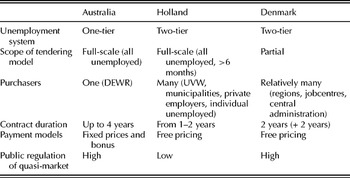
We have chosen to compare Denmark to Australia and the Netherlands because the latter have full-scale tendering models, meaning that all target groups of jobseekers are referred to external service providers and that the PES has stopped providing traditional employment services to the unemployed. Public authorities are instead used as gate-keepers in the quasi-market, and pay out unemployment and social security benefits. This allows us to study the implications of a shift to a contracting-out model close to its pure form. Both countries were pioneers in contracting out the PES: in 1998 Australia adopted a full-scale tendering model, and the Netherlands followed suit in 2001. Therefore it is possible to identify trends and developments over time in both the market structure and the governance system. Trends and developments which are now emerging, or perhaps already have emerged, in Denmark, where the development of the tendering model still is in an early stage. The main differences between the three countries are illustrated in the table below (Table 1).
Main differences and similarities in the tendering models in Australia, the Netherlands and Denmark

Sources: Bredgaard and Larsen (Reference Bredgaard and Larsen2006); Van Berkel and Van der Aa (Reference Van Berkel and Van der Aa2005); Sol and Westerveld (Reference Sol and Westerveld2005); Considine (Reference Considine, Sol and Westerveld2001, Reference Considine, Bredgaard and Larsen2005a, Reference De Koning2005b).
A further reason for comparing Denmark, Australia and the Netherlands is that the three countries represent three very different labour market and welfare models. If it proves possible to identify similar mechanisms and trends across three such different labour market and welfare models, then it would seem safe to conclude that such trends and mechanisms are related to the tendering model as such; i.e. they are part and parcel of the inherent logic of contracting-out, transcending differences in labour market and welfare models.
The analysis is based on an updated study carried out in 2005, which, in addition to desk research, included a series of in-depth interviews with relevant actors in the field. In each country a round of interviews was carried out in 2005 with representatives of in total 42 broadly comparable organisations active in the field (representatives of national labour market administration, trade unions, employers associations, local government associations, public employment service offices, branch organisations of service providers, for-profit providers as well as non-profit providers). The findings were published in a Danish book in autumn 2006 (Bredgaard and Larsen, Reference Bredgaard and Larsen2006). The analysis in this article will focus on the conclusions drawn on the basis of that study (for more detailed description of the individual countries, see Considine Reference Considine2000, Reference Considine2001, Reference Considine2005a, Reference Considine, Sol and Westerveld2005b; Koning, Reference Koning2004; Sol and Westerweld, 2005; Struyven, Reference Struyven2004, Reference Struyven, Bredgaard and Larsen2005; Struyven and Steurs Reference Struyven and Steurs2003, Reference Struyven and Steurs2005).
Across the three countries, the official political intentions behind contracting out employment services seem to have been, above all, to make the much criticised public employment services systems cheaper and better (Bredgaard and Larsen, Reference Bredgaard and Larsen2006, Reference Bredgaard and Larsen2007). However, there seem to be other policy agendas as well, such as instilling a more pronounced work first approach in delivery of employment services. And there seems to be an agenda about political power as well, such as a wish to minimise the influence of labour market organisations, seen most clearly in the Netherlands. And, finally, there is the ideological agenda. In our analysis, however, we are going to concentrate on the first agenda: the explicitly politically formulated arguments to create a more efficient and un-bureaucratic system, which can also be formulated as the quasi-market theory (Le Grand and Bartlett, Reference Le Grand and Bartlet1993).
In Australia and the Netherlands great efforts were initially made to make the ‘quasi-markets’ attractive enough for many providers to want to participate in them. Both countries succeeded in meeting these criteria (Bredgaard and Larsen, Reference Bredgaard and Larsen2006). The Danish market for employment services was launched as a reduced model, where service providers were contracted parallel to a still functional public service delivery in both the PES and municipalities. Quasi-markets for employment services are also markets where semi-public and voluntary (non-profit) providers are active. In Australia, voluntary organisations account for about 50% of the market. It is interesting to note in this context that there is a strong tendency for the ‘non-profit’ providers to pick up a ‘business culture’, to be able to compete in the market (Considine, Reference Considine2003). In Denmark, trade unions and unemployment insurance funds account for about 20% of the market share. Unlike in Denmark, branches of the former PES system were initially transformed into private providers in Australia and the Netherlands; although after a while these privatised organisations have disappeared from the market.
Finally, there are some important differences in the payment models of the three countries. Australia offers a generally higher payment for disadvantaged groups and fixed prices for specified target groups and programmes. In general, the major part of payments is performance related and falls due when a successful outcome has been achieved, especially 13 weeks’ employment. The Netherlands operates a so-called ‘no cure, no pay’ model for the short-term unemployed (only outcome payment), and ‘no cure, less pay’ for the long-term unemployed (combined commencement and outcome fees). As in Denmark, service providers make their own price estimations in the tender bids, and prices tend to be the most important selection criteria for winning contracts. Since 2005, Denmark has operated a centralised payment model, which in general awards 25% as commencement fees and 75% as outcome payments.
Do quasi-markets deliver on their promises?
In the following, we are going to try and answer the question whether contracting-out models are able to live up the political demands for efficiency gains, improved quality, as well as simplification and de-bureaucratisation. We will first investigate efficiency, and how to create a quasi-market. Then we will look at quality of services delivered, and finally conclude with an evaluation of public regulation and the goal of simplification and de-bureaucratisation.
A more efficient and cheaper market?
Although it is difficult to assess the cost efficiency before and after contracting out, experiences from both Australia and the Netherlands show that there are high transaction costs involved in establishing a quasi-market for employment services. Some will be one-off costs, but, even so, contracting out still seems to entail substantial transaction costs (for purchasers as well as providers), and in particular tendering rounds seem to be very cost heavy. It does, however, also appear to be possible to reduce these transaction costs, by means of more public regulation and increased professionalism, as has been shown especially in Australia (Bredgaard and Larsen, Reference Bredgaard and Larsen2006).
Because of high transaction costs, there is an inbuilt dilemma in the tendering model. On the one hand, one of the goals of contracting out employment services is to get ‘better and cheaper’ services, a goal which can be achieved by creating competition between a number of (private and public) service providers in publicly regulated tendering rounds. On the other hand, the tendering rounds themselves tend to generate massive bureaucracy and considerable transaction costs, in particular in the transitional phase between a PES and a quasi-market model. The reduction in public spending aimed for will, of course, only be achieved provided the cost savings brought about by involving external (primarily private) providers outweigh the transaction costs resulting from the tendering rounds (Bruttel, Reference Bruttel2005). Especially Australia, but also the Netherlands, has experimented to reduce transaction costs. The problem is, though, that transaction costs seem to be higher, the freer and more transparent the market and conditions for competition are. It is possible to reduce transaction costs by entering into more stable provider and partnership relations, as has happened in Australia, but this implies moving away from the original intentions behind the competitive tendering model. It needs to be borne in mind that creating and maintaining a market structure is an ongoing process, which will continue to demand new public regulation.
In Denmark, too, the transaction costs involved in establishing a market have turned out to be substantial – for some surprisingly so. The providers find that preparing and presenting tender bids require disproportionate amounts of resources. And the administrative tasks, such as working out payment and documentation of jobseekers’ employment situation, have also turned out to be quite demanding (Rambøll, 2004: 57, 93–94). The majority of providers say that the workload of administrative and setting-up procedures is considerably higher than expected. It has also proved difficult for the purchasers to describe the services required in precise terms, and the tendering material has therefore been rather vague at times. This has led to diverging interpretations of the services to be delivered, which again leads to extra work when trying to clarify and settle differences of expectations (Rambøll, 2004).
Experience from the three countries show that transaction costs are an inescapable by-product of contracting out. It is a problem that will have to be taken into account when considering how to design a quasi-market. There are many indications that the freer the market, the higher the transaction costs. So the strategic choice here is to decide what level of costs is acceptable. However, there is no standard model to fall back on for such calculations. Designing a market is an ongoing process.
The full-scale tendering model has been in operation for almost ten years in Australia and about six in the Netherlands. But, in spite of that, there is still little valid and systematic knowledge on the outcomes and effects the system is able to deliver. This makes it difficult to evaluate the efficiency of the private service providers compared with the previous PES system, including cost-effectiveness. All the same, there are some indications that the shift to contracting out has produced cost savings in Australia, even though discontinuation of some cost-heavy programmes around the time of contracting out might also explain some of the savings. It is not possible to make comparisons for the Dutch system. So even if it is difficult to draw any conclusion whether the contracted-out employment services system is indeed ‘better and cheaper’ than the old public system, there can be no doubt that contracting out has resulted in a fundamentally different employment services system (which in itself makes before-and-after comparison difficult). The same applies for Denmark, where the quasi-market model was introduced parallel with a still functioning PES system, which, in principle, should make it possible to compare the outcomes and effects of the two systems. In practice, this is far from easy, as the first effect measurements have proved.
Better services?
The quasi-market model is assumed to lead to more individually tailored services, using more innovative methods and tools, and benefiting also from closer contact with business enterprises. Some have expressed fears that quasi-markets led to ‘creaming’ and ‘parking’ (i.e. cherry-picking by prioritising services to the least expensive job-seekers, who are closest to the ordinary labour market, and discriminating against supposedly expensive job-seekers by only giving them minimal assistance required by contracts). In the following, we will have a closer look at these expectations.
In the light of the great expectations that contracting out would lead to more innovative methods, experiences in both Australia and the Netherlands can only be described as a disappointment for the authorities. The general impression is that, in spite of the freedom to choose their own methods, providers hardly ever come up with innovative solutions. Rather than developing new methods and innovating services, the providers’ primary focus is on survival, and they are not willing to take any risks unless the outcome is considered certain. In Australia, ever-stronger regulation of services plays a part in this as well. And there can be no doubt that the choice of payment model is an important factor in both countries. The risk of investing in innovative methods that cannot be guaranteed to produce quick results lies mainly with the providers. And the providers find the risk involved in not sticking to beaten paths to be simply too high. In Denmark, the methods used by providers have also been highly influenced by the way external providers have been involved in the delivery of employment services. In practice, it turns out that external providers have been used mainly to ‘relieve’ the PES of administrative tasks: as extra hands to help out with the contact periods (as in Australia there are mutual obligations to be in contact at specified points of the unemployment period). One consequence of this ‘resource strategy’ is that when it comes to methodology, the focus has largely been on minimising costs and not on maximising effects (Rambøll, 2004). In 2005, the Minister of Employment launched a new action plan (implemented autumn 2006), which means that external providers can no longer be used to just handle purely administrative tasks (such as contact periods). However, at the same time, the payment model has changed in a much more effect-oriented direction, and providers will be forced to finance jobseekers’ activities themselves (instead of referring them to activities paid for by the authorities). This is not likely to make development of innovative methods any easier, as the providers will have to take over most of the economic risks.
Experiences from Australia (and to some extent the Netherlands) indicate that free choice as a quality driver is difficult to implement in practice. Practically all our respondents are of the opinion that, to the extent jobseekers have a free choice, it is exercised mostly on the basis of chance and not the quality of the provider; for instance geographical proximity of the provider. It is also debatable whether the individual jobseeker can be expected to possess the knowledge and capacity necessary to make an informed choice, leading to rejection of the least qualified and selection of the provider with the best outcomes. And furthermore there seems to be a trade-off: the more freedom of choice the individual jobseeker is given, the higher the transaction costs. Obviously this trade-off does nothing to further the possibilities of realising a high degree of free choice in practice. It needs to be mentioned, though, that after our data collection ended, the use of individual reintegration budgets (IRO) has increased substantially in the Netherlands. This may be indicative of more freedom for jobseekers to choose their provider; but we have not been able to evaluate recent Dutch experiences in detail. In Denmark there ought to be good conditions for a high degree of free choice, as there are relatively many providers of employment services. In reality, however, the individual jobseekers have been offered limited choice so far (Rambøll, 2004). Just as in Australia and to some extent in the Netherlands, the idea of freedom of choice as a driver for higher quality turns out to be difficult to make work in practice. Even if public authorities and the government publicly support the principle of jobseekers’ freedom to choose, in practice freedom of choice is mainly the preserve of the purchasers (i.e. the authorities). So, the freedom of jobseekers to choose their own provider of employment services has turned out to be rather limited.
Even if using the jobseekers’ freedom to choose their provider as a market driver does not work as intended, the relationship between provider and jobseeker nevertheless changes, turning into a sort of consumer relation. Several respondents point out that jobseekers express great satisfaction to be seeing private providers rather than public authorities. The difference in attitude on the part of private providers may of course explain this satisfaction, but it might also have to do with a rather lenient sanctioning practice.
As for the tools used by providers, what providers primarily aim for is motivating and preparing the jobseekers through encouragement, job search and job training activities. It is characteristic that providers in Australia, the Netherlands and Denmark use formal education and training to a very limited extent. However, it is difficult to say whether these more expensive tools are disregarded because of inherent traits of the contracting-out model, or as a consequence of the general political shift towards a work-first strategy. Both might explain it, so perhaps it is the old chicken-or-egg discussion. Nevertheless, contracting-out models have some inbuilt dilemmas when it comes to improving the skills of the unemployed. When financial responsibility lies with the provider, there is a clear tendency towards under-investment in educational activities, since such investments are considered long-term, uncertain and cost-heavy; this collides head-on with the demands facing providers to deliver quick employment effects. This runs against the original intentions (at least when it comes to methodology), and will probably prove politically unacceptable in the long run, as the political debates in Australia and the Netherlands seem to indicate.
It is striking that neither in Australia, nor in the Netherlands or Denmark have business networks been used to directly match businesses’ recruitment needs with reintegration of jobseekers. It is surprising that, in general, the major recruitment firms and temping agencies have chosen not to enter this new market. Against this background, it must be concluded that there is a strong supply-side orientation in employment services, and that contrary to what might have been expected, involvement of the business community remains weak. This makes it difficult to meet the needs of the labour market by means of employment policy, which is a problem especially in a situation when businesses increasingly demand highly skilled labour.
In both Australia and the Netherlands, extensive creaming and parking of jobseekers is a fact. As was the case when discussing methods and tools, this is to a very large extent due to the financial risks being offloaded on to providers, with performance-related pay and full responsibility for finance of activities. In the Netherlands, this effect is accelerated further by price competition in a downward spiral, and by allowing providers, in certain cases, to refer jobseekers back. Whether this inherent creaming and parking in the two countries’ tendering models reflects political intentions, as providers in both Australia and the Netherlands claim, is not possible to answer unambiguously based on our analyses. There are also signs that creaming and parking can reach politically unacceptable levels. In Australia public regulation has been introduced to counter creaming and parking, and in the Netherlands there is mounting public criticism of the providers, both because of creaming and inadequate services for weak groups of jobseekers. In the Danish debate, creaming and parking have so far not been explicitly on the agenda. It could be, of course, that creaming and parking is not practiced to the same extent as in Australia and the Netherlands, or that the authorities simply do not know enough about how providers carry out their work or that creaming and parking in the Danish context is taboo. Based on the interviews carried out in Denmark, we have found indications that all three explanations have some validity. But it is also evident that the very open prioritising of target groups found among Australian and Dutch providers does not happen to the same extent in Denmark. However, there is a risk that it will become more widespread with the new central payment model of 25% commencement fee and 75% performance-related pay. Increased performance pay carries the inherent risk of more open and generally accepted classification of target groups into investment-worthy and (weak) investment-unworthy jobseekers. Reducing creaming and parking calls for extensive public monitoring and regulation.
De-bureaucratisation and simplification of public regulation?
The advocates of contracting out argue that quasi-markets in employment policies create less bureaucratic and more responsive delivery of employment services. In the following we will test this assumption by analysing experiences in the three countries. We do so by analysing the procedures for initial assessment of jobseekers (the referral and profiling process) and the types of subsequent public regulation implemented to improve the functioning of the quasi-markets.
The outcome of the initial assessment is strongly linked with the design of the payment model. If payment goes up in line with the target group's distance from the labour market, as is the case in both Australia and the Netherlands, the authorities will have an interest in underestimating the target group's distance from it, whereas the providers will have an interest in overestimating this distance. Providers therefore often complain that the target groups referred to them are too ‘weak’. At the same time, the financial risk is offloaded on to providers, who are bound by contract to take a certain number of jobseekers, often practically overnight, whereas the authorities themselves are under no obligation to refer the number of jobseekers agreed in the contract. To prevent mutual distrust, the authorities go to great lengths to set objective and transparent assessment criteria. There is even a tendency towards automation of the assessment process, based on such objective criteria. In Australia a web-based questionnaire (JSCI) is used, and the Netherlands also uses standard questionnaires and interviews (Kansmeter and Kwint). In Denmark, there is an ‘assessment toolbox’ (a brochure preparing the jobseeker, a labour market portal of income source history, a job barometer, and a dialogue guide). The assessment process is used to profile the jobseeker into the right target group. Target groups are then offered to the market, and jobseekers eventually referred to a provider. This assessment process is cost-effective, but unfortunately it also makes it difficult to identify the individual jobseeker's real barriers to (re)integration on the labour market. Quasi-automated and standardised assessment means that jobseekers are quite often reluctant to divulge information felt to be sensitive or very personal but nevertheless vital for correct target group categorisation and subsequent referral (e.g. mental illness, drug abuse).
In spite of all the efforts to professionalise and standardise the assessment process, it is telling that practically all providers submit jobseekers to their own screening to ascertain their qualifications and needs. Their assessment will probably be based on more subjective criteria such as motivation, not measured in the public assessment tools, and on the provider's own more or less arbitrary target group categorisation.
Even though the intention behind the tendering model is to make it as close to a real market as possible, it seems that public regulation is nevertheless vital; on the one hand to actually create ‘real’ market conditions, and on the other to prevent politically unacceptable consequences inherent in the market model, such as creaming and parking.
In particular, in Australia this has led to considerable re-regulation of the quasi-market, through setting up strict rules for the activities of the providers (contact periods, jobseeker account, case managers, no right to refer jobseekers back, etc.), but also through extensive monitoring and evaluation. Paradoxically, this leads to widespread re-bureaucratisation (or the development of market bureaucracies; cf. Sol, Reference Sol, Bredgaard and Larsen2005: 170), the exact opposite of the original intention behind choosing the quasi-market model. This tendency is less pronounced in the Netherlands, where it seems to be a deliberate political choice to leave the market to regulate itself. But the problems – or the imperfections – of the market are nevertheless evident in the Dutch context as well. The response to the problems has been a host of changes to the tendering conditions and criteria. And what is more, there seems to mounting pressure for public intervention in the Netherlands.
A particular characteristic found in both countries is an almost institutionalised lack of trust between public authorities and providers. The public authorities, according to the providers, distrust providers, whom they suspect by definition of thinking of profit maximisation only (and short-changing the authorities); and the providers feel that they are being increasingly hemmed in by regulation of every minute detail, under constant surveillance and robbed of the autonomy to organise delivery of services. In this connection, it was quite a paradox to learn that providers in both Australia and the Netherlands crave for more partnership and dialogue (which they define as characteristic of a real market), whereas the authorities are bending over backwards to create what they think characterise a ‘real’ market, namely clear and transparent market conditions.
The trend described above (establishing and developing a sufficiently free market, followed by re-regulation to remedy the unintended, market-inherent by-products) has no direct parallel in the Danish quasi-market. This is partly due to the fact that Denmark has not introduced a full-scale model, and partly due to the fact that the Danish experience is still in its early stages. Nevertheless, characteristics similar to the other two countries can be found. In general, public regulation in Denmark shares many of the characteristics of the Dutch model, in that the system has been based on considerable decentralised freedom to organise the involvement of private providers. This has created more mutual trust and dialogue between regional authorities and providers. The new ‘action plan’, however, introduced a centralised payment model and tighter monitoring and control of the use of external providers. This is also an expression of a wish on the part of central authorities to be more in ‘control’ of the involvement of providers. On the one hand, it shifts the involvement of external providers away from administrative tasks to delivery of services where they, as the action plan puts it, ‘will be able to make a difference’, and, on the other, introduces a much more competitive performance-related payment model. This initiative brings the model close to a pure tendering model, which, as has been seen in Australia and the Netherlands, tends to hamper partnership and cooperation based on mutual trust. Such ideas of partnership, dialogue and cooperation are much more characteristic of a preferred-provider model than of a tendering model. The aim of a tendering model is to create fair and equal conditions for competition and transparency. The preferred-provider model requires a high degree of trust between purchaser and provider, whereas the tendering model, as we have seen in Australia and the Netherlands, easily leads to institutionalised lack of trust. Combining the advantages of the two models is almost impossible.
Conclusion
In spite of the differences in the institutional history and design of quasi-markets in Australia, the Netherlands and Denmark, there is a remarkable number of similarities in the implementation and outcomes of the market structure. We have found that the contracting out of the public employment service encounters similar dilemmas and challenges in the construction and maintenance of a ‘real market’, and has similar implications for the governance as well as policy substance of employment policies. Across the three countries, the official political intentions behind contracting out employment services have been, above all, to make the much criticised public employment services systems cheaper and better by tendering (primarily) for-profit providers in the delivery of employment services.
The first main objective for policy-makers and central bureaucrats is to set up an attractive market structure with easy access and exit through transparent and objective tendering criteria. At the outset, all three countries managed to establish relatively free markets with many providers. Over time, however, there seems to be an increase in public regulation, reining in the free market conditions. There is also a trend towards a concentration of providers, growing larger in size and fewer in numbers. These trends are most notable in the case of Australia, who has the longest experience, but the trend can also be seen to a lesser extent in the Netherlands and Denmark, although the recent popularity of individual reintegration agreements in the Netherlands has meant an ‘explosion’ in the number of providers.
During the process of ‘market creation’, the ongoing tendering rounds and subsequent monitoring and supervision of market behaviour creates substantial transaction costs. There are clear indications that the freer the market, the higher the transaction costs. So the strategic choice here is to decide what level of costs is acceptable. However, there is no standard model to fall back on for such calculations. Designing a market is an ongoing process. Furthermore, there is still little valid and systematic knowledge on the outcomes and effects of shifting to quasi-markets in employment policy. This makes it difficult to conclude whether quasi-markets are indeed ‘better and cheaper’ than the old public system. There can be no doubt, however, that contracting out results in a fundamentally different employment services system.
The great expectations that contracting out would lead to more innovative methods has so far – despite a few exceptions to the rule – been a disappointment for the authorities in all three countries. Rather than developing new methods and innovating services, service providers fight to survive in the market, and are reluctant to take risks unless the outcome is considered certain. Providers struggle to motivate and prepare the jobseekers through encouragement, job search and job training activities, which means that formal education and training are used to a limited extent. When responsibility for financing activities lies with the provider, there is a clear tendency towards under-investment in long-term and uncertain instruments, and a clear orientation towards work-first approaches. Contracting-out is accompanied by a strong supply-side orientation in employment services, and, contrary to what might have been expected, involvement of employers and business networks among service providers remains weak. This makes it increasingly difficult to meet the needs of the labour market, which is a problem especially in a situation when businesses increasingly demand highly skilled labour. In addition, free user choice can hardly be applied as a driver to improve the quality of services. Often choice is exercised on the basis of idiosyncratic factors and not the quality of the provider. It is also debatable whether the individual jobseeker can be expected to possess the knowledge and capacity necessary to make an informed choice. Furthermore, there seems to be a trade-off: the more freedom of choice the individual jobseeker is given, the higher transaction costs. However, the relationship between provider and jobseeker does indeed change, turning into a sort of costumer–business relation. Often jobseekers express great satisfaction to be serviced by private providers rather that public authorities.
It is a common experience in all three countries that quasi-markets have difficulties in catering to the needs of the most disadvantaged jobseekers. Creaming and parking of jobseekers is almost unavoidable within a framework of market-economic logic, as outcomes of activities are uncertain and these jobseekers have a host of complex problems requiring long-term and cost-heavy initiatives. Avoiding creaming and parking calls for extensive public monitoring and regulation. So even if the intention behind contracting-out is to create a ‘real market’, public regulation is vital to actually create real market conditions, and to prevent politically unacceptable consequences inherent in the market model. But due to governance being based on output and outcomes, what actually happens in the market for employment services is less visible than it used to be and hidden under the cloak of confidential business contracts. Therefore, political accountability also becomes blurred.
In summary, we find that quasi-market models have difficulties in living up to the preconditions for a well-functioning market, as well as political expectations. The efficiency gains and cost-savings, which are spurring the introduction of quasi-markets, are still largely unknown and undocumented. Instead, it is quite clear that a quasi-market model creates a new type of employment policy, and new conditions for steering and governing the labour market and employment policy. Clouded in the ‘technical’ language of improved efficiency and effectiveness, such changes are often neglected and depoliticised.