Background
Infectious diseases are acquired in health care settings and their contamination has been considered as a significant concern all over the world.Reference Galtelli, Deschamp and Rogers 1 , Reference Pearse 2 According to previous studies, the chain of infection can be acquired before a patient reaches the hospital. Due to transporting patients, ambulances can possibly be a source of different microorganisms. However, ambulances are ideally known as the first service in public health systems world-wide. Although many preventive programs are currently emphasized, infection control related to prehospital care isn’t usually considered as an essential part of public health.Reference Pittet, Tarara and Wenzel 3 – 5 In recent years, to prevent transmission of infectious diseases at different levels, such as residential and medical environments, surfaces impregnated with antimicrobials are employed.Reference De Muynck, De Belie and Verstraete 6 There are some studies about the transmission of bacteria to humans from different levels; however, the role which is played by environmental surfaces in the spread of bacterial diseases has still remained. A few scientific findings are available about the transmission of bacteria from surfaces to hands and from hands to mouth.Reference Rusin, Maxwell and Gerba 7 Meanwhile, more than 30 new infectious diseases have been identified in the world during the last decades, and millions of people are currently affected by infectious agents. Among them, the emergence of new pathogenic strains from the nonpathogenic bacteria are important and can be caused a by a wide range of pandemics.Reference Dye, Scheele, Dolin, Pathania and Raviglione 8 , Reference Salvato, Nemerow and Agardy 9 Although some universal precautions could reduce many of the risks, contamination of surfaces of the ambulances by blood, secretions, and other fluids of patients can lead to dangerous consequences. Therefore, different procedures are recommended to prevent the transmission of bacteria between personnel and patients.Reference Alrazeeni and Al Sufi 10 This study was focused on the Ambulance Services of Qom Province, Iran, which is managed by Qom Emergency Medical Service (EMS). By 2014, 56 ambulances in Qom EMS and 35 EMS centers were run by 250 staffs. So, there are three main infectious areas with high-risk in prehospital environments: (1) direct transfer by hands of clinical practitioners; (2) invasive devices, particularly those which are used for intravenous cannulation; and (3) the emergency environments of the hospitals.
Objectives
The aim of this study was a determination of the effectiveness of disinfectant on the rate of microbial contamination at the rear and front cabin of ambulances, as well as medical equipment being utilized in Qom EMS.
Methods
Study
This was a quasi-experimental study with a before-after design that was conducted in 2016. In this study, the 12 ambulances (active at rural and urban) entered into the study were randomly selected out of the total possible 56 ambulances of Qom EMS.
After assigning a code to each ambulance, 11 sites (such as front doorknobs, keys, steering wheel, stretchers, internal walls, scissors, bag-valve masks, oxygen humidifiers, drawer knobs, laryngoscopes, and stethoscope) were sampled. The ambulances were selected. First, sterile swabs (pre-moistened with phosphate buffer) were used primarily for the collection of the specimens from different places in each ambulance. Next, all surface places of the ambulances were disinfected by Saya sept-HP-2% solution containing quaternary ammonium compounds (QACs) and polyhexamethylene biguanide (PHMB; Behban Shimi Pharmaceutical Co.; Iran) according to the factory’s instruction for 10 minutes. Finally, re-sampling of the points was performed under the same conditions. The swabs of both before and after applications were put into phosphate-buffered saline (pH 7.2) and then transferred to the Shahid Beheshti Hospital Laboratory, Qom, Iran. These were inoculated into Brain Heart Infusion Broth (Merck Group; Germany) for 24 hours at 37°C. Subculture was done on blood agar and Eosin Methylene Blue agar (Merck Group; Germany) media. The identification of the bacteria was performed by Gram staining and a collection of the biochemical standard tests.
Statistical Analysis
Data were analyzed by descriptive statistics, including percentages and means (standard deviations [SD]). Frequency tables and descriptive statistics were employed to describe data. A paired t-test was used to assess statistical significance, using SPSS 16 software (IBM; Armonk, New York USA). All P values were 2-tailed and statistical significance was considered as P<.05.
Results
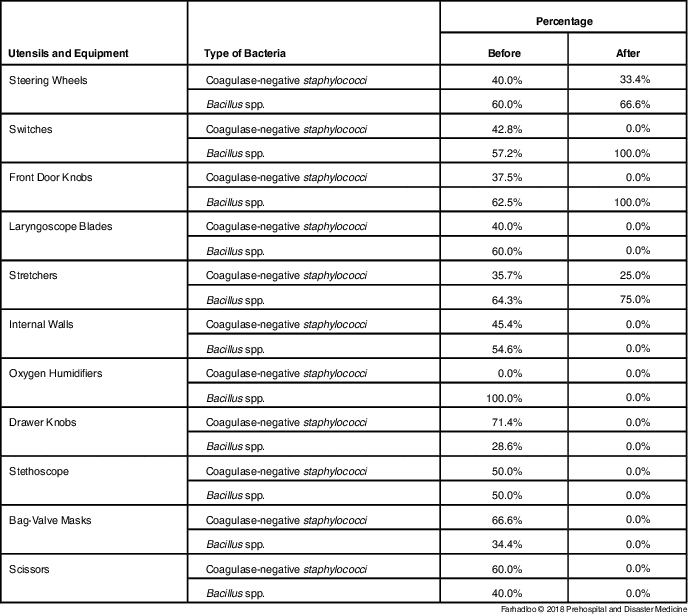
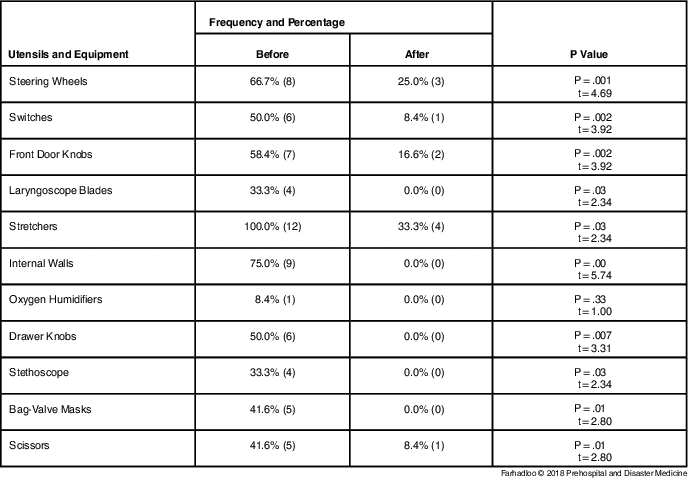
Statistical results showed that bacterial contaminations from ambulance surfaces and equipment were relative to Staphylococcus and Bacillus spp. In oxygen humidifiers, for instance, 100% of infections were caused by Bacillus spp. The highest contamination rate in this study was related to coagulase-negative staphylococci with 53%, followed by Bacillus spp. with 47%. Most contaminated places were related to the stretcher and inside of the ambulance by 100% and 75% of cases, respectively. The isolation rate of the over ambulances, internal walls, oxygen humidifiers, drawer knobs, stethoscope, and bag-valve masks was diminished to zero after the application of disinfectant (Table 1). After disinfection, most sites demonstrated bacterial reduction; for example, 67% of steering wheels (eight ambulances) were contaminated before cleaning, but 25% (three ambulances) were contaminated afterward (Table 2). Among examined medical instruments in the before step, stretchers had the highest contamination rate (100%) and oxygen humidifiers had the lowest (8%). After using disinfectant, stretchers still had the highest infection rate (33%) and other areas on the site of the drawer knobs, bag-valve masks, ambulances internal walls, stethoscope, laryngoscope blades, and oxygen humidifiers showed the lowest level of contamination. Given the positive effect of disinfectant in microbial contamination reduction of ambulance equipment, six of the 11 sampling rates were zero, so the effective role of disinfectants to reduce and eliminate pathogenic microorganisms was seen clearly (Table 2).
Determination of Degree and Type of Ambulance Equipment Infection Before and After Application of the Disinfectant

Determination of Frequency and Percentage of Ambulance Equipment Infection and Comparison of Microbial Contamination Rates Before and After Application of Disinfectant

Discussion
Environmental cleanliness is very important, not only for prevention of infection, but also for patient confidence and safety.
Ambulances can be a source of different microorganisms, considering their main role in patients’ transportation; many staffs and patients may be exposed to them. This research was conducted to detect some bacteria and to evaluate a disinfectant solution for decontamination in 12 ambulances in Qom, Iran. In this study, samples were collected from 11 different sites per ambulance, a total of 132 sites before and 132 sites after the application of the commercial solution. Bacillus spp. and coagulase-negative staphylococci could pose as substantial agents in nosocomial infections. These can cause a range of infections not only for immune-compromised patients, but also for personnel.Reference Jarvis 11 , 12 Using indwelled or implanted foreign bodies, which are indispensable in modern medicine, can lead to this complication. Usually, the main source of endogenous infections caused by coagulase-negative staphylococci is microbial flora of the skin and the mucous membranes of the host.Reference Becker, Heilmann and Peters 13 In the current study, coagulase-negative staphylococci (53%) were the most common infection isolated from instruments and equipment. This finding was similar to the Noh, et al study who evaluated bacterial contamination in metropolitan ambulances where the prevalence rate of Staphylococcus was 46%.Reference Noh, Shin and Kim 4 In another study which was conducted by Okon, et al, coagulase-negative staphylococci were the most frequent microorganisms and were isolated from different parts of the operating rooms.Reference Okon, Osundi and Dibal 14 These bacteria are a part of normal flora of the skin of individuals and can be spread as a source of infection, so it is recommended for health care agents to utilize gloves during medical procedures and avoid direct contact between hands and other instruments. No trace of infection was found after the application of antimicrobial agents (on six of 11 examined tools; eg, laryngoscopes, ambulances internal walls, oxygen humidifiers, drawer knobs, stethoscopes, and bag-valve masks). The switches and front door knobs did not show any contamination with coagulase-negative Staphylococci. In addition, Bacillus spp. were also totally removed from scissors. This result has demonstrated a high impact of the disinfectant solution on reduction, and even total annihilation, of microorganisms available on medical and non-medical equipment of ambulances. Each new service of emergency can be a fresh source of contamination caused by paramedic crews and by the equipment. Due to the role of ambulances, they cannot be expected to be sterile; however, their continuous checking is necessary. Some studies suggested that the most prevalent causes of nosocomial infections on hospital equipment and ambulances are gram-positive Staphylococcus. Reference Ekrami, Kayedani, Jahangir and Kalantar 15 , Reference Rago, Buhs, Makarovaite, Patel, Pomeroy and Yasmine 16 Unlike other studies, this research proved that immobile utensils carry the highest amount of infections, which is comparatively the highest in stretchers. This is due to the fact that stretchers have the highest degree of contact with patients’ bodies and are subject to different infections carried along through shoes, shirts, and other belongings of patients. In this project, the most contaminated places were stretchers (100%), followed by ambulances’ internal walls (75%). It concludes that ambulance surfaces are the most contaminated parts. On the contrary, in the Nigam, et al study, the most contaminated places were rails of the grid/track or floor (92%), while stretchers and walls were the third places (67%).Reference Nigam and Cutter 17 According to Noh, et al, contamination rates of the stretcher car handle and stretcher car sidebar contamination were 71% and 89%, respectively.Reference Noh, Shin and Kim 4 These results are consistent with the present study. It seems that data are logical due to the higher use of the stretchers and the contact of the patient’s body, medical staff, and other equipment with them. It is essential that disinfection of spillages of blood and body fluids should be carried out promptly with a suitable agent. Application of protective clothes and medical gloves is necessary for health care personnel to prevent them from spreading microorganisms on medical equipment. Comparison of statistical results which were obtained before and after the application of QACs and PHMB showed that the impact of this disinfectant is significantly effective on all equipment and utensils, except for the oxygen humidifiers in which infection degrees were low before the disinfectant was applied.
Limitations
Due to financial limitations, the researchers in this study could not focus on antimicrobial susceptibility testing of isolated bacteria and the evaluation of other microorganisms such as viruses, parasites, and fungi.
Conclusions
Results of this study showed that infection degree of the utensils and instruments which are used in ambulances of the Qom Medical Emergency Response Center is high. This contamination level might be attributed to a misapplication of disinfectants and making wrong use of them on different surfaces and equipment utilized in the ambulances. As in regards to the significant impact of disinfectants, it is proposed to obligate all prehospital emergency care centers to follow the instructions compelling application of such antibacterial agents. Comprehensive education infection control programs also help in understanding disease transmission and etiology of infections for personnel. It is also recommended to perform further studies for other pathogenic microorganisms, including fastidious bacteria, viruses, and fungi.
Acknowledgments
This study has been supported by the Qom University of Medical Sciences (grant No: 94573). The researchers thank and appreciate the friendly cooperation of Qom Emergency Medical Services and laboratory of Shahid Beheshti Hospital, Qom, Iran.