Introduction
The genus Thecacoris (Phyllanthaceae, formerly Euphorbiaceae) was described from Madagascar by A. de Jussieu in 1824 based on T. madagascariensis A.Juss. Leandri added Thecacoris perrieri Leandri from Madagascar in Reference Leandri1937, and in Reference Leandri1957 another new species, T. humbertii Leandri. He also transferred two species to Thecacoris: T. cometia (Baill.) Leandri based on Cometia lucida Baill. (non T. lucida (Pax) Hutch.) and T. spathulifolia (Pax) Leandri based on Cyathogyne spathulifolia Pax. Leandri’s paper (1957) gave ample evidence in favour of uniting Cyathogyne Müll.Arg. (Müller Argoviensis, Reference Müller Argoviensis1864) with Thecacoris, but he transferred only C. spathulifolia to Thecacoris, not C. bussei Pax nor the type species C. viridis Müll.Arg. Transfer of the latter was effected by Webster in Reference Webster1994 although he referred it to Leandri. Radcliffe-Smith (Reference Radcliffe-Smith and Polhill1987) treated Cyathogyne as a distinct genus and united the two East African species C. bussei and C. spathulifolia, simultaneously published by Pax (Reference Pax1903), under the former name. Govaerts et al. (Reference Govaerts, Frodin and Radcliffe-Smith2000) erroneously united them under the latter name. In 1996 Radcliffe-Smith followed the generic concept of Leandri (Reference Leandri1957) and Webster (Reference Webster1994) and transferred Cyathogyne bussei to Thecacoris.
Léonard (Reference Léonard1995) recognised the genera as distinct, based on a number of small characters of the habit, the leaves, the inflorescence, the presence of petals, the shape of the pistillode, the angle between the pedicel and the columella, the fruit-wall, as well as some seed characteristics. These characters unite the continental African forest species of Thecacoris and separate this group from Cyathogyne viridis. His comparison of this group of continental forest species with Thecacoris madagascariensis, the type species of the genus, raised doubts as to whether they are congeneric, especially when the seeds are compared. Léonard (Reference Léonard1995) compared the continental forest species with Thecacoris madagascariensis on the one hand and with Cyathogyne viridis on the other hand and concluded that both genera should remain separate. His incomplete knowledge of Thecacoris madagascariensis may have caused him to misinterpret the evidence; it may have been more logical to conclude that Cyathogyne viridis shows the same characters as the type species of Thecacoris and that therefore these two genera should be united. P. Hoffmann (pers. comm., 2006) stated that after a detailed examination of material of Thecacoris madagascariensis her conclusion is that this species and Cyathogyne viridis belong to the same genus. She advocates an eventual separation of the continental forest species at a subgeneric level. Such a separation at subgeneric or even generic level (for which the name Baccaureopsis Pax (Reference Pax1909) is available) should, in my opinion, be strongly supported by molecular evidence.
Key to the species of Thecacoris in West Africa
1a. Herb or shrublet (0.2–)0.3–0.6(–1) m tall; stem often partly procumbent, rhizome-like and rooting; inflorescence usually branched (From South Nigeria to Central Africa) 5. T. viridis
1b. Shrub to small tree (0.6–)2–10 m tall and up to 10 cm dbh; inflorescence unbranched (West and Central Africa) 2
2a. Inflorescences pendulous, > 15 cm long; ovary pubescent; fruits appressed-pubescent, sometimes almost glabrous at maturity; leaves (10–)17–34 × (4–)6–15 cm (SW Cameroon, N Gabon) 1. T. grandifolia
2b. Inflorescences ± erect, ≤ 12 cm long; ovary glabrous, or nearly so; fruit glabrous; leaves (1.5–)3–20(–31) × (1–)3–10(–13) cm (West and Central Africa) 3
3a. Leaves (1.5–)3–12(–14) cm long with (4–)5–9 pairs of main lateral nerves; midrib puberulous above (SE Côte d’Ivoire, SW Ghana) 3. T. micrantha
3b. Leaves (4–)12–20(–31) cm long with (6–)7–12(–15) pairs of main lateral nerves; midrib glabrous above (West and Central Africa) 4
4a. Stipules 2–6(–7) mm long; petioles (1–)2–5(–11) mm long; petals absent (South Nigeria, western Central Africa) 2. T. leptobotrya
4b. Stipules (3–)5–7(–12) mm long; petioles (4–)5–12(–16) mm long; petals present (West Africa, western Central Africa) 4. T. stenopetala
Synopsis of the West African Species of Thecacoris
1. Thecacoris grandifolia (Pax & K.Hoffm.) Govaerts in Govaerts et al., World Checklist and Bibliogr. Euphorbiaceae 1517 (2000). – Cyathogyne grandifolia Pax & K.Hoffm. in Engler, Pflanzenr. IV, 147, XV: 41 (1922). – Type: Cameroon, Ndonge, Ledermann 6199 and 6311 (syn B†); neotype, designated here, forest near Mekom Bakossi, 8 km E of Kumba–Mamfe Rd, near Konye, 16 iv 1986, Nemba & Thomas 14 (neo MO; isoneo WAG).
Note. The following collections, hitherto mainly identified as Thecacoris cf. annobonae Pax & K.Hoffm. (Keay, Reference Keay, Hutchinson and Dalziel1958), belong to T. grandifolia: Cameroon. Kumba Distr., 22 iii 1956, Binuyo & Daramola FHI 35639 (K); 21 iii 1948, Brenan et al. 9329 (K); 25 iv 1959, Daramola FHI 29832 (K); 26 iv 1959, Daramola FHI 29847 (K); SW Province, 26 iv 1986, Etuge & Thomas 48 (MO, WAG); Kumba Distr., 19 i 1951, Keay & Russell FHI 28679; 40 km NNE of Douala, 30 iv 1976, Letouzey 14774 (HBG, K, WAG); near Konye, 28 v 1986, Nemba & Thomas 99 (K, MO, WAG); Kumba Distr., 9 iv 1951, Olorunfemi FHI 30507 (K); 19 iv 1951, Olorunfemi FHI 30531 (K); 15 vi 1951, Olorunfemi 30619 (K); 5 km S of Kumba, 25–31 v 1983, Thomas 2143 (MO, WAG); near Kumba, 14 iv 1984, Thomas 3447 (K, MO), 3448 (K, MO), 3449 (K); Korup Nat. Park, 3 iv 1988, Thomas et al. 7635 (K, MO, WAG), 7636 (K, MO, WAG); Banya, 15 km W of Manyemon, 29–30 vi 1988, Thomas 8141 (K, MO, WAG); 25 iv 1988, Thomas & Mambo 8235 (K, WAG). Gabon. Cristal Mts, E of Nkan, 13 ii 1968, Hallé & Villiers 5232 (P).
Thecacoris annobonae Pax & K.Hoffm., published by Pax & Hoffmann in Reference Pax, Hoffmann and Engler1922, was based on Mildbraed 6499, 6554 and 6557. This material was lost in the Berlin Herbarium fire of 1943. Mildbraed 6557 (HBG), here designated as the lectotype, is the only duplicate of these three syntypes that has been traced. This duplicate undoubtedly belongs to Thecacoris trichogyne Müll.Arg. Thecacoris annobonae is thus placed in synonymy under T. trichogyne, a species from Central Africa.
2. Thecacoris leptobotrya (Müll.Arg.) Brenan, Kew Bull. 1952: 446 (1953); Keay in Fl. West. Trop. Afr., ed. 2, 1: 372 (1958). – Antidesma leptobotryum Müll.Arg., Flora 47: 529 (1864). – Type: Gabon, Sierra del Crystal, 1862, Mann 1714 (holo K; iso P).
3. Thecacoris micrantha Breteler, sp. nov.Figs 1,2.
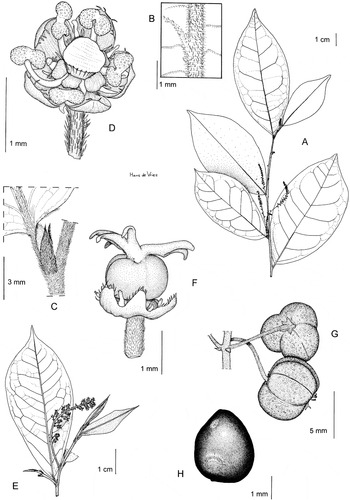
Fig. 1.Thecacoris micrantha Breteler. A, flowering male branch; B, detail of indumentum on midrib above; C, stipule; D, male flower; E, branchlet with female inflorescence; F, female flower; G, part of an infructescence with two fruits; H, seed (A–D, Beentje 404-a; E, F, Jongkind & Abbiw 2169; G, H, Thijssen 294). Drawn by H. de Vries.
 Fig. 2.
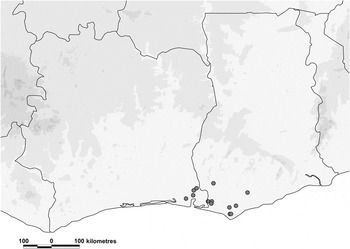
Distribution of Thecacoris micrantha Breteler in Côte d’Ivoire and Ghana.
Praesentia petalorum Thecacoridi stenopetalae (Müll.Arg.) Müll.Arg. maxime similis, sed differt stipulis minioribus, foliis parvis costa supra pilosa, floribus minioribus disco glabro et fructibus minioribus. – Type: Côte d’Ivoire, between Aboisso and Bonoua, 4 ix 1969, Thijssen 294 (holo WAG; iso BR, E, K, MO, P).


Shrub 1.5–3 m tall. Branchlets puberulous-tomentellous. Stipules early caducous or not, triangular, 1–3 mm long, ≤ 1 mm wide, appressed-pubescent outside, glabrous inside. Leaves: petiole grooved above, 1–3(–6) mm long, puberulous-tomentellous; lamina elliptic, sometimes obovate, often very unequal in size, (1.5–)2–3(–4) times as long as wide, (1.5–)3–12(–14) × 1–5(–6.5) cm, rounded to cuneate at base, 0.5–1(–2) cm acuminate at apex; lateral nerves (4–)5–9 pairs, thin, flush to slightly prominent above, ± distinctly prominent beneath; puberulous-tomentellous on the flush or impressed midrib above (sometimes also on the main laterals), ± appressed-pubescent on the prominent midrib beneath and more sparsely so on the main laterals, the remaining surface and the revolute margin glabrescent. Inflorescence racemose, puberulous-tomentellous, the male 1.5–2 cm long, the female 2–7 cm long, 3–10 cm long in fruit; bracts broadly ovate-triangular, ≤ 1 mm long, appressed-pubescent, ciliate. Male flowers c.1.5 mm in diameter; pedicel ≤ 1 mm long, puberulous; sepals 5, united at base, thin, almost hyaline, ± elliptic in outline, c.0.6 mm long, with a few ± appressed hairs, ciliate; petals 5, filiform, ≤ 0.5 mm long, glabrous; stamens 5, 1 mm long, glabrous; disk glands 5, glabrous; pistillode obconical, c.0.5 mm long, glabrous. Female flowers c.2 mm in diameter; pedicel 0.5–2 mm long, puberulous, accrescent in fruit; sepals ± triangular, c.1 mm long, hairy as in the male flowers; petals as in the male flowers; small staminodes sometimes present; disk annular, entire to slightly lobulate, glabrous; pistil 2 mm long, glabrous; ovary globose, c.1 mm in diameter, slightly 3-lobed; styles 3, bifurcate. Capsule 3-lobed, glabrous, 5–6 mm long, 6–7 mm in diameter; pedicel in fruit 7–12 mm long, ± straight or slightly curved towards the fruit; columella 3–4 mm long. Seed brown, smooth, shiny, 3 × 2 mm.
Distribution. SE Côte d’Ivoire, SW Ghana.
Habitat and ecology. In undergrowth of primary evergreen rain forest; altitude 0–100 m.
Additional specimens examined. Côte d’Ivoire. Near Ayamé, 15 vii 1965, Aké Assi 8139 (G); 18 km NE of Ayamé, 17 vi 1975, Beentje 404-a (WAG), 404-b (WAG); Ayamé, 12 v 1965, Miège s.n. (G); Soumié, 27 iv 1931, Service Forestier Côte d’Ivoire 456 (P). Ghana. Tano Anwia F.R., 31 xii 1954, Adams 2263 (K); Benso, viii 1952, Andoh 3744 (BM); Subiri F.R., ix 1951, Andoh 5572 (K, P); Benso, viii 1953, Andoh 5744 (P); Nkwanta, 11 ix 1912, Chipp 366 (K); Abra W.R., 26 ii 1965, Hall 2888 (P); 2 km N of Twife Mapong, 3 xi 1973, Hall & Abbiw GC 44588 (MO, P, WAG); 22 km ESE of Takoradi, 14 vii 1995, Harder et al. 3423 (MO, WAG); Ankassa Game Res., 19–20 iii 1995, Jongkind & Abbiw 2144 (MO, WAG), 2169 (MO, WAG); Ankassa F.R., 12 iii 1996, Merello et al. 1398 (K, MO), 1414 (MO); 8 miles from Princess Town, 28 iii 1954, Morton A 342 (K); Ankassa F.R., 12 iii 1996, Schmidt et al. 3442 (MO); Simpa W.P., v 1930, Vigne 1954 (K).
Note. Specimens of Thecacoris micrantha were previously (Keay, Reference Keay, Hutchinson and Dalziel1958; Aké Assi, Reference Aké Assi2001) assigned to T. stenopetala, then the only known species in that area. Thecacoris micrantha is a narrow endemic of the relatively wet region situated on both sides of the southern border between Côte d’Ivoire and Ghana. Some other species with a similar distribution, such as Cola umbratilis Brenan & Keay (Sterculiaceae), Combretum tarquense J.J.Clark (Combretaceae), Hymenostegia gracilipes Hutch. & Dalz. (Leguminosae – Caesalpinioideae) and Tapura ivorensis Breteler (Dichapetalaceae), are illustrated in Poorter et al. (Reference Poorter, Bongers, Kuamé and Hawthorne2004).
4. Thecacoris stenopetala (Müll.Arg.) Müll.Arg. in DC., Prodr. 15(2): 246 (1866); Keay in Fl. West Trop. Afr., ed. 2, 1: 372 (1958). – Antidesma stenopetalum Müll.Arg., Flora 47: 520 (1864). – Type: Sao Tomé & Principe, Principe Island, Mann s.n. (holo K).
Thecacoris manniana (Müll.Arg.) Müll.Arg. in DC., Prodr. 15(2): 246 (1866); Exell, Cat. Vasc. Pl. S. Tomé 287 (1944). – Antidesma mannianum Müll.Arg., Flora 47: 519 (1864), syn. nov. – Type: Sao Tomé & Principe, Sao Tomé Island, sine loc., Mann 1073 (holo K) (see note).
Thecacoris membranacea Pax, Bol. Soc. Brot. 10: 158 (1892), syn. nov. – Type: Sao Tomé & Principe, Sao Tomé Island, Quintas s.n. (holo B†). Lectotype, designated here: Quintas in Moller 993 (COI) (see note).
Notes. The basionyms of Thecacoris manniana and T. stenopetala were simultaneously published and later simultaneously transferred to Thecacoris. According to the author of both species Antidesma mannianum from Sao Tomé differs from A. stenopetalum from Principe in being more slender and having flowers that are half as large. This difference in flower size reflects flower development. The flowers of the type of Antidesma mannianum are, although already open at the top, not fully expanded, which accounts for their smaller size. A thorough investigation of material of both species did not reveal any character by which they might be separated.
The holotype of Thecacoris membranacea, an unnumbered Quintas collection in the protologue (Pax, Reference Pax and Henriques1892) and lost in Berlin, was later (Pax, Reference Pax1894) cited as Quintas 121. According to Exell (Reference Exell1944) the COI-duplicate of the Berlin specimen is numbered Quintas 993 (in the Moller collection).
Of the specimens cited by Exell (Reference Exell1944) under Thecacoris stenopetala the following collections from COI belong to the genus Maesobotrya Benth., probably an undescribed species: Campos 75, Exell 291, 301, 355, 356 and Quintas 315 (see Exell, Reference Exell1959: 466). The collection Campos 76, also cited by Exell under this species, is identified as Antidesma vogelianum Müll.Arg.
5. Thecacoris viridis (Müll.Arg.) Leandri ex G.L.Webster, Ann. Missouri Bot. Gard. 81: 52 (1994). – Cyathogyne viridis Müll.Arg., Flora 47: 536 (1864); Keay in Fl. W. Trop. Afr., ed. 2, 1: 375 (1958). – Type: Equatorial Guinea/Gabon, Corisco Bay, 1862, Mann 1868 (holo K; iso P).
Acknowledgements
I am grateful to my wife B. J. M. Breteler-Klein Breteler for preparing the electronic version of the manuscript and to Mr H. de Vries for the excellent illustration. Dr R. H. M. J. Lemmens is kindly acknowledged for the translation of the species diagnosis into Latin and Dr J. J. Wieringa for preparing the distribution map.