INTRODUCTION
In early 2012, South Africa's Western Cape Liquor Act (WCLA) was finally signed into law after years of debate, contestation and negotiation. Its ascension reflects the increasing and disproportionate risks that alcohol now poses to human life, society and development in South Africa (Parry Reference Parry2005; World Health Organization 2010, 2011). This burden may be particularly marked in South Africa, but alcohol control activities are intensifying throughout the wider southern African region (Dobrow et al. Reference Dobrow, Goel and Upshur2004; Pitso & Obot Reference Pitso and Obot2011; World Health Organization 2014). Here, policy action has been largely sparked by the relationship between alcohol, risky sexual behaviour and HIV/AIDS (Morojele et al. Reference Morojele, Kachieng'a, Mokoko, Nkoko, Parry, Nkowane, Moshia and Saxena2006; Charman et al. Reference Charman, Petersen and Piper2012) as well as cultural influences including Islam and evangelical Christianity (Van Dijk Reference Van Dijk and Bryceson2002; Willis Reference Willis2006; Shikwati Reference Shikwati2012). The WCLA is also underpinned by similar concerns and motivations, but its central justification remains liquor's association with violence and crime, ‘both in the regulated and unregulated sector of the industry’ (Provincial Government of the Western Cape (PGWC) 2003: 68). This is largely because ‘most violent crimes take place on weekends within 500 metres of a drinking establishment, the most common are robbery, armed robbery and assault with intent to do grievous bodily harm; most perpetrators are young men; and the vast majority of victims and perpetrators are under the influence of alcohol’ (Steinberg Reference Steinberg2011: 356). The ‘drinking establishments’ of particular concern here are shebeens or ‘the unlicensed outlets that proliferate in [poor] residential areas that do not adhere to spatial planning and other regulatory requirements’ (PGWC 2003). That South Africa has this bifurcated regulated/unregulated liquor retailing sector is an artefact and legacy of the state's colonial and apartheid use of alcohol regulation as a tool of social, spatial, economic and political control. Within this, the ‘politico-legal’ intervention of the licence (Valverde Reference Valverde2003) has long been a mechanism by which the state has sought to manage sociality, risk and space in relation to alcohol.
Shebeens are archetypal South African spaces, but, like alcohol itself, are ‘object[s] of contestation’ (Carney et al. Reference Carney, Myers, Louw, Lombard and Flisher2013: 13) that can simultaneously function as conduits for risk behaviours (see Aekplakorn et al. Reference Aekplakorn, Hogan, Tiptaradol, Wibulpolprasert, Punyaratabandhu and Lim2008) as well as much-needed micro-enterprise, livelihood opportunities (King Reference King2002). In contrast to policy discourses of criminality, shebeens remain ‘one of the most common facets of the contemporary informal economic fabric in South African cities’ (Rogerson & Hart Reference Rogerson and Hart1986: 156). In legal terms they may exist outside urban planning and liquor licensing regulations, but they remain a particularly resilient and dynamic legacy of the country's past systems of spatial, economic and social exclusion of non-whites. Prohibitions on the sale and consumption of alcohol under colonial and apartheid rule meant that shebeens emerged as places of resistance, pleasure, coping and, ultimately, economic survival for many city residents. Over time, the composition of alcohol sold in shebeens has shifted from traditional homebrews to industrially manufactured clear beers, ciders and spirits. As a result, shebeens are not only essential components of the liquor industry value chain, but also differ markedly from informal liquor retailers elsewhere in southern and East Africa who continue to sell informally produced beverages (Willis Reference Willis2002; Pitso & Obot Reference Pitso and Obot2011). However, in common with other informal liquor traders across the continent, access to licences presents the main barrier to the legitimacy of South African shebeens (Briscoe Reference Briscoe2000). Indeed, South African Breweries (SAB) has (unsurprisingly) noted that there are an estimated 120,000 shebeeners in the country ‘pursuing an honest living but who fall outside the law by administrative fiat and as a result, struggle to grow their businesses, develop their entrepreneurial skills and who have a limited incentive to trade responsibly’ (SABMiller, 2008). The alcohol industry's response to this fiat has long been to argue for the formalisation of the informal trade. This formed a central logic of the 2003 National Liquor Act which aimed to promote ‘diversity of ownership’ and ‘new entrants’ into the manufacturing and distribution tiers of industry. The disparity between the WCLA's conceptualisation of shebeens as spaces of deviance and shebeeners’ own entrepreneurialism in response to local demand hints at why the ‘regulation of access to alcohol has been described as an obsession in South Africa’ (Rogerson & Hart Reference Rogerson and Hart1986: 157).
Shebeens remain the primary targets of regulatory activity around alcohol and the WCLA has granted the South African Police Service (SAPS), Provincial Liquor Officers and the Cape Town Metro Police new enforcement powers to raid them, seize liquor, fine, arrest and give criminal records to shebeeners (Syed et al. Reference Syed, Dadwal and Martin2013). While these enforcement activities may not have been immune to broader controversies over corruption and violence within South African policing (Altbeker Reference Altbeker2007; Breetzke Reference Breetzke2012), they have helped to reinvigorate questions about the most effective and equitable ways of regulating informal liquor given that while drinking poses significant risks to health and human development, shebeens still play an important social and economic role in South Africa's poor urban communities. The crux of the challenge consequently remains how to reconcile the restrictive ‘politico-legal’ conceptualisation of liquor licences and the coercive mandate of enforcement agencies in ways that can manage and reduce risks while also recognising and fostering the important social and economic function of these public drinking spaces.
This challenge is only made harder because most South African studies of alcohol have emerged from public health/epidemiological traditions exploring the burden of disease attributable to alcohol (Bradshaw et al. Reference Bradshaw, Groenewald, Laubscher, Nannan, Nojilana, Norman, Pieterse, Schneider, Bourne, Timæus, Dorrington and Johnson2003; Schneider et al. Reference Schneider, Norman, Parry, Bradshaw and Pluddemann2007), the contribution of alcohol to violence, accidents and injury (Norman et al. Reference Norman, Matzopoulos, Groenewald and Bradshaw2007; Matzopoulos et al. Reference Matzopoulos, Myers, Butchart, Corrigall, Peden and Naledi2008) or the role of alcohol in unsafe sex and HIV/AIDS transmission (Morojele et al. Reference Morojele, Kachieng'a, Mokoko, Nkoko, Parry, Nkowane, Moshia and Saxena2006; Kalichman et al. Reference Kalichman, Simbayi, Vermaak, Joose and Cain2008; Fritz et al. Reference Fritz, Morojele and Kalichman2010). While this body of work supports the World Health Organization's call to ‘regulate or control informal alcohol’ (2010: 15) by controlling supply and access, it underplays the role of shebeens as ‘a complex cultural element in urban Black life as well as a vital informal income source’ (Rogerson & Hart Reference Rogerson and Hart1986: 162, emphasis added; see also Ross Reference Ross2010) in a country with very high unemployment. Similar concerns have resulted in ambivalent alcohol control policy stances in several African countries, not least Kenya (Willis Reference Willis2003), Namibia (Kapitako Reference Kapitako2010; Walker Reference Walker2012) and Uganda (UYDEL 2010). Indeed, shebeens are a clear instance where the heart of city life is constituted by ‘the capacity for its different people, spaces, activities and things to interact in ways that exceed any attempt to regulate them’ (Simone Reference Simone2010: 3). Liquor thus not only illuminates the multiple limits to the regulation of urban space, but also the continued importance of what Steinberg has called ‘hybrid structures of community protection’ (Reference Steinberg2009: 166) and their constant metamorphosis in response to heightened regulatory and enforcement efforts.
To explore these ideas, the paper first examines recent debates on informality in South Africa and the liminal space that shebeens have come to occupy with this sector. It then reflects on shebeens as sites of significant historical and contemporary governmental unease over the limits to its own regulatory capacities, before examining the WCLA in more detail. The paper then turns to data generated from business surveys and interviews with shebeeners across four case study sites in Cape Town as well as interviews with the Metropolitan police to explore: (1) the density and location of alcohol micro-enterprises, (2) the characteristics of shebeens and (3) shebeener strategies of regulation and self-preservation amid the enforcement of the WCLA. Taken together, this critical examination of shebeening in the context of urban informality helps expose an understudied domain of city life in contemporary South Africa that is rendered a unique regulatory conundrum by virtue of being at once a setting for pleasure and a source of income, while at the same time, a pernicious barrier to the achievement of health and human development goals.
SHEBEENS AS SITES OF AMBIGUITY AND REGULATORY CHALLENGES
The term ‘informal economy’ is most commonly traced back to Keith Hart's 1973 paper in which he distinguished between those engaged in waged employment (formal) and unwaged, self-employment (informal) in Ghana. This dichotomous thinking was also part of a 1972 International Labour Organisation report on Kenya and provided a clear rationale for the economic and development policies that the international community then recommended to the Global South (Miner et al. Reference Miner, Dubinski and Daniszewski2007: 1036). As Hart contends, ‘ “formal” incomes [come] from regulated economic activities and “informal” incomes, both legal and illegal, [lie] beyond the scope of regulation’ (Reference Hart, Guha-Khasnobis, Kanbur and Ostrom2006: 25). Building from this, the pervasive assumption is therefore that the formal is based on ‘rule-based stability’ (Kanbur Reference Kanbur2009: 3), while the informal is characterised by a lack or disregard for rules and, therefore, instability. However, ‘in contrast to such notions of formal social interaction, informality should not be read as social disorganization or anarchy’ (SABMiller 2008: 25). Instead, there is now widespread recognition of and interest in the important continuities between both sectors (Guha-Khasnobis et al. Reference Guha-Khasnobis, Kanbur and Ostrom2006). It is also important to recognise ‘the complexity of the dialectical interconnectedness of informal economies and the wider structures in which they are set’ (Goldthorpe Reference Goldthorpe2010: 153). If informality is both ‘shaped by and shape[s] the wider political economy in which [it] is set’ (Goldthorpe Reference Goldthorpe2010: 138), then it is clear that strategies of regulation form a central mode by which informality is not just controlled, but also produced (Kanbur Reference Kanbur2009). Indeed, the act of occupying, trading in, using or consuming otherwise legitimate goods in the wrong spaces produces informality. Such ‘spatial practices of informality’ (Kudva Reference Kudva2009: 1625) are intricate given that the urban settlements in which shebeens proliferate often exist in a ‘complex continuum of legality and illegality’ (Roy Reference Roy2005: 149), defined by contestations over land rights, use, zoning and service provision. As a consequence, informality is directly and indirectly produced by state efforts including: migration policies; economic policies; land use controls; housing provision; employment opportunities; transport infrastructure; skills and training (White et al. Reference White, Bunting, Raybould, Adamson, Williams and Mathers2004) that enable some to access the legitimate means to trade and ensure that others will always be excluded from such processes.
Unlike many other countries with significant urban informal sectors, concern has been expressed in South Africa about the degree to which waged informal work far outstrips self-employment, suggesting significant residual barriers to the kind of entrepreneurialism so fêted elsewhere (Klasen Reference Klasen2000). Such barriers may include problems in accessing start-up credit, the perceived low profitability of informal work when compared with waged employment, crime, risks of business failure, transport costs and fear of the jealousy that might result from personal success (Cichello et al. Reference Cichello, Almaleeh, Ncube and Oosthuizen2006; Rogerson Reference Rogerson2007). Amid this, shebeens stand out as a particularly problematic category in relation to both the informal economy and spaces of informality. They are essentially flourishing micro-enterprises selling a legal product obtained through formal channels such as wholesalers and supermarkets, but rendered illegal by virtue of (1) being located in residential rather than business zones and (2) occupying structures ineligible for liquor licences. They therefore straddle a double regulatory domain affected by changes in formal liquor policy as well as efforts to regulate urban informality. In a sense, therefore, shebeens represent a delicate instance of informality whose economic viability is (and has long been) acutely sensitive to efforts to formally regulate liquor tout court.
This is not a new situation and the South African history of liquor reveals a series of reoccurring struggles: for racial equality; spatial control; worker productivity; industrial expansion; state monopolisation; and gendered employment opportunities (Rogerson & Hart Reference Rogerson and Hart1986; La Hausse Reference La Hausse1998; Mager Reference Mager1999, Reference Mager2004). Under apartheid, informal liquor retailing became a major urban livelihood opportunity and the country's most significant retail market for the formal liquor trade (Kudva Reference Kudva2009; Samara Reference Samara2010). This history of shebeening has received considerable scholarly attention, especially in relation to the development of state brewing capacity (Rogerson Reference Rogerson1992), the growth and globalisation of SAB (Mager Reference Mager1999), the changing delineations of liquor ‘appropriate’ to African culture and biology (Mager Reference Mager2004, Reference Mager2008) and the trade's gender dynamics. The appendage of the title shebeen ‘Queen’ or ‘King’ to the patron is perhaps misleadingly grand, as what little is actually known about shebeens and township drinking indicates, to the contrary, that ‘backyard shebeens … were modest enterprises’ (Mager Reference Mager1999: 379). Despite this modesty, their sheer proliferation and cultural importance has meant that shebeens were responsible for introducing ‘a powerful new drinking culture into township life’ (Mager Reference Mager2004: 744) and, in turn, creating significant regulatory challenges.
After 1994, laws and policies were amended to redress the social and economic inequalities of apartheid and affirm the rights and responsibilities set out in the constitution. The new era of liquor control was one of the multiple domains that bore the historical imprint of racialised policies and their intentional exclusion of Africans from legitimate liquor trading opportunities.
In the formulation of the WCLA therefore, shebeens are positioned as spatial and social conduits for many of the contemporary problems besetting South African cities: violence; HIV/AIDS; under-age drinking; drugs; criminality and injury (Schneider et al. Reference Schneider, Norman, Parry, Bradshaw and Pluddemann2007). We do not dispute that economic investment in alcohol as well as the costs attributable to alcohol-related harms would be far better utilised to foster human development (Budlender Reference Budlender2009). However, in this paper we seek to examine how present strategies of alcohol regulation conceptualise and seek to rationalise informality as threat and the implications of this for the shebeen sector's attempts to operate viable micro-enterprises in contexts with a gross lack of alternative employment opportunities. In so doing, we necessarily reflect upon the limits to the legal regulation of shebeens and, moreover, whether these archetypal informal spaces might be policed in ways that work with shebeeners’ own existing self-regulatory and risk mitigation strategies.
These questions are both particularly important and intensely political given the significance of the informal sector to South Africa's huge liquor industry, the scale of shebeening in its poor urban communities and the gross inequities in access to the legitimate means to sell alcohol. For example, in the Western Cape alone, there are an estimated 25,500 shebeens (Petersen & Charman Reference Petersen and Charman2010) overwhelmingly located in non-white areas of the city. By contrast, 86% of the province's 8072 liquor licences are white-held. Yet, rather than redress the inequitable distribution of economic opportunity through greater formalisation of black micro-enterprise as set out in the 2003 National Liquor Act, the WCLA instead sets out strict licensing conditions based on land use classification where individuals can apply for a liquor licence only for premises that they own and that are located within commercial, rather than residential zones. Licences also require certain levels of building amenity/quality (e.g. solid structure, two toilets etc.). This requirement automatically precludes most shebeens as home-based enterprises situated in residential areas in townships or informal settlements. The process of obtaining a licence is also complex and expensive, making it unsurprising that the overwhelming majority of successful applications make use of (high cost) liquor consultants. The WCLA's shaky passage through Parliament took almost nine years, was subject to numerous iterations and public consultations and became a central platform for the Democratic Alliance (DA) party at the 2008 provincial elections.
As a result, the WCLA also reflects the significant lobbying efforts of a number of groups including industry representatives, neighbourhood and shebeen associations, as well as reflecting the DA's own hard line on crime, drugs and alcohol (Lawhon & Herrick Reference Lawhon and Herrick2013). Our research aims to provide an alternative view of informal alcohol retailing to that enshrined within the Act. As such, we argue that shebeens are highly variegated micro-enterprises that actively undertake strategies of social and spatial control in order to mitigate alcohol-related harms among drinkers and evade the attention of the police and/or criminals. In this reading, shebeens may be technically illegal, but exhibit significant ingenuity in the face of vulnerability to the effects of criminality, police raids and corruption. This, in turn, has great significance for the WCLA's likely efficacy in managing either alcohol-related harms or conditions of informality.
METHODS
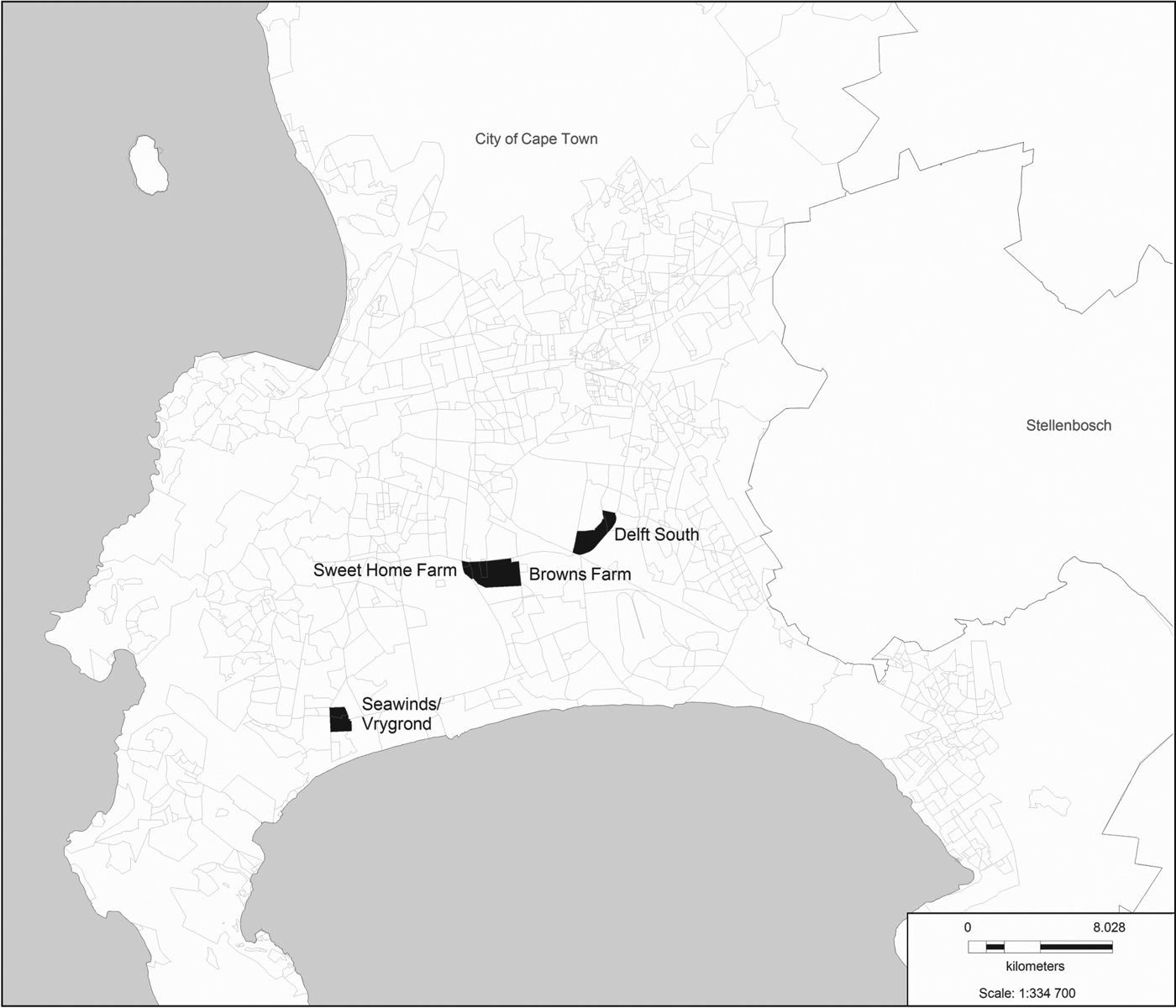
This paper draws on data collected in 2012/2013 from four case study sites in the City of Cape Town: Brown's Farm; Delft South; Sweet Home Farm; and Vrygrond (see Figure 1). The combined area comprises approximately 38,721 households and a population of 157,796, with differing proportions of black and coloured South Africans as well as migrants from elsewhere in Africa. The sites were chosen because they each contain specific dynamics of informality and social marginalisation representative of the predominant human developmental challenges (e.g. poverty, homelessness, unemployment, crime and racial marginalisation) that face the urban poor in Cape Town. Moreover, the case study sites are also varied in terms of their settlement typologies, transport links and other infrastructural endowments. For example: Brown's Farm has a mix of formal housing and shacks; Sweet Home Farm is a large informal settlement; Delft is a recently built formal township; and Vrygrond's three sites span a relatively new formal township (Capricorn), slum housing (Overcome Heights) and an apartheid-era township (Sea Winds). At each site, a business census was undertaken to explore the characteristics of micro-enterprises through a questionnaire and interviews with individual business owners. This noted the location, ownership, built structure and characteristics of a variety of micro-enterprises including educare centres and hairdressers. In order to supplement these data, several semi-structured interviews with Cape Town's municipal police on current strategies of shebeen closure were also undertaken. Together these interviews, the business census and questionnaires with shebeen owners aim to provide a critical and novel dataset to critically explore the nature of informality in relation to current urban strategies of alcohol control.
Location of case study sites.

The business census identified 645 liquor retailers and the questionnaire tool was used with 465 of these. This questionnaire explored: time in business; weekly number of crates of beer sold; assets at the premises (TV, jukebox etc.), experiences of crime; policing; motivations for starting the business and future outlook. In support of our argument, we present both the interview notes of the researchers (presented here in italics) and verbatim words of the respondents themselves (presented in inverted commas). The names of the interviewees, their businesses and the street localities at which their businesses operate were anonymised and assigned a number in keeping with ethical conventions. However, their case study location was retained for the purpose of contextualisation. Each of the interviewees has been linked to a designated site and database number (for example V21; V=Vrygrond, B=Brown's Farm, D=Delft, S=Sweet Home Farm) with their gender and time in business in brackets for additional information [for example M,7]. Although the great majority of the identified liquor businesses were operating illegally and in a covert manner, we were able to identify most retailers simply by asking respondents to point out neighbouring liquor retailers. However, in certain areas such as Vrygrond and parts of Delft South, the number of very small size liquor retailers is potentially under-reported. This is most likely a reflection of community fears about the impact of the increased visibility that inclusion in such a study might bring. Primarily such fears have been of police raids as well as of the influence of drug gangs who seek to ‘control’ the territory of alcohol retailing as a market space.
Outlet density
Our research shows that liquor retailers represent the largest category of informal micro-enterprise in the four case study sites in Cape Town, accounting for almost 17% of all businesses. Through their multiplier effects, notably on employment from glass recycling, cleaning, car guarding, security and food take-away, the liquor sector may well account for an even greater percentage of informal economic activity. The research identified four spatially distinct forms of liquor businesses: taverns (licensed premises, on-trade); shebeens (both off and on-trade); spaza-shebeens (small shops that sell basic provisions and liquor, mainly for off-consumption); and businesses micro-manufacturing traditional beer/concoctions for on-consumption. Of these, shebeens are by far the most ubiquitous category. It is interesting to note, however, that while there are categorical differences between individual drinking venues, the broad patterns of their spatial distribution is remarkably similar across all sites. These patterns, we argue, represent geographies of convenience and familiarity, that both reflect the nature of shebeens as businesses and the limited financial means available to shebeeners. These will be further discussed with reference to the example of Brown's Farm.
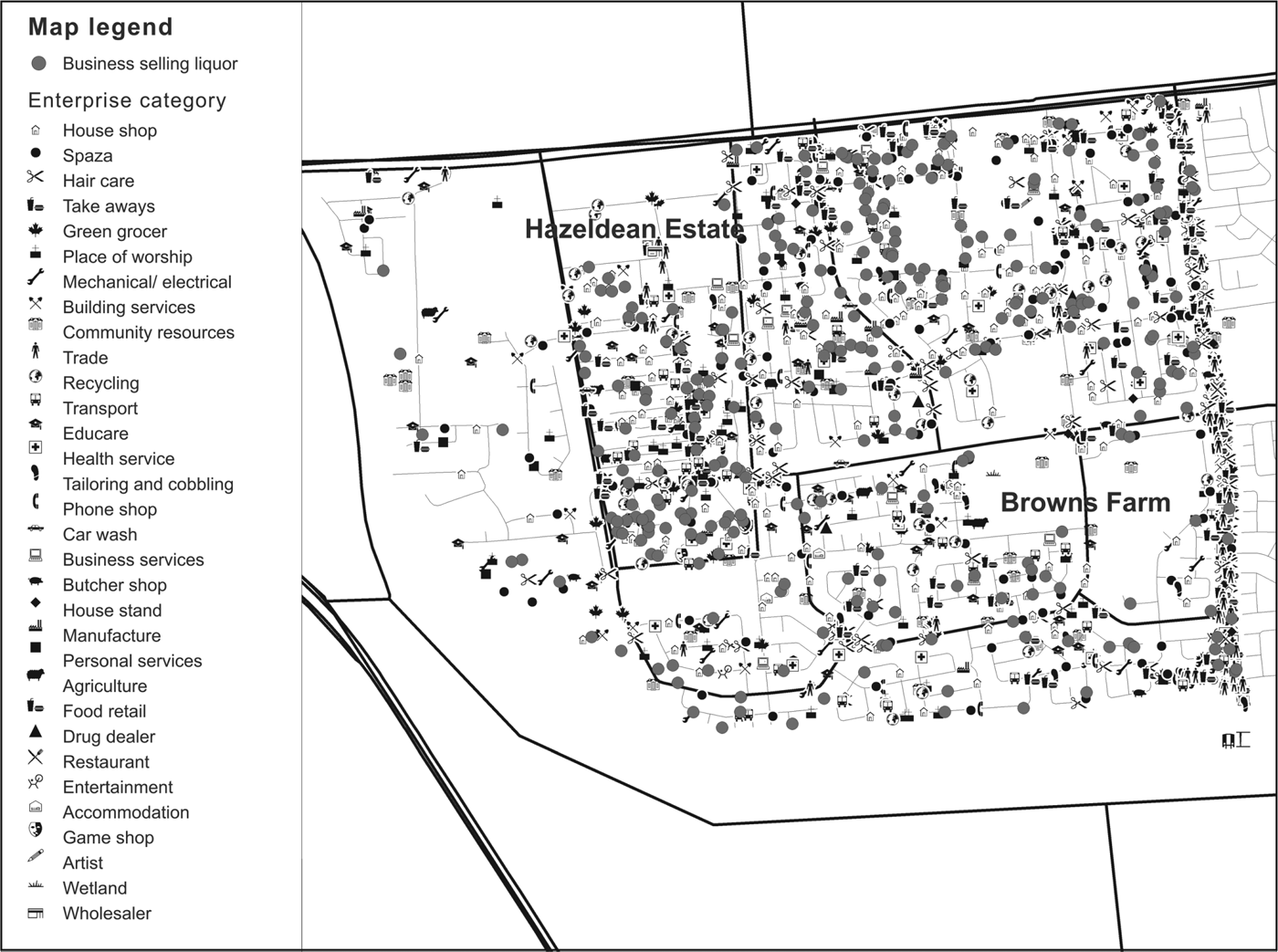
Figure 2 shows the spatial distribution of liquor enterprises in Brown's Farm and the adjacent Hazeldean estate. The map shows that liquor retailing businesses are fairly evenly situated across Brown's Farm and that, in sharp contrast to the distribution of most other micro-enterprises, are not clustered along main arterial transport routes. In the case of liquor retailers, their lack of any obvious clustering suggests that their distribution (as well as density) is determined by highly localised market dynamics whereby each outlet is positioned to serve a short walking distance, typically no longer than 10 minutes. We found no evidence of clustering or strategic positioning in relationship to transport nodes or major or minor roads in any of the four sites. Instead, shebeens tend to locate in the heart of residential areas rather than exhibiting any evident intention to occupy a corner stand or commercially favourable locality. To a certain extent this finding problematises the discourse of shebeeners as strategic entrepreneurs as, in reality, they largely operate from homes in locations that reflect neighbourhood demand for proximate and convenient liquor and socialisation opportunities. This is further evidenced in the degree to which shebeen customers principally comprise neighbours and personal acquaintances.
Distribution of businesses selling liquor in context of all micro-enterprises in Browns Farm and Hazeldean estate.
Figure 2 also clearly shows that the frequency of outlets is considerably higher in informal settlements (slums), than in more formal settlements, even though liquor is predominantly sold without a licence in both. The South end of Hazeldean Estate is characterised by slum housing and here shebeens are not only smaller, but far more numerous. In this particular context, homes (shacks) are typically less than 10 meters square, population density may be as high as 350–450 people per hectare (Pharoah Reference Pharoah, Pelling and Wisner2009) and households have no access to recreational space. This increases the demand for places to socialise or just sit in relative peace. By contrast, outlet density decreases in formal suburbs, as represented by the far north of Hazeldean estate. In many middle class settlements, liquor outlets are virtually absent as most home owners have vehicles and private recreational space by which they can access liquor outlets and also store and consume drinks at home. This reduces the need for the kind of publicly accessible space afforded by shebeens. These findings chime with studies exploring the relationship between alcohol outlet density, area deprivation and drinking patterns (Gerry Reference Gerry1987; Marks and Wood Reference Marks and Wood2010), where liquor availability is more often correlated to area deprivation and ‘alcohol-related incivility’ (Henry Reference Henry1987), than individual drinking practices. While these studies are located in Europe and North America, deprivation also drives informal liquor retailing as a ‘survivalist’ micro-enterprise in South Africa (Wilkinson & Pickett Reference Wilkinson and Pickett2006).
The high frequency of liquor retailers in informal settlements may thus reflect higher unemployment levels and limited alternative self-employment opportunities, as well as fears and experiences of crime. With 3·5 million non-fatal injuries a year and a rate of assaults/attacks four times the global average (Seedat et al. Reference Seedat, Van Niekerk, Jewkes, Suffla and Ratele2009), South African anxiety over crime is worsened by public perceptions of the police as ‘inconsistent, ill-disciplined and lacking in confidence and skill’ (Marais Reference Marais2011: 230). Concerns over mounting police corruption (Mattes Reference Mattes2006: 14) and the more recent ‘freewheeling phenomenon’ of ‘contemporary vigilantism’ (Mattes Reference Mattes2006: 231) are cementing residents’ lack of trust in the due process of law as well as the state's capacity to deliver it. In the context of drinking, attending local shebeens to avoid needing to walk on dark, unsafe streets and mixing only with known patrons are then actually pragmatic ways of carving out spaces of safety in otherwise perilous urban locales. This pragmatism also has consequences for the enforcement of alcohol regulations as smaller shebeens are far harder to identify and, therefore, raid and close. Ironically, the drive to attend ‘safer’ spaces may well undermine state capacity to regulate them.
Enterprise size and characteristics
The great majority of informal liquor retailers operate very small businesses and sell only very small volumes largely obtained through formal channels including wholesalers, supermarkets and self-employed distributers (Lawhon Reference Lawhon2013). Shebeens are thus an essential component of the formal liquor trade. They account for an estimated 80% of SAB's domestic sales (Kudva Reference Kudva2009) and 90% of informal retailers receive deliveries from formal suppliers (Samara Reference Samara2010), making their ‘illegality’ somewhat ironic. In order to categorise businesses by size, we used weekly beer sales as a proxy indicator (using the unit one beer crate=12×750 ml). Based on beer sales volumes reported by respondents, we developed three enterprise size groupings: (1) less than 16·5 crates or 150 litres per week or the maximum volume permitted under the WCLA for home consumption (low volume); (2) 16·5–65 crates per week (medium volume); (3) more than 66 crates per week, the minimum quantity for direct delivery from the manufacturers/wholesalers (high volume). This shows that the sector is heavily skewed towards low volume businesses (70% of the sample), with only 6% classified as high volume. Only 30 (or 7%) of the businesses surveyed held liquor licences which reflects the structural and economic barriers to trading legitimately as much as the lack of incentives to formalise, pay tax and extend rights to shebeen employees. Indeed, almost all the businesses surveyed were located in residential zones, a designation necessitating a complex application for land-use re-zoning to even apply for a licence. Furthermore, 68% operated from a shack or container, neither of which structures would qualify for a licence under the current regulations. Moreover, licences require proof of property ownership and consultant fees in excess of R10,000 to navigate the myriad paperwork (Kudva Reference Kudva2009). This is an unthinkable amount for shebeeners unable to access credit.
Despite the perilousness of the informal trade, our survey still found evidence of significant longevity among liquor retailers. The average business in our sample had traded for 5·6 years, notable at a time of police raids, confiscation of stock, rising reports of corruption (Mansvelt Reference Mansvelt2010), significant population turnover as well as on-going efforts to formalise the case study sites through urban upgrading programmes. It should be noted that the picture is uneven, with 20% of the identified businesses in Brown's Farm having started-up in the past year despite increasing police pressure. The scale of this effort is marked: of the 465 businesses surveyed, 62% had been raided by the police in the previous year. As a result of arrest and prosecution, 51% of the businesses were compelled to close, but the great majority subsequently re-opened with only 6% closing permanently. It is important to note that Cape Town's policing context is complex with respect to liquor. The City's Metro police have deployed a dedicated ‘Substance Abuse Taskforce’ to work alongside the national South African Police Service (SAPS). Yet the two agencies police different aspects of liquor law, with the Metro police assuming responsibility for city by-laws relating to public nuisance, noise, opening hours, drink-driving and land ordinance violations. The SAPS, by contrast, polices the liquor licences which are issued by the province. The service thus holds ultimate responsibility for raiding and closing unlicensed shebeens. By contrast, the Metro Police has limited powers of prosecution. SAPS also collates and holds crime data, runs local police stations, issues warrants and holds powers of arrest (Metro Police, personal communication, 2011).
Within this complex system, corruption and collusion are a persistent problem. For example, our research revealed shebeeners being asked for bribes by the police in return for evading fines and arrest. In Brown's Farm, for example, seven respondents reported paying bribes and 15 reported the police asking for bribes. As one explained, ‘I was raided three times, but I bribed them on all occasions … they just closed me down and no arrest was made’ (BF, 52). The interlaced and variegated policing responsibilities and actions by the two police forces thus (re)shapes the dynamics of informality. Our research suggests that the informal trade evolves not from a regulatory vacuum, but rather the interstitial spaces between police competencies and regulatory bodies such as courts, Liquor Boards and Tribunals (Syed et al. Reference Syed, Dadwal and Martin2013). This situation leads shebeeners to undertake dynamic survival strategies that are further discussed below.
Socio-spatial strategies of informal liquor retailers
Interviews with retailers suggest that about two-thirds (62%) of low-volume outlets had been raided by police in the past year, often accompanied by cases of extortion and liquor theft. This indicates that the police targeting of shebeens through the WCLA has not been confined to larger businesses or those known to be sites of criminal activity. Moreover, such raids significantly affect the way drinking occurs, the organisation of shebeens as places of interaction and the conduct of business. While the South African media has discussed shebeen raids and closures as evidence of successful liquor law enforcement, there has been no analysis of the effect of such activities on the everyday practices of the informal liquor trade itself. While this represents an interesting conceptual sphere of informal/formal contestation, it also treads on an important area of policy about which there is very little empirical data. Here we explore the responses of shebeeners to police raids as well as their experiences of these interactions. These responses speak to broader strategies of social control undertaken by business owners to mitigate the social (and economic) harms related to the consumption of alcohol and are examined here to problematise assumptions that a lack of responsibility, regulation and control characterises informality. In so doing, they show how alcohol control does not eradicate the informal trade, but rather catalyses its transmogrification as a response to such external threats.
In one interview, a respondent described her experience of a police raid thus: ‘they broke in at past 10 [pm], they brutally fought with the people in the shebeen. They used spray guns, one lady got injured, her eyes were damaged. They hid their beers’ (B90 [F,2]). In another case, the respondent had been raided many times: at least five times in last 12 months. The police took liquor and demanded R500 ‘bail’, but she refused. Went to court but the case was dismissed. Since then she has been ‘closed’ (during the day) but re-opens [at night] when the police have left (B65 [F,10]). The intensification of policing has resulted in businesses relocating to sites that are less easily accessible (often deep within informal settlements), changing business hours, switching to off-consumption, restricting customers to certain ‘low-risk’ cohorts, employing scouts to warn of impending police raids and securing the complicity of neighbours to conceal the business. A respondent explained that his customer base is old people because young people cause trouble so [he] does not sell to people he doesn't know and young people. [He] thinks that police won't come to his place because it is hidden (B237 [M,8]). Another respondent decided to change his business from on-consumption to off; a move which he explains: ‘I opened [the shebeen] because of my uncle. He needed booze after work and kept sending me, then one day I thought I should sell so he won't have to send me.’ [He] has been raided many times in last 12 months and has also been arrested […]. Police confiscated liquor, so [he] decided to close [for] a while: ‘When they [the police] came again there was no booze. I opened again because people wanted booze [however] I decided it should be take-away …’ (B171 [M,10]).
Among the businesses surveyed, there was a very low level of financial and infrastructural investment. This may be attributed both to vendors’ lack of access to capital/credit as well as their vulnerability to police action. In the three sites where very small businesses predominate (Vrygrond, Brown's Farm and Sweet Home Farm), fewer than 20% of outlets displayed liquor signage and/or posters of major brands. In all four sites combined, only 19% of liquor retailers have been supplied with branded fridges from manufacturers. The reluctance of informal liquor retailers to make capital investments is apparent in terms of the paucity of outlets that provide table games (19%), juke boxes (10%) and satellite television (9%), dispelling that idea that shebeens play music (most do not) and/or provide an attraction for (high risk) masculine sociability via games and television. The reason that the great majority of shebeens are small seems, from interviews, to be an active strategy of self-preservation at a time of uncertainty and threat, rather than reflecting a lack of entrepreneurial ambition. For example, as one female liquor trader explained: she does not want the business to grow, just wants to do enough to put food on the table, [for] when the business grows it attracts attention from the police (V18 [F,5]). Similarly, in another locality, a respondent said that her father, who ‘acts as security’ [internally and watching out for police] does not want to own a big business because it attracts police (B2 [F,1]). In effect, therefore, our findings suggest that police closure efforts may be unwittingly reinforcing and entrenching an informal liquor sector characterised by a very high number of small outlets which are often the hardest to identify, police and permanently close.
In understanding the character of shebeens, it is necessary to appreciate the deliberate use of rules and regulations to construct ‘manageable’ places. These strategies, in turn, condition access to alcohol, shape the drinking environment and minimise the risks of drunken behaviour. This happens by segregating the customer base, and/or minimising social conflict and opposition from neighbours (and the broader community) and/or avoiding crime and the attention of police. A common strategy, for example, is to attract a certain profile of customer through either open discouragement (directed mainly towards young people, but also women) or through promoting particular entertainment. For example, one respondent explained that this shebeen operated under strict rules; [it] is open from 6:30 am … until 10 pm and customers said they are told to purchase their final drinks 30 min before closing. A short distance from this venue, another respondent explained that his business was a family business, and that it was ‘a meeting place … playing jazz and for elderly gentlemen’. He used to have a game machine, but took it away because it attracted younger kids. He said, ‘I do not get raided because this place is different … no youngsters, no ladies and only gentlemen allowed here’ (V51 [M,7]). A shebeen owner, who started his business as a result of being made redundant, explained his approach: ‘Yes I play music … but not the kind of stuff that youngsters like … I mainly play jazz … thugs will come here but I do not let them stay … they can buy beers but must take it away from here … I want to offer people a safe place to relax after a hard day's work’. A common strategy used by shebeeners is selling certain kinds of drinks, a similar tactic used in licensed establishments to attract wealthier and, thus, more ‘responsible’ drinkers in many countries (Herrick Reference Herrick2011). In South Africa, similar social connotations between drinks and drinkers are common. For example, a female shebeen owner explained: Her main sellers are wine and [illegally manufactured] concoctions preferred by older drinkers, the wine and concoctions sell quickly and are cheap – younger people prefer beer which she sells less of, [because she] believes the beer invites problems associated with youth when they drink (V65 [F,7]).
Whilst many respondents excluded youth and (young) women, others saw these cohorts as important customers, though recognised the need to more rigorously ‘control’ a youthful and gendered environment. Speaking about the pool table and girls [which] cause most of the problems [because] there's always fighting around them, a male shebeen owner felt that the owners had to be vigilant to maintain control; in his words: ‘When you have a business you must be responsible and act when there are problems. You must stop quarrels before they start and look after the people. I don't like blood in my place’ (V44 [M,9]). In a similar vein, another shebeener said he always has control of his patrons and approaches gangsters and thugs if they come to his place … he warns them not to cause nonsense outside his business. [He] said foreigners have told him that they feel safe in his establishment because he stands up for his customers (V47 [M,10]). In seeking to create specific environments, a number of shebeen owners determine rules of conduct for patrons which are both formally and informally imposed, such as barring patrons from bringing weapons into the venue, which help uphold shebeeners’ honour. For example:
E's Rules; ‘(1) No fighting inside, (2) If someone has a weapon/gun you must tell E and she will call police, (3) If someone has dagga [marijuana] then tell E and she will call police, (4) No stealing including peoples drinks, (5) Respect everyone even those you do not understand, (6) No damaging this property or [you will] face the wrath of the community, (7) If you owe me money please pay because I am suffering’ (SHF 68 [F,19]).
Shebeeners’ ability to carve out sociable and safe spaces in otherwise unsafe or perilous neighbourhoods is, however, affected by externalities beyond their direct control: state regulatory actions on one hand and the threat of criminality on the other. While many shebeeners try to avoid police attention; Cape Town's wider criminality is something they have less personal control over. Crime affects shebeens and taverns directly: as cash-based enterprises, shebeens have become easy targets for theft and (armed) robbery. Our data from Brown's Farm indicate a clear correlation between enterprise size and robbery. Although 23% of all liquor traders reported being victims of armed robbery in the past five years, (licensed) taverns were more severely affected and low volume traders the least affected. For many shebeen owners, crime presents an omnipresent risk that not only requires dynamic mitigation strategies, but also further undermines policy legitimacy (Tsoeu Reference Tsoeu2009). In this vein, robbery and police raids represent a combined challenge given that, for many interviewees, policing was seen not as law enforcement, but itself a crime committed by the police. A respondent from Sweet Home Farm explained: [Now] one of the major challenges is police brutality because it is as though crime now is wearing a badge’ (SHF 67 [M,7]). Despite these challenges, the informal liquor sector demonstrates the kind of extreme resilience that will only undermine the aspirations of the WCLA. Indeed, nearly all of the Brown's Farm respondents vowed to continue trading as most reported no alternative micro-enterprise opportunities and an inability to obtain employment within the formal sector. It is ironic therefore that despite the intensely personal experiences of alcohol control, many saw the very concept as alien and exclusionary. As one shebeener in Browns Farm retorted, liquor laws ‘are not made with them but for them’ (B92 [F,2]).
CONCLUSION
The paper has examined the characteristics of the informal liquor sector in four case study sites in the city of Cape Town. It has also explored the socio-spatial control strategies deployed by shebeeners to manage and mitigate the risks of patron drunkenness, police raids and enforcement activities and criminality. In so doing, it has contributed to the exceptionally limited empirical data about shebeening amid conditions of poverty in South African cities. Alcohol control has long been an incredibly contested area of urban governance in the country, in part as the persistence of the informal liquor trade is a constant reminder of the multiple failures of the formal economy as well as the difficulties of policing and enforcing existing regulations. In contrast to assertions of shebeeners as irresponsible and a community ‘scourge’ (Winde Reference Winde2012) found in policy papers and political speeches, our research shows that liquor retailers are consistently engaged in the same kind of efforts of self-regulation to evade and manage police attention that Schärf identified in his 1984 thesis. Shebeeners may not always act in the common good, but our findings reinforce the need to rethink regulation in contexts characterised by their dynamic, socially negotiated micro-regulatory strategies that enable residents to cope with and navigate the kind of quotidian uncertainties and challenges captured so eloquently by Simone (Reference Simone2010).
Our research also finds that current alcohol control strategies are unlikely to result in fewer shebeens in informal settlements. Indeed, our interviewees demonstrated the same resilience that has characterised the shebeen sector from its colonial inception and which is magnified when household survival is at stake. The findings demonstrate shebeeners’ consistent willingness to resist state control, both overtly through enduring arrest and paying bribes and covertly through reshaping the spaces in which their businesses operate to minimise unwanted police attention and social conflicts with the community. This is as much testament to the necessity of and limits to earning a living for the urban poor in Cape Town as it is to the enduring popularity and accessibility of liquor retailing as a means to do so. This exploration of liquor therefore necessitates a return to the very concept of urban informality as a heuristic device to uncover the ever-shifting relationship between the legal and illegal, legitimate and illegitimate, authorized and unauthorized. This relationship is both arbitrary and fickle and yet is the site of considerable state power and violence, as the actions of police raids on shebeens demonstrate. In this sense, the informality of unlicensed liquor traders serves to deconstruct the very basis of urban regulatory legitimacy and its various instruments: maps, surveys, property, zoning and the law (Roy Reference Roy2011: 233).
If shebeens indeed provide a regime of self-regulation that can control local drinking environments, as we have sought to demonstrate, questions remain as to how coercive authorities should respond to their mandate to uphold statutory liquor laws. In some countries, both in Africa and in the global North, this has necessitated a re-prioritisation of policing, focusing on maliciously illegal activities whilst turning a blind eye to more non-threatening misdemeanours. In the case of Kenya, Willis (Reference Willis2006: 10) observed that where the state had laid a ‘light regulatory hand’ on those alcoholic beverages produced in the informal sector, the places where people drank were more likely to be ‘a very public part of any community’. By contrast, where the state took on a more prohibitory stance, especially towards those venues selling commercial beverages, drinking assumed more covert and risky forms. In the city of Windhoek, Namibia, the authorities sought to address the proliferation of illicit liquor venues in residential areas through creating economic zones in which liquor traders would be able to obtain a licence to operate (Walker Reference Walker2012). The relative success of this initiative (extending licences to approximate 28% of outlets) reportedly rests on the role afforded to the community in monitoring adherence to the licensing conditions along with the willingness of the state to engage with shebeeners in dialogue. Less self-evidently, its relative success also rests on the tolerance of the authorities towards the emergence of a mini leisure economy grounded on drinking sociability. The Namibian idea of relocating shebeens out of residential areas to zoned ‘high streets’ has caught the imagination of the Western Cape DA political leadership (Zille Reference Zille2012). However, the version of the model that has been mooted is premised on reducing access to liquor, rather than collaborative risk reduction strategies with micro-enterprise owners (City of Cape Town 2012). Moreover, the complexity of land-use re-zoning as well as questions around the viability of relocating established businesses has stalled any further progress on these policy ideas.
An alternative approach that does not criminalise the minor offence of selling liquor or operating a shebeen, but focuses on enhancing the quality of life through better social services, investment in public space, reducing fear, crime and violence, and in particular one that encourages informal business growth might be more suitable to South African conditions. The possibilities to be gained from such an approach can be learnt from interventions such as the quality of life campaign in Bogotá (Beckett & Godoy Reference Beckett and Godoy2010). In this case, police authority against benignly illegal acts such as drug possession and ‘disorderly’ behaviours were constrained, whilst programmes aimed at promoting a widespread culture of responsible citizenship and civic pride sought to encourage shifts in social norms. At the same time, public expenditure on services increased and squatter settlements were legalised. Alcohol control was an important part of this strategy, but the emphasis focused on promoting responsible consumption, within which framework night clubs were subjected to a mandatory 1 a.m. closing time, which was subsequently extended to 3 a.m.
Alcohol control is a laudable and essential aspiration and set of policy initiatives. However, without due attention to the reality of urban lives, livelihoods and the modes by which cities are rendered livable by their residents, the regulation of the informal trade will merely provoke unintended consequences that themselves exceed current regulatory capacity. This exploration of the dynamism of the shebeen sector thus does not seek to downplay the importance of regulation. Instead, it illuminates the magnitude, scale and complexity of alcohol as a multi-layered and multi-sectoral urban governance challenge for which regulatory strategies are essential. However, in order to have a positive effect on alcohol-related harms, policy and its enforcement must be attuned to and work in tandem with the kind of ‘hybrid structures of community protection’ discussed here (Steinberg Reference Steinberg2009: 156). This is crucial if regulatory and enforcement efforts are to mitigate rather than deteriorate conditions of everyday existence for South Africa's urban poor.