Introduction
Social interactions in long-term care settings between staff and residents with dementia have been characterized as task-oriented, patronizing, and/or overly directive (Ward et al., Reference Ward, Vass, Aggarwal, Garfield and Cybyk2008; Williams et al., Reference Williams, Herman, Gajewski and Wilson2009; Vasse et al., Reference Vasse, Vernooij-Dassen, Spijker, Rikkert and Koopmans2010). Staff–resident interactions can be infrequent, short, and fragmented (Ekman et al., Reference Ekman, Norberg, Viitanen and Winblad1991; Kolanowski et al., Reference Kolanowski, Buettner, Litaker and Yu2006). Such interactions can result from tightly regulated caregiving schedules. Staff members in long-term care facilities, especially front-line staff, are expected to complete large volumes of work in short periods of time. Front-line staff may not see the practical advantages of effective communication as a useful mechanism to complete their workload more efficiently or as a means to fulfill a resident's psychosocial needs. However, meaningful staff–resident conversation can lead to decreases in disruptive behaviors among residents, particularly for those with dementia, which in turn may translate into less time spent by staff redirecting or calming agitated residents (Ashburner et al., Reference Ashburner, Meyer, Johnson and Smith2004; Carpiac-Claver and Levy-Storms, Reference Carpiac-Claver and Levy-Storms2007; Stein-Parbury et al., Reference Stein-Parbury, Chenoweth, Jeon, Brodaty, Haas and Norman2012).
Previous studies demonstrated that there are considerably fewer interactions between staff and residents with dementia versus staff interactions with residents without dementia (Kitwood and Bredin, Reference Kitwood and Bredin1992; Ward et al., Reference Ward, Murphy, Procter and Weinman1992; Acton et al., Reference Acton, Yauk, Hopkins and Mayhew2007; Ward et al., Reference Ward, Vass, Aggarwal, Garfield and Cybyk2008). For example, residents with dementia were left alone for approximately 75% of the time; the more confused residents remained inactive for nearly 85% of the time (Hallberg et al., Reference Hallberg, Norberg and Eriksson1990). The differences in the level of interaction for residents with dementia versus those without dementia can be attributed to staff perceptions that residents lack awareness. Furthermore, conversations between social partners and persons with dementia appear to lack mutuality (Hamilton, Reference Hamilton1994); that is, conversations are perceived to be one-sided. Thus, staff may not see the need to maintain any sort of interaction because they assume that their communication has minimal, if any, impact on or usefulness for the resident. Raters of such aberrant staff–resident interactions can excuse the style because of staff members’ perceived lack of awareness (Shakespeare, Reference Shakespeare1998). Additionally, many staff do not have formalized education and training in person-centered care even though there has been a recent emphasis toward person-centered approaches in long-term care settings. Despite impairments in cognitive and communicative abilities, persons with dementia retain the need for meaningful social interaction (Williams et al., Reference Williams, Kemper and Hummert2003). This need can be addressed with communication that supports their identity and preferences. Person-centered care incorporates life history, values, and personal preferences of individuals with dementia and moves away from the “us versus them” mentality (Kitwood, Reference Kitwood1997). The focus is on the intersubjectivity between conversation partners and the formation of rewarding relationships through conversation and caregiving in general (Kitwood and Bredin, Reference Kitwood and Bredin1992).
Persons with dementia look to their caregiver for cues on how to react and how to perceive themselves (Langdon et al., Reference Langdon, Eagle and Warner2007). This puts a greater responsibility on caregivers to communicate in ways that promote personhood, well-being, and respect. However, this greater responsibility for staff need not be viewed as labor intensive (Kitwood, Reference Kitwood1997). If caregiving is focused on the person rather than on the disease, communicative interactions are more likely to be enhanced (Ryan et al., Reference Ryan, Meredith, MacLean and Orange1995). Indeed, long-term care staff members who incorporated person-centered communication strategies in their conversations with individuals with dementia were rated as more affirming, competent, helpful, and satisfied with the conversation than staff who used directive language (Savundranayagam et al., Reference Savundranayagam, Ryan, Anas and Orange2007).
The existing literature on staff use of person-centered communication with residents with dementia has focused on reducing patronizing communication or “elderspeak” (Williams et al., Reference Williams, Ilten and Bower2005; Williams et al., Reference Williams, Herman, Gajewski and Wilson2009; Passalacqua and Harwood, Reference Passalacqua and Harwood2012). Reducing elderspeak is indeed an important component to person-centered communication. However, more direct approaches to increasing person-centered communication are needed. Other researchers who directly addressed person-centered communication in nursing homes have analyzed conversations between a single resident with dementia and experienced communicators who were not nursing home staff (Ryan et al., Reference Ryan, Byrne, Spykerman, Orange and Davis2005). Findings from such studies have provided examples of the types of communication to avoid and the types of communication strategies to use more frequently. For example, staff should avoid using collective pronouns (e.g. “we are going to take a bath”) and diminutives (e.g. “silly girl”; Williams et al., Reference Williams, Kemper and Hummert2003) but increase their use of open-ended questions that tap into autobiographical memory (Santo Pietro and Ostuni, Reference Santo Pietro and Ostuni2003; Ryan et al., Reference Ryan, Byrne, Spykerman, Orange and Davis2005).
Although the long-term care sector acknowledges the importance of person-centered care, little is known about the extent to which staff communication is indeed person-centered. Accordingly, the current study had two objectives. The first objective was to assess whether staff–resident interactions during routine caregiving tasks were person-centered. Assessing communication of staff–resident dyads (a) during routine care activities and (b) involving staff who are untrained in communication techniques provides a realistic account of whether person-centered communication is feasible given real-world constraints such as workload and time limits. The second objective was to assess the extent to which staff miss opportunities to use person-centered communication strategies. Assessing the instances in which missed opportunities occur may identify contexts in which staff can use person-centered communication. In other words, missed opportunities can highlight the lack of person-centered care. Analyzing the contexts of the missed opportunities can offer insights into when and how to incorporate person-centered communication during routine care tasks.
Methods
Participants and procedure
Conversations (N = 46) involving 13 staff–resident dyads were audio-recorded in a nursing home located in a large metropolitan city in USA. The recordings were collected during routine care tasks (e.g. assisting with activities of daily living and getting residents ready for breakfast) at four occasions over a 12-week period. Eight of the staff–resident dyads were audio-recorded during the morning shift and the remaining five dyads were recorded during the night shift. Thirty-five percent of the recordings were with residents with middle clinical stage Alzheimer's disease (AD). Their Mini-Mental State Examination (MMSE; Folstein et al., Reference Folstein, Folstein and McHugh1975) scores ranged from 12 to 18 out of 30. The remaining 65% of recordings were with residents in late stage AD who had MMSE scores ranging from 0 to 11. All staff participants were female except for one. All but two residents were female. All participants (or their legal guardians) provided written consent. The study was approved by the requisite Human Research Ethics Board.
Data analyses
Conversations between staff and residents with AD were transcribed orthographically and segmented into utterances. Utterances made by staff were coded by trained research assistants for person-centered communication and missed opportunities. A coding system of personhood indicators was developed from Kitwood's list of categories of positive person work or interaction (Kitwood, Reference Kitwood1997). Four indicators that were the most relevant to conversations were chosen from this list including recognition, negotiation, facilitation, and validation. Recognition involves acknowledging a resident as a person, calling him/her by name, and affirming him/her uniquely (e.g. greeting, listening, direct eye contact) by incorporating his/her life story in conversations. Negotiation involves being consulted about one's preferences, desires, and needs. Facilitation enables a person to do what s/he would not be able to do by providing the missing parts of the action. Facilitation also enables the initiation of an interaction, an opportunity to amplify this interaction, and a way to help the person gradually fill it with meaning. Finally, validation involves acknowledging the reality of a person's emotions or feelings, and responding on a feeling level. Definitions and examples of each of the four categories are provided in the Appendix.
Missed opportunities for person-centered communication also were coded. Missed opportunities were defined as instances where one of the four person-centered communication strategies could have been used to preserve and/or enhance a resident's sense of self. Missed opportunities were not part of the original transcripts but were inserted to identify when person-centered utterances could have been used. Both the form and function of missed opportunities for person-centered communication were analyzed to investigate when they occurred (i.e. whether they happened in isolation or within a specific sequence) and the roles they would have played in the conversation if they occurred.
Two trained researchers were involved in coding the data. Agreement analysis was performed on 20% of the transcripts. Two transcripts from times 1, 2, and 3 and three transcripts from time 4 were selected to reflect the average number of staff utterances for all transcripts. The average number of staff utterances per transcript was 124 for all 46 conversations. The average number of staff utterances per transcript was 130 for the nine transcripts used to the agreement analysis. Agreement analysis was performed using the following calculation: total number of agreements divided by the total number of agreements and disagreements. The occurrence agreement was 91% for recognition and 92% for negotiation. The occurrence agreement was 84% for facilitation and 85% for validation. The occurrence agreement for missed opportunities was 82%. Occurrence agreements for missed opportunities for each type of person-centered code were not tabulated because any one of those codes could have been used to signify the nature of the missed opportunity.
Results
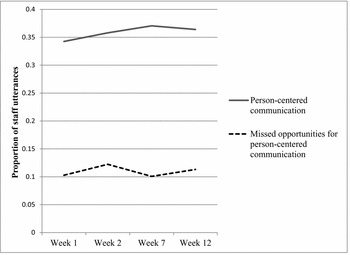
The average proportions of staff utterances that were person-centered and the missed opportunities of person-centered communication did not vary by time (see Figure 1). This suggests that staff communication in the current sample was stable and the recordings provided baseline information on staff communication during routine care tasks.
Proportion of staff utterances that are person-centered and missed opportunities for person-centered communication.

Person-centered utterances
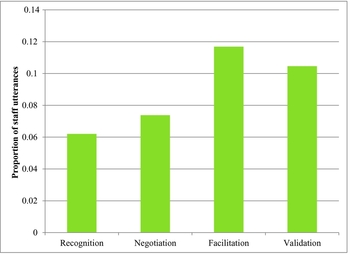
The average proportion of staff utterances that were person-centered in each transcript was 0.36. The mean distribution of the four indicators of person-centered communication is found in Figure 2. There were no differences in the proportion of person-centered communication in conversations with residents with middle or late stage AD. The following are examples of each of the four indicators of person-centered communication found in the staff–resident conversations.
Mean proportion of person-centered utterances by staff.

Recognition
Staff members recognize residents by incorporating their life histories into conversations in an effort to acknowledge residents as unique individuals. In Example 1, the staff member recognized that the resident has a daughter and that the daughter often visits during the weekend. Note that the staff member did not merely inquire about any person visiting but rather focused on the resident's daughter. The two utterances coded as recognition illustrate that the staff member is aware of the resident's family background and is able to relate to the resident on a personal level while simultaneously performing care tasks and fulfilling her job obligations.
Example 1
Staff: Has your daughter been here today? [Recognition]
Resident: Ahh no.
Staff: She comes on the weekend, don't she? [Recognition]
Resident: Just the weekend.
Negotiation
Negotiation involves consulting a resident about his/her preferences, desires, and needs. This strategy is particularly useful with persons in the later stage of dementia, where they may not be able to communicate verbally their needs or their understanding. In Example 2, offering a choice gave the resident an opportunity to maintain control while simultaneously acknowledging that the resident's preferences were important. Moreover, the resident's response showed that he understood the question.
Example 2
Staff: you wanna sit here and watch the news or do you wanna go up front? [Negotiation]
Resident: go down.
Facilitation
Facilitation involves recognizing when the person with dementia attempts an action or a thought and enabling him/her to respond, to initiate, or to sustain that action/thought. Two types of facilitation were common throughout the transcripts. The first (Example 3) was a conversation starter. The staff member in Example 3 facilitated the start of a conversation by showing interest in the resident's life history. The second type of facilitation, illustrated in Example 4, involved fulfilling a need that the resident would not be able to fulfill on his own.
Example 3
Staff: [11 sec pause] so when you was young what was your hobbies? [Facilitation]
Resident: I liked to sew.
Example 4
Resident: [long pause] I need coffee.
Staff: we gonna make sure you get some then. [Facilitation]
Validation
Validation involves expressing and understanding the feelings of the resident with dementia. The primary difference between facilitation and validation is that statements that are more feeling oriented are categorized as validation and those that are more action oriented are categorized as facilitation. A staff member reassured the resident in Example 5 that she will be protected by empathetically responding to her fear of getting lost.
Example 5
Resident: [short pause] I always get lost in this place. Staff: oh I would never let you be lost. [Validation]
Resident: no you wouldn't.
Missed opportunities for person-centered utterances: patterns of occurrences
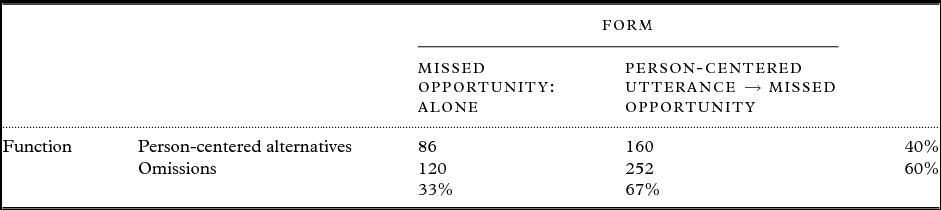
The average proportion of staff utterances in each transcript that were missed opportunities for person-centered communication was 0.11. There were no differences in the proportion of missed opportunities in conversations with residents with middle or late stage AD. There were 618 occurrences of missed opportunities for person-centered communication across all 46 transcripts. Conversation analyses revealed the following patterns in terms of form and function of the missed opportunities. In terms of form, there were two major contexts in which missed opportunities for person-centered communication occurred. Thirty-three percent of all missed opportunities occurred without a preceding person-centered utterance (see Example 6). The remaining 67% were found in sequences where person-centered utterances were followed closely by missed opportunities for person-centered communication (see Example 7). In terms of function, the missed opportunities were categorized as (a) person-centered alternatives to original staff utterances, and (b) omissions, where a person-centered utterance could have been used during a conversation but was not present (see Table 1). Omissions are situations when a resident said something but the staff person ignored and/or moved onto the next topic instead of uttering a person-centered statement. It is important to reiterate that the utterances coded as missed opportunities in all examples were not in the original transcripts and include suggested person-centered strategies that staff could have used. The missed opportunities could be addressed with any of the four person-centered strategies discussed in the previous section (i.e. recognition, negotiation, facilitation, and validation).
Form and function of missed opportunities

Forty percent of all occurrences of missed opportunities were categorized as person-centered alternatives to existing utterances. The following two examples illustrate missed opportunities categorized as person-centered alternatives and occurring both in isolation (Example 6) and within a specific sequence where the missed opportunity followed a person-centered utterance (Example 7).
Example 6 illustrates the resident's resistance to care when the staff person communicates in a directive manner (e.g. “let's get you a shave goin here” and “yeah we gotta shave yo”). The use of the collective pronouns such as “we” is patronizing when the care task is not collaborative or when the staff person did not intend the task to be collaborative, as is the case in Example 6. The utterance, “yeah we gotta shave yo,” is a missed opportunity for person-centered communication (e.g. negotiation). An alternative to that utterance is listed below, in the form of negotiation.
Example 6. Missed Opportunity: Alone and person-centered alternative
Staff: [11 sec pause] alright Richard let's get you a shave goin here.
Staff: okay?
Resident: No.
Staff: yeah we gotta shave yo.
Missed Opportunity: do you want to shave your face, or would you like me to help you? [Negotiation, person-centered alternative]
Staff: okay?
Staff: [long pause] get all the little hair off your face.
In Example 7, the staff person affirmed the resident's arthritic pain using validation and attempted to determine whether the pillow alleviated the resident's pain (e.g. “oh it didn't help, huh?”). However, the conversation shifted and became directive. Instead, the staff could have asked the resident what could be done to ease her pain and discomfort.
Example 7. Missed opportunity: Following a person-centered utterance and person-centered alternative
Resident: [10 sec pause] I have arthritis this morning.
Staff: it's sore? [Validation]
Staff: dats why you had that pillow there. [Validation]
Resident: yeah.
Staff: oh it didn't help, huh? [Facilitation]
Staff: [short pause] mkay.
Staff: try harder
Missed Opportunity: can I do anything to help it feel better? [Facilitation, Person-centered alternative]
Staff: put yo+. . .
Staff: got yo legs+//.
Staff: uncross yo legs there.
Missed opportunities that functioned as omissions were the most common and found in the remaining 60% of occurrences of missed opportunities. Among missed opportunities coded as omissions, the missed opportunities that occurred on their own contained the fewest occurrences of missed opportunities (see Table 1). Example 8 shows that the staff person failed to acknowledge the resident's expressions of pain. In contrast, the most occurrences of missed opportunities, which were coded as omissions, were found in excerpts with sequences where person-centered utterances were followed closely by missed opportunities for person-centered communication (see Example 9). Example 9 shows that the staff person was capable of communicating in a person-centered manner but did not sustain that type of interaction.
Example 8. Missed Opportunity: Alone and omission
Staff: hold on.
Staff: [long pause] feet down flat.
Resident: [10 sec pause] ouch.
Resident: that hurt.
Staff: [short pause] okay.
Staff: okay.
Missed Opportunity: sorry about that Mrs. Dunby [Validation, Omission]
Example 9. Missed Opportunity: Following a person-centered utterance and omission
Staff: I know these pretty shoes.
Staff: who got these for you? [Facilitation]
Staff: Maureen? [Recognition]
Resident: yeah.
Missed Opportunity: how is Maureen doing? [Recognition, Omission]
Staff: [short pause] okay.
Missed opportunities for person-centered utterances: context of occurrences
The purpose of identifying missed opportunities was to identify contextual cues that can help staff remember to use each of the four indicators of person-centered communication while they are helping residents with activities of daily living. One of the common missed opportunities for recognition occurred when staff began and ended their interactions. As illustrated in Example 10, not all staff took the opportunity to address the resident by name when greeting and when leaving the resident. Calling a person by name reinforces the self.
Example 10
Staff: [short pause] you have a good night.
Staff: okay?
Resident: thank you.
Staff: you're welcome. [Validation]
Resident: [short pause] thank you for helping me.
Staff: you're welcome. [Validation]
Staff: okay.
Staff: anytime.
Resident: leave the door open.
Staff: okay. [Facilitation]
Missed Opportunity: goodnight Lucille. [Recognition, Omission]
Missed opportunities for negotiation were observed when staff told residents what to do without providing options or for not inviting their help in completing the task. It is more person-centered to negotiate with residents by offering options (e.g. asking residents to perform the task in whole, in part, or in concert with the staff, or asking them which task they might want completed first). The following excerpt describes how a staff person missed an opportunity to negotiate with a resident during morning care.
Example 11
Staff: alright Donald [Recognition]
Staff: here are your glasses.
Staff: okay.
Staff: [short pause] look sophisticated. [Validation]
Staff: give me five.
Staff: there we go.
Staff: my buddy! [Validation]
Staff: [7 sec pause] one more thing.
Staff: comb your hair.
Missed Opportunity: would you like to comb your hair? [Negotiation, Person-centered alternative]
At the beginning of Example 11, the staff person was person-centered. She recognized the resident by calling him by name. She validated him with compliments (e.g. “look sophisticated”) and affirmations (e.g. “my buddy”). However, the momentum of her person-centered utterances was dampened by her instruction to comb his hair. Instead, the staff person could have negotiated by asking if the resident would like to comb his hair. The missed opportunity, in Example 11, serves as an alternative to the existing “comb your hair” utterance.
Another common missed opportunity for negotiation during routine care tasks involved providing specific information about what the staff person was going to do next. Often, a staff person would say “I'm gonna take your shirt off, okay?” The staff person checked for permission after telling a resident what s/he was going to do instead of initially asking or negotiating with the resident. Instead, the staff person could have asked, “Is it okay to take off your shirt?” Asking for permission prior to performing an action is especially important if the action puts the resident in a potentially uncomfortable, vulnerable, or intimate situation.
Missed opportunities for facilitation were found in three contexts. First, missed opportunities were observed when a resident was confused about what the staff person said and/or confused about his/her environment. In Example 12, the resident was confused about her own name. By stating “how are you, Ann,” the staff person could have reassured the resident that she was Ann without highlighting the fact that she could not recognize her name.
Example 12
Staff: hey Ann. [Recognition]
Resident: [short pause]what?
Resident: [short pause]what?
Resident: what about Ann?
Staff: Ohhh.
Missed Opportunity: how are you, Ann? [Facilitation, Person-centered alternative]
Second, missed opportunities for facilitation were observed when staff failed to probe or find out more about the resident when s/he mentioned something of value to him/her (e.g. family, hobbies, etc.). In Example 13, the resident mentioned her age with pride. The staff could have started a conversation about birthdays instead of ending the topic with “wow.” This is a missed opportunity because the staff could have gotten to know more about the resident's life history.
Example 13
Resident: thank you.
Staff: you're welcome. [Validation]
Resident: oh I'll take this.
Staff: yeah.
Staff: okay. [Facilitation]
Resident: after all I'm in my 80's now.
Staff: wow.
Missed Opportunity: When is your birthday? [Facilitation, Person-centered alternative]
The third pattern that was observed with missed opportunities for facilitation involved tasks where residents had a passive role. Note the extended silence while the staff was fixing the resident's bed in Example 14. When the task is not cumbersome for the staff and when the resident's role in the task is passive (so as not to require much cognitive resources), asking the resident about her/his day or the activities s/he is interested in illustrates staff interest in the resident's life.
Example 14
Staff: [long pause] let's fix your bed back.
Silence for 2 minutes and 7 sec
Missed Opportunity: How was the poetry group you attended? [Facilitation, Omission]
There were also three contexts in which missed opportunities for validation occurred. First, missed opportunities for validation occurred when staff failed to affirm a resident's feelings when s/he expressed signs of uncertainty, distress, or discomfort. The staff person in Example 15 was focused on task completion and did not acknowledge the resident's pain.
Example 15
Staff: we gotta dry.
Staff: [long pause] alright?
Staff: so we won't get no
Staff: skin breakdown.
Staff: okay.
Staff: let me dry your back.
Resident: [groaning].
Staff: why not!
Missed Opportunity: I know it can be a bit uncomfortable. [Validation, Person-centered alternative]
Staff: [long pause] gotta be dry.
Staff: [short pause] there.
Second, missed opportunities for validation occurred in situations when residents expressed lack of confidence or self-deprecating comments. Example 16 shows the resident stating “I don't do a good job” and the staff person failing to provide reassurance.
Example 16
Staff: can you comb your hair for me? [Facilitation]
Resident: no.
Staff: Lillian can you try? [Negotiation]
Resident: I can try.
Staff: thank you. [Validation]
Resident: [3 sec pause] I don't do a good job.
Missed Opportunity: I think you do. [Validation, Omission]
Finally, missed opportunities for validation occurred when residents expressed positive emotions. In Example 17, the staff member could have expressed agreement with the resident's positive feelings. Similarly, the staff person could have acknowledged that her actions were helping the resident instead of stating, “I can't keep doing it, Mrs. Kingsley.”
Example 17
Resident: oh that just feels wonderful.
Staff: okay
Missed Opportunity: Im glad to hear it feels good. [Validation, Person-centered alternative]
Resident: keep doing that.
Staff: [Laughter]
Staff: I can't keep doing it Mrs. Kingsley.
Missed Opportunity: That would be nice, wouldn't it? [Validation, Person-centered alternative]
Discussion
The goals of the study were to assess the extent to which staff–resident interactions during routine caregiving tasks were person-centered and to investigate the extent to which staff miss opportunities to use person-centered communication strategies. The patterns observed across staff–resident interactions in this study provide insights into the nature of social interaction in long-term care facilities. The majority of staff–resident interactions were task focused. This is to be expected given that the recordings occurred during routine caregiving tasks. Staff in this study were not trained in person-centered communication. However, over a third of all transcripts contained person-centered utterances, suggesting that person-centered communication is possible during routine care tasks. It is entirely likely that staff who are trained in person-centered communication are likely to increase the amount of person-centered utterances.
In order to understand how social interactions between staff and residents can be enhanced, this study examined the contexts in which missed opportunities for person-centered communication occurred. The majority of missed opportunities followed person-centered utterances. Within this category, the most common types of missed opportunities were omissions. These are interactions where staff could have used a person-centered utterance but instead focused on the immediate care task. This finding is important because the positive impact of the initial person-centered utterances was not sustained; that is, they were followed closely by missed opportunities. It is possible that once staff are trained to identify person-centered strategies they use currently, they may be more likely to sustain person-centered interactions.
Overall, the contexts in which missed opportunities were observed provide ecologically valid insights into the development of interventions designed to increase person-centered communication. Previous findings have reported that most staff-resident interactions were short, involving staff entering and quickly exiting a resident's room (Ekman et al., Reference Ekman, Norberg, Viitanen and Winblad1991). Therefore, it is critical that staff acknowledge a resident by name when greeting and when saying good-bye. In particular, person-centered communication at the start of a conversation can establish rapport with residents and may avoid situations where residents resist care, as illustrated in Example 6 (Herman and Williams, Reference Herman and Williams2009).
Performing care tasks does not need to be a one-directional endeavor. Routine care tasks are opportunities to negotiate by asking about preferences, such as the color or style of an article of clothing a resident might like to wear. It is also important to wait for a response when asking a question and to check to make sure that the resident heard the question. Furthermore, care tasks where the resident has a passive role are opportunities to facilitate conversations about the resident's life history. Combing a resident's hair, for example, does not strain a resident's physical and/or cognitive abilities. As such, the resident can take a more active role in maintaining a conversation. Knowing when to use facilitation requires that staff pay attention to the resident's behavioral and communicative expressions. Examples 12 and 13 illustrated that the missed opportunities for facilitation occurred when the staff failed to acknowledge the resident's confusion or when the resident shared parts of his/her life story. Such omissions by staff can be avoided with education and training on how to identify opportunities for person-centered communication. Similar to facilitation, the resident is often the source of contextual cues for validation. Opportunities for validation occur when a resident expresses feelings, both positive and negative. A person-centered response to such feelings involves affirming the resident's perspective. It is important to note that using one person-centered strategy may enable staff to use other person-centered strategies. For example, using facilitation to find out more about a resident could in turn help a staff member to use recognition more often. Staff can bring up what s/he has learned about a resident in future conversations.
Although the number of dyads in this study is relatively small, the conversations provide insight into the daily lives of residents as they interact with staff during morning and evening shifts. One of the major strengths of this study is that staff–resident interactions were recorded during care tasks, specifically getting residents ready for breakfast and ready for bed. The results indicate that routine care tasks can be fruitful opportunities for person-centered communication. Moreover, the interactions were recorded at four different time points and demonstrated stability in the nature of person-centered communication and missed opportunities for such communication. Future studies should examine conversations between other types of staff and other types of activities. For example, to what extent do recreation therapists engage in person-centered communication? This study is also the first to code for the presence of missed opportunities for person-centered communication. The analysis of missed opportunities for person-centered communication has demonstrated that staff need to be attentive to residents’ behaviors and communication, especially to initiate and maintain conversations, facilitate tasks, and validate their feelings. Although the contextual cues involved the resident, this study's primary focus was on staff communication. Future studies should examine if person-centered communication by staff results in more positive statements and less resistiveness to care by the resident. Similarly, do missed opportunities for person-centered communication result in more negative statements and more resistiveness by the resident? Such studies will lend credence to the benefits of person-centered communication when interacting with residents with dementia. As long-term care settings shift toward a person-centered approach, the findings from this study indicate that social interaction between staff and residents with dementia has yet to fully reflect this change in ideology.
Conflict of interest
None.
Acknowledgments
This work was supported by an Academic Development Fund from Western University. The author is grateful to all staff caregivers and residents with dementia who participated in this study. The author acknowledges Natalie M. Davidson, Rachel K. M. Garrett, Trisha L. Meyer, Melyssa Curtis, and Kelsey Moore-Nielson for their diligent assistance on this project.
Appendix
Personhood Categories (Kitwood, Reference Kitwood1997; Savundranayagam et al., Reference Savundranayagam, Ryan, Anas and Orange2007)
-
1) RECOGNITION:
-
a) To acknowledge the resident as a person, known by name, affirmed in a unique way (e.g. greeting, listening, direct eye contact)
Example 1:
Nurse Aide: “Come along, Mrs. Jones <recognition>, your dinner is being served.”
Example 2:
Nurse Aide: Hi, Mr. Stuart, how are you today? <recognition>
-
b) Can also include Biographical Statements. Code when the staff member refers to something about the resident's family, life, or day. This category is coded BY TOPIC, not by individual statement. DO NOT code general statements such as statements about the current weather situation.
E.g.: a. “I saw your sister yesterday in the mall.”
b. “Has your husband been to visit lately?”
c. “How many kids do you have?”
-
-
2) NEGOTIATION:
-
a) To consult about their preferences, desires, needs.
-
 Much negotiation takes place over simple everyday issues, such as whether a person feels ready to get up, or have a meal, or go outdoors.
-
Negotiation gives a sense of control to a person with dementia
Example 1:
Mrs. Johnson: I, uh . . . I can't find my place. Oh . . . here it is!
Staff: Actually, your table is over there (pointing). Would you like to walk over together before the meals are served ? <negotiation>
Example 2:
Staff: That was a nice bit of fresh air, wasn't it? I'm ready for my dinner now, would
you like to join me ? <negotiation>
-
-
-
3) VALIDATION:
-
a) To acknowledge the reality of a person's emotions/feelings, and give a response on the feeling level
-
b) To appreciate and respond to the desire or need that a person may be expressing; to help if necessary, to convert it to an intention
-
c) To use empathy and gain some sense of what a person may be experiencing
-
d) To understand a person's definition of the situation
-
e) To respond sensitively to any signs that a person's definition of the situation is changing, and to move with any changes that occur
*Note: to distinguish between validation and facilitation, statements that are more feeling oriented should be categorized under validation and those that are more action oriented should be categorized under facilitation.
Example 1:
Mrs. Johnson: (eagerly) Why don't I help set the uhm . . . tables – that way . . . uh . . . lunch'll arrive sooner! (reaches for the butter knives)
Staff: Mrs. Johnson, that'd be really helpful ! <validation> We can set the tables together and soon have things under control . <validation>
Example 2:
Mr. Lawton: Where's Mary? Isn't she supposed to be here?
Staff: Mary will be at work now, and she knows you're here. You have managed well this morning since you've been worried about Mary. <validation>
-
-
4) FACILITATION:
-
a) To work together
-
b) To involve the person's initiative and abilities in a shared task, with a definite aim in view.
-
c) To enable a person to do what otherwise he/she wouldn't be able to do, by providing the missing parts of the action.
-
d) To enable interaction to get started, to amplify it and to help the person gradually fill it out with meaning
-
e) To enable a person to sustain his or her action; to keep it from falling into the void because of memory failure
-
f) To be ready either to initiate or respond to the resident; neither rushing in too quickly, nor holding back for too long.
-
g) To enable the use of remaining abilities by requesting that the resident perform an activity of daily living.
-
h) To fill gaps in meaning (note: explaining the task to the resident is only facilitation if it is filling a gap in understanding and the resident prompted the explanation.
Example 1:
Mrs. Smith: (wanders into the dining hall) Have you seen . . . have you seen it?
Staff: What is it you're looking for, Mrs. Smith? Can I help ? <facilitation>
Tell me what it is and we can look for it together . <facilitation>
Example 2:
Mrs. Rogers: She knew I didn't want to go to the ball game, and instead we uhm uhm . . .
Staff: What happened then ? <facilitation>
-