1. The problem and the research history
As is well known, OB has two genitive constructions with dependent substantives. In the first, the head assumes the bound form, while the immediately following dependent takes the genitive case (Ø-gen): šēp šarrim “the king's foot”. In the second, the head has the free form, while the dependent is introduced by the preposition ša and takes the genitive (ša-gen): kaspum ša awīlim “the boss's money”.Footnote 2
The variation between Ø-gen and ša-gen constructions in OB was first studied by Ungnad (Reference Ungnad1904–05: 40–44) for the Code of Hammurabi. Ungnad showed that, in the simplest kind of NP (i.e. the NP comprising only two constituents, a head substantive and a dependent substantive), Ø-gen greatly outnumbered ša-gen, yet he did not attempt to describe their distribution. Ungnad also showed that ša-gen rather than Ø-gen was mostly used in complex NPs – those with more than two immediate constituents, i.e. with multiple heads or dependents.
Little research has been done on the subject since Ungnad Reference Ungnad1904–05.Footnote 3 The available descriptions reproduce, for the most part, Ungnad's findings.Footnote 4 For example, a widely used textbook of OB Akkadian focuses on complex NPs and pays little attention to the simplest kind of NP.Footnote 5
In this paper, we describe the distribution of the Ø-gen and the ša-gen constructions in OB. The corpus of the study consists of OB letters, because, of all genres, letters replicate the spoken OB vernacular most faithfully. Our research is based on frequency counts gleaned from c. 6,200 OB letters available in two databases, ARCHIBAB (www.archibab.fr) and OBTC (www.klinopis.cz/nobtc).Footnote 6 We have counted the tokens of each of the two constructions for certain frequent heads. We shall begin with simple NPs (i.e. those containing only the head and a substantive dependent), and then proceed to NPs with more constituents.
We study only those genitive constructions in which both the head and the dependent are genuine substantives freely combined to form a genitive NP.Footnote 7 We do not consider heads of compound nouns such as bēl awātim “litigant” and mār šiprim “messenger”, or noun-derived prepositions such as ina libbi “in(side)” or ša qāt(i) “under control of” (Huehnergard Reference Huehnergard2011: 99–101; Mayer Reference Mayer2011). Since compounds and freely formed NPs are notoriously difficult to tell apart (Haspelmath Reference Haspelmath2002: 154–61), we count among compounds the CAD entries with lemmata such as “abu A in bīt abi” (CAD A/1 73), as well as the lemmata from Huehnergard's and Mayer's studies. We list these items, where available, at the end of our Appendix entries.
2. The thesis
We start from our observation that certain OB substantives take only Ø-gen dependents, while others take both Ø-gen and ša-gen. Thus, in the corpus, mārat PN “PN's daughter” is the only way to render the notion, which means *mārtum ša PN is ungrammatical. Other head nouns admit both the synthetic and the analytical construction, e.g. eqel PN and eqlum ša PN “PN's field”.Footnote 8
Linguistic literature describes this kind of distribution as the alienability contrast (or “alienability split”) between inalienable vs. alienable possession.Footnote 9 In languages with an alienability split, there are two adnominal possessive constructions displaying a certain distribution. In particular, a closed set of substantives used as NP heads can be compatible with only one of the constructions. Substantives belonging to this group are traditionally referred to as inalienable nouns. Substantives that are able to head the other construction are referred to as alienable nouns.Footnote 10 The second construction (incompatible with “inalienable” nouns) is often more complex, i.e. it requires more coding material. This is, in particular, the case with OB.
The term alienability is misleading if it is to be taken literally as indicating a feature of the referents (such as physical or legal “alienability”) or an intrinsic semantic trait of the nouns in question. According to the traditional view, the semantic core of inalienable nouns consists of relational nouns, i.e. nouns with an obligatory argument, such as, e.g., “brother” and other kinship terms.Footnote 11 The bulk of inalienable nouns usually fit into a few easily definable semantic groups, though there is no rule to predict how a given noun will be treated in a given language that has two genitive constructions. To sum up: contemporary linguistics uses “alienability” as a purely syntactic description, for want of a better and semantically non-committal word.
Thus, (in)alienability is a lexical feature that must be indicated in lexicons, including a future dictionary of OB. In other words, a good dictionary must state explicitly with which genitive construction(s) the given frequent noun is attested.
3. Ø-GEN only: inalienable nouns
In OB, we have found four semantic groups of inalienable nouns and a few frequent inalienable nouns that do not fit neatly into clear-cut groups. Note that all of them take only Ø-gen, whatever their meaning in a given NP, literal or metaphoric, and whatever the semantic nature of the bond between them and their dependents in a given case.Footnote 12
In languages with an alienability split, it is kinship and body part terms that most consistently behave as inalienable nouns.Footnote 13 This is what happens in OB: simple genitive constructions headed by terms for kinship and body parts take only Ø-gen.Footnote 14 Among hundreds of genitive constructions headed by kinship terms such as abum “father” (10 tokens), ummum “mother” (8), mārum “son” (681),Footnote 15mārtum “daughter” (81), aḫum “brother” (31), aḫātum “sister” (10), and aššatum “wife” (47), we have found no indisputable ša- gen.Footnote 16 The rule also applies to metaphoric meanings of kinship terms, such as mār ālim “resident of the city”. As for body parts, we have checked the corpus for īnum “eye” (22), libbum “heart” (157), qaqqadum “head” (43), qātum “hand” (46), šaptum “lip” (19), and šēpum “foot” (46), including their metaphoric meanings, such as šaptum “utterance” or libbum “middle”. All of these appear only with Ø-gen.Footnote 17
Part-whole quantifiers are also expected to be inalienable nouns.Footnote 18 In the corpus, only bāmtum “half” (13), šapiltum “rest, remainder” (32) and šittum “rest, remainder” (46) are frequent enough to be considered. Each of them heads Ø-gen only. For other part-whole quantifiers, such as muttatum “half” (9), gamartum “totality” (6) and šaluštum “third” (7), we have also found only Ø-gen, yet these nouns are rare relative to the first group, so one cannot be certain about their behaviour as heads of genitive constructions.
Another tightly-knit OB group of inalienable nouns consists of agent nouns derived from transitive verbs. These deverbal substantives take dependents that correspond to the direct objects of the source verb. Agent nouns derived from transitive verbs according to the productive pāris (muparris, mušapris) or paris (for certain semantically static verbs) patterns always head Ø-gen encoding the semantic object, if they take a substantive complement at all.Footnote 19 Apart from the frequent compounds nāši biltim “tribute bearer”, ā lik idim “travel companion” and rakbūt imērim “donkey riders”, what remains in the corpus for a meaningful frequency count is wābilum “carrier” (43 tokens). Besides, the Prologue of the Hammurabi Code contains a good selection of non-stock instances such as mukammer nuḫšim u ṭuḫdim “the one who heaps abundance and plenty”, etc.
For the rest of the OB lexicon, we have found a few more substantives that head only Ø-gen. We have taken into account only very frequent nouns, since working with small samples may turn out to be misleading: the larger the sample, the more chances there are to come across ša-gen with head nouns that select Ø-gen in the majority of cases, see below on bītum “house(hold)” and ṭuppum “tablet, letter”.
Bēlum “lord” heads 73 tokens of Ø-gen as against no single instance of ša-gen. However, wardum “servant” and šarrum “king” behave as heads of NPs unlike bēlum, although they also express relative social standings (see section 4).
Šulmum “well-being” heads 147 Ø-gen constructions as against no single ša-gen. “Nominalizations”, “abstractions”, “physical and mental states” are treated as inalienable nouns in a number of languages (Nichols Reference Nichols and Shipley1988: 584–94; Heine Reference Heine1997: 10). However, OB does not have a general rule of the kind: purussûm “decision” takes both constructions (see section 4).
Šumum “name, fame” always heads Ø-gen (25 tokens). Substantives for “name” are often treated as inalienable in languages with split possession (Heine Reference Heine1997: 10).
4. Both Ø-GEN and ša-GEN are used: alienable nouns
The other OB substantives permit both genitive constructions. The examples below show that, for certain nouns as heads, the use of one construction over another does not influence the meaning of the NP in question, while the reasons for selecting either Ø-gen or ša-gen remain opaque:
bēlī ana PN1u PN2lišpuram-ma (…) erṣet mātimša qātīšunu lišērišū ša tašpuram (…) ana PN1u PN2udanninamma aštapram (…) erṣetam ša mātimša qātīšunu ušerrešū “‘May my lord write to PN1 and PN2 (…) so that they provide for cultivating the land of the district under their command,’ this is what you wrote to me. (…) I have written to PN1 and PN2 in strong language. (…) They will provide for cultivating the district's land under their command”. (AbB 4 19: 7–22)
aššum eqlim ša PN1ša ina berītim ṣabtu unnedukkī ina amārīka eqel PN1mala ina berītim ibaššû ana PN2idin “As for the plot of PN1, which he holds in the midland, as soon as you see my letter, give PN1’s plot, as much as there is in the midland, to PN2”. (AbB 13 2: 4–11)
mār PN1ša GN PN2mārī taḫḫu ša PN3maṣṣar ekallim ana qinnāzim iṣbat-ma iptād (…) PN2 […] mār PN4ana qinnāzim ul šaṭer ana taḫḫi PN3šaṭer “The son of PN1 from GN has drafted PN2 my son – he is a substitute for PN3 the palace guard – into a work unit and has confined him. (…) PN2 […] the son of PN4 has not been assigned to a work unit; he has been registered as PN3’s substitute”. (AbB 13 46: 6–9, 13–6)
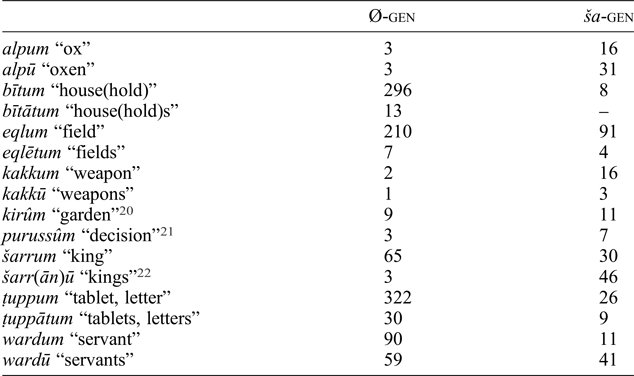
However, we have found a few quantitative regularities in the distribution of the two constructions. Certain head nouns prefer one of the constructions, though they may take the other one as well. In some cases, the explanation is semantic, in other cases it is related to a feature of the OB nominal inflection, while sometimes the reason remains unclear to us. Let us consider the ratio of Ø-gen to ša-gen for a few frequent head nouns (Table 1).
The ratio of Ø-gen to ša-gen for certain frequent head nouns of OB

In some of the above cases, the distribution may have to do with the kind of semantic bond between the head and the dependent. For example, “plot of (a given grain)” is almost always expressed via Ø-gen (40 vs. 1), while “palace land” is always eqel ekallim (26 tokens in the corpus). One is tempted to surmise that non-referential dependents (i.e. those expressing a feature of the head rather than referring to an individual object) favour Ø-gen.Footnote 23 To check this suggestion, further study is needed.
Bītum “house(hold)”, with almost 300 tokens of Ø-gen vs. only 8 of ša-gen, is a borderline case between alienable and inalienable nouns.Footnote 24 Note that four or five of the eight ša-gen tokens have locative arguments (“house in …”), while this usage is not reliably attested for Ø-gen headed by bītum. However, eqlum does not have the same distribution: “field of (an owner)” (except the palace) and “field (in a location)” display comparable frequency of the two constructions, 93 Ø-gen vs. 69 ša-gen, and 44 Ø-gen vs. 27 ša-gen respectively.
In other cases, the explanation is related to the inflectional morphology. With masculine plural nouns as heads, OB prefers ša-gen, even for the nouns which, in the singular, take Ø-gen more frequently than ša-gen. The example of šarrum in the above table is particularly telling. The reason may be that Ø-gen is a double-marked construction: the head takes the bound form, the dependent takes the genitive case. If the bound form is phonologically indistinguishable from the free-standing form, speakers may try to avoid a homonymy of the two forms by using ša-gen. This is the case with masculine plural heads: it is the only paradigmatic slot wherein the bound form is identical to the free-standing form.Footnote 25
For the rest, Table 1 shows that various heads display uneven distribution of the two forms. At the present stage of our research, this observation resists a cogent interpretation. The apparently indiscriminate use of both Ø-gen and ša-gen with certain nouns may have a diachronic reason, but this cannot be assumed without a study of other Akkadian varieties.
5. Complex noun phrases
This section is meant as an improved restatement of what was described in Ungnad Reference Ungnad1904–05.
Ša-gen has to be used whenever there intervenes, between the head and its substantive argument, a bound pronoun, another head, another genitive dependent, an adjective, or an appositive substantive. The following examples illustrate this point:
• A bound pronoun intervening: šībīša ša kaspim u šeim mādūtim “numerous witnesses against her concerning silver and barley” (AbB 9 49: 24 f.)
• Another head intervening: ina amātim u wardī ša b ī tī ša “among the slaves and slave-girls of her household” (AbB 9 49: 9).Footnote 26
• Another genitive dependent intervening: ṭuppi šarri ša ta’’ittim “the king's letter with a warning” (CTMMA 1 69: 5).Footnote 27
• An adjective intervening: wardum ṣeḫrum ša bēlīya “a young servant of my lord” (ARM 13 147: 25).
• An appositive substantive intervening: eqlum mērešum ša ekallim “arable land of the palace” (ARM 27 100: 5).
Within a NP, an attributive adjective can either precede or follow the dependent substantive:
• ṭēmam gamram ša šeem “a complete report concerning the grain” (ARM 27 101: 29 f.)
• ṭēm kirîm šuāti gamram “a complete report concerning this garden” (AbB 4 13: 15)
• alpum marûm reštûm ša igisêm “a fattened upper-quality ox for the celebration” (ARM 14 5: 5)
• alpam ša išteat bilat kaspim marâm “a fattened ox worth one talent of silver” (AbB 3 114: 5’’ f.).
In the above examples, all the head nouns are alienable. For inalienable heads, the evidence of our corpus is scarce, yet both constructions appear in OB:
• ana aḫḫī PN ṣeḫḫerūtim “to PN's younger brothers” (ARM 14 16: 22 f.)
• mārum rēštûm ša Ekur “the first-born son of the Ekur temple” (CH Epilogue: L 83 f.).
We do not have an explanation for the choice of construction with attributive adjectives. For the set phrase ṭēmum gamrum “complete report”, the two constructions are equally frequent (see the Appendix s .v.).
As for genitive constructions with more than one substantive dependent, our parsing of the corpus shows that these follow the same pattern as simple genitive constructions.Footnote 28 With inalienable nouns, only Ø-gen is admissible, e.g.:Footnote 29
šulum halṣim u errētim “the safety of the district and the weirs” (ARM 14 20: 9 f.)
With alienable nouns, both constructions can be used:Footnote 30
aššum eqel PN1u PN2 “concerning the plot of PN1 and PN2” (AbB 4 81: 43)
ana kirîm ša PN1u PN2 “to the garden of PN1 and PN2” (AbB 14 69: 14 f.)
Ø-gen within this collocation is well attested (e.g. there are eight tokens for eqlum “field”), but the low frequency of both constructions does not permit us to recognize a pattern.
Conclusion
The distribution of Ø-gen vs. ša-gen in the simple NP across all frequent OB substantives is a first desideratum for further research. Besides, as is well known, the language of OB letters is not homogeneous: it displays local varieties (or “dialects”), and it changes over time. Yet, at the approximation level of the present inquiry, we have found no dialectal differences in the distribution of the two constructions, which nonetheless does not mean they did not exist in real life. Further, this distribution must be studied for all major varieties of vernacular Akkadian, i.e. Sargonic, Middle Babylonian, Neo-Babylonian, as well as Old Assyrian, Middle Assyrian, and Neo-Assyrian. This kind of study may provide a diachronic explanation for some of the facts described above.
Abbreviations
- AbB
Altbabylonische Briefe in Umschrift und Übersetzung
- ARM
Archives royales de Mari
- CH
Code of Hammurabi
- CTMMA
Cuneiform Texts in the Metropolitan Museum of Art
- FM
Florilegium Marianum
- GAG
W. von Soden, Grundriß der akkadischen Grammatik (von Soden Reference Von Soden1995)
- NP
Noun phrase
- OB
Old Babylonian
- PN
Personal name
Supplementary material - Appendix
To view supplementary material for this article, please visit https://doi.org/10.1017/S0041977X19000648.