





1. Epistemic appropriation
While first coined in the work of American legal scholar Kimberlé Crenshaw, the term “intersectionality” is now used widely within academia but also throughout society at large. The term was first used to describe the position of Black women in American society, as existing on the intersection of multiple systems of oppression, as they are oppressed both as women and as Black people (Crenshaw Reference Crenshaw1989, Reference Crenshaw1991). Because of this specific position, Black women are often left out of research and activism that deals with either women or Black men. However, the way that the term is used and discussed now does not always mirror this initial use. First, since the term has gained widespread popularity, it is now commonly printed onto clothing sold by online stores such as Amazon.com, where you can easily get your hands on a T-shirt marking you as an “intersectional feminist” for a price as low as eighteen US dollars (Amazon.com 2026). Second, even within academia, the term is also used in diverging ways. The term is used often but might not always be credited to Crenshaw, removed from its context within Black feminist thought. Lastly, the term is often discussed in ways that are not entirely congruent with the initial aim of using the term, which was to denote specific axes of oppression. In some debates, the term is used not to point out these specific oppressions, but rather to indicate any social position, even ones where one does not face a specific kind of marginalization, or the term is used less to investigate these oppressions than to signal a surface level awareness of them (Lewis Reference Lewis2013; Nash Reference Nash2019; Salem Reference Salem2018).
The three examples here, where intersectionality is sold on T-shirts, where there is a lack of credit given to Crenshaw and the Black feminist tradition and when the term is used superficially and out of context, are examples of “epistemic appropriation.” Since being first discussed in 2018, the notion of epistemic appropriation has gained increasing attention in the literature on epistemic injustice (Davis Reference Davis2018; Kok Reference Kok2025; Medina Reference Medina2022; Podosky Reference Podosky2023; Rogers Reference Rogers2021). Epistemic appropriation was first conceptualized as “an unjust epistemic practice” that “harms marginalized knowers through the course of conceptual dissemination and intercommunal uptake” (Davis Reference Davis2018: 702). In other words, on such views, epistemic appropriation takes place when epistemic resources, such as concepts, words, stories, that are created by marginalized knowers, knowers who are oppressed within society, are taken up by dominant knowers and this practice harms these marginalized knowers. As such, it is an unjust practice. Furthermore, “the harm of epistemic appropriation […] is twofold,” as “epistemic resources developed within the margins gain intercommunal uptake” and then “are overly detached from the marginalized knowers responsible for their production” (705). These resources can then be “utilized in dominant discourses in ways that disproportionately benefit the powerful” and are therefore misdirected (705). In other words, epistemic appropriation occurs when epistemic resources that are developed in marginalized communities are shared to dominant ones and then detached from these communities and misdirected. Crucially, then, epistemic appropriation “involves a sort of conceptual theft” (Davis Reference Davis2018: 719). Epistemic appropriation as a phenomenon crucially shows that the way that power is distributed can determine the way that the epistemic resources within a society are used and taken up. Paying attention to epistemic appropriation therefore is understanding that the epistemic domain is never neutral.
Relating this to “intersectionality,” we can see these features clearly in the first two examples. In both of these examples, the term intersectionality is detached from its origins, which is within Black feminist thought. Furthermore, the term is then misdirected. In the T-shirt example, this happens in the form of profits for Amazon.com, and when the term is used without crediting, this happens in the form of career gains for other academics. Another example of this kind of epistemic appropriation, one that is not necessarily related to “intersectionality,” is the appropriation that takes place when academics from elite universities come into marginalized communities to do research and then extract this knowledge to further their own careers, without giving back to the community they researched (Davis Reference Davis2018).
Strikingly, though, this conception of epistemic appropriation fails to make sense of the last example discussed, related to the term being used differently. These kinds of cases are taken up by Podosky (Reference Podosky2023), who distinguishes between two different types of epistemic appropriation that do not seem to have as an essential feature the combination of detachment and misdirection. Podosky argues that epistemic appropriation can be parsed out into appropriation that is either resource-preserving or resource-obscuring. Resource-preserving epistemic appropriation is close to what is discussed in Davis (Reference Davis2018), it is epistemic appropriation that leaves relatively intact the resource that is appropriated, such as the first two intersectionality examples, or the research example. Resource-obscuring appropriation, however, is different, as it does not involve the preservation of an epistemic resource, but involves this resource being obscured. Resource-obscuring appropriation takes place when, after a resource is taken up by another community, the conceptions attached to the resource change. In other words, resource-obscuring epistemic appropriation changes the resource in question, and the way that it is used. This conception of epistemic appropriation is then able to make sense of the last “intersectionality” example, in which the term is used differently after being taken up. Another example of this kind of appropriation is the way that the word “woke” was used in the Black community to signal awareness of social issues but is used now commonly used with mocking or suspicion by wider society (Podosky Reference Podosky2023).
However, while the distinction between resource-preserving and resource-obscuring appropriation is useful, the phenomenon is not fully exhausted. Generally, epistemic appropriation, in both of these accounts, seems to involve some degree of wrongness and uptake from separate marginalized to dominant communities. However, I will argue in the following that the notion of epistemic appropriation should not be limited to these cases alone. There might be instances of epistemic appropriation that are not necessarily wrongful, that happen within communities, not between them, that do not happen from marginalized to dominant communities but in another direction. An example of such a possible case – and I return to this in the next section – is the reclaiming of slurs by marginalized knowers. This seems like it would be a case of epistemic appropriation but does not seem to fit the previous conceptualization of the phenomenon, as it does not seem to be wrongful, and happens in a different direction than the cases of epistemic appropriation discussed in this section. In this article, then, I propose expanding epistemic appropriation in a way that is able to accommodate these kinds of cases that address wrongness, directionality, and inter-communality. I propose to expand the definition of epistemic appropriation to be as follows:
Epistemic appropriation is the uptake of epistemic resources that obscures something about the resources.
While relatively broad, this definition of epistemic appropriation can accommodate multiple different kinds of epistemic appropriation. It does not assume that epistemic appropriation is automatically wrongful. Furthermore, it does not assert that epistemic appropriation happens necessarily from marginalized communities to dominant ones, nor does it assert that epistemic appropriation happens only between communities, not within them. Lastly, it allows for both resource-preserving appropriation – where the origin of the resource is obscured – and resource-obscuring appropriation – where the resource itself is preserved. In other words, this definition allows for cases of epistemic appropriation that are not wrongful, that do not happen from marginalized to dominant communities, epistemic appropriation that takes place within communities and lastly, epistemic appropriation that is resource-obscuring. This is then a definition of epistemic appropriation that is based on inductive reasoning that is able to accommodate intuitive cases of epistemic appropriation, as I show in the rest of the paper.
In the following, I then defend this expanded definition by engaging with the various elements of it. First, I say something about the (lack of) wrongfulness of epistemic appropriation. I then consider the notion of uptake, specifically the directionality and the communality of it. Lastly, I reflect on the kinds of epistemic resources that can be considered, and where they ought to come from for something to be considered epistemic appropriation. I then end by discussing some of the implications of accepting this new definition of epistemic appropriation.
As mentioned, this is a definition of epistemic appropriation that is based on intuitive cases. Because of this, this definition remains quite broad and picks out only the most basic conditions for something to be epistemic appropriation. I then want to stress that this definition is only preliminary and can be whittled down further. In no way do I want to assert that this is the final definition of epistemic appropriation that can accommodate all possible cases, which also runs the risk of being able to include cases that do not intuitively seem like epistemic appropriation. However, by giving this definition, I hope to provide a theoretical foundation to foster discussion on the topic, a foundation that can be reconsidered. I do not want to close the conceptual structure, I aim to keep this open and provide a starting point for further investigation (Dotson Reference Dotson2012). The main goal of this paper is then to provide a theoretical starting point from which to continue further investigations into the topic of epistemic appropriation, in order to delve deeper into possible cases of epistemic appropriation that might not have been accommodated previously.
2. Wrongness
The first characteristic of this expanded definition of epistemic appropriation I want to discuss is the notion of wrongness. As mentioned previously, I want to be able to account for cases of epistemic appropriation that are not necessarily wrongful but still count as appropriation. If we take epistemic appropriation to be some kind of conceptual theft, as involving detachment from the community of origin, there seem to be certain cases of epistemic appropriation that might not be wrongful but do involve this element of detachment. As hinted at previously, one paradigmatic case, one that intuitively seems to fit, is the reclaiming of slurs.
Although the reclaiming of slurs is often called reappropriation, it is almost never the case that slurs were previously used by the marginalized community at hand, appropriated by a dominant community and then used against the marginalized one (Herbert Reference Herbert2015).Footnote 1 In most cases, the reclaiming – or claiming – of slurs is “centered on the implicit idea that the targeted group ought to have control over the term that has been used against them” (Herbert Reference Herbert2015: 131). Some scholars distinguish between insular reclamation, which is the reclamation of slurs that stays within the community that was originally targeted, such as with the n-word and pride reclamation, where the slur is used more widely to express pride about one’s group membership, such as “queer” (Cervone et al. Reference Cervone, Augoustinos and Maass2021; Jeshion Reference Jeshion2020). When slurs are (re)-claimed, the words are co-opted, taken first by the community that they are used to target and subsequently used differently. This change can take place only within the community the slur was used against, as would be the case with insular reclamation, or within society more broadly, as with pride reclamation.
This does then seem to be a case of epistemic appropriation – to the extent that Podosky, for example, considers it might be one. However, it differs from paradigmatic accounts of epistemic appropriation in two ways. First, the reclaiming of slurs does not seem to be wrongful. On the contrary, it is often framed as something that is just. Second, in this case, the appropriation takes place in the opposite direction: from dominant to marginalized communities. I return to this second characteristic in the next section. Crucially, I think that even if it differs on these two counts, it should still be considered a case of epistemic appropriation because it involves conceptual theft, meaning that the resources in question are not willingly shared by the community of origin, and the connotations attached to these resources change. Something about the resource is obscured. Consider only how “queer” seems to mean something different now than it might have done fifty years ago. It involves the uptake of epistemic resources, and in this process, the resource itself, the slur used as a slur, is obscured. Subsequently, if we 1.) take this to be a case of epistemic appropriation and 2.) agree that this is not wrongful, we can then distinguish at least two types of epistemic appropriation – wrongful epistemic appropriation and non-wrongful epistemic appropriation. I have shown this distinction in Table 1.
Epistemic appropriation plot.
Source: Author.

Accepting that epistemic appropriation can either be wrongful or non-wrongful means that epistemic appropriation can be characterized as a neutral phenomenon, as a way to describe what has happened without any set moral judgement, as it is not necessarily wrongful. It can be something that is wrong, but also something that is just, as with the reclaiming of slurs. This does, however, raise the question of what the wrong-making factor of epistemic appropriation is, or can be. The suggestion here might be – and Podosky suggests this as analogous with discussions on cultural appropriation – that epistemic appropriation is only wrong when dominant groups appropriate from marginalized ones. In this case, this seems to make sense – the marginalized communities in question are appropriating, co-opting, something that has been used against them by those who oppress them. I examine this suggestion in the next section. For now, however, I have supported the first feature of this expanded definition of epistemic appropriation, as I have argued that epistemic appropriation can either be wrongful or non-wrongful. In the next section, I discuss the matter of uptake and how this further complicates models of epistemic appropriation.
3. Uptake
Epistemic appropriation is taken to be a subtype of epistemic injustice – a field that deals with the ways in which social power influences and complicates communication between individuals and groups (Fricker Reference Fricker2007). Epistemic injustice was first divided up into two subtypes: testimonial injustice and hermeneutical injustice. Testimonial injustice “occurs when prejudice causes a hearer to give a deflated level of credibility to a speaker’s word,” and hermeneutical injustice “occurs at a prior stage, when a gap in collective interpretive resources puts someone at an unfair disadvantage when it comes to making sense of their social experiences” (Fricker Reference Fricker2007: 1). Epistemic appropriation is then another subtype of epistemic injustice, one that occurs at the stage where epistemic resources are distributed or shared between communities. In that sense, it is related to hermeneutical injustice, as epistemic appropriation concerns “epistemic harms that occur during the later stages of conceptual dissemination and intercommunal uptake” (Davis Reference Davis2018: 704). Uptake is then the phase in which epistemic appropriation can occur, when epistemic resources travel from one group to another – consensually or not. Epistemic appropriation is generally taken to be something that occurs when epistemic resources travel from a marginalized community to a dominant one because the way in which resources are distributed is influenced by societal power relations. However, as I have shown with my discussion on the appropriation of slurs, epistemic appropriation can occur in other directions. My expanded definition of epistemic appropriation thus does not contain reference to the direction in which epistemic appropriation can occur.
3.1. Direction
In the previous section, I argued that epistemic appropriation can be both wrongful and non-wrongful. The question is then why certain kinds of epistemic appropriation are wrongful and why others are not. In the previous section, I discussed that one such suggestion might be that epistemic appropriation is wrongful only when it happens with the flow of power – when epistemic appropriation takes place from marginalized to dominant communities, as could be the case with cultural appropriation (Matthes Reference Matthes2016; Podosky Reference Podosky2023). I now want to examine this suggestion further.
At first glance, this seems to make sense when we look at the examples at hand. When it comes to the reclaiming of slurs, it seems to be the nature of power and the direction of the appropriation that make it just – it is because slurs have been used against certain marginalized actors that they can be reclaimed by them. However, this becomes less straightforward when we consider other examples that are not cases of reclaiming. For example, let us consider an example put forth by Davis: The Enfranchisement of Women. Here, John Stuart Mill took credit for Harriet Taylor Mill’s work and thoughts, whether this was discussed between the two or not – he received the benefits of publishing this work. The work was detached from Harriet Taylor Mill and misdirected to John Stuart Mill, making this seemingly a wrongful case of epistemic appropriation. John Stuart Mill, as the man in the relationship, is a member of a dominant group in society, whereas Harriet Taylor Mill, as a white woman, is much more marginalized, especially at that point in time. However, when we consider the same scenario reversed, does this really cease to be wrongful epistemic appropriation? If Harriet Taylor Mill took credit for John Stuart Mill’s work, the direction of the appropriation would be reversed – it would be epistemic appropriation from a dominant to a marginalized knower or group. However, I would hesitate to say that this would not be wrong, as it still involves plagiarism and theft. I do think that there might be some intuitive sense that it is not exactly the same thing – a man taking credit for a woman’s work seems different from a woman taking credit for a man’s work, especially when this work pertains to the oppression that women face – but both seem to be wrong.
Take another example: Rebecca F. Kuang’s Reference Kuang2023 novel Yellowface, where the main character June Hayward, a white author, steals her deceased Chinese-American friend Athena Liu’s manuscript and publishes it as her own (Kuang Reference Kuang2023). Subsequently, June Hayward goes to great lengths to pass off the manuscript as her own and appear racially ambiguous in order not to be questioned as the author of the work. Again, this is a situation of epistemic appropriation, where one person takes credit for another’s work, and in this case, this happens between a more dominant and more marginalized knower, as June Hayward is white, and Athena Liu Chinese-American. However, similarly to the enfranchisement of women, if the situation was reversed – if Liu stole Hayward’s work – this would still seem wrong, as it is still (conceptual) theft.Footnote 2 It is not the same situation, that much is clear, especially when one considers the lengths June Hayward goes to in order to appear racially ambiguous, but the theft of manuscript by a more marginalized person would still be wrong. The difference between marginalized to dominant epistemic appropriation and dominant to marginalized epistemic appropriation does therefore not seem to be able to fully explain the difference between wrongful and non-wrongful epistemic appropriation.
These cases of epistemic appropriation, in which the direction is reversed, but the appropriation does not cease to be wrongful, occur on the individual level. On the individual level, there might be some idea of interpersonal morality that shapes these interactions, where stealing is wrong no matter who does it.Footnote 3 When we move to another level, the group level, this seems to be more complicated. The appropriation of slurs, for example, or the appropriation of “woke” and “intersectionality” occur on this level. While this is less bound by interpersonal moral norms, I do still think wrongful dominant to marginalized appropriation could occur on the group level. Imagine for example a case in which a dominant group uses a certain epistemic resource to describe themselves, like “bunnies.” This is not a term that has anything to do with any marginalized group. Now imagine a marginalized group taking up this term and using “bunnies” to mock the dominant group, to make fun of them. There are arguments to be made to say that this, at the very least, is not non-wrongful epistemic appropriation. I would agree that it would not be oppressive, but it might still be wrong. If anything, we can conclude here that at least the direction in which the appropriation occurs is not sufficient to decide whether an instance of epistemic appropriation is wrongful. This then means that, as stated previously, epistemic appropriation can be defined as something that is not necessarily wrongful and something that occurs in all directions. Furthermore, because directionality is not sufficient to determine why a specific instance of appropriation is wrongful, this means that both dominant and marginalized groups epistemically appropriate resources, and that this might be wrong in both instances. The only thing it might not be, when marginalized knowers appropriate resources from dominant ones, is oppressive. This opens up further avenues for theorizing on the ways that epistemic appropriation can function.
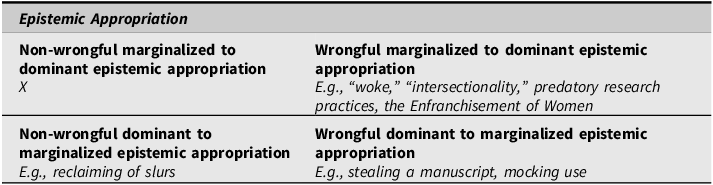
Even if the flow of power does not explain whether epistemic appropriation is wrongful or not, it does then seem important to make the distinction between marginalized-to-dominant epistemic appropriation and dominant-to-marginalized epistemic appropriation, where the first marker refers to the group or community the epistemic resource is taken from. Both of these kinds of appropriation can, as shown, either be wrongful or non-wrongful. See Table 2.
Table 2 shows four distinct kinds of epistemic appropriation: both wrongful and non-wrongful marginalized to dominant epistemic appropriation and both wrongful and non-wrongful dominant to marginalized epistemic appropriation. Wrongful marginalized to dominant epistemic appropriation, non-wrongful dominant to marginalized epistemic appropriation and wrongful dominant to marginalized epistemic appropriation have all been discussed before. Wrongful marginalized to dominant epistemic appropriation is the paradigmatic case of epistemic appropriation that is discussed by both Davis and Podosky: it is epistemic appropriation that involves dominant knowers appropriating epistemic resources from marginalized knowers and either preserving or obscuring them, as in the cases of predatory research practices, the appropriation of “woke,” or intersectionality and so onwards. Non-wrongful dominant to marginalized epistemic appropriation is then exemplified by the reclaiming of slurs. Furthermore, wrongful dominant to marginalized epistemic appropriation pertains to these reverse cases that have been discussed that remain wrong even when the direction of the appropriation is reversed. This might then also involve cases where marginalized knowers appropriate certain hermeneutical resources – words, concepts – from dominant communities and use them with mocking when this is not necessarily deserved.
The only epistemic appropriation in Table 2 that has not yet been discussed is non-wrongful marginalized to dominant epistemic appropriation. These are supposedly cases where dominant knowers epistemically appropriate resources from marginalized communities, but this is not wrongful. Even though this could be a theoretical possibility, I do not think that this could exist in practice, as any kind of non-wrongful appropriation in this situation would simply be a case of successful uptake of epistemic resources.
In the reappropriation of slurs, there is something that makes the fact that it clearly is epistemic appropriation justified – the fact that these very resources have been used to oppress those who appropriate them. However, when appropriation happens in the other direction, when dominant knowers appropriate from marginalized ones, there is little to no chance that they are appropriating resources that have been used to oppress them, leading me to think that there would be no justification that would make this kind of epistemic appropriation non-wrongful. Take for example English folk hero Robin Hood: him stealing from the rich and giving the poor might to some extent justify the act of theft, but the reverse – the rich stealing from the poor – would just be plain wrong. Epistemic appropriation, to some extent, is still theft and when it goes against the flow of power this theft might be justified, but not the other way around.
This can be further explained by considering the notion of epistemic oppression. Epistemic oppression “refers to persistent epistemic exclusion that hinders one’s contribution to knowledge production” (Dotson Reference Dotson2014: 115). Davis (Reference Davis2018) argues that epistemic appropriation can be a form of epistemic oppression, to the extent that it fulfills the following condition: it contributes to this persistent epistemic exclusion. This persistent epistemic exclusion is related to oppression to the extent that it is those who are marginalized in society that are excluded from contributing to knowledge production. Non-wrongful dominant to marginalized epistemic appropriation and wrongful marginalized to dominant epistemic appropriation are both related to epistemic oppression in different ways, with the former trying to remedy it – by reclaiming certain resources – and the latter being a paradigmatic case of how marginalized knowers are excluded from knowledge production. Wrongful dominant to marginalized epistemic appropriation, however, is not related to epistemic oppression as these instances of epistemic appropriation are wrong, but they are neither systemic nor persistent, nor do they have a lot to do with the social position of the dominant knower whose resources are appropriated. This accounts for the difference between wrongful marginalized to dominant appropriation and wrongful dominant to marginalized appropriation. Consider the aforementioned “bunnies” example. In this case, marginalized knowers appropriate, on a group level, an epistemic resource from a dominant group. While this might be wrongful epistemic appropriation, it is not related to epistemic oppression.
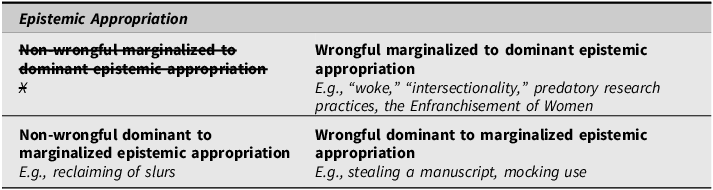
Bringing this back to non-wrongful marginalized to dominant appropriation, it is hard to imagine a case that is epistemic appropriation – that involves conceptual theft, misdirection – but does not contribute to the oppression of the marginalized knowers whose resources are appropriated. See then Table 3.
In Table 3, non-wrongful marginalized to dominant epistemic appropriation is removed, as it would be very unlikely to occur. Table 3 allows for three possible kinds of epistemic appropriation and specifically allows for epistemic appropriation that is non-wrongful and that happens in a different direction than in the paradigmatic cases.
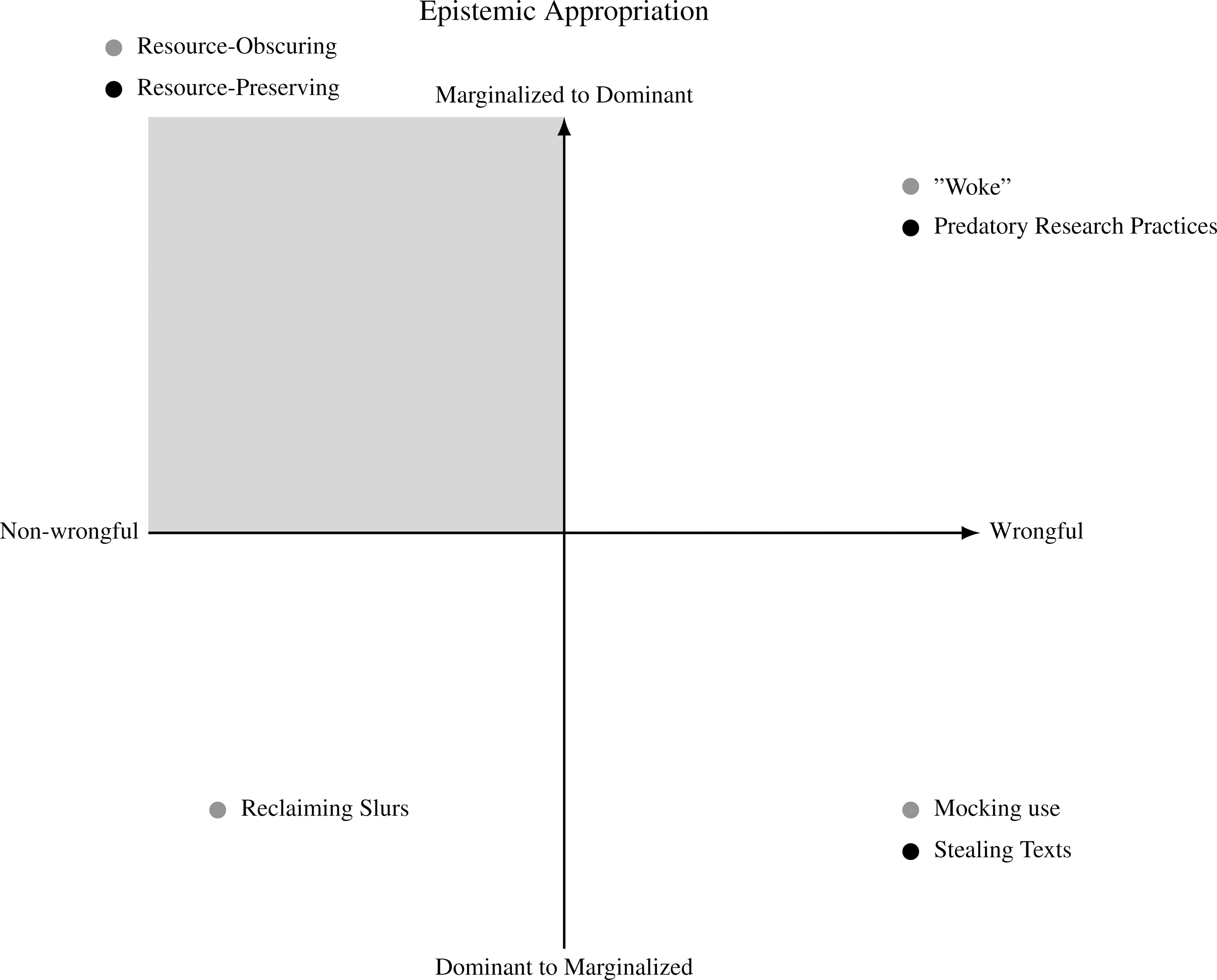
While this model of epistemic appropriation allows for many more possibilities and versions of epistemic appropriation, it might leave out one specific thing: epistemic appropriation between marginalized knowers and groups and between dominant knowers and groups. It is not necessarily the case that epistemic appropriation always happens between one clearly dominant actor and one marginalized one. We might easily imagine one marginalized group appropriating another marginalized group’s epistemic resource, be it a word or concept, or a story or narrative. These cases might be more difficult to place within one box, which is why I would propose we look at epistemic appropriation on some kind of scale, as shown in Figure 1.
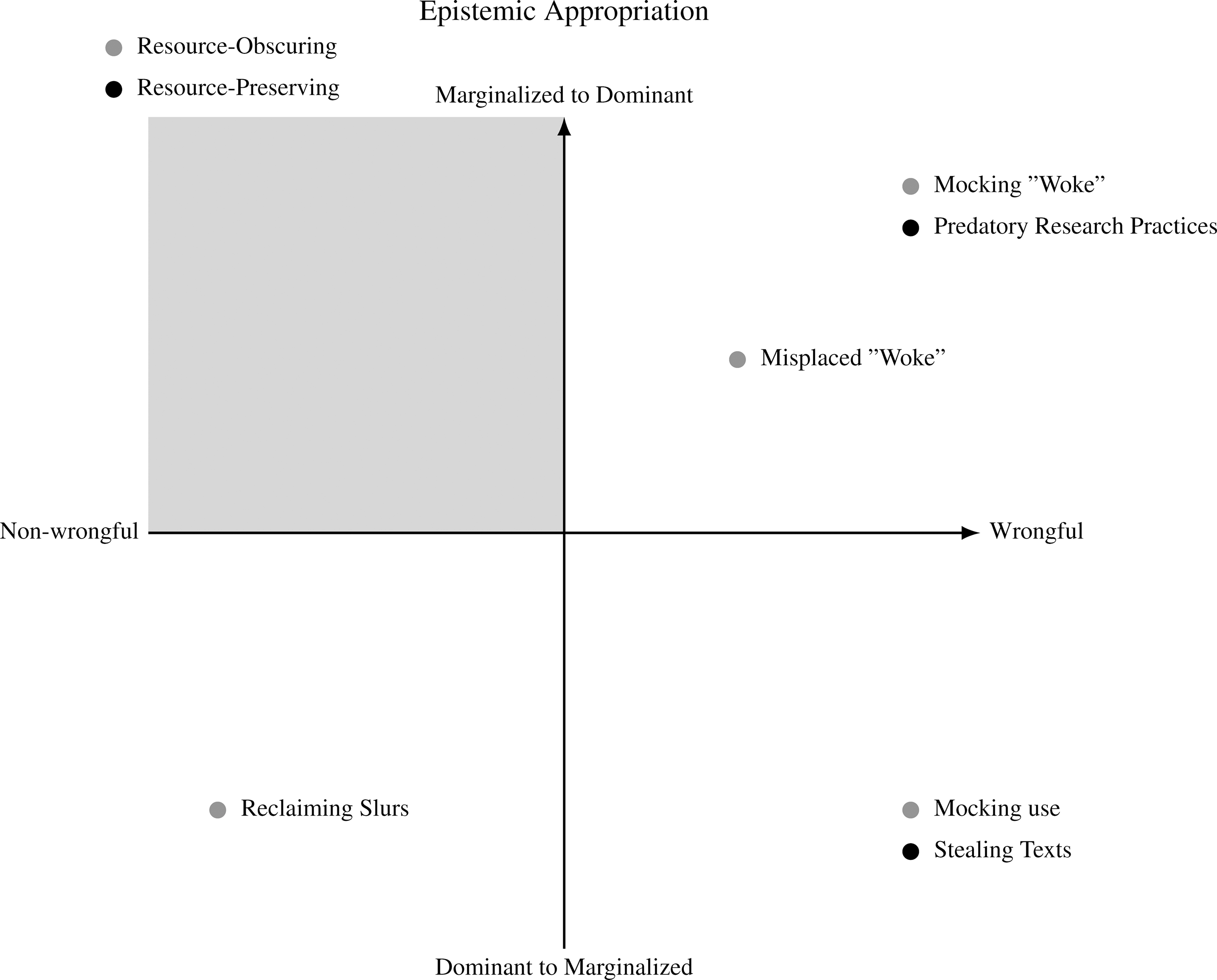
Figure 1 shows the four categories of epistemic appropriation that I outline in Tables 2 and 3, but puts this on a scale, where the four different areas in the graph are the four different kinds of epistemic appropriation, with the non-wrongful marginalized to dominant appropriation blocked out. The examples that have been previously discussed are mapped onto the model. These examples are all relatively extreme cases, hence their positions at the margins of the model. However, one might imagine less extreme cases of epistemic appropriation that can still carry the moniker of any of these categories but fall – on the graph – somewhere closer to the middle. Imagine for example a feminist group – primarily consisting of white women – taking up using the term “woke,” in order to signal awareness of sexism and misogyny, thereby taking the term from its original context and changing the meaning. Then imagine the common appropriation of the term “woke,” when it is used with mocking. We might easily imagine the first appropriation to be closer to the middle of the figure than the second one, because white women are also marginalized in society and face oppression – albeit in a different way. In any case, they might be in a relative position of power when it comes to other minorities, but it is not the same as the other appropriation of “woke.” Figure 2 shows this placed on the model, as “misplaced ‘woke’” as opposed to “mocking ‘woke’.”
Non-wrongful and wrongful epistemic appropriation.

Table 1. Long description
A table titled ‘Epistemic Appropriation’ with two rows and two columns. The first row contains the header ‘Non-wrongful epistemic appropriation’ and ‘Wrongful epistemic appropriation’. The second row under ‘Non-wrongful epistemic appropriation’ lists ‘E.g., reclaiming of slurs’ and under ‘Wrongful epistemic appropriation’ lists ‘E.g., woke, intersectionality, predatory research practices’.
Four categories of epistemic appropriation.

Table 2. Long description
A table titled Epistemic Appropriation with four rows and three columns. The columns are labeled Non-wrongful marginalized to dominant epistemic appropriation, Wrongful marginalized to dominant epistemic appropriation, Non-wrongful dominant to marginalized epistemic appropriation, and Wrongful dominant to marginalized epistemic appropriation. The first row under Non-wrongful marginalized to dominant epistemic appropriation is labeled X. The second row under Wrongful marginalized to dominant epistemic appropriation lists examples: woke, intersectionality, predatory research practices, the Enfranchisement of Women. The third row under Non-wrongful dominant to marginalized epistemic appropriation lists an example: reclaiming of slurs. The fourth row under Wrongful dominant to marginalized epistemic appropriation lists examples: stealing a manuscript, mocking use.
Three categories of epistemic appropriation.

Table 3. Long description
A table titled Epistemic Appropriation with four rows and three columns. The columns are labeled Non-wrongful marginalized to dominant epistemic appropriation, Wrongful marginalized to dominant epistemic appropriation, Non-wrongful dominant to marginalized epistemic appropriation, and Wrongful dominant to marginalized epistemic appropriation. The first row under Non-wrongful marginalized to dominant epistemic appropriation is labeled X. The second row under Wrongful marginalized to dominant epistemic appropriation lists examples: woke, intersectionality, predatory research practices, the Enfranchisement of Women. The third row under Non-wrongful dominant to marginalized epistemic appropriation lists an example: reclaiming of slurs. The fourth row under Wrongful dominant to marginalized epistemic appropriation lists examples: stealing a manuscript, mocking use.
Epistemic appropriation plot revised.
Source: Author.

With Figure 2, we can acknowledge both appropriations of woke as resource-obscuring, wrongful marginalized to dominant epistemic appropriation, but also acknowledge the difference between the two cases – one might be less wrong than the other and one happens between marginalized groups. In both situations, there is still a power differential between the groups where one is relatively more marginalized than the other, but to a lesser extent. This model then allows for both wrongful and non-wrongful epistemic appropriation and for epistemic appropriation between dominant and marginalized groups and between marginalized and marginalized groups.
3.2. Inter-communality
When we consider that epistemic appropriation might occur in all directions, we might also consider the following possibility: epistemic appropriation might not only occur between separate communities and their members, but it might also occur within them.Footnote 4 In the previous section, I argue that two kinds of appropriation of “woke” are not the same because of the relative power differential between the groups. The groups that I have discussed up until now have been relatively specific – such as the group of white women appropriating the term “woke.” However, groups are not always as easy to demarcate and within communities, and there will be differing levels of power within them, because groups are not homogenous.
When we take the notion of intersectionality seriously, this problem becomes even more apparent. As discussed previously, the term intersectionality was coined by Kimberlé Crenshaw (Reference Crenshaw1991, Reference Crenshaw1989) to discuss the position of Black women in American society. Black women, according to Crenshaw, had been historically lumped in with two groups: white women and Black men, erasing their own distinct position on the intersection of multiple kinds of oppressions – both raced and gendered. Black women then face their own specific kind of oppression that is not the same as the oppression faced by Black men and white women. We cannot just assume that there are such discrete groups as “women” and “Black people.” Communities are complex, and in them, there is immense variation (McCall Reference McCall2005). The inherent internal diversity of groups is further underscored in the work of María Lugones, who, coming from the Latin-American context writes about the notion of mestizaje, or intermixing, impurity (Carastathis Reference Carastathis, DiPietro, McWeeny and Roshanravan2019; Lugones Reference Lugones1994). She argues that there is an inherent heterogeneity within groups that should not be erased because accepting mestizaje “defies control through simultaneously asserting the impure, curdled multiple state and rejecting fragmentation into pure parts” (Lugones Reference Lugones1994: 460).
This tracks out, as even the most “dominant” group one can imagine, like a group of white men, might still diverge internally, maybe on the level of class, of ability, of age, making it very difficult to parse out one homogenous group that can be used for analysis. Individuals occupy sometimes overlapping, sometimes diverging social positions – one might be relatively powerful in one scenario and not in another. This would then be a problem for this account of epistemic appropriation, as it is characterized as an intercommunal practice. Imagine a white gay man appropriating a Black gay man’s way of speaking. This is a case of epistemic appropriation, clearly, but occurs within the gay community, even though the two members in this case have diverging levels of power.Footnote 5 These differences will always exist within groups and therefore complicate this notion. Of course, we could parse out communities to very specific characteristics, but if we follow Lugones, even in these communities there would still be diversion and overlap. If we take the white and Black gay men, in this context, the white man is in a position of relative power. However, if for example this man is also disabled, and then Black man is not, and the Black man appropriates certain hermeneutical resources used by disabled folks to describe their own experiences and uses it out of context of mocking, for example, this would also be epistemic appropriation where one might argue that the Black man is then relatively dominant in this situation. This is not to say that this is always the case but does show the internal divergence of different groups and the ways in which things can get complicated and messy, and the ways in which epistemic appropriation can happen within groups. Furthermore, epistemic appropriation that is not related to epistemic oppression, but still wrong, might easily occur in relatively homogenous communities – such as one rich, white, able-bodied white man taking credit for another rich, white, able-bodied white man’s work.
These complications then lead me to posit that epistemic appropriation is not only an issue that occurs inter-communally but also intra-communally, as epistemic appropriation that is not related to oppression can easily occur in the most homogenous community but also taking into consideration that there are different social positions to occupy and that communities are rarely homogenous at all. This then is why I do not refer to epistemic appropriation as an inter-communal practice but leave this open in my expanded definition of the phenomenon. Epistemic appropriation can occur between groups and between individuals, and between and within certain communities, simply because communities are too heterogenous to make clear distinctions. Let us return to my proposed definition of epistemic appropriation, as the uptake of epistemic resources that obscures something about the resources. I have argued that this definition is deliberately non-deterministic in order to be able to accommodate both resource-preserving and resource-obscuring appropriation, both wrongful and non-wrongful epistemic appropriation, and epistemic appropriation in all directions, even within communities. The last element that I have yet to address is what these epistemic resources are, or what they could be, and most importantly: where they can come from.
4. Epistemic resources
In the scaled model of epistemic appropriation that I have proposed as depicted in Figures 1 and 2, there are two axes depicting the extent to which appropriation is wrongful and the extent to which it is marginalized to dominant or vice versa. The dots in this model then depict the epistemic resources that are appropriated. In my expanded definition of epistemic appropriation, I do not specify further than stating that the resources in question here are epistemic. Second, I do not denote an origin, and I do not argue that epistemic resources ought to originate in a certain community in order to be appropriated. In this section, I address both of these issues: what these resources are and their origin. As for the first issue, it is important to note that epistemic resource is a catchall term – it is not specific. In my proposed model of epistemic appropriation, epistemic resource can denote at least two different kinds of resources: distributive epistemic resources and hermeneutical resources.
Distributive epistemic resources are resources that have some material value after extraction, in distribution. This is exemplified by most of the cases that Davis (Reference Davis2018) discusses, such as the research done by elite academics, and The Enfranchisement of Women. In both these cases, the resources that are appropriated seem to be the testimony, or even an entire piece of work, of marginalized knowers. In appropriating this work from marginalized knowers, the dominant actors in this scenario gain material benefits, as the researchers are helped in their careers, and John Stuart Mill received all of the credit for his wife’s work. These resources can be used as interpretative resources – as resources that can be used to understand one’s own experience – but the value of these resources seems to lie more in their distribution after extraction. It is the fact that these resources are extracted and redistributed to others that allows these dominant knowers to gain certain material benefits, but these resources are not necessarily utilized for understanding. In other words, the value of appropriating them is mostly material, not only epistemic.
Hermeneutical resources are different from distributive resources in the function they have, as their value is primarily epistemic. Hermeneutical resources are resources that are used for interpreting and communicating one’s experiences, such as terms like “woke” and “intersectionality.” These resources are, when appropriated, used by those who appropriate them. For example, in the appropriation of “woke,” the term is now used with mocking. In other words, it is taken up into the arsenal of understanding and communication of those who appropriate the resource. The crucial difference between distributive resources and hermeneutical resources is the function that they occupy, with one serving to provide material benefits, the other epistemic benefits. This is not to say, however, that resources cannot both serve as distributive and hermeneutical resources, and, furthermore, that the material functions have no epistemic effects and vice versa.
The difference between the two kinds of appropriated resources can be largely covered by the distinction between resource-preserving and resource-obscuring appropriation, but not fully. Distributive epistemic resources can also change meaning in their uptake – a story might be altered to benefit the group or person who appropriates it in order to provide more material benefits. An example of epistemic appropriation discussed by Davis (Reference Davis2018) is the life story of Sojourner Truth, which was appropriated by a rich white woman called Beecher Stowe. In doing so, in appropriating this life story, she changed a lot – and got a lot wrong. In this sense, then, the value for Beecher Stowe was material, as she received monetary and social benefits from taking this story, but in the process this distributive resource was obscured. Furthermore, hermeneutical resources can also be appropriated without the meanings or conceptions attached to them changing or not changing much. Take the previous example of the white feminists taking up “woke” – this appropriation is markedly closer to the original use of the term than the mocking kind of appropriation. Because of this, it is important to distinguish between an epistemic resource’s distributive function and its hermeneutical function.Footnote 6
This distinction, between an epistemic resource’s function as a distributive or hermeneutical resource, is then essential for the last element of epistemic appropriation that is to be discussed – the question of where these resources should come from. In previous work on epistemic appropriation, there seems to be the assumption that for a resource to be appropriated, it has to originate in the community it is appropriated from. Upon further inspection, though, I do not think this assumption fully holds. When it comes to extracted epistemic resources, this seems to fit. It is in the fact that a resource was created in a certain community but misdirected to another one that the wrong of this kind of epistemic appropriation lies – it is conceptual “theft”: the problem is stealing from one another (Davis Reference Davis2018).Footnote 7
However, when it comes to hermeneutical resources, this becomes much more difficult to ascertain. Of course, there are paramount cases where the term originates quite clearly in one community and is then appropriated, but this is not always the case. Take for example the word “queer,” which at this point has been appropriated by the LGBTQ+ community and changed from the previous dominant societal use. However, the term queer did not always have the same meaning and was not originally used in a pejorative way against LGBTQ+ individuals (Sayers Reference Sayers2005). This term has clearly been appropriated but does not originate in the community it was appropriated from, at least not in its original use. Furthermore, this focus on origin excludes the appropriation of terms that have long before existed – imagine only the different ways in which the term “woman” has been used politically over the centuries. These uses are different, but the term has existed for a very long time. At first sight, this then would not be appropriation because the term does not originate in a certain community. However, I would argue against that and say that a term in itself does not have to originate in a certain community in order for it to be appropriated, but its use does have to originate there. In other words, a hermeneutical resource can be appropriated from a community if this community has a stake in a certain use of the term. This can accommodate the appropriation of “queer” – it was appropriated from a community with stake in its pejorative use – and the appropriation of long-existing concepts.
Alternatively, we might imagine dominant actors taking up terms championed by marginalized actors and using them against them. While this might certainly happen with terms that do originate in the communities at hand – imagine a powerful white man using “intersectionality” to argue that he is also socially disadvantaged because of his intersecting identities – this might also happen with terms that already exist – imagine an authoritative regime taking up the term “democracy” to describe themselves after protestors demand democracy. While there is more work to be done to argue more specifically that these are instances of epistemic appropriation, it does further show that terms do not always originate in a certain community when they are taken. Again, it is the stake that certain knowers have in the use of the resource that seems to be essential, not the origin of the resource.
In this section, then, I have distinguished between distributive epistemic resources and hermeneutical resources, and the different ways that they can be appropriated. I have shown that “epistemic resources” is a catchall term that can contain both of these kinds of resources, or, that certain resources can serve one or both of these functions to some extent. Furthermore, I have argued that for epistemic appropriation of certain epistemic resources to take place, it is not absolutely necessary that the resources at hand originate in the community that they are appropriated from. Rather, the community that the resources are appropriated from has to have some kind of stake or interest in a certain use of the resources at hand.
5. Wrapping up
In order to conclude, let us return to the expanded definition of epistemic appropriation that I put forth in the first section of this paper, which is as follows:
Epistemic appropriation is the uptake of epistemic resources that obscures something about the resources.
Throughout this paper, I have supported this definition by examining various aspects of it and argued how they make up epistemic appropriation. First, this definition allows for both resource-preserving and resource-obscuring epistemic appropriation, and even middle cases. Second, I argued that epistemic appropriation as a phenomenon is not inherently wrongful, and that cases of epistemic appropriation that are non-wrongful exist, such as the reclaiming of slurs. Therefore, I have not defined epistemic appropriation as such. I then discussed the issue of uptake, and argued that first, epistemic appropriation is not something that only happens when resources are taken from marginalized actors by dominant ones. I argued that epistemic appropriation can occur in all directions, including between marginalized actors and dominant actors. However, crucially, I have argued that while these cases of epistemic appropriation can be wrong, they might not be oppressive. I then argued that even determining that epistemic appropriation occurs only inter-communally is difficulty when keeping in mind the diverging power relations that exist within groups. These issues account for the expanded definition of epistemic appropriation not mentioning either a set direction or inter-communality. Lastly, I discussed the epistemic resources at hand. I have argued that first, epistemic resources can have different functions, either distributive or hermeneutical. Second, I have argued that, keeping these functions in mind, the epistemic resources that are appropriated do not have to originate in the community that they are appropriated from, but this community does have to have some kind of stake in the specific use of the resource. Hence, this expanded definition of epistemic appropriation that does not mention the specific type of resource that is appropriated, nor does it indicate that the resources in question have to originate in a certain place.
This expanded definition of epistemic appropriation is deliberately open-ended. Rather than taking up specific characteristics of the phenomenon, I have chosen to, in my definition of the phenomenon, indicate only what seem to me to be the essential characteristics. Epistemic appropriation, in essence, is only the taking of epistemic resources by one from another that in some way obscures them. In the rest of this paper, I have discussed what the specifics of this phenomenon can look like, the ways in which it can be either resource-preserving or resource-obscuring, wrongful or non-wrongful, the direction in which it takes place, et cetera. My choice not to specify the phenomenon was deliberate, as I want to stress two important points. First, I want to provide a theoretical starting point for investigations into phenomena that could be considered epistemic appropriation that is not restrictive and can accommodate a myriad of cases. For instance, I want to be able to accommodate cases that are neither specifically resource-preserving nor resource-obscuring, like the epistemic fata morgana (Kok Reference Kok2025). Second, I want this definition to be open-ended so it can be amended further. If I go too deep into specifics, it risks epistemic appropriation being conceptualized too specific a phenomenon, and this conceptualization might not be sufficiently malleable. Although I have delved deeper into this phenomenon, I do not pretend to have had the last word on what epistemic appropriation is and can be. However, I hope to have provided a starting point for further investigation into the phenomenon.Footnote 8
As mentioned in the introduction of this paper, paying attention to epistemic appropriation is accepting that the epistemic realm is never neutral. Epistemic appropriation as a subtype of either epistemic injustice or epistemic oppression is a practice that should be discussed, specifically because it shows the ways in which power operates along every plane of society. Furthermore, it shows that we cannot just assume that remedying hermeneutical injustice by coming up with new terms to describe our experiences is the end of the process. Epistemic appropriation shows how epistemic resources once they exist can still be misplaced and misused and can remind us to be wary of the way that we share resources. However, this expanded look into the phenomenon also shows that epistemic appropriation is not something that is always oppressive and wrong, but it can also be used for liberatory aims, like in the appropriation of slurs. All in all, epistemic appropriation as a phenomenon urges us to remain cautious but also shows how resistance might be possible even in situations of unjust power relations.
Acknowledgements
I want to thank Benjamin Matheson and an anonymous referee for their feedback on this paper, which helped substantially improve it. This work was supported by the Swiss State Secretariat for Education, Research and Innovation (SERI) under contract number [MB22.00083].


 Open access

