Introduction
Integrated Pest Management (IPM) is widely used across a range of crops to improve crop yields and economic returns whilst minimizing significant harm to natural environments (Dent, Reference Dent1995). IPM practices seek to reduce our reliance on pesticides by promoting the methods of cultural, mechanical and biological pest control (New, Reference New2005; Crowder and Harwood, Reference Crowder and Harwood2014). Most prominent among the tools employed in IPM is the use of predators and parasitoids of pest species (Alford, Reference Alford2011). Given that natural enemies are often the most important means of population control in nature, their use in agriculture is a logical solution to manage pest arthropods without degrading the environment (New, Reference New2005).
Documenting trophic interactions in agroecosystems is a necessary first step in identifying naturally-occurring predators that may be capable of providing effective biological control of pest species. Aphids (Hemiptera, Aphidoidea) are one of the most important crop pests in temperate regions and damage crops by limiting plant growth, transmitting plant viruses, and encouraging the growth of sooty moulds through the deposition of aphid honeydew on plant tissues (Solomon et al., Reference Solomon, Jay, Innocenzi, Fitzgerald, Crook, Crook, Easterbrook and Cross2001; Dedryver et al., Reference Dedryver, Le Ralec and Fabre2010).
Among the diverse array of predatory arthropods that consume aphids, the insectivorous larvae of syrphine hoverflies (Diptera: Syrphidae: Syrphinae) have been cited as potential biological control agents of aphid pests (Rodríguez-Gasol et al., Reference Rodríguez-Gasol, Alins, Veronesi and Wratten2020) in a variety of crop systems: apple (Dib et al., Reference Dib, Jamont, Sauphanor and Capowiez2016), broccoli (Prasad et al., Reference Prasad, Kabaluk, Meberg, Bevon and Henderson2009), cabbage (van Rijn et al., Reference van Rijn, Kooijman and Wackers2006; Prasad et al., Reference Prasad, Kabaluk, Meberg, Bevon and Henderson2009), lettuce (Smith et al., Reference Smith, Chaney and Bensen2008; Hogg et al., Reference Hogg, Nelson, Mills and Daane2011), sorghum (Colares et al., Reference Colares, Michaud, Bain and Torres2015), sweet pepper (Pekas et al., Reference Pekas, De Craecker, Boonen, Wäckers and Moerkens2020), strawberry (Kovanci et al., Reference Kovanci, Kovanci and Gencer2007) and wheat (Wang et al., Reference Wang, Liu, Chen, Ji, Zhou and Wang2009). Laboratory experiments have shown that syrphine hoverfly larvae are voracious aphid predators, consuming up to 168 aphids per day and 1140 aphids during larval development (Tenhumberg and Poehling, Reference Tenhumberg and Poehling1995; Hopper et al., Reference Hopper, Nelson, Daane and Mills2011). The daily consumption rates of hoverfly larvae at different points during development has demonstrated that numbers of aphids consumed daily increase steadily, reaching a peak at approximately two-thirds of the way through the larval period before decreasing rapidly in the time leading up to pupation (Tinkeu and Hance, Reference Tinkeu and Hance1998; Hopper et al., Reference Hopper, Nelson, Daane and Mills2011). Moreover, habitat manipulation experiments have demonstrated that adding additional floral resources can boost populations of aphidophagous hoverflies and lower pest abundances within crops (Bowie et al., Reference Bowie, Gurr, Hossain, Baggen and Frampton1999; van Rijn et al., Reference van Rijn, Kooijman and Wackers2006; Hogg et al., Reference Hogg, Nelson, Mills and Daane2011).
For example, Hogg et al. (Reference Hogg, Nelson, Mills and Daane2011) revealed that planting strips of sweet alyssum, Lobularia maritima (L.) Desv., alongside lettuce crops in California boosted numbers of larvae of the hoverfly, Eupeodes fumipennis (Thomson), to such an extent that aphid colonies were reduced by over 80%. Bowie et al. (Reference Bowie, Gurr, Hossain, Baggen and Frampton1999) documented significantly lower numbers of aphids in areas near wheat field edges planted with canola, which coincided with the regions harbouring the greatest densities of syrphine larvae. Thus, in the right context and with the aid of additional pollen and nectar sources, aphidophagous hoverflies can regulate aphid colonies in at least some crops so that pest populations do not reach economically damaging levels.
However, establishing trophic linkages between species is difficult in a field setting because visual observation is time-consuming and can disrupt normal predator foraging decisions (Gomez-Polo et al., Reference Gomez-Polo, Alomar, Castañé, Lundgren, Piñol and Agustí2015). Microscopic gut contents analysis can be useful when insect diets contain solid food fragments, but hoverfly larvae are exclusively fluid feeders (Gomez-Polo et al., Reference Gomez-Polo, Alomar, Castañé, Lundgren, Piñol and Agustí2015, Reference Gomez-Polo, Alomar, Castañé and Agustí2016). Consequently, determining actual predation rates and the influence of intercropping additional floral resources is difficult. Here we evaluate a simple molecular tool for detecting agricultural predation (e.g., Piñol et al., Reference Piñol, San Andrés, Clare, Mir and Symondson2014) and field test this among strawberry fields in the southeast of England.
There are 283 species in 68 genera of syrphids, in the UK, of which 118 species in 23 genera are within the predominantly aphidophagous Syrphinae subfamily (Ball and Morris, Reference Ball and Morris2015). Gilbert (Reference Gilbert2005) found 12 UK aphid species that occur recorded as prey of larval hoverflies at least 100 times in a review of the literature. Of these, two species, Myzus persicae (Sulzer) and Aphis gossypii Glover, are known pests of commercial strawberry, in addition to the important strawberry pests Chaetosiphon fragaefolii (Cockerell) and Macrosiphum euphorbiae (Thomas) (Solomon et al., Reference Solomon, Jay, Innocenzi, Fitzgerald, Crook, Crook, Easterbrook and Cross2001).
Among the many DNA-based approaches to molecular diet assessment, some approaches have favoured taxon-specific assays (e.g., Gariepy et al., Reference Gariepy, Haye and Zhang2014) while other approaches rely on the depth of sequencing available in high-throughput sequencing (HTS) technologies to examine dietary breadth without the need to target particular prey species (Pompanon et al., Reference Pompanon, Deagle, Symondson, Brown, Jarman and Taberlet2012). While there are risks of one taxon inundating the signal of another (see discussion in Piñol et al., Reference Piñol, San Andrés, Clare, Mir and Symondson2014), one major advantage of the more generalized approach of HTS is the ability to detect prey without a priori knowledge of which taxa are present. In our case, without a specific taxonomic target and well-established taxon-specific assays (which can be exceptionally hard to develop robustly), we use the HTS approach to ensure a wider taxonomic screen of the predator–prey system. In general, shorter (<250 bp) amplicons are generally used when substantial degradation is expected as is typical of the contents of insect predator guts (Gomez-Polo et al., Reference Gomez-Polo, Alomar, Castañé, Lundgren, Piñol and Agustí2015). Shorter fragments are more likely to be recovered from a wider variety of taxa but may impose a limit on taxonomic resolution thus imposing a trade-off (Clare, Reference Clare2014).
To date, HTS technologies have been successfully employed to examine the gut contents of ant larvae (Wulff et al., Reference Wulff, Kjeldgaard, Eubanks and Sword2021), grasshoppers (McClenaghan et al., Reference McClenaghan, Gibson, Shokralla and Hajibabaei2015) and spiders (Zhong et al., Reference Zhong, Tan, Wang and Yan2019). In addition, Mollot et al. (Reference Mollot, Duyck, Lefeuvre, Lescourret, Martin, Piry, Canard and Tixier2014) used HTS to investigate the impact of cover crops on the gut contents of eight ground-dwelling arthropod predators in an experimental banana plantation in Martinique. The researchers were particularly interested in the impact of cover crops on the predation of the pest banana weevil Cosmopolites sordidus (Germar). Their results showed that the gut contents of predators collected in plots with cover crops more often contained DNA of non-pest prey than plots with bare soil beneath the banana plants, suggesting that cover crops increased the density of non-pest alternative prey with potentially negative consequences for the biocontrol of C. sordidus (Mollot et al., Reference Mollot, Duyck, Lefeuvre, Lescourret, Martin, Piry, Canard and Tixier2014).
More relevant to this study, Gomez-Polo et al. (Reference Gomez-Polo, Alomar, Castañé, Lundgren, Piñol and Agustí2015) analysed the gut contents of aphidophagous hoverfly larvae in Mediterranean lettuce crops using HTS. These authors found both crop pest and non-pest prey DNA in the hoverflies Episyrphus balteatus (De Geer), Eupeodes corollae (Fabricius) and Sphaerophoria spp. (Gomez-Polo et al., Reference Gomez-Polo, Alomar, Castañé, Lundgren, Piñol and Agustí2015).
We tested whether the protocols previously applied, mainly to dietary analysis of mammalian predators (e.g., Clare, Reference Clare2014), could be used to detect trophic interactions between aphids and larval hoverflies in the context of biocontrol in a commercial strawberry field where floral intercropping was being employed. The aims of the study were to determine the following: (1) how frequently aphid DNA could be detected in hoverfly gut contents; (2) whether individual species of hoverfly and aphid could be resolved using this current approach and (3) whether predator–prey DNA detection rates varied according to the presence or absence of sown flower species. To our knowledge, this study represented the first attempt to use HTS to examine the diets of aphidophagous hoverfly larvae in commercial strawberry and the impact that additional floral resources may have on prey DNA detection rates.
Methods
Study site
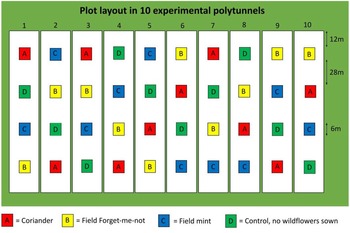
The field study was carried out between April and August 2016 in a commercial strawberry, Fragaria x ananassa Duch. cv. ‘Jubilee’, plantation at a farm in Kent, UK (51.25038° N, 0.34955° E; elevation: 104.9 m at northern end, and 94.0 m at southern end of field). Strawberry plants were grown in 1 litre coir plant pots on table tops under polythene-clad (150 μ polythene) Spanish tunnels. The 1.88 ha field contained 12 contiguous tunnels (each 7 m wide × 165 m long, with no gap between tunnels) oriented north to south, of which only the central ten tunnels were used for the study to mitigate any edge effects (Chacoff and Aizen, Reference Chacoff and Aizen2006). Beyond the northern field edge was an arable field, and additional fields of protected horticultural crops bordered the remaining three sides. Wind breaks of Italian alder, Alnus cordata (Loisel.) Duby, were present along the eastern and southern edges of the field, approximately 3 m from the end of the polytunnels (fig. 1). Six wildflower species grew naturally at the base of the alder wind break on the eastern edge of the field: bramble, Rubus fruticosus agg., cow parsley, Anthriscus sylvestris (L.) Hoffm., creeping thistle, Cirsum arvense (L.) Scop., hogweed, Heracleum sphondylium L., honeysuckle, Lonicera sp. L., and scentless mayweed, Tripleurospermum inodorum (L.) Sch.Bip. Hemlock, Conium maculatum L., grew in three isolated patches along the southern windbreak. Apart from these wildflowers, no additional sources of pollen and/or nectar were present along the field boundaries or on the ground under the polytunnels. Aphicides were only applied to the crop at the beginning of the growing season including Aphox (pirimicarb, 1.4 kg ha−1) on 16 April, and Aphox plus Calypso (thiacloprid, 0.7 kg ha−1) on 5 May.
Arrangement of the experimental plots within the polytunnels. All polytunnels were contiguous, with no space between the tunnels. An additional unused polytunnel was present on either side of the ten experimental tunnels.

Field study experimental design
The strawberries were intercropped with coriander, Coriandrum sativum L., field forget-me-not, Myosotis arvensis (L.) Hill and field mint, Mentha arvensis L., grown from seed (Herbiseed, Twyford, UK) at NIAB EMR with the goals of being: (1) attractive to hoverflies as a source of nectar and/or pollen (Colley and Luna, Reference Colley and Luna2000; Morris and Li, Reference Morris and Li2000; Haenke et al., Reference Haenke, Scheid, Schaefer, Tscharntke and Thies2009; Hassan et al., Reference Hassan, Mahmood, Nazir, Fatima and Aslam2017), (2) capable of producing flowers in the first year after sowing, (3) grown to a maximum height of <1 m, (4) not harmful or poisonous to humans, (5) not known to be attractive to major strawberry pests, and (6) neither invasive nor considered pernicious arable weeds. Intercropping was established using a randomized block design with four treatments in ten adjoining polytunnels (fig. 1). Along the strawberry rows, plots with one of the three introduced flower species formed the first three treatments, compared with a control treatment in which no additional floral resources were sown. Flowering plants received the same irrigation and fertilizer as the strawberry plants which were matched to the requirements of the variety and the growth stage of the strawberry plants.
In each tunnel, four 3 × 6 m plots, separated by 28 m, were assigned using a random number generator to one of the four treatments. Within each treated plot, plug plants of one of the three sown species were inserted along the central three rows (out of five rows of plants in each polytunnel) of table-top strawberries so that every third plant pot contained the sown flower species. This pattern resulted in a planting density of one sown flower container per metre along the row and 18 additional flower containers per plot. Rather than removing or replacing pots of strawberries, sown flower pots were placed on the table tops in gaps between pots of strawberries. Each pot was drip-irrigated on the same line as the strawberries. Coriander and mint seedlings were planted on 8–11 April, and forget-me-not plants were potted on 10–11 May due to a delay in their availability from the seed supplier. The blooming periods for the wildflower species were as follows: coriander: 27 May–25 July; forget-me-not: 28 June–25 July; mint: 13 July–23 August. Strawberry flowers were in bloom throughout the surveying period. In the control treatment, empty flower pots were introduced at the same density as sown flower pots to account for bias arising from the presence of additional pots between strawberry plants.
Field surveys
Surveys were carried out 4 days a week and all plots were surveyed six times during the strawberry flowering period: May–August 2016. During each round of surveys, tunnels were visited between 09:00 and 17:00 in a random sequence and the plots within each tunnel were then surveyed in random order to mitigate bias due to time of day or day of the year (Rotheray and Gilbert, Reference Rotheray and Gilbert2011). A seventh round of surveys was carried out in the last 2 weeks of August during which only field mint and control plots were visited, as coriander and forget-me-not plants had ceased flowering.
During each survey, aphid-infested strawberry plants within 6 m of each plot were hand-searched for hoverfly larvae for 5 min (Hogg et al., Reference Hogg, Nelson, Mills and Daane2011). All sides of leaves, stems and flowers were thoroughly examined, and hoverfly larvae were collected into 1.5 ml Eppendorf tubes, and labelled with the plot number, tunnel number and date. All specimens were then stored at −80°C prior to dissection.
Dissection of hoverfly larvae
Hoverfly larvae were dissected on sterile Petri dishes under a dissecting microscope. A scalpel and forceps were used to slice open the larvae immediately behind the mouthparts. The gut contents were then squeezed out of the larval integument, or outer skin, by holding onto the posterior end of the larvae with forceps and applying pressure with a scalpel starting at the posterior end and moving forwards to the head. The extracted contents of each larva were then collected into a new 1.5 ml Eppendorf tube (i.e., a separate tube for each larva). Forceps and scalpel were sterilized between dissections by first passing the utensils through an open flame and then washing them in ethanol. A new Petri dish was used for each specimen to reduce the likelihood of cross-contamination of specimens.
DNA extraction
Prior to DNA extraction using the DNeasy Tissue Kit (Qiagen, Hilden, Germany; protocol for animal tissues), larval gut contents were placed in a new1.2 ml tube with 180 μl of ATL buffer, 20 μl of proteinase K and a metal ball bearing. A negative control sample containing all buffers, but no larval gut content, was included to test for cross-contamination during the DNA extraction procedure. Tubes were sealed tightly and placed in racks, which were shaken at 30 oscillations per second for 2 min in a tissue lyser (Qiagen Tissue Lyser II, Hilden, Germany). The lysed contents in solution were then transferred to a new 1.5 ml Eppendorf tube labelled with the sample number, and the DNeasy extraction protocol was resumed at the incubation step. Extracted DNA was eluted in 100 μl AE buffer provided by the manufacturer and stored at −80°C in a new 1.5 ml Eppendorf tube, labelled with the sample number and extraction date.
DNA sequencing
PCR and sequencing were performed by the Genome Centre, Queen Mary University of London. In brief, amplification of a 157 bp fragment of the mitochondrial cytochrome c oxidase subunit 1 was performed using primers ZBJ-ArtF1c and ZBJ-ArtR2c (Zeale et al., Reference Zeale, Butlin, Barker, Lees and Jones2011) adapted to include Fluidigm tags CS1 and CS2. This region targets a segment internal to the 657 bp region used in standard DNA barcoding and is located at the 5′ end of COI. Each 10 μl PCR reaction contained 5 μl of Qiagen multiplex PCR (Qiagen, CA, USA) master mix, 3 μl of water, 0.5 μl of each 10 μM primer and 1 μl of eluted DNA. PCR amplification was as follows: 95°C for 15 min; 50 cycles of 95°C for 30 s; 52°C for 30 s; 72°C for 30 s and 72°C for 10 min. Amplicon QC was performed using a DNA D1000 TapeStation (Agilent Technologies, 5301 Stevens Creek Blvd, Santa Clara, CA, United States) and quantification was performed using a QuBit dsDNA HS Assay Kit (Invitrogen, Life Technologies). Sequencing was performed bi-directionally with 10 bp Fluidigm indexes following manufacturer's protocols and sequencing was run on the MiSeqv2 Chemistry using a 2 × 150 bp run with 300 cycle run (Illumina).
Data analysis
We performed two parallel analyses of the data to cross check identifications between different genetic reference collections to increase the confidence in our IDs. These represent equivalent procedures but access slightly different underlying reference collections using alterative procedures to increase our confidence in the IDs.
In Approach 1, reads were merged in Mothur (Schloss et al., Reference Schloss, Westcott, Ryabin, Hall, Hartmann, Hollister, Lesniewski, Oakley, Parks, Robinson, Sahl, Stres, Thallinger, Van Horn and Weber2009) and then processed using the Galaxy platform (Afgan et al., Reference Afgan, Baker, Batut, Van Den Beek, Bouvier, Čech, Chilton, Clements, Coraor, Grüning, Guerler, Hillman-Jackson, Hiltemann, Jalili, Rasche, Soranzo, Goecks, Taylor, Nekrutenko and Blankenberg2018). Primer sequences and adaptors were removed using CLIP from the FASTX-toolkit (Assaf, Reference Assaf2010) and all sequences that were longer or shorter than the target amplicon length of 157 bp were filtered out. Sequences were collapsed into unique haplotypes using COLLAPSE from the FASTX-toolkit (Assaf, Reference Assaf2010). All haplotypes were screened using a BLAST search against a reference database of >600,000 sequences extracted from Genbank. Because initial results from Genbank returned species identifications that included taxa apart from expected aphidophagous hoverflies and aphids, a bespoke reference database was created using sequences belonging only to UK species of aphids and syrphine hoverfly, which were selected from the results of our initial screening of our sequences against the full BOLD sequence library. Using this hierarchical approach, we then parsed this output using custom python scripts and filtered out any matches lower than 98% identical to a sequence in the reference database. Only 98–100% matches were retained for the analysis to try and limit the false-positive rate in detecting aphid or hoverfly DNA (Hebert et al., Reference Hebert, Cywinska, Ball and de Waard2003).
In Approach 2, we use the more recently developed mBRAVE platform which provides less user control of the analysis but provides a direct way to access data on the BOLD platform (http://www.barcodinglife.org) by way of premade reference libraries extracted from BOLD into mBRAVE. Raw reads were uploaded to mBRAVE and merged using a minimum expected overlap of 20 bp and maximum substitutions of 5 bp. We set MinQV to 0 to retain all data and max bases with low QV (<20) or extra low QV (<10) to 75. We removed sequences <100 bp or >600 bp and trimmed the front and back end by 30 and 23 bp, respectively, to remove primers. We set the ID threshold to 8% (the most permissive available) and used the SYS-CRLINSECTA library for identifications (updated 28 July 2019). At the time of use, this database contained 638,699 sequences representing 197,528 species (482,577 BINs). We used the analytics cart feature to extract all potential identifications and removed any ID with fewer than 200 reads assigned (experimentally determined as minimizing false positives, unpublished data). We then recorded all cases where aphid DNA was detected. While the ID threshold was set low (92%) removing cases with <200 reads assigned had the effect of putting all by four cases of detection at >98% identical to a reference BIN.
Statistical analysis
All analyses were carried out in R version 3.4.1 (R Core Team, Reference Team2017) using data from Approach 1 (we comment only on the similarity of Approaches 1 and 2). Prey DNA detection rates were modelled using generalized linear mixed models (GLMMs) with a binomial distribution. GLMMs were fitted using the ‘lme4’ package (Bates et al., Reference Bates, Maechler, Bolker and Walker2015). Fixed effects included plot row position within the tunnel (1–4, from north to south), tunnel number (1–10 from west to east) and the interaction between survey round and treatment (coriander, forget-me-not, mint or control). The interaction between plot number (1–40) and survey round was included as a random effect to assess the effect of any differences in trends within individual plots from one survey week to the next.
The optimal model was chosen by starting with a full model containing all possible fixed effects and running the ‘drop1’ function in R to identify and then remove the least significant fixed effect from the full model. This process was then repeated, continually removing the least significant explanatory variable, until only significant fixed effects remained. The significance of the random effect was tested by removing the random effect and comparing the optimal model against the corresponding GLM using the likelihood ratio test.
Results
A total of 149 hoverfly larvae were collected from all plots over the course of the field study. These generated ≈3.4 million reads representing ≈650 K haplotypes. Using Approach 1, 145 hoverfly specimens (97.3%) returned sequences that matched at least one hoverfly species in the bespoke sequence library. Approximately half (72/145; 49.7%) of all larval specimens returned a 100% match to just one hoverfly taxa while 18 specimens contained 100% matches to more than one hoverfly species. Finally, 55 samples contained only 98–99% matches to hoverfly species of which 27/55 (49.1%) returned a 98–99% match to a single species of hoverfly with the rest matching more than one hoverfly species.
Of the 145 samples containing hoverfly DNA, 55 (37.9%; bootstrapped 95% confidence interval: 29.7–45.5%) also contained DNA fragments that matched aphid records in our database. An inspection of our bespoke reference database suggests variation in these small regions is minimal in both hoverflies and aphids with a few taxa either unrepresented, represented only by partial sequences or by fewer than three records. With this limited reference set, some taxa did not contain diagnostic characters. Consequently, we comment only on predation rates of hoverflies on aphids and do not narrow this further to lower taxonomic levels. Thus, approximately one in three hoverfly larva specimens tested positive for aphid DNA. Approach 2 generated a similar outcome with 41 records of aphid DNA in hoverflies (compared to 55 in Approach 1) reflecting differences in the taxonomic representation in the underlying reference collections.
Prey DNA detection rates by sown flower treatment
Using the data from Approach 1, the presence of additional sown floral resources had a significant impact on aphid DNA detection rates in hoverfly larval gut contents (χ2(3) = 12.79, P = 0.0051, fig. 2). Over half of the hoverfly specimens (17/30; 56.67%) collected within 6 m of forget-me-not plots contained aphid DNA, compared to under 10% of specimens (2/22; 9.09%) collected near coriander plots (Z = −3.11, P = 0.010; fig. 2). Prey DNA detection rates in specimens from mint (15/38; 39.47%) and control plots (21/55; 38.18%) were intermediate between rates from coriander and forget-me-not plots (fig. 2). Using Approach 2, values were very similar to those of Approach 1 (forget-me-not – 12/30, coriander – 2/22, mint – 11/38 and control – 13/55).
Mean percentage (±SE) aphid prey DNA detection rates from hoverfly larvae collected in each of four treatments in a strawberry crop interplanted with single species plots of coriander, Coriandrum sativum L., field forget-me-not, Myosotis arvensis (L.) Hill or field mint, Mentha arvensis L., compared to a control with no additional floral resource. Means sharing the same letter do not differ significantly (α = 0.05).

Discussion
We demonstrate that it is possible to use HTS technology to detect aphid DNA in the larvae of hoverflies where observation and dissection-based approaches are untenable or inefficient. We further demonstrated that aphid DNA was detectable in approximately a third of the hoverfly larvae recovered from strawberry plants suggesting a strong predation role within agricultural fields. We also provide preliminary evidence that there may be increased predation rates corresponding to types of floral intercropping which suggests a mechanism to manipulate this natural ecosystem service. However, this study does not rule out impacts related to prey handling, prey preference, intraguild predation, etc.
The aphid DNA detection rate in our study (37.9%) was almost identical to the 36% prey DNA detection rate documented among E. balteatus larvae reared in Mediterranean lettuce crops (Gomez-Polo et al., Reference Gomez-Polo, Alomar, Castañé, Lundgren, Piñol and Agustí2015). However, we suspect this is a conservative estimate. We set our detection level at 98% in Approach 1 and removed any positive with <200 reads in Approach 2 and in doing so likely removed some true positives. Our choice was made to minimize type 1 errors and is based on parameters optimized using positive controls but may lead to conservative estimates, particularly when digestion may degrade DNA making it less detectable (Symondson, Reference Symondson2002) than that of positive controls. Additionally, a proportion of the older, third-instar larvae may have stopped feeding prior to pupating at the time of collection (Rotheray, Reference Rotheray1993) artificially increasing the number of negatives by targeting individuals no longer feeding. The developmental stage of the hoverfly larvae collected in the present study was not recorded. Previous work has shown that aphidophagous syrphid larvae consume aphids at different rates at different points in their development (Tinkeu and Hance, Reference Tinkeu and Hance1998; Hopper et al., Reference Hopper, Nelson, Daane and Mills2011). Therefore, future studies should investigate whether larval developmental stage impacts the rate of prey DNA detection in the larval gut contents.
In addition to biological effects, in a review of invertebrate gut contents studies, Symondson (Reference Symondson2002) documented that prey DNA detection rates were often below 100%, even in predators that had been fed prey <24 h prior to the gut contents analysis. As hoverfly larvae are primarily active at night (Rotheray and Gilbert, Reference Rotheray and Gilbert2011), the fact that specimens were collected during the day may have led to many samples with prey DNA which had already become undetectable in the guts of the hoverfly larvae. Moreover, previous researchers have documented an array of other potential sources of variation in the detectability of prey DNA including temperature, mass of predator, quantity of prey consumed, number of DNA sequences present in aphid prey and the preservation of the sample (Weber and Lundgren, Reference Weber and Lundgren2009). These factors may all reduce detectability and further depress estimates of predation.
There was a strong trend towards aphid DNA detection rates varying according to the provision of floral resources. While we observed a significant difference between predation when coriander or forget-me-not were provisioned, neither differed from control plots. Hoverfly larvae collected on strawberry plants near forget-me-not plots were more likely to contain aphid DNA fragments than larvae found near plots intercropped with coriander. However, it is not clear whether the provision of floral resources increases the resources for hoverflies and in turn boosts local populations and thus predation rates or attracts aphids which in turn increase predation rates. While our data only point to an association, the potential to manipulate biocontrol requires additional study. If intercropping can provision additional aphid predators and in turn reduce numbers of aphids on strawberry plants, some level of insecticide reduction may be possible.
We did not analyse hoverflies or aphids to species level due to some ambiguity in our ability to identify species in several cases. This is particularly driven by a lack of taxonomic representation in the reference collection which makes assessing the reliability of IDs difficult. In general, minimal reference collection for target taxa represents a significant problem because a good estimate of intra- and interspecific variation of the genomic region in the target taxa is needed to assess the robustness of the ID system. In future work, longer amplified regions may increase our level of resolution and bespoke sequencing of additional species and individuals are required to augment existing reference collections to validate species level identifications and determine which species can (or cannot) be differentiated by this region (Gojković et al., Reference Gojković, Francuski, Ludoški and Milankov2020).
Despite our inability to provide species level identifications, this study validates DNA as a method of measuring hoverfly aphid predation, and it provides new evidence to suggest that hoverflies may be capable of providing strawberry growers with aphid pest control services. Prior research has already indicated that adult hoverflies may play an important role as strawberry pollinators (Albano et al., Reference Albano, Salvado, Duarte, Mexia and Borges2009; Hodgkiss et al., Reference Hodgkiss, Brown and Fountain2018); therefore, hoverflies with aphidophagous larvae could provide strawberry growers with dual pollination and pest control ecosystem services and should be encouraged.
Future work should focus on refining the DNA detection to provide additional taxonomic resolution, determine whether our increased predation in proximity to some floral resources is significant and by what mechanism. If this relationship is upheld, within-crop manipulations to entice the most effective aphid predators into strawberry rows could be used to reduce the need for chemical pesticides.
Acknowledgements
This research was funded jointly by the East Malling Trust and Royal Holloway University of London. We would like to thank the staff at Hugh Lowe Farms Ltd for providing us with a study site and helping to coordinate and set up the field study on their farm. NIAB EMR staff who provided glasshouse space and watering of sown flowers.
Author contributions
Experiment was conceived of by DH, MF and MB; field work and lab work was conducted by DH and ELC; analysis was performed by DH and ELC; all authors contributed to the manuscript preparation.