Emotion dysregulation or “a pattern of emotional experiences or expressions that is experienced either too intensely or too enduringly to be adaptive” (Beauchaine, Reference Beauchaine2015) both predisposes to multiple types of psychopathology (Beauchaine & Zisner, Reference Beauchaine and Zisner2017) and predicts more impaired functioning (Sallquist et al., Reference Sallquist, Eisenberg, Spinrad, Reiser, Hofer, Zhou and Eggum2009; Silk, Steinberg, & Morris, Reference Silk, Steinberg and Morris2003; Stringaris & Goodman, Reference Stringaris and Goodman2009). Recent focus on understanding psychopathology in the context of interactions between domains of brain–behavior relationships, as described in the Research Domain Criteria (RDoC), has moved the field forward (Cuthbert & Insel, Reference Cuthbert and Insel2013). Using an RDoC-based conceptualization emphasizes the importance of dimensional, transdiagnostic predictors of psychopathology, including emotion dysregulation. Emotion dysregulation encompasses multiple RDoC constructs, including both positive and negative affect valence systems, cognitive systems, social processes, and arousal (Cuthbert & Insel, Reference Cuthbert and Insel2013). To date, research on the development of emotion dysregulation in psychopathology has primarily focused on dysregulated expressions of negative affect, including the subdomain of irritability (Brotman, Kircanski, & Leibenluft, Reference Brotman, Kircanski and Leibenluft2017). However, some evidence shows dysregulated positive affect also predicts impairment and psychopathology (Klein, Kotov, & Bufferd, Reference Klein, Kotov and Bufferd2011; Putnam & Stifter, Reference Putnam and Stifter2002; Rydell, Berlin, & Bohlin, Reference Rydell, Berlin and Bohlin2003; Vogel, Jackson, Barch, Tillman, & Luby, Reference Vogel, Jackson, Barch, Tillman and Luby2019). Conceptually emotional processing includes both positive and negative valence systems (Cuthbert & Insel, Reference Cuthbert and Insel2013). Thus, there may be separable effects of dysregulation in negative versus positive valence domains. Here we investigate the developmental trajectory of dysregulation in both positive and negative affect, which we term excitability and irritability respectively, along with their relationship to later behavioral and neural correlates of emotion regulation, psychopathology and functional outcomes.
Dysregulated negative affect is a dimensional risk factor linked with psychopathology and impairment
Irritability, or “a low threshold for experiencing anger in response to frustration” includes both chronic low-level negative affect and intermittent outbursts of anger (Brotman et al., Reference Brotman, Kircanski and Leibenluft2017). Irritability has been related to concurrent diagnosis and later development of multiple psychiatric disorders, including attention-deficit hyperactivity disorder (ADHD), oppositional defiant disorder, anxiety, and depression (Brotman et al., Reference Brotman, Schmajuk, Rich, Dickstein, Guyer, Costello and Leibenluft2006; Copeland, Angold, Costello, & Egger, Reference Copeland, Angold, Costello and Egger2013, Reference Copeland, Shanahan, Egger, Angold and Costello2014; Dougherty et al., Reference Dougherty, Smith, Bufferd, Carlson, Stringaris, Leibenluft and Klein2014, Reference Dougherty, Smith, Bufferd, Kessel, Carlson and Klein2016; Ezpeleta, Granero, de la Osa, Trepat, & Domènech, Reference Ezpeleta, Granero, de la Osa, Trepat and Domènech2016; Leibenluft, Cohen, Gorrindo, Brook, & Pine, Reference Leibenluft, Cohen, Gorrindo, Brook and Pine2006; Pagliaccio, Pine, Barch, Luby, & Leibenluft, Reference Pagliaccio, Pine, Barch, Luby and Leibenluft2018; Stringaris & Goodman, Reference Stringaris and Goodman2009; Wakschlag et al., Reference Wakschlag, Perlman, Blair, Leibenluft, Briggs-Gowan and Pine2018; Whelan, Stringaris, Maughan, & Barker, Reference Whelan, Stringaris, Maughan and Barker2013). Irritability is linked to development of disruptive behavior, poor family relations, worse school functioning, increased suicidality, substance use, risky behavior, school dropouts, poorer work performance, and worse health outcomes (Copeland et al., Reference Copeland, Angold, Costello and Egger2013, Reference Copeland, Shanahan, Egger, Angold and Costello2014; Ezpeleta et al., Reference Ezpeleta, Granero, de la Osa, Trepat and Domènech2016; Leibenluft et al., Reference Leibenluft, Cohen, Gorrindo, Brook and Pine2006). In the fifth edition of Diagnostic and Statistical Manual of Mental Disorders (DSM-V), disruptive mood dysregulation disorder was added to better classify children with extreme and impairing irritability (Roy, Lopes, & Klein, Reference Roy, Lopes and Klein2014). Although irritability in early childhood can be normative (Belden, Thomson, & Luby, Reference Belden, Thomson and Luby2008; Wakschlag et al., Reference Wakschlag, Choi, Carter, Hullsiek, Burns, McCarthy and Briggs-Gowan2012) and typically declines from preschool to school age (Dougherty et al., Reference Dougherty, Smith, Bufferd, Kessel, Carlson and Klein2016; Leibenluft et al., Reference Leibenluft, Cohen, Gorrindo, Brook and Pine2006; Wakschlag et al., Reference Wakschlag, Perlman, Blair, Leibenluft, Briggs-Gowan and Pine2018; Wiggins, Mitchell, Stringaris, & Leibenluft, Reference Wiggins, Mitchell, Stringaris and Leibenluft2014), elevated irritability within the normative range is associated with an increased risk of later psychiatric problems (Wakschlag et al., Reference Wakschlag, Estabrook, Petitclerc, Henry, Burns, Perlman and Briggs-Gowan2015).
Dysregulated positive affect is separable from irritability and confers unique risks
While dysregulation of positive affect is an infrequent focus of research in developmental psychopathology, emotion dysregulation characterized by increased positive affect has also been shown to increase risk of later psychopathology and impairment. As early as 6–12 months of age, infants assessed as having high positive affect had increased risk of externalizing symptoms at age 2 (Putnam & Stifter, Reference Putnam and Stifter2002). The frequency and intensity of positive affect in 5-year-old children have also positively correlated with anger, negatively correlated with soothability, and predicted externalizing behavior (Rydell et al., Reference Rydell, Berlin and Bohlin2003). Similarly, children with higher parent-reported positive anticipation had higher rates of aggression (Deater-Deckard et al., Reference Deater-Deckard, Beekman, Wang, Kim, Petrill, Thompson and DeThorne2010). In prior work, using a data-driven factor analysis of clinical interview items we have demonstrated that in a group of preschoolers enriched for early-onset affective disorders, dysregulation of negative affect consistent with irritability was separable from dysregulation of positive affect, which we termed “excitability” (Vogel et al., Reference Vogel, Jackson, Barch, Tillman and Luby2019). Preschoolers with higher excitability were more impaired, had increased externalizing symptoms, and increased emotion lability into their teen years above and beyond the risk imparted by irritability, early life trauma, or childhood psychiatric diagnosis (Vogel et al., Reference Vogel, Jackson, Barch, Tillman and Luby2019).
Emotion dysregulation undergoes developmental change
A number of studies have demonstrated that irritability has a normative decline throughout childhood and adolescence (Caprara, Paciello, Gerbino, & Cugini, Reference Caprara, Paciello, Gerbino and Cugini2007; Hawes et al., Reference Hawes, Perlman, Byrd, Raine, Loeber and Pardini2016; Pagliaccio et al., Reference Pagliaccio, Pine, Barch, Luby and Leibenluft2018; Wiggins et al., Reference Wiggins, Mitchell, Stringaris and Leibenluft2014). Importantly, the children who deviate from this normative decline and continue to have elevated irritability have increased risk of later psychopathology (Dougherty et al., Reference Dougherty, Smith, Bufferd, Carlson, Stringaris, Leibenluft and Klein2014; Hawes et al., Reference Hawes, Perlman, Byrd, Raine, Loeber and Pardini2016; Wiggins et al., Reference Wiggins, Mitchell, Stringaris and Leibenluft2014), impairment (Caprara et al., Reference Caprara, Paciello, Gerbino and Cugini2007; Dougherty et al., Reference Dougherty, Smith, Bufferd, Carlson, Stringaris, Leibenluft and Klein2014), and abnormalities in brain development (Pagliaccio et al., Reference Pagliaccio, Pine, Barch, Luby and Leibenluft2018). This normative decline is thought to be related to normative developmental gains in cognitive control and emotion regulation (Hawes et al., Reference Hawes, Perlman, Byrd, Raine, Loeber and Pardini2016; Pagliaccio et al., Reference Pagliaccio, Pine, Barch, Luby and Leibenluft2018; Siever, Reference Siever2008). Research on the relationship between positive affect dysregulation and outcomes has to date been focused on early childhood (Deater-Deckard et al., Reference Deater-Deckard, Beekman, Wang, Kim, Petrill, Thompson and DeThorne2010; He et al., Reference He, Degnan, McDermott, Henderson, Hane, Xu and Fox2010; Putnam & Stifter, Reference Putnam and Stifter2002; Rydell et al., Reference Rydell, Berlin and Bohlin2003; Vogel et al., Reference Vogel, Jackson, Barch, Tillman and Luby2019), and thus the full developmental course of dysregulation of positive affect is unclear. However, there is evidence of continuity between dysregulated expressions of positive affect in early childhood and overall dysregulated affect in later childhood (Nigg, Reference Nigg2006), suggesting developmental continuity of positive affect dysregulation.
By identifying the developmental trajectories of dysregulation in positive and negative affect, we may be able to improve our understanding of the underlying brain–behavior relationships and improve our ability to predict later life outcomes. For example, if children with high excitability, or dysregulation of positive affect, are less likely to exhibit the normative decline in irritability and more likely to have persistent emotion dysregulation, this may indicate excitability has a strong relationship to control processes that are essential to emotion regulation. Similarly, if excitability is more likely than irritability to persist beyond early childhood, young children with high excitability should potentially be considered at high risk of persistent dysregulation and future impairment, and thus targeted for intervention.
Excitability and irritability may have distinct but also overlapping neural correlates
Understanding the relationship between excitability, irritability, and neural activations during emotion regulation tasks may guide our understanding about the mechanisms of these maladaptive processes. In the brain, emotion dysregulation has been described as dysfunctional patterns of “bottom-up” emotion generation and “top-down” emotion regulation processes (Sheppes, Suri, & Gross, Reference Sheppes, Suri and Gross2015). The amygdala is commonly implicated in bottom-up emotion generation (Etkin, Büchel, & Gross, Reference Etkin, Büchel and Gross2015) and children with emotion dysregulation in disorders ranging from anxiety (Young, Sandman, & Craske, Reference Young, Sandman and Craske2019) to bipolar (Rich et al., Reference Rich, Schmajuk, Perez-Edgar, Fox, Pine and Leibenluft2007; Wiggins et al., Reference Wiggins, Brotman, Adleman, Kim, Oakes, Reynolds and Leibenluft2016) have increased sensitivity in the amygdala response to emotional stimuli. Brain regions responsive to reward, including the ventral striatum (VS), are implicated in the bottom-up generation of positive emotions (Etkin et al., Reference Etkin, Büchel and Gross2015). Emotion regulation initially engages automatic processes supported by the ventromedial prefrontal cortex (vmPFC) and ventral anterior cingulate cortex (vACC) (Etkin et al., Reference Etkin, Büchel and Gross2015). Subsequently, top-down effortful regulation may occur and is associated with activity in ventrolateral PFC (vlPFC), dorsolateral PFC (dlPFC), inferior frontal gyrus (IFG), dorsal ACC (dACC), and inferior parietal cortex (IPC), all of which are cognitive control regions (Buhle et al., Reference Buhle, Silvers, Wager, Lopez, Onyemekwu, Kober and Ochsner2014; Etkin et al., Reference Etkin, Büchel and Gross2015; Kohn et al., Reference Kohn, Eickhoff, Scheller, Laird, Fox and Habel2014). Studies that investigate whether excitability and irritability are related to bottom-up activation in positive and negative valence systems and/or top-down emotion regulation in cognitive control regions is a critical next step to elucidate brain–behavior relationships in this domain.
The Current Study
Given the importance of emotion dysregulation in impairment and psychopathology, particularly our growing understanding that excitability may also predict worse outcomes, we aimed to further characterize the trajectory of dysregulation in both positive and negative affect (excitability and irritability) and assess how the development of excitability and irritability predict later emotion regulation, psychopathology, and impairment. Using similar definitions of excitability and irritability as in Vogel et al., Reference Vogel, Jackson, Barch, Tillman and Luby2019, we assessed the change in excitability and irritability scores over the course of childhood starting in preschool and through early adolescence. We hypothesized that similar to prior studies, we would find a general decline in irritability across development (Hawes et al., Reference Hawes, Perlman, Byrd, Raine, Loeber and Pardini2016; Pagliaccio et al., Reference Pagliaccio, Pine, Barch, Luby and Leibenluft2018; Wiggins et al., Reference Wiggins, Mitchell, Stringaris and Leibenluft2014), though excitability may be more stable over time given the limited developmental information available (Nigg, Reference Nigg2006). Then, we used multilevel models to describe the trajectory of individuals’ change in excitability and irritability across development and queried whether these trajectories predicted later outcomes. Given prior associations of irritability with both internalizing and externalizing forms of psychopathology, we hypothesized that irritability trajectory would be related to both internalizing and externalizing symptoms (Copeland et al., Reference Copeland, Angold, Costello and Egger2013, Reference Copeland, Shanahan, Egger, Angold and Costello2014; Stringaris & Goodman, Reference Stringaris and Goodman2009; Vogel et al., Reference Vogel, Jackson, Barch, Tillman and Luby2019). Given our prior work demonstrating that preschool excitability was an even stronger predictor of externalizing psychopathology but was not related to internalizing psychopathology, we predicted that excitability measures would predict only externalizing pathophysiology (Vogel et al., Reference Vogel, Jackson, Barch, Tillman and Luby2019). We hypothesized that both overall levels of irritability and excitability as well as a lack of decline in such would predict later development of greater mood lability and overall impairment, though excitability would be a stronger predictor as in Vogel et al., Reference Vogel, Jackson, Barch, Tillman and Luby2019. Given that developmental change in emotion dysregulation is thought to be in part related to increasing cognitive control, we also hypothesized that higher excitability and irritability with less developmental decline would be associated with less neural activity in cognitive emotion regulation regions, such as PFC, during cognitive emotional reappraisal.
Method
Participants
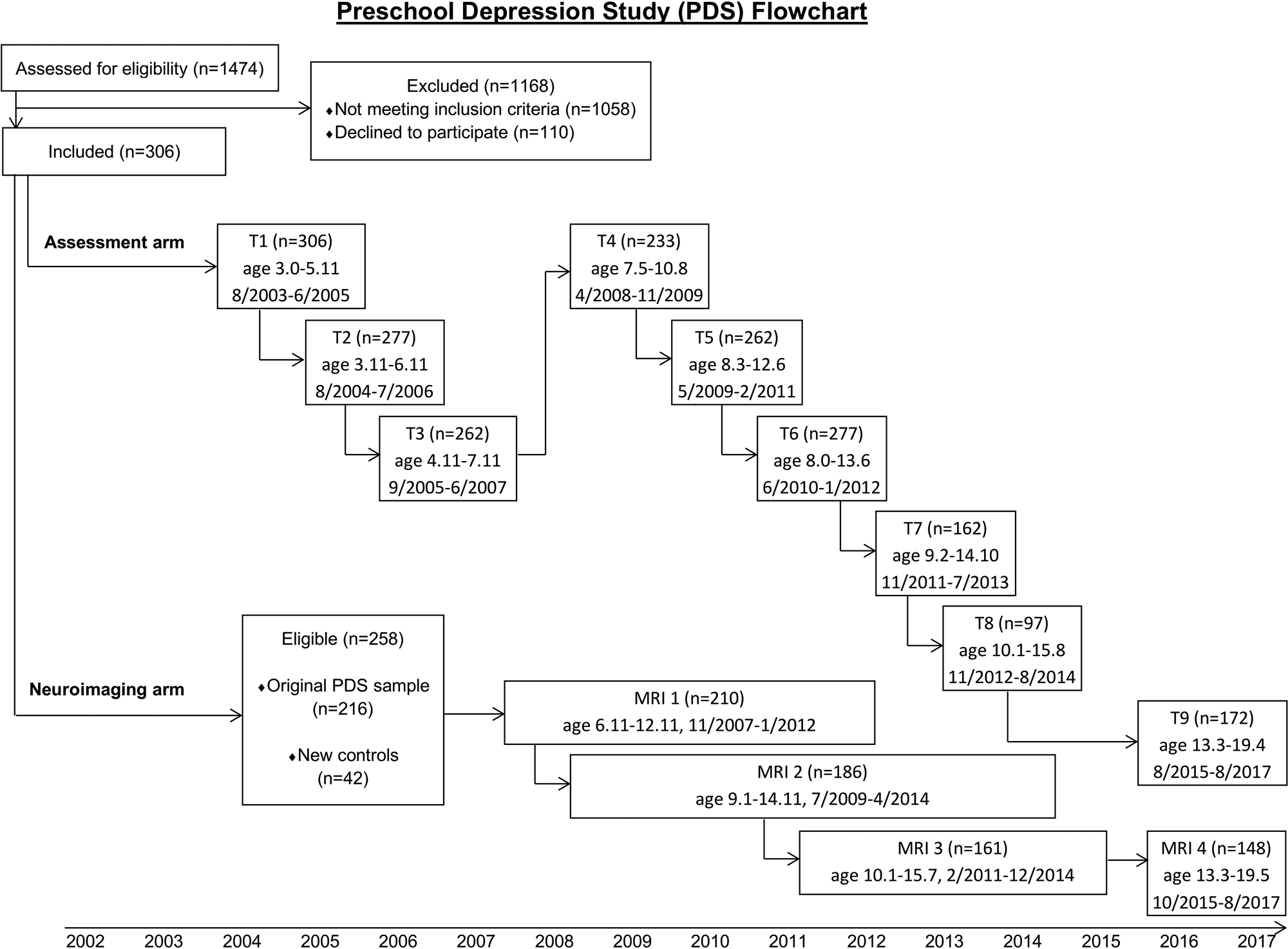
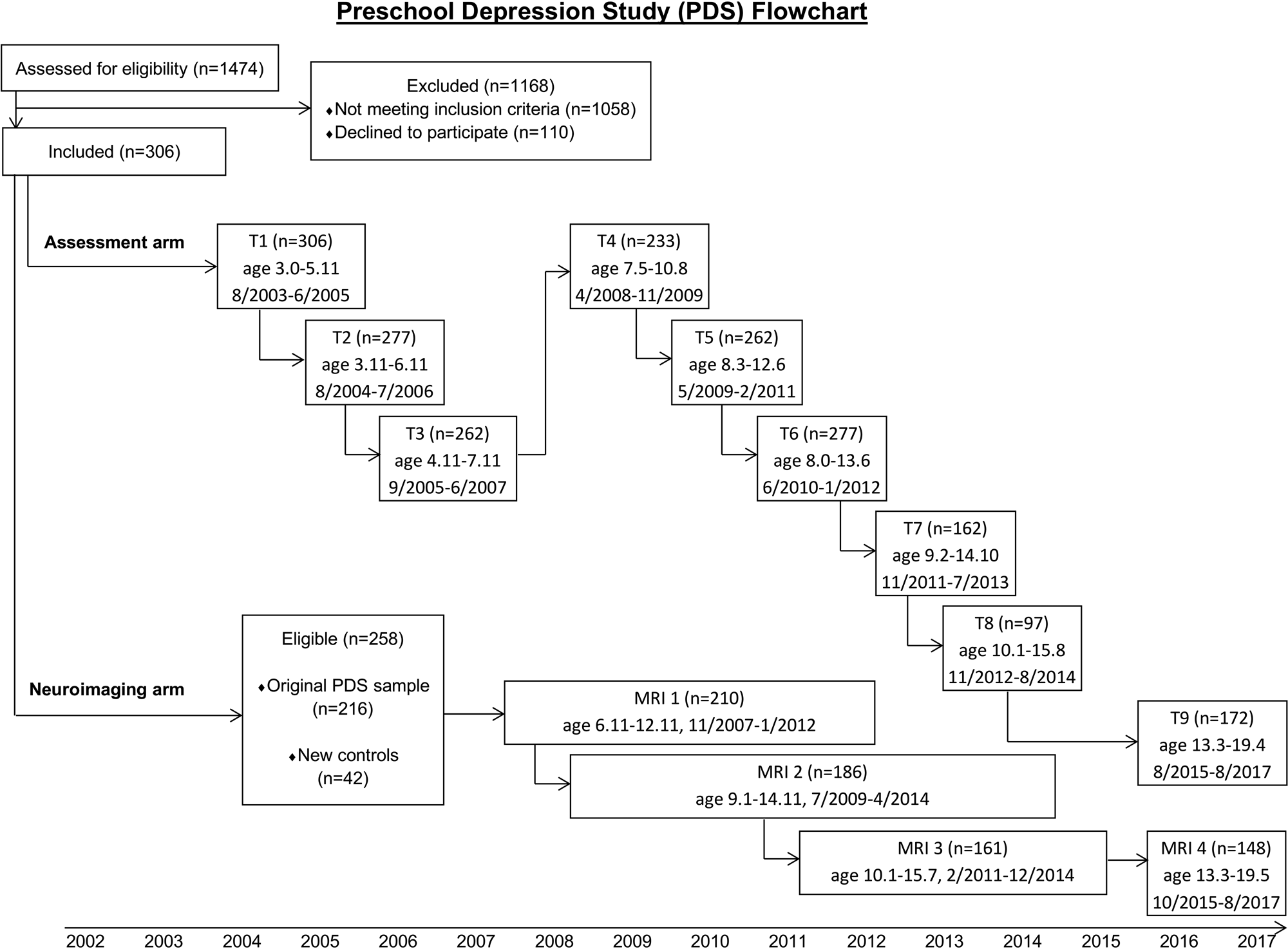
Participants included the 306 children enrolled in the preschool depression study (PDS), a 17-year longitudinal study enriched for children with early-onset affective symptoms recruited from community sites, who had a baseline assessment at age 3–5.11 years (mean 4.0 years). Details of recruitment and follow up for the PDS have been previously reported (Luby, Gaffrey, Tillman, April, & Belden, Reference Luby, Gaffrey, Tillman, April and Belden2014), and can be seen summarized in Figure 1. After the initial baseline assessment, children and parents were invited to participate in an additional five in-person assessments that occurred approximately yearly, though with an approximate 3-year interval between Timepoints 3 and 4, and included clinical interviews, observed interactions, and questionnaire completion at Timepoints 2–6. In middle childhood, a neuroimaging component was added to this study and only a subgroup of children were invited to continue to participate for the remaining three sessions (Timepoints 7–9) with Timepoint 7 and Timepoint 8 occurring approximately a year apart and Timepoint 9 occurring approximately 3 years after Timepoint 8, including clinical interviews, questionnaires, observed interactions, functional magnetic resonance imaging (fMRI), and electroencephalography (EEG) sessions. Two hundred and ninety-three children had at least one follow-up assessment and were included in our analysis of the trajectory of dysregulation factor scores across time. Of the original participants, 129 participated at the final included assessment (Timepoint 9) at age 14–19 (mean 16.0 years) and were included in our outcome analyses. Of these 129 participants, 116 successfully completed an emotion regulation task during fMRI acquisition at Scan 4, which was concomitant with Timepoint 9. As seen in Supplementary table scan 1, there are no significant differences in children who were initially enrolled and those that completed an assessment at Timepoint 9/ Scan 4 in age at enrollment, gender, adverse childhood experiences (ACEs), ever having an attention-deficit/hyperactivity disorder (ADHD) diagnosis, baseline Excitability factor score, or baseline Irritability factor score. Significantly fewer participants who ever received a diagnosis of major depressive disorder (MDD) participated in the Timepoint 9/Scan 4, outcome, assessment, and emotion regulation task.
Preschool depression study flowchart indicating initial recruitment, enrollment, and subsequent assessment points.
Assessments
Preschool Age Psychiatric Assessment (PAPA) (Egger & Angold, Reference Egger, Angold, Delcarmen-Wiggins and Carter2004): standardized clinical interview of parents to assess children's psychiatric symptoms from ages 3 to 7, used to assess symptoms at Timepoints 1–3. For these analyses, the PAPA was used to define symptoms for the dysregulation factor scores.
Childhood Age Psychiatric Assessment (CAPA) (Angold et al., Reference Angold, Prendergast, Cox, Harrington, Simonoff and Rutter1995): standardized clinical interview of parents and children to assess children's psychiatric symptoms from ages 6 to 18, used to assess symptoms at Timepoints 4–8. For these analyses, the CAPA was used to define symptoms for the dysregulation factor scores.
Adverse Childhood Experiences (ACEs) (Felitti et al., Reference Felitti, Anda, Nordenberg, Williamson, Spitz, Edwards and Marks1998): assessed via parent report at each timepoint, converted into a z score, and averaged across time. The normalized score was used as a covariate in later analyses.
Child Clinical Global Assessment Scale (CGAS) (Shaffer, Fisher, Lucas, Dulcan, & Schwab-Stone, Reference Shaffer, Fisher, Lucas, Dulcan and Schwab-Stone2000): interviewer rated measure of overall functioning based on both parent and child reports, used to assess functioning at Timepoint 9.
MacArthur Health and Behavior Questionnaire (HBQ) (Essex et al., Reference Essex, Boyce, Goldstein, Armstrong, Kraemer and Kupfer2002): parent rated report that measures functioning in multiple areas of life, including impairment in overall functioning, peer relationships, and domains of psychopathology including internalizing and externalizing symptoms, obtained at Timepoints 1–9. At Timepoint 9, the outcome used for these analyses, Cronbach's alpha for the Internalizing Scale was 0.95, for the Externalizing Scale was 0.93 and for Global Peer Relations was 0.84.
Kiddie Schizophrenia and Affective Diagnosis Schedule (KSADS) (Kaufman et al., Reference Kaufman, Birmaher, Axelson, Pereplitchikova, Brent and Ryan2016): clinical diagnostic interview performed with both parent and teen, here used to assess presence of depression at Timepoint 9.
Emotion Regulation Checklist (ERC) (Shields & Cicchetti, Reference Shields and Cicchetti1997): self-report questionnaire with two subscales – negativity/lability and emotion regulation – used to assess emotional functioning at Timepoints 5–9. In the current study group, the Cronbach's alpha for the emotion regulation subscale was 0.77 and for the lability/negativity subscale was 0.88 at Timepoint 9.
Borderline Personality Features Scale for Children (BPFS-C) (Crick, Murray-Close, & Woods, Reference Crick, Murray-Close and Woods2005): self-report questionnaire assessing symptoms of borderline personality disorder symptoms, including subscales of affective instability, negative relationships, identity problems, and self-harm, used to assess symptoms at Timepoint 9. In the current study group, the total score was used to assess emotion dysregulation at follow up and the negative relationships subscale to assess peer relations as an outcome. Cronbach's alpha for the total instrument was 0.90, for the negative relationships subscale 0.74, affective instability subscale 0.70, identity problems subscale 0.70, and self-harm subscale 0.79.
fMRI cognitive emotion regulation task
In brief, participants engaged in an emotion regulation task in which they either viewed negative stimuli or used pre-taught cognitive regulation strategy to decrease their negative emotions. An in-depth description of this cognitive reappraisal task based on one developed by Silvers and Oschner (Silvers et al., Reference Silvers, McRae, Gabrieli, Gross, Remy and Ochsner2012, Reference Silvers, Shu, Hubbard, Weber and Ochsner2015) has been provided in prior literature (Belden, Pagliaccio, Murphy, Luby, & Barch, Reference Belden, Pagliaccio, Murphy, Luby and Barch2015; Elsayed, Vogel, Luby, & Barch, Reference Elsayed, Vogel, Luby and Barch2021). Stimuli: images were taken from the International Affective Picture Series (IAPS) and supplemented using an in-house image set selected to be appropriate for viewing by children (e.g., photos of other children crying). IAPS stimuli have been rated for valence (1–9; extremely negative to extremely positive) and arousal (1–9; no arousal to extreme arousal). The images used had valence scores less than 4 and arousal scores greater than 4. Training in reappraisal: Children first participated in pre-scan training to ensure understanding of the use of cognitive reappraisal strategies, such as looking on the bright side or imagining a good outcome, to decrease their experience of negative emotions in response to viewing sad images. Imaging task: After training, children participated in the same task while in the 3 T Siemens PRISMA scanner. Children were instructed to either passively view sad or neutral images or to use the pre-taught cognitive reappraisal techniques. At the start of each trial, participants fixated on a cross for 500 milliseconds (ms). Then participants saw instructions to either “view” or to “make positive”, trying to decrease their experienced emotion for 2,000 ms. After, participants were presented with a photo (i.e., neutral or sad) for an 8,000 ms interval. Following each picture, children were prompted to answer the question, “How do you feel?”. Children had 4 s to rate their affect on a scale from one to four using a four-button box. After the affect-rating period, the word “RELAX” was shown for 4–8 s. The combinations of neutral and sad photographs with neutral versus regulate instructions resulted in three conditions: view neutral (non-emotional photo), view sad (sadness without reappraisal), and reappraise sad (reappraise while viewing a sad photo), the last of which is the focus of our analyses here.
fMRI image acquisition & processing
Acquisition: Data were collected on a Siemens PRISMA 3 T scanner with a 32-channel head coil. Participants completed T1- and T2-weighted structural scans (0.8 mm3) in addition to ~19 min of task-based blood oxygen level dependent (BOLD) scanning across four scans. Task-based scans were acquired using a T2*-weighted multiband EPI sequence (Multiband [MB] = 7, 72 axial slices per volume, 2.4 mm isotropic voxels, echo time [TE] = 33.1 ms, repetition time [TR] = 720 ms, field of view [FOV] = 216 mm, flip = 52°).
Processing: fMRI data were run though the Human Connectome Project minimal preprocessing pipeline (Barch et al., Reference Barch, Burgess, Harms, Petersen, Schlaggar and Corbetta2013; Glasser et al., Reference Glasser, Sotiropoulos, Wilson, Coalson, Fischl, Andersson and Jenkinson2013). Briefly, structural scans were registered to 0.8 mm MNI152 T1 templates and resampled to 2 mm. Functional data were corrected for PRISMA scanner gradient distortions, readout distortions, and bias field correction using opposing pair spin-echo field maps and rigid body alignment to a single band reference image. Data were co-registered to within subject T1 and resampled to MNI152 2 mm isotropic voxels using a single step resample. Data were finally normalized to a grand mean of 10,000. Further preprocessing and analysis was conducted using analysis of functional neuroimages (AFNI). Spatial smoothing with a 6-mm smoothing kernel (full width at half-maximum [FWHM]) and linear trend removal were conducted. Relative root mean square (RMS) errors (mm) were extracted. Participants with greater than 0.20 RMS realignment estimates were excluded from all analyses.
We computed general linear models (GLM) for each individual using an event related-design analysis in AFNI (Cox, Reference Cox1996). We estimated the hemodynamic response function for each condition (i.e., view sad, view neutral, reappraise sad) and for the rating period (not examined, but used to account for variance appropriately) in predefined regions of interest chosen for their role in emotion regulation (Belden et al., Reference Belden, Pagliaccio, Murphy, Luby and Barch2015; Diekhof, Geier, Falkai, & Gruber, Reference Diekhof, Geier, Falkai and Gruber2011; Elsayed et al., Reference Elsayed, Vogel, Luby and Barch2021). A hemodynamic response shape was assumed using an 8-s boxcar function convolved with a hemodynamic response function. This produced parameter estimates for each stimulus type relative to baseline fixation, which were used in all subsequent statistical analyses. These individual-level estimates of BOLD activity for each condition were submitted to group-level random effects models. We created the following pairwise contrasts passive viewing of sad versus neutral pictures (view sad > view neutral trials) and cognitive emotion regulation of sad pictures versus passive view of sad pictures (reappraise sad > view sad) for each region. As we had no specific hypothesis regarding laterality of response, all bilateral regions were collapsed into a single region of interest (ROI). For this analysis, bilateral regions were considered to be and region in which the contralateral region was located within 10 mm Euclidean distance of the contralateral coordinates. All imaging analyses corrected for multiple comparisons across the regions assessed using false discovery rate (FDR) correction (Benjamini & Hochberg, Reference Benjamini and Hochberg1995).
Neuroimaging data from 11 individuals were excluded because of missing data and excessive motion, bringing the total neuroimaging sample size to 117. Of these 11 individuals, four had missing information on one or more runs, three or more had RMS values greater than .20 for more than two run runs of the study, one had missing structural data, one had unusable motion data, one had RMS values greater than .20 for one run and missing data for another run, and one had BOLD activity in a ROI > 4 standard deviation [SD] from the group mean.
Data Analytic Plan
The general analysis plan was to first calculate excitability and irritability factor scores at all available timepoints. Then we planned to assess the trajectory of excitability and irritability across time for both the overall group using mean values as well as for individuals by extracting estimated intercepts and slopes from multilevel linear models of the factor scores. Finally, these individual measures of excitability and irritability level at age 4 (intercept) and change across time (slope) were entered into GLMs to predict later outcomes, including emotion dysregulation, general burden of internalizing and externalizing psychopathology, and overall functioning. All analyses were performed using SAS version 9.4 (SAS Institute Inc., Cary, NC, USA). Multilevel models allow missing timepoints, so participants with factor scores available for at least 1 wave were included in the models and therefore had estimated intercepts and slopes. The GLMs of later outcomes did not allow missing data, so only subjects with non-missing data for the outcome measures, independent variables (excitability and irritability intercepts and slopes), and covariates were included in these analyses. Participants with outcome data differed from those without only in that they were more likely to have been diagnosed with depression at some point (Supplementary Table S1). All outcome analyses utilized FDR correction for multiple comparisons (Benjamini & Hochberg, Reference Benjamini and Hochberg1995), correcting for all comparisons of a particular type of outcome (i.e., brain regions involved in emotion regulation). Only results that remained significant after correction for multiple comparisons are indicated in all tables in bold and are reported in the text.
Calculating factor scores
Excitability and irritability factor scores were calculated from parent-reported standardized clinical interview items from the PAPA (Timepoints 1–3) and CAPA (Timepoints 4–8), using items reflecting emotion dysregulation identified in a prior exploratory factor analysis (Vogel et al., Reference Vogel, Jackson, Barch, Tillman and Luby2019). To aid in examining the development across time using two different forms without fully overlapping items, scores on each interview item were converted to percentage of maximum possible (POMP; Cohen, Cohen, Aiken, & West, Reference Cohen, Cohen, Aiken and West1999) for that item (i.e., if a child was scored as a 1 when the maximum for that item was 4 and the minimum 0, the POMP score would be 25). For each timepoint, all available items from the excitability scale were averaged to calculate the excitability factor score for that timepoint; all available items from the Irritability scale were averaged for the irritability factor score for that timepoint. The mean POMP factor score was calculated for each participant for each timepoint at which the PAPA or CAPA were collected for that participant (Timepoint 1, ages 3–5.11, mean 4.0 years through Timepoint 8, ages 10–16, mean 13.2 years). Cronbach's alpha for the excitability scale ranged from 0.59 at Timepoint 8 to 0.93 at Timepoint 7; all timepoints other than Timepoint 8 had Cronbach's alpha ≥ 0.70. Cronbach's alpha for the irritability scale ranged from 0.70 at Timepoint 7 to 0.86 at Timepoint 1.
Assessing the trajectory of excitability and irritability factor scores
First, to assess the mean trajectory of excitability and irritability across childhood, mean excitability and irritability factors scores across participants were calculated for each time point. To assess means and individual differences in trajectories, a series of multilevel growth models (MLMs) were fitted. Random intercept and slope coefficients were modeled to describe the trajectory of each individual's excitability and irritability factor scores across childhood. Intercept was scaled so as to reflect average initial age (4), whereas the slope is scaled by years. The significance of the random effects for each model was used to determine whether there were individual differences in the intercepts and slopes for both excitability and irritability. The range, mean and SD of the individuals’ intercepts and slopes were calculated to characterize the trajectory of individuals’ patterns of excitability and irritability factor scores across time.
Predicting outcomes from longitudinal excitability and irritability
GLMs using excitability and irritability intercepts and irritability slope as independent variables were performed to predict outcome variables at Timepoint 9. In all models we included the z-transformed ACEs variable (ACES-Z), gender, and diagnosis of depression at Timepoint 9 intercept as covariates in the model. Prior analyses have demonstrated that ACEs are predictive of not only excitability and irritability factor scores (Vogel et al., Reference Vogel, Jackson, Barch, Tillman and Luby2019), but also overall functioning, psychopathology, emotion dysregulation, and borderline personality features score (Geselowitz et al., Reference Geselowitz, Whalen, Tillman, Barch, Luby and Vogel2020). Sex has been shown to impact not only borderline personality features scores, but also adolescent psychopathology (Avenevoli, Swendsen, He, Burstein, & Merikangas, Reference Avenevoli, Swendsen, He, Burstein and Merikangas2015; Merikangas et al., Reference Merikangas, He, Burstein, Swanson, Avenevoli, Cui and Swendsen2010) and as such, parent-reported sex was included as a covariate. As the PDS was a group enriched for childhood depression and there is a clear impact of concurrent depression on global functioning, we also controlled for concurrent diagnosis of depression. Initially, each predictor variable (excitability intercept and irritability intercept and slope) were modelled separately, and multiple correlations for each outcome were corrected for using FDR (Benjamini & Hochberg, Reference Benjamini and Hochberg1995). For each Timepoint 9/Scan 4 outcome for which there was a significant finding, another model was run including both excitability and irritability intercepts in the model. Regressions were calculated for four outcome domains.
(1) Emotion dysregulation: GLMs of excitability and irritability intercept and slope at Timepoints 1–8 predicting emotion dysregulation at Timepoint 9, measured by the ERC and BPFS-C, controlling for ACEs-Z, gender, and diagnosis of depression at Timepoint 9.
(2) Psychopathology: GLMs of excitability and irritability intercept and slope at Timepoints 1–8 predicting psychopathology at Timepoint 9, measured by HBQ Internalizing and Externalizing scales, again controlling for ACEs-Z, gender, and diagnosis of depression at Timepoint 9.
(3) Overall functioning: Parent- and child-rated CGAS and parent rated overall functional impairment on the HBQ were obtained. Similar GLMs of excitability and irritability intercept and slope at Timepoints 1–8 were conducted predicting Timepoint 9 global peer relations, as calculated by the parent report represented by the HBQ Peer Relationship scale and child-reported BPFS-C Negative Relationships scale.
(4) BOLD activity during emotion regulation: GLMs of excitability and irritability intercept and slope at Timepoints 1–8 predicting Timepoint 9/scan 4 BOLD activity as measured by fMRI during a cognitive emotion regulation task in prespecified regions (Elsayed et al., Reference Elsayed, Vogel, Luby and Barch2021).
Results
Excitability remained stable across childhood while irritability declined over time
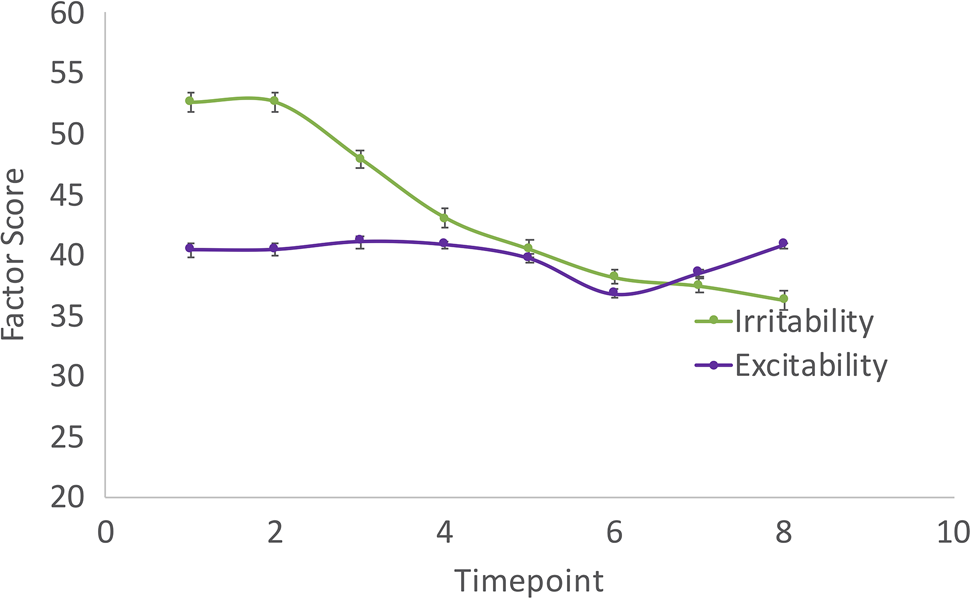
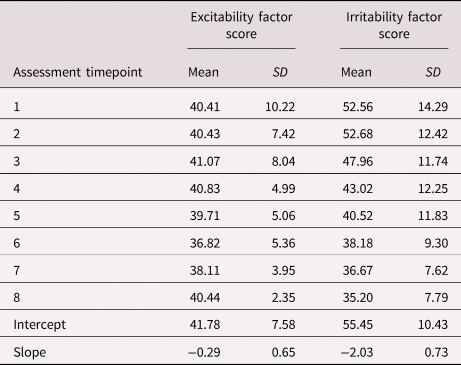
Generally, there was a high correlation between irritability and excitability factor scores, with the correlation between the mean excitability factor score across the time of the study and mean irritability factor score across the time of the study of 0.62 (p < .001), and correlations between irritability and excitability at any given timepoint ranging from a high of 0.63 (p < .001) at Timepoint 6 to a low of 0.292 (p = .017) at Timepoint 8. On average, the excitability factor score remained stable over the timeframe studied while the average irritability factor score declined over development (Figure 2 and Table 1).
Mean factor scores across childhood. Excitability and irritability factor scores for each timepoint of Preschool Age Psychiatric Assessment (PAPA)/ Childhood Age Psychiatric Assessment (CAPA) are plotted. Error bars represent standard error of the mean (SEM).
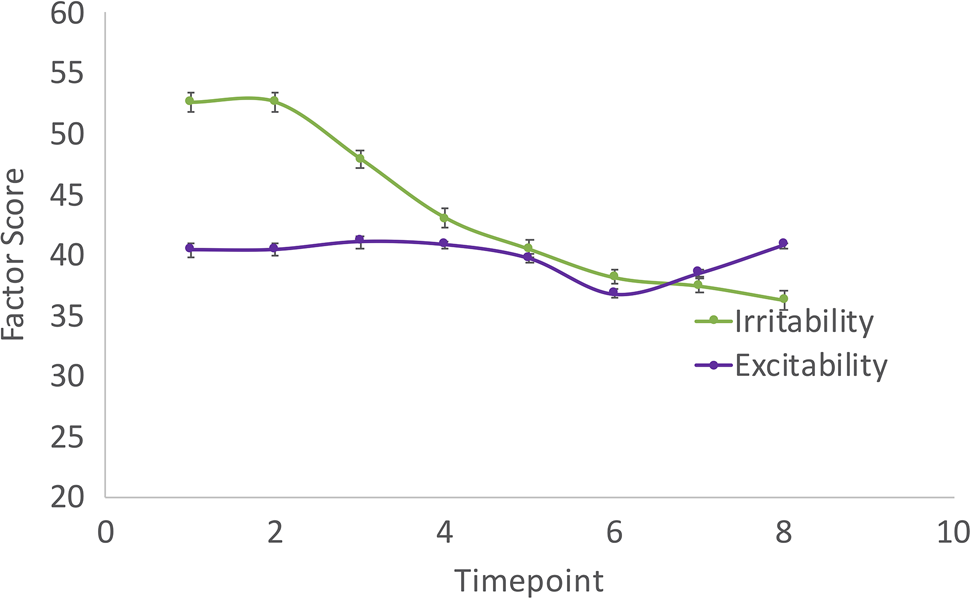
Mean excitability factor scores remain stable, while mean irritability factor scores decline across childhood. Mean and standard deviations of individual multilevel model intercepts, centered at age 4, and slopes of the linear model are also reported. SD = standard deviation
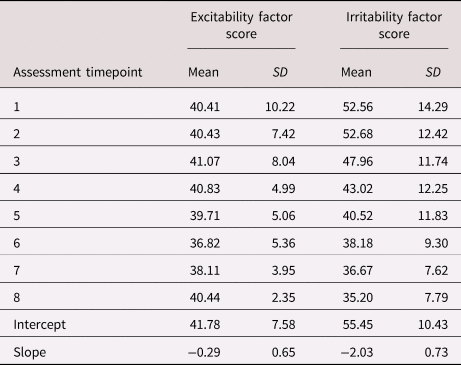
When multilevel models were used to assess the trajectory of the dysregulation factor scores over time for individuals, a similar pattern was seen with overall decline in irritability and stability in excitability. Importantly, random effects for all models demonstrated significant individual differences for excitability and irritability intercepts and slopes. The mean of individual intercepts at age 4 were similar to overall mean values early in development (Table 1). The slope or rate of change of excitability factor score over time for each participant was around zero, while all participants had a negative slope of irritability factor scores (Table 1).
Of note, there was an almost a perfect correlation between excitability intercept and slope (r = −1.00, and given there was almost no change in excitability across time, we focused solely on excitability intercept in subsequent analyses. In contrast, while there was a significant correlation between irritability intercept and slope (r = −0.76, p < .001) the relationship had more variability around the average slope than seen in excitability and both intercept and slope were included in subsequent analyses.
Excitability predicts later emotion dysregulation, symptoms of psychopathology and overall functioning, particularly in peer relationships
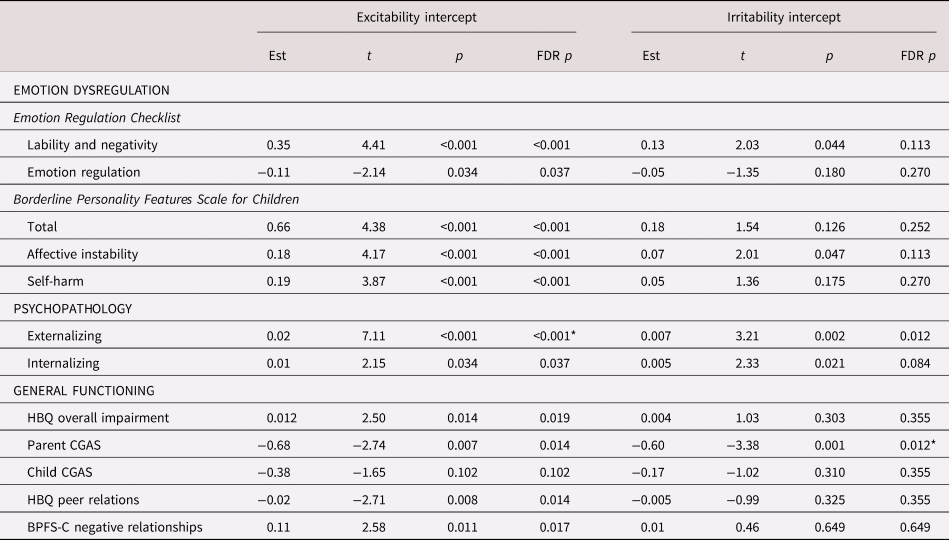
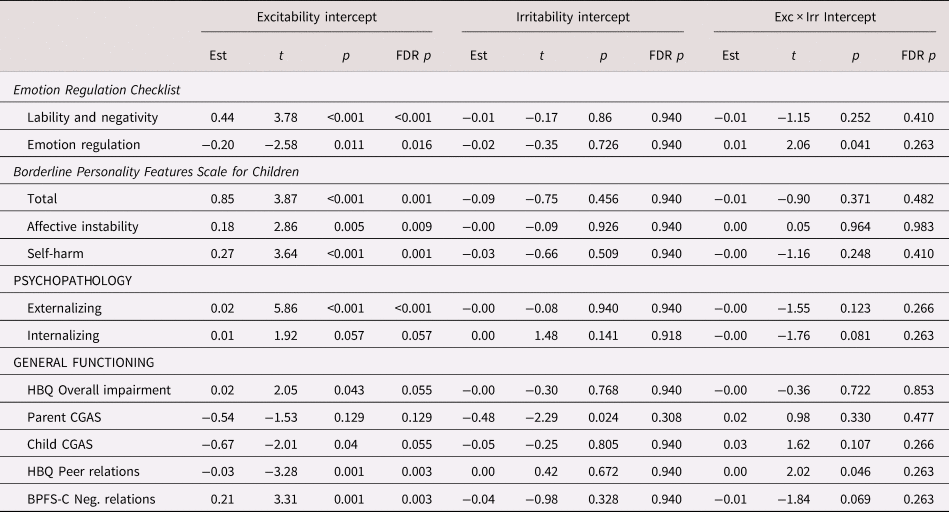
As shown in Table 2, when controlling for gender, ACES-Z, and concurrent (Timepoint 9) diagnosis of depression, greater values of the intercept of the excitability factor score predicted later (Timepoint 9) emotion dysregulation as measured by both parent report with higher Lability and Negativity scores and lower Emotion Regulation scores on the ERC. Greater excitability intercepts also predicted increased dysregulation as measured by the child-reported BPFS-C total score, as well as all subscales, including affective instability. Moreover, it predicted overall burden of psychiatric symptoms, predicting both Externalizing and Internalizing symptoms, as measured by the HBQ. Greater excitability intercepta also predicted greater functional impairment and worse parent-reported score, though did not significantly predict child-reported CGAS. Excitability intercept specifically predicted problems with peer relations as measured by the parent report on the HBQ and the negative relationships subscale of the child-reported BPFS-C.
General linear models predict T9 outcomes from the intercept of excitability factor scores and irritability factor scores. All models include gender, z-scored adverse childhood experiences (ACES-Z), and concurrent diagnosis (T9) of major depressive disorder (MDD)
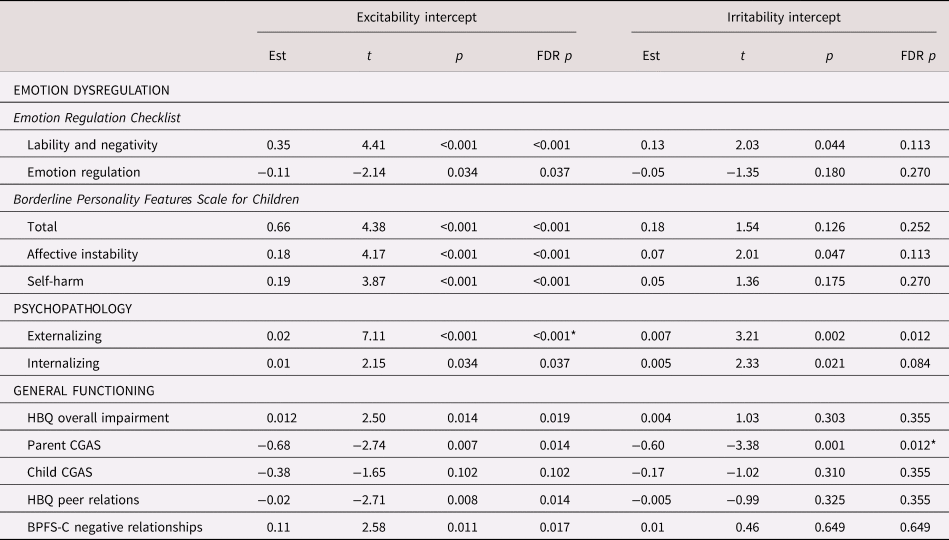
ACES-Z significantly predicted ERC lability/negativity and emotion regulation but no other outcomes once correcting for multiple comparisons. T9 MDD diagnosis significantly predicted ERC lability/negativity and emotion regulation, HBQ internalizing symptoms, functional impairment and global peer relationships, BPFS-C total, negative relationships and affective instability, parent and child CGAS score after correcting for multiple comparisons. Gender significantly predicted BPFS-C negative relationships, identity problems, and child CGAS score after correcting for multiple comparisons.
HBQ = Health and Behavior Questionnaire, CGAS = Child Global Assessment Scale, BPFS-C = Borderline Personality Features Scale for Children.
In contrast, when controlling for gender, ACES-Z, and concurrent (Timepoint 9) diagnosis of depression, the intercept of the irritability factor score predicted only externalizing symptoms, as measured by the HBQ and overall functioning as measured by the parent-reported CGAS after correcting for multiple comparisons. Interestingly, while there was more change in the slope of irritability than excitability across childhood, there was not a significant relationship between any of the emotion dysregulation, psychopathology or general functioning variables and the slope of the irritability factor score.
For those outcomes that were predicted by either excitability or irritability, we entered both predictors into the same model, along with the interaction of excitability and irritability, gender, ACES-Z and concurrent major depression diagnosis to determine if these had independent effects. As shown in Table 3, after correcting for multiple comparisons in this joint model only excitability predicted a number of key emotion regulation and social outcomes: (a) emotion dysregulation as measured by ERC Lability/Negativity scale; (b) emotion regulation as measured by ERC emotion regulation scale; (c) dysregulation as measured by the total score and affective instability subscale of the Borderline Personality Feature Scale for Children (BPFS-C); (d) self-harm as measured by the BPFS-C subscale; (e) externalizing psychopathology as measured by the HBQ; (f) peer relationships as measured by both the HBQ and BPFS-C negative relationships scale. In the combined model, irritability intercept did not significantly predict any outcomes. While we attempted to discern if there were any interactions between excitability and irritability in predicting later outcomes by including an interaction term in the model, none of these effects survived correction for multiple comparisons.
General linear models predict T9 outcomes from the intercept of excitability factor scores and irritability factor scores as well as their interaction. Models included gender, z-scored adverse childhood experiences, and T9 major depressive disorder (MDD) diagnosis
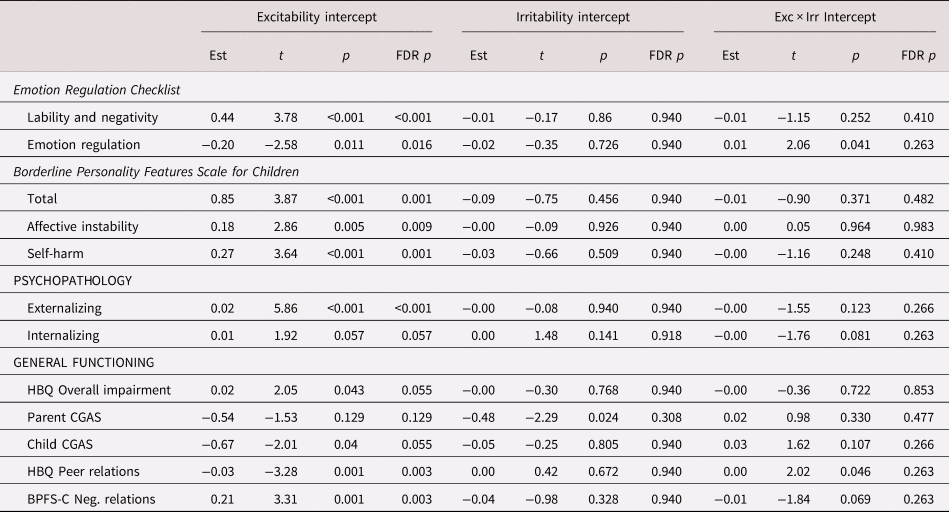
ACES-Z significantly predicted ERC lability/negativity, emotion regulation and BPFS-C negative relationshipsT9 MDD diagnosis significantly predicted ERC lability/negativity and emotion regulation, HBQ internalizing symptoms, functional impairment and global peer relationships, BPFS-C total, negative relationships and affective instability, parent and child CGAS score after correcting for multiple comparisons. Gender significantly predicted BPFS-C negative relationships, identity problems, and child CGAS score.
HBQ = Health and Behavior Questionnaire, CGAS = Child Global Assessment Scale, BPFS-C = Borderline Personality Features Scale for Children.
Excitability predicts lower neural activations during cognitive emotion reappraisal
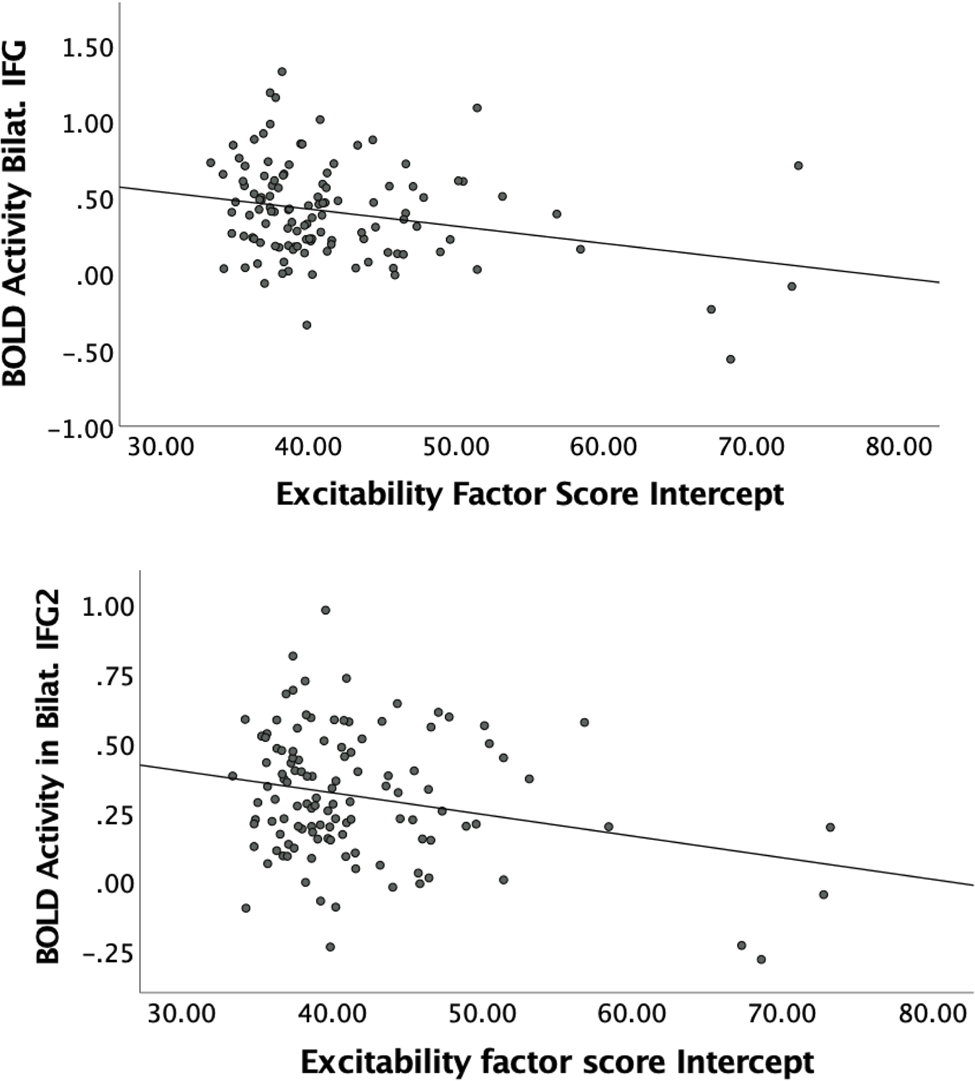
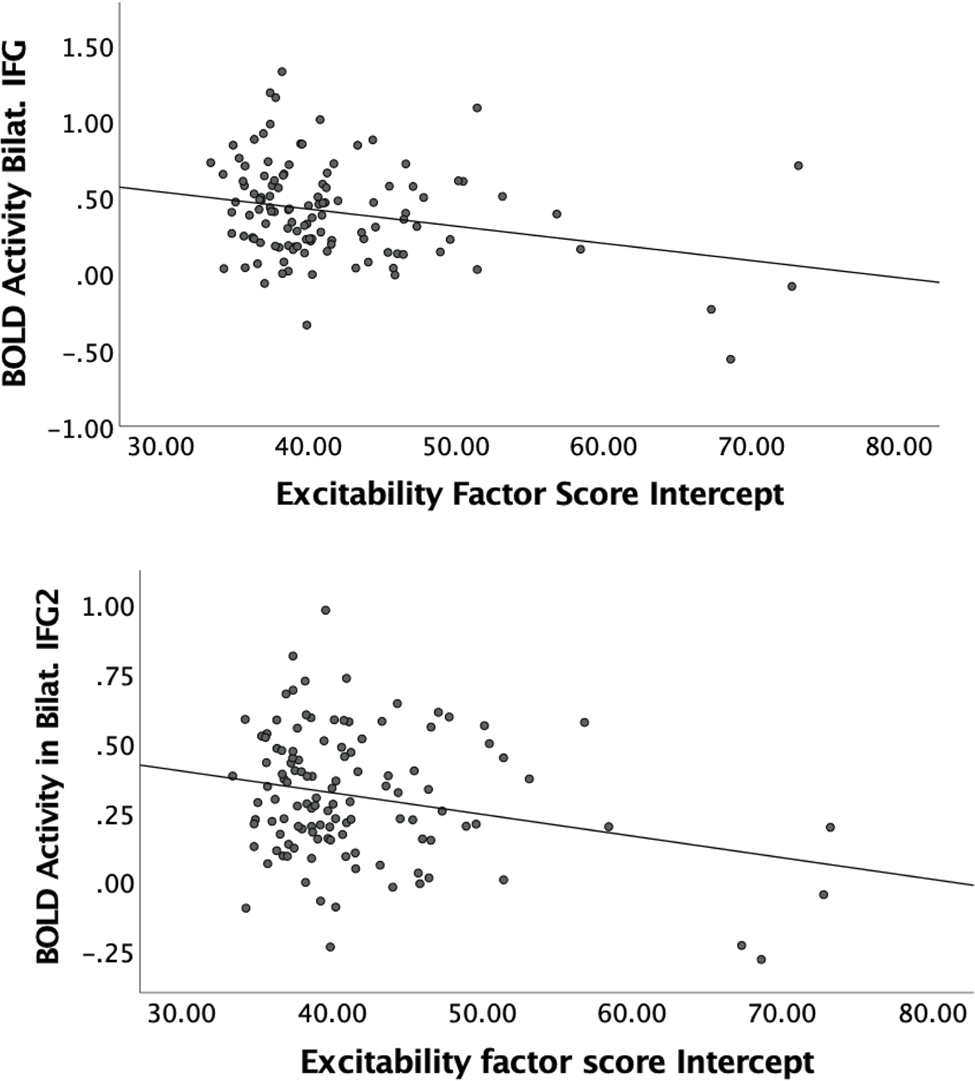
We assessed BOLD activation in regions previously noted to be used in active emotion regulation (Belden et al., Reference Belden, Pagliaccio, Murphy, Luby and Barch2015; Elsayed et al., Reference Elsayed, Vogel, Luby and Barch2021) when participants engage in cognitive reappraisal while undergoing fMRI. In our ROI based analysis there was a significant relationship between the overall level of excitability (intercept) and BOLD activity in bilateral IFG regions during reappraisal, when correcting for multiple comparisons (mean left and right IFG 1 [Minnesota Neurological Institute and Hospital, MNI, coordinates −50, 30, −10/50, 30, −10] adjusted r 2 = 0.059, F = 8.297, p FDR = .05; mean left and right IFG 2 [MNI coordinates −52, 22, −2/60, 26, 6] adjusted r 2 = 0.053, F = 7.600, p FDR = .05), Figure 3. The excitability intercept continued to predict BOLD activity in these inferior front gyrus regions during reappraisal even when controlling for overall ACES-Z and concurrent depression diagnosis (mean left and right IFG 1 from excitability factor score intercept, β = −0.228, t = −2.259, p = .026; IFG 2 from excitability factor score intercept β = −0.241, t = −2.359, p = .020). However, the two bilateral IFG regions were not predicted by the MLM intercept or slope of irritability after correcting for multiple comparisons (mean left and right IFG 1 adjusted r 2 = 0.043, F = 6.316, p = .013, p FDR = .17; mean left and right IFG 2 adjusted r 2 = 0.028, F = 4.317, p = .04, p FDR = .17). Table 2 in the Supplementary Material shows the relationship between MLM excitability intercept and BOLD activity in all predefined emotion regulation regions during cognitive reappraisal 10–14 years later. There were no significant relationships between irritability intercept or slope and BOLD activations in any ROI.
Excitability factor score intercept predicts blood oxygen level dependent (BOLD) activity in IFG. BOLD activity during cognitive emotion reappraisal in the two bilateral inferior frontal gyrus (IFG) regions involved in emotion regulation was predicted by excitability across childhood.
Discussion
Here we demonstrate the importance of considering dimensional domains of both positive and negative valence in the development of emotion dysregulation across childhood. We demonstrate separable developmental trajectories for dysregulation in positive affect (excitability) and dysregulation in negative affect (irritability). We also show how these trajectories predict later self- and parent-report of emotion dysregulation, multiple forms of psychopathology and overall impairment in late adolescence in a group of youth enriched for early affective psychopathology. Specifically, we demonstrated that overall excitability, a novel conceptualization of emotion dysregulation recently described in the literature, is more predictive of later emotion dysregulation and psychopathology than the more widely known construct of irritability. In addition, we show that excitability across development also predicts lower neural activations in regions involved in explicit emotion regulation during a cognitive reappraisal task. Together, these results demonstrate the importance of assessing not only irritability but also excitability in children with affective symptoms. While excitability is a relatively new construct not typically assessed in children with emotion dysregulation, our findings suggest that it is a relatively stable feature that is more predictive of ongoing emotion dysregulation, including neural correlates of dysregulation, symptoms of psychopathology, and both general and social impairment.
Assessing excitability is important in developmental psychopathology
There has been increasing focus on the study of irritability, a dimensional measure of predominantly negative affect that in the last 20 years has been found to be vitally important in understanding concurrent and later impairment (Brotman et al., Reference Brotman, Kircanski and Leibenluft2017). There is substantial evidence that children with elevated irritability are more likely to struggle with emotional and behavioral problems (Brotman et al., Reference Brotman, Schmajuk, Rich, Dickstein, Guyer, Costello and Leibenluft2006; Dougherty et al., Reference Dougherty, Smith, Bufferd, Carlson, Stringaris, Leibenluft and Klein2014, Reference Dougherty, Smith, Bufferd, Kessel, Carlson and Klein2016; Ezpeleta et al., Reference Ezpeleta, Granero, de la Osa, Trepat and Domènech2016; Stringaris & Goodman, Reference Stringaris and Goodman2009; Wakschlag et al., Reference Wakschlag, Perlman, Blair, Leibenluft, Briggs-Gowan and Pine2018; Whelan et al., Reference Whelan, Stringaris, Maughan and Barker2013). Further, findings also suggest that even increased irritability in the normative range can impair a child's functioning (Wakschlag et al., Reference Wakschlag, Estabrook, Petitclerc, Henry, Burns, Perlman and Briggs-Gowan2015). Yet as noted in the introduction, giving both positive and negative valence systems full consideration (Cuthbert & Insel, Reference Cuthbert and Insel2013), emotional dysregulation in positive as well as negative affect should be assessed.
To date, there has been much less focus on dysregulation of positive affect. Given that increased positive affect can be protective of certain forms of psychopathology such as depression (Sallquist et al., Reference Sallquist, Eisenberg, Spinrad, Reiser, Hofer, Zhou and Eggum2009) and anxiety (Silk et al., Reference Silk, Steinberg and Morris2003), it has left aside a group of children who are very impaired from emotion dysregulation but who are not chronically irritable. The few early childhood studies of increased positive affect have shown that it predicts externalizing symptoms and aggression (Deater-Deckard et al., Reference Deater-Deckard, Beekman, Wang, Kim, Petrill, Thompson and DeThorne2010; Putnam & Stifter, Reference Putnam and Stifter2002; Rydell et al., Reference Rydell, Berlin and Bohlin2003), and our own prior work using a data-driven analysis in early childhood demonstrated excitability was even more predictive of later emotion dysregulation, externalizing psychopathology and general impairment than irritability (Vogel et al., Reference Vogel, Jackson, Barch, Tillman and Luby2019). Here we expand upon our work on elevated positive affect in preschool and demonstrate that not only does early childhood excitability predict later outcomes, but excitability throughout childhood remains an important predictor of impairment. First, we showed excitability is relatively stable across development. In addition, we demonstrated directly that increased excitability across childhood (excitability factor score intercept) is an important predictor of impairment in emotion regulation, increased affective lability, increased symptoms of internalizing and externalizing psychopathology, global impairment, and impairment in relationships in adolescence as measured by both self and parent reports. Importantly, while there is a moderately high correlation between excitability and irritability, the impairment conferred by excitability across development is above and beyond the relationships attributed to irritability. These findings underscore the importance of studying dysregulation across both positive and negative affect to best understanding the development of emotion dysregulation and its role in the development of psychopathology.
Excitability is a stable across childhood, while irritability declines from early childhood through adolescence
Consistent with prior studies both in the same population (Pagliaccio et al., Reference Pagliaccio, Pine, Barch, Luby and Leibenluft2018) and others (Caprara et al., Reference Caprara, Paciello, Gerbino and Cugini2007; Hawes et al., Reference Hawes, Perlman, Byrd, Raine, Loeber and Pardini2016; Wiggins et al., Reference Wiggins, Mitchell, Stringaris and Leibenluft2014), irritability declined across childhood in this group of children enriched for early affective symptoms. There was a decline in average irritability, as the mean irritability factor score calculated at each timepoint declined across development. However, individuals’ irritability factor scores also declined across development, as the MLM estimated slopes of irritability factor score were all less than zero. In contrast, excitability was stable across childhood. Excitability was stable at the group level, with group mean excitability factor score showing little change between preschool and adolescence. Excitability also showed limited change in each individual, as there was little variation in the MLM estimated slope of excitability factor scores across individuals.
In early childhood assessments of emotion dysregulation, excitability emerged as particularly important. Irritability is known to have a normative decline across childhood, thus while elevated irritability in early childhood does predict later impairment, understanding which children will normatively decline and which will persist remains unclear. Given the stability of excitability across childhood, if a child has increased excitability in early childhood, it predicted persistent impairment. Thus, while there is a correlation between excitability and irritability, as excitability is a more stable characteristic in early childhood it may prove to be a more useful marker for early identification and targeted intervention. In addition, elevated excitability may indicate a more fundamental and nonnormative problem with emotion dysregulation rather than the developmentally appropriate impairment sometimes seen with irritability. In other words, elevated irritability in early development may indicate “bigger” negative emotions than can be handled by the developing regulation systems, perhaps an exaggeration of a normal developmental effect corresponding to the “terrible twos” and normative tantrums. However, having elevated excitability may be more indicative of a core mismatch between the size of a person's emotional response in both positive and negative directions and the ability of their regulatory system's ability to return the emotion to a more neutral baseline. This conceptualization would account for the correlation between excitability and irritability, as while there are a number of children that are high in both, our data suggest that variance in excitability has a stronger relationship to later emotion dysregulation and impairment.
Increased excitability is associated with impaired emotion regulation capacity and positive affect generation
As discussed in the introduction, emotional expressions consist of both “bottom-up” processes of emotion generation and “top-down” processes of emotion regulation (Etkin et al., Reference Etkin, Büchel and Gross2015; Sheppes et al., Reference Sheppes, Suri and Gross2015). The analyses here support a role for both, though emphasize the importance of “top-down” processes. Excitability factor score predicts lower scores on the emotion regulation subscale of the ERC, reflecting less efficacy utilizing emotion regulation strategies (Shields & Cicchetti, Reference Shields and Cicchetti1997). In addition, higher excitability factor scores predicted lower neural activations in the IFG, explicit emotion regulation regions (Belden et al., Reference Belden, Pagliaccio, Murphy, Luby and Barch2015; Diekhof et al., Reference Diekhof, Geier, Falkai and Gruber2011), during a cognitive emotion regulation task, which was not the case for irritability factor scores. Together, these findings indicate that youth high in excitability have less regulatory activation, even when consciously trying to regulate.
However, we cannot exclude a role for “bottom-up” neural processes in excitability. There is indirect evidence of a relationship between “bottom-up” emotion lability and excitability, as there is a significant relationship between excitability and ERC measured lability and negativity, a parent report measure of affective instability, as well as the BPFS-C affective instability subscale, a self-report measure of emotional lability. Unfortunately, due to the task design of the emotion regulation task, we were unable to assess for the difference in activations in response to positively and negatively valences images, where we would predict to see the separable impact of excitability and irritability on “emotion generation”.
Limitations and Future Directions
Given the nature of our study population, there are several limitations in interpreting our findings. Our understanding of how excitability impacts the development of psychopathology is limited to a clinically enriched population of children with early-onset affective and behavioral symptoms. We are uncertain if excitability has the same predictive ability in a general population or in a group of children without affective psychopathology. Assessing excitability in disruptive behavior disorders without depression as well as in a general population are important future directions to understand the overall impact of excitability.
Our analyses use excitability and irritability factors that were empirically defined in the preschool age period (Vogel et al., Reference Vogel, Jackson, Barch, Tillman and Luby2019). While all but two of the items in the excitability and irritability factors were assessed in both PAPA and CAPA, the lack of complete overlap limits our ability to assess measurement invariance across development. In addition, at older ages some items were very rarely or never endorsed, again limiting our ability to know that we are measuring excitability as effectively later in childhood. For the present analyses these limitations are outweighed by the benefits of using a data-driven approach to identifying excitability and irritability. However, improving the assessment of excitability across childhood is an essential future direction.
We have demonstrated that excitability predicts lower activations in regions involved in explicit emotion dysregulation of negative emotions. However, we were unable to assess how excitability specifically impact the regulation of positive emotions and if this differs from irritability, as positive images were not included in the emotion regulation task. In addition, while we have indirect evidence that excitability also impacts emotion generation, we were unable to assess this directly in this regulation task. Assessing the relationship between excitability and irritability with emotion generation in general as well as positive valence / reward specific neural regions will be important to understand the neural basis of emotion dysregulation.
Finally, we have provided evidence that excitability predicts later emotion dysregulation impairment and psychopathology. Therefore, assessing dysregulation in positive affect in the form of excitability is important in the evaluation of children with early-onset affective symptoms, to inform the prediction of future psychopathology and impairment. Further, a focus on excitability and its early modification may be a fruitful future direction for early intervention. Early interventions such as Parent×Child interaction therapy (McNeil & Hembree-Kigin, Reference McNeil and Hembree-Kigin2010) and more specifically Parent×Child interaction therapy emotion development, which focus more broadly on emotion dysregulation may help to target excitability (Luby, Barch, Whalen, Tillman, & Freedland, Reference Luby, Barch, Whalen, Tillman and Freedland2018). Other therapeutic modalities for older children such as dialectical behavioral therapy may also be useful approaches (Perepletchikova et al., Reference Perepletchikova, Nathanson, Axelrod, Merrill, Walker, Grossman and Walkup2017) to improve the functioning of children with high excitability.
Conclusions
We have previously demonstrated that dysregulation that includes positive affect, or excitability, is separable from dysregulation of negative affect, or irritability using data-driven analyses, and that early excitability predicts later impairment over and above irritability (Vogel et al., Reference Vogel, Jackson, Barch, Tillman and Luby2019). Here, we have extended these findings, demonstrating distinct developmental trajectories for excitability and irritability, where excitability is stable across childhood while irritability declines with age. We demonstrated that excitability across development predicts later emotion dysregulation, internalizing and externalizing psychopathology, global impairment and impairment in relationships, as well as having less neural activation in frontal regions involved in explicit emotion regulation during cognitive emotion reappraisal. Together, this reinforces the importance of assessing excitability (dysregulation that includes positive affect) as it appears to be a more stable and impactful predictor of impairment and psychopathology than irritability. Children with affective symptoms and high excitability may be targeted for intervention, and the effect of interventions designed to improve emotion regulation on excitability should be assessed.
Supplementary Material
The supplementary material for this article can be found at https://doi.org/10.1017/S0954579421000705
Acknowledgment
We would like to thank the children and families who have participated in the preschool depression study.
Funding Statement
Funding for this work was provided by The National Institute of Mental Health (NIMH; Grants R01 MH064769 to JL and MH090786 to JL and DB; Grant T32 MH100019 supported AV). The NIMH had no further role in the design and conduct of the study; collection, management, analysis, and interpretation of data; or preparation, review, or approval of the manuscript. Funding for AV was also provided by the George and Debra Couch Post-Doctoral Scholar Fund.
Conflicts of Interest
None.