

In the wake of the contested 2009 presidential elections in Iran, a popular consensus has taken shape among scholars, commentators, and Western government officials on the immense role in the Iranian economy of a single government organization: the Islamic Revolutionary Guards Corps (IRGC). Abbas Milani, for instance, states that the IRGC, an elite branch of the Islamic Republic's armed forces, is akin to a “military junta” and controls “minimally about 60 percent of the economy.”Footnote 1 Said Arjomand describes the situation as a “military-industrial-commercial complex” with the IRGC's “economic empire” at its commanding heights.Footnote 2 And at a speech in Riyadh in February 2010, U.S. Secretary of State Hillary Clinton expressed her government's belief that the IRGC was, “in effect, supplanting the government of Iran” and “moving toward a military dictatorship” with firm control over the economy.Footnote 3 In this view, often informed by scandals in the Iranian press, accusations by opposition elites, and boasts by former Guards members themselves, the IRGC's praetorian status in the country's postrevolutionary order has allowed it not only to consolidate its political position within the state but also to centralize the domestic economy under its charge. The relative institutional cohesiveness of the IRGC, compared to other state agents, is assumed to transfer to the economic sphere.Footnote 4
In contrast to this interpretation, which perceives the main tendency as centralization of economic control under a militarized state apparatus, the popular consensus among political elites within the Islamic Republic, no matter where they lie on the ideological spectrum, is that massive and rapid privatization of state-owned assets is needed as an economic panacea for the country's woes. ʿAli Khamenei, Iran's leader and supreme jurist, decreed in 2006 that 80 percent of the public sector should be privatized, declaring the effort a “kind of jihad.”Footnote 5 Since the pronouncement, Iran's government has claimed that this is precisely what is occurring. A glossy report for foreign investors, entitled The Business Year: Iran 2011, announced that Iran had “conducted one of the most effective and wide-ranging privatization efforts seen in the region in recent years.” In 2010 alone, it stated, more than 300 state-owned enterprises (SOEs), including petrochemical plants, banks, fuel refineries, airlines, insurance companies, automobile manufacturers, and agricultural conglomerates were either transferred out of state hands or promised by the official Iranian Privatization Organization to be transferred soon.Footnote 6
In December 2010, however, an Iranian parliamentary commission on privatization reported that, out of seventy billion USD worth of assets of SOEs divested since 2006, only 13.5 percent of the shares had gone to the private sector (defined as any firm or agent outside of the public, cooperative, or nongovernmental public sectors).Footnote 7 The remainder was transferred to what is often called the pseudo-state or parastatal sector: banks, military firms, state-linked investment and holding companies, endowed foundations, pension funds, and President Mahmoud Ahmadinejad's dividend program of “justice shares.” This report points to a process contradicting both of the assessments outlined previously. The Iranian economy has become neither centralized under the control of a single entity nor privatized in the normally understood sense of the term. A handful of Iranian economists have derided the outcome as “pseudo-privatization” rather than “real privatization.”Footnote 8 Yet, by the sheer scale of capital involved, an economic transformation has surely taken place. While scarcely a monopolization by any one actor, this process of pseudo-privatization raises critical questions for contemporary understandings of Iranian economy and society.
In this article, based on interviews conducted in Iran during 2009 and 2010, primary data from parliamentary and governmental reports, and secondary sources, I argue that while the IRGC's presence in economic activities is substantial, the existence of such activities in conjunction with those of other subcontractor firms, investment funds, and state-linked economic actors needs to be situated within a larger analytical field. Rather than a praetorian state with a cohesive institutionalized actor dominant in the economy, the Islamic Republic resembles a subcontractor state that has decentralized both its economic and its social responsibilities.
The article proceeds as follows. First, drawing from literature on privatization in the global South, I bring the “social” back in by highlighting the typically tenuous relationships between state elites, social pressure, and successful privatization outcomes. I then detail the process by which the fractious political elite of the Islamic Republic, whose formation was steeled in revolution and war, gradually developed a homogenous discourse of economic liberalization and privatization. Next, I assess the nature and degree of privatization in Iran, comparing programs of previous administrations with the more radical efforts of the Ahmadinejad government. I argue that protracted intraelite struggle after the Iran–Iraq War (1980–88) constrained the state's ability to sharply change the direction of economic policy. In addition, the state remained embedded within a variety of social groups with opposing interests, contributing to the inability to fully implement real privatization. In other words, to understand Iran's political economy, we need to look at how “the social” has operated as a check on maneuvers by the political elite. The economic prominence of the IRGC and parastatal organizations is not a sign of their militaristic takeover of the state. Like the state itself, these organizations are constrained by 1) the legacy of a decaying, war-forged social compact that promised a wide array of welfare benefits to citizens in various social classes and status groups and 2) political infighting between elites who use economic policy as a battleground for factional struggles.
Finally, I reframe Iran's economic transformation by utilizing three ideal types of capitalist development in middle-income countries in eastern Europe and East Asia: capitalism from without, from below, and from above. Successive periods of Iran's postwar history (1989–present) roughly correspond to each of these ideal types. The rise of the subcontractor state, I contend, should not be confused with the logic of militarism. Instead, the subcontractor state is an outcome of the way in which politics and society shaped the form of capitalism that has taken root in the Islamic Republic.
PARADOXES OF PRIVATIZATION IN THE GLOBAL SOUTH
Much commentary in Iran, as in other low- and middle-income countries, tends to attribute the many distortions, failures, and unintended consequences of economic liberalization to the persistence of state intervention in the market. Yet a central paradox of economic liberalization in the late 20th century, especially when such reforms were perceived to have succeeded, was that the reduction or elimination of statist policies involved the intervention of the state.Footnote 9 The “myth of the market” is that economies operate free of state institutions. In reality, processes of commodification and marketization demand a robust state with high regulatory capacity, which Michael Mann identifies as “infrastructural power.”Footnote 10 Scholars such as Kiren Chaudhry forcefully argue that competitive markets are not simply created by “smashing” the state but rather that “the instruments of the state must be redeployed to perform the much more difficult task of indirect regulation and administration.”Footnote 11 In other words, successful privatization of SOEs, often built up during years of import-substitution industrialization conducted in tandem with state formation itself, requires a state capable of initiating and carrying through such a major transformation. The paradox of privatization is that, as Haggard and Kaufman contend, “for governments to reduce their role in the economy and expand the play of market forces, the state itself must be strengthened.”Footnote 12
Successful privatization needs high state capacity. But perceptibly “strong” states do not always privatize, even if privatization is desired by policymakers, since elites can block policy change from within or without the government. Scholars of economic policy have identified the presence of “relatively autonomous” technocratic organizations within the state, or “insulated change teams,” as a key variable of success.Footnote 13 The concept of relative autonomy, though, has traveled a long theoretical distance. Originating in Marxian debates over whether states could be independent of capitalist elites, later usage of “autonomy” within development studies shifted toward a Weberian framework to analyze whether states could be sufficiently independent of social pressure to carry out structural transformations in the economy.Footnote 14 For example, SOE privatization usually requires state autonomy from public sector groups such as workers, often through dismantling or overcoming former corporatist linkages with labor.Footnote 15 The responses of domestic business elites to state efforts at liberalization can also depend on how state–business relations have been previously structured during eras of high tariffs, infant industries, and other protectionist policies.Footnote 16 In sum, to act autonomously in relation to powerful social actors, including state and business elites, that could lay claim to public assets, governments need to carve institutions out of the state apparatus that are unconstrained by such linkages. Explaining well-managed privatization via such autonomous state organizations therefore entails an examination of the social and political context in which opportunities to transfer public goods into private hands may emerge.Footnote 17
Moreover, the social function of SOEs can vary widely. As Chang and Grabel write, “Often SOEs are charged with serving too many objectives (e.g., social goals, industrialization, and the provision of basic services), and the relative importance of each goal is unclear.”Footnote 18 One might expect such overloaded SOEs particularly in states that depend heavily on natural resource commodity exports for government revenue, especially when trade-offs between capital accumulation and social distribution are not sharply demarcated. For instance, under the administration of President Hugo Chavez, Petroleos de Venezeula, S.A., the national oil company of Venezuela, renegotiated contracts with private domestic and international actors and expanded direct expenditures on new social services for the urban and rural poor. This was a shift away from the company's strategy in the 1990s to fashion itself a multinational corporation operating in global markets. Critics argued that the incorporation of expanded social objectives could harm the company's firm-level investment opportunities.Footnote 19 However, as Steffen Hertog has shown, Gulf states have produced profitable SOEs in lieu of substantial privatization. In the United Arab Emirates, Saudi Arabia, and Qatar, this was an outcome of “decades of nonpolitics”—an absence of social pressure from below, which allowed for extensive state autonomy in economic policy making. Populist measures, in these Gulf cases, were not required for successful state-building projects. SOEs were relieved both from pressures of bureaucratic predation and expectations of redistribution. Firms’ management could be directed and incentivized toward rationalized market calculations, forming small “islands of efficiency.”Footnote 20 As a result of historically contingent political and social formations, such as a relatively small citizenry and a large migrant working class, such states developed “embedded autonomy” in relation to themselves. The “resource curse” of state capture and patrimonial linkage, often attributed to easy access to natural resources, is likely due more to politics than petroleum.Footnote 21
In Iran, politics also determined how, to whom, and over what networks economic resources flowed during the process of restructuring domestic firms and markets. State formation after 1979 was embedded within and constrained by an array of social actors. To understand why, we first need to place Iran's seemingly haphazard economic policies within the political drama of revolution, war, and postwar reconstruction. Throughout the entire postrevolutionary period, a factionalized and fractious state elite prevented the coalescing of a unified apparatus that could fully apply the technocratic blade to the public sector. The flux of competition among political entrepreneurs, electoral and otherwise, relied upon popular mobilizations of a variety of social bases and status groups. At times, intraelite conflict provided opportunities for market activity by domestic private sector actors, as in the banking industry in the early 2000s. In subsequent years, though, state transfer of public sector companies was mostly channeled toward organizations whose member constituencies had been produced alongside the state itself, whether large pension funds for the formal labor force, “justice share” cooperatives for “revolutionary” status groups, or the military's growing network of subcontractors that provided avenues for upward status mobility among war veterans. While states that construct autonomy from protected elites and other powerful social actors are best poised to carry out “real privatization,” Iran's postrevolutionary trajectory embedded the state deeply within the domestic social arena. The result has been the rise of the subcontractor state.
NATIONALIZATION BY NECESSITY
Article 44 of the Iranian constitution, the legal basis for SOE privatization since its amendment in 2004, has a remarkable history. According to ʿIzzatullah Sahabi, a member of Khomeini's 1979 Revolutionary Council, it was placed into the second draft of the constitution by ayatollahs Bihishti and Alviri and Hujjat al-Islam Bahunar and approved by popular referendum in October of that year.Footnote 22 Originally, Article 44 stated:
The state sector is to include all large-scale and mother industries [i.e., large downstream oil and gas production], foreign trade, major mines, banking, insurance, power generation, dams and large-scale irrigation networks, radio and television, post, telegraph and telephone services, aviation, shipping, roads, railroads and the like; all these will be publicly owned and at the disposal of the state. The cooperative sector is to include cooperative companies and institutions involved in production and distribution that are established in urban and rural areas in accordance with Islamic precepts. The private sector consists of agriculture, animal husbandry, industry, trade, and services that supplement the economic activities of the state and cooperative sectors.Footnote 23
The spirit of Article 44 was partly a move to bolster the left-leaning credentials of the Khomeini-led state and partly a recognition of the circumstantial nationalization that had already taken place amid revolutionary collapse. In 1979, year one of the revolution, a segment of Islamic liberals backing provisional government head Mihdi Bazargan was content with keeping a large private sector intact in order to ensure continued domestic investment. Bihishti, however, was more concerned with the success of Khomeinist forces. Secular leftist groups in the 1979 revolutionary coalition insistently called for nationalization of major industry as part of a socialist transformation of Iran and possessed a formidable social base that competed with Khomeini loyalists. As Khomeini's “lieutenant,” not to mention a political genius in the mold of Trotsky, Bihishti moved to outflank the leftist competition through the use of language such as that in Article 44. In reality, most of the antipathy toward the private sector by the revolutionaries remained directed at those elite families connected with the old regime or Western-linked capital. The new state, therefore, did not expropriate all factory owners and landholders but ended up in control of the economy mostly by exigency rather than plan.
After war with Iraq began in late 1980, state control over production and distribution was strengthened. Bazargan's original intentions for boosting the private sector were sidelined. This stemmed, however, more from need than ideology. By the fall of 1981, Khomeini loyalists had occupied the state's commanding heights, and a new five-year plan was drafted to commence in 1983. The plan stressed common Third Worldist pieties such as self-sufficiency in production and unshackling the Iranian economy from the “dependent development” of the shah's rule. In reality, the document was merely a codification of the war economy. Its lofty goals were never implemented due to the country's ad hoc governance.Footnote 24 As the public sector expanded in the war economy, parastatal organizations that had initially formed as Khomeinist auxiliaries during the postrevolutionary struggle—the IRGC, the volunteer basīj militia, the rural development agency Construction Jihad, and the welfare organization Imam Khomeini Relief Committee—became crucial to operations both on and off the front lines. These included not only military logistics, supply transport, and recruitment efforts but also employment and welfare provision. As Kaveh Ehsani notes, “Public sector employment more than doubled after the revolution, from 1.7 million in 1976 to 3.5 million in 1986. According to one estimate, within three years of the revolution, one in six Iranians above the age of fifteen belonged to one state and revolutionary body or another.”Footnote 25
Even during the war, however, the private sector employed the majority of the labor force in agriculture, services, and small-scale manufacturing. Such private sector activities often competed in the economy with newly formed state-sponsored cooperatives and revolutionary organizations.Footnote 26 After a recession induced by the oil slump in 1986, the government gradually shifted some activities in trade and commerce, especially nonoil exports, to private hands, effectively utilizing the robust black market in order to meet consumption needs during the crisis years of the war. Capitalists outside of such preferential networks invested in the most available and inflation-protected assets: real estate and construction. Again, however, this process was facilitated by the state, which freed up urban land for use and made housing loans with low fixed interest rates easily procurable. As the economist Kamal Athari has noted, the housing sector has always been the backbone of private sector development in Iran. From 1980 to 1986, even as war and political uncertainty upended other economic sectors, there was a housing boom in urban areas.Footnote 27
Meanwhile, latent ideological differences were emerging within the new political elite. A self-described “radical” faction, with members such as Prime Minister Mir Husayn Musavi, Bihzad Nabavi, and Ayatullah Muhammad Musavi Khuʾiniha, pushed for more statist intervention: taxes on commerce and income, labor regulation, land redistribution, import substitution, and increased scrutiny of private property.Footnote 28 In reality, the postrevolutionary economic debate between prominent elites in the 1980s never questioned the sanctity of private property per se but rather concerned the suitable balance of state and market. The radicals’ measures, passed in the parliament, were doggedly rejected by a conservative faction based in the Guardian Council, a de facto House of (clerical) Lords enshrined in the 1979 constitution with veto power. Khomeini frequently sided with the populist radicals until his death in 1989, though little coherent economic policy emerged from the intraelite strife during his tenure as leader and supreme jurist.
THE LIMITS OF LIBERALIZATION
After the war ended in 1988, a “third way” faction coalesced under President Akbar Hashemi-Rafsanjani (r. 1989–97) whose members self-identified as pragmatists or “constructionists.” This faction was the first to broach the issue of SOE privatization in the public sphere. Politically, Rafsanjani saw himself as an updated version of the modernizing 19th-century Qajar bureaucrat Amir Kabir, whose biography he had written as a young cleric in the 1960s. The technocrats Rafsanjani brought into his government publicly ridiculed the visible lack of scientific knowledge and economic expertise during the war years. Masʾud Nili, an economist at the Planning and Budget Organization during the late 1980s and a main author of Rafsanjani's first Five-Year Plan (1989/90–1993/94), boasted that during this period, Islamic leftists and radicals believed in a dirigiste economy, and Islamic conservatives believed in a “traditional” market economy (commerce and trade through mercantile networks with a night-watchman state), while a new self-described “expert” faction under Rafsanjani recognized that a “modern” and competitive market economy was the correct path for the country.Footnote 29 Technocratic expertise was to supplant revolutionary fervor.
Rafsanjani's first Five-Year Plan aimed to reduce state control in the economy, marketize the distribution of consumer goods, borrow capital on international financial markets, and reform the country's multi-tiered currency exchange rates. It was bitterly attacked by the radicals—solidly entrenched in parliament in the late 1980s with Mihdi Karubi as speaker—in print media such as Salam and Bayan. They accused the government of capitulating to Western capitalism, favoring industry over agriculture, and relying on foreign debt. Stung by his critics, Rafsanjani repudiated the claims, asserting that his plan was for a “mixed, Islamic economy.”Footnote 30 Yet Rafsanjani and his aides then strategically allied with conservatives in the Guardian Council to disqualify members of the radical faction from running in the 1992 parliamentary elections. The Khomeinist “left” was effectively purged from the political field, and Rafsanjani was compared to Gorbachev and de Klerk in the international media. Iran's “perestroika,” however, was short lived; a balance of payments crisis ensued due to an oil price collapse in 1993 and 1994, unemployment and inflation reached untenable levels, and protests broke out in several major Iranian cities. Rafsanjani reluctantly backed off from his reforms.
The political infighting of the early 1990s affected the SOE privatization process. Out of 770 public companies, the government identified 391 that could be privatized according to the constitutional language of Article 44. In practice, SOE sales became protracted and mostly occurred through direct negotiations with interested buyers instead of through public auctions. As privatization proceeded, critics from both the left and right claimed it was riddled with corruption and that it effectively handed over the state to a new and undeserving āqāzādih—the “sons of the elite.” In interviews with business actors who possessed decades of private sector experience during 2009 and 2010, I inquired about this early privatization effort in the Islamic Republic. Several respondents provided anecdotal evidence that many companies were known to be loss making. Skittish private capital was not convinced of the government's promise of secure and profitable investment outlets. Indeed, in 1994, parliament, now controlled by conservatives, prohibited government sale of SOEs through negotiated transfers. Instead, transaction houses were created to preferentially sell companies’ shares to large endowed foundations (bunyādhā) whose beneficiaries included war veterans, families of martyrs, basīj members, and other “devotees” of the revolution.Footnote 31 The parliament's move blocked the transfer of SOEs to private entities and established an early precedent of “pseudo-privatization” into the hands of these and other parastatal entities.Footnote 32 By one calculation, of the 331 companies that were fully or partially transferred under the name of privatization between 1989 and 1994, half of the shares went to parastatal organizations.Footnote 33 The remaining SOEs were told to become self-sufficient in their operation costs, but hard budgets were rarely enforced by the state due to these companies’ social function as large employers and their easy access to preferential foreign exchange rates.
As the Rafsanjani administration grappled with the conservative-majority fourth parliament (1992–96), radicals such as Khuʾiniha and Karubi slowly moderated their views and eventually declared themselves as “reformist” politicians. The transformation of most of the Khomeinist left to political liberalism has received much scholarly attention, but their gradual acceptance of economic liberalism is less noticed. One reason is that Muhammad Khatami, Iran's minister of culture from 1982 to 1992, did not offer much of an economic plan during his 1997 presidential campaign. Once elected, he proposed an economic reorganization plan in 1998 and then the third Five-Year Development Plan (2000–2005). While also emphasizing the goal of a universal social welfare system, the plans continued earlier efforts at economic liberalization—which was not surprising since most of Khatami's economic team was retained from the Rafsanjani administration.Footnote 34 By no means did the reformists entirely recant their earlier stances on economic policy, since many of them continued to lambast Rafsanjani's approach well after the election of Khatami. Nevertheless, the ideological shift was underway. Leftists gingerly moved toward economic liberalism, while economic liberals appealed for political reforms. As Nili recalled in 2002, “The [plan] managers that had statist economic orientations are today implementing plans oriented towards a modern competitive economy and support of the private sector.”Footnote 35
This was a practical marriage of political convenience, however, not a necessary outcome of Iran's postrevolutionary development. Reformist elites publicly rethought their precepts of the revolution but mostly in the realm of politics, not economics. Stressing concepts of civil society and a deideologization of the public sphere, the movement found a popular champion in Khatami, who seemed to promise an Islamic Republic with a human face. The reformists who did accept Rafsanjani's project of economic modernization attempted to reverse his top-down approach, arguing that it could only come to pass once political modernization had begun. The most significant economic successes achieved in Khatami's administration, after years of foot-dragging from the conservative-controlled Guardian Council, were the 2002 unification of tiered exchange rates and a floating peg of the Iranian rial to the dollar. Yet economists close to Rafsanjani had first suggested this reform in the late 1980s, signaling how slowly the state machinery of the Islamic Republic has operated when it comes to economic liberalization.
PRIVATE SECTOR GROWTH WITHOUT PRIVATIZATION
In the late 1990s, a curious process began that economist and former MP Ahmad Maydari called “private sector growth without privatization.”Footnote 36 As mentioned, private capital never fully disappeared in postrevolutionary Iran. Some Pahlavi-era industrialists and merchants, looking for new opportunities, reinvested their capital in the country. Others, such as mid-level bureaucrats and provincial figures, amassed small fortunes during the 1980s via land grabs in an unsettled legal environment.Footnote 37Bāzārīs who lacked political clout to obtain coveted import licenses or foreign currency allotments turned to speculation in black and grey markets.Footnote 38 Beginning in the early 1990s, Tehran mayor Ghulamhusayn Karbaschi (r. 1989–98) encouraged speculative capital to further move into housing and commercial construction projects, extracting “fees and taxes from merchants and developers in exchange for exemption from zoning laws and protection from political pressure.” Private investment in the city's construction sector from 1987 to 1997 increased by a factor of fifteen, funding Tehran's “growth machine” as the capital's high-rise skyline and ringed highways took the shape recognized today.Footnote 39
Private capital soon found another outlet. Facing a staunchly conservative Guardian Council that eagerly vetoed down any reform too far reaching, Khatami's administration was well aware of the political limitations on privatization, Rafsanjani-style. As an alternative, the government began to grant licenses for establishing private companies in sectors where these were justifiable under Article 44's language. In 2009, one Tehran-based small-business owner told me that the best year for “entrepreneurs” over the past two decades in Iran was “definitely the second year of the Khatami government [1998–99].” First occurring in banking and insurance, licenses were later extended to the subsidiary oil, power plant, construction, airlines, telecommunications, and postal sectors. As a result, new enterprises emerged and flourished in sectors formerly dominated by quasi-monopolies. For example, in the 1990s, only a few SOEs produced all industrial dairy products in Iran. By the late 2000s, over twenty private companies were active in the field along with the original SOEs. Instead of transferring public monopolies to private hands, Khatami's government allowed the private sector to compete with public and parastatal firms for market share. In fields such as banking, this competition generated consumer-friendly innovations such as electronic accounts, internet banking, and ATMs, all of which state banks eventually adopted.
Banking exemplified Iran's rising private sector during this period.Footnote 40 In 1999, three of Tehran's housing construction magnates formed the Housing Credit Institution, which was allowed to provide housing and auto loans only. To attract middle-class household savings, it paid higher interest than state banks, advertising with the slogan “two percent more.” Also in 1999, a former Tehran stock market manager, a Central Bank official, and several Pahlavi-era textile and plastics industrialists founded Saman Credit Institution with a start-up capital of 1.1 billion tomans. In 2001, it became Saman Bank with a capital stock of twenty billion tomans. By the late 2000s, Saman was valued at 300 billion tomans (about $300 million USD), with large public pension funds in the steel and copper sectors as major shareholders. One of Saman's founders stated that two changes had made its growth possible: consumer credit for goods such as autos, appliances, and computers; and innovations in electronic banking services. A former industrialist with good relations to the Ministry of Industry founded Karafarin Bank, whose other investors included top members of SOE conglomerates. Parsiyan Bank, whose advert campaigns lavishly recalled ancient Persepolitan friezes, grew out of the investment arm of automobile SOE Iran Khudraw. Parsiyan soon became the country's third largest bank and the largest listed on the Tehran stock exchange.Footnote 41 As a final example, the major shareholders of Iqtisad-i Nuvin Bank, which advertised itself as “Iran's first private bank,” had been active in light industry and construction.
By 2009, with only 4.7 percent of Iran's branches, private banks held 34 percent of the country's total long-term deposits and 25 percent of its short-term deposits.Footnote 42 As the stories of these banks illustrate, private sector growth without privatization during the Khatami era did not arise from a vacuum. Instead, a particular form of capitalist development, in which private entities coexisted with public ones, emerged out of organizational networks linked to previous state-building efforts in the industrial sector as well as networks of diaspora and domestic capital. This would not have been possible if the private sector had been completely wiped out after the revolution. Furthermore, just as nationalization during the war years was a mostly ad hoc response to political exigencies and elite factional competition, this new growth in the private sector emerged out of a makeshift solution to constraints imposed by intraelite political strife during the 1990s.
Khatami's administration did attempt to push ahead on SOE privatization without breaching Article 44. The Third Development Plan (2000–2005) stipulated that public ownership would be broken up except where “the state has a natural monopoly.” A government commission indicated that only 128 out of 724 firms needed to remain state owned; in addition, it recommended that more than 1,000 parastatal companies be privatized, including those controlled by large foundations and related institutions.Footnote 43 But the Guardian Council loudly attacked Khatami's plan as antithetical to Article 44's nationalist spirit, partly echoing (without crediting) the former radicals’ earlier critique of Rafsanjani's liberalization agenda. In 2004, however, the Rafsanjani-chaired Expediency Council released a long-awaited and binding interpretation of Article 44 that clearly supported the Khatami administration.Footnote 44 The ruling disallowed further protest by the Guardian Council, amending Article 44 to oblige the government to divest from majority control in heavy industry, downstream oil and gas refineries, mining, power generation, banking, aviation, shipping, insurance, infrastructure, and telecommunications sectors. By then, however, Khatami's second term was nearing its end, and conservative intransigence in other state branches limited implementation of his administration's privatization goals.
In short, while discussed far less than the debate over democratic pluralism in the Islamic Republic, much of Iran's political elite has undergone an ideological transformation on economic matters. Yet this shift in thought is not unique. In Iran, as in other middle-income countries in the 1980s and 1990s, privatizing the assets of an ossified, semi-authoritarian state was perceived as a radical position. It was not surprising then that many of the left-leaning Khomeinist elites found themselves, twenty years after the 1979 revolution, extolling the state-tempering properties of market discipline. Only one faction remained outside the consensus on privatization: the conservatives. While during the 1980s, they took a relatively laissez-faire position on private ownership, conservatives had never presented private sector growth as the main pathway for developmental success. Furthermore, conservatives stood to lose if SOE privatization reordered the elite and brought in newcomers as potential challengers. They were unwilling to cede the commanding heights of the Iranian economy in an uncertain political climate where new and unknown owners were feared. As Muhammad-Riza Bahunar, a high ranking conservative MP, bluntly stated, “Article 44 of the constitution was the place for the disputes between left and right groups within the country's political system that had begun during the government of the Sacred Defense [Iran–Iraq War] and continued for twenty years.”Footnote 45 After the election of Mahmoud Ahmadinejad, however, the conservatives’ stance on the issue shifted significantly.
PARASTATAL SECTOR GROWTH THROUGH PSEUDO-PRIVATIZATION
As neither a septuagenarian nor a member of the ʿulamaʾ, Ahmadinejad was not Iran's average conservative. Running on a platform of pious competence, his image as an educated, technocratic engineer was strategically cultivated to resonate with Iranians tired of a seemingly useless state apparatus. To his advantage was an apathetic Brezhnevian air surrounding the reformist movement, which had descended into infighting once conservative obstruction stalled Khatami's sociopolitical agenda. Ahmadinejad's allies deftly took advantage of the stalemate between reformists and the old conservative faction, calling themselves, at first, “developers” and then also “principlists.” The latter term originated during the 1990s as an emblematic counterpoint to reformists, who conservatives argued had diluted revolutionary principles. Campaign slogans cleverly injected symbols of Iranian nationalism into the visage of a proletarian-cum-statesman. Ahmadinejad and his circle countered the reformists’ faded discourse of civil society and political pluralism with a rehashed critique of the perceived corruption of Rafsanjani—who was running for president yet again—and a vague promise of income redistribution. Old-guard conservatives looked on warily. Yet they also envied Ahmadinejad's plebiscitary success and so hitched their wagon to his rising political clout.
After his 2005 second-round electoral victory against Rafsanjani, Ahmadinejad did what most good politicians do: he stole his opponents’ ideas. SOE privatization was to move forward, he announced, but with the benefits distributed to the people via a program entitled “Justice Shares.” This plan sounded oddly similar to the 2005 presidential campaign manifesto of Rafsanjani, which proposed that every Iranian family would receive stock shares of divested companies. Private sector boosters—including the Iranian Chamber of Commerce, Industry, and Mines and the Tehran Stock Exchange—had imagined that “popular” share divestment would dilute and diversify stock ownership, thereby increasing the demand for further privatization.Footnote 46 Supreme Jurist ʿAli Khamenei's intervention and public support for privatization, in a May 2005 announcement and a July 2006 executive order, provided a legitimating push against conservative holdouts. With the Leader's blessing, no one could claim privatization belonged solely to a reformist agenda. Ahmadinejad, however, put his own spin on the plan. Article 44's revision under the previous president's watch mandated that the state sell or transfer majority ownership to all nongovernmental sectors, defined as “private, cooperative, and non-government public sectors.” The last category is the legal definition of most of the parastatal sector and includes public pension funds, military contractors, and endowed foundations not under the purview of the national budget.
Ahmadinejad followed the article's new language to the letter. The Justice Share program created a system of provincial committees that oversaw the formation and administration of investment cooperatives for these shares. By using cooperatives, another institutional layer was added between the private and public sectors. Originally, it was announced that the lowest two income deciles of the population—about thirteen million people—would be given justice shares, at half the share's face value, payable over ten years. The third to sixth income deciles would be permitted to purchase justice shares at full price, also payable over ten years. Justice Share dividend payments would allow individuals to eventually pay back share ownership costs. Investment cooperatives could exercise their new power as minority shareholders in divested companies, but government bodies were barred from appointing new company and cooperative managers.Footnote 47 During implementation of the program, however, various status groups in addition to income clusters received shares: low-income villagers and nomads (seventeen million shares), public sector retirees (thirteen million), beneficiaries of the Imam Khomeini Relief Committee and other welfare organizations (8.5 million), families with martyr status (1.3 million), seminary students and clergy (178,000), and, curiously, over 15,000 journalists. Other groups announced to be eligible soon were carpet weavers, Qurʾanic scholars, young addicts in treatment, construction workers without labor contracts, and bus and taxi drivers.Footnote 48
These status groups were not chosen randomly. They represent already existing categories of beneficiaries within the fragmented yet broad Iranian welfare system that developed after the 1979 revolution. By 2009, the government stated that forty-one million people—over half of the population—had applied for and received justice shares. The Central Board of Justice Share Distribution includes the president and several key ministers as well as the head of the Martyrs and Veterans Affairs Foundation, the commander of basīj forces, and the head of the Imam Khomeini Relief Committee. The private sector was kept out of the loop.
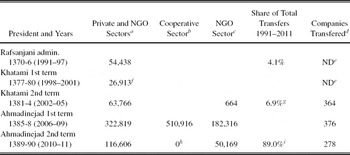
Ahmadinejad's push for privatization from 2006 onward allowed his government to brand its efforts as “performance execution” of the sort earlier administrations failed to enact. Privatization was hardly a secret; rather, it formed a strategic component of the president's public relations campaign against his critics. While reformist elites had been effectively sidelined from most state institutions after 2005, preventing the exercise of countervailing force against such policies, left-liberal opposition was also defanged because there was no effective ideological argument remaining in their arsenal. In late 2009, Iranian Privatization Organization (IPO) head Ghulamriza Haydari Kurd-Zanganih announced that the government had divested 800,000 billion rials (around eighty billion USD) and more than 370 companies. This huge divestment, far larger (in real terms) than the amounts divested during both the Rafsanjani and Khatami administrations combined, took three main forms. First, SOEs were sold through the Tehran Stock Market, public auction, or negotiation. Private-sector firms, including private banks and investment companies, as well as the “nongovernmental” parastatal sector have been active in this type of SOE privatization. Second, SOE shares were transferred out of the public sector under the category of Justice Shares, which placed those assets in the cooperative sector. Third, due to the 2006 changes in Article 44, government debt owed to parastatal pension funds and other nongovernmental organizations could be settled, in lieu of cash payments, via direct cash-to-equity divestment of SOE ownership. In Table 1, using the IPO's own data, I compare these three forms of SOE divestment and their relative size from 1991 to 2011. This table shows that the Ahmadinejad government has divested far more SOE assets than its predecessors. Including justice shares, the scale of transfer is over eight times higher than all earlier efforts combined, even though the current president's second term is still incomplete. According to IPO data, the largest amount of divestment occurred in the oil, chemicals, metals, electricity, and telecommunications sectors.
Value, Recipients, and Methods of State-Owned Enterprise Transfers in Iran 1991–2011 (Constant Billions of Rials with Base Year 2011)

Note: Persian calendar years begin on March 20. Figures adjusted for inflation using the Consumer Price Index of the Central Bank of Iran to base year 1390; 10,000 billion rials ≈ U.S. $1 billion. NGO, nongovernmental organization.
aStock market, auctions, and negotiated transfers.
bJustice shares.
cTransfers in lieu of debts owed by government.
dFull or partial divestment of shares.
eThe number of divested companies before 1381 is not available in IPO data, although figures for Rafsanjani-era transfers are given in the text of this article.
fBecause there is a break in Iranian Privatization Organization (IPO) data after 1380, this table uses two separate IPO data files to compare amounts over the entire time period.
gRefer to both terms of Khatami's presidency.
hAdditional justice shares have not been distributed after the first two rounds.
iRefer to Ahmadinejad's presidency through 2011.
Source: Iranian Privatization Organization (www.ipo.ir).
During previous administrations, SOE divestment had generated its share of notorious scandals. In the late 1990s, for instance, an upstream management company named Petropars was created to act as the main supervisor for subcontractors in Iran's natural gas sector. Registered in England, Petropars was majority owned by the National Iranian Oil Company's pension fund. Conservatives in the parliament accused President Khatami's oil minister, Bizhan Namdar Zanganih, of favoritism and covert deals, especially with Bihzad Nabavi, by then an outspoken reformist MP who also held a position in Petropars. Nabavi eventually resigned the post amid factional wrangling, but technocrats defended the overall privatization process. Longtime Rafsanjani supporter and former deputy oil minister ʿAli Hashimi stated, “If there is corruption, it lies in the subcontracting.”Footnote 49
In 2009, amid post-election street demonstrations and international media attention, far larger divestment scandals made the front pages. Tehran's spacious International Exposition Center, where the popular Annual Book Fair is held, was transferred in July to the Armed Forces Social Security Organization as payment for government debt. In September, 51 percent of the Telecommunications Company of Iran (TCI) was sold to a conglomerate linked to the IRGC Cooperative Foundation, a large investment company and service contractor. The conglomerate, Itimad-i Mubin, denied that the IRGC's military command would have any role in managing the newly privatized TCI. Yet the opaque auction of over eight billion USD in shares had been limited to two bidders, with the other reportedly linked to a basīj investment cooperative.Footnote 50 In essence, two military parastatals were competing for a major share in the lucrative domestic telecom market. Of course, all of these transfers, whether debt cancellations or block share sales, are included in the IPO's definition of privatization. When criticized by MPs who were IRGC veterans themselves, IPO head Kurd-Zanganih and others pointed out that pension funds invest in similar types of holdings in countries around the world and are legally allowed to do so in Iran under Article 44.Footnote 51
In July 2009, one of these MPs, Hamid Riza Fuladgar, head of a special commission on privatization, candidly spoke to Iʾtimad newspaper. When asked about the possibility of SOEs crowding out private sector investment, he stated:
This is not the only problem. There are many quasi-governmental companies: companies the banks created, the Social Security Investment Company (SHASTA), investment companies formed by ministries, retirement funds . . . all of these have assigned duties. Of course, the officials in these organizations say they are working within the law. And they are right—these companies are established according to the commerce law, but they now stand as a barrier against the private sector. Article 44's aim is not only to transfer companies. . .. Shares are only being shifted, and it is not happening in the private sector, and new investment is not taking place. The capital that is circulating is the government's itself. Was it not our goal to add new capital to the country's production sector? Was not this the [new] vision for Article 44?Footnote 52
Fuladgar is no reformist. The Isfahan MP and former Construction Jihad member is allied with political elites such as Tehran mayor Muhammad-Baqir Qalibaf and parliament speaker ʿAli Larijani, both former IRGC members. Alif, a news website published by conservative MP and former labor minister Ahmad Tavakuli, protested in similar terms:
The honorable government has limited the implementation of the general policies of Article 44 and related laws to the transfer of large government corporations to semi-governmental institutions . . . [therefore] it is difficult to find a company in the private sector that can expand in a logical way based on its work, innovation, and entrepreneurship.Footnote 53
In other words, rather than quietly fostering centralization of economic activities under IRGC control, important members of the conservative political elite who shared the IRGC's worldview were vociferously attacking the pseudo-privatization process in which IRGC-spawned contractors and public sector pension funds were participating. Full divestment, not centralization, was their demand.
Criticisms from within the political elite mounted. In November 2009, the Parliament Research Center, headed by Tavakuli, issued the report “Transition from the State to the Pseudo-State Economy.” The document calculated that 264 SOEs valued at fifty-four billion USD had been divested between 2004 and 2009. Of this total, 68.5 percent went to justice shares, 12.5 percent went to debt cancellations, and only 19 percent was sold or negotiated through the stock market. Yet even SOEs sold on the stock market did not all go to the private sector. Within these sales from 2007 to 2009, eighty-two firms’ shares were given to the nongovernmental public sector, worth 3.7 billion USD. Two such entities, the Social Security Investment Company (SHASTA) and Iranian Mihr Iqtisad (a basīj-linked cooperative turned bank), obtained 46 percent of these shares. Other major parastatals that acquired SOE assets were IRI Shipping Lines and several public industrial joint-stock companies.Footnote 54
In late 2010, Fuladgar's special parliamentary commission released four reports on privatization outcomes. These stated that 70 billion USD in over 300 companies had been transferred since Ahmadinejad's first term, including shares in automakers Iran Khudraw and Saipa, Sadirat, and Tijarat Banks, Asia Insurance, and the aforementioned TCI. After deducting justice shares, debt cancellations, and transfers to parastatals and cooperatives, only 13.5 percent was transferred to the private sector.Footnote 55 Critics argued that SOEs underwent “a kind of relocation” but not to the private sector.Footnote 56 A 2012 report by the Judiciary's Inspection Organization contended that the transfer process had sacrificed “quality for quantity.”Footnote 57 In sum, conservative elites who had long stymied earlier administrations’ attempts at SOE privatization were forcefully attacking the Ahmadinejad government for not privatizing far enough.
This intraelite struggle over the structure of the economy is difficult to understand if we assume a priori that the elite operates as a military junta or centralized praetorian ruling apparatus. Instead, postrevolutionary dynamics of elite conflict need to be embedded in broader processes of state formation that reshaped the elites themselves. Iran's political field narrowed considerably between 2003 and 2009, as reformist politicians in parliamentary and presidential elections were disqualified, harassed, and sidelined. Concurrently, state ministries underwent a major bureaucratic reshuffling, as older government staff retired and new loyal cadres rose up the ranks. As Mehrzad Boroujerdi has shown, these new individuals were predominantly not clerics. Instead, they were educated in technical fields that emerged within Iranian higher education organizations founded to populate revolutionary institutions with trustworthy staff. Most of them hold engineering degrees and thus possess forms of cultural capital different from those gained in seminary training. As with the first generation of post-1979 cadres, who used new revolutionary credentials to upend hardened networks of local elites from the Pahlavi era, this second-generation “new class” came from Iran's provincial peripheries, not the seat of power in Tehran. They are indebted to the state for social prestige garnered through participation in both the Iran–Iraq War as well as the postwar administration of provincial rule.Footnote 58 Akin to the “red engineers” of postrevolutionary Russia or China, these individuals ascended through the bureaucracies of the Islamic Republic.Footnote 59
Ahmadinejad himself governed a northern province before he became Tehran's mayor. He and his close aides emerged from peripheral circumstances and were able to transform bureaucratic loyalty into a usable set of credentials. Reformists, older conservatives, and Iranian urbanites may lampoon these credentials—educational as well as cultural—as sub-par, but they are not useless. Men with provincial biographies, stationed outside Tehran for years, now populate the IRGC's top ranks. This experience enables the many subcontracting companies that today are staffed with IRGC retirees in the private sector, for example, to adeptly navigate the provincial waters teeming with homegrown urban elites, each with a localized “economy of favors.”Footnote 60 Older conservatives fear ceding any more political ground to members of this “new class,” who can convert their local knowledge and stored accumulation of favors into economic capital. Mimicking the reformists, these now self-described “moderate” conservatives had hoped that “real” SOE privatization would empower countervailing forces outside of the state's rising cadres.
Ahmadinejad loyalists, however, do not dominate the IRGC, basīj, and other high-prestige bureaucratic organizations. Instead, this “new class” has mostly internalized and reproduced the self-dividing tendencies of the first postrevolutionary generation, albeit with a key difference. In the first decades of the Islamic Republic, prestige and status could best be garnered by maneuvering within the government. Once the entire political elite fell behind an ideological consensus of shrinking the state through privatization, a host of new opportunities opened within the multiplying and cross-cutting networks of the subcontractor state.
So far, this article has focused on the elite level. Significant nonelite actors within Iranian society have also shaped the contours of pseudo-privatization: pensioners, the “deserving” poor, military cadres and retirees, civil service workers and bureaucrats, villagers, and occupational categories. These overlooked status groups all laid claim to a complex and entrenched postrevolutionary social compact, one that the state could not easily jettison. Pseudo-privatization was not simply a top-down elite-driven project but also structured by claims from below. These demands and expectations were borne out of the country's postrevolutionary formation of a new and broader welfare system. In the Islamic Republic, intraelite conflict prevented the state from extracting itself from social linkages that state organizations had fostered and relied upon during the postrevolutionary decades in order to generate basic capacities for governance. As the state subcontracted out a wider range of its social welfare and economic functions, pseudo-privatization became the method of least resistance.
A HUNDRED PARASTATALS BLOSSOM
Rather than a discrete entity, Iran's parastatal sector contains numerous organizations that do not make up a single distributional coalition. Tension and opposition of interests is the norm because the postrevolutionary state has been embedded in a diverse set of nonelite status groups and social actors at different historical junctures. This occurred not only because of intraelite conflict that forced political factions to cultivate strong social bases but also due to revolutionary mobilization and recurring contention from below, institutions of war mobilization and their organizational legacies, and nationalist projects of economic development amidst geopolitical isolation. In this section, I discuss how pseudo-privatization responded to and enlarged particular constituencies via three different pathways: the Social Security Organization's (SSO) investment company SHASTA, the Justice Share Program, and the IRGC's economic contracting activities.
Pension Funds
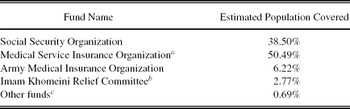
SHASTA is one of the largest pension fund investment companies in the country and a major recipient of divested SOE shares. Iran's main social insurance funds cover health insurance as well as pensions, varying from occupational funds where employees contribute a share of monthly premiums to funds for low-income households and special-status or occupational categories where the state fully pays enrollment and coverage costs. In Table 2, these main funds and their estimated coverage levels are compiled.Footnote 61 This table's coverage levels are undoubtedly misleading, since households can be enrolled in multiple funds. Other households remain inadequately covered due to the incomplete implementation of universal insurance. Estimates of the uninsured in Iran range between 5 and 9 percent of the population.Footnote 62 Nevertheless, as the table shows, two organizations are responsible for the vast majority of health insurance coverage. The Medical Service Insurance Organization operates under the supervision of the Ministry of Health and Medical Education, while the SSO is under the Ministry of Cooperatives, Labor, and Social Welfare. The SSO's beneficiaries are mostly located in the formal labor force—that is, middle- and working-class occupations in the public and private sectors with formalized wage and benefit contracts. The nongovernmental SHASTA, as the SSO's investment arm, is mandated with growing and maintaining the asset pools that pay the health and pension costs of these beneficiaries.
Main Health Insurance Funds and Coverage in Iran (2008)

aOversees funds for civil servants, rural households, and smaller funds for particular occupational/status categories such as university and seminary students.
bGovernment-linked foundation that covers eligible low-income households and other status groups defined as vulnerable.
cSpecialized public insurance funds for banking, oil, petrochemical, electricity, municipal, airlines, TV and radio, auto, rail, and steel sectors.
Source: Ibrahimipour et al., “A Qualitative Study of the Difficulties in Reaching Sustainable Universal Health Insurance Coverage in Iran,” Health Policy and Planning (2011): 486.
As with pension funds worldwide over recent decades, SHASTA has shifted its activities into what Robin Blackburn has labeled “grey capitalism.”Footnote 63 Pension fund assets, accumulated to support workers as they “grey” into retirement, are being increasingly invested in riskier, more volatile, and insecure “grey” financial assets that promise higher returns but conversely can be wiped out by economic crises. Before the revolution, the SSO held workers’ pension contributions mostly in fixed long-term deposits. In 1989, nearly 80 percent of SSO's investment portfolio was still in these low-risk deposits. By 2000, this share had decreased to 10 percent, while 70 percent of its total portfolio was composed of direct and indirect investments in the Iranian economy. In that year, SSO-held companies produced 43 percent of pharmaceutical and hygienic products, 36 percent of cement, 35 percent of televisions, 25 percent of fireproof products, 31 percent of refrigerators and freezers, and 35 percent of rubber in Iran.Footnote 64 In 2012, after a further decade of expansion, SSO's investments in the economy amounted to over 15 billion USD (about 3.5% of GDP) in over 150 companies.Footnote 65
In 2003, the World Bank criticized Iran's pension benefits, in comparison to those of European and other Middle Eastern countries, as overly generous. Fiscal pressure pushed the SSO to become more active in the acquisition of SOEs, both on the Tehran Stock Market and in negotiations over government debts to the fund. In 2001, for example, the government transferred assets worth 400 million USD to the SSO to cover constitutionally mandated obligations to pensioners. The SSO also purchased government bond issuances and financed public infrastructure projects.Footnote 66 In January 2010, SSO head ʿAli Zabihi stated that over 27.5 million Iranians lived in SSO-enrolled households and warned that, even with high returns on these investments, future commitments to pensioners would surpass incoming revenues.Footnote 67 These fiscal pressures have been exacerbated. In 2011, SSO officials claimed the fund was owed nearly 24 billion USD by the government.Footnote 68
Iran's pension fund financialization shares characteristics with global trends. In the Chilean model of privatized pension fund associations, the pension system for formal sector workers is also utilized as a method of SOE privatization. In South Korea's national pension scheme, public pensions invest in both public sector bonds and financial sector assets.Footnote 69 The Turkish army's pension fund invests in over sixty Turkish firms, and Saudi Arabia's general social insurance fund holds stakes in the country's growing industrial sector.Footnote 70 The United States contains the largest low-risk bond-holding pension fund in the world as well as California's public employees’ retirement system, which invests two-thirds of its assets in global equities. As Blackburn writes, “Those who dislike and distrust pension-fund capitalism must reckon with the fact that it is already hugely important and likely to become more so.” Descrambling the private–public mix of retirement funds, if even possible, would “scarcely be supported by those who hold funded pension entitlements.”Footnote 71
Given these types of institutional investors in wealthier countries, SSO officials defend the presence of pension funds in the market. Due to starkly reduced birth rates, Iran's current “baby boom” generation of working adults will not likely be replaced in full. Pensioners would hardly accept a selloff of SHASTA's investment portfolio to the private sector without major guarantees of future entitlements by the state. Pension financialization in the Islamic Republic has therefore created a sizable interest group for pseudo-privatization—the Iranian middle class and formal labor force. Funneling public sector companies to the SSO and other pension funds is one method of subcontracting the state's direct welfare obligations to the parastatal sector. As with “grey capitalism” more generally, however, this strategy precariously rests on contradictory pressures of generating high profits against maintaining employment and wages in these same companies.
Justice Shares
If SHASTA is pension fund capitalism for Iran's middle strata, could the Justice Shares program operate as “popular capitalism” for poorer classes? The reformist newspaper Iʾtimad claimed that “justice shares are shares without profit,” and conservative MPs quarreled that payouts to nine million shareholders on the eve of the 2009 presidential elections were an illegal form of electioneering by Ahmadinejad with no regard to the companies’ balance sheets.Footnote 72 Government supporters, however, assert that companies owned by justice share cooperatives are mostly profitable, and share values have substantially risen over the past several years. Finance Minister Shams al-Din Husayni stated that buyers of privatized SOEs must sign contracts agreeing to maintain medium-term employment levels and claimed that his ministry's investigation of twenty-eight such firms showed that nearly all increased employment levels.Footnote 73 Another inquiry showed, however, that in eight divested SOEs profits that previously had been reinvested or sent to the treasury were mostly paid out as justice share dividends.Footnote 74 Parliament's reports on Article 44 also conveyed numerous violations: companies divested without parliamentary approval, shares distributed by status and occupational categories instead of income deciles, loss-making companies divested without attention to existing debts, and no accounting for the sources of share dividend profits.Footnote 75
In other words, justice share-divested companies are torn between fiscal profitability and social prerogatives. In sectors where reinvestment is crucial, this could lead to bankruptcy or collapse. Provincial justice share cooperatives could eventually act as trading entities on the stock market, adding powerful institutional investors to a diverse mix that may rationalize domestic industries toward more profitable activities.Footnote 76 This would also empower provincial elites in these cooperatives, generating new networks of influence linked to the heterogeneous “revolutionary” status groups and other households that possess these shares on paper. The outcome of this type of financialization is unpredictable. A common critique of Iran's Justice Shares program harkens back to Russia's 1990s privatization voucher program. Now seen by many of its citizens as a Ponzi scheme that led to the emergence of an oligarchical industrial class, Russia's version of “popular capitalism” allowed vouchers to be freely traded upon receipt. As journalist David Hoffman wrote, “Millions were immediately exchanged for a bottle of vodka or sold for a song.”Footnote 77 Currently, Iran's justice shares cannot be sold by the original recipients, many of whom I interviewed. Some of these households expressed unease in declaring income levels to the government for purposes of receiving shares—a common view in middle-income countries where tax collection is haphazardly enforced. Yet I also found that these households were well inserted in Iran's complex welfare system. Depending on residence, income, and occupation, they already were receiving benefits or subsidies through a variety of social policy institutions. These individuals perceived that justice shares were simply one more linkage between state and society generated over the past thirty years.
A Russia-style scenario is not unfathomable in Iran's future. The former director of the stock market, Allahvirdi Rajai-Salmasi, now a managing director of Saman Bank, argued that selling and buying individual justice shares would increase liquidity in Iran's capital market and create a “culture of investment.”Footnote 78 If shares do become tradable, via cooperatives or individuals, new market actors could quickly take over SOEs, whether in the private or parastatal sector. The experience of Russia, though, where state linkages were never absent from the new capitalist oligarchy, illustrates that even privatization fully designed to shift assets to a “real” private sector can lead to a form of pseudo-privatization.
Parastatal Subcontractors
Cooperatives, firms, and investment conglomerates affiliated with the IRGC and parastatal bodies do not signify a creeping militarization or “revolutionary” ideological subordination of Iran's economy so much as they characterize the commodification of bureaucratic privilege and status held by individuals in these organizations. The engineering arm of the IRGC, Khatam al-Anbiya, is often mentioned in media stories and reports detailing the firm's large infrastructural projects funded by the Ahmadinejad government.Footnote 79 Yet, in essence, it is run as a private entity that often contracts out activities to other domestic and foreign companies.Footnote 80 The organization first emerged during the Iran–Iraq War, but the use of military engineering contracts for development stems from President Rafsanjani's decision to involve the IRGC in postwar reconstruction efforts. This was done partly to keep hundreds of thousands of Revolutionary Guards cadres employed and partly because a new generation of engineers and managers had been trained with useful skills. As Rafsanjani stated in May 1993, “In this way [IRGC members] earn an income, which they can use to maintain and repair their [military] machinery, while they are adding to the country's capacity for contractual work.”Footnote 81 Over the past decade, the firm and its subcontractors have replaced foreign companies in the development of oil and gas fields, pipeline projects, and highway and tunnel construction. Indeed, economic sanctions against foreign companies doing business in Iran, led by the United States, have hastened this process. Yet Khatam al-Anbiya seems to have no qualm with foreign capital itself. Its entities previously worked with European companies, as in the construction of Gudar-i Landar dam, and more recently with Chinese, Indian, and Russian firms on gas and oil projects.Footnote 82
As with the 2009 sale of Iran's main telecom company, many of these construction contracts are inked in murky, no-bid deals. The revolving door between contracting executives and government posts adds to suspicions of patronage politics.Footnote 83 This can be seen as either IRGC proficiency in capturing state largesse or the exercise of technocratic legitimacy amid a dearth of competitors in management and development; it is likely both. Still, even while IRGC contractors argue that they alone have the necessary economies of scale and accumulated technological experience to carry out thousands of development projects at costs lower than foreign firms brought in by local actors, they also boast that they subcontract out “sixty to seventy percent” of their projects to the “private sector.”Footnote 84 While this figure seems exaggerated, it is still telling. The overall structure of these parastatal contractors more closely reflects a proliferation of new networks of influence peddling via the breakup of the public sector than a transfer of infrastructural power and organizational capacity to the IRGC.
Parastatal subcontractors and investment houses are increasingly active in the domestic economy, to be sure, but they still end up competing with the economic activities of endowed foundations such as the Foundation of the Oppressed or the Imam Reza Shrine Foundation. These entities inherited Pahlavi-era industries, lands, and companies, acting as economic agents as well as minor social welfare organizations. Zam-Zam Soft Drink Company, for example, which belongs to the Foundation of the Oppressed, originated in the confiscation of pre-1979 Coca-Cola factories. Several major hotels in Tehran that formerly belonged to the Hilton Corporation also belong to this foundation. Yet private sector enterprise, including subsidiaries of foreign capital, still developed in these sectors. Pepsi and Coca-Cola soft drinks eventually were licensed for production and sale in Iran, sitting alongside Zam-Zam in corner grocery stores. Such parastatal forms of economic activity are common to middle-income countries under a variety of guises, and they do not necessarily crowd out private capital even though they may be uncompetitive outside of a protected domestic market.Footnote 85
Taken as a whole, then, the rise of the subcontractor state in Iran increasingly corresponds to the post-Soviet trajectory of many Eastern European countries, where scholars such as Katherine Verdery have argued that privatization often produced “new states” alongside the actual states. There, apparatchiks and firm managers easily converted themselves into “entrepratchiks.” The valuation of public sector firms was “shot through with politics,” and those who benefited the most were “the former bureaucratic and managerial apparatus of the party-state.” These individuals could “create parasitic companies on the side” to siphon off assets and then leverage political connections for maintaining advantageous economic positions.Footnote 86 Yet, unlike the one-party states of eastern Europe, a wide variety of social actors still exist within Iran's parastatal sector with opposing as well as overlapping interests in the distribution and privatization of state resources. The Islamic Republic remains embedded in these groups for a set of historical reasons—political factionalism, popular mobilization, postwar welfare policies, and projects of nationalist legitimation—that are intertwined with its postrevolutionary state formation. To put it another way, these distributional conflicts underpin a decades-long struggle over what form of capitalism will become dominant in Iran.
CONCLUSION: IN IRAN, CAPITALISM FROM WHERE?
As Nazib Ayubi argued two decades ago, privatization in Middle Eastern states has tended to produce “grey areas” between public and private sectors—spheres of activity separate in Western liberal thought, if not practice. Ayubi noted that it is common to witness “private businesses cream off public resources and public officials ‘parachute’ on private companies.”Footnote 87 For Iran, framing such activities under an overarching notion of praetorianism—of a neopatrimonial, sultanistic, or militaristic type—mistakenly overlooks the turbulent and zig-zag political processes that characterize the country's postrevolutionary history. To more fruitfully situate the narrative outlined previously in a broader comparative framework, we can use the three ideal types that Ivan Szelenyi and his collaborators have created to compare processes of capitalist development within post-Soviet eastern Europe and socialist East Asia: capitalism from without, above, and below.Footnote 88
In Poland, Hungary, and the Czech Republic, a technocratic class within the state allied with reformist intellectuals and strong working classes to overpower preexisting socialist bureaucracies. Easy access to Western capital and the implementation of neoliberal prescriptions resulted in a “capitalism from without,” whereby privatization was pursued along relatively Weberian rational–legal lines, and former apparatchiks were marginalized from the political means to manipulate the transfer of the public sector. In these countries, neoliberalism formed the “ideological cement” of the alliance between technocrats and dissident political entrepreneurs, but the existence of countervailing worker protest constrained new governments from enacting the most radical of antistatist measures. The result by the late 1990s was a liberal democratic state, a fair amount of economic dynamism, and export-oriented, foreign direct investment-based methods of capital accumulation.
In Russia, Ukraine, Romania, and Serbia under Milosevic, a patrimonial bureaucracy retained power and used the privileges of its offices and clients to amass private wealth. This is a “capitalism from above” that relies less on market exchange and more on political exchange. Communist officials turned private owners were less likely to pursue entrepreneurial activities in favor of maintaining patrimonial links with their business partners, while communist ideologies were abandoned in favor of extreme nationalist legitimation of new states. Rapid privatization without the bureaucratic-legal institutional setting for stable ownership rights led to a high degree of “asset stripping” of the SOE sector. The state remained large, but its capacity to regulate the transition was almost nonexistent. The emerging financial-industrial sector was parasitical in its relationship to the market, with little economic dynamism and few available public goods. The political outcome of capitalism from above was a multiparty authoritarian state with unfree and unfair elections.
In China and Vietnam, a technocratic class gained hegemony over economic policy and allied itself with a sui generis domestic bourgeoisie, but a state bureaucracy retained political power. This “capitalism from below” featured a class of small investors originating or reappearing in new spaces next to and within the interstices of a large state-owned industrial sector, often beginning in agricultural or petty commodity production. The bureaucracy and the technocracy checked each other's excesses toward extreme patrimonial or neoliberal policies, resulting in a hybrid system of capital accumulation and mixed forms of property (such as China's township-village enterprises). The balance of political power allowed space for a high amount of economic dynamism among nonelites, including workers and peasants. Patron–client relations still existed within market operations, but they did not prevent a state-led development that balanced the provision of public goods and infrastructure, technological upgrading of remaining SOEs, and selective utilization of foreign investment. The political outcome was a high capacity state that partially and gradually liberalized its authoritarian structures of governance.
These are, of course, ideal types. Yet they help us to frame the previously discussed shifts in Iran's postrevolutionary economic trajectory as well as to compare it with Middle East and North Africa neighbors. Rafsanjani's technocratic project, later allied with the reformists’ dissident liberalism, was an attempt to construct an Iranian capitalism from without. These elite factions saw no problem with allowing foreign capital in to help structure and rationalize a process of economic liberalization. This strategy was checked by fragmented state bureaucracies and oppositional elite factions, channeled into parastatal activity, and further curtailed by U.S.-led sanctions from the mid-1990s onward. This period in Iran stands in contrast to Turkey's Justice and Development Party, for instance, whose rise to power in 2002 after a long phase of political factionalism resulted in unprecedented privatization of Turkish SOEs to foreign capital.Footnote 89
The temporary outcome of the stymied reformist project in Iran was, surprisingly, capitalism from below, as entrepreneurs in private sector banking and consumer goods industries spawned a dynamic and competitive market expansion that coexisted with the public sector. This was reinforced because the Iranian petty bourgeoisie was never fully expropriated after 1979, so a dormant entrepreneurial habitus could reemerge in the 1990s once avenues for capital accumulation in goods and services opened up. Of course, most of these entrepreneurs had public connections themselves, but they utilized these networks of privilege within the private sector to outcompete public companies through organizational and market innovations. As in Tunisia or Kuwait, this economic pluralism did not result in a sustained push for democratization. Private capitalists in Iran had little structural power to break the factional deadlock of the political elite nor did they exhibit much inclination to try.Footnote 90
Iran after 2005, however, most resembles capitalism from above, as wide and dispersed patrimonial networks have come to dominate the technocratic agencies. Like the Egyptian state in the 1990s, privatization played an important “accumulative role . . . among the acting and former members of the bureaucracy.”Footnote 91 The result is not centralization around any one state organization but rather parasitic asset stripping of the public sector, on the one hand, and the emergence and expansion of subcontracted “new states” under the guise of parastatal and cooperative entities, on the other hand. On the ideological plane, instead of technocratic neoliberalism, a resurgent nationalism rules the roost. If this process continues, the economic dynamism of these hybrid forms of property ownership, even within the parastatal sector, will likely exhaust itself. This will have profound consequences on the subcontracted welfare functions of the parastatal sector unless the state constructs a more universalized welfare system in its place.
In sum, the politics of privatization in Iran, through a variety of agents and a wide array of recipients, were enmeshed within post-1979 internecine struggles among the political elite. Yet mass politics was also forcefully present, since various social classes and status groups formed the constituencies of competing parastatal organizations. This was the critical reason why the state never acquired the sufficient political insulation from below usually needed for technocratic liberalization. Even though all factions came to speak the same language of privatization, the structure and restructuring of political competition prevented the formation of an autonomous state apparatus that could implement such a plan, whether in clerical or military form. On the contrary, by subcontracting out its social and economic responsibilities, the Islamic Republic has neither achieved its privatization dreams nor enhanced its state capacity for other, equally transformational, projects.